FT : Crypto and meme corporate bonds may follow their own path

Crypto and meme corporate bonds may follow their own path
Creditors are unlikely to take their cues from the equity market

The crash of some of the flagbearers of the equity bubble in recent years has been painful for investors. We have seen “pandemic winner” Netflix dive 75 per cent from 2021 peaks, crypto exchange operator Coinbase plunge 86 per cent and the one-time meme stock and cinema chain AMC lose 80 per cent.

Less noticed are the losses of their bonds. The damage wreaked there is more moderate and offset by coupon payments — a Netflix bond maturing in 2030 has returned a negative 19 per cent from recent peaks, a Coinbase 2031 bond negative 36 per cent and an AMC 2026 bond negative 19 per cent. Some of this is to do with the very different capital structures of the individual companies and risks of the bonds compared with equities.

For hedge funds that profit from arbitrage trades across capital structures, such differences present a playground full of opportunities. But the gaps also illuminate differences in the ownership and return characteristics for stocks versus bonds.

First, the holder base for corporate bonds is largely institutional even though most investment-grade-rated issuance is publicly registered. The publicly registered junk bond is a species bound for extinction, as onerous disclosure requirements and increased time to market push companies towards private placements to institutions. While institutional investors can trade frequently, the day trader concept and associated heightened volatility are largely a retail phenomenon in stocks.

Second, while it is blatantly obvious to say that the return prospects differ for non-distressed bonds and stocks, the maths is a little more nuanced.

Bondholders’ downside risk, like that of shareholders, is unlimited if a company defaults (although in practice, unsecured creditors get an average of 35 cents back for every dollar invested in a defaulted company). But our upside is capped. Bond documents typically include a provision that says a company may choose to repay (or call) a bond prior to maturity and issue new debt at a lower interest rate, meaning the investor won’t necessarily realise much benefit from an improving balance sheet. 


That means the sky-high growth forecasts that drove Netflix, Coinbase and AMC stocks to their peaks simply can’t get priced into their bonds. Creditors still suffer from misjudgments but the tyranny of the capped upside saves us from ourselves when growth seems infinite.

Finally, corporate bond performance must be disaggregated into total and excess return. That latter refers to the return of the bond after comparing it with what investors could earn on “risk free” government bonds of similar terms.

So what story do the bonds of Netflix, Coinbase and AMC tell? The “excess” return of Netflix’s 2030 maturity bond is about negative 7 per cent from its November peak. That means more than half of its negative return has to do with the bear market in US Treasuries. Coinbase’s 2031 bond, on the other hand, has had a negative excess return of 28 per cent from November compared with negative 5 excess return for its index benchmark. AMC’s excess return from its June 2021 peak was negative 14 per cent.

The bond market appears relatively more comfortable with the financial strength of Netflix. Coinbase’s 2031 bond, on the other hand, reflects the scepticism that has persisted since it was issued last September. Unusually, the bond traded below par almost immediately — although the stock, and the Bloomberg Bitcoin Index, did not peak until November. It’s not necessarily that creditors were ahead of the game in forecasting crypto’s recent sell-off — rather, we don’t have the equity-like mindset necessary for the crypto bullishness embedded in Coinbase’s peak levels.

Finally, AMC has strengthened its financial position with capital raisings when its shares were surging. But its bonds with a first lien, or claim on company assets, trade at a big premium to debt compared with a second lien. This suggests ongoing concern about the company’s financial prospects.

Who knows where the bonds of these companies will be a year from now? But the crash in the stocks of the companies does raise questions about the logic of the rules that permit individuals to buy shares in Coinbase or AMC but not their unregistered bonds in order to “protect” unsophisticated investors.

FT : Hedge funds braced for further stock market turmoil

Hedge funds braced for further stock market turmoil
Caution intensifies despite already steep losses in 2022

US hedge funds are running their most cautious bets on stock prices in more than a decade, in a sign that many managers believe market declines may yet have further to run.

By the middle of this month, US funds had cut their net exposure — the difference between bets on rising prices and bets on falling prices — to around their lowest level since at least 2010, according to a Morgan Stanley note sent to clients. Funds in Europe and Asia, meanwhile, cut their bets to around the lowest level of the past year.

The caution comes as a number of top managers appear to be taking bearish positions in their portfolios, even though the S&P 500 has already dropped 18 per cent this year and the Stoxx 600 has lost more than 15 per cent.

US-based Bridgewater Associates, founded by billionaire Ray Dalio, has recently taken 27 short positions above the 0.5 per cent disclosure threshold in European stocks, according to data group Breakout Point. Those bets are worth around €9.8bn in total. The $151bn-in-assets group has already been positioning for a sell-off in US Treasuries, US equities, and corporate bonds on both sides of the Atlantic.

And BlackRock star manager Alister Hibbert, one of the sector’s strongest performers, recently moved his portfolio so that bets on falling prices outweigh bets on rising prices.

The negative sentiment comes during a very tough year for equity hedge funds, many of which have been hit by a sharp sell-off in their holdings in fast-growing technology stocks, while also finding they have been holding insufficient short positions — bets on falling prices.

US long-short equity funds are down 14.1 per cent on average this year, while European funds have lost 8.3 per cent, according to Morgan Stanley. The first five months of this year mark the worst start to a calendar year for equity long-short funds on record, according to data group HFR.

Equity hedge funds have been “shelled” this year, “so when you are losing money every day you need to get out of harm’s way and live to play another day”, said Tiger Williams, founder of outsourced trading company Williams Trading.

The week to June 16 marked “one of the largest in terms of global short [position] additions we have seen in recent years”, Morgan Stanley wrote in the note. That came shortly before a 3.3 per cent rally in US stocks over the past week, only their second week of gains in the past 12 weeks, although they are still down sharply this month.

Among the casualties this year have been Chase Coleman’s Tiger Global, which was down 52 per cent in the first five months of the year, and fellow ‘Tiger cub’ Lee Ainslie’s Maverick Capital, while Boston-based Whale Rock Capital and Dan Loeb’s Third Point have also suffered losses.

WWD : ‘Preferred’ Fibers Grow, Yet 52 Percent of Fashion Says Origins Unknown

‘Preferred’ Fibers Grow, Yet 52 Percent of Fashion Says Origins Unknown
Textile Exchange counts preferred fibers reaching a new threshold across 30 percent of the industry yet transparency origins remain mysterious.

Can consumers be certain of the origins of their cotton, polyester, wool, leather or any given material?

Not if the brand isn’t sure in its materials sourcing strategy.

On Monday, Textile Exchange revealed its latest corporate fiber and materials benchmark tracing the 12-month sourcing and management practices of 232 brands and retailers, among them PVH Corp., Timberland, H&M Group, Inditex, Eileen Fisher and more. Giving a glimpse of the sector’s aims — representing about 30 percent of the industry or a sizable $680 billion — this report is a progress pulse point on the uptake for “preferred” materials. The term includes those materials that result in “improved environmental and/or social sustainability outcomes and impacts” compared to conventional counterparts, per Textile Exchange. While not conclusive, the nonprofit’s benchmarking processes are reviewed annually by Elevate, a third-party assessment firm.

Today, preferred encompasses everything from recycled polyester to organic and recycled cotton. The materials were assessed for their risks, investments, transparency, impact targets and general perceptions.
In a new milestone, preferred materials surpassed 50 percent, up from 44 percent industry-wide adoption in the previous year, per the report. Without question, Europe led the way in adoption.
By breakdown, preferred cotton leads and now represents 65 percent of overall cotton self-reported by participating brands, with recycled polyester jumping to 32 percent of polyester use, compared to 21 percent the year before. (Polyester, of course, still dominates materials production at 52 percent of the global fiber basket, with only 15 percent coming from recycled inputs in the grand scheme of things).
To that, Textile Exchange’s synthetics lead Kate Riley reiterated that synthetic materials growth is expected to continue.
“In order to remain within the 1.5-degree pathway and ensure climate goals are achieved, the impacts of synthetic fibers must be significantly reduced, and we must accelerate the transition away from fossil-fuel derived synthetics toward synthetics from recycled or regenerative sources,” she said.
In a self-elected leaderboard, Textile Exchange recognized a number of companies based on adherence to preferred fiber sourcing, circularity and participation. “Overall Leaders” or 47 companies — among them H&M Group, C&A, Puma, Levi’s, Norrøna Sport and Veja — placed among Textile Exchange’s top-performers across categories while, “SDG Leaders,” for example, are those 17 companies (including Asics and PVH) that aligned fiber sourcing with the United Nations’ Sustainable Development Goals. Suppliers and manufacturers like Lenzing Group and YKK Corporation were also named in a special supplier section.
Textile Exchange accentuated the importance of drafting decisions off of a materials strategy, or one which provides a framework to identify risks to supply, focus investment and drive sustainability performance. Luckily, nearly all or 98 percent of companies have a materials strategy today.
Company business leaders also ranked their top risks, spanning climate change, human rights, chemical use, waste and textile waste. While climate was the top-ranked business risk, there are still companies (36 percent) yet to commit to climate action through target-setting.


Too, transparency still remains a gray area, with 52 percent of sourcing regions still stamped “unknown country of origin,” despite mild point improvements. More revealing is how each material ranks in known origins. Heading the material pack is down fiber at 91 percent known origins, cotton at 61 percent, wool at 45 percent, manmade cellulosics at 42 percent, polyester at 30 percent, polyamide at 19 percent and leather at 15 percent.
While there are early signs of brands decoupling from conventional production with the rush of resale, repair and other circular tack-ons, the data was not enough to warrant a deeper trend. Other discrepancies exist between mobilizing the SDGs and reporting on unsold goods. Only about 3 percent of companies are reporting publicly on how they are doing away with excess.

WWD : China’s Beauty Market Seen Surpassing 1 Trillion Yuan in Sales

China’s Beauty Market Seen Surpassing 1 Trillion Yuan in Sales
While growth has slowed recently, rising household incomes and the increasing growth of domestic brands are seen driving the market.

China has become key to growth for global beauty companies, driven by rising household incomes, new entrants and the increasing development of local brands.

But over the last few months, there have been growing signs of concern, leading to questions as to whether the strong are simply getting stronger in China, or is the market weakening?

This month, the most important marketing event for the beauty industry in the first half of the year — the “6.18 online shopping festival” — was affected by a combination of factors such as ongoing epidemic control measures, the introduction of new regulations, weak consumption, rising raw material prices and supply chain disruptions. The event was described by industry insiders as “the most difficult 6.18 in history.”

According to data from the National Bureau of Statistics of China, the total retail sales of cosmetics goods from January to May were $22 billion, down by 5.2 percent, including $4.34 billion n May, down 11 percent. Sales in May 2021 were $4.98 billion, an increase of 14.6 percent on May 2020.

With negative growth in the cosmetics category over the past four quarters in a row, the “6.18 online shopping festival” became a critical opportunity to boost sales. Yet statistics showed the opposite: total online sales of beauty and personal care (skin care and makeup) on Tmall, JD and PDD reached $6.12 billion, a drop of nearly 20 percent compared to last year’s $7.64 billion, and the number of cosmetic brands achieving 100 million yuan sales in GMV decreased from seven last year to three this year.

The pre-pandemic global cosmetics market was vibrant. According to Euromonitor, the global cosmetics market reached $488 billion in 2018 and $514.8 billion in 2019. In China, the market volume reached $38.5 billion in 2018, leading the world with a growth rate of 14.9 percent and the market volume reached $77.6 billion in 2020.
Gian Andrea Positano, director of Cosmetica Italia Centro Studi, the Italian association of cosmetics companies, said during the 6.18 China International Beauty Summit organized by WWD China, that “the Italian beauty market is expected to reach 12.9 billion euros in 2022, an increase of 6.5 percent year-on-year,” while the figure for China is estimated to reach $92.1 billion. The increase will mostly be driven by the fast-growing segment of male cosmetics and the the rise of Chinese beauty products.
Two major factors contributed to the meteoric rise of the beauty market in China. Over the last decades, more than 5,000 foreign cosmetics have entered the Chinese market, generating continuous growth, while at the same time creating a favorable business environment for local beauty companies. With the major involvement of international brands, the Chinese beauty industry value chain is becoming more sophisticated.
The second factor is the growing consumer base for beauty and skin care products, which expanded rapidly due to rising household incomes, the increasing consumption power of lower-tier cities and the rise of independent Chinese brands. Yet those figures express mixed message since gaps still exist despite the booming market.


For Shiseido, which has been on the Chinese market for 41 years, China became the largest overseas market in 2017. Its China offices in Shanghai was positioned as its “second headquarters” at the end of 2019.
Shiseido’s “second headquarters” in Shanghai.
Revlon, which entered the Chinese market as early as 1996, reported sales figures of $29.8 million in China already in 1998. Yet following that strong market debut, the beauty firm revealed its withdrawal from China in 2013. But after several ups and downs and a high-profile reentry into the market in 2019 after the acquisition of Elizabeth Arden, the company still failed to gain traction. News about its seeking bankruptcy reorganization became a much-searched topic in China and triggered a round of “sentimental consumption” by loyal consumers. But earlier this month, Revlon filed for Chapter 11 bankruptcy protection in the U.S.
L’Oréal Group, which officially entered the Chinese market in 1997, has grown by more than 20 percent for the last two years. With operations in 150 countries and regions, China is its second-largest market.
In an indication of the importance of the market to its future, L’Oréal in May revealed the establishment of its first investment company in China, marking the beginning of investment from the beauty giant in Chinese start-ups.
LOréal’s research and innovation center in China.
Shortly afterward, Xiamen Ziyue Equity Investment Partnership (Limited Partnership), an entity of Ziyue Fund — Shiseido’s first China investment — was registered with a capital of $74.77 million.
Oriental Beauty Valley in Shanghai’s Fengxian District, one of the world’s leading cosmetics industry clusters, is home to L’Oréal’s Shanghai Beauty2 Investment Co. Ltd. and the third R&D center of Shiseido in China. The former is dedicated to investing in innovative beauty technologies, while the latter empowers its portfolio companies in the beauty industry with R&D centers and production bases.
By the end of 2021, the Oriental Beauty Valley had gathered more than 2,200 companies related to the “beauty economy,” with more than 3,000 brands, contributing to more than 40 percent of the sales of cosmetics in the whole Shanghai region, with an industry scale of nearly $10.4 billion.


It is also home to domestic beauty industry leaders such as Jala Group and Pechoin, and has formed a “beauty and health industry alliance” with major players in the beauty and health industry to promote cooperation and investment. This “urban industry ecosystem,” offering full regional coverage, functional integration, industry support and a broad range of services, has a brand value of $4.28 billion.
Jala Group’s headquarters.
Yuan Fei, general manager of the Oriental Beauty Valley, attended the China International Beauty Summit held by WWD China. When asked about how to empower the post-pandemic development of the industry, he said, “Apart from land, plants, buildings, talents and R&D, the most important thing is to provide a market opportunity for enterprises. Oriental Beauty Valley creates an inclusive and open industrial cluster, allowing companies to feel at home, and cooperate with upstream and downstream partners, even grow in harmony with friends and competitors on this platform.”
Despite various challenges, clusters like the Oriental Beauty Valley helped to make the Chinese market more attractive to international companies. As L’Oréal China’s chief executive officer Fabrice Megarbane explained at the launch of Shanghai Beauty2 Investment Company, “The most important thing for L’Oréal is to look for opportunities in the midst of challenges and seize the initiative.”
Jesper Herold Halle, commercial consul at the Danish Consulate General in Shanghai, who aims to facilitate cooperation with Danish companies working in China, also stressed to WWD China that “right now, it is the best time to enter the Chinese market — a market full of opportunities and potential.”
Both domestic and international entrants into the market have a long history to play off of.
As early as 1829, the first Chinese national cosmetics brand, Xiefuchun, was established, focusing on duck-egg face powder, ice musk oil and fragrance products. In 1862, Kophenix, a brand from Hangzhou, was founded with products such as goose-egg face powder and pearl cream being highly sought after. In the 1930s, Chinese industrial cosmetics began to develop, with Shanghai Vive and Pechoin becoming the favorites of Shanghai’s celebrities and being exported to Southeast Asia. In 1898, the predecessor of Shanghai Jahwa Corp., the Hong Kong-based Kwong Sang Hong cosmetics company, was established, and then moved to Shanghai to become the first modern Chinese cosmetics company, creating the Liushen, Maxam, Heborist and other brands. Although domestic brands dominated most of the Chinese beauty industry in the last century, from the ’90s onward, leading European and international firms entered the market and played a crucial role in its development. They include:


• 1981: Products from Shiseido were launched in major shopping malls in Beijing
• 1985: Johnson & Johnson enters the China market
• 1989: The official market entry of Olay
• 1989: Unilever enters Shanghai
• 1989: Avon and Guangzhou Cosmetics Factory establish the Guangzhou Avon Company as a joint venture
• 1993: Estée Lauder enters China
• 1995: Maybelline enters Guangzhou
• 1996: L’Oréal enters China.
By the beginning of the 21st century, almost most of the major international cosmetic brands had entered the market.
According to Positano, “Habits of Chinese consumers are different from that of European consumers, so to gain competitiveness in the Chinese market, it is important to follow the new consumer habits.”
As a result, localization of international brands has entered a new period of rapid development, from the early days of direct introduction of imported products, to adjustments of product formulations according to the needs of Chinese consumers, and the current export of products made in China to foreign markets and the increased speed of new product development.
At this point, “sustainability” has become the core path for development. At Oriental Beauty Valley, for example, the development and marketing of biodegradable cosmetic packaging materials; the integration of green supply chains and the establishment of clean beauty standards, and the exploration of the market-oriented transformation of “carbon reduction” through carbon trading are being expanded and practiced.
Clearly, China is not just a key consumer market and manufacturing hub, but has begun to become a driver of innovation. From the establishment of R&D centers to investment funds, international beauty giants such as L’Oréal, Shiseido and Unilever have continued to expand their investments in China while Shanghai Jahwa Corp., Jala Group and Florasis have started their internationalization to explore international markets.
And while foreign brands are increasing their presence in the Chinese market, Chinese beauty brands are also going abroad through cross-border e-commerce. This trend of bringing in from abroad and going out from China has remained unchanged in these challenging times, with the Chinese beauty market expanding from 600 billion yuan, or $89.69 billion, to 1 trillion yuan, or $149.48 billion.


According to the “China Cross-Border E-Commerce Development Report 2021” jointly released by Google and Deloitte, in terms for overseas performances, beauty and personal care stood out in 2020, with many fast-growing direct-to-consumer brands emerging and showing potential.
But for Chinese beauty brands, the key is to learn from international groups, especially in terms of sustainability.
As Zhao Bingbing, chief representative for Greater China at the London Development Promotion Agency, said, “Chinese beauty brands shall change their storytelling approach to adapt to the cultural environment overseas, paying particular attention to the two main values of embracing multiculturalism and sustainability.”

(ZH) The Illinois Political Establishment's Shameful Response To The Departure O

The Illinois Political Establishment's Shameful Response To The Departure Of Ken Griffin And Citadel

By Mark Glennon of Wirepoints
On a wall in Ken Griffin’s office at Citadel in Chicago, I’m told by people who worked there, hangs a thank you note from a six-year old. Like many kids that age, he was enthralled by prehistoric creatures so he wrote to thank Griffin for funding Evolving Planet, a permanent wing in Chicago’s Field Museum.
The six-year old was my son, who asked if he could write it after my wife had taken him for what must have been the fifth time to the exhibit.
I was proud that he had the simple decency to feel a need to thank somebody.
I wish I could say the same about the Illinois political establishment’s send-off to Griffin and Citadel, who are leaving for Florida. There was no decency in any of it.

Griffin is among the most successful financial entrepreneurs in history and Citadel was a crown jewel in Illinois’ economy. But the decency of a proper send-off was nowhere to be found in Illinois’ leadership. There wasn’t even the standard, “we’re disappointed to see them go,” which they usually say about corporate departures. Just a kick out the door for a golden goose.
Gov. J.B. Pritzker’s response was petty and rude. As reported by Greg Hinz at Crain’s, Pritzker’s terse statement doesn’t even name Griffin or Citadel. “Countless companies are choosing Illinois as their home, as we continue to lead the nation in corporate relocations and had a record number of business start-ups in the past year,” said Pritzker’s statement. “We will continue to welcome those businesses—including Kellogg, which just this week announced it is moving its largest headquarters to Illinois—and support emerging industries that are already creating good jobs and investing billions in Illinois, like data centers, electric vehicles and quantum computing,” the statement added. That was it.
Chicago Mayor Lori Lightfoot’s response was only slightly better. She did thank Citadel and its team for their philanthropic work and economic impact, but went on to dismiss their importance, making absurd claims about how well Chicago is doing. “Our economic outlook has never been stronger and we will continue to build upon a best-in-class recovery in the nation amongst large U.S. cities,” she said.
If other members of Illinois’ ruling class said anything of substance at all I cannot find them.
Then there’s Rich Miller, a columnist and blogger who is better described as the de facto spokesperson for Illinois’ political establishment.
His Twitter post and headline said, “After apparent spectacular political failure, Ken Griffin takes ball, goes home to Florida.” What a venal and irresponsible response to a sad event that will truly hurt already struggling Chicago and Illinois.
Miller went on to ridicule Griffin’s statement that his decision to leave was driven in part by employees asking to relocate. “Yeah, it’s about the employees,” Miller wrote. Miller and others cynically ascribe Griffin’s decision only to the failing campaign of Richard Irvin for governor, who Griffin heavily supported. Employee concerns about crime, taxes, corruption, insurmountable debts and all the rest had nothing to do with it, they’d have us believe.
Illinois’ loss from Citadel’s departure is enormous. Griffin has personally donated roughly $1.5 billion during his residency in Illinois to a range of philanthropic causes. Over $600 million of that was in Chicago.
Griffin alone has paid more than $200 million in yearly state taxes in recent years, and huge tax sums no doubt have also been paid by his 1,000 Illinois employees, many of whom are very well paid. The Washington Free Beacon reports that Citadel employees have funneled over $1 billion to the state’s coffers over the past decade. See my colleagues’ separate article with more details on the impact.
None of that is of much importance, apparently, to those happy to see him leave.
How would Griffin haters explain their glee over his departure? If they were asked, they’d probably say what quite a few of them were saying on social media. It’s the standard characterization of conservatives like Griffin: He’s just another rich guy who cares nothing about the little guy. That’s why he regularly opposed the establishment, which is dedicated to equality. Helping the little guy is what we’re about in Illinois, and we don’t want people like him who oppose that.
Maybe someday they will be confronted with how that equality thing has been working out in Illinois after decades of near complete one-party rule. If that happened, they’d face the reality that Illinois ranks much worse than the national average – ninth worst compared to other states – in the standard measure for income inequality. They’d see that Illinois is no better than middling when measured by the number of its citizens below the poverty line, ranking twenty-second highest among the states. They’d be reminded that Illinois’ unemployment rate persistently lags the nation, and much more
The list goes on and on, but actual results mean nothing to them. It’s the thought and the words that they pretend to think count.
There’s a special irony here and a more important lesson. Illinois did reduce inequality by driving Griffin away. Inequality drops whenever the rich flee. But does that really help the poor and middle class? Of course not.
The point was made nicely in a recent op-ed by two University of Chicago law professors. More billionaires will increase income inequality here, “but that would be a boon to government revenue,” they wrote. “When it comes to policies, Illinois would be better served by ones that attract successful entrepreneurs, not ones that drive them out of the state.”
Those are the policies Griffin supported while he was here, and that’s what earned him the establishment’s ire.
So here we are. Illinois is now more equal. And poorer. The political establishment has one less opponent to worry about. The planet indeed evolves, as Griffin’s wing at the Field Museum displays. Just not always for the better.

(ZH) Hedge Fund CIO: How Will The Fed Do QT? Each Crisis Has Increased Markets'

Hedge Fund CIO: How Will The Fed Do QT? Each Crisis Has Increased Markets' Dependency On Fed Liquidity

By Eric Peters, CIO of One River Asset Management
“The Fed is “all in” on re-establishing price stability,” Fed Governor Waller pronounced in pleasantly direct language. “Experience has shown that markets need time to adjust to a turn from accommodation to tightening.”
In response to questions, Waller spoke with blunt determination: “I don’t care what’s causing inflation, it’s too high, it’s my job to get it down. The higher rates and the path that we’re putting them on, it’s going to put downward pressure on demand across all sectors.”
Powell offered his own sober message, “A soft landing is our goal. It is going to be very challenging. It has been made significantly more challenging by the events of the last few months – thinking of the war and of commodities prices and further problems with supply chains.”
New York Fed economists provide a bit more precision, arguing that “the chances of a hard landing are about 80%,” starting in Q4 2022.
Something will break. Something always does.
Digital did and the regulatory landgrab has started in full force. Lagarde, with plenty of serious policy decisions ahead, observed that “crypto assets and DeFi have the potential to pose real risk to financial stability.”
Spain’s Minister of Finance, Montero, announced digital asset owners would need to declare holdings and trading “in anticipation of regulations that would soon be carried out throughout the European Union.”
The East-West divide is clear in policy focus. President Xi is focused on growth, vowing to “strengthen macro-policy adjustment and adopt more effective measures to strive to meet the social and economic development targets for 2022 and minimize the impacts of Covid-19.”
Strains in emerging markets are being managed from within. Sri Lanka’s 22mm people are in the most severe economic crisis in nearly a century and India’s Foreign Secretary Kwatra underlined, “India stands ready to help Sri Lanka through promoting investments, connectivity and strengthening economic linkages,” beyond the $4bln aid already provided.
The East-West center of gravity between global war and peace sits in Kaliningrad, a tiny Russian province pressed between NATO countries. Lithuanian President Nauseda offered that “Russia cannot be stopped by persuasion, cooperation, appeasement or concessions.”
Elevated rhetoric continued when Russia’s Foreign Minister Lavrov drew comparison to Hitler’s war against the Soviet Union. “The EU and NATO are bringing together a contemporary coalition to fight and, to a large extent, wage war against Russia.”
* * *
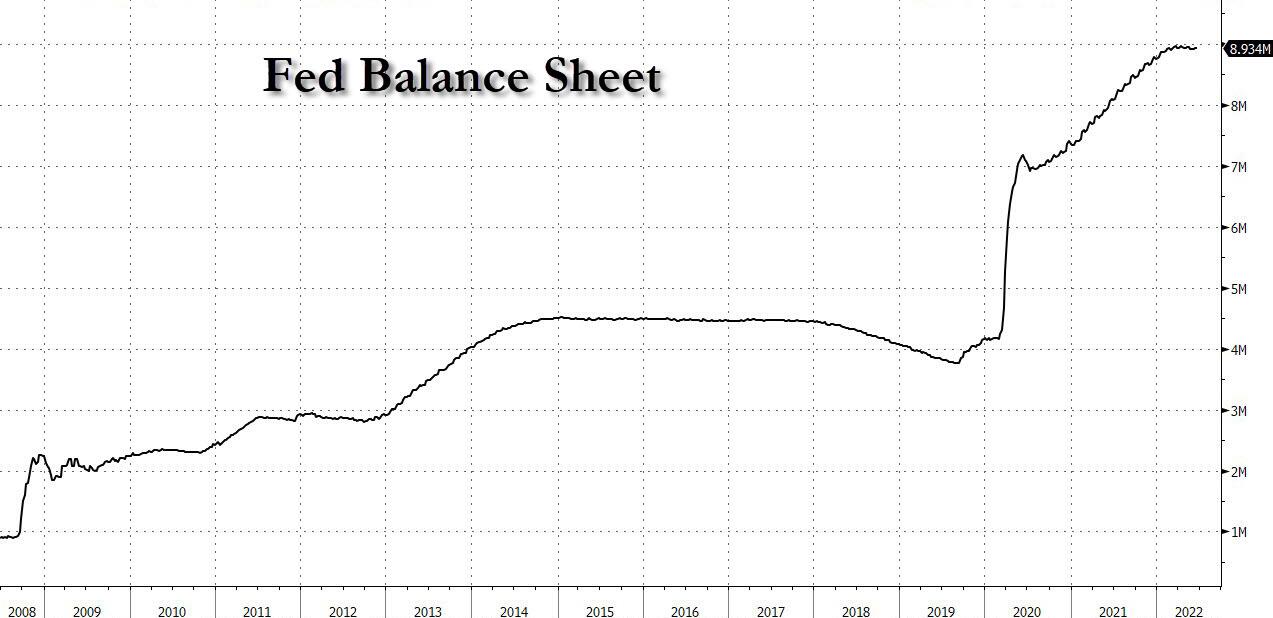
Liquidity Unknowns I: How much QT is too much QT? We don’t know. There is no tidy math formula, no general equilibrium model, no linear approximation that will tell you. The trouble is, in a world of false precision, everyone wants a number. And policymakers have a hard time saying, “we don’t know,” especially when it’s true. Through the week ending June 22, balances with Federal Reserve Banks – previously known as ‘excess reserves’ – stood at $3.115trln. Powell guided the market that the end point for the Fed balance sheet would shrink another $2.5trln to $3trln. How does that math work?
Unknowns II: Yet again new tools were needed in this cycle. To make sure rates didn’t fall below the Fed’s floor, they needed a broader mechanism to absorb excess liquidity. That mechanism was private sector access to the reverse repo facility. Remember the 2018 period of QT. Excess reserves were $1.9trln before liquidity conditions started to bite in September. Private sector reverse repos were basically zero. Today? $2.5trln. The Fed’s liabilities are acting as the riskless asset to private money funds in a way. The Fed clearly thinks reverse repos will decline. We don’t know. Behavior could drive it up if everyone wants liquidity and wants to face the Fed. As reverse repos rise, excess reserves decline. QT has more liquidity plumbing risk today – tools can turn into weapons.
Unknown III: The risks are different but the strategy with QT is the same – start small, increase gradually, and then let it run. It isn’t the obvious choice. Reducing the pace as liquidity is withdrawn is a more natural path – you typically slow as you approach a stop sign, after all. We will know when the tightening – both in liquidity and interest rates – has gone too far. Weak links will break. Digital plays the role of EM in this cycle – big enough to be noticed, not enough to get policy to stop. Asset deflation, a USD credit crunch, and risks from maturity transformation has led to capital controls with 11 digital intermediaries. As in the Asia Crisis, the ecosystem will respond to gain independence and resilience.
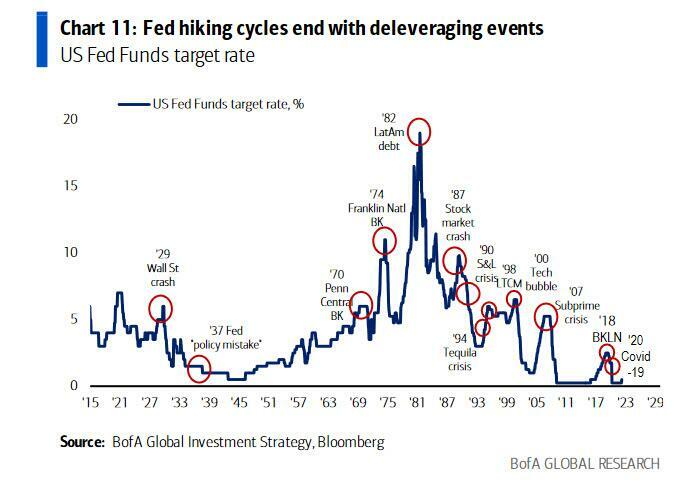
Unknown IV: Digital is the warning sign, not the circuit-breaker. Typical candidates – a rapid rise in the US dollar, EM currency and debt crisis, and banking strain – are just not applicable. After each crisis is a response, and those responses act like a vaccine against future ‘shocks.’ Emerging markets have insulated themselves with large holdings in the US dollar. Currency depreciation forced EM central banks into more orthodox positions well ahead of the Fed, ECB, and BOJ. Banks don’t have the space to make the mistakes of the GFC, with leverage financing pushed to capital markets. But markets have not been weaned from liquidity. To the contrary, each crisis has increased dependency on Fed liquidity.
Unknown V: The adjustment in broader markets is orderly. How else would it be? Disorder is how it ends, not how it starts. “It is like jumping from the 100th floor of a building and saying, ‘so far, so good’ halfway into the drop,” a prolific investor remarked when confronted with “contained” language head of the GFC. Liquidity transformation in traditional markets, the driver of digital weakness, is everywhere. And it is a so-far, so-good story. ETF discounts make the point emphatically. An illiquidity pocket means that ETFs would clear the way closed-end funds do – hunting for a price where a buyer is willing to absorb the liquidity risk. Mortgage ETFs are down 9.7% for the year and trade exactly on net asset value. So far, so good.
Unknown VI: What we can see is rarely the problem. The grandest mismatch resides in private markets. “Prior to the pandemic, many had already grown concerned about public market valuations and were exploring private capital markets in the hopes of addressing lower return projections for their traditional 60/40 portfolios.” Pronouncements like these became the norm. A generation of “J-curve” investors – the pattern of private investments to draw capital and then deliver rapid returns – was born. Everyone wants a liquidity buffer. Nobody has one. And in the everything bubble, to get one you are selling assets in the hole. You sell what you can. You promise never again, even if enticed by the Fed toolkit. Until it happens again.

FT : Car charging start-up EO dumps Spac for private funding

Car charging start-up EO dumps Spac for private funding
UK group says collapse of deal with New York-listed company a ‘blessing in disguise’

EO, a British provider of electric vehicle charging to companies such as Amazon and Tesco, is close to securing private funds to back its expansion into the EU and US after a failed attempt to float in the US through a Spac.

EO was forced this year to ditch a $675mn deal to combine with First Reserve Sustainable Growth, a New York-listed special purpose acquisition company. The move came as the war in Ukraine and wider slump in tech-related stocks caused the market for Spac backed flotations to freeze.

Charlie Jardine, who founded EO Charging in 2014, said it had been a “challenging time to go public” but that the collapse of the deal now looked like a “gift”.

Jardine, who declined to comment on the identity of the new investor before the deal concludes, said the money would allow the company to expand in Europe, including a new headquarters in Germany, as well as roll out services in the US.

“It’s probably a blessing in disguise being private for a few reasons. We don’t have the commitments around being a public company and can actually focus on executing the plan.”

EO provides charging points and services to companies that own fleets of electric vans and trucks such as Amazon, DHL and various supermarkets, and is looking to expand in areas such as electric buses.

The North American market would be a key focus in future, he added, given the market there was lagging behind Europe and expected to grow quickly given the interest among large US companies.

EO made about £19mn in revenue in 2021, doubling its tally for the year before. It made a loss of £3mn on an earnings before interest, depreciation and amortisation basis, with projections to become profitable at this level in 2023, according to an investor presentation seen by the Financial Times.

Jardine added that there were no more plans to go public in the near future.

“The public market is definitely not going to suddenly get better,” he said, pointing to the slump in valuations of listed rivals. “It’s going to probably be a bit of a challenge for some time. Anyone who is in EV, automotive or technology is probably taking a pounding.”

Jardine also warned that the UK market was set for a period of turbulence from next week when new regulations over EV chargers are brought in.

These will bring in rules over permitted charging times and the requirement for smart chargers to be fitted. The aim is to reduce load impact on the grid by setting the default to no access during peak times for charge points at offices or depots.

Although this can be overridden, the process will become more complicated, and potentially more costly, which has raised fears that the confusion could set back company plans to install chargers.

EO is bringing out its own range of smart chargers but Jardine warned that the confusion could be a setback for the sector.

EO surveyed more than 500 UK fleet managers and found that almost half were unaware of the change or failed to understand it. A quarter worried that the new smart charging regulations would raise the cost of running EV fleets, while more than half said changes to grants and regulations in the UK had led to higher implementation costs.

FT : Record number of companies sign first London office leases

Record number of companies sign first London office leases
Demand from start-ups and groups moving to city allays Covid fears

The number of companies signing up to lease London office space for the first time hit a record last year, allaying fears that Covid would kill off the city’s ability to attract large employers.

According to an analysis by estate agency Cushman & Wakefield, 59 businesses made their first foray into central London last year, a record since the company began tracking data in 2013.

A third of those were businesses relocating from outside London and the remainder were start-ups signing their first office lease in the city, according to the agency.

The high figures show a rebound in demand from 2020s record lows, and are partly explained by the release of pent up demand from tenants that opted to stay put during successive lockdowns in the first year of the pandemic.


But they also demonstrate the capital’s enduring appeal to businesses, despite higher office costs and the rise of homeworking, and provide a positive signal to London property owners, which have been nervously waiting on employers’ office decisions.

One widely held expectation in the early phases of the pandemic was that employers would shrink their city centre headquarters and open a series of satellite offices — or spokes — closer to their staff.

But, according to Ben Cullen, head of UK offices at Cushman, the opposite has been happening.

“The reality is that occupiers are establishing themselves in places that are easy to reach but they are not doing the spokes,” he said. Instead businesses are letting staff work remotely for a portion of the week, he said.

Growing evidence suggests that overall occupancy levels are likely to remain well below pre-pandemic averages, having crept up only as far as 30.6 per cent last week, according to data from Remit Consulting.

But while the overall picture is gloomy, demand for modern, high-spec space has proved relatively resilient, with high profile companies such as Google’s parent Alphabet, social media company TikTok and estate agency JLL willing to pay high rents for prime sites.

According to Cullen, companies taking on new leases in London are doing so to attract the best staff. “Beyond Tesla and Goldman Sachs, companies are not obliging people to come back in. Instead, they want a space which is going to tempt them back in.”

In another sign that demand is still there for certain blocks, Paddington Square, a 350,000-square foot office in west London has been fully pre-let ahead of opening later this year.

Investment manager Capital Group has taken nine floors in the Sellar-owned development, expanding from its previous office space in Victoria. Retail group Kingfisher and packaging company DS Smith will also be tenants.

Average rents in the block are £80-£90 per square foot, a high figure for the area, according to one person with knowledge of the lease terms.

James Sellar, chief executive of Sellar, said he was surprised by the depth of demand for new offices. “During the pandemic we saw the market go into the deep freeze. We didn’t get into leasing until the summer and all that pent up demand came out,” he said.

FT : RWE warns UK tax on electricity generators would risk £15bn investment in r

RWE warns UK tax on electricity generators would risk £15bn investment in renewables
Power producer sounds alarm over government’s ambition to impose windfall tax

The head of RWE has warned that Germany’s biggest utility will reconsider £15bn of investment it plans to make in the UK’s renewable energy sector if the country imposes a windfall tax on electricity generators.

RWE is one of the UK’s largest power producers, supplying about 15 per cent of the country’s electricity through assets such as gas-fired plants and wind farms.

But its chief executive Markus Krebber warned a windfall tax on electricity generators’ profits would force a rethink of investments planned in areas such as offshore wind.

“With the current [fiscal] framework our commitment is to invest £15bn in the UK until the end of this decade,” Krebber told the Financial Times. “[That is] net investment from RWE, it will be higher with our partners and if things change we reconsider.”

He added: “If the environment changes — and part of that is of course the regulatory framework and political decisions — everybody would reconsider.”

Several leading investment groups including Newton Investment Management and Baillie Gifford have also cautioned that a windfall tax on the electricity sector would be “short-sighted” and put a brake on the rollout of renewable energy technologies in the UK just as the government wants to bolster domestic electricity supplies.

Chancellor Rishi Sunak in May hit out at electricity generators for making “extraordinary profits” due to high power prices. He said the Treasury was examining “appropriate steps” to ensure the sector contributed to a £15bn support package for households facing soaring energy bills. Sunak has already imposed a 25 per cent “energy profits levy” on UK oil and gas producers.

Paul Flood, a portfolio manager at Newton Investment Management, which has invested just under £1bn in renewables in Britain, said his group would “think very carefully about our current holdings in the UK” if Sunak imposed additional taxes on generators.

American colleagues at Newton had already cancelled “significant” investments in UK renewable companies because of uncertainty about the regulatory regime, Flood added.

Nicoleta Dumitru, a multi-asset investment manager at Baillie Gifford, whose holdings include a 5 per cent stake in renewable investment trust Greencoat UK Wind, said a windfall tax would “potentially slow down the pace of renewable deployment in the UK”. “It would be a real shame to see a windfall tax chip away at the attractiveness [of the UK market],” Dumitru said.

Jim Wright, fund manager at Premier Miton Investors, which invests in groups such as RWE and SSE through its global infrastructure fund, warned that many other countries were trying to attract investment in renewables as governments sought to reduce their reliance on Russian gas.

“The increase in the perceived risk of UK investment increases the likelihood that other jurisdictions will prevail in attracting capital,” Wright said.

The Treasury said it recognised that any steps taken following its evaluation of electricity generators’ profits needed “to be proportionate and avoid creating undue distortion or impacts on UK investment”.

Billions of pounds have been wiped off the value of London-listed electricity companies such as SSE, Drax and Centrica since the Financial Times first reported in May that Sunak planned to extend a windfall tax to the sector.

However, the companies’ share prices ended the week higher as government officials privately signalled to energy executives that the industry was too “complex” and they feared an additional levy could “clobber investment”.

RWE’s warning risks a further deterioration in its relations with the UK government. It is one of several energy companies to have angered ministers by delaying the start of a long-term contract for its Triton Knoll wind farm off the Lincolnshire coast — a move that allows it to benefit from higher prices in electricity spot markets.

The joint venture that owns Triton Knoll, of which RWE is the biggest partner, has been making more money for the electricity generated from the third phase of the scheme after it decided to delay the start of the contract by one year. The practice is legal but is considered exploitative by ministers.

Krebber insisted the UK government should look at generators’ profits over a longer period.

“When I look at our investment in the UK of course sometimes you make a bit more money but we also had periods where we didn’t make literally any money on our asset base in the UK,” he said.