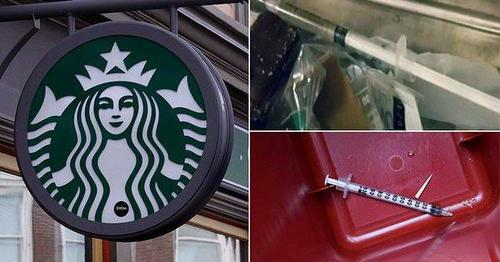
Starbucks Closing 16 Stores In Major Cities Due To 'Increasing Threats' From Bathroom Drug Dens
Four weeks ago, Starbucks CEO Howard Schutz told the NY Times that the company was assessing increasing threats to public safety over it's "all inclusive" 2018 bathroom policy that encouraged homeless people and drug addicts to make copious use.

Now, the company is now shuttering 16 locations in major cities over incidents related to drug use and 'other disruptions' in its cafes, according to the Wall Street Journal.
The company on Monday announced that it would be permanently closing six stores each in Seattle and Los Angeles, as well as two in Portland, OR, and single locations in Philadelphia and Washington DC by the end of the month.
The move comes after workers reported incidents involving drug use by customers and members of the public - which, logically, comes after the company's 2018 virtue signaling campaign which eventually included the installation of needle deposit boxes at various locations after employees signed a petition demanding the company do more to protect them.

"We read every incident report you file—it’s a lot," wrote operations leads Debbie Stroud and Denise Nelson in a message to U.S. employees Monday. "We cannot serve as partners if we don’t first feel safe at work." (Starbucks refers to its employees as 'partners')
Starbucks also said that it would give store managers leeway to close restrooms, limit seating or reduce operations in response to safety concerns. The moves are part of policies aimed at addressing workers’ concerns, including about their safety on the job, the company said.Managers can continue to change store layouts if needed, including limiting seating to customers, the spokeswoman said. The company said it would provide additional guidance to baristas in how to deal with active shooter scenarios and conflict de-escalation at work. -WSJ
Last month, Schultz told the NYTimes that increasing threats to public safety and an expanding mental health crisis have made it challenging for employees to manage stores under open bathroom policies. He said the decision was an "issue of just safety."
"We have to harden our stores and provide safety for our people," the CEO of America's largest coffee chain said. "I don't know if we can keep our bathrooms open."
Remember when Howard Schultz thought he was fit to be president of the United States?
MAKOR UPDATE EDF
ELECTRICITE DE FRANCE (EDF FP)
Makor view
Last Wednesday July 6th, the French Prime Minister Ms E.Borne during its general political speech declared that the French State will increase its stake in EDF from 83.77% to 100%. The day after, the French Finance Minister B.Le Maire confirmed that the French State will engage EDF’s restructuring with the aim of delisting EDF by October.
On Friday July 8th, EDF published a press release noting the announcement made by the French State and confirmed the search for a new CEO that will take the role in September. In the same time, some articles mentioned EUR7Bn to buyout the minorities and the FT mentioned SG and Goldman Sachs as advisers (each restricted on 04/05 for SG and 08/07 for GS wit a target price of EUR11.9 based on a 50/50 valuation P/E and DCF).
On Monday July 11th, Reuters article mentioned a EUR8bn amount to buy-out the minorities that could top up to EUR10Bn including the 09/24 CB (issue price @ EUR11.7, nominal value of EUR10.93 and can be redeemed by the company at any time starting 14/09/2022 under certain prices circumstances- Please see following link for more details : https://www.edf.fr/sites/groupe/files/contrib/groupe-edf/espaces-dedies/espace-medias/cp/2020/2020-09-08_cp-certifie_succes-emission-oceanes-vertes-paris-206533-v2a.pdf ).
Considering all these information’s and based on the General rules of the AMF (and precedent Simplified offer made in France, the last one being on Europcar), we could assume the following calendar that fits well with the French Government announcement that EDF will be fully nationalized by October:
Makor Estimated Calendar
13/07/2022
Announcement of the transaction
13/07/2022
AMF Notification
02/08/2022
Note en response from EDF (+15 BD)
18/08/2022
AMF Approval (+12BD)
23/08/2022
Publication of all documents to the public (+3 BD)
24/08/2022
Opening of the Offer (+3 BD)
22/09/2022
Closing of the offer (+22BD)
27/09/2022
Result of the offer (3BD)
30/09/2022
Settlement (+3BD)
BD: Business day per AMF General Rules
Regarding the price offered to minority shareholders, we’ll take a conservative view based on EUR8Bn for the equity (current number of shares outstanding is 3.868.480.343 of which 83.77% is held by the French State so floating is 626.693.815 net of treasury shares), this would translate into EUR12.75 eg 24% premium over the current share price. Question is if the shares related to the CB will be considered for the full dilution or if the company will use the EUR2.5Bn raised during the capital increase to redeem them.
EDF is currently trading at EUR10.3, a 17% discount to our EUR12 Target price. Once announced, we expect EDF shares to trade closed to the offer price
This message has been sent by Makor Securities London Ltd which is authorised and regulated by the FCA (625054). This message is for professional clients and eligible counterparties only, not intended for "retail clients". The information contained in this message is confidential and is for the exclusive use of the intended recipient. If you receive this message in error please inform us and delete all copies of it. The information is not intended as an offer or solicitation to buy or sell any financial instrument. All comments and statements are to be considered the opinions of the author not the Company and are not intended to be relied upon. We cannot guarantee that this message or any attachments are virus free and accept no liability for any viruses or the consequences thereof.
Activist investors wage record number of campaigns in Europe
British companies prove especially vulnerable to restive shareholders
Activist investors waged a record number of campaigns against European companies in the first half of the year, with British companies proving especially vulnerable to restive shareholders.
There were 35 activist campaigns targeted at companies in Europe during the period, according to data compiled by investment bank Lazard, up 67 per cent from the previous year. UK companies represented more than a third of all targets.
“Activist investors love value stories and Europe has been operating at relatively lower valuations,” said Mary Ann Deignan, managing director and head of capital markets advisory at Lazard, which counts an activist campaign once it has been made public. “But I also think we are seeing a longer-term trend of increasing activity in Europe.”
Activists have targeted several big British companies, including consumer goods business Unilever, which in May added Nelson Peltz to its board after his firm Trian Partners built a 1.5 per cent stake in the company.
Shell, the oil major, was the subject of a campaign from London-based Odey Asset Management, which has urged the company to drop its appeal against a landmark Dutch court ruling targeting its climate strategy.
Shell is also contending with pressure from US hedge fund Third Point, which has called on it to split into two businesses — a legacy oil and chemicals business and a green arm focused on the future.
HSBC is also facing demands to break up, with the bank’s largest shareholder, Chinese insurer Ping An, wanting it to separate its Asian business from its western operations in an effort to boost years of lacklustre investor returns.
France, which accounted for 20 per cent of such campaigns in Europe during the first half of the year, has also become an increasingly popular destination for activists, according to Lazard. The proportion of campaigns accounted for by the country had tripled over the past five years, the investment bank said.
While the number of activist campaigns in Europe reached a high in the second quarter, there was a reduction in the number of US companies being targeted. There were 22 new campaigns against American companies between April and June, down 50 per cent from the first quarter, Lazard said.
“It’s a tale of two markets,” said Deignan. “The US was extremely strong in the first quarter and Europe less so. Now we’ve seen a reversal of that trend.”
However, Deignan said it would take more time to determine whether the figures signalled a long-term shift.
Even as dealmaking has cooled down, many activists are still focused on forcing executives to sell the company they run, either outright or in part.
The number of campaigns focused on forcing a company to sell this year is on track to surpass the total recorded in 2021. Activists are also pushing management teams to implement new business strategies and improve capital allocation in light of the worsening economic backdrop.
Heathrow introduces passenger cap for first time to avert disruption
UK’s busiest hub tells airlines to stop selling tickets as it warns of disruption, long waits and cancellations
London’s Heathrow airport has introduced a daily limit on the number of passengers for the first time and told airlines to stop selling tickets over the next two months in an attempt to avert more summer travel disruption.
The UK’s busiest airport said no more than 100,000 people would be able to fly each day on departures from the airport until September 11, or passengers would face more long waits and last-minute cancellations.
The airport, which handled 125,000 departing passengers a day before the pandemic, has been affected by staff shortages in its own security as well as among airlines and ground handlers, forcing it to cap traveller numbers.
“We are asking our airline partners to stop selling summer tickets to limit the impact on passengers,” said chief executive John Holland-Kaye on Tuesday.
Heathrow has an average of 104,000 daily departing seats under its current schedule this summer, which means it will have to cut hundreds of flights.
Of the 4,000 excess seats above the 100,000 limit, about 1,500 a day have already been sold to passengers, Heathrow said.
However, at about 10 a day or just over 600 in total facing cancellations, it will only be a fraction of the 70,000 scheduled flights at the airport over the next two months.
Although the majority of passengers travelling this summer will not be hit by the cancellations, airports and airlines are still facing a heavy blow to their reputations as they recover from the pandemic.
Such drastic measures were virtually unheard of before this summer’s travel disruption, but the crisis in staffing across the aviation industry has forced airports to take extreme action.
London Gatwick and Amsterdam Schiphol have already introduced their own caps in response to the staff shortages.
British Airways, the largest airline operating from Heathrow, has cancelled about 30,000 flights this summer in response to its worker shortfall and operational problems at airports.
Other major European airlines including Lufthansa and KLM have also cut some flights and even changed ticket pricing to try to stop new customers from booking.
Holland-Kaye said some “critical functions” were still “significantly under resourced” at Heathrow, particularly ground handlers, which are subcontracted by airlines and typically handle tasks such as check-in and baggage.
“Over the past few weeks, as departing passenger numbers have regularly exceeded 100,000 a day, we have started to see periods when service drops to a level that is not acceptable,” Holland-Kaye added, pointing to problems including long wait times, bags not travelling with passengers and last-minute cancellations.
Holland-Kaye said the airport had been forced to impose the cap because not enough airlines had cut flights despite encouragement from the government to trim their schedules early to avoid the last-minute disruption at many UK airports in late spring.
Working out the likely number of cancellations at Heathrow over the next two months, industry executives have assumed about 150 people per aircraft, which on rough calculations would mean about 10 flights being cancelled a day and 620 in total.
US Small Business Optimism Outlook Crashes To Record Low, Yield Curve Inverts Most Since 2007
Shortly after German investor confidence collapsed to its weakest since the 2011 debt crisis (as the country faces the growing prospect of a recession and risks mount that it’s shut off from Russian energy supplies), US Small Business optimism plummeted more than expected in June with inflation topping the factors driving fear into American entrepreneurs.
Headline optimism among US small-business owners slumped in June to the lowest level since early 2013 (down 3.6 to 89.5, well below 92.5 exp), but a net minus 61% of owners last month said they expect better business conditions over the coming six months, down 7 percentage points from May and the worst result in the survey’s 48-year history.

Source: Bloomberg
All 10 sub-components worsened in June...

Inflation continues to be a top problem for small businesses with 34% of owners reporting it was their single most important problem in operating their business, an increase of six points from May and the highest level since quarter four in 1980.
“As inflation continues to dominate business decisions, small business owners’ expectations for better business conditions have reached a new low,” said Bill Dunkelberg, NFIB chief economist.“On top of the immediate challenges facing small-business owners including inflation and worker shortages, the outlook for economic policy is not encouraging either.”
The record low outlook is strongly indicating bad times for the economy to come. In concurrence, those expecting real sales growth is also historically low, expected better credit conditions has deteriorated and only 3% of small business owners think the current period is a good time to expand their business.
The NFIB concludes rather ominously, "these indicators make a very strong case for a decline in economic activity. How long and how severe is now the question. It appears that real GDP growth was negative in the first two quarters of the year, some say that is a recession. But employment has yet to yield to the forces of decline, a good sign..."
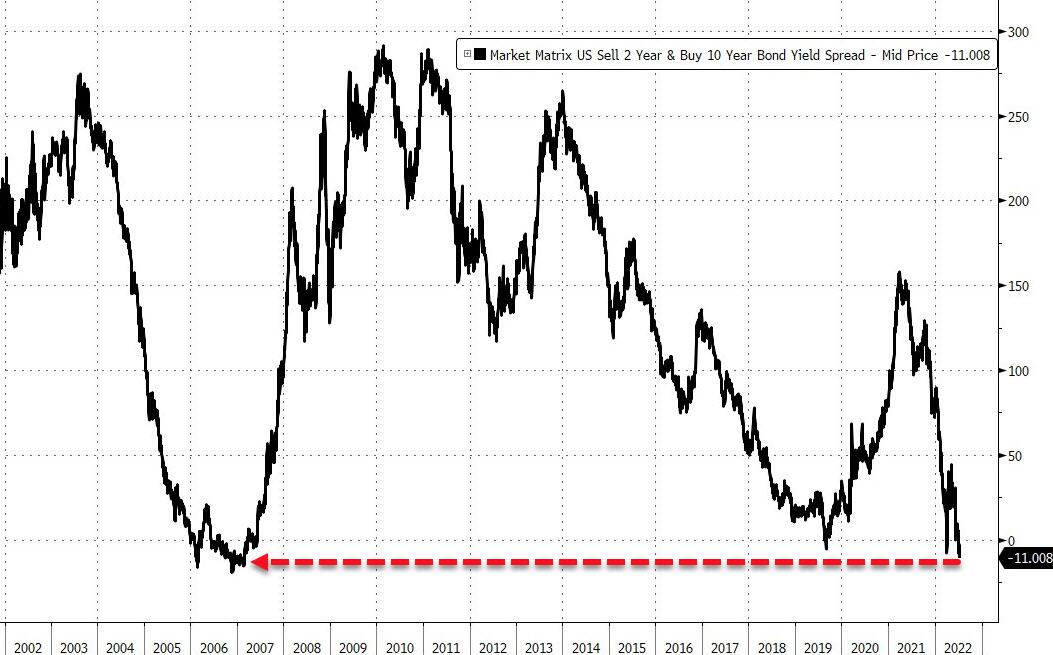
We note that the yield curve (2s10s) has collapsed to its most inverted since 2007 this morning...
"However this plays out, small business owners are bracing for challenging times ahead."