The Week’s 10 Biggest Funding Rounds: Whatnot Goes Big; TAE Powers Up With $250M
This is a weekly feature that runs down the week’s top 10 funding rounds in the U.S. Check out last week’s biggest funding rounds here.
Rounds raised by U.S.-based startups were big this week, with three topping $200 million. No one category stood out, as investors wrote checks for anything ranging from livestream shopping to biotech to ways to develop clean drinking water. After a slow start to the month, large rounds have come back into play for some startups.
1. Whatnot, $260M, e-commerce: Investors clearly seem to think livestream shopping is the next evolutionary step for commerce. DST Global and Alphabet’s growth fund, CapitalG, co-led a $260 million Series D for Los Angeles-based Whatnot. The round now values the live shopping platform at $3.7 billion—a 2.5x increase from September when its valuation was $1.5 billion. That’s an impressive jump considering the venture market was very different in September. However, the company seems to be coming off an impressive year. Whatnot said it grew sales more than 20x year over year last year, and more than tripled its monthly sales thus far in 2022. Founded in 2019, the company has raised nearly $485 million, according to Crunchbase data.
2. TAE Technologies, $250M, energy: The promise of real nuclear fusion energy continues to fire up investors. TAE Technologies is the latest to ride that wave of interest, as the Foothill Ranch, California-based company raised a $250 million round that induced cash from the likes of Google and Chevron. The last year has been big for fusion startups, as companies such as Commonwealth Fusion Systems, Helion Energy, General Fusion and others have raised substantial rounds. Fusion energy—created when two atoms are merged—is the holy grail of clean energy. With many experts thinking it is getting closer to being commercialized, investors are lining up their bets. TAE has collected a lot of those bets, as the company—founded in 1998—said it has now raised $1.2 billion.
3. Delfi Diagnostics, $225M, biotech: Unfortunately, cancer remains a public health concern, and early ways to detect and monitor the dreaded disease are always going to be highly sought after. Baltimore-based Delfi Diagnostics has developed a way to look for DNA fragments in a patient’s bloodstream that are linked to specific forms of cancer. The new technology was interesting enough to help the company close a $225 million Series B led by DFJ Growth. The company—founded in 2019—will use the new proceeds for continued development and commercialization of its blood tests. Delfi has now raised more than $330 million, according to Crunchbase.
4. Meati Foods, $150M, food tech: You can buy a lot of filet mignon with $150 million—probably even more if it’s “faux” filet mignon. Boulder, Colorado-based Meati Foods became the latest food tech startup making plant-based meat to score a large funding round, locking up a $150 million Series C funding led by Revolution Growth. Meati specializes in creating whole-cut steak cutlets and chunks that use mycelium—a mushroom root—to stand in for meat. Cuts of meat have proven a problem for the fake meat industry as the texture is hard to replicate. However, Meati’s cuts are already being sold in grocery stores and restaurants in Arizona and Colorado. The company has raised $278.6 million to date, according to Crunchbase.
5. Source, $130M, environmental engineering: Other than oxygen, nothing is more important than water—yet viable sources of drinking water are getting scarcer. Scotttsdale, Arizona-based Source, a developer of sustainable drinking water technology, closed a $130 million Series D led by Breakthrough Energy Ventures and The Drawdown Fund. The company’s tech uses the sun to draw water vapor out of the air and transform it into mineralized drinking water, even in low-humidity locations. According to the company, at least 2.4 billion people globally do not have clean water to drink, and by 2050 that number will increase to 6 billion as a result of climate change. Founded in 2014, Source says it has raised a total of $270 million to date.
6. ClassDojo, $125M, edtech: San Francisco-based edtech startup ClassDojo announced it closed a $125 million Series D led by Tencent that valued the company at $1.25 billion. The round was raised in September, but was not announced at the time. Founded in 2011, the company has now raised more than $190 million, per Crunchbase.
7. (tied) Camp4 Therapeutics, $100M, biotech: Cambridge, Massachusetts-based biotechnology firm Camp4 Therapeutics raised a $100 million Series B led by Enavate Sciences. Founded in 2016, the company—which is developing RNA treatments—has raised $190 million, according to Crunchbase.
7. (tied) FlexGen, $100M, energy storage: Durham, North Carolina-based FlexGen closed a $100 million Series C led by Vitol. Founded in 2009, the energy storage solutions provider has now raised more than $275 million, per Crunchbase data.
9. Halborn, $90M, cybersecurity: Miami-based Halborn, a cybersecurity firm for traditional finance and blockchain-based customers, completed a $90 million round led by Summit Partners. Founded in 2019, this was the company’s first external round.
10. BigHat Biosciences, $75M, biotech: San Mateo, California-based BigHat Biosciences raised a $75 million Series B funding round led by Section 32. Founded in 2019, BigHat, which is developing antibody therapies for patients using machine learning and synthetic biology, has raised $105 million to date, according to the company.
Meet The 32 New Unicorns That Joined The Board In June 2022
Despite ongoing concerns about overvalued private companies, and a stymied public market for new debuts, new billion-dollar valued companies are still joining The Crunchbase Unicorn Board. Thirty-two companies joined the board in June, around three companies every two working days.
Of the companies that joined the Unicorn Board last month, London-based payments company SumUp leads the pack with the largest funding raise, $623 million, and the highest valuation, $8.5 billion. Collectively, this batch of 32 companies raised $4.5 billion last month.
The company with the earliest funding stage to unicorn is India-based edtech Physics Wallah, which raised $100 million in a Series A round. The profitable company provides low-cost test-prep classes.
Search less. Close more.
Grow your revenue with all-in-one prospecting solutions powered by the leader in private-company data.
The most active lead investors in these billion-dollar valued rounds include Goldman Sachs Asset Management with three investments, and Craft Ventures and Westbridge Capital, each with two investments.
Across these companies, Y Combinator has the highest count with four portfolio companies, all via its accelerator program at seed-stage fundings.
Marketing and professional services leads with the largest count of companies followed by financial services and cybersecurity companies.
Here are the companies, organized by sector.
Marketing and professional services
- New York-based AlphaSense, a research platform for companies looking for business intelligence, raised a $225 million Series D valued at $1.7 billion led by Goldman Sachs Asset Management and Viking Global Investors.
- London-based apprenticeship talent marketplace Multiverse raised a $220 million Series D which valued it at $1.7 billion. The funding was led by General Catalyst, Lightspeed Venture Partners and StepStone Group.
- Front, a customer relationship management platform based out of San Francisco, raised a $65 million Series D to be valued at $1.7 billion, led by Battery Ventures and Salesforce Ventures.
- Massachusetts-based airSlate, a document management services company, raised a $52 million Series C led by G Squared. The company was valued at $1.3 billion.
- Santa Barbara-based call intelligence company Invoca raised an $83 million Series F valued at $1.1 billion led by late-stage investor Silver Lake Waterman.
- Bangalore-based LeadSquared, a sales execution CRM platform, raised a Series C of $153 million led by Westbridge Capital. The funding valued the company at $1 billion.
- SaaS vendor management company Vendr from Boston raised a $150 million Series B valued at $1 billion led by Craft Ventures and SoftBank Vision Fund.
Financial services
- London-based point-of-sale payments company SumUp raised $623 million in a round led by Bain Capital Tech Opportunities, which valued it at $8.5 billion.
- Banking software enterprise solution Backbase raised a private equity funding of $128 million. Motive Partners led the round, valuing the Netherlands-based company at $2.6 billion.
- Real-time compensation platform Pave, based in San Francisco, raised a $100 million Series C. Pave was valued at $1.6 billion after the round led by Index Ventures.
- Ecuador-based Kushki, an e-commerce payment solution, raised a $100 million Series B led by Kaszek, which valued the company at $1.5 billion.
- Insurance provider Branch, based in Columbus, Ohio, raised a $147 million Series C valued at $1.1 billion and led by Weatherford Capital.
Privacy and security
- Security compliance company Vanta, based out of San Francisco, raised a $110 million Series B led by Craft Ventures which valued the company at $1.6 billion.
- Boston-based Immuta, a company that secures cloud data, raised a $100 million Series E valued at $1 billion and led by cybersecurity VC firm NightDragon Security.
- Tel Aviv-based Perimeter 81, a secure network company for a distributed workforce, raised a $100 million Series C valued at $1 billion and led by B Capital Group.
- Security and compliance company JupiterOne, based in North Carolina, raised a $70 million Series C valued at $1 billion and led by Tribe Capital.
Sustainability
- Fast-charging electric vehicle stations provider Electrify America, based in Virginia, raised a $450 million corporate round valued at $2.5 billion and led by Siemens Financial Services.
- Paris-based EcoVadis, an environmental impact assessor for vendors, raised a $500 million private equity round valued at $1 billion which was led by PE firms Astorg and climate change investor Beyond Net Zero.
- Bay Area-based Turntide Technologies, developer of electric motor systems to reduce energy consumption, raised an $80 million funding valued at $1 billion and led by OGCI Climate Investments.
Health care
- Nashville, Tennessee-based health care service CareBridge raised a $140 million funding valued at $1 billion and led by Oak HC/FT.
- Developer of diagnostic devices Visby Medical, based in San Jose, raised a $135 million Series E which valued the company at $1.06 billion. Although the Series E was first announced in March, the valuation was not disclosed until the company announced its Series E extension in late June.
Web3
- San Francisco-based NFT marketplace Magic Eden raised a $130 million Series B led by Electric Capital and Greylock which valued the company at $1.6 billion.
Real estate
- Seoul-based ZigBang, an apartment-seeking app, raised an $8 million funding led by Shinhan Venture Investment which valued it at $1.6 billion.
Semiconductor
- Israel-based 4D-imaging radar company Vayyar raised a $108 million Series E that valued the company at $1.5 billion. The funding was led by Koch Disruptive Technologies.
Cloud computing
- Cloud computing company Jaguar Microsystems from Shenzhen raised a $15 million Series B led by Tencent, valuing the company at $1.3 billion.
Wireless infrastructure
- Digital 9 Infrastructure acquired the stake of Canada Pension Plan Investment Board in U.K.-based Arqiva, a communications and infrastructure company. The secondary market financing valued Arqiva at $1.2 billion.
Edtech
- India-based Physics Wallah, an edtech platform that provides live and online classes and has helped more than 6 million students according to its announcement, raised a $100 million Series A valued at $1.1 billion. The funding was led by GSV Ventures and Westbridge Capital.
Manufacturing
- Sustainable textile company Recover from Spain, raised a $100 million funding led by Goldman Sachs Asset Management which valued it at $1.1 billion.
Food and Beverage
- Tampa, Florida-based beverage company Cirkul raised a $70 million Series C valued at $1.1 billion led by New York-based PE firm SC.Holdings.
E-commerce
- Mumbai-based Purplle, an online store for cosmetics, raised a $33 million Series E valued at $1.1 billion led by South Korea-based Paramark Ventures.
Robotics
- Robotics company MegaRobo, from Beijing, raised a $300 million Series C led by Asia Investment Capital, GGV Capital and Goldman Sachs Asset Management, which valued the company at $1 billion.
Logistics
- Chicago-based FourKites, a supply chain visibility platform, raised a corporate round led by FedEx valuing the company at $1 billion. The funding amount was not disclosed.
Methodology
The Crunchbase Unicorn Board is a curated list that includes private unicorn companies with post-money valuations of $1 billion or more and is based on Crunchbase data. New companies are added to the Unicorn Board as they reach the $1 billion valuation mark as part of a funding round.
Funding to unicorn companies includes all private financings to companies that are tagged as unicorns, as well as those that have since graduated to The Exited Unicorn Board.
Pope Francis authorized wire-tapping of financier accused of defrauding Vatican of millions: report
The Vatican authorized secret wiretaps on an Italian financial broker based in London who has been charged with defrauding the Holy See of hundreds of millions of dollars, according to leaked documents.
Pope Francis granted investigators the power to bug phones, intercept emails and arrest anyone without approval from British judges, The Times of London reported.
The Vatican’s Office of the Promoter of Justice used those powers to target millionaire Raffaele Mincione, a fund manager accused of cheating the Vatican amidst a roughly $350 million real estate venture.
The scandal centers on a massive Vatican investment in a former Harrod’s warehouse in London, which was set to be converted into luxury apartments.
Mincione is one of 10 people, including a cardinal, embroiled in the controversy, which first came to light in 2014. He has denied wrongdoing.
Last month, prosecutors questioned Mincione about his management of a fund that owned the London property.
In April 2021, the pope amended Vatican law, permitting religious leaders like cardinals and bishops to stand trial before the Vatican’s civilian-led courts, the Telegraph reported.
Days later Pope Francis allegedly ordered “the adoption of technological tools suitable for intercepting fixed and mobile devices, as well as any other communication, including electronic ones,” according to the leaked documents. “These powers may be exercised against subjects whose communication activities are considered useful for carrying out the investigations.”
Weeks later, Mincione’s phones and computer were seized by Vatican authorities and Italian police at a hotel in Rome, while the financier was vacationing, according to the report. His Italian lawyer claims he was put under surveillance.
Mincione’s attorney’s have written to British officials urging them not to cooperate with the Vatican’s investigation.
It’s Time for Fashion Brands to Exit Russia
H&M’s decision to permanently close its Russian stores is a signal that fashion brands can no longer take a wait-and-see
In the immediate aftermath of Russia’s invasion of Ukraine on Feb. 24, almost all Western fashion brands suspended operations in Russia. At first, the thinking was that the industry could pause sales to show solidarity with Western customers who overwhelmingly supported Ukraine in the conflict, while leaving the door open for a return once the war was over.
Nearly five months later, experts are giving up hope for a short-term peaceful resolution. This week, H&M said it would wind down its business in Russia, once the Swedish retailer’s sixth-biggest market. The decision means 170 stores will close, and some 6,000 employees will lose their jobs.
“After careful consideration, we see it as impossible given the current situation to continue our business in Russia,” chief executive Helena Helmersson said in a statement. “We are deeply saddened about the impact this will have on our colleagues.”
So far, H&M and Nike, which permanently closed its Russian operations in June, are the exceptions. They will soon be the rule.
When retailers like Zara parent Inditex, luxury giants LVMH and Kering, and online retailers Yoox Net-a-Porter and Farfetch suspended sales in Russia, they did so partly to avoid running afoul of Western sanctions, and partly to head off public outcry. It worked — photos of dark Zara and Dior stores inside Moscow shopping malls satisfied most consumers, even if some knew their owners could theoretically turn the lights back on anytime they wanted.
That middle ground is increasingly unviable, as the war drags on and atrocities such as the massacre in the Ukrainian town of Bucha come to light.
Brands now face a choice: they can shut their Russian operations entirely, as H&M and Nike have done. They can sell their Russian businesses, as off-price retailer T.J. Maxx did when it sold a 25 percent stake in the Russian retailer Familia. Or they can continue with a wait-and-see approach.
Leaving Russia entirely comes at a cost: H&M said closing its Russian business will cost 2 billion Swedish crowns ($191.3 million at current exchange rates). It also means permanently walking away from a market that provided 4 percent of the group’s sales in the fourth quarter of 2021.
Those figures are likely higher than at most other retailers, even large ones. Adidas operates 500 stores in Russia and other former Soviet states, but said pausing business there would cut 2022 revenue by just 1 percent. The goodwill generated with many consumers by taking a forceful step to cut ties with Russia is probably worth that, if not more, especially for brands that are early to take the leap.
For brands that operate in Russia via franchisees, selling their business to those partners may be the most practical way out. A former McDonald’s partner now operates the fast food chain’s former Russian locations under a new brand, Vkusno & tochka. However, this isn’t a fool-proof solution: Some of the McDonald’s Russian stores are still using its branding illegally, potentially hurting the company’s image if service and the quality of its food drops. In fashion, where grey market goods are a problem even in normal times, it’s not hard to imagine a future where “Versace” and “Adidas” stores sell fakes and illicitly sourced goods.
Meanwhile, as malls in Moscow sit half-empty, domestic brands are benefiting from the lack of foreign competitors. Reuters reported that sales levels for Russian apparel, shoe and accessory brands were 2.6 times higher in March and April 2022 versus 2021, according to Ozon, Russia’s second-largest e-commerce platform.
The Most Remote Luxury Hotels in Europe
These far-flung locations may be difficult to reach, but for those seeking exclusive and unusual holidays, they provide tranquil escapes.
MILAN — From isolated islands off the coast of Montenegro to remote parts of Italy, the most insidious meanders of the French Alps to the Portuguese countryside — the most remote hotels in Europe are often also the most luxurious.
These far-flung locations may be difficult to reach, but for those seeking exclusive and unusual holidays, they provide tranquil — and beautiful — escapes.
Here, WWD explores some of the most secluded five-star hotels in Europe that promise exceptional and unforgettable experiences.
The Eremito Hotel, Italy
What is more isolated than a 14th-century monastery redeveloped as a hotel and located in the Umbrian valleys of Italy?
This is the case of Eremito, which translates to hermit, a hotel situated in Parrano, a 40-minute drive from the closest town, Orvieto, and surrounded by 3,000 hectares of protected natural reserve.

The Eremito Hotel in Umbria.
COURTESY IMAGE / MARCO RAVASINI
Founded and owned by Marcello Murzilli, the structure is known to be the first digital-detox hotel in Italy. It doesn’t have internet, business centers, minibars or televisions, and is intended for solo travelers only, exclusively offering single-bed occupancy. At The Eremito Hotel, the main source of light comes from candles, and what little electricity the hotel does use is generated by a state-of-the-art array of photovoltaic cells.

A hallway inside the Eremito Hotel in Umbria, Italy.
COURTESY IMAGE / MARCO RAVASINI
Bedrooms — formerly used by the monastery’s priests — are insulated to stay cool without air conditioning in the summer. In winter months, the rooms are heated with an underfloor heating system.

The restaurant inside the Eremito Hotel, in Umbria.
COURTESY IMAGE / MARCO RAVASINI
The restaurant, known as the “refectory,” offers a simple cuisine based on vegetarian and vegan traditional recipes made of fresh vegetables and seasonal fruits, while the bread and pasta are all homemade, as are the jams and desserts. The dinner is consumed in silence, together with the other guests at a big common table. During the summer, guests enjoy their meals on the outside patio.
The Refuge de la Traye, France
Similar to Eremito, the Refuge de la Traye is nestled in a haven of nature, at the heart of the three valleys in a ski area, and situated at an altitude of 1,650 meters in the French Alps. Built in 1982, the structure was originally a mountain lodge and was renovated into a luxury hospitality destination in 2019. It offers only six rooms and suites, which creates a private, intimate, homey vibe.

Refuge de la Traye
COURTESY IMAGE
The hotel places an emphasis on its natural surroundings, offering courses such as zip-lining and tree-climbing, electric mountain biking, pottery workshops, pony rides and spa retreats.
There is a wellness center, a sauna, a hammam, an outdoor jacuzzi, a fitness room, a tearoom, a lounge and a cigar salon, a children’s indoor playroom, a screening room, a chapel and two small lodges that are available to book.

The outdoor jacuzzi at the Refuge de la Traye.
COURTESY IMAGE
The hotel’s restaurant, La Table, offers Savoyard specialties such as raclettes and fondues during the colder seasons, and fresh vegetables and wood-fired pizzas during the summer.

“La Table,” the restaurant at the Refuge de La Traye.
COURTESY IMAGE
Located on the terrace overlooking the Alps, the restaurant is one of the most jaw-dropping features of the luxury inn.
Casa na Terra hotel, Portugal
Surrounded by the green countryside and wide ocean beaches in the Alentajo region in Portugal, the Casa na Terra hotel is situated near the artificial lake Monsaraz. It is unique, resembling an alien station or a luxury bunker hidden by the vegetation: only the dome and patio are visible from the outside, minimizing the impact the building has on the landscape or the view.

Casa na Terra, Portugal
COURTESY IMAGE
Casa na Terra, designed by architect Manuel Aires Mateus, is the latest addition to the Portuguese hotel group Silent Living, which already owns the Santa Clara 1728 in Lisbon, and the Cabanas no Rio in Comporta.
With only three suites, each with a bright, private patio and a fully equipped kitchen, this structure is a place where visitors rest up, thanks to the minimal style of the hotel in neutral colors such as white, gray and beige.

Casa na Terra in Portugal.
COURTESY IMAGE
Casa na Terra has only one common area, which acts as the heart of the hotel, as meals are consumed inside the guests’ rooms.
The Aman Sveti Stefan, Montenegro
Aman, one of the biggest luxury hotel chains, is bringing a high-end lodging experience to a small island off the coast of Montenegro.
The Aman Sveti Stefan is located on the island of Sveti Stefan and is connected to the mainland by a narrow isthmus. The restored village lies across the bay from Villa Miločer, a former royal retreat. The hotel grounds are spread across 80 acres, with two kilometers of beaches and a stand-alone Aman Spa.

The Aman Sveti Stefan in Montenegro.
COURTESY IMAGE
The hotel houses 51 rooms, cottages and suites connected by stone steps and cobbled paths. The restored dwellings feature hand-rendered stucco, stone and local oak, in keeping with the village’s rustic legacy, with sea or garden views.
Aman Sveti Stefan also offers two restaurants, in addition to the grill bar and the pool bar. The Arva, the structure’s main restaurant, is available for dinner-service only.

The Spa at Aman Sveti Stefan, Montenegro.
COURTESY IMAGE
Facilities include a fitness center, hydrotherapy and swimming pools, three hotel-owned beaches, wine tasting and boat trips.
Weekend Papers Summary
NEW YORK TIMES
-The Jan. 6 panel after 8 hearings: where will the evidence lead?
The House committee has set out a comprehensive narrative of the effort to overturn the 2020 election. But it’s unclear if that will be enough to achieve its legal and political goals.
-Steve Bannon found guilty of contempt in case related to capitol riot inquiry. He is the first close aide to former President Donald J. Trump to be convicted as a result of one of the investigations into the Jan. 6 attack.
-Russia agrees to let Ukraine export grain, easing world food shortage.
Ukraine and Russia signed a deal to lift Russia’s blockade of Ukrainian ports, which has worsened a global food crisis — their most important agreement since the war began.
-The NBA has kept a low profile in public campaign to free Brittney Griner, the WNBA star who has been detained in Russia since February. The NBA which founded the women’s league in 1996, has said it is working behind the scenes to help Griner.
-President Biden’s new economic scorecard is the price at the pump.
President Biden has grown fond of boasting about a streak of falling gas prices, a move wrapped in risk and irony, our correspondent writes in an analysis.
-The pandemic isn’t over, but most U.S. states have formally said that it’s no longer a health emergency. Get Covid news.
- GOP assails NY bail laws after the suspect in Zeldin attack is released
the suspect was released without bail hours after the attack against Representative Lee Zeldin, the Republican candidate for governor.
-Health officials in Rockland County offered polio vaccinations and urged the public to get shots as they investigated whether the disease had spread.
-Some Republican-led counties are refusing to certify election results — a move that could throw American democracy into chaos if it becomes widespread.
THE FINANCIAL TIMES
-Volkswagen’s chief executive Herbert Diess, the architect of the German carmaker’s multibillion-euro push into electric vehicles, will leave the company within weeks after being forced out by union leaders and shareholders. The 63-year-old, who took over in the years following the VW emissions scandal, will be replaced by Porsche chief executive and former VW manager Oliver Blume from the start of September. His departure follows a vote by VW’s supervisory board, which is controlled by a loose alliance of workers’ representatives and the state of Lower Saxony, the company’s second-largest shareholder.
-The Spanish government has said that the EU’s proposal for blanket targets to cut gas use ahead of a winter supply crunch is “not efficient, fair or equitable” as bickering between member states over the plan increases. Teresa Ribera Rodríguez, minister for ecological transition, complained that Brussels’s plan to ask countries to cut gas demand by 15% starting next month and over the winter was not discussed with member states before its announcement on Wednesday.
-Since January 6 2021, Liz Cheney has been focused on a single goal: making sure Donald Trump never again occupies the Oval Office. On Thursday she came a step closer to achieving that ambition as she wrapped up the last in a series of live hearings investigating last year’s attack on the US Congress and whether the former president played a role in stoking it.
-US Federal Reserve chair Jay Powell has expressed deep admiration for Paul Volcker, his legendary predecessor who defeated the high inflation that plagued the US economy from 1965 to 1982. Then, as now, Volcker was fighting more than a decade of loose monetary policy, combined with supply shocks stemming from geopolitical turmoil. But though he extols the man, Powell is deviating from Volcker’s methods. This is perhaps why inflation continues to accelerate, now topping 9% in the US and spreading rapidly throughout the world.
-Kyiv and Moscow have struck a deal aimed at averting a global food crisis, agreeing a “de facto ceasefire” on cargo ships that will collect millions of tonnes of stranded grain from Ukrainian ports. At a signing ceremony on Friday in Istanbul, UN secretary-general António Guterres hailed it as a “beacon of hope on the Black Sea”.
-This April, after a five-year absence in which he flirted with a run for the US presidency, Schultz returned to the company he built into the world’s largest coffee chain, taking his third turn as its chief executive.
“Love and responsibility brought me back to Starbucks,” he told analysts in May. At the same time he warned that major changes in customer behaviour during the coronavirus pandemic had put the business under “significant pressure”.
NY POST
-Google has fired a senior software engineer who claimed that the company had developed a “sentient” artificial intelligence bot, the company announced Friday. Blake Lemoine, who works in Google’s Responsible AI organization, was placed on administrative leave last month after he said the AI chatbot known as LaMDA claims to have a soul and expressed human thoughts and emotions, which Google refuted as “wholly unfounded.”
-The accusations against Republican gubernatorial candidate Lee Zeldin’s alleged attacker are grave enough for a more serious charge that could have gotten him held on bail, said legal experts. Troubled Army veteran David Jakubonis was charged with attempted second-degree assault, which led him to be automatically sprung from custody under New York’s controversial bail-reform law. But former Manhattan prosecutor Mark Bederow said the details in the felony complaint against Jakubonis — who’s accused of swinging “a set of self-defense knuckles which had two sharp pointed ends” at Zeldin’s throat after threatening, “You’re done” — make a case for attempted first-degree assault, which is eligible for bail.
-Jay Carney, the Amazon executive who vastly expanded its lobbying and public affairs operation after a stint as White House press secretary, is joining Airbnb as policy and communications head, the home rental startup said on Friday. Carney, who worked at Amazon for seven years as Senior Vice President of Global Corporate Affairs, will start at Airbnb in September and report to co-founder and CEO Brian Chesky.
Barron’s Weekend Summary: When Amazon reports second-quarter earnings on July 28, Wall Street analysts expect revenue growth of just 5%
Cover Story:
-When Amazon reports second-quarter earnings on July 28, Wall Street analysts expect revenue growth of just 5%. That’s a tepid number by Amazon standards, and if things are just slightly worse than expected, revenue could actually decline. It would be a telling moment, with Amazon facing its greatest set of challenges since founder Jeff Bezos began selling books out of his house almost 30 years ago.
Interview:
-This week, Barron’s has interviewed Sammy Simnegar, the Fidelity Magellan manager. He describes himself as a realist. It’s that realism that has made the Fidelity Magellan manager rethink his views about much-loved megacap technology stocks, hold off on bargain-hunting in some hard-hit parts of the market, and be skeptical of all the comparisons to the 1970s. In the past three years, Simnegar has built on a career as an international investor to scout out quality U.S. growth companies for the $23.6 billion Fidelity Magellan fund—once managed by famed stockpicker Peter Lynch—and the $4B Fidelity International Capital Appreciation fund, which he has helmed for 14 years.
Tech Trader:
-Not all tech CEOs are created equal. CEOs with nontechnical business backgrounds—I call them the “suits”—are likely to have a more difficult time making accurate product assessments and picking the right engineering teams. And so it isn’t all that surprising that some of the industry’s lackluster performances have come under such suits. Unity Software CEO John Riccitiello began his career in marketing and brand manager roles at Clorox and PepsiCo after graduating with a business degree. Following a stint at a private-equity firm, he served as CEO of videogame publisher Electronic Arts from 2007 to 2013. During his tenure, EA’s stock fell by more than 60% after he went on an acquisition spree of gaming studios—several of which failed and were shut down in the ensuing years.
The Trader:
-The word is “recession,” and defining one isn’t easy. It’s usually up to the National Bureau of Economic Research to determine when one has started, but it often takes so long that the slowdown is over by the time one is declared. Others point to the technical definition of two consecutive quarters of declining economic growth—something that could be declared as soon as this coming Thursday, when second-quarter gross domestic product is released.
-It’s been a tough three years for restaurants. First Covid-19 kept people from visiting their favorite eateries, while the stop-start return to normal life has kept traffic from returning to normal. And just when everything was looking up, out-of-control food inflation—combined with a shortage of delivery drivers and other staff members—has hit profit margins. Now restaurants have to contend with slowing growth and perhaps a recession, something that has caused the S&P 500 Restaurants sub-index to drop 17% so far this year, in line with the S&P 500.
Features:
-Investors have several ways to protect themselves from continued high inflation, chiefly through the purchase of Treasury inflation-protected securities, or TIPS. Most individual investors are unfamiliar with the $1.7T TIPS market, but these Treasury bonds deserve a place in portfolios.
-Stephen Byrd, Morgan Stanley’s head of North American equity research for power/utilities and clean tech, is overweight on solar stocks Sunrun and AES, as well as hydrogen fuel-cell developer Plug Power. In the longer term, Byrd and his research team at Morgan Stanley believe distributed energy resources, such as rooftop solar, might disrupt traditional utilities as extreme weather events and electric-grid instability increase, energy bills rise, and the cost of solar panels and similar products decline.
European Trader:
Wise is a London listed fintech company. It’s based in the trendy east London district of Shoreditch. Senior executives hot desk next to junior employees. The office is a former tea factory and features a sauna. But its services aren’t nearly as edgy as those of its fintech cousins dealing in cryptocurrencies. Wise simply helps people transfer money between more than 50 state-backed fiat currencies at cheaper rates than what Main Street banks charge. It handled $76B worth of transfers last year and boasts more than 13M customers.
Emerging Markets:
The implosion of China Evergrande last autumn, and a cascade of defaults that followed, smashed those cozy assumptions, and jacked up those yields to double digits for most privately owned builders. The “mortgage boycott” currently sweeping China has driven a fresh bond selloff. Investors are wary of dip buying, however. “Before the boycott, there was a view that we should be closer to the bottom,” says Tracy Chen, a portfolio manager for global credit at Brandywine Global. “Now we see developer stress hasn’t ended yet.”
Commodities:
Gasoline prices have fallen for 37 days in a row, and are now averaging $4.40 per gallon, down from over $5 last month. And the latest government data showed that drivers are using less gas than they were a year ago, probably because they’re still discouraged by high prices. Average prices remain $1.25 more than they were at this time last year. But there are some signs that the drop in prices is starting to convince some drivers to get back on the road.
Streetwise:
This week, Jack Hough looks at railways and railway stocks in the USA. US rails, in particular, have spent years slashing head count and leaning more heavily on the remaining workers to boost returns, but their shares now appear vulnerable in the near term. Service and volumes have slipped, and crew shortages are to blame. A strike has been delayed, but not yet averted. Hiring more workers in a hurry could cost dearly. Not hiring them could be worse
Did Russia And China Just Announce A "New Global Reserve Currency"?
Submitted by QTR's Fringe Finance
If you’ve blinked over the last month, you may have missed it…
China and Russia are taking their shot at the U.S. dollar. And as often happens with consequential news in the United States and the West, no one seems to notice or even care.
Since the beginning of the year, I have been writing about the possibility of Russia and China challenging the US dollar’s global reserve status. Now, it’s happening.
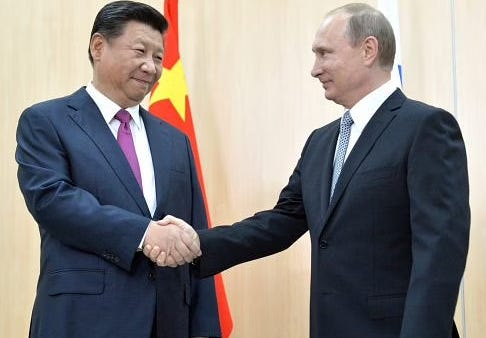
It shouldn’t be any surprise to those paying attention that Russia and China are strengthening their economic ties amidst continued Western sanctions on Russia as a result of the country’s war in Ukraine.
What may surprise some people, however, is that Russia and the BRICS countries, including Brazil, Russia, India, China, and South Africa, are officially working on their own “new global reserve currency,” RT reported in late June. Nobody even seemed to notice.
“The issue of creating an international reserve currency based on a basket of currencies of our countries is being worked out,” Vladimir Putin said at the BRICS business forum last month.
And of course, as Russia has been cut off from the SWIFT system, it is also pairing with China and the BRIC nations to develop “reliable alternative mechanisms for international payments” in order to “cut reliance on the Western financial system.”
In the meantime, Russia is also taking other steps to strengthen the alliance between BRIC nations, including re-routing trade to China and India, according to CNN:
President Vladimir Putin said Wednesday that Russia is rerouting trade to "reliable international partners" such as Brazil, India, China and South Africa as the West attempts to sever economic ties."We are actively engaged in reorienting our trade flows and foreign economic contacts towards reliable international partners, primarily the BRICS countries," Putin said in his opening video address to the participants of the virtual BRICS Summit.
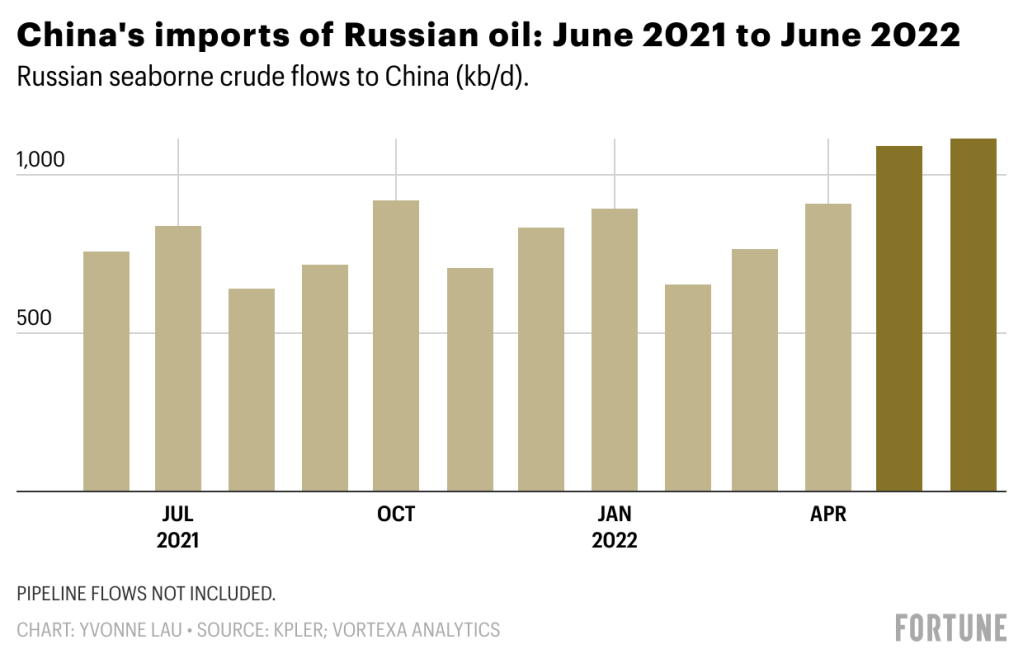
In fact, “trade between Russia and the BRICS countries increased by 38% and reached $45 billion in the first three months of the year” this year, the report says. Meanwhile, Russian crude sales to China have hit record numbers during Spring of this year, edging out Saudi Arabia as China’s primary oil supplier.
"Together with BRICS partners, we are developing reliable alternative mechanisms for international settlements," Putin said.
Putin continued, stating last month: "Contacts between Russian business circles and the business community of the BRICS countries have intensified. For example, negotiations are underway to open Indian chain stores in Russia [and to] increase the share of Chinese cars, equipment and hardware on our market."
In June, Putin also accused the West of ignoring "the basic principles of [the] market economy" such as free trade. "It undermines business interests on a global scale, negatively affecting the wellbeing of people, in effect, of all countries," he said.
President Xi echoed Putin’s sentiments, according to a June writeup by Bloomberg:
“Politicizing, instrumentalizing and weaponizing the world economy using a dominant position in the global financial system to wantonly impose sanctions would only hurt others as well as hurting oneself, leaving people around the world suffering. Those who obsess with a position of strength, expand their military alliance, and seek their own security at the expense of others will only fall into a security conundrum.”
Today’s article is not behind a paywall, because I believe its content to be too important - but if you have the means and wish to support my work, I’d love to have you as a subscriber: Subscribe now
The developments obviously further my long held belief that a gold backed global reserve currency is on its way - something I have been writing about for months.
I’m also stunned that nobody seems to care that arguably the largest shift on the global macroeconomic playing field over the last half century may be taking place.
Sure, under the context of the conflict in Ukraine, the news may seem “par for the course” of sorts, which may result in the media and the financial world downplaying it. But put this piece of information out there on its own, without context - that there is a coordinated global challenge taking place to the U.S. dollar - and it would be the biggest news story in decades. Imagine if China and Russia just dropped this out of nowhere? Now, remember that both countries have been working on, and preparing for, this situation for years.
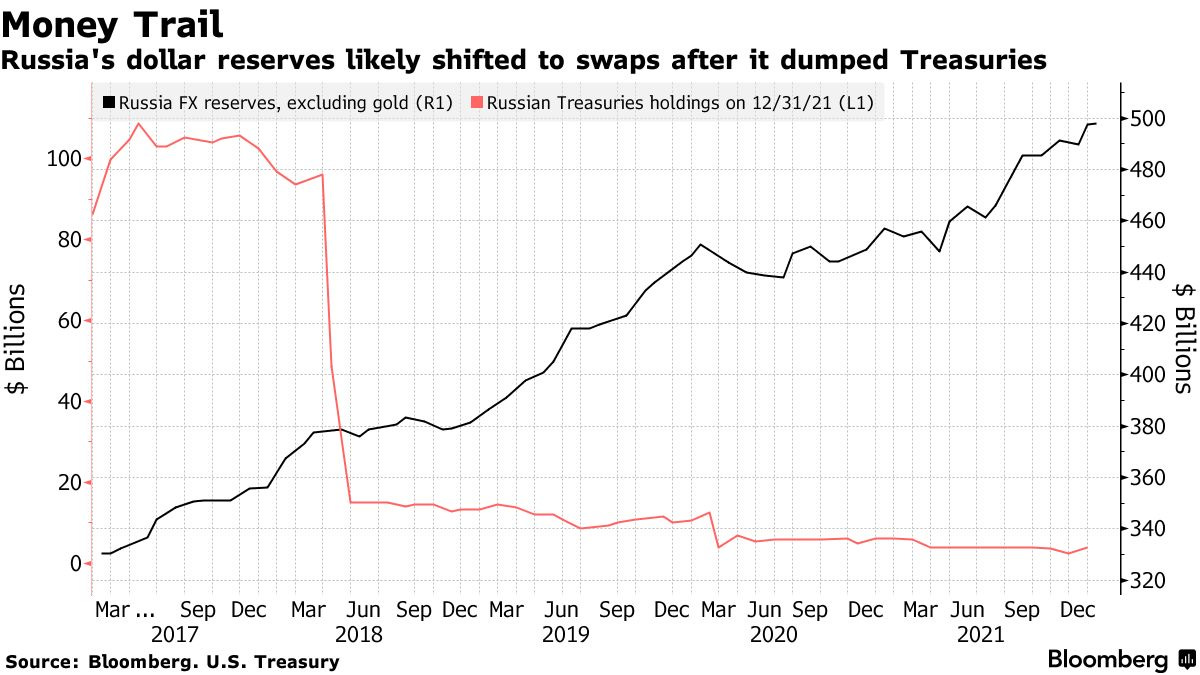
I mean, holy hell, look at Russia’s Treasury holdings as far back as 2018:
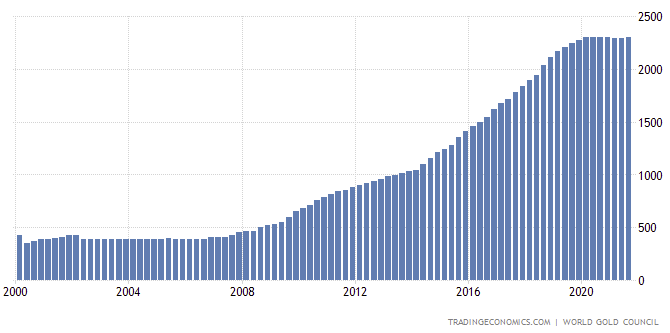
As I’ve noted before, Russia was also increasing its holdings of gold over the same period:
And this headline came out in 2020, just months before Russia’s invasion of Ukraine
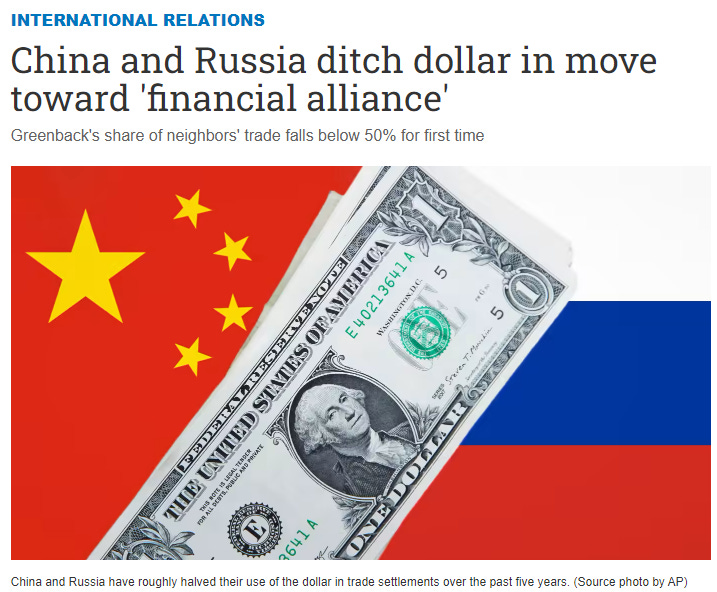
Does anyone think it’s a coincidence?
Nikkei wrote at the time:
Dedollarization has been a priority for Russia and China since 2014, when they began expanding economic cooperation following Moscow's estrangement from the West over its annexation of Crimea. Replacing the dollar in trade settlements became a necessity to sidestep U.S. sanctions against Russia.
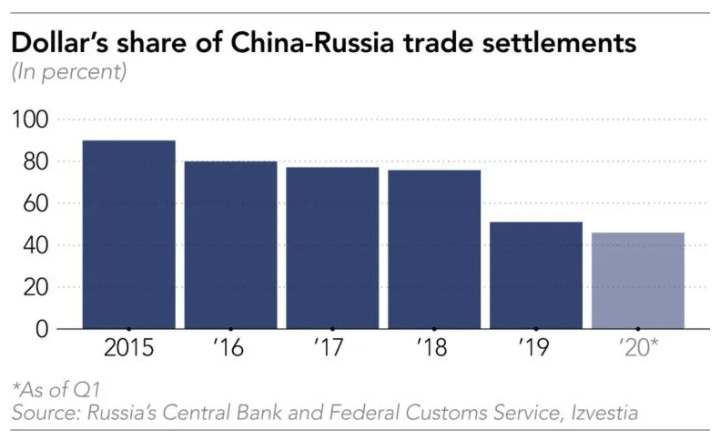
Ergo, it seems to me that the BRIC nations understand exactly how precarious of a financial situation the U.S. - and our dollar - is in. Despite the dollar’s recent strengthening, these nations have been in the midst of a multi-decade-long plan to de-dollarize. Even before the Ukraine conflict started, both China and Russia were stockpiling gold and working on denominating transactions outside of the U.S. dollar. It was another “secret” that was out there in the open.
Remember how “insane” this headline was just 6 months ago when I predicted it for the first time?
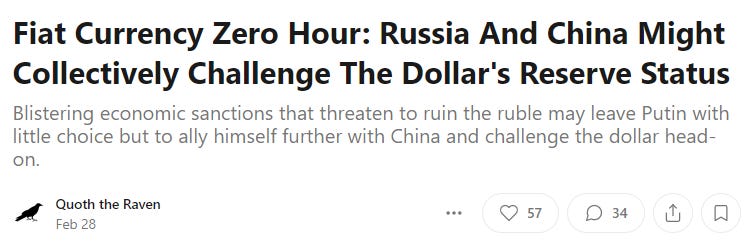
Everybody told me that it was a stretch. Today, it isn’t so much anymore.
Meanwhile, since the BRIC conference, ties between Russia and China continue to tighten, with Japan even warning this week about the pair’s “strengthening of military ties” - at the same time China has closely scrutinized a planned trip by House Speaker Nancy Pelosi to Taiwan.
Japan said this past week:
“As a result of the current aggression, it is possible that Russia’s national power in the medium- to longterm may decline, and the military balance within the region and military cooperation with China may change.In the vicinity of Japan, Russia has made moves to strengthen cooperation with China, such as through joint bomber flights and joint warship sails involving the Russian and Chinese militaries, as well as moves to portray such military cooperation as strategic coordination.”
Japan said this alignment between the two countries “must continue to be closely watched in the future.”
While the economic gears turn behind the scenes, China is also becoming incresingly cagey about Taiwan. The country “has sent warplanes into Taiwan's self-declared air defense zone identification zone many times in recent months,” according to CNN, and recently alluded to the idea of a no-fly zone over Taiwan ahead of a planned visit by Nancy Pelosi.
President Biden commented on Pelosi’s travel plans this week, stating: “The military thinks it’s not a good idea right now. But I don’t know what the status of it is.”
We’re sure Pelosi will wind up going anyway. Remember, this is the same woman who danced her way through Chinatown while Covid was spreading to the U.S., from China, to prove she wasn’t racist.
I can hear her en route to Taiwan now:
“I negotiate million dollar stock trades for breakfast, I’m sure I can handle this Euro trash.”
Centrica comes out fighting from energy market shake-up
British Gas owner under pressure to reinstate dividend and set out plan for growth
Eighteen miles off the Yorkshire coast, a large sandstone reservoir offers one clue to a riddle Centrica investors are hoping the company will soon help them solve.
This week the energy company that owns British Gas was awarded a licence to reopen the “Rough” reservoir as a gas storage facility to help with supplies this winter, as fears spread of a shortage across Europe if Russia cuts off exports.
UK ministers still need to sign off on financing but Centrica investors have taken the development as a hint that gas storage could become a more integral part of the company’s longer-term growth strategy.
Shareholders are increasingly impatient to discover more about how Chris O’Shea, Centrica’s chief executive since 2020, intends to take advantage of the rapidly changing energy market.
“We would like to see a clearer long-term strategy as to how to return to [sustainable] earnings growth,” one institutional investor told the Financial Times.
So far Centrica has weathered the energy crisis.
Investec analyst Martin Young is forecasting adjusted operating profit of about £1.3bn when the company publishes first-half results next week, as it has benefited from high gas and power prices.
The improved performance — and the accumulation of a big cash pile — has led some top shareholders to increase pressure on Centrica to reinstate the dividend, which was pulled in 2020. One top 10 shareholder told the Financial Times that resuming the payout when the group reports its first-half results next week was “an absolute must”, even though British households are facing steep increases to their energy bills.
Centrica’s previous chief executive, Iain Conn, slimmed down its oil and gas operations and sold off assets such as large gas-fired power plants, but the company still produces gas from beneath UK waters and owns a 20 per cent stake in Britain’s nuclear power plants.
Its first-half results will also benefit from a final contribution from its oil and gas production assets in Norway, which were sold in May. An agreement struck in 2013 to buy liquefied natural gas from US group Cheniere Energy should become profitable in the future, having previously been lossmaking.
Even Centrica’s core energy supply business, British Gas, is strengthening after years of decline as domestic customers defected to rivals offering cut-price deals.
Centrica has rescued around 750,000 customers in the past 18 months from collapsed suppliers as soaring gas and power prices proved the company’s longstanding theory that many of its competitors’ business models were unsustainable.
Its share of the British domestic supply market had recovered by the end of 2021 to nearly 20 per cent for electricity and 28 per cent for gas, according to the latest available data from the regulator Ofgem. It had fallen as low as 18 per cent for electricity and 26 per cent in gas before the crisis in the retail market took hold last year.
Part of Centrica’s revival has been down to luck.
It had tried to sell the entirety of its oil and gas portfolio, including in the UK, as it sought to focus on energy supply but it failed to find a suitable buyer. It also similarly scrapped the disposal of its 20 per cent British nuclear stake after the sales process stalled.
But O’Shea has been stripping out layers of unnecessary management from the company and has further reduced costs.
Analysts estimate that Centrica has around £750mn of net cash, putting it in a position to reinstate its dividend next week.
Investors also want to know how O’Shea will use future cash flows as it is poised to benefit from continued high commodity prices.
JPMorgan Cazenove estimates Centrica will generate £3.5bn in free cash flow over the next three years, before pension contributions. That would be equivalent to around 70 per cent of its current £5bn market capitalisation.
“[Centrica] will need to do something about the cash flows that are coming, particularly if gas prices stay high for a longer term,” agreed Deepa Venkateswaran, analyst at Bernstein. However, O’Shea hasn’t so far “been very clear about what the opportunities for investment could be”, she added.
Centrica had planned to hold a capital markets day last year to give more clarity on how it would participate in the UK’s bid to reduce greenhouse gas emissions to net zero by 2050 but it was cancelled as Britain’s energy retail market was in the throes of a crisis.
O’Shea has talked to analysts about other possible investments, such as batteries, electric vehicle charging and local energy generation assets but will soon need to be more explicit, said Young of Investec.
“What they haven’t really done to a great extent . . . is say: ‘Right this is the bit of the net zero pathway we are going to focus on and these are the type of things that we are going to do.’”
Spelling out its plans to help the UK through strategically important investments such as reopening Rough could help dispel any political and consumer backlash if the dividend is restored next week, as expected. The dividend resumption would come as British households are grappling with a severe cost of living crisis, fuelled by soaring energy bills.
One top 10 investor also urged O’Shea to make clear the company’s role in rescuing stranded household customers.
“It’s really important the public understand that Centrica and the British Gas brand name have protected a large chunk of the retail market,” the investor said. “It is not necessary at this stage for Centrica to be too shy about what it has done.”