- Holmen (HL9C TH) +1.1%
- Shares fell 5.8% on Friday
- Norsk Hydro (NOH1 TH) +1%
- Orange (FTE TH) +0.7%
- Orange, MasMovil to Merge Spanish Operations in $19 Billion Deal
- TUI (TUI1 TH) +0.5%
- Ryanair a Beat, Pricing Outlook Promising, Analysts Say (1)
- Ryanair Reports $174 Million Profit as Europe Heads to Beach (1)
- Siemens Healthineers (SHL TH) -1.3%
- Kone (KC4 TH) -1.3%
- Wacker Chemie (WCH TH) -1.4%
- UCB (UNC TH) -1.4%
- Jefferies Shifts Biotech Ratings; Merck KGaA Buy, Galapagos Cut
- Delivery Hero (DHER TH) -1.5%
- HelloFresh (HFG TH) -1.5%
- Haleon (H6D0 TH) -1.6%
- Ferrari (2FE TH) -1.7%
- Philips (PHI1 TH) -6.7%
- Philips Earnings Miss on Inflation, China’s Covid Lockdowns (1)
- Uniper (UN01 TH) -7.5%
- Uniper Germany Has Halted Withdrawals From Storage: Regulator
Stocks and US equity futures slipped Monday, sapped by a dimming economic outlook that’s also cooling expectations for peak interest rates and bolstering sovereign bonds. Asian equities fell amid declines in Japan as well as in Chinese technology shares. S&P 500, Nasdaq 100 and European contracts were in the red. China’s property shares bucked the prevailing trend, pushing higher amid a report that officials plan a fund to support struggling developers. The nation’s real-estate crisis is among the major fault-lines for the world economy. Australian debt jumped in the slipstream of a Treasuries rally Friday. The US 10-year yield was at about 2.77%, paring a sliver of last week’s drop. Investors have shifted to betting that ebbing economic expansion, and possibly even a recession, will moderate high inflation and soften the current cycle of monetary tightening that’s roiled global markets in 2022. A dollar gauge fluctuated, oil slid to around $94 a barrel and Bitcoinweakened below $22,000, reflecting the cautious mood across assets. The Federal Reserve policy decision this week, along with earnings from the likes of Google’s Alphabet Inc. and technology titan Apple Inc., will help to clarify the outlook for a one-month-old rebound in stocks from 2022’s selloff. Retreating business activity and mixed earnings performance from major firms left US shares in the red on Friday. Treasury Secretary Janet Yellen said she doesn’t see any sign that the US is in a broad recession. Former Treasury Secretary Lawrence Summers said a soft landing is highly unlikely. wheat climbed as commodity markets digested a Russian missile strike on Odesa’s sea port that threatened to test a fledgling agreement to unblock Ukrainian grain exports from the Black Sea.
Nikkei -0.75% Hang Seng -0.75% CSI -0.82% Shanghai -0.71% Shenzen -0.97%
Eur$ 1.0205 CNH 6.7590 CNY 6.7557 JPY 136.20 GBP 1.1983 CHF 0.9631 RUB 58.1790 TRY 17.7747 WTI$ 94.03 -0.71% Gold 1,726.60 -0.06% BTC 21,800 -4% ETH 1,512.17 -6%
S&P -0.10% Nasdaq -0.09% EuroStoxx -0.64% FTSE -0.50%
Macro :
- Pre-Fed Jitters Send Bitcoin Back Into Sub-$22,000 Trading Range
- Goldman Strategists Say European Earnings Are Below Expectations
- Biggest Oil Stock ETF Sees Short Sellers Unwind Bets After Rout
- French Lawmakers Reject Windfall Tax Profit in Close Vote
- WHO Chief Overrules Panel to Call Monkeypox Global Emergency
- China May Use Tiered-Data Strategy to Prevent US Delistings: FT
Keep an eye on :
- AIR FP : Boeing Defense Workers Reject Contract, Plan to Strike Aug. 1
- AOF GY : Atoss Software Maintains FY Sales Forecast, Meets Estimates
- BAS GY : Austria to Tap Gas Storage Tank Key to German Supply, SZ Says
- BAVA DC : Bavarian’s Vaccine Gets Monkeypox Label Approved in Europe
- BELLE SS : Vinted Offers to Buy Rebelle for SEK14.10 in Cash Per Share
- BOBNN SW : Bobst Group Public Tender Offer by Largest Holder JBF Finance
- DE US : Gates Transfers 3.02m Deere Shares to Foundation From Cascade
- DTE GY : T-Mobile US in $500m Pact to Settle Suit Over Cyberattack
- ENX FP : Euronext Says Saturn Will Be Unavailable for Remainder of Day
- EOA FP : Forvia Confirms FY Guidance, Says Hella Integration on Track
- FILA IM : Fila Says Group’s Debt Is in Renegotiation Process
- GALP PL : Galp, TAP Set Up Partnership for Sustainable Aviation Fuel
- GALP PL : Galp 2Q Adjusted Net Beats Estimates
- GET FP : France Blocks Efforts to Increase Eurostar Services: Telegraph
- ICAD FP : ICADE 1H Group Net Current Cash Flow per Share Beats Estimates
- BAER SW : Julius Baer 1H Operating Income Misses Estimates
- ORA FP : Orange, Masmovil Sign Binding Deal to Combine Spain Operations
- ETL FP : UK Satellite Operator OneWeb Said to Near Merger With Eutelsat
- KNIN SW : Kuehne + Nagel 1H Ebit CHF2.20B
- MC FP : Luxury Goods Balance-Sheet Strength Offers Spending-Spree Scope
- PHIA NA : Philips Cuts FY Comparable Sales Forecast
- POM FP : Plastic Omnium 1H Ebitda EU414M Vs. EU461M Y/y
- RYA ID : Ryanair 1Q Profit After Tax Beats Estimates
- SHA GY : Schaeffler to Buy Ewellix for About EU582m
- SHEL LN : Shell Is Said to Seek Sale of Controversial UK Oil Field Cambo
- TFI FP : TF1 Acquires Rights to French Team Football Matches Through 2028
- TFI FP : BinDawood Unit to Acquire Majority Stake in TF1 Unit Ykone
- UBI FP : Ubisoft Pushes Back Next Assassin’s Creed Title in Another Delay
- UCG IM : Banco BPM to UniCredit's 2Q Pits Sovereign Risks vs. NII Upside
- VOW GY : VW’s Diess to Leave in Sudden Exit; Porsche’s Blume Steps In
- VOW GY : VW’s Billionaire Clan Plotted CEO Ouster While He Was on US Trip
- VOW GY : VW Taps Porsche’s Team-Playing Modernizer to Amp Up Tesla Chase
>>> Up
>>> Down
* ADP Cut to Underperform at RBC; PT 115 euros
* Biogaia Cut to Hold at Handelsbanken
* DWS Cut to Hold at Jefferies; PT 25 euros
* Electrolux Professional Cut to Hold at SEB Equities
* *GALAPAGOS DOWNGRADED TO UNDERPERFORM AT JEFFERIES, PT EU48
* Nordic Nanovector Cut to Sell at ABG; PT 1.50 kroner
* Philips Cut to Hold at SocGen; PT 23.80 euros
* Snap Cut to Peerperform at Wolfe
* Telenet Cut to Hold at Jefferies; PT 15 euros
* TietoEVRY Cut to Hold at Nordea
* *UCB CUT TO HOLD VS BUY AT JEFFERIES, PT EU85
>>> Initiation
* GB Group Rated New Buy at Citi; PT 607 pence
* Grifols Rated New Hold at Jefferies; PT 17.60 euros
* Haleon Rated New Hold at Jefferies; PT 330 pence
* Intl Petroleum Rated New Sector Outperform at Peters & Co
* Merck KGaA Reinstated Buy at Jefferies; PT 205 euros
>>> Call
* GB Group New Buy at Citi, Offers Value Following De-Rating
* European Asset Manager PTs Cut at Jefferies, DWS Down to Hold
Race Towards Net Zero Will Break Energy Market, Drive Up Energy Price: Analyst
An analyst has warned that the push for net zero with existing renewables technologies by 2050 will break the energy market and lead to a stark increase in Australia’s energy price within a decade.
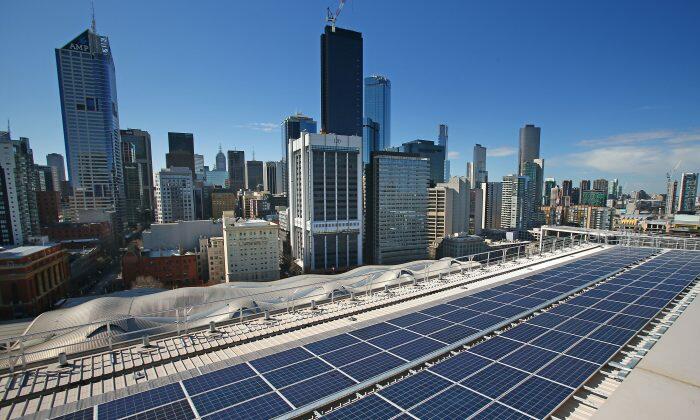
It comes as Australia, and the world, continues to struggle with an energy crisis amid supply issues plaguing much of the country’s east coast in June, causing the national operator to suspend the electricity market for more than a week.
Institute of Public Affairs research fellow Kevin You on July 17 said the recent incidents of market failures “are not accidents” but are “all designed features of net zero by 2050,” which he said is “casting a dark cloud” over the fossil fuel industry.
He noted that investors are “intimidated” by “the iron fist of the government,” which is likely to place regulatory burdens on coal fired power generators, gas, and oil projects, and on downstream electricity businesses that deal with traditional energy generators.
“You know what happens when the government sticks its nose where it doesn’t belong—whether it be in the transport industry, the aviation industry, in energy generation, in energy distribution—it breaks the market,” he told the audience at Australia’s largest annual liberty conference, the Friedman conference.“Investors have been scared witless by the spectre of net zero hanging over the energy market, the same way the spectre of communism hung over Europe in 1848.”
You described the net zero target as an attempt by “big government, controlled by an elite circle of faceless men, the renewables lobby, and rent seekers” to “take over and take down the energy market.”
Billions in Subsidies
In the pursuit of net zero, the government is directing investment into so-called renewables, offering the sector annual subsidies of up to $8 billion (US$5.5 billion) a year until 2030.
Meanwhile, the Labor government, elected in May, has committed to cutting greenhouse gas emissions by 43 percent by 2030, and investing in renewables while promising “cheaper electricity prices for homes and businesses.”
“There is a race for renewable energy jobs and investment around the world, and Australia should be leading that race,” Energy Minister Chris Bowen said.
However, a similar pledge was made in the 2007 election, when the then-Rudd government promised that renewables would generate at least 20 percent of Australia’s electricity supply by 2020.
The promise remained unfulfilled, with renewables making up 7 percent of Australian energy consumption in 2019-20, according to the Department of Climate Change, Energy, the Environment and Water.
Cost of ‘Unreliable’ Renewables
But despite its popular appeal, renewable energy is “unreliable,” You said, arguing that “if it can sustain itself in the free market, then it wouldn’t need taxpayer money to line up the pockets of big renewable industries.”
“If renewables can compete in the energy market, then let them compete in a free and fair market against called against gas against nuclear power.”
The analyst, whose research focuses on the political economy and industrial relations, predicted that for every gigawatt removed from the grid, wholesale energy prices will jump by $22 (US$15.25) per megawatt hour. This means that the average quarterly market price per megawatt hour will jump from A$89 to A$111.
You also estimated that in the next eight years, 11 gigawatts of capacity offered by coal fired power generators will be taken offline. This, he said, will translate to a quadrupling in wholesale electricity prices, with the flow on effect being a doubling in retail electricity prices.
“So far, the literal doubling of electricity prices is only felt by several thousand households who are customers of small electricity retailers.“But it will only get worse from here,” You warned.
Frank Calabria, managing director of Origin Energy, which operates Australia’s largest coal-fired power station, estimated that reaching net zero by 2050 would require $120 trillion (US$86.25 trillion) to be invested in the energy sector between now and 2050.
If this cost is split among the population of the developed world (1.3 billion people), the cost would be equivalent to A$369,000 for a household of four—that’s an annual cost of $13,200 per household for the next 28 years.
“Balancing tighter supply and demand in the market is an increasingly complex challenge, with the back-up, or firming, of variable renewable supply met by a combination of technology,” he told the Australian Energy conference on June 7.
IPA research fellow You also noted that Australia’s emissions are nowhere near that of China.
“Australia emits just over 1 percent of the world’s greenhouse gases,” he said.
“China emits more carbon in 16 days than Australia does in a year. That’s two weeks of emissions from China amounts to as much as a year’s worth of emissions from Australia. Right now, China’s got 57 coal fired power stations for every single one in Australia.”
Most Chinese Property Junk Bonds Are Trading Below 35 Cents
By Ye Xie, Bloomberg Markets Live commentator and reporter
1. China’s mortgage-boycott problem is still growing. More homebuyers halted payments on unfinished apartments, affecting at least 319 projects, up from 235 a week ago, according to Capital Economics. By all accounts, the situation is still manageable. Most economists estimate that the affected loans make up about 1%-2% of China’s $5.8 trillion in mortgages.
But the problem is that Beijing has yet to break the vicious circle in the housing market. The boycotts undermine confidence of new homebuyers, which reduces the cash flow of troubled developers and causes more of the type of construction delays that motivated the boycotts in the first place.
Already, the top 100 private developers, which account for more than a third of the projects under construction, are experiencing liquidity risks, according to Goldman Sachs. Reflecting this risk, about 73% of China’s high-yield property bonds are trading below 35 cents on the dollar, a level deemed as distressed by Goldman’s analysts. Left unsolved, it could quickly create problems in the banking system.
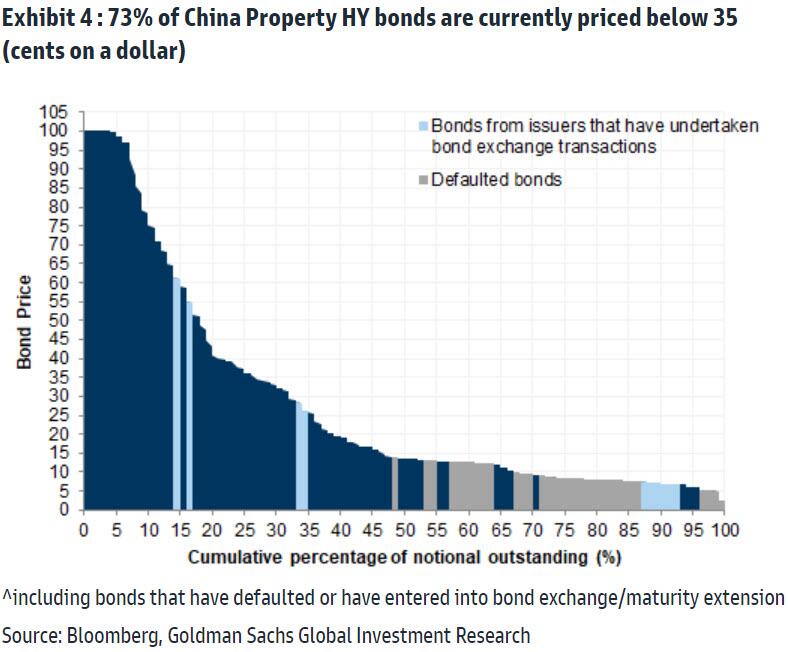
Source: Goldman Sachs
What’s the solution? Policy makers are considering remedies, including allowing a grace period for mortgage payments of affected homeowners. Bank of America’s economists led by Helen Qiao expect local governments and state-owned enterprises to step in to complete the unfinished projects. But they also warn that it may take time to resolve the issue, and governments of lower-tier cities may not have sufficient funds to come to the rescue.
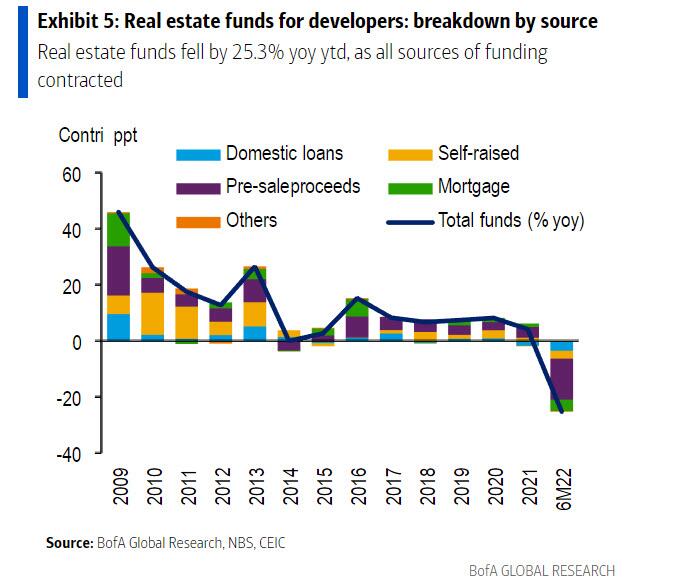
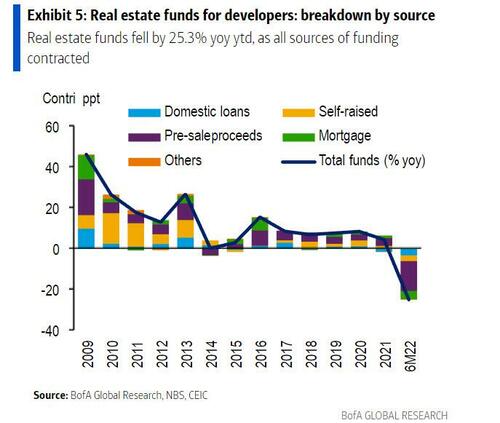
Source: Bank of America
2. The housing troubles and sporadic Covid outbreaks took momentum out of the economic rebound. The consensus 2022 GDP forecast in a Bloomberg survey has declined to 4%, and a number of economists, including at Bloomberg Economics, only see a growth rate of 3%. The outperformance of Chinese stocks since last month also has faded.
In response to the latest housing drama, the PBOC kept liquidity abundant, with interbank borrowing costs dropping below 1.5% for the first time since December 2020. Meanwhile, traders took advantage of the cheap funding to build leverage in the bond market, sending the overnight repo trading volume to records almost on a daily basis.
3. Recession risks keep rising as central banks tighten monetary policy. A survey of purchasing managers by S&P Global on Friday showed activities in both the euro zone and US contracted. The ECB ended eight years of negative interest rates with a 50bp hike last week. The Fed is expected to raise rates by 75 bps this week for a second consecutive meeting. But traders are betting that the Fed will slow down the rate increases afterward and wrap the tightening campaign by December.
Elon Musk’s Friendship With Sergey Brin Ruptured by Alleged Affair
Tesla chief’s liaison with Google co-founder’s wife led to couple’s divorce filing
Elon Musk engaged in a brief affair last fall with the wife of Sergey Brin, prompting the Google co-founder to file for divorce earlier this year and ending the tech billionaires’ long friendship, according to people familiar with the matter.
Their falling out is one of a string of personal issues Mr. Musk has faced even as he juggles business challenges, including manufacturing disruptions at Tesla Inc. TSLA 0.20% and a court fight over his desire to withdraw his $44 billion bid for Twitter Inc.
Mr. Musk is the richest person in the world, with an estimated fortune of $240 billion, and Mr. Brin ranks eighth world-wide, with $95 billion, according to the Bloomberg Billionaires Index.
Messrs. Brin and Musk, among the nation’s most famous entrepreneurs, were longtime friends. Mr. Musk has said that for years he regularly crashed at Mr. Brin’s house in Silicon Valley.
Mr. Brin provided Mr. Musk with about $500,000 for Tesla during the 2008 financial crisis, when the company was struggling to increase production. In 2015, Mr. Musk gave Mr. Brin one of Tesla’s first all-electric sport-utility vehicles.
In recent months, there has been growing tension between the two men and their teams, according to the people familiar with the matter. Mr. Brin has ordered his financial advisers to sell his personal investments in Mr. Musk’s companies, some of those people said. It couldn’t be learned how large those investments are, or whether there have been any sales.
Mr. Brin filed for divorce from Nicole Shanahan in January of this year, citing “irreconcilable differences,” according to records filed in Santa Clara County Superior Court. The divorce filing was made several weeks after Mr. Brin learned of the brief affair, those people said.
At the time of the alleged liaison in early December, Mr. Brin and his wife were separated but still living together, according to a person close to Ms. Shanahan. In the divorce filing, Mr. Brin cited Dec. 15, 2021, as the date of the couple’s separation.
A lawyer for Mr. Brin declined to comment. Mr. Musk didn’t respond to a request for comment. A spokeswoman for Ms. Shanahan, who runs a foundation focused on reproductive justice, also didn’t respond to requests for comment.
About 11 hours after this article published online, Mr. Musk tweeted: “This is total bs. Sergey and I are friends and were at a party together last night!” He added that he’d only seen Ms. Shanahan twice in three years with other people around and that it wasn’t romantic.
In an interview early this month with the news website Puck, Ms. Shanahan said of the divorce filing: “I hope for Sergey and I to move forward with dignity, honesty and harmony for the sake of our child. And we are both working towards that.”
Over the past two months, Mr. Musk’s personal life has drawn considerable attention. He has been accused of exposing himself to a flight attendant at his aerospace company, SpaceX, which he has denied; the publication Business Insider reported he had two children late last year with a female executive at another company he co-founded, Neuralink; and one of his 10 children has publicly disavowed him.
Mr. Brin and Ms. Shanahan are now involved in divorce mediation, with Ms. Shanahan seeking more than $1 billion, according to people familiar with the negotiations.
The two sides have yet to come to an agreement, with Mr. Brin’s side claiming that Ms. Shanahan is asking for much more than her prenuptial agreement entitles her to, the people said. Ms. Shanahan’s side is arguing that her request is only a fraction of Mr. Brin’s $95 billion fortune, and that she signed the prenuptial agreement under duress, while pregnant, the people said.
Mr. Brin co-founded Google, now a unit of Alphabet Inc., GOOG -5.81% along with Larry Page in 1998, and helped build it into one of the world’s most valuable companies. He and Mr. Page stepped down from management of Alphabet in 2019, but both remain on the board.
Since then, he has been heavily involved in fitness pursuits, at one point trying to learn many different Olympic sports, according to people who know him. He runs a $4.4 billion family foundation that has supported such causes as education and Parkinson’s research, and he is affiliated with an airship startup called LTA Research and Exploration. He is currently writing a physics textbook.
Global shortage of fibre optic cable threatens digital growth
Rising prices of critical components casts shadow over 5G rollout and development of data centres
A worldwide shortage of fibre optic cable has driven up prices and lengthened lead times, endangering companies’ ambitious plans to roll out state of the art telecommunications infrastructure.
Europe, India and China are among the regions most affected by the crunch, with prices for fibre rising by up to 70 per cent from record lows in March 2021, from $3.70 to $6.30 per fibre km, according to Cru Group, a market intelligence firm.
Although the pandemic prompted some of the biggest tech and telecoms groups to slash their capex, there has been a surge in demand for internet and data services, leading to a shortfall in availability of the crucial but often overlooked material.
Companies like Amazon, Google, Microsoft and Facebook owner Meta are expanding their data centre empires to meet soaring demand, including laying vast international fibre networks under the ocean. Meanwhile, governments have set ambitious targets for the rollout of superfast broadband and 5G, both of which require vast quantities of fibre optic cable to be laid under the ground.
“Given that the cost of deployment has suddenly doubled, there are now questions around whether countries are going to be able to meet targets set for infrastructure build, and whether this could have an impact on global connectivity,” said Michael Finch, an analyst at Cru.
Total cable consumption increased by 8.1 per cent in the first half of the year compared to the same time last year, according to Cru estimates. China accounted for 46 per cent of the total, with North America representing the fastest growing region, at 15 per cent year on year.
Underpinning the shortage are rising prices of some of the critical components that go into fibre optic technology, in which light is carried along flexible fibres with a glass core.
There has been a shortage of helium, a crucial component in the manufacture of fibre optic glass, in part caused by plant outages in Russia and the US, which has caused prices of the element to increase by 135 per cent over the past two years. Meanwhile, prices of silicon tetrachloride, another key component in fibre production, have increased by up to 50 per cent according to Cru.
“In my professional career I’ve never seen anything like this inflationary crunch,” said Wendell Weeks, chief executive of Corning, the biggest producer of fibre optic cable in the world, which played a significant role in inventing the technology in 1970.
Weeks added that the company is ramping up production to meet soaring demand from governments, telecoms companies and big tech groups, including building new facilities in the US and Europe.
Prices of fibre have now reached their highest level since July 2019, according to Cru, although North America has been less severely hit than Europe, China and India.
Weeks said that in the US prices had increased by only 2 per cent in 2022, and had otherwise fallen every year since 2012. “It’s going to continue to be tight for a while but we’ll get through this hyper-crunch,” he added.
Martijn Blanken, chief executive of Exa Infrastructure, an international digital infrastructure company, said fibre prices had increased by at least 20 per cent over the past six months and that “in some cases it’s so erratic you need to check it by the day”. “We add clauses with our clients so that we’re not liable for these price hikes,” he added.
This has led to significant increases in lead times for some fibre products, stretching out from 20 weeks to almost a year for many smaller customers.
“All of us are prioritising giving fastest delivery to our biggest customers,” said Ankit Agarwal, managing director of STL, one of the largest fibre suppliers in Britain.
‘I’m so bearish that I’m bullish?’
Investors cut equity allocations to lowest level since Lehman collapse
There is certainly no shortage of reasons for investors to feel gloomy at the moment: no end in sight to the war in Ukraine, high energy prices, soaring inflation, rising interest rates, lingering Covid . . .
The growing risk that all of this will drag leading economies into recession has spoked large institutional investors, writes Chris Flood in London. As a group, they have chopped their allocations to equities to the lowest level since the collapse of Lehman Brothers in September 2008, according to Bank of America’s widely followed monthly fund manager survey.
Pessimism has reached a “dire level,” says Michael Hartnett, BofA’s chief investment strategist. One indication of this: the survey, of 259 investment managers with combined assets of $722bn, found cash holdings last month had reached a 21-year high. And almost four in five of those polled expected corporate profits to deteriorate than at any point during the coronavirus pandemic or when Lehman collapsed.
Contrarians may see all the gloom and pessimism as a “buy” signal. But the “I’m so bearish that I’m bullish” argument doesn’t wash with Hartnett. He cautions that any bounce for stocks or bonds is unlikely to turn into a sustained rally until it is clear that the Federal Reserve has decided that it has tightened monetary policy sufficiently to control inflation.
Meanwhile Albert Edwards, global strategist at Société Générale, is true to his customarily bearish stance. He thinks that central banks’ role in fuelling rising prices and their misjudgement about the severity of the current increase in inflationary pressures could prevent them from stepping in again to provide support if financial markets continue to weaken. He asks:
“Has the arrogance and hubris of western central bankers now been curtailed? And if so, what will that mean for the future?”
It’s a big question and one that will haunt investors following a prolonged period of central bank largesse. This is unlikely to be repeated while inflation remains a problem in the eyes of policymakers.
Do you think it’s time to buy equities? Email me: harriet.agnew@ft.com
Why young investors aren’t ready to give up on risk
With $1,000 in savings and two US government stimulus checks, Chris Zettler began investing in 2020. First he bought companies he knew, he says, “but then I got bored with it”. He moved on to call options in companies with volatile share prices, riding the price swings, writes Madison Derbyshire in New York. He used a win to buy 100 shares in the meme stock AMC at $30 in May and sold at about $65 in June.
The 35-year-old finance major at the University of Alabama, Birmingham, had a TD Ameritrade account that allowed him to trade on margin and place nearly $8,000 in bets with his original $4,000 of capital. He turned that into $18,000.
Zettler saw his account balance rise to $50,000 before falling to $35,000 when a bet went sideways. He sold $20,000 of shares and paid his college tuition fees: “I got lucky as heck,” Zettler says.
Yet the risk was worth it, he adds. The possibility of making outsized returns outweighed the risk of loss: “If I did it again, would I have done it the responsible way and just sat on that $4,000? Shoot, no . . . You don’t have anything to lose so you might as well shoot your shot.”
Zettler is part of a generation of investors who came of age around the 2008 financial crisis and in its aftermath. Having struggled to accumulate wealth through traditional means over the past decade, many have turned to speculating in the riskier corners of financial markets.
Experts say the growing appetite for speculative assets such as cryptocurrencies, NFTs and “meme stocks” (whose value skyrocketed in early 2021, driven by retail traders and social media hype) is about more than just getting rich quick.
Stagnant wages, rock bottom interest rates, soaring house prices — and now, corrosive inflation — have cut away at the idea that the under-40s can follow the well-trodden path to financial security that their parents took. Younger investors report feeling like the game is rigged and that playing by the old rules is a losing strategy.
Read the full story here on how even amid a meltdown in crypto markets, there are few signs that “generation moonshot” is planning to retreat from the game.
Navigating Retail’s New Era of Risk
In the post-Covid era, retailers who rethink their supply chains will lower their exposure to risk and unlock profound competitive advantage, argues Doug Stephens.
KEY INSIGHTS
- Globalised supply chains optimised for low cost come with profound risks to capital, brand reputation, society and the planet.
- As the world becomes more interconnected and turbulent, these risks are growing.
- Rebuilding supply chains for shared risk, transparency and intelligence is the answer.
If a single image has come to define the failure of global supply chains amid the Covid-19 crisis it’s that of the Ever Given — one of the world’s largest container ships — stuck in a diagonal death grip inside the Suez Canal, heavy with more than twenty thousand units of cargo destined for Western retailers. For almost a week, the ship jammed up worldwide shipping, halting nearly $10 billion in trade a day, before eventually being freed.
But the plight of the Ever Given was just the tip of the proverbial iceberg. Indeed, the entire global shipping industry had seemingly run aground – if only metaphorically – as dock workers at many of the world’s largest ports suffered from the effects of the virus. Soon, merchants everywhere began to see panic buying, empty shelves and bottomless backlogs to fill them: a shock to the system of western merchants and consumers who had largely operated with an assumption of unconstrained access to whatever they’ve wanted, whenever they’ve wanted it.
How could our supposedly modern supply chains be so fragile?
On closer inspection it’s clear that today’s global supply chains are the product of centuries of growth but little meaningful evolution when it comes to risk management. Indeed, Covid-19 was not the first major derailment of the global supply chain. Less than 200 years earlier, a similar breakdown brought an entire global industry to its knees.
When America Ran on Cotton
At the turn of the 19th century, the economy of the freshly constituted United States of America ran principally on cotton, which, by 1825, had found significant demand in England and Europe. While cotton could be sourced elsewhere, the US had several advantages. Boundless, fertile land, an objectively superior strain of cotton, and most significantly, slave labourers.If anything, it was the use of slave labour that made it simply impossible to compete with the United States with on the global cotton market.
By the mid-1800′s two thirds of all cotton imported by Great Britain and Europe was being sourced from America. India, Brazil and Egypt struggled to make up the remaining third. According to some historical reports, close to 80 percent of England’s cotton imports came from America. Fully half of the factories in Britain at the time were for cotton production. Goods made from cotton comprised nearly 40 percent of all British exports. And about 1 in 5 British workers relied on the cotton trade to put food on the table.
Then on April 12, 1861, something happened that would throw America and global cotton supply into a state of chaos. Confederate troops fired on South Carolina’s Fort Sumter, plunging America into civil war. By July of that same year, a mere three months after the start of the conflict, supply of American cotton to England was reduced to nearly nothing, where it would stay for the better part of three years. The effects on England’s economy were devastating, with factory closures and rampant unemployment, coupled with meteoric inflation in the price of cotton and cotton goods.
By the time the American Civil War ended and US cotton exports resumed, England and other countries had learned their lesson, spreading their cotton imports across alternate sources of supply. Thus preventing the US from ever again recapturing such an outsized share of the global cotton market.
At this point you might reasonably imagine that having experienced what many saw as the first true global raw materials shortage, the retail industry would have completely rethought the premise of supply chains and the inherent risk of putting all one’s eggs in a single, distant basket for the sake of low price. You’d surely assume that governments would never again allow their economies and labour forces to become so inextricably dependent on a single industry, commodity or source of supply.
But you’d be wrong.
Flash forward 76 years to America’s Port Newark. It was here in 1937 that trucking entrepreneur Malcom McClean had an idea. As he sat for hours while his cargo of cotton (yes, cotton) was unloaded and reloaded onto a waiting ship, McClean imagined how much more efficient it would be if only his entire truck could be lifted onto the ship. A huge saving of time and labour, he thought.
In 1956, after almost two decades of planning, McClean’s musings became reality when he loaded 58 metal containers in Port Newark onto the S.S. Ideal X, a recommissioned tanker ship that McClean had specially outfitted to carry uniform cargo containers on a maiden voyage to Houston, Texas. It was a short journey with long lasting consequences.
McClean had managed to reduce the cost of loading and unloading cargo from $5.83 per ton to just 16 cents. And with that, intermodal transportation was born,an innovation that would usher in a new era of supply chains.
Modern cargo ships like the Ever Ace, a leviathan of a vessel with a capacity of almost 24,000 containers, have made it possible to venture farther and with more payload than America’s cotton barons ever could have dreamed.
This single innovation,the container ship, swung open the doors of the global economy to countries like China. Like the US of 200 years earlier, China was a nation rich with land, resources and a low cost labour market plagued with widely reported instances of modern slavery. The combination of ultra-cheap transport coupled with the fractional labour costs drove a wave of hyper-globalised supply chains that delivered plentiful goods to western consumers but in the process also created risks that would make the cotton collapse of 1861 look like a picnic.
Today, the vast majority of what is consumed in the world is made in the East. Roughly eighty percent of Walmart’s non-food inventory is made in China. Seventy-five to eighty percent of Amazon’s new marketplace sellers, in its top four markets, are also based in China. Just as England found itself dangerously addicted to American cotton, western economies have become alarmingly addicted to Asian manufacturing. If the US of the 1800′s became the world’s cotton factory to disastrous ends, Asia in the 1990s and 2000s became its everything factory, creating risks we are only now beginning to understand.
The High Risk of Low Cost
Although separated by almost 200 years of history, the cotton famine of the 1860′s and the supply chain crises of today share the same root cause: a myopic and often perilous focus on lowest landed unit cost. Procuring vast quantities of cheap goods has driven and continues to drive most of today’s top brands because most see price as the cornerstone of competitiveness. However, as supply chain expert John Thorbeck often says, we operate in an era where business leaders must once and for all appreciate that the singular pursuit of low cost comes with an extraordinary number of risks that make businesses far less competitive, the first being the risk to financial capital.
Most companies today, according to Thorbeck, are accounting only for the front-end advantage that low cost might afford them. What they’re failing to properly consider are the deleterious back-end costs that accompany it. For example, the massive orders and long lead times implicit in most globalised supply chains make responding to fluctuations in demand nearly impossible. In a world where consumer preference can shift on a viral TikTok video, fashion-based products may be out of fashion even before they reach the rack. The result is slow turns, deep markdowns, write-offs, and heaps of dead stock in warehouses, much of which eventually becomes landfill. Increasingly unpredictable weather events may disrupt seasonal weather changes, once again throwing demand into chaos. And given record levels of consolidation in manufacturing across many categories of goods, a hiccup at a single factory on the other side of the planet can spur weeks of supply shortages.
It is also logical to assume that risks to global supply chains will become more frequent and profound as we become increasingly interconnected as a global community. Whether driven by economic turmoil, civil unrest, climatic events, or yes, the next pandemic, disruption today moves at light speed compared to only a few decades ago, so frequent and fast-moving, that we must completely rethink and rebuild our supply chains. But how?
Rebuild for Shared Risk
Most supply chains are merely a loosely connected set of individual companies, each with its own goals, data and resources, as well as an accepted share of the financial risk inherent in any supply chain. Often, within such groups, one party or parties will try to gain some material advantage over the others, perhaps by seeking lower prices, more favourable terms, or any number of other concessions. To some this might seem simply like shrewd business. But when this happens, it’s essentially one party attempting to shift its risk to another party or parties. If, for example, a retailer can secure a 10 percent lower price, it clearly lowers its risk to capital. The problem in doing so, however, is that it sets off a daisy-chain of risk shifting. Because, in theory at least, parties forced to take on more risk will likewise similarly seek to off-load that risk to others in the chain. Soon, trust suffers, performance wanes, corners are cut and links in the chain grow weaker, subjecting everyone to greater risk, which often only becomes fully clear when a crisis hits
So, instead of simply shifting risk, brands should aggressively work to transform their supply chains into digital ecosystems where members share risk and work collectively to reduce it for all. An ecosystem, operated on a shared platform of data analytics and operational resources, along with a jointly used set of tools for managing demand planning, business continuity, key raw material or product stockpiles, transportation contingencies and even inter-industry materials demands to avoid shortages due to spikes in demand across categories. The goals of the group may also include plans to regionalise a percentage of supply to provide a fallback position should a crisis arise.
The point is that each member of the ecosystem protects not only their own interests but those of the group and in so doing, reduces risk and improves business outcomes for all, making every link in the supply chain, from upstream design and production through to retail, stronger.
Rebuild for Transparency
Most retail buyers today know their primary suppliers. They know who they are, where they are located, and may even have some understanding of their practices and reputation. However, when it comes to knowing secondary suppliers (their suppliers’s suppliers), things get murky fast with most companies reporting little to no visibility into this layer of their supply chains. This is the very definition of risk. And too frequently today it’s one that is showing up to undermine the reputations of retailers and brands.
In 2020, for example, the Australian Strategic Policy Institute, “identified 27 factories in nine Chinese provinces that are using Uyghur labour transferred from Xinjiang since 2017.” In all, 87 well known international brands were identified in the report as (wittingly or unwittingly) using these factories for production. Indeed, numerous studies have shown that beyond tier one vendors, most supply chains are essentially black boxes offering very little visibility, traceability or transparency.
Whether or not they have been sideswiped by allegations of environmental crimes or human rights abuses, brands are quickly realising that a new and radical level of supply chain transparency is essential — not only to avoid reputational damage to their brands but also to attract consumers, 75 percent of whom in a recent University of Pennsylvania study indicated that a brand’s sustainability credentials are an “important factor” when choosing products. It follows then that those brands that can supply consumers with verifiable data to back up their social and environmental claims will outperform. Technologies like RFID tagging and blockchain are already helping proactive brands begin better trace their products through the supply chain from point of origin to point of sale.
Consumer sentiment on corporate social and environmental accountability is converting directly into investor demands. According to a Reuters report, “investors managing over $130 trillion in assets have written to more than 10,000 companies calling on them to supply environmental data to non-profit disclosure platform CDP.” The CDP (Carbon Disclosure Project) manages an open scorecard, listing participating companies, countries and regions and their disclosures on performance across issues like climate change, water security and deforestation. With increased pressure by the investment community for such disclosures, it’s only a matter of time before outlying companies become conspicuous by their failure to report and are cut off from global capital markets.
In turn, such investor demands are forcing governments to accept the writing on the wall. If they hope to attract investment in their national economies, they and their corporate citizens will have to achieve above average performance on environmental, social and governance issues. It’s reasonable therefore to assume an increasingly aggressive stance by government regulators, because failing to do so will send capital, growth and prosperity elsewhere.
Rebuild for Intelligence
For most companies today, supply chain planning remains largely a finger-to-the-wind exercise. Most use some combination of volume, velocity and visibility to project supply and demand. Many still rely on fairly rudimentary data sets – stock on-hand, sales velocity, order lead-time, and in-transit order quantity. Sprinkle in some accounting for seasonality and you’ve got inventory management 101 - a system that was feasible when the planet was less interconnected and change was slower.
But in an increasingly fast-paced, globalised landscape, these considerations only scratch the surface of what brands need to factor into their planning. Weather patterns, industry sales projections, consumer trends and macro-economic indicators are now also vital. Stepping out even further, what about geopolitical issues, transportation costs and environmental performance optimization? All these new and dynamic data points are increasingly vital. The problem is no human being can possibly consider all these things at once.
Therefore, the incorporation of artificial intelligence and machine learning into an organisation’s planning systems is becoming a critical investment that is helping pioneering companies outperform competitors in both revenue growth and margin expansion. While most brands today are still playing checkers, forward-thinking brands are already beginning to play 3-D chess, modelling supply and demand data across dozens of new real-time data inputs.
Rebuild for Good
And finally, beyond all the business cases supporting a rethink of supply chain goals and behaviours, there’s the human case. As primatologist Jane Goodall once said, “The most intellectual creature to ever walk Earth is destroying its only home” a jarring truth in which retail has a conspicuous hand.
A recent report from the environmental advocacy group Ship It Zero indicates that “Container imports from America’s 15 largest retail giants in 2019 caused the same climate pollution as three coal-fired power plants or the energy needed to power 1.5 million American homes. These retail giants have produced 7.3 times more carcinogenic sulphur oxide emissions than all road vehicles in the United States combined, or 2 billion trucks and cars.” And that’s just the 15 largest U.S. retailers. The apparel industry is responsible for 10 percent of global emissions. And the next time you’re admiring the beauty of an ocean, know that beneath its surface lies 16 million tons of plastic. In fact, 90 percent of the plastic that has ever been created — whether from packaging, parts or products themselves — still exists, in some form today.
Our obsession with low price also exacts a human cost. Whether it’s the garment workers in Pakistan who are paid $112 per month, the forced labour camps of China or the victims of factory fires and collapses in places like Bangladesh, our fellow human beings are paying an inhuman toll for our low-cost consumer products. But such abuses are hardly limited to foreign workers. As our lust for cheap products becomes increasingly insatiable, we in the west have become willfully blind to abuses closer to home. Whether it’s working conditions in the Amazon warehouses of America or documented instances of forced labour in England’s garment factories, we have become increasingly consumerist at the expense of human suffering, even when that suffering takes place close to home.
Regrettably, too many companies today take all this to mean that their goal should be to do less harm. This, says Cradle to Cradle author William McDonough, is the wrong way to think about it. Consider, he once said to me, your reaction if your local water treatment facility announced an effort to gradually, over time, reduce deadly levels of lead in your drinking water. You’d be outraged and demand that all lead be removed immediately.
Becoming a Force for Good
The goal of brands should not be to simply lessen the damage caused by their supply chains. Rather the aim ought to be to do zero harm and indeed even transform their business activity into a force for good. For many companies this might sound like a pipedream, yet inspiration for such transformation can be found around us today.
For example, denim production tends to be a messy business, and one that uses conspicuous amounts of energy and water, resulting in an effluent sludge containing dyes and a range of other toxins, much of which escapes through the process into local sources of drinking water. It’s been an inconvenient truth in the denim industry for decades and one that Sanjeev Bahl was determined to tackle head on.
Bahl is the founder of Saitex, a unique denim manufacturing company in Vietnam. He and his team devised an entirely new system of manufacturing; one that recycles 98 percent of all water used in the process (2 percent evaporates). Where heat and steam are recycled. Where 100 percent of the jeans are air-dried and biomass is used to generate heat. A facility where solar energy is used to generate electricity. Where ozone technology and lasers are used to replace old harmful methods for distressing fabrics. And to top it all off, Saitex reclaims the waste sludge from the process, turning it into bricks, which are then used to build affordable housing for Saitex workers, all of whom, as it turns out, receive wages well above industry and regional standards.
This is what being a force for good looks like. But beyond the obvious societal and environmental payoffs, Bahl has done something else. He’s all but completely de-risked Saitex as a supply chain partner, thereby harnessing a remarkable competitive advantage over his competitors, while also becoming a force for good.
It’s time to fix a system that has, for at least 200 years, run amok. Time to not only repair but also reverse the damage done by a global retail industry addicted to low cost. That also means redefining our concept of “cost” for the tumultuous age in which we find ourselves, where the true cost of every product now includes an array of risks: to capital, to brand reputation, to the planet and to humanity at large. If reducing unit cost was the competitive advantage of the past, eliminating risk is the competitive advantage of the future.