WSJ : The SEC’s Cryptocurrency Confusion

The SEC’s Cryptocurrency Confusion
Is bitcoin a security or a form of money? A little bit of both, and other things as well.

After years of threatening to sue Coinbase for listing unregistered securities, the Securities and Exchange Commission is now rumored to have launched an investigation into the company and other exchanges. If it proceeds, the SEC may be on track to make a serious mistake.

Skeptics wonder why Coinbase doesn’t simply register the tokens it sells with the SEC. It’s not that simple. Since its inception, cryptocurrency has confounded regulators because it is unlike any traditional financial instrument. Like regular money, crypto can be used to pay for ordinary goods. Bitcoin is one example, which has a growing base of thousands of merchants who accept payments directly over the currency’s Lightning Network.

Some leading cryptocurrencies can be sent to an app and then used to generate a QR code, which is accepted in 20 national chains like Petco, Chipotle, Office Depot and Regal Cinemas. Last week I used crypto tokens that the SEC has previously alleged were unregistered securities to buy an ice-cream cone and a burrito.

But here’s where things get confusing. Some crytpo tokens appear to function as a type of equity, from which you expect profit. Governance tokens in crypto exchanges, which allow users to vote on changes to how the protocol operates, will share their profit with you. But in a way, profit-sharing tokens aren’t like equity securities at all. The traditional corporate structures—boards of directors, executives, even companies—aren’t present on the other end of the transaction. There’s no one who could file or sign the financial statements for such projects.

NEWSLETTER SIGN-UP
Opinion
Morning Editorial Report
All the day's Opinion headlines.

PREVIEW
SUBSCRIBE
There’s even more diversity among tokens. Some are like those you might get from a Chuck E. Cheese to play videogames. These often take the form of tokens used to store data. Imagine if every time you saved a document to the cloud, you needed a token to do so. Payment for data storage is one of the more popular uses of crypto tokens.

Cryptocurrency is so difficult to categorize because many of its variants blur the lines between traditional categories of money, stock and commodities. Most are a bit of each. Some tokens can be used to store data and serve as a form of payment or an investment—all at the same time. The purpose depends on the user’s preference.

Even if cryptocurrency developers wanted to register their projects with the SEC, as traditional public companies are required to, they couldn’t. They don’t have a board, CEO or CFO to file the requisite paperwork with the commission. Nor do they have proxy voting of shares by mail, which the commission still requires companies provide to shareholders.

Consider another facet of crypto that would shock the drafters of the 1933 Securities Act. Imagine if a bank or stock exchange were run by an autonomous, open-source computer code that took deposits and processed loans. Occasionally the code is modified by a few hundred anonymous coders around the world, who collaborate over the internet to keep it running smoothly.

This isn’t some science-fiction movie. Billions of dollars are deposited and loaned out in this way each day. The combined market capitalization of these “decentralized finance” developers would be enough to make them the 18th-largest bank in the U.S.

Tokens that represent an interest in these autonomous computer banks and exchanges are some of the targets of the SEC’s investigations and regulatory inquiries. They are also the same tokens I used to buy my ice cream and burrito last week.

The SEC’s position—that most tokens are securities and must register or face enforcement—is obtuse. It’s also an approach that works to the benefit of the scammers and hucksters who have abused the crypto space.

If the SEC were instead to build a regulatory regime tailored to the needs of crypto investors, as SEC Commissioner Hester Peirce has requested, we would be better able to separate the legitimate crypto projects from the scams. Defendants in SEC actions can now use the nebulous character of crypto tokens to their advantage. When cases are brought against legitimate enterprises, such as Coinbase, that’s a good thing; when brought against fake projects that steal crypto, it isn’t. The morphable character of crypto tokens will confound cookie-cutter application of the regulated security definition.

Innovations require a rethinking of federal securities law. The SEC was 10 years late to the game on delivering financial statements electronically. It was similarly behind the curve in allowing CEOs to share company information over social media. It shouldn’t make the same mistake with crypto.

Mr. Verret is an associate professor of law at Antonin Scalia Law School and a former member of the SEC’s Investor Advisory Committee.

WSJ : Chinese Investors Still Leery of U.S. Acquisitions After Oversight Changes

Chinese Investors Still Leery of U.S. Acquisitions After Oversight Changes
The number of Chinese companies filing for national security clearance remains depressed following a 2018 law

Chinese investors have shied away from buying U.S. companies following changes to U.S. foreign investment law, according to a report from the Committee on Foreign Investment in the U.S.

Requests from China-based acquirers for clearance to buy U.S. companies in 2021 remained down from 2018, when the U.S. passed the Foreign Investment Risk Review Modernization Act, according to Cfius, which released its 2021 annual report on Tuesday.

“We’ve definitely seen a decline in China buying in the U.S.,” said Christine Daya, a Washington, D.C.-based partner at the law firm DLA Piper. “Things are really down…because of Firrma.”

Cfius, an interagency committee run by the U.S. Treasury Department, reviews foreign investments in U.S. companies or real estate for possible national security concerns and can recommend the president block or unwind deals. Firrma gave the committee more resources and a broader purview, a move widely seen as aimed at the risks posed by Chinese investment stateside.

In 2021, 45 Chinese investors made requests with Cfius asking for a green light on corporate transactions, the report said, compared with 55 in 2018.

From 2016-2018, Chinese investors filed an average of 56 notices a year, compared with 32 filings on average in 2019-2021.

The relatively depressed number last year was particularly striking, given that 2021 saw a record level of merger and acquisition activity. The total value of global M&A transactions reached about $5.9 trillion in 2021, up nearly 50% from 2018’s $4.0 trillion figure, according to data provider Refinitiv.

Heightened Cfius filing requirements for investors controlled by foreign governments also could be affecting the level of Chinese investment, Ms. Daya said.

In addition to powers to review a broader set of transactions, the 2018 law also directed more resources to Cfius, helping it to toughen its enforcement.

Though most transactions reviewed come to the committee because the parties filed notices, the committee said it had looked at 135 transactions on its own initiative in 2021, up from 117 in the previous year.

FT : Investors grow frustrated with hedge funds after historic losses


Investors grow frustrated with hedge funds after historic losses
Industry is on track to post one of its worst years on record as long-short players struggle

Hedge funds are heading for one of their worst years of performance on record, leaving investors frustrated with how many managers have failed to offset sharp falls in equity and bond markets.

Funds were down 5.6 per cent on average in the first six months of 2022, according to HFR. While a narrower HFR daily index of performance shows them clawing back around 0.5 per cent last month, the industry is nevertheless on track for its second-worst year of returns since 1990, when the data provider’s records begin — beaten only by steep losses during the 2008 global financial crisis.

Much of the pain has been concentrated in so-called long-short equity funds, which manage around $1.2tn in assets and which bet on rising and falling stock prices. They dropped 12 per cent on average in the first half of the year, according to HFR. The group was expected to have gained only around 1 per cent in July, according to an estimate by JPMorgan head of positioning intelligence John Schlegel, a much shallower rebound than the 7 per cent rally last month for global equities.

“Clearly, in long-short equity it’s been a complete disaster,” said Scott Wilson, chief investment officer of the endowment fund at the Washington University in St Louis, Missouri, adding that some funds had given up years of gains in this year’s sell-off. He said it had been a “rough year” for funds that had bet on the fast-growing companies that were in vogue at the height of the pandemic but have pulled back sharply in 2022.

Among the funds suffering is ‘Tiger cub’ Lee Ainslie’s Maverick Capital, which made double-digit gains in each of the past three years but was down 35 per cent in the first six months of the year. Fellow cub Glen Kacher’s Light Street was down more than 40 per cent.


Daniel Loeb’s Third Point fell around 20 per cent in the first half of the year, having lost money on stocks including software firm SentinelOne and electric-vehicle maker Rivian Automotive, according to investor documents. And Skye Global, set up by former Third Point analyst Jamie Sterne, fell more than 35 per cent in the first half of this year after losing 10.4 per cent in June, according to numbers sent to investors.

In a note to clients, seen by the Financial Times, Sterne said the fund’s strong run of performance over nearly six years “was emphatically broken [in the second quarter of 2022] with extremely poor performance”. The fund, which is still up an annualised 30 per cent since launch, was hit by a large position in Amazon. Amazon had been down 36 per cent in the year to June, but has since cut its losses to about 19 per cent.

Not all funds have suffered. Some managers such as Brevan Howard trading moves in government bonds and currencies, oil traders like Pierre Andurand and quant funds betting on market trends have made big gains this year. That has helped buoy the $4tn industry’s average returns, which are well ahead of equity markets.

Nevertheless, the performance from many other funds marks a disappointment for investors who had harboured high hopes that, after years of lacklustre returns over the past decade, rising interest rates and choppier markets could allow managers to prove their worth. Sparkling performance in 2020 appeared to signal a return to a golden age of trading.

Instead, funds lagged well behind the market last year, and have in the case of many long-short funds looked ill-equipped to deal with Wall Street’s S&P 500 falling 13 per cent, including dividends, in 2022 so far. “Some funds should have dropped the term ‘hedge’ a long time ago,” said Andrew Beer, managing member at US investment firm Dynamic Beta.

Long-short funds are “not what you want to have in this market”, said Patrick Ghali, managing partner at Sussex Partners, which advises clients on hedge funds, adding that he prefers strategies that provide more diversification.

There are already signs that the losses are deterring investors, many of whom were already wary of hedge funds. Having received a net $13.92bn of inflows last year, hedge funds attracted just $440mn in the first quarter of this year, including a large outflow in March, according to data group eVestment.

And data from fund administrator Citco show that funds suffered more than $10.1bn of outflows in June, with redemptions of $7.8bn expected for the third quarter and $6.4bn for the end of the year.

Washington University’s Wilson decided several years ago to cut his fund’s allocation to hedge funds from about 20 per cent of the portfolio, and has now reduced it to around 5 per cent.

He says that there is a “portfolio construction problem” with these funds. First, holding a basket of hedge funds can leave an investor effectively owning a huge number of long and short equity positions that can resemble the market, meaning that they would be better served simply owning cheaper index trackers. Second, if one hedge fund makes money and a second fund loses a similar amount, the investor still ends up paying the first fund manager a performance fee.

Other investors are also taking action. Dutch pension fund ABP has been reducing its exposure to hedge funds and assessing which strategies it can carry out in-house, rather than allocating to an external manager, as a way of reducing costs and improving control.

However, the weak performance does not appear to have dented the industry’s own confidence in its ability to attract investors.

A survey of 100 hedge funds managing $194bn by technology firm SigTech found that 23 per cent expected a dramatic increase in institutional investors’ allocations to hedge funds over the next two years and a further 60 per cent expecting a slight increase. Only 4 per cent expected investor allocations to fall.

FT : Investors grow frustrated with hedge funds after historic losses

Investors grow frustrated with hedge funds after historic losses
Industry is on track to post one of its worst years on record as long-short players struggle

Hedge funds are heading for one of their worst years of performance on record, leaving investors frustrated with how many managers have failed to offset sharp falls in equity and bond markets.

Funds were down 5.6 per cent on average in the first six months of 2022, according to HFR. While a narrower HFR daily index of performance shows them clawing back around 0.5 per cent last month, the industry is nevertheless on track for its second-worst year of returns since 1990, when the data provider’s records begin — beaten only by steep losses during the 2008 global financial crisis.

Much of the pain has been concentrated in so-called long-short equity funds, which manage around $1.2tn in assets and which bet on rising and falling stock prices. They dropped 12 per cent on average in the first half of the year, according to HFR. The group was expected to have gained only around 1 per cent in July, according to an estimate by JPMorgan head of positioning intelligence John Schlegel, a much shallower rebound than the 7 per cent rally last month for global equities.

“Clearly, in long-short equity it’s been a complete disaster,” said Scott Wilson, chief investment officer of the endowment fund at the Washington University in St Louis, Missouri, adding that some funds had given up years of gains in this year’s sell-off. He said it had been a “rough year” for funds that had bet on the fast-growing companies that were in vogue at the height of the pandemic but have pulled back sharply in 2022.

Among the funds suffering is ‘Tiger cub’ Lee Ainslie’s Maverick Capital, which made double-digit gains in each of the past three years but was down 35 per cent in the first six months of the year. Fellow cub Glen Kacher’s Light Street was down more than 40 per cent.


Daniel Loeb’s Third Point fell around 20 per cent in the first half of the year, having lost money on stocks including software firm SentinelOne and electric-vehicle maker Rivian Automotive, according to investor documents. And Skye Global, set up by former Third Point analyst Jamie Sterne, fell more than 35 per cent in the first half of this year after losing 10.4 per cent in June, according to numbers sent to investors.

In a note to clients, seen by the Financial Times, Sterne said the fund’s strong run of performance over nearly six years “was emphatically broken [in the second quarter of 2022] with extremely poor performance”. The fund, which is still up an annualised 30 per cent since launch, was hit by a large position in Amazon. Amazon had been down 36 per cent in the year to June, but has since cut its losses to about 19 per cent.

Not all funds have suffered. Some managers such as Brevan Howard trading moves in government bonds and currencies, oil traders like Pierre Andurand and quant funds betting on market trends have made big gains this year. That has helped buoy the $4tn industry’s average returns, which are well ahead of equity markets.

Nevertheless, the performance from many other funds marks a disappointment for investors who had harboured high hopes that, after years of lacklustre returns over the past decade, rising interest rates and choppier markets could allow managers to prove their worth. Sparkling performance in 2020 appeared to signal a return to a golden age of trading.

Instead, funds lagged well behind the market last year, and have in the case of many long-short funds looked ill-equipped to deal with Wall Street’s S&P 500 falling 13 per cent, including dividends, in 2022 so far. “Some funds should have dropped the term ‘hedge’ a long time ago,” said Andrew Beer, managing member at US investment firm Dynamic Beta.

Long-short funds are “not what you want to have in this market”, said Patrick Ghali, managing partner at Sussex Partners, which advises clients on hedge funds, adding that he prefers strategies that provide more diversification.

There are already signs that the losses are deterring investors, many of whom were already wary of hedge funds. Having received a net $13.92bn of inflows last year, hedge funds attracted just $440mn in the first quarter of this year, including a large outflow in March, according to data group eVestment.

And data from fund administrator Citco show that funds suffered more than $10.1bn of outflows in June, with redemptions of $7.8bn expected for the third quarter and $6.4bn for the end of the year.

Washington University’s Wilson decided several years ago to cut his fund’s allocation to hedge funds from about 20 per cent of the portfolio, and has now reduced it to around 5 per cent.

He says that there is a “portfolio construction problem” with these funds. First, holding a basket of hedge funds can leave an investor effectively owning a huge number of long and short equity positions that can resemble the market, meaning that they would be better served simply owning cheaper index trackers. Second, if one hedge fund makes money and a second fund loses a similar amount, the investor still ends up paying the first fund manager a performance fee.

Other investors are also taking action. Dutch pension fund ABP has been reducing its exposure to hedge funds and assessing which strategies it can carry out in-house, rather than allocating to an external manager, as a way of reducing costs and improving control.

However, the weak performance does not appear to have dented the industry’s own confidence in its ability to attract investors.

A survey of 100 hedge funds managing $194bn by technology firm SigTech found that 23 per cent expected a dramatic increase in institutional investors’ allocations to hedge funds over the next two years and a further 60 per cent expecting a slight increase. Only 4 per cent expected investor allocations to fall.

FT : Funds need clear standardised labels

Funds need clear standardised labels
Regulators must force industry to improve transparency

Natasha Ednan-Laperouse was 15 years old when she boarded a plane from London to Nice. After eating a shop-bought baguette that contained trace amounts of sesame — to which she was severely allergic — she collapsed during the flight and later died.

Following this tragedy, food retailers are now required to display a full list of ingredients and allergens on every item. This is Natasha’s Law.

The purpose of standardised food labelling is to create a simple and intelligible system that protects consumers from harm.

But when it comes to labelling financial products, the systems we have are so simple as to be nonsensical. Does the consumer gain anything from the ubiquitous generic warning that “the value of your investments can go down as well as up, so you could get back less than you invested”? 

Investment funds carry a numerical rating ranging from 1 (low risk) to 7 (high risk) that tells us very little about the nature of risks involved. And while the consequences of mislabelling a fund are far from a matter of life and death, they can nonetheless be devastating.

This year I have spoken to many people who are stunned at the fall in the value of their retirement funds. They, and sometimes their financial advisers, fell into the trap of chasing returns, buying funds with the best recent performance.

Over the past decade, these have been invested in growth stocks, predominantly in the US with its growth-friendly combination of huge technology-focused venture capital funds and near-zero borrowing costs. Let’s call that era Growthtopia. It was impossible to ignore annualised returns of 20 per cent for growth stocks from 2009 to 2021 and many investors were lured into the honey trap.

Since then, growth stocks have fallen sharply. The Russell 1000 Growth exchange-traded fund has fallen by almost 30 per cent and some of the most popular growth stocks, such as Coinbase, are down 80 per cent or more. But we all know, thanks to the Financial Conduct Authority, that the value of our stocks can go down as well as up, so what’s the problem?

The problem for most retail investors is understanding what they are buying. Some bought active funds in the hope that their outperformance was due to expert stockpicking. Instead, many active funds outperformed simply because of their tilt towards growth stocks.

The chart shows a selection of the largest, best-performing funds over the decade from 2011-21 which had a heavy tilt towards growth and which have, in some cases, almost halved in value this year.


So how can retail investors get a better sense of what they are buying in the funds market? I suggest a standardised approach to labelling a fund in three parts: a clear description of its investment style, a sensible benchmark and simple return attribution. Let’s see how that would work in practice, using a popular fund whose name doesn’t give much away: Scottish Mortgage Investment Trust.

Scottish Mortgage’s benchmark is the FTSE All-World Index, ostensibly because it invests in global stocks. However, this is not a good comparison, as it ignores one of the primary sources of Scottish Mortgage’s high returns and its dramatic fall this year — its tilt toward growth stocks.

A more appropriate index would be the ACWI Growth index from index provider MSCI which, like Scottish Mortgage, includes emerging market stocks alongside those from developed markets. This index invariably tracks the performance of the fund more closely.

If Scottish Mortgage is outperforming the global market while growth as a style isn’t, that is a great accomplishment. But outperformance when growth is outperforming isn’t nearly as impressive, as investors could buy the same style through a passive fund more cheaply. Choosing the right benchmark is key to determining this.

Finally, funds usually publish their returns over different periods alongside the performance of their benchmark. But we seldom know the source of return. Is it down to the fact that all equity markets are rallying? Is it driven by the style tilt of the fund? Is it due to currency effects, such as weakening sterling? Or is it due to skilful stock selection?

These are precisely the questions a model for attributing the sources of return seeks to answer by deconstructing a fund’s return into these different sources. A standardised approach to return attribution would shine a light on why a fund has outperformed or underperformed and help investors gauge whether any outperformance will continue.

The key question for most investors is how much of the return is down to the skill of the fund manager. That is, after all, why we pay more for active funds.

Active managers are unlikely to implement a standard labelling system themselves, just as food manufacturers had to be jolted into action with Natasha’s Law. It is down to regulators such as the FCA to ensure that investors have an objective insight into a fund’s ingredients. Only then can they gauge whether a fund is earning its fees.

FT : Italy/bonds: borrowing costs are rising but the ECB is here to help

Italy/bonds: borrowing costs are rising but the ECB is here to help
Markets are right to signal that collapse is far from imminent

Eight years ago, Italy’s state auditor drew widespread derision when it claimed that credit rating agencies should have taken the country’s history and beauty into account before downgrading its debt. With borrowing costs on the rise once again, a better argument is required. Instead of art, Italy should focus on the eurozone.

Rising inflation, an economic slowdown and the first European Central Bank rate rise in over a decade are all problems for a country with Italy’s level of debt. The resignation of prime minister Mario Draghi and with it the possibility of a Eurosceptic government ratchets up the fear in bond markets.

Italy recently paid the highest rate to borrow since the eurozone crisis. The spread between Italian and German 10-year bonds, regarded as the benchmark, reached a two-year high last month.

This spread is a marker of extra perceived risk. Italy’s debt pile is equal to around 150 per cent of its GDP. Remember that the EU’s debt ceiling is supposed to be 60 per cent of GDP. Italy also has the biggest proportion of debt held by residents of any large eurozone country. And although it issued longer-dated debt when rates were low, it failed to take advantage of the situation and lengthen average debt maturities to the same extent as Spain.

Still, Italian bond yields remain far below the heights they reached in the eurozone crisis. Markets are right to signal that collapse is far from imminent while the ECB is promising to intervene. It is not quite “whatever it takes” but the central bank has pledged to buy the debt of countries that come under pressure as bond yields rise — so long as it deems them to be doing what they can to keep public debt down.

Vague as it is, this support should be enough to narrow the spread. Assessing the risk of Italian debt means looking at more than the country’s own balance sheet. While the eurozone remains in place, Italy’s sovereign bond yields should cleave closer to Germany’s. 

FT : Man Group: long story falls short for UK hedge fund with go-go algos

Man Group: long story falls short for UK hedge fund with go-go algos
Record performance fees are clouded by the performance of long-only funds

Investors will not forget the first half of 2022 in a hurry. It was the toughest six-month period for a traditional 60-40 portfolio for 90 years. But volatile markets suit computer-driven hedge funds. On Tuesday, London-listed Man Group, which makes heavy use of trend-detecting algos, reported record performance fees — up 42 per cent compared with the first half of 2021.

A pity, then, that its performance was dragged down by the long-only funds — about a third of assets under management. They declined in value by 12.5 per cent. Overall assets under management fell 4 per cent in the half year, as adverse currency movements compounded the investment losses.

Moreover, there has been a pick-up in redemptions since May. Net client inflows amounted to just $100mn in the quarter to June. The explanation, Man says, was that clients needed to raise cash to meet demands elsewhere in their portfolios. They left the door ajar on their way out: 90 per cent of the redemptions were partial.

Maintaining AUM matters for management fees, which have grown at a steady 8 per cent a year over the past five years. But performance fees are perforce more variable. They have averaged 20 per cent over the past 10 years, but have sometimes dipped as low as 5 per cent, according to Citi.

Man’s policy is to buy back shares with capital generated from performance fees. It has returned almost half of its market capitalisation in the past six years. Volatility of earnings explains why Man’s shares trade on a lowly price/earnings ratio of 9, a third less than long-fund specialist Schroders. That is despite a share price rise of more than a quarter in the past year

Investors are taking a cautious view of hedge funds. Last year’s net inflows have partly reversed in 2022. But the first half of this year demonstrated the value of liquid alternatives. Another bout of market turbulence could again play to Man Group’s strengths.

FT : US imposes sanctions on Vladimir Putin’s reputed girlfriend and other Russi

US imposes sanctions on Vladimir Putin’s reputed girlfriend and other Russian elite
Treasury department also targets multinational company, yacht and sanctions-evasion operation

The US imposed sanctions on Russian president Vladimir Putin’s reputed girlfriend on Tuesday alongside other members of the Moscow elite and businesses that it says are enabling the war in Ukraine.

“The United States is taking additional actions to ensure that the Kremlin and its enablers feel the compounding effects of our response to the Kremlin’s unconscionable war of aggression,” US secretary of state Antony Blinken said in a statement announcing the measures.

Treasury secretary Janet Yellen said her agency would “use every tool at our disposal to make sure that Russian elites and the Kremlin’s enablers are held accountable for their complicity in a war that has cost countless lives”.

The Treasury department said it had imposed sanctions on a number of Kremlin-connected elites, including Alina Kabaeva, a former Olympic rhythmic gymnast and member of parliament who the US described as having a “close relationship to Putin”.

It also listed a big multinational company, a yacht and a sanctions-evasion operation among other entities it had hit with restrictions.

Kabaeva, who is chair of the board of a media company owned by some of Putin’s closest allies, was hit with sanctions by the UK and EU earlier this year.

Putin has said almost nothing about his private life since divorcing his first wife, Lyudmila Ocheretnaya, in 2013. His eldest daughters Maria and Katerina head up state-funded science programmes and occasionally appear in public under pseudonyms.

Russian tabloids, however, have reported that Putin has been in a relationship with Kabaeva since 2008, when a newspaper was shut down after claiming the two were engaged.

The US also imposed sanctions on the father-and-son chemicals tycoons Andrey Guryev, founder of fertiliser producer PhosAgro, and his son, also Andrey, the company’s former chief executive.

The elder Guryev owns Witanhurst, the second-largest home in London after Buckingham Palace, and Alfa Nero, a yacht he bought for $120mn in 2014.

The US described Guryev as a “known close associate” of Putin, whose doctoral thesis supervisor Vladimir Litvinenko owned more than 20 per cent of PhosAgro before transferring most of the stake to his wife in May.

It also said several other oligarchs hit with sanctions were “Putin enablers”, including Alexander Ponomarenko, the co-owner of Moscow’s largest airport, who it said had “close ties to other oligarchs and the construction of Vladimir Putin’s seaside palace”.

PhosAgro, fellow fertiliser producer EuroChem, and the airport were not subject to the sanctions, the Treasury said.

The US and EU issued clarifications exempting Russian agriculture and fertiliser exports from sanctions last month as part of efforts to get Moscow to lift its blockade of Ukraine’s Black Sea ports.

FT : UK risks deepening recession, warns think-tank

UK risks deepening recession, warns think-tank
By 2024, millions will be left with no savings as cover, says National Institute of Economic and Social Research

The UK economy is sliding into recession, with no let-up in sight in a cost of living crisis that will leave more than 5mn households with their savings exhausted by 2024, according to new forecasts by the National Institute of Economic and Social Research.

The think-tank expects GDP to fall “slightly” over the second half of 2022 and the first quarter of 2023 but said on Wednesday that the risks of a deeper recession were growing. It saw an “evens chance” that GDP would be lower at the end of 2022 than a year earlier.

It also said that regional disparities were widening, with London powering ahead of the rest of the country.

Niesr called on the next prime minister to step up direct support for the poorest households, rather than prioritising tax cuts, arguing that even if inflation slowed next year, food and energy prices were set to remain at levels that would cause ongoing hardship for many people into 2024.

“Political uncertainty in Westminster is untimely and will delay fiscal support to millions,” Niesr said. It urged the government to increase its energy grant to low-income households and boost benefits payments for at least six months when regulated gas and electricity prices rise again in October.

The £200bn of savings some households had accumulated during the pandemic could help prop up consumer spending in the second half of the year, Niesr said. But these were distributed “highly unequally”, with demand for foreign holidays “surging as millions are reported to be struggling with shopping for household essentials”.

The think-tank predicts that the number of households with no savings at all to fall back on will double to 5.3mn by 2024, with almost 7mn households living from one pay cheque to the next with savings worth less than two months of disposable income.

More than 1mn households could experience severe destitution, Niesr added, with food and energy bills exceeding their disposable income and forcing them “to choose between eating and heating” or to turn to loan sharks.

“There is no substitute for continued targeted welfare,” Niesr said, noting that the race for the Conservative party leadership had focused on tax cuts rather than the “urgent necessity to continue support for the most vulnerable”.

It also said that the government should use some of its fiscal room to raise public sector pay according to the needs of individual sectors, rather than “with an eye to inflation”, arguing that public services were generally provided without a price, so did not directly feed consumer price inflation.

The think-tank blamed both the Bank of England and the government for allowing high inflation to take hold, arguing that a premature tightening of fiscal policy had left monetary policymakers “reluctant to raise rates with demand still fragile”.

Stephen Millard, Niesr’s deputy director for macroeconomics, said it was now “up to the monetary policy committee to make sure inflation does come down next year and the new chancellor to support those households most affected”.

(ZH) Utilities Fear Lack Of Transformers As Peak Hurricane Season Looms

Utilities Fear Lack Of Transformers As Peak Hurricane Season Looms

The first two months of hurricane season have been quiet, but that could all change as peak hurricane season begins. US utilities warn about the increasing risks of sourcing critical components to repair power grids if storms wreak havoc.
An upswing in tropical storms and hurricane activity usually begins in August and lasts through early October. This is illustrated in the graph below produced by The Weather Channel.
Power-grid operators warned that transformers, distribution lines, and poles are in short supply. This would increase the possibility of prolonged power outages if a tropical storm or hurricane devastated an area.
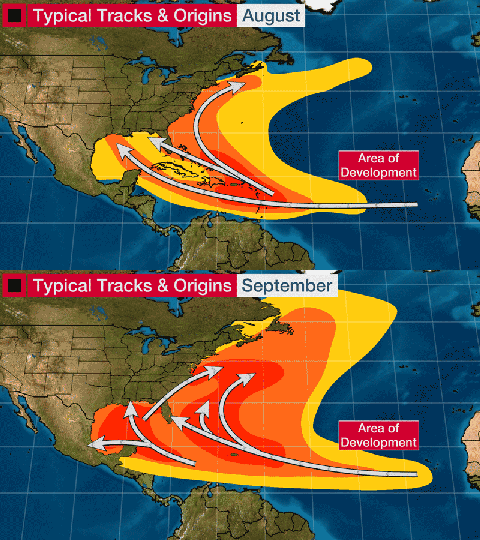
The concern with entering the active period of hurricane season is that a larger area in the Atlantic can fuel tropical development, which means more potential landfall areas. This is shown below:
For people in coastal areas known for frequent tropical activity, perhaps having a generator on standby with Starlink internet might not be a terrible hedge if utility companies struggle to fix grids following storms this season.