Weekend Papers Summary
NEW YORK TIMES
-Pennsylvania has hosted crucial victories and devastating defeats for both Republicans and Democrats, and it is now the ultimate battleground as peak campaign season arrives. Its races could determine the future of abortion rights and fair elections in the state, control of the Senate and whether the Trump era can hold.
-Divergent realities challenge Biden’s defense of democracy. President Biden seeks to confront threats to American institutions, but Americans are deeply divided on who is imperiling them.
-Former Attorney General William Barr dismisses Trump’s request for a special master. Former Attorney General William Barr said the Justice Department was justified in investigating former President Trump’s handling of government materials.
-With midterms looming, McConnell’s woes pile up. Senator Mitch McConnell, the minority leader, has allowed Democrats to claim policy victories as Republicans’ hopes of reclaiming the Senate dim.
-The FBI found 48 empty folders that had contained classified documents at former President Trump’s Florida home.
-The UN will keep two experts at embattled nuclear plant: Russia and Ukraine have blamed each other for shelling at the Zaporizhzhia station, where some inspectors have been assessing damage and risks.
-In a surprise, Russia says the gas pipeline to Germany will remain closed. The pipeline won’t reopen Saturday as expected, heightening fears Russia will step up its use of energy to pressure Europe on its support of Ukraine.
-Investigators, citing looting, have seized 27 antiquities from the Met
The museum said it was cooperating with the Manhattan district attorney’s office, which has executed several search warrants at the institution.
-Eight migrants drown as dozens are swept down Rio Grande. A large group attempting to cross into Texas was overcome by a fast-moving current, the authorities said.
-College football playoff will expand to 12 teams. The change, intended to capitalize on America’s appetite for the sport, could take effect as soon as the 2024 season. It is expected no later than 2026.
-US Job market cooled but was still strong in August. Employers added 315,000 jobs last month, a sign that the labor market remained resilient in the face of higher interest rates and fears of recession.
-Argentina reels from assassination attempt on its powerful Vice President
The man accused of trying to shoot Vice President Cristina Fernández de Kirchner seemed interested in fringe ideologies, according to his social media.
-Pete Buttigieg is trying to fix air travel with a ‘dashboard.’ The Transportation Department says a new tool compels airlines to commit to compensating passengers after cancellations or delays.
THE FINANCIAL TIMES
-State-owned Gazprom, which was meant to restore operations on the Baltic Sea pipeline on Saturday after three days of maintenance, said the suspension was due to a technical fault. The move came hours after the G7 countries said they were pushing ahead with a plan to try to impose a price cap on Russia’s oil exports as part of an attempt to lower revenues flowing to Moscow that can be used to fund its invasion of Ukraine.
-The US Securities and Exchange Commission — in an early flashpoint of an investigation that has spread across Wall Street — found that JPMorgan failed to track more than 21,000 texts and emails, sent and received on personal phones or through unapproved apps, related to the co-working company, according to people familiar with the matter. The investigation, which became public last year, has ensnared a growing number of banks, which are preparing to pay more than $1B in fines to the SEC and Commodity Futures Trading Commission, dwarfing earlier penalties for record-keeping breaches.
-ESG has an existential defect. Fix this and ESG can thrive. The flaw is that ESG has carried two meanings from birth. Regulators have never bothered disentangling them, so the whole industry speaks and behaves at cross purposes.
-FBI agents retrieved just over 100 classified or secret files from Donald Trump’s Florida resort when they raided it last month, as well as 43 empty folders marked “classified”, according to documents released on Friday.
-Hedge funds snapped up Berkshire Hathaway stock in the second quarter, with DE Shaw, Renaissance Technologies and Bridgewater Associates buying millions of shares in Warren Buffett’s conglomerate.
-Cinema operators have spent years pushing back against the streaming revolution, but the US trade group that represents the industry is now looking to Netflix, Apple and Amazon to help revive the struggling business.
John Fithian, head of the National Association of Theatre Owners, told the Financial Times that discussions are under way with Apple, Amazon and Netflix about wider theatrical releases of their films and there is “some optimism” about an agreement.
-President Putin paid his respects on Thursday as Mikhail Gorbachev lay in state at Moscow’s Central Clinical Hospital, but he will not attend the former leader’s funeral on Saturday due to a scheduling conflict, the Kremlin has said. Nor will the funeral be a full state affair, while Russia’s international pariah status due to its war of aggression in Ukraine and the difficulty of travelling to Moscow mean no foreign dignities have pledged to make the trip.
NY POST
-John Harwood, the veteran White House correspondent for CNN, announced he is leaving the embattled cable network on Friday — the latest high-profile departure under new boss Chris Licht. Harwood tweeted “personal news,” announcing “today’s my last day at CNN.” The 65-year-old former editor-at-large for CNBC — whose resume includes stints as a reporter for the New York Times and the Wall Street Journal — tweeted he was “proud of the work” and that he was “lucky to serve the best in American media.”
-Ex-Treasury Secretary Larry Summers dismissed optimism sparked by a solid August jobs report, warning that a stronger labor market could actually make inflation worse. Summers delivered his latest dire outlook for the US economy after federal data showed US employers added a robust 315,000 jobs last month. The report included a higher-than-expected 62.4% labor force participation rate, stoking optimism that tight labor conditions that contributed to inflation are easing.
-New York City is suing Starbucks over the “wrongful termination” of a barista who worked at an Astoria store that had just voted to unionize, the Department of Consumer and Worker Protection said Friday. Austin Locke, who had worked for Starbucks for the past six years, was canned on July 5 — a month after employees at the store voted in favor of a union.
Closing Stock Market SummaryThe stock market had a good run in the morning trade that saw the S&P 500, Dow Jones Industrial Average, and Nasdaq each gain 1.0% at their highs. The market had a quick, and sharp, reversal in the afternoon, however, following a Bloomberg TV report that Gazprom is going to keep the Nord Stream 1 pipeline shutdown due to a "technical issue" that involves an oil leak. Additionally, there was no timetable provided for when the pipeline might reopen.
The morning gains were driven by a belief that less strong August employment data (versus July) could compel the Fed to take a less aggressive rate-hike path. The Gazprom news, which came on the heels of G7 members agreeing to impose a price cap on exports of Russian oil, quickly took over investor mentality.
Shortly after the open, market breadth showed advancers leading decliners by a 7-to-2 margin at the NYSE and a 3-to-2 margin at the Nasdaq. At the close, decliners led advancers by a roughly 3-to-2 margin at both the NYSE and the Nasdaq.
Mega cap stocks were an influential downside driver in the afternoon trade but they had plenty of company as a risk-off mentality took root following the Gazprom news and ahead of the extended holiday weekend.
Every S&P 500 sector reached positive territory this morning before the downside momentum left all the sectors in the red, with the exception of energy (+1.8%).
The energy sector benefited from the rising cost of oil in a notably volatile session for the energy complex futures. WTI crude oil futures settled 0.5% higher at $86.91/bbl. Natural gas futures fell 5.4% to $8.75/mmbtu.
The Treasury market also had a dynamic session with the 2-yr note yield ultimately falling 12 basis points to 3.40% while the 10-yr note yield fell seven basis points to 3.20%.
As a reminder, US equity markets are closed Monday.
Looking ahead to Tuesday, market participants will receive the final August IHS Markit Services PMI reading (prior 44.1) at 9:45 a.m. ET. The August ISM Non-Manufacturing Index (consensus 55.2%; prior 56.7%) will be out at 10:00 a.m. ET.
Reviewing today's economic data:
- August nonfarm payrolls increased by 315,000, average hourly earnings rose a smaller-than-expected 0.3% month-over-month, and the unemployment rate ticked up to 3.7% from 3.5% as the labor force participation rate jumped to 62.4% from 62.1%.
- The key takeaway is that the labor market remains in pretty solid shape. It didn't function with the same zest it showed in July, but, objectively, it is running at a pace that is wholly inconsistent with an economy on the cusp of a recession.
- Factory orders for manufactured goods declined 1.0% m/m in July (consensus +0.2%) following a downwardly revised 1.8% increase (from 2.0%) in June. Shipments of manufactured goods declined 0.9% after increasing 0.8% in June.
- The key takeaway from the report is that this was the first decline in order activity in ten months, meaning it could simply be a natural pullback after an extended period of new order increases as opposed to a meaningful turning point. Alas, future reports are needed to shed better light on the situation.
Dow Jones Industrial Average: -13.8% YTD
S&P 400: -15.8% YTD
S&P 500: -17.7% YTD
Russell 2000: -19.4% YTD
Nasdaq Composite: -25.7% YTD
David Greenberg on Leading L’Oréal USA Forward
For David Greenberg, the recently appointed CEO of L'Oréal USA, the company's new West Coast headquarters symbolizes the next generation of growth for the beauty giant.
“Oh, I wasn’t expecting that one,” said David Greenberg, chief executive officer of L’Oréal USA and president of North America zone, when asked about his leadership style.
On the heels of his 29th anniversary at L’Oréal, working across markets, divisions and brands, how is he approaching his new title?
“What I know is that at the heart of L’Oréal is product innovation, excitement, creating desirable brands,” he went on. “And what I really think my role is, as the CEO of L’Oréal USA, is to nurture that, to help this company in the U.S., which is also the home to many brands in the group.”
About 35 beauty brands total, with L’Oréal USA — L’Oréal Group’s largest subsidiary — generating more than $8 billion in sales annually, according to the company.
Greenberg is a L’Oréal veteran. He succeeded Stéphane Rinderknech, who left the company in February to head up LVMH Moët Hennessy Louis Vuitton’s hotel division. Greenberg, an American, follows a long list of Frenchmen in the role. He was most recently president of L’Oréal Professional Products Division in North America, and has been president of Maybelline New York, Garnier and Essie in L’Oréal’s Consumer Products Division. He also directed marketing for the L’Oréal Paris brand.
“It’s the most dynamic, the most competitive and the most diverse country in the planet,” he said of the U.S. “So, it’s a place also where we can showcase best practices in beauty and help the group in all parts of the world be even more successful. My role is to foster all of that to create the right culture and climate of openness, of transparency, of simplicity, of collaboration and of positive spirit.”
The executive was inside L’Oréal USA’s new West Coast hub — marking the company’s first headquarters outside New York City. Officially opened on Aug. 23 at 888 North Douglas Street in El Segundo, Calif., the space unites NYX Professional Makeup, Urban Decay, Pulp Riot and Youth to the People under one roof. Sitting on a 25-acre campus, it’s more than 100,000 square feet of office and communal spaces. It was developed by Hackman Capital Partners and designed by Blitz.
“We were so fortunate to find this building,” said Carol Hamilton, group president of acquisitions for L’Oréal USA, revealing it was once an aerospace facility.
“Most of the people who worked in this building were women, because the men were fighting the wars,” continued Hamilton, who’s been at L’Oréal for 38 years. “They built the planes for the men to fly. And so, it’s a source of great pride for L’Oréal that this is one of the places where women were emancipated to work. It’s very meaningful to us. And we didn’t know that until after we’d signed the lease. It was a great discovery for us. And we feature it on that poster there.”
She pointed to aircraft imagery, steps away from the main entrance — a bright, open and airy lobby. A L’Oréal ad campaign is prominently displayed near fresh plants and four 25-foot embalmed palm trees; the colors are a warm, golden hue, recalling the California sunset. To the right is a permanent store, offering special discounts to employees. (“Every division, every product and every function is represented here,” said Hamilton. “Isn’t that great?”) And in the background hang the words “Café California,” a barista and natural juice bar.
Keeping the original structure and wood, with a 45-foot-tall ceiling, the design is a “river concept,” Hamilton continued. “You can see all the way to the end of the building. It creates a flow of movement and spaces, where community gathers. We thought that was so important, with people coming back to work. They want to come back to socialize, not to be isolated into separate offices. That was one of the important aspects.”
There’s a main gathering area with seating, which leads to the upstairs — equally open and airy office spaces. NYX Professional Makeup is on one side while Urban Decay is on another. Further back, it’s Pulp Riot and Youth to the People, adjacent to an empty section ready for the next acquisition.
The layout is reminiscent of start-up culture, with clear glass walls as barriers. (It’s also dog friendly, with a gym, solar panels, full of recycling bins and healthy food options on the lunch menu.)
“Being able to see activity going on,” Hamilton said of the importance of transparency. “We’re still learning and balancing people’s desire for privacy and confidentiality with keeping everything open.”
Unsurprisingly, the decision was a topic of conversation.
“We call them neighborhoods without boundaries,” Hamilton added. “But [we] also wanted to still create and maintain brand identity, because each of the brands came from a different office, and they were really afraid of losing their identity. That was a balancing act.”
Malena Higuera, Urban Decay’s general manager, admitted the openness between brands created a bit of consternation in the beginning. “I’ll be open about that. Change always comes with some trepidation.”
“Obviously, there’s an adjustment,” added Yann Joffredo, global president of NYX Professional Makeup. “People are creatures of habits.”
You May Also Like
But employees are finding their rhythm, he added, discovering nooks for privacy when needed, and after working from home all this time amid COVID-19, they’re craving in-person interactions.
Agreeing, Higuera said collaborating across brands will help productivity. “For me, this represents such a new chapter for the brand, for the team. Every intention of this space was built with foresight for the future and work for the future….It leaves me with a lot of real good energy for what I think is going to come out of this, out of these walls…We are a motley crew of brands that are boldly different and stand for something, and yet, by coming together, we stand up taller.”
Greenberg shares similar thoughts.
“When I look around, and I see the collaboration, and I see the conversations going on, I see the sharing,” he said. (There are content studios for each brand.) “And I see people from different brands talking to each other. I see a hairdresser talking to a makeup artist, and they’ve never met before and never would have met before. When I see all of that happening, I can’t help but feel that that’s exactly the spark that creates great ideas. And from there amazing things can happen. So I’m optimistic that this is going to be an engine of growth for us, that it’s going to really help us.”
It’s been a successful first half of the year for L’Oréal, with sales increasing by 20.9 percent, reaching 18.36 billion euros. In North America, sales grew by a reported 23.5 percent.
“Every brand here played an important part, without question,” Greenberg said of West Coast brands, singling out NYX Professional Makeup as a particularly strong performer. “We grew ahead of the market in every category.”
Located in the outskirts of Los Angeles, the new L’Oréal USA hub is well positioned; it’s between Silicon Valley and Silicon Beach, miles from Los Angeles International Airport — in proximity to ports with shipments coming from Asia.
By investing in California, L’Oréal is investing in the future of beauty, Joffredo said. It’s the land of influencers — the new celebrities — home of Hollywood, as well as sustainability and wellness.
“We tend to say the values of California are the values of this next generation,” Joffredo said. “It’s good to be at the center of the culture change. It was New York for a while. I don’t want to be that person, but New York lost it a little bit. I think right now it’s happening in Cali, and this is where we want to be….This is where the party is going.”
Being on the West Coast is “a reflection of a vision of beauty, a voice of beauty that is more optimistic, more colorful, vibrant, more diverse,” he continued. “That shows everywhere here.”
“We have some of the best professional influencers on the West Coast, and most of our artists actually live out here,” said Leslie Marino, president of Professional Products Division. She oversees L’Oréal’s Professional Products Academy — the hairdressing school — which now has its first West Coast location, uniting all nine L’Oréal professional hair care brands.
“I find it to be extremely modern,” she said. “This is the new way of working. This is what it looks like. This is what the new workplace looks like in this new, hybrid world.”
Adapting the 3-2 hybrid work model, employees — about 500 in total (it’s currently at 55 percent occupancy) — are asked to be in-person three days a week.
“I’ve always felt that being part of L’Oréal is really leaving an imprint on the world,” Greenberg said. “Our brands are very cherished, they’re very public. There’s an enormous amount of pride at L’Oréal, in working here and working on our brands….We’ve moved into new areas in recent years. From sustainability and diversity, inclusion to green sciences and beauty tech. We’re a company that is as equally a tech company as a beauty company. We’re experimenting. We’re piloting. We’re investing in venture capital, acquiring brands. So, all these things make for an unbelievable, rich ecosystem full of exciting opportunities. My goal is that all of our employees feel that excitement and feel connected to the mission of the company.”
How will L’Oréal USA continue to incorporate digital into different aspects of the business?
“It’s now fully integrated, it’s fundamental,” he said. “We’ve been on the journey of data, big data, customized data, personalization, now for a number of years. So, we’re really harnessing data for insights. We’re investing in technology for AI, for predictability and projections, for personalization. We’re trying to help consumers find the right products for them through the increased knowledge of their needs, and then helping them through education and through clearer and more personalized communication to make the right choices for them. So, it’s amazing from the professional to the consumer, how well that can work.”
Internally, he revealed they’ve changed their vocabulary. Employees are now referred to as residents — a detail Hamilton shared as well.
“Employees to me is a transaction,” she said. “It’s cold. But residents, there’s a sense of elegance to it and caring about it. We’re really looking to change, take out corporate talk and make it as personal as possible.”
Nearing the end of the tour, she proudly presents the “cabana.”
“[It’s] where we will celebrate successes, announce major events and basically, party,” she said.
The West Coast hub has been a long time coming, said Greenberg, after realizing the company wasn’t “harnessing the true experience of California, that the brands weren’t necessarily fully benefiting from all of the resources of L’Oréal.”
And now that it’s complete, its construction and new company approach will influence other L’Oréal locations, he said: “From this, we’ll be inspired now to look at our New York space differently. We’ll see what that ends up being, but I can assure you, it will change.”
"Good News Is Bad News" Dynamic Won't Last Much Longer
Recent better-than-expected US data has been bad for stocks and bonds as a less accommodative Fed leads to higher yields and lower stock prices. But that dynamic might soon reverse, as leading indicators point to a significant deterioration in growth through the rest of the year.
This week jobless claims, the headline ISM and the Conference Board’s consumer confidence have all exceeded expectations. Today we will also get the latest update for employment, with last month’s data delivering a big upside surprise.
The market is treating good news as bad news, as positive economic data is leading to higher shorter and longer-term yields, and thus causing stocks to drop.
But don’t expect this to persist for much longer. Global financial conditions remain very restrictive. The Global Financial Tightness Indicator is very low, which anticipates the downward trend in the manufacturing ISM -- a proxy for growth overall -- will continue apace.

Truck sales are an excellent leading barometer of economic activity. Almost two-thirds of the dollar value of North American freight is moved by trucks. The fall in truck sales has been leveling off, but is likely to resume given the slump in truck new orders. This presages weaker economic activity ahead in the US.
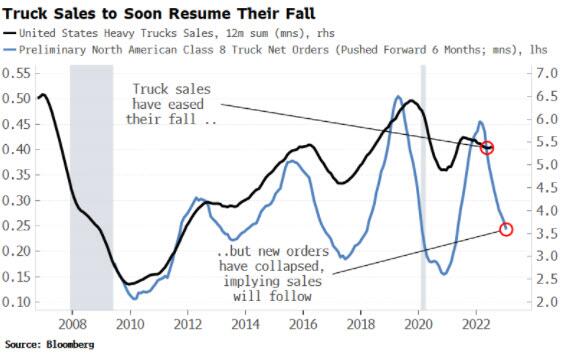
Payrolls is out later today, with last month’s data showing a huge upside surprise. But the same goes here: data should soon resume a downward track. The Conference Board’s Leading Index anticipates the y/y payroll growth will be flat by early next year, from over 4% currently.
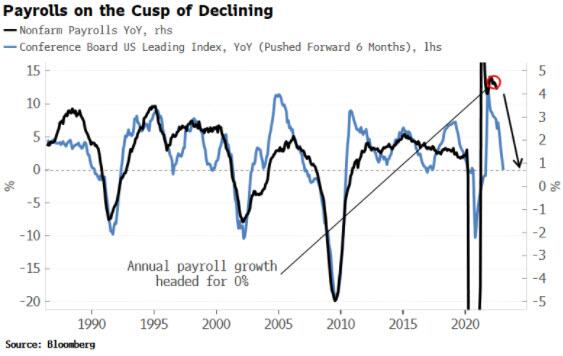
Any recent let-up in economic data should be seen as a pause rather than a reprieve. The interim move lower in yields should soon re-assert itself, taking some pressure off equities.
However, the bigger picture is that bonds face more risk to the downside than the upside as it becomes apparent inflation is entrenched. Further, while liquidity remains poor and global financial conditions tight, stocks remain mired in a bear market, meaning a sustainable rally is off the cards, steep sell-offs are an ongoing risk, and the VIX should stay elevated.
Gapping down
In reaction to earnings/guidance:
- OXM -3.5%, NX -1.8%, SPWH -1.4%
Other news:
- SENS -2.3% (CFO to step down names new CFO)
Analyst comments:
- TLYS -2.7% (downgraded to Neutral from Buy at Seaport Research Partners)
- AZRE -2.2% (downgraded to Sector Perform from Outperform at RBC Capital Mkts)
- LYB -1.4% (downgraded to Neutral from Overweight at JP Morgan)
- DOW -1.3% (downgraded to Neutral from Overweight at JP Morgan)
- NVDA -0.6% (downgraded to Neutral from Outperform at Daiwa Securities)

Gapping up
In reaction to earnings/guidance:
- HCP +16.8%, LULU +9.7%, PD +5%, NCNO +3.8% (also Bank Operating System selected by Rabobank Australia and New Zealand), AVGO +2.1%
Other news:
- OOMA +3.5% (acquires Junction Networks also reports earnings)
- MNTS +3.5% (files for $200 mln mixed securities shelf offering)
- HUMA +2.9% (files for $300 mln mixed securities shelf offering; also stock offering)
- MMS +2.8% (awarded $6.6 bln Medicare contract)
- RKLB +2.8% (successfully test fires reused Rutherford first stage engine for the first time)
- XOM +1.6% (to sell all interests in the Aera oil-production operation to Green Gate)
- CLR +1.5% (files mixed securities shelf offering)
- SHEL +1.3% (to sell its stake in Aera Energy LLC to IKAV for $2 bln)
- GOLD +1.3% (sells Royalty Portfolio to Maverix Metals for total consideration of up to $60 million)
- FREY +1% (files for $500 mln mixed securities shelf offering; also stock offering)
- NOVA +1% (applies to develop a solar and storage focused "micro-utility" in California)
- HSBC +1% (Federal Reserve Board announces termination of enforcement action with HSBC)
Analyst comments:
- CRM +0.4% (upgraded to Neutral from Sell at Guggenheim)