WSJ : Peloton Co-Founder John Foley Faced Repeated Margin Calls From Goldman Sac

Peloton Co-Founder John Foley Faced Repeated Margin Calls From Goldman Sachs as Stock Slumped
Former CEO had pledged Peloton shares once valued at $300 million as collateral for personal loans; ‘This was not a fun personal balance-sheet reset,’ he says

John Foley, the co-founder and former chief executive of Peloton Interactive Inc., PTON -3.41% faced repeated margin calls on money he borrowed against his Peloton holdings before he left the fitness company’s board last month, according to people familiar with the situation.

As Peloton’s shares slumped over the past year, Goldman Sachs Group Inc. GS -2.11% asked Mr. Foley several times to provide fresh funds or additional collateral for personal loans the bank had extended to him, the people said. The company’s share price has fallen nearly 95% from its $160 peak in December 2020.

Resigning from the board gave Mr. Foley flexibility to sell or pledge more Peloton shares, though he said the margin calls weren’t the reason he left the company.

“I didn’t resign from the board because I was underwater,” he said. “To the extent that I took on debt through Goldman, it was because I am bullish on Peloton and still am. It was and is a great company.”

The former chairman and CEO had pledged as collateral about 3.5 million Peloton shares as of the end of September 2021, or about 20% of his stake at the time, securities filings show. The pledged shares were worth more than $300 million a year ago. At current prices, they are worth roughly $30 million.

Mr. Foley was able to secure private financing and avoid stock sales by Goldman, the people said. He declined to say on Monday how much of his current stake had been pledged or how much he had borrowed against his holdings.

His seat on the board limited his ability to raise additional funds because most public companies prohibit directors and executives from selling their shares during certain trading periods. In addition, Peloton’s policy limits pledges for margin loans by directors or executives to 40% of the value of an individual’s shares or vested options.

Mr. Foley’s decision to leave the board on Sept. 12 followed a tumultuous several months at the company he co-founded a decade ago, as well as a sharp decline in his personal wealth as Peloton’s sagging fortunes diminished the value of his holdings. His stake in the company, worth $1.5 billion a year ago, is currently worth less than $100 million.

“Everyone can see I had a rocky year,” Mr. Foley said. “This was not a fun personal balance-sheet reset.”

In February, Mr. Foley stepped down as Peloton’s CEO and was succeeded by Barry McCarthy, a former Netflix Inc. and Spotify Technology SA executive. Mr. Foley kept his position as Peloton’s executive chairman and continued to hold a controlling stake in the company through Class B shares with 20 votes apiece.

A few weeks later, Mr. Foley reported selling $50 million worth of Peloton shares in a private transaction. At the time, Peloton said the sale was part of the executive’s personal financial planning. The sale left him and his wife, Jill Foley, a former Peloton executive, with 6.6 million shares and options on another 8.4 million, according to securities filings, which combined are currently worth less than $100 million. He hasn’t reported any stock or option sales since March. Business Insider reported in March that Mr. Foley was in discussions with Goldman about restructuring his personal loans.

Peloton’s business deteriorated throughout the spring and summer, with the company in August reporting a $1.2 billion loss and the first ever quarter in which its subscriber numbers failed to grow. The company has cut thousands of jobs this year to stem its losses, including a round of layoffs unveiled last week.

Mr. Foley’s 10-year tenure as CEO was marked by rapid growth and sometimes lavish spending. He took heat from Peloton employees last December for hosting a black-tie holiday party that included some of the company’s celebrity instructors weeks after implementing a hiring freeze. Pictures circulated on Instagram of gown-clad instructors dancing at New York’s luxury Plaza Hotel. Mr. Foley acknowledged on social media that the event caused “frustration and angst” among employees.

That same month, Mr. Foley paid $55 million to purchase an oceanfront mansion in East Hampton, N.Y., according to real-estate records and people familiar with the transaction. He and Ms. Foley in September put their Manhattan penthouse up for sale. The property, last priced at $6.5 million, is in contract to be sold, according to listings website StreetEasy.

Margin loans, or borrowing against portfolios of stocks and bonds, come with the risk that a broker can call for additional cash or collateral to meet the minimum equity required if a security’s price drops too low. Sharp drops in stock prices during the 2000 dot-com burst and the 2008 financial crisis generated margin calls for executives at well-known companies.

Peloton requires directors, executives and employees to get approval for pledging their shares as collateral for margin loans. Other Peloton executives also have pledged some of their Class B holdings, and in the annual report Peloton filed last month, the company warned that investors could be harmed if its stock fell and executives were forced to sell shares.

Goldman has worked closely with Peloton, including when Mr. Foley was the CEO. The investment bank was one of the lead underwriters of the company’s initial public offering in 2019. Goldman bankers also co-led a $1 billion stock offering in November 2021.

Investors initially soured on Peloton—its shares fell 11% the day they made their debut at $29. The stock surged in 2020 during the onset of the Covid-19 pandemic, giving the company a peak market value of $50 billion and making Mr. Foley a billionaire on paper. The shares closed down 3.4% Tuesday at $8.78.

(ZH) Funding Panic Imminent? Fed Quietly Sends $3.1 Billion To Switzerland Via S

Funding Panic Imminent? Fed Quietly Sends $3.1 Billion To Switzerland Via Swap Line

BofA Chief Investment Strategist Michael Hartnett has a favorite markets phrase that may be the only one a trader in this day and age needs: "Markets stop panicking when central banks start panicking."
Well, in what may be the best news to shellshocked bulls after the worst September and worst Q3 in generations, in a harrowing year for markets, central banks are starting to panic. First it was the BOJ, then the BOE and now, it's Switzerland's turn.
Two weeks ago after the (first) panicked pivot by the BOE, when global markets were in freefall, we said that markets desperately needed some words of encouragement from the Fed, or failing that - and with the dollar soaring to new all time highs every day - the Fed had to make some pre-emptive announcement on USD Fx swap lines, if only to reassure global markets that amid this historic, US dollar short squeeze, at least someone can and will print as many as are needed to avoid systemic collapse.
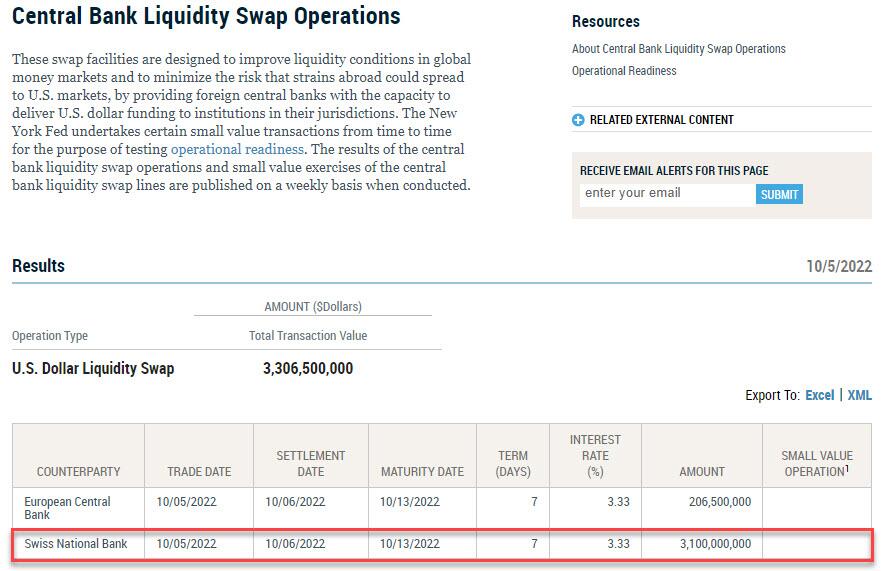
Fast forward two weeks when there still hasn't been any formal announcement from the Fed, but every so quietly - and just as we expected - the Fed shuttled $3.1 billion to the Swiss National Bank to cover an emergency dollar shortfall.
Remarkably, this was the first time the Fed sent dollars to the SNB this year, and the first time the Fed used the swap line in size (besides a token amount to the ECB every now and then)!
The next logical question obviously is: why does Switzerland suddenly have a financial institution needing $3 billion in cheap (3.33%) overnight funding. We don't know the answer, but have a pretty good idea of who the culprit may be.
And speaking of the coming crisis, recall what we said at the start of September: the coming Fed pivot will have nothing to do with whether the Fed hits or doesn't hit its inflation target, and everything to do with the devastation unleashed by the soaring dollar (a record margin call to the tune of some $20 trillion) on the rest of the world.
Today, none other than Bob Michele, the outspoken chief investment officer of J.P. Morgan Asset Management, told everyone that we were right: as paraphrased by Bloomberg, Bob said "the relentless dollar could forge a path to the next market upheaval."
Michele has been in de-risking mode, sitting on a pile of cash which is near the highest level he has held in 10 years. And he is long the dollar. While a market crisis sparked by the greenback is not his base case, it’s a tail risk that he is monitoring closely.
Here’s how it could happen: Foreigners have snapped up dollar-denominated assets for higher yields, safety, and a brighter earnings outlook than most markets. A big chunk of those purchases are hedged back into local currencies such as the euro and the yen through the derivatives market, and it involves shorting the dollar. When the contracts roll, investors have to pay up if the dollar moves higher. That means they may have to sell assets elsewhere to cover the loss.
“I get concerned that a much stronger dollar will create a lot of pressure, particularly in hedging US dollar assets back to local currencies,” Michele said in an interview. “When the central bank steps on the brakes, something goes through the windshield. The cost of financing has gone up and it will create tension in the system."
The market probably saw some of that pressure already: as we noted at the time, investment-grade credit spreads spiked close to 20 basis points toward the end of September. That’s coincidental with a lot of currency hedges rolling over at the end of the third quarter, he said -- and it may be just “the tip of an iceberg.
So far so good: and where we agree especially with Michele is what he thinks happens next: as Bloomberg writes, "the central bank will be so committed to combating inflation that it will keep raising rates and won’t pause or reverse course unless something really bad happens to markets or the economy, or both. If policy makers pause in response to market functionality, there has to be such a shock to the system that it creates potential insolvencies. And a rising dollar might do just that."
And the fact that the Fed is already quietly shuttling billions of dollars to various central banks to plug dollar overnight funding holes, confirms that the rising dollar has already done just that.

FT : Bank of England signals to lenders it is prepared to prolong bond purchases

Bank of England signals to lenders it is prepared to prolong bond purchases
Officials have privately indicated flexible approach if market volatility flares up

The Bank of England has signalled privately to bankers that it could extend its emergency bond-buying programme past this Friday’s deadline, according to people briefed on the discussions, even as Governor Andrew Bailey warned pension funds that they “have three days left” before the support ends.

Bailey’s comments late on Tuesday came as pension funds raced to shore up their derivative strategies before Friday’s “cliff edge”. The industry has said it needs more time to avoid a repeat of the forced selling that prompted the BoE to launch the emergency support scheme.

Several bankers who have been briefed by the BoE said officials are watching whether so-called liability-driven investment managers, which help pension funds manage risks in their portfolios, have been able to build up enough cash reserves to enable their clients to meet margin calls.

The BoE was forced to step in two weeks ago with a £65bn programme to buy government bonds in order to help pension schemes that have been caught up in a vicious circle after chancellor Kwasi Kwarteng’s September 23 “mini” Budget set off a historic sell-off in gilts.

Representatives from the central bank informed some lenders on Tuesday that it was prepared to extend the facility past the October 14 end date if market conditions demanded it, according to three people briefed on the discussions.

“They told us that they were watching the LDI managers closely to see whether they had managed to generate enough liquidity for their clients to cope with margin calls and would decide whether to extend the facility on Thursday or Friday,” said one banker.

The conversations took place before Bailey, speaking at an event organised by the Institute of International Finance in Washington, insisted the central bank “will be out by the end of this week.”

Philip Shaw, economist at Investec, said the BoE was battling with conflicting objectives, since its action on financial stability — although not conducted in the same way as quantitative easing — was still effectively “a form of easier monetary policy”.

But Peter Schaffrik, economist at RBC Capital Markets, said the BoE might have little choice but to extend its support for the gilts market, and delay plans for quantitative tightening, because “if financial stability is threatened, it starts overriding the other goals a central bank has”.

One banker who had not been briefed by the BoE said that “if the market gets in trouble, they will have to open [the programme] again”. Referring to Bailey’s comments, the banker added that “making such a strong statement is not helpful. Instead they are creating a much bigger cliff edge.”

At the IMF in Washington on Tuesday, the head of financial stability noted that the only way that yields on UK government bonds were likely to come down was if the government reversed course on its unfunded tax cuts.

Tobias Adrian said that the tax cuts were leading markets to expect the BoE had to raise interest rates more than otherwise. “Certainly, a change in fiscal policy would change the trajectory of interest rates going forward,” he said.

Backing the BoE’s targeted and temporary intervention with a cut-off date, he said that more long-lasting action to bring down gilt yields would be inflationary if the government did not change course. “The BoE has the price stability objective and that is going to stand in the way of having permanently lower interest rates,” he said.

>>> Europe : Brokers Upgrades & Downgrades - 12th of October 2022 V2(+)

>>> Up
* Morgan Advanced Raised to Outperform at RBC; PT 330 pence
* Orsted Raised to Neutral at Citi; PT 579 kroner
* Orthex Raised to Accumulate at Inderes; PT 4.40 euros (+)
* Sinopec ADRs Raised to Neutral at Goldman; PT $51.02

>>> Down
* Avanza Downgraded to Sell at Citi on Weaker Savings Outlook
* Brenntag Cut to Equal-Weight at Barclays; PT 84 euros
* Covivio Cut to Neutral at Goldman; PT 50.50 euros
* Fielmann Cut to Hold at M.M. Warburg; PT 33 euros (+)
* Fuller Smith & Turner Cut to Sell at Panmure Gordon
* GEA Group Cut to Underperform at RBC; PT 28 euros
* ICADE Cut to Sell at Goldman; PT 32.50 euros
* Kloeckner Cut to Neutral at Oddo BHF; PT 8 euros (+)
* Maasoeval Cut to Hold at Fearnley; PT 32 kroner
* OCI Cut to Hold at Berenberg; PT 47 euros
* Restaurant Group Cut to Hold at Berenberg; PT 35 pence
* Ryanair Cut to Hold at Liberum; PT 11 euros (+)
* Schibsted Cut to Neutral at Goldman; PT 185.40 kroner
* Smiths Cut to Underperform at RBC; PT 1,600 pence
* Tullow Cut to Hold at Jefferies; PT 48 pence
* *VERBUND CUT TO HOLD VS BUY AT DEUTSCHE BANK, PT EU87

>>> Initiation
* Argenx ADRs Rated New Market Perform at Oppenheimer
* DEME Group New Buy at Jefferies on Growth From Energy Transition
* MYNA US Rated New Outperform at Credit Suisse; PT $10
* Porsche AG Rated New Buy at Berenberg; PT 96.80 euros

>>> Call
* Citi’s Buckland Says Overweight Financials, Tech, Healthcare
* GEA, Smiths Cut, Morgan Advanced Raised by RBC in Industrials
* Kloeckner Update Implies Up to 25% Cut to FY Ests.: Jefferies (+)
* Porsche New Buy at Berenberg on Brand Power, Electrification
* RBC Cuts S&P 500 Target, Earnings Citing Weak GDP Through 2023
* Restaurant Group Shares Not Cheap, Cut to Hold at Berenberg

Business Of Fashion : Benoit Pagotto: The Nike-Backed Gamer Building the Supreme

Benoit Pagotto: The Nike-Backed Gamer Building the Supreme of the Metaverse
Virtual fashion brand RTFKT rocketed from launch to Nike acquisition in less than two years. The man on the joystick isn’t a Silicon Valley geek but a French provocateur with a radical business vision and a warning for the fashion industry: ‘A lot of brands are going to die.’

PARIS — Benoit Pagotto believes the next wave of breakout fashion brands will sell virtual looks to a generation who grew up with video games. The shift, he says, will be bigger than the streetwear revolution that powered the rise of Supreme and Off-White and transformed the business models of mega-labels from Gucci to Dior.
“Some of my best memories of spending time with my friends as a kid — it’s stuff we did in video games,” says Pagotto, smoking in a black Balenciaga hoodie at a streetside cafe in central Paris.
“I was a weirdo in my generation, but now every 13-year-old is a gamer. And most fashion brands — even Supreme — they don’t understand.”
Last December, sportswear giant Nike made a big bet on Pagotto’s thesis, acquiring his virtual fashion brand RTFKT less than two years after launch. In a statement announcing the transaction, RTFKT appeared in the pantheon of Nike Inc.’s multi-billion-dollar megabrands Nike, Jordan and Converse.

Just months before, RTFKT had made headlines for selling out $3.1 million of limited-edition virtual sneakers priced from $3,000 to $10,000 a pair in under seven minutes. The coup — pulled off by a team of only five people, unencumbered by the materials, manufacturing and distribution costs that come with selling physical goods — illustrated just how profitable virtual fashion could be for those with technical know-how and the cultural savvy to make owning it a “flex” online.
Designed by digital artist Fewocious and released as non-fungible tokens (NFTs), the sneakers “had three key things: the creator story, scarcity and the right price points,” says Pagotto.
In March 2021, RTFKT sold $3.1 million of virtual sneakers designed by digital artist Fewocious for $3,000 to $10,000 a pair in under seven minutes. (Courtesy RTFKT)
By year’s end, RTFKT had generated $180 million in revenue with a team of just 15. “Compare this to the money that Nike makes per employee — we are one of the most profitable businesses in the world,” says Pagotto.
A back of the envelope calculation supports his point. In 2021, Nike generated $44.5 billion in sales with a workforce of about 73,000 people, or about $610,000 per employee. The same year RTFKT generated more than $12 million per employee.
“It’s the efficiency you can have when your brand is mainly digital,” he says. “But you need to understand the tech, the content and the culture.”
A New Model for Brand Building
In 2019, when Pagotto began pitching RTFKT to investors, the first slide of his presentation said: “Making Nike’s 2025 Roadmap Happen in 2020.” By this, he meant building a digital-first business, “90 percent digital, 10 percent physical, which is to me the model for a true lifestyle brand of the future,” he explains.
His plan was rooted in two core convictions: (1) that our digital possessions would soon be more valuable than our physical possessions, both emotionally and financially, and (2) that the value of a brand was increasingly linked to the strength of its community.
Demand for collectibles like RTFKT’s Fewocious sneakers exploded in 2021, in part fuelled by crypto speculation that saw bitcoin and ethereum hit all-time highs. But the market has since fallen back to earth and remains niche. The opportunity in virtual fashion made for video games, however, is significant.

Epic Games’ Fortnite, which attracts between 2.9 and 4 million players at any given time, generated $5.8 billion in revenue in 2021, much of it from selling “skins” which change the appearance of characters. According to DMarket, a Los Angeles-based marketplace for NFTs and virtual goods, the global market for skins is already worth $40 billion a year.
“NFTs are still a small world but gaming is huge, with millions of people playing everyday,” says Pagotto. “Fortnite sells more fashion than most fashion labels.”
In this world, community engagement is central to the power of a brand. “Community market cap is very important,” adds Pagotto. “It’s very important who your community is because they are the ones representing you daily and they’re the ones who are going to build on top of you and co-create your brand.”
Nike was skilled at harnessing scarcity and creativity to generate desire, and had developed a successful playbook for limited-editions drops and artist collaborations for its physical products, but was slower to seize the opportunity in digital goods and cautious about loosening control over its carefully managed brands.
“We wanted to build Nike for digital creators,” says Pagotto. “Most brands define what they represent; we do this with the community. We’re the main input, but they remix it, co-create it.”
Louis Vuitton became the first major luxury brand to develop skins for video games when it partnered with Riot Games’ League of Legends back in 2019. But brands really took notice after rapper Travis Scott’s Fortnite concert series in April 2020, which offered attendees special skins and, at its peak, attracted 12.3 million concurrent players. It was becoming clear that video games could be at least as powerful a cultural phenomenon as the hip-hop and skateboarding scenes that gave rise to the streetwear boom, and that the opportunity in virtual fashion was real.
“These digital products have a kinship with streetwear in that the t-shirt is not the value — the scarcity is the value, the community is the value — but the opportunity is much bigger than streetwear because of the scale of the tech,” says Ian Rogers, LVMH’s former chief digital officer who, in 2020, joined crypto wallet maker Ledger, an early investor in RTFKT. “It’s like Supreme for the era of digital identity.”

From Banlieue to Brand Master
Pagotto has a sharp mind. He also has years of experience in three domains that proved critical to the early success of RTFKT: gaming, fashion and branding.

The Frenchman grew up in the working-class suburbs outside Paris. His mother was a nurse. His father was a draughtsman for an electronics company who listened to Björk and Radiohead.
Pagotto’s cultural diet ranged from Arthur Rimbaud to Akira. He got into gaming at a young age, playing pen-and-paper fantasy games like Dungeons & Dragons, then Sega Genesis, his first console, and developed an early interest in the business side of the video games sector. “I loved the competition,” he recalls. “Sega versus Nintendo, then Sony came out of the blue and f*cked everyone with PlayStation.”
He was a good student and valued the French school system, which emphasised “critical thinking, argumentation, dissertation.” At 17, he got a summer job in London at Mark Constantine’s cosmetics chain Lush, where he “learned how to build a brand in a community-friendly way, listening to people on forums.”
Back in Paris, he attended the prestigious École Nationale Supérieure des Beaux-Arts, where he “loved being provocative.” For his final project, he invented 13 “fake artists” including a photographer who “took pictures of bald women to talk about the poetry of getting old.” He pretended they were real and even staged an exhibition of their work. “The other students were very serious. I wanted to do something tongue in cheek,” he says. His final presentation didn’t go well. “They accused me of spitting in the soup.” But he cited Marcel Duchamp and got his diploma.
Pagotto had a student job at hip retail temple Colette — a pioneer in colliding luxury fashion and streetwear — which he had discovered after visiting its Rue Saint-Honoré store for an exhibition on the British studio that did the album covers for his favourite musicians Autechre and Aphex Twin. He stayed 5 years, working on the shop floor “every weekend, every holiday, every sale season.”
At Colette, Pagotto learned “a huge amount about the luxury world,” including the importance of newness, curation, display and how to create cultural value. “We had a crazy Saint Laurent dress upstairs, Nike sneakers downstairs; a lollipop, a lighter and a €70k Chrome Hearts belt. We had big celebs, rich people, tourists, Karl Lagerfeld buying books,” he recalls. “It was a cultural destination.”
After Beaux-Arts, Pagotto studied advertising and took a series of jobs in brand strategy at agencies from Paris to Singapore. He always worked closely with top bosses as “the voice of young people who knew about sci-fi and video games but also high fashion and contemporary art” and learned that “brands are like artistic concepts, you need a clear vision of the world, then you can do whatever you want — it could be physical, it could be digital — but most important is the people you aggregate around that vision, because they are the best ones to spread it.”
Fashion for Gamers
By 2015, Pagotto had turned his attention to virtual reality and e-sports, “the next big fandom based activity,” he explains. As marketing director at leading e-sports organisation Fnatic, he pitched Nike for sponsorship. “They said, ‘No, you guys are sitting down on chairs, it’s not sports.’” Four years later, Nike sponsored the League of Legends Pro League in China, outfitting e-sports players for the first time.
“I was at Fnatic during these four years when things went from no one wants to talk to us to everyone wants to do something in e-sports,” recalls Pagotto. “I was one of the first to do limited-edition jerseys, bringing streetwear to e-sports, but I was tired of selling clothes. I wanted to sell skins, I wanted to do digital goods.”
Selling skins typically required a long-term deal with a game publisher. But in 2018, Pagotto met Chris Le, one of the world’s most famous designers of skins for the video game Counter Strike, and the two discovered NFTs together. “With NFTs you could sell scarce digital goods, and even though you could not show them in games, you could showcase them to other gamers [via digital wallets].”
RTFKT’s co-founders, shown here in avatar form, first came together in late 2018. Online they are known as Benit0, Clegfx and Zaptio. (Courtesy RTFKT)
At the same time, gaming was becoming stylish. Chris had started applying Counter Strike skins to images of Jordans, while Pagotto began seeing his Fnatic players wear Gucci, Supreme and Off-White out in the real world. “The era of gamers with acne wearing shorts and t-shirts was over. They were becoming superstars and style icons,” says Pagotto. “They had money, but where could they spend it? Gucci wasn’t made for their culture.”
The two mocked up a pair of Fortnite-inspired Yeezy 700s and posted the image to Fnatic’s Instagram. It was the most engaged post in the history of the company. “Everyone was texting us, ‘When can we buy the shoes?’” recalls Pagotto.
Soon after, Pagotto found Steven Vasilev, who ran a sneaker customisation studio in London, and the three created physical shoes that Pagotto’s League of Legends team wore to the 2019 League of Legends World Championship in China.
Benoit, Chris and Steven: the triad behind RTFKT had come together. “We saw an opportunity to create our own brand, born in this culture, digital-first, made for this generation,” says Pagotto. “Now everyone loves games, anime, sci-fi, Harry Potter.”
Two Years to Nike Deal
Pagotto, Le and Vasilev founded RTFKT in January 2020 just before the Covid-19 outbreak triggered a digital consumption boom. Interest in cryptocurrencies and NFTs exploded. The company became profitable the same year. “It was a blessing,” says Pagotto. “Without Covid, things would have never gone that fast.”
In September 2020, RTFKT designed a pair of sneakers inspired by the futuristic design of Tesla’s Cybertruck and photoshopped them onto Elon Musk attending the Met Gala. The image sold as an NFT for $11,000.
It was a classic Pagotto provocation. “Nietzsche wrote: if nothing is true, everything is permitted,” he says. Not everyone was amused, but it made waves on Twitter and Reddit. “It was Chris who taught me to embrace hate,” says Pagotto. “Today it’s good to have some people think it’s bad, because it creates more engagement.”
In September 2020, RTFKT designed a pair of sneakers inspired by Tesla’s Cybertruck and photoshopped them onto Elon Musk attending the Met Gala. (Courtesy RTFKT)
But it was the Fewocious drop in March 2021 that really put RTFKT on the map. By May, the company had raised an $8 million venture round led by Andreessen Horowitz. The same month, they began talks with Nike. “When Nike approached us, we thought we were going to get sued because we were making fake Air Force 1s,” says Pagotto. (Nike’s iconic Air Force 1 was the “canvas” for many of RTFKT’s early releases). “But they said we want to buy you. We were shocked.”
The buyout was Nike’s first big move in the metaverse and a watershed for virtual fashion. The year before, RTFKT had made $200,000 in sales. By the time the deal closed in December 2021, it was set to generate $180 million for the year.
Pagotto declined to discuss the terms of the transaction. But accordingly to market sources, RTFKT sold for more than $200 million in a deal that came with a lucrative provision giving the founders a share of resale royalties from its NFTs, thought to range from 10 to 20 percent, a significant income opportunity given the global, liquid and ‘always on’ nature of the market.
It was Pagotto’s idea to position RTFKT alongside Nike’s megabrands in the statement announcing the acquisition. “There’s Nike, Converse and Jordan, the more premium one. RTFKT is the digital-native one with luxury pricing,” he says.
The deal gave Nike a “petri dish for web3 next-gen luxury,” says Pagotto. “They watch everything we do and take learnings.” It also gave them direct access to some of the best minds in the space. Pagotto and his co-founders are now senior directors at Nike. They work with Nike Virtual Studios, a digital collectibles unit launched in January 2022, and report to Nike strategy head and board member Melanie Harris.
Meanwhile, for RTFKT, the sale unlocked access to Nike’s world-class marketing savvy and manufacturing capabilities. Physical goods have always been part of RTFKT’s vision. “There is still value in artefacts and the magic of seeing something from online appear in real life,” says Pagotto. “Physical shoes and hoodies can also be powerful markers of belonging to an online community.”
The Nike payout was “life-changing” for Pagotto, except that his life hasn’t actually changed much. He wanted to buy a new apartment but still goes home to his “student flat.” “I got a membership at the spa in Cheval Blanc just to remind myself that I’m rich, but I’ve been too busy to do much else.”
The acquisition was big news and a month after travelling to Nike’s Beaverton, Oregon campus for on-boarding in January 2022, Pagotto, Le and Vasilev knew they needed to deliver their first RTFKT x Nike sneaker quickly.
In April 2022, RTFKT released the RTFKT x Nike Dunk Genesis CryptoKicks, the brand’s first digital sneaker with Nike. (Courtesy RTFKT)
“We needed to do something or else people would think we were dead,” says Pagotto. They had created “skin vials” allowing digital sneakers to be updated with new looks. But they knew they wanted a Dunk designed by Nike chief design officer John Hope and that this would take weeks to be approved. So they bought time.
In an email to their Nike bosses, they proposed to launch an NFT series called MNLTH, a metallic box emblazoned with the RTFKT and Nike logos. The RTFKT community would need to complete months of “challenges and quests” to open them. Inside, NFT holders would find the Dunk, a “skin vial” and another MNLTH. The subject line of the email: “Just Do It.”
“I was proud of that email,” says Pagotto. “It was attacking the DNA, challenging them, so they couldn’t say no.” It worked. They got the green light and at the end of April 2022, the RTFKT x Nike Dunk Genesis CryptoKicks made their debut.
RTFKT’s Roadmap
RTFKT is evolving from a virtual fashion brand to a fully fledged “metaverse company” that sells more than digital outfits. Its most successful product category is now avatars. “It’s not just what you put on, but characters: we can sell who you are,” explains Pagotto. “You can have multiple characters, which you can interchange depending on your mood.”
In November 2021, RTFKT released a coveted line of “CloneX” avatars with artist Takashi Murakami. The characters were released as a series of 20,000 NFTs across eight “DNA types” whose numbers were carefully calibrated to entice collectors eager for things others don’t have: humans (50%), robots (30%), angels (8.75%), demons (8.75%), reptiles (1.25%), undead (0.6%) Murakamis (0.5%) and aliens (0.15%). In February 2022, a rare CloneX avatar with Murakami “DNA” and white octopus hair changed hands for $1.25 million.
In June 2022, when Facebook parent Meta began selling digital outfits by Balenciaga, Prada and Thom Browne for $8.99 a piece in the company’s new Avatars Store, Pagotto, like many, was unimpressed. They were the antithesis of RTFKT’s strategy, which positioned digital assets, not as mass market goods, but as scarce collectibles, steeped in creativity and digital craftsmanship.
“First, we did digital sneakers, then virtual fashion and now avatars; the next step is to become a world-building company.”
Now, RTFKT has set its sights on building whole worlds for its avatars to inhabit, meaning its product offering will grow from virtual fashion and cool-looking characters to experiences in virtual environments of its own construction.
“First, we did digital sneakers, then virtual fashion and now avatars; the next step is to become a world-building company,” says Pagotto. “It’s about creating a universe around the drops. If you don’t get into world-building yourself, in X years time Fortnite is going to tell you, ‘Ok you get 10 percent revenue share.’”
Last Friday, RTFKT began dropping teasers for Project Animus, the codename for its next big release. The project, to launch in 2023, will consist of several thousand unique “companions” which play a key part in the complex backstory, or “lore,” the company has begun to weave as it focuses on world-building.

“The lore is very important,” says Pagotto. “You have to make it interesting, so it can be expanded in many directions. Just like brand building, you have to set your core beliefs, you have to create the context, and then people will build on it.”
Pagotto is a fan of “modding” culture in video games, where amateurs hack a game’s source files — from the textures to the game engine — and modify them, often making them better than the originals. He cites Team Fortress, a popular game series that grew from a mod based on Quake. “The community will always be more creative, because they have the time and the passion,” he says.
RTFKT already makes the 3D files for its products available to its community, so they can customise and sell them. It has yet to develop a platform where it curates the best creations and takes a cut of sales, but it’s on the roadmap for next year. “We plan to build out the platform side of the business,” says Pagotto.
He expects to see a long tail of new creators offering everything from virtual fashion to mini-games. “Even with Shopify, if you are 13 you can’t start a DTC brand — you need the manufacturing and you need the logistics — but you can be 13 and make your digital brand and you can be better than the big brands because you know how to market it, you understand content, you understand TikTok.”
For bigger brands, a strong community is the best defence. “It’s very important to be attractive to creators; that’s the biggest change for brands,” he adds. “You need the right people in your community or you will be overwhelmed by creators who are more culturally relevant and technically savvy.”
“A lot of brands are going to die.”
Business Of Fashion : Yoox Net-a-Porter Names Alison Loehnis as Interim CEO

Yoox Net-a-Porter Names Alison Loehnis as Interim CEO

Following the announcement of Richemont’s deal to spin off YNAP in a joint venture with Farfetch, Loehnis will take up the role of interim chief executive of the loss-making e-commerce group on Oct. 31.

Loehnis, currently president of Net-a-Porter, Mr Porter and The Outnet, will lead the company until parent Richemont completes the sale of a 50.7 percent stake to Farfetch and real estate mogul Mohamed Alabbar. On completion of the deal, which is expected to close before the end of the year, a new CEO will be appointed.

Loehnis will succeed Geoffroy Lefebvre, who is leaving to pursue entrepreneurial opportunities outside of Richemont Group.

WWD : LVMH Remains Bullish After Strong Quarter

LVMH Remains Bullish After Strong Quarter
The world’s largest luxury group saw double-digit growth in the third quarter, driven by strong local demand and returning foreign visitors in Europe, the U.S. and Japan.

PARIS — It was smooth sailing in the third quarter for LVMH Moët Hennessy Louis Vuitton despite growing concerns about a global recession.

“I’ve learned that in economy when things are announced in advance, they usually don’t happen because economic agents take measures to avoid them,” Jean-Jacques Guiony, chief financial officer of LVMH, told analysts during a conference call on Tuesday.

The luxury conglomerate stated Tuesday its “growth continues at the same pace.” Revenues soared 19 percent in the third quarter, as Europe, the U.S. and Japan benefited from the conjunction of strong local demand and the return of foreign visitors.

The group’s sales in Asia also showed “significant improvement,” aided by the partial lifting of COVID-19 related restrictions.

Total revenues in the three months to Sept. 30 totaled 19.76 billion euros, well exceeding the Bloomberg consensus estimate of 18.83 billion euros. That represented a rise of 19 percent on a like-for-like basis versus the same period last year.

For the third quarter, LVMH reported double-digit organic growth in all divisions.

In its key fashion and leather goods division, organic sales grew 22 percent during the period, beating the forecasted 16.2 percent consensus.

Sales of watches and jewelry were up 16 percent, versus a consensus of 14.3 percent, as Asia perked up in the third quarter, thanks to the improved pandemic situation in China.

Perfumes and cosmetics also performed above consensus, showing a 10 percent increase. Meanwhile, the selective retailing division, which recorded a 15 percent growth, was below analysts’ forecast.

Reporting third-quarter results after the close of the Paris Bourse, LVMH said its sales for the first nine months of 2022 were 56.5 billion euros, a 28 percent year-over-year leap amounting to an organic growth of 20 percent.

Growth was driven by the fashion and leather goods division, which grew 24 percent to 27.82 billion euros in organic terms, with Louis Vuitton and Christian Dior Couture continuing to shine, and Celine and Loewe experiencing “very strong growth.” Loro Piana also maintained “good momentum.”

Dior was singled out for its outstanding growth in all product categories, with an “excellent performance” of its leather goods and ready-to-wear as well as the “continued success” of designs like the Lady Dior bag.

Watches and jewelry rose 16 percent in organic terms, buoyed by Bulgari’s growth driven by jewelry; and Tiffany & Co.’s “strong momentum” in the U.S., where its Lock collection was off to a “solid start,” although analysts queried Guiony about a perceived slowdown at Tiffany.

The executive reiterated that the American jeweler’s growth was still in the double digits and while he allowed that it had slowed compared to effervescent earlier quarters, its overall performance in organic terms was “still very satisfactory.”

He described the group as “extremely happy” with how Tiffany’s business reacted following changes enacted since the 2021 acquisition and that its performance was “still way above what [LVMH] had in mind” following its purchase.

Strong performance in watches had him commenting that it was “a category that is well-suited to an inflation environment,” but that he could not pinpoint a root cause. “I’d rather have good numbers that I can’t fully explain than the other way around,” quipped Guiony.

Selective retailing leapt 20 percent during the first nine months of the year. Sephora had an “excellent performance,” with a strong rebound of its stores’ activity. Meanwhile, its travel-retail counterpart DFS continued to suffer from persistent difficulties due to continuing sanitary restrictions in Asia.

Across geographies, the group described “a balanced mix of revenue around the world,” although Asia’s share diminished to 32 percent, down from 36 percent in the same nine-month period in 2021, with Europe and the U.S. benefiting from this reshuffling.

There was a profusion of questions around China, ranging from its consumer base growth to the duty-free strategy, especially in Hainan, when the country reopens to international travel.

Overall, the executive cautioned against talking about recovery in China, highlighting that “things are better than in the second quarter,” but “they are not back to normal” as lockdowns and supply chain disruptions continue.

As for duty free, while there is “significant business to be done” in Hainan, the question was a “non-starter” as LVMH would not move “at the expense of [its] business philosophy, which is to control the business [it does] in [its] own retail stores,” Guiony pointed out, noting that duty-paid stand-alone boutiques on the island were an option.

Asked how digital retail was going as consumers return to stores, Guiony said that with the exclusion of mainland China where the pandemic continues to impact operations, business was shifting back toward brick-and-mortar, with the growth rate of digital slowing down.

“But don’t take me wrong – digital is still growing double digit,” the executive said, citing its 13 percent share of total sales, against 14 percent last year.

Prices also had analysts querying Guiony about the group’s plans — especially at Louis Vuitton and Dior — both in the context of a possible recession and in light of the dollar’s continued strength.

This had Guiony commenting that “it seems like pricing power is the sort of windfall comes from the sky” with haves and have-nots among brands, reminding that both houses were now enjoying desirability cultivated through “marketing, product, distribution strategies” — over long periods of time.

Increasing prices in Europe because of U.S. consumers flocking there to enjoy the benefits of a strong dollar was not on the table for now, Guiony said, noting that “currencies would be a tailwind this year and next year” across business lines. Currency impact for the third quarter went from 8 to 10 percent in the third quarter.

Overall, “luxury is not a proxy for the general economy,” reminded Guiony, noting that the behavior of affluent consumers was more sensitive to real estate or stock market shocks than NGDP fluctuations “at this point in time.”

While the sector is not immune to shocks or recession – Guiony noted the latter “has not materialized into full swing yet…if ever it does” – “the most important point [was] that unlike some industries, [luxury businesses] have the ability to pass [increased costs of doing business] on to customers,” he said.

For now and like competitors, the luxury group is facing “a certain level of price pressure” but, according to Guiony, “nothing unpalatable.”

This later had Bernstein’s Luca Solca commenting in a note analyzing LVMH’s results that “the high-end consumers have yet to suffer the impact of higher inflation and lower macroeconomic growth — the relief of getting out of the pandemic alive has trumped any bad news, as consumers who can embrace a ‘carpe diem’ attitude: nobody wants to be the richest person in the graveyard.”

For the last quarter of 2022, the luxury behemoth expressed confidence that its current growth trend will continue, despite the uncertain economic and geopolitical context.

Kering and Hermès International are due to report third-quarter results on Oct. 20. Meanwhile, Compagnie Financière Richemont will release its first-half results on Nov. 11.

WWD : Farfetch Expands on Fashion Concierge Service

Farfetch Expands on Fashion Concierge Service
Big spenders on the platform can now ask the service to find that one-of-a-kind item with the click of a button.

Farfetch is making it easier to go exotic.

The luxury fashion platform has expanded its Fashion Concierge service, helping the company’s best shoppers acquire the rare, the unique and the “incredibly hard to find” with the click of a button.

Farfetch’s stylists started offering the concierge service in 2017 to a select group of its private clients — the top tier of the company’s loyalty program, where shoppers spend at least $12,000 annually on the platform.

But now any of Farfetch’s private clients can submit requests to the “proprietary sourcing service” through the company’s app, receiving results via email and push notification.

And the sky seems to be the limit on just what big spenders can ask for.

In the past the service has procured clients a $2.4 million Richard Mille Watch, a $500,000 Rolex, a $40,000 Ashi Studio wedding dress, a $60,000 Louis Vuitton Courrier Lozine Trunk, a $360,000 8.01-carat oval diamond and a $75,000 Hermès Bluetooth Boom Box.

Betty Huang, vice president of Fashion Concierge at Farfetch, said the service has outposts in the U.K., U.S., Hong Kong and France that specialize in getting to the hard-to-find (and sometimes leveraging the platform’s special relationship with brands to do so).

“We source essentially anything,” Huang said, noting the service is often asked to find hard luxury goods, especially watches and jewelry.

“During the pandemic we actually noticed people are asking more for art and homeware, so we’ve expanded our categories to include more lifestyle categories as well,” Huang said. “They have one place to shop and we can get them access to essentially anything they want.”

Huang said the people who use the concierge service haven’t shown any real reticence given the economy — with inflation, war and the threat of recession all bearing down. But the categories that have been showing strong growth, jewelry and watches, are also often seen as investments.

FT : EDF: Macron needs unlikely ally in Meloni for Edison disposal

EDF: Macron needs unlikely ally in Meloni for Edison disposal
Big-ticket deals are possible amid volatile energy prices and surging debt costs

EDF should consider lightening its debt load with asset sales after the government nationalises it. Its Italian gas and power business Edison would be an attractive candidate — if French president Emmanuel Macron can only persuade Italy’s Giorgia Meloni to play nice.

France is in the process of buying out minorities in the struggling nuclear group. EDF will need to solve production outages and build new reactors. And it must do so with €60bn of year-end net debt and income deeply in the red, according to S&P Global estimates.

Despite denials from EDF, the sale timing would be favourable. Both businesses are doing well this year. The power generation arm has 6.4GW of capacity, of which almost 70 per cent is gas-fired and the rest renewable. This unit benefits from electricity prices that, in the first half of 2022, were almost four times higher than the previous year. At 5.5 times expected 2022 ebitda, the business might fetch €4bn.

Edison’s gas business combines storage capacity and a portfolio of gas contracts for supplies from the likes of Qatar, Libya and Algeria. After a 450 per cent year-on-year jump in Italian gas prices, on 6 times projected — bumper — ebitda for this year, the business might be worth €3.5bn. The combined enterprise value, after corporate costs, would reach €7.2bn. That would take a chunk out of EDF’s debt pile.

The flipside is that this price tag makes Edison a big mouthful for industrial or private equity buyers. Moreover, the politics of energy are fraught. Italy’s new government, led by the nationalistic Brothers of Italy party, might balk at France auctioning off a business whose initial purchase Italian politicians resisted.

If EDF did put Edison on the block it would be an interesting test of two propositions. The first is that big-ticket deals are possible amid volatile energy prices and rising debt costs. Also, one wonders whether Italy’s prospective prime minister Meloni would observe passively in the event of a sale.