>>> Stoxx 600 Pre-Market Indications

DAX:
  • Deutsche Bank (DBK TH) +4%
    • Deutsche Bank Lifts Revenue Outlook as Rising Rates Fuel Trading
  • Puma (PUM TH) +3.6%
    • Puma Maintains FY Ebit Forecast
  • Symrise (SY1 TH) +2.9%
    • Symrise Boosts FY Organic Revenue Forecast
  • Mercedes (MBG TH) +2.5%
    • Mercedes Hikes Profit Goal With Demand Outstripping Supply (1)
  • Covestro (1COV TH) +1.3%
    • Covestro Double-Upgraded at Citi With More Bad News Unlikely
  • Fresenius SE (FRE TH) -0.5%
    • Fresenius Will Factor in Elliott’s Strategy Ideas, CEO Tells FAZ
  • Infineon (IFX TH) -1%
    • Ivy Science & Tech Adds KLA Corp, Exits GlobalFoundries
  • Fresenius Medical (FME TH) -2.3%
    • Fresenius Medical Cut to Sell at Deutsche Bank; PT 24 euros
MDAX:
  • Bechtle (BC8 TH) +2.1%
    • Bechtle Raised to Buy at Deutsche Bank; PT 52 euros
  • Commerzbank (CBK TH) +1%
    • Commerzbank Unit Sweetens Deals for Franc Borrowers in Poland
  • Evotec SE (EVT TH) +0.8%
  • Aroundtown (AT1 TH) +0.7%
  • K+S (SDF TH) +0.5%
  • Lufthansa (LHA TH) -0.6%
  • Delivery Hero (DHER TH) -0.6%
  • Varta (VAR1 TH) -0.8%
  • Deutsche Wohnen (DWNI TH) -1%
  • Aixtron (AIXA TH) -1.1%
SDAX:
  • Ceconomy (CEC TH) +2.6%
    • Ceconomy 4Q Sales Beats Estimates
  • Heidelberger Druck (HDD TH) +0.9%
  • SMA Solar (S92 TH) +0.6%
  • Instone Real Estate (INS TH) +0.5%
    • Instone Real Estate to Boost Share Buyback Program
  • Hamborner REIT (HABA TH) +0.3%
  • Deutsche PBB (PBB TH) Flat
  • Nordex (NDX1 TH) -0.3%
  • Uniper (UN01 TH) -3.1%
    • Watch European Utilities as Uniper Warns of €3.2 Billion Loss

>>> Stoxx 600 Pre-Market Indications

  • Deutsche Bank (DBK TH) +3.7%
    • Deutsche Bank Lifts Revenue Outlook as Rising Rates Fuel Trading
  • Symrise (SY1 TH) +2.7%
    • Symrise Boosts FY Organic Revenue Forecast
  • Puma (PUM TH) +2.5%
  • Telefonica (TNE5 TH) +2.4%
    • Telefonica To Record €1.3 Billion Spanish Tax Refund in 4Q (1)
  • Dassault Systemes (DSYA TH) +2.4%
    • Dassault Systemes 3Q Non-IFRS Operating Margin Misses Estimates
  • Mercedes (MBG TH) +2.1%
    • Mercedes Hikes Profit Goal With Demand Outstripping Supply (1)
  • Bechtle (BC8 TH) +2.1%
  • UniCredit (CRIN TH) +2%
    • UniCredit Boosts Targets a Second Straight Quarter on Rates (1)
  • Santander (BSD2 TH) +1.8%
    • Santander Profit Beats Estimates on Tailwind From Rate Hikes (1)
  • Covestro (1COV TH) +1.3%
    • Covestro Double-Upgraded at Citi With More Bad News Unlikely
  • Aixtron (AIXA TH) -1.1%
  • Carl Zeiss Meditec (AFX TH) -1.1%
  • Hexagon (HXG TH) -1.2%
  • Glencore (8GC TH) -1.3%
  • UMG (0VD TH) -1.5%
  • Infineon (IFX TH) -1.8%
  • Heineken (HNK1 TH) -2.1%
    • *HEINEKEN 3Q ORG. BEER VOLUME +8.9%, EST. +11.8%
  • Fresenius Medical (FME TH) -2.6%
  • ASML (ASME TH) -3.2%
    • Watch European Tech Stocks as Microsoft, Google, TI Disappoint

>>> Europe : Brokers Upgrades & Downgrades - 26th of October 2022

>>> Up
* Bechtle Raised to Buy at Deutsche Bank; PT 52 euros
* HSBC Raised to Neutral at Exane; PT 600 pence
* Imerys Raised to Buy at AlphaValue/Baader

>>> Down
* Billerud Cut to Hold at Handelsbanken
* Fresenius Medical Cut to Sell at Deutsche Bank; PT 24 euros
* Gestamp Cut to Equal-Weight at Barclays; PT 4 euros
* Neoen PT Cut to 31.90 euros from 37 euros at Citi
* SSAB Cut to Hold at Handelsbanken
* Viaplay Cut to Hold at SEB Equities; PT 248 kronor

>>> Initiation
* Fresenius SE Reinstated Equal-Weight at Morgan Stanley

>>> Call
* Adidas Fighting ‘Too Many Fires;’ RBC Cuts to Sector Perform
* BioMerieux 3Q a Beat, Shares May Get Modest Boost: Jefferies
* Covestro Double-Upgraded at Citi With More Bad News Unlikely
* Goldman Sachs Says US Equity Bottom Conditions Are Not There Yet
* Michelin 3Q Sales Beat; Guidance May Weigh on the Shares: RBC
* SBB Downgraded as Citi Sees Tougher Property Market Correction

>>> What to look at today - 26th of October 2022

Stocks were mixed as major Asian indexes rose and US futures fell after post-market slumps in Google parent Alphabet Inc. and Microsoft Corp. marred a three-day rally on Wall Street. Equities rose in China, Japan and South Korea while contracts for the Nasdaq 100 slid. Alphabet dropped as much as 7% in after-market trading on revenue that came in below expectations and Microsoft lost 8% following a disappointing revenue forecast. Positive signs for Asia included China’s central bank and foreign-exchange regulator indicating they would maintain the healthy development of stock and bond markets, while reiterating that the yuan would be “basically stable.” A near 5% rebound in a gauge of US-listed Chinese stocks on Tuesday helped claw back some of the record loss suffered in the wake of President Xi Jinping breaking with China’s collective leadership. Hong Kong’s tech gauge made strong gains for a second day but was still short of recouping Monday’s near 10% slide.  A gauge of the dollar was unchanged while the pound fell on a report that UK Prime Minister Rishi Sunak was considering a delay to next week’s planned fiscal statement.  The yen weakened to around 148 per dollar ahead of the Bank of Japan’s policy decision Friday, when monetary settings are expected to be kept unchanged. Meanwhile, the central bank boosted purchases of longer-dated government bonds as rising yields threatened to loosen its grip on the yield curve. Treasuries held to gains, with the 10-year yield falling below 4.10% after data for US home prices and consumer confidence underscored concern over the economic outlook.  US After Hours Big tech names lower on earnings: GOOG -6.7%, TXN -5.7%, SPOT -5%, FFIV -3.6%, MSFT -3.1%; CMG -1.8% also lower; JNPR +3.9%, V +2.5% higher on earnings

Nikkei +0.86% Hang Seng +1.25% CSI +1.10% Shanghai +0.95% Shenzen +1.90%

Eur$ 0.9965 CNH 7.2870 CNY 7.2759 JPY 148.06 GBP 1.1466 CHF 0.9938 RUB 61.5375 TRY 18.6048 WTI$ 84.59 -0.87% Gold 1,660 +0.42% BTC 20,180 -0.05% ETH 1,482.40 +0.57%

S&P -1.08% Nasdaq -2.00% EuroStoxx -0.38% FTSE -0.24% Dax -0.15% SMI -0.09%

Macro :
- Deutsche Bank’s von Moltke Sees 2% Germany Recession Next Year
- BofA Says Client Flows Into Single Stocks Near Historic Extremes
- Hedge Funds Are Slashing Leverage to Weather Market Slump
- Goldman Sachs Says US Equity Bottom Conditions Are Not There Yet
- Italian bank fundraising attracts ‘state aid’ scrutiny in Brussels

Keep an eye on :
- AC FP : Saudi Fund Invests in Hotel Chain Habitas (Correct)
- ADS GY : Adidas Cuts Ties With Ye, Absorbing €250 Million Hit to Profit
- AKRBP NO : Aker BP 3Q Net Income Meets Estimates
- ASM NA : ASMI 3Q Net Sales Beats Estimates
- ATO FP : Atos 3Q Revenue Beats Estimates
- ATO FP : Atos Sales Rise With €2.7 Billion Secured to Finance Split
- AZA SS : Avanza Survey Shows Swedish Savers Less Pessimistic on Stocks
- BARC LN : Barclays 3Q CIB Revenue Misses Estimates
- BAS GY : BASF 3Q Adjusted Ebit Beats Estimates
- BAYN GY : Chemours Cuts FY Adjusted EPS Forecast, Misses Estimates --> CC +3% In after Hours
- BETSB SS : Betsson 3Q Operating Profit Meets Estimates
- BIM FP : BioMerieux 3Q Sales Beats Estimates
- ALCAR FP : Carmat Gets Approvals to Resume Eficas Clinical Study in France
- CEC GY : Ceconomy 4Q Sales Beats Estimates
- DSY FP : Dassault Systemes 3Q Non-IFRS Operating Margin Misses Estimates
- DWS GY : DWS 3Q Net Inflows Misses Estimates
- ELK NO : Elkem 3Q Ebitda Beats Estimates
- FORTUM FH : Fortum: No Impact From Further Losses of Uniper During 2022
- GLEN LN : Peru Espinar Community to Protest Glencore’s Copper Mine
- HOFI SS : Hoist Finance 3Q Operating Income SEK595M Vs. SEK488M Y/y
- HYQ GY : Hypoport Prelim 9M Ebit EU31M
- ITX GY : Zara’s Owner Agrees to Sell Russian Operations to Daher Group
- INS GY : Instone Real Estate to Boost Share Buyback Program
- INTC US : Intel’s Mobileye Raises $861 Million to Top Goal for IPO
- KCR FH : Konecranes 3Q Adjusted Ebita Beats Estimates
- KAMBI SS : Kambi 3Q Ebit Misses Estimates
- KPN NA : KPN 3Q Adjusted Ebitda After Leases Meets Estimates
- LIN GY : Linde’s Frankfurt Exit Is Testimony to DAX Index’s Struggles
- MELE BB : Melexis 3Q Ebit Beats Estimates
- MBG GY : Mercedes Boosts FY Cars Adjusted Return on Sales Forecast
- MBG GY : Mercedes Hikes Profit Goal With Demand Outstripping Supply
- ML FP : Michelin Postpones Capital Markets Day Amid ‘Hyperinflation’
- MMT FP : M6 3Q Revenue Meets Estimates
- NVG PL : Navigator Co 9M Net Income EU270.5M Vs. EU114.2M Y/y
- NEX FP : Nexans Boosts FY Ebitda Forecast, Beats Estimates
- NAS NO : Norwegian Air 3Q Ebit Matches Estimates
- ORP FP : Orpea Forced to Renegotiate Debt After ‘Gravediggers’ Scandal
- OVH FP : OVH FY Revenue EU788M Vs. EU663M Y/y
- RKTLN : Reckitt 3Q Like-for-Like Sales Beats Estimates
- RED SM : Red Electrica 3Q Net Income Beats Estimates
- RIO LN : Rio Tinto Reiterates Commitment to Oyu Tolgoi
- SAN SM : Santander Profit Beats Estimates on Central Bank Rate Tailwind
- SGO FP : Saint-Gobain Signs 10 Year PPA With TotalEnergies in N. America
- SEBA SS : SEB Ends Second Share Buyback Program, Starts New For SEK1.25b
- SKAB SS : Skanska 3Q Operating Profit Beats Estimates
- SMCP FP : SMCP 3Q Organic Sales +9.4%
- SNAP US : Snap’s Evan Spiegel Slams the Metaverse, Touts Own AR Vision
- SF SS : Stillfront 3Q Ebit Misses Estimates
- SW FP : Sodexo FY Organic Revenue Beats Estimates
- SUN SW : Sulzer 3Q Orders CHF852M
- SY1 GY : Symrise Boosts FY Organic Revenue Forecast
- TKTT FP : Tarkett 3Q Net Sales EU1.01B Vs. EU809.4M Y/y
- TEF SM : Telefonica to Receive €1.3 Billion in Tax Refund
- TEF SM : Telefonica, Liberty Said to Weigh Sale of Stake in UK Towers Arm
- TEL NO : Telenor 3Q Ebitda Beats Estimates
- HO FP : Thales Boosts FY Sales Forecast
- TOD IM : Founder Della Valle’s Bid on Tod’s Will Not Be Completed
- TTE FP : Saint-Gobain Signs 10 Year PPA With TotalEnergies in N. America
- TRELB SS : Trelleborg 3Q Adjusted Ebit Misses Estimates (1)
- UCG IM : UniCredit Sees FY Net Income Above EU4.8B, Saw About EU4B
- UN01 GY : Uniper Warns of €3.2 Billion-Loss as Higher Gas Prices Bite
- DG FP : Vinci 9M Like-for-Like Sales +12%
- DG FP : Vinci’s Results Should Help Alleviate Any Concerns: Street Wrap
- WPP LN : WPP 3Q Comparable Organic Sales Misses Estimates

FT : ECB to start talks on shrinking balance sheet amid bond market turmoil

ECB to start talks on shrinking balance sheet amid bond market turmoil
The eurozone’s central bankers will begin discussions this week, as well as raising rate by a likely 75 basis points

The European Central Bank is expected to start the delicate process of shrinking its balance sheet this week after eight years of bond purchases and generous lending more than quadrupled its total assets to €8.8tn.

The shift would mark an intensification of the ECB’s efforts to remove monetary stimulus and cool inflation, which in September reached an all-time high of 9.9 per cent in the 19 countries that share Europe’s single currency, almost five times its 2 per cent target.

Policymakers must proceed with caution or risk a UK-style bond market sell-off that would add to the economic problems facing the region. “It is going to be a challenging six months for the ECB, in which many of the potential trade-offs between inflation, growth and financial stability could become more intense and tricky to manage,” said Silvia Ardagna, senior European economist at Barclays.

Thursday’s meeting of the ECB governing council in Frankfurt is set to agree on raising interest rates, almost certainly by 0.75 percentage points for the second consecutive time. That would lift its deposit rate to 1.5 per cent — the highest it has been since January 2009.

Several members of the council, headed by ECB president Christine Lagarde, have said they also plan to discuss ways to start shrinking the balance sheet, which has ballooned over the past decade from around €2tn to a figure that equates with 70 per cent of eurozone gross domestic product.


Markets have grown accustomed to generous support from the ECB. Removing this stimulus when the eurozone is being dragged into recession by an energy crisis and investors are nervous about the high debt levels of southern European countries could be a recipe for financial market turbulence. Giorgia Meloni said in her first parliamentary speech as Italy’s prime minister that tighter monetary policy was “considered by many to be a rash choice” that “creates further difficulties” for heavily indebted member states such as Italy.

A key decision awaiting the ECB this week is how to reduce the attractiveness of €2.1tn in ultra-cheap loans that it provided to commercial lenders after the pandemic hit, known as targeted longer term refinancing operations (TLTRO).

This scheme kept banks lending during the pandemic. But now the ECB is raising rates above zero, it will allow lenders to make €28bn of risk-free profits by simply placing money they borrowed back on deposit with it, according to estimates by US bank Morgan Stanley.

Such a taxpayer-funded boost for banks is politically unpalatable when households and businesses are struggling with rising borrowing costs. An ECB poll of lenders published on Tuesday showed eurozone banks were becoming much pickier in granting loans, pulling back from supplying mortgages at the fastest rate since the 2008 financial crisis.

One option is to change the terms of the loans retrospectively, but banks have warned this could trigger legal challenges and increase risk premia in some countries. Another is to change the rules for remunerating reserves, paying zero interest on TLTRO borrowing. Analysts expect any change to result in early repayment of about €1tn of TLTRO loans in December. The ECB declined to comment.

The central bank could also signal it is preparing to shrink the €5tn portfolio of bonds it has amassed over the past decade.


Reducing the amount of maturing securities it replaces from early next year — a process known as quantitative tightening — would move the ECB closer in line with the US Federal Reserve and the Bank of England. But economists warn shrinking the bond stockpile runs the risk of heightened turmoil.

A sell-off in UK bond markets forced the BoE to intervene last month by restarting its bond purchases temporarily only weeks before it planned to begin selling the large portfolio of gilts it already owns.

Frederik Ducrozet, head of macroeconomic research at Pictet Wealth Management, said the UK sell-off was “a useful reminder that any aggressive withdrawal of liquidity risks being highly disruptive for the bond market and the transmission of monetary policy”.

Given the scars left by the eurozone sovereign debt crisis a decade ago, when spiralling borrowing costs for governments in southern Europe brought the eurozone to the brink of collapse, the ECB intends to tread carefully.

France’s central bank governor François Villeroy de Galhau advocated a careful approach when he told the Financial Times last week: “Balance sheet normalisation shouldn’t be completely on automatic pilot: let us start clearly but cautiously, and then accelerate gradually.”


The ECB bought over €2tn of bonds over the past two years, hoovering up more than all the extra debt issued by eurozone governments in that period. It only stopped enlarging its bond portfolio in July and it continues to buy about €50bn of securities a month to replace those that mature.

Villeroy said he envisaged the ECB would decide on plans to stop reinvestments in its largest pool of bonds — the €3.26tn asset purchase portfolio — as soon as December, with a view to implementing the change during the first half of next year.

The central bank is expected to continue reinvesting a separate €1.7tn pandemic emergency purchase portfolio (PEPP) until 2025 at the earliest. The ECB can focus PEPP reinvestments on certain countries, providing a first line of defence against any severe sell-off in the bond markets of heavily indebted countries.

By building up such a large portfolio of government bonds, the ECB has created a scarcity of highly rated securities, such as German Bunds, which brings down risk-free rates at a time when the ECB is trying to raise them.

Konstantin Veit, portfolio manager at Pimco, said: “As there are limited safe options out there to invest in, this leads to collateral scarcity and drives a large part of the money market to trade well below the ECB’s deposit rate.”

Germany’s debt agency this month sought to address this problem by creating more bonds that it can lend out to investors via repo markets.

(ZH) Visualizing The Largest Public Companies By Market Cap (2000–2022)

Visualizing The Largest Public Companies By Market Cap (2000–2022)
BY TYLER DURDEN
WEDNESDAY, OCT 26, 2022 - 03:05 AM
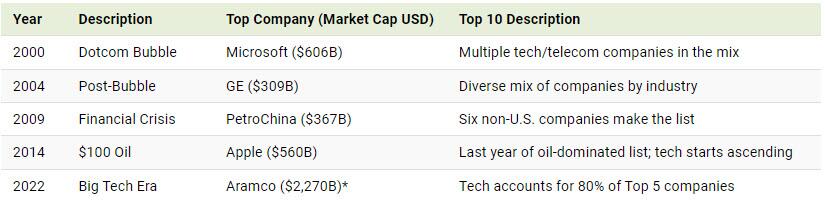
The 10 largest public companies in the world had a combined market capitalization of nearly $12 trillion as of July 2022.
But, as Visual Capitalist's Carmen Ang and Jeff Desjsardins detail below, two decades ago, the players that made up the list of the largest companies by market capitalization were radically different - and as the years ticked by, emerging megatrends and market sentiment have worked to shuffle the deck multiple times.
This racing bar chart by Truman Du shows how the ranking of the top 10 largest public companies has changed from 2000 to 2022.

Market Cap vs. Market Value
Before diving in, it’s worth noting that market capitalization is just one of many metrics that can be used to help value a company.
Simply put, a company’s market cap measures the combined price of a company’s outstanding shares—in other words, it’s the price someone would pay if they wanted to purchase the company outright at current stock prices (theoretically speaking).
But while a market cap provides insight into what equity is worth at a given time, calculating the market value is far more complicated and nuanced. After all, a price paid might not reflect the actual value of a business. To get a measure of value, other metrics like a company’s price-to-sales (P/S) ratio, price-to-earnings (P/E) ratio, or return-on-equity (ROE) may be considered.
The Largest Public Companies by Market Cap (2000–2022)
Over the last two decades, investor sentiment has shifted as different trends have played out, and the types of companies buoyed up by the market have changed as well.
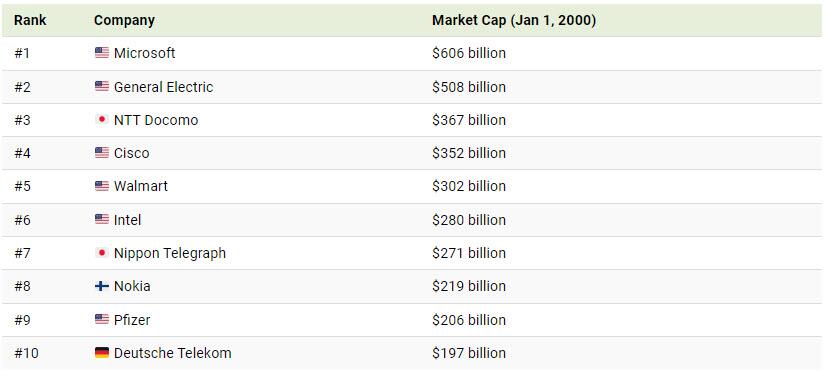
For instance, tech and telecom companies were big in the very early 2000s, as investors got excited about the seemingly endless potential of the newly-introduced World Wide Web.
In the middle of the Dotcom bubble, investors were pouring money into internet-related tech startups. As PC and internet adoption picked up, investors hoped to “get in early” before these companies started to really turn a profit. This overzealous sentiment is reflected in the market capitalizations of public companies at the time, especially in the tech or telecom companies that were seen as benefitting from the internet boom.
Of course, the Dotcom bubble was not meant to last, and by January 2004 the top 10 list was looking much more diverse. At this time, Microsoft had lost the top spot to General Electric, which had a market cap of $309 billion. Then in the late 2000s, energy companies such as ExxonMobil, PetroChina, Gazprom, and BP took over the list as oil prices spiked well over $100 per barrel.
But fast forward to 2022, and we’ve come full circle, with Big Tech back in the limelight again.
Largest Companies by Market Cap (July 1, 2022)
Four of the five largest companies are in tech, and Tencent also cracks the list. Meanwhile, Tesla is classified as an automotive company, but it is thought of as an “internet of cars” company by many investors.
Big Picture Trends in the Top 10 by Market Cap List

*As of July 1, 2022. Since then, Saudi Aramco has been re-surpassed by Apple due to a reversal in oil prices.
Trending Downwards?
Amidst rising interest rates, crippling inflation, and political issues like the ongoing conflict in Ukraine, signs point towards a potential global recession. Tech companies fared well during the COVID-19 pandemic, but will likely not be immune to the impacts of a generalized economic slowdown.
It’ll be interesting to see how things pan out in 2023, and which companies (if any) will manage to stay on top throughout the turmoil.

WSJ : Are Electric Cars Actually the Future?

Are Electric Cars Actually the Future?
Students discuss transportation changes and American infrastructure.

In this Future View, students discuss electric cars.


It’s More Than Electric Cars

Electric cars are only one variable in the equation. According to the U.S. Energy Information Administration, as of 2021, fossil fuels fed 60% of the U.S. power grid. Meanwhile, American infrastructure has not been adequately updated in decades, making it extremely vulnerable to weather damage and cyber attacks. This power system is the primary source for electric-vehicle manufacturing and charging—which means that even though electric cars are not gasoline-powered, they are still created and charged by inefficient, insecure and unrenewable sources of energy.

Record investments by the Saudi Royal Investment Fund and China’s Communist Party in electric vehicles reflect an increasing competition and trend in the global markets toward electric vehicles. Around 55% of China’s energy continues to rely on coal, while Saudi Arabia’s is around 60% reliant on fossil fuels. Neither of these nations is concerned about the environmental impact of electric vehicles. Their investment is a matter of competing with the U.S.

American leaders need to understand that the battle between being a climate leader and competing in global markets is not a binary choice. By investing in new infrastructure and fully embracing renewable energies we will be less reliant on foreign nations and less vulnerable to weather and cyber attacks, while providing the foundations to maintain American economic hegemony.

—Andrew Lymm, London School of Economics and Political Science, international relations


The Enthusiasm Is Everywhere

Most people will have heard of California’s ban on sales of gasoline-powered cars by 2035. Auto makers themselves are making equally sweeping promises: GM touts a “path to an all-electric future” with its own proclamation of ending production of gasoline vehicles by 2035. Mercedes announces the same, but with a target year of 2025. Honda already has gotten rid of the nonhybrid version of its Civic in Europe. And in the financial markets, Tesla, an all-electric company from the start, had at one point a stock valuation that was greater than its top five carmaker rivals combined.

A lot of this is hype and hot air. But taken together, it signals confidence and agreement among auto makers, governments and citizens about the promise of a future of all-electric transportation. California’s commitment to ban gasoline-powered vehicles is not an adversarial regulation to coerce companies. It is rather one more contribution to what is now an undeniable tsunami of enthusiasm for the electric future.

—Simon Alford, Cornell University, computer science


Who Wants Cars Anyway?

Cars should not be the future. Our system of roads and private vehicles is not sustainable, no matter how efficiently we fuel our cars. Electric cars may be a step toward sustainability, but at a certain point we must accept that cars are an antiquated means of transportation.

Cars need to be replaced with robust public transportation. Buses, trains and trolleys take up less space and are cheaper and more efficient, not to mention safer, than cars. Subway trains don’t spend the majority of time parked in driveways. They are always moving and benefiting the general public.

Without cars (and the parking lots they require), we could have greater density of businesses, housing and parks. The type of transportation best for the environment is human-powered walking, and that type of transport is not possible while we remain dependent on cars.

—Sam Walhout, Brown University, economics


Batteries Are Catching Up to Gasoline

It might seem strange to an alien that we use costly equipment, designed by some of the sharpest engineers on earth, to extract jet-black sludge from below the earth’s surface—only then to refine it and explode it in a tank on wheels to get from point A to point B.

That’s only half the story, of course. While electric cars are often marketed as fully green, they aren’t. The driver is just trading burning a petroleum product for burning coal or obliterating plutonium atoms somewhere far away to make electricity.

FT : Saudi Arabia willing to pump more oil if global energy crisis worsens

Saudi Arabia willing to pump more oil if global energy crisis worsens
Riyadh’s energy minister says Opec+ supply cuts were needed to provide future production buffer

Saudi Arabia’s energy minister has signalled a willingness to pump more oil if the global energy crisis worsens, while describing this month’s decision by the Opec+ cartel to cut crude supply during a period of high prices as a “mature” decision.

Prince Abdulaziz bin Salman said the move to produce less oil from next month, which has caused a rift with the US, was necessary to provide a bigger spare capacity buffer if sanctions on Russian exports, or any other unforeseen events, led to a major drop in global supply.

“You need to make sure you build a situation where if things [get] worse you have the ability to [respond],” Prince Abdulaziz, who also chairs the oil producers’ group, told the Future Investment Initiative investor conference in Riyadh. “Running out of capacity has a much dearer cost than what people can imagine.”

He added: “We will be the supplier of those who want us to supply.”

The Opec+ production cut, announced this month, pushed oil prices higher just as much of the world was struggling with soaring energy costs and rising inflation. The decision by its member countries, which includes Russia, provoked a fierce backlash from the White House, which accused the cartel of helping to prop up Russia’s war in Ukraine.

Prince Abdulaziz used the onstage interview to present Saudi Arabia, the world’s biggest oil exporter, as a responsible energy provider to the world. He criticised the US for withdrawing millions of barrels oil from its Strategic Petroleum Reserve, the world’s largest, to prevent prices rising faster.

“We, as Saudi Arabia, decided to be the maturer guys,” he said. “People are depleting their emergency stocks . . . [using] it as a mechanism to manipulate markets when its profound purpose is to mitigate shortages of supply.”

OECD oil stocks were 243mn barrels below the five-year average as of the end of August, according to the International Energy Agency. Stocks in the US SSP are at their lowest level since 1984.

Relying on emergency stocks for oil supply “may become painful in months to come”, Prince Abdulaziz added.

Riyadh said production cuts were needed now to restore its spare capacity and avoid the possibility of a more dangerous spike in crude prices later. Critics say the kingdom’s aim was to prop up its own revenues by maintaining oil above $90 a barrel — almost twice the long-term historical price.

Brent, the international oil benchmark, was trading at about $93 a barrel on Tuesday.

The oil spat has pushed US-Saudi relations to near historic lows and stoked anxiety in European capitals over high energy prices. But Prince Abdulaziz insisted Saudi Arabia was ready to send more oil to Europe if EU sanctions on Russian crude, which come into full force on December 5, led to shortages that needed to be filled.

Exports to Europe had already risen to 950,000 barrels per day in September from 190,000 b/d a year earlier, he said, adding that Saudi Arabia was in talks with “many” European governments, including Germany, Poland, the Czech Republic, Croatia and Romania, about boosting supply.

FT : Warner Bros Discovery: M&A disaster movie seeks Hollywood ending

Warner Bros Discovery: M&A disaster movie seeks Hollywood ending
Front-loading bad financial results is an age-old plot device to set up a happy finale

Warner Brother Discovery seems to be losing the plot. In early spring, Discovery closed its blockbuster acquisition of Warner Media assets from AT&T. Broadcasting group HBO was the biggest trophy.

The fortified US media group was supposed to be a serious rival to the likes of Disney, Netflix and Comcast. For now, it looks like the latest M&A meltdown.

Late on Monday, WBD said that it would take as much as $4.3bn in restructuring charges. The bulk of these consist of content impairments and development write-offs. This will not be the last we hear of the money pit created by the streaming wars

Hollywood was left in shock earlier this year when WBD shelved the release of the Batgirl film adaptation. Over the summer, the company admitted it had reduced its $10bn operating profit target for 2022 by as much as a tenth.

Media integrations are messy. WBD is attempting to smash two disparate companies together amid an economic slowdown and an advertising slump. Still, front-loading bad financial results is an age-old plot device to set up a happy ending.

On Tuesday, shares of WBD moved little. Wall Street was already braced for bad news. Since the deal closed in the spring, WBD shares are down by nearly half. Investors now worry that a $50bn debt load looks bloated compared with a market capitalisation of just $30bn.

WBD says that of $4bn in potential charges, cash costs only represent about a quarter. That might be comforting except that just months ago it shelled out $42bn to AT&T and gave shareholders in the telecoms group 71 per cent of the new WBD. According to filings, the transaction has generated $21bn alone in new goodwill on the balance sheet, representing the excess purchase price that cannot be allocated to specific assets. 

WBD believes that in the next year or two it will become a streamlined cash machine. At that moment of triumph, accounting charges from yesteryear would mean little. Today’s write-offs are an ominous warning against assuming that is a foregone conclusion.