FT : Fed officials in danger of splitting on future rate rises, warn economists

Fed officials in danger of splitting on future rate rises, warn economists
Some dovish policymakers fear monetary tightening campaign may end up going too far

A united front among Federal Reserve officials is in danger of splintering as sharper divisions emerge among policymakers over how forcefully to squeeze the economy to tackle inflation, economists have warned.

As the US central bank prepares to slow the pace of interest rate rises next month after one of the most aggressive tightening campaigns of recent times, it is grappling with disagreements over how much more restraint will be needed and the extent to which the economy must suffer.

“It’s a group that likes consensus if they can reach it, but they may not be able to,” said Bill English, former director of the Fed’s division of monetary affairs. “The fundamental issue is that it’s going to be much less clear what they need and want to do with policy.”

On Wednesday Fed watchers will look for more guidance from chair Jay Powell in remarks to be delivered at the Brookings Institution against the backdrop of whipsawing financial markets that have struggled to interpret policy signals from the central bank.

Minutes from the Fed’s last policy meeting in November suggest some officials have taken comfort in data pointing to a slight easing of inflation, while another cohort still appears wary of further upward price pressure — especially stemming from the historically tight labour market.

Andrew Hollenhorst, chief US economist at Citi, said the minutes showed officials no longer unanimously agreed that the risk of doing too little outweighed the risk of doing too much, with some saying the cumulative effect of the Fed’s tightening could “exceed what was required” to bring inflation under control.

“It’s going to be a really different experience analysing the Fed and listening to their public pronouncements because you will have this division”, he said.

Earlier this year, decisions around policymaking were more clear-cut. As it became obvious that inflation was becoming more embedded in the economy, the Fed nearly unanimously decided to jettison its more cautious approach to raising interest rates and ploughed ahead with four consecutive 0.75 percentage point rate rises.

The most recent of these hikes, implemented in November, lifted the federal funds rate to a new target range of 3.75 per cent to 4 per cent — a level officials believe is high enough to begin restraining consumer demand.

However, the Fed has now reached a tricky inflection point where it must decide the degree to which it should begin taking its foot off the brake, amid signs that businesses and consumers are starting to wobble under the weight of rapidly rising borrowing costs.

While officials broadly back a half-point rate rise in December, Mary Daly of the San Francisco Fed has conceded that the coming months would involve a “much more difficult” phase of policymaking.

“The spread of opinion gets wider at turning points. Some people are more eager to jump on [them] as evidence of something sustainable than others,” said Ian Shepherdson, chief economist at Pantheon Macroeconomics.

“At the moment, I think it’s no more than fraying at the edges, but I would expect over the next few months that disagreements probably will become more widespread,” he added.

At the root of these divisions is a simmering debate about the trajectory of inflation. Commodity prices and housing costs have already plummeted from their peaks, while goods prices have started to ease, but those tied to services sectors remain stubbornly high.

Retail margins have also declined as companies mark down products to clear excess inventory, a process vice-chair Lael Brainard has said could “meaningfully” help reduce inflationary pressures. Meanwhile, wage growth, although far exceeding the Fed’s 2 per cent target, has begun to ease, according to some metrics.

Among the most vocal officials warning against wishful thinking over inflation have been Loretta Mester of the Cleveland Fed and governor Christopher Waller, who have argued the central bank needs to see much stronger evidence that price pressures are easing to be sure it has inflation under control.

They, along with James Bullard of St Louis and Neel Kashkari of Minneapolis, have said the Fed is not yet close to pausing its rate rises.

While Brainard has also said the Fed has more work ahead, she was an early advocate for slowing the pace of rate rises and has consistently warned about international spillovers from the central bank’s tightening campaign.

Susan Collins, president of the Boston Fed, echoed this sentiment earlier this month, saying: “As rates get higher, the concerns that we might go too high do increase.”

Complicating officials’ assessment of the economy is the fact that rate rises impact different sectors by different magnitudes at different times. Disruptions from the coronavirus pandemic and the war in Ukraine have damaged “faith” in their own inflation forecasts, said Ray Farris, a chief economist at Credit Suisse.

That has led to a reliance on backwards-looking data as officials try to decide how restrictive they need to be and how long they should maintain rates at a given level, he added.

Most economists believe the funds rate will need to surpass 5 per cent next year for the US central bank to sufficiently cool down the economy, with many also forecasting a mild recession. Despite protestations from officials, including John Williams at the New York Fed this week, traders in fed funds futures markets still say the central bank will slash rates in the latter half of next year.

With data likely to become even more mixed over the coming months, English, who is now at Yale University, expects at least a “dissent or two” over future rate decisions as the faultlines between Fed officials deepen.

“There’s always a risk when there’s a lot of communication from a lot of different committee participants, that you have a cacophony problem,” he said. “On the other hand, if there’s genuine uncertainty and genuine disagreement across the participants, it’s probably helpful to have that be known by the public.”

FT : Franco-German fighter jet project still faces turbulence

Franco-German fighter jet project still faces turbulence
Macron and Scholz declarations are no guarantee of trouble-free collaboration on defence programme


Twice in two weeks French and German politicians have declared the end of a long impasse in their project to deliver one of the most complex fighter programmes in the world — a system of systems combining aircraft, drones and advanced communications.

And twice they have been put in their place by Dassault Aviation, the French aerospace and defence company that will lead the core part of the programme — the fighter jet itself.

Eric Trappier, Dassault’s chief executive, last week dismissed declarations by French president Emmanuel Macron and German chancellor Olaf Scholz that agreement had been reached on building a prototype as a “pseudo-political announcement”. A few days later the company again insisted no industrial accord had been signed after comments by the French prime minister Elisabeth Borne in Germany.

Dassault plays hard ball and always has done. Deeply integrated into both the French political and military establishments, it is supremely confident in its role as guarantor of France’s sovereignty in combat aircraft. Majority controlled by the Dassault family, the company has always displayed a certain independence from the norms of corporate diplomacy when it comes to telling politicians what it thinks. But it is a good reminder that whatever the politicians say, they will need arch rivals Dassault and Germany-based Airbus Defence and Space to play nicely if they want Europe’s biggest defence project to succeed.

The two companies have long been bitter rivals — dating back to when Airbus held a significant stake in the much smaller aerospace group as a proxy for the French government. Over the past year they have been fighting tooth and nail over how to share intellectual property on the future fighter and development of the crucial flight control system. Those battles — at times overly emotional, according to people involved in the project — have already delayed progress by a year. To be fair, the politicians were not entirely wrong. There has been some progress on two obstacles to the so-called demonstrator phase.

It seems that Dassault’s own proposed flight control system will be used for the prototype, according to several people with knowledge of discussions. And second, an apparent compromise has been secured in an entirely separate Franco-German programme to develop a future tank. Germany’s Bundestag has always insisted that the fighter and tank projects run in parallel, to ensure the country has the lead in one of the collaborations.

Now the expectation is that an industrial agreement on the so-called Phase 1B of the future fighter programme could be signed within days.

But this does not guarantee a trouble-free future for the project, where Spain is also a partner. While Dassault may have won the battle over the prototype, everything is still to play for in the next phases of the programme. For example, Airbus still expects to be involved in developing the flight control system to be used for the actual aircraft. As this critical system is unlikely to be developed completely from scratch, that will require some sharing of Dassault’s IP — which the French company remains viscerally opposed to.

Meanwhile, Germany’s Bundestag continues to insist on an equal sharing of the technological benefits of the programme. There is no evidence that either side has materially changed its position.

Politicians may have thought they could accelerate things with a public statement after a few grudging concessions. But Dassault will not be bounced into anything. Its Rafale fighter is selling like hot cakes, helped by government support. With constant upgrades it is good for a few more decades, says Trappier. The company can afford to wait things out, if need be.

At best the agreement that will be signed by Dassault and Airbus simply buys time for the two sides to carry on negotiating over the bigger spoils of the programme. The hope seems to be that once they start working together, the engineers rather than politicians or top management will develop the positive momentum needed to carry the project to fruition.

It is a big gamble. Politically, the collaboration is important — a key pillar of Europe’s ambition for greater strategic autonomy in defence. But that is not necessarily the industrial perspective. Neither Airbus Defence and Space, nor Dassault, would have chosen the other as a partner for a new fighter programme. It is difficult to see how “pseudo-political announcements” will change that.

FT : Top Adidas executive rebuked in ‘final warning’ over comments on diversity

Top Adidas executive rebuked in ‘final warning’ over comments on diversity
Chief sales officer Roland Auschel received a bigger bonus even after compliance investigation

A top Adidas executive received a “final warning” last year over repeated “inappropriate and unacceptable” remarks about diversity at the sportswear group, according to people familiar with the matter.

Chief sales officer Roland Auschel was the subject of a compliance probe after a string of complaints by Adidas employees, these people told the Financial Times. While he was rebuked by the supervisory board, he nonetheless received a 26 per cent increase in his bonus in the same year and a contract extension in early 2022.

The revelation of the probe, which started in late 2020 and closed last year, comes as Adidas grapples with allegations that it mishandled and downplayed racism.

In October, the sportswear group cut ties with rapper and fashion designer Kanye West following global outrage over his antisemitic comments. In 2020, top human resources executive Karen Parkin resigned after telling employees that discussions about racism were “noise”.

Last week, Adidas said it would launch an investigation into allegations of misconduct against West after the company was accused of turning a blind eye to the artist’s inappropriate behaviour during their Yeezy trainers tie-up.

Asked about the Auschel allegations, Adidas told the FT that “a reputable law firm” investigated complaints about “potential breaches of internal conduct guidelines” in a “comprehensive and independent” probe. People familiar with the matter added that the investigation, which was overseen by the supervisory board, was triggered by several anonymous employees who turned to the group’s whistleblower hotline.

Eight people who worked with Auschel, one of Adidas’s most senior and best-paid executives, told the FT that a number of employees have been offended by remarks that they found derogatory, discriminatory and racist, leading to various complaints to the chief executive and the human resources department.

In one incident, which was investigated in the compliance probe, Auschel told more than 200 managers at meeting at the brand’s headquarters in 2019 that the promotion of a black manager was Adidas’s “contribution to diversity”. Some Adidas employees were furious at the suggestion the manager was chosen for his ethnicity rather than his skills.

“It was completely inappropriate,” said one person who was present, adding that at the behest of other senior managers, a video of his speech was not published on the Adidas intranet, as would have been typical. Multiple Adidas insiders who worked underneath Auschel said it was not an isolated incident.

Auschel did not respond to a request for comment. Adidas chair Thomas Rabe, chief executive of German media giant Bertelsmann, declined to comment.

The law firm concluded in a lengthy report that Auschel’s conduct was not grave enough to fire him under Germany’s labour laws, Adidas said. “There have been no further indications of possible misconduct since then,” the company said in a statement, adding it was part of the group’s diversity and inclusion efforts “to recognise sincere efforts to bring about positive change”.

The supervisory board was also keen to avoid the departure of another top executive after losing its head of global brand, Eric Liedtke, in late 2019 and Parkin in 2020, according to a person familiar with the matter, who said Auschel’s more than 30 years with the company also played a part in the response.

“The investigation revealed a training need for the executive in question in the areas of communication and diversity, equity and inclusion,” Adidas said, adding that its “expectation to comply with the conduct guidelines” was “emphatically addressed”. Auschel subsequently “underwent several months of coaching in 2021”.

Auschel was rebuked by a member of the supervisory board in personal meetings, who told the 59-year-old that his remarks were unacceptable and inappropriate for the company and had to stop immediately. “Auschel received a final warning, he was given a last chance,” said one person familiar with the matter.

“He does not mean his remarks in the way that many people understand them,” the person added.

The board’s sanctions against the executive did not include any financial penalty. He received a 26 per cent increase in his variable pay in 2021, lifting his total remuneration to €3.6mn.

Adidas has been struggling to deal with diversity and racism since the protests erupted over the George Floyd killing in 2020. The group’s main competitor, Nike, spearheaded condemnations, launching an influential campaign with the tagline “For once, Don’t do it”. Adidas employees petitioned senior executives to come out with a strong anti-racism statement, but the company retweeted its rival’s campaign instead.

>>> US After Hours Summary: CRWD -18.6%, NTAP -11.2%, INTU -1.6% lower on earnin

After Hours Summary: CRWD -18.6%, NTAP -11.2%, INTU -1.6% lower on earnings; WDAY +8.5%, HPE +2.5% higher on earnings; HZNP +31.1% pops as it confirms buyout discussions; W +11.2% reports post-Thanksgiving sales

After Hours Gainers:

Companies trading higher in after hours in reaction to earnings/guidance: WDAY +8.5% (also authorizes new $500 mln share repurchase program), HPE +2.5%

Companies trading higher in after hours in reaction to news: HZNP +31.1% (confirms preliminary discussions regarding potential buyout), VRDN +21.3% (in sympathy with HZNP M&A news), W +11.2% (reports post-Thanksgiving sales), WBX +3% (private placement of $43.5 mln), FUBO +2.1% (Sports Network launches on Amazon Freevee), CRM +0.8% (U.S. online sales rose 9% yr/yr during Cyber week), MAXR +0.3% (to build two new geostationary communications satellites for SiriusXM), CBL +0.2% (declares special dividend of $2.20/sh), MIR +0.1% (to sell physical medicine assets of Biodex Medical), ASPN +0.1% (stock offering), LTHM +0.1% (announces research collaboration), CMRE +0.1% (establishes a new dry bulk operating platform), BA +0.1% (awarded $398 mln U.S. Air Force modification contract)

After Hours Losers:

Companies trading lower in after hours in reaction to earnings/guidance: CRWD -18.6%, NTAP -11.2%, INTU -1.6%, CMP -0.7%

Companies trading lower in after hours in reaction to news: XFOR -20.5% (top-line results from phase 3 trial of Oral Mavorixafor), ASTS -10.4% (stock offering), NOTV -4.9% (to close two isolator facilities), MU -1.7% (makes cautious comments on pricing at investor conference), ALTO -1.5% (stock offering), SLDP -0.9% (CEO to retire), SANA -0.8% (confirms key program timelines and portfolio prioritization), CDXS -0.6% (provides update on strategy; workforce reduction; discontinue investment in some programs), RIO -0.6% (to invest a further $600 mln in renewable energy assets in the Pilbara), DDOG -0.5% (announces availability of Universal Service Monitoring), FL -0.4% (names new COO; CFO to step down), SIRI -0.2% (MAXR to build two new geostationary communications satellites for SiriusXM), SNPS -0.1% (names new CFO)

>>> US Close Dow +0,01% S&P -0,16% Nasdaq -0,59% Russell +0,31%

Closing Stock Market Summary

Today's trade started on a more upbeat note, aiming to rebound from yesterday's retreat. The wind got knocked out of the market's sails, however, around 11:00 a.m. ET due to a sharp turn lower in Apple (AAPL 141.17, -3.05, -2.1%) amid ongoing worries about potentially large iPhone 14 Pro production shortfalls this quarter. 

Other mega cap stocks suffered losses today, dragging down the main indices. The Vanguard Mega Cap Growth ETF (MGK) logged a 0.9% loss versus a 0.3% gain in the Invesco S&P 500 Equal Weight ETF (RSP).

After the initial leg lower, the market was able to inch off session lows. The Dow Jones Industrial Average snuck into positive territory in the late afternoon, climbing off a 0.6% loss earlier. 

The weaker tone to the market was in contrast to Hong Kong's Hang Seng, which rose 5.2% on a growing hope that Chinese authorities will take steps in coming months to shift away from the extreme zero-COVID policy restrictions and pave the way for stronger growth.

That hope was not reflected in U.S. equities. Market participants played a waiting game ahead of Fed Chair Powell's speech at 1:30 p.m. ET on Wednesday at the Brookings Institution entitled Economic Outlook, Inflation, and the Labor Market. That speech will influence the market's policy path expectations, so it is understandable that conviction would be lacking in front of it.

Market participants also await more key economic data this week, including the November Employment Situation Report on Friday. Today's data releases showed a 0.1% month-over-month increase in the September FHFA Housing Price Index (prior +0.7%), a 10.4% year-over-year increase in the S&P Case-Shiller Home Price Index (prior 13.1%), and a 100.2 reading for the November Consumer Confidence Index (prior 102.2) that also included an uptick in year-ahead inflation expectations to 7.2% from 6.9%.

Market internals reflected the mixed action. Advancers led decliners by a roughly 3-to-2 margin at the NYSE and were just about even with decliners at the Nasdaq.

The Russell 2000 (+0.3%) and S&P Mid Cap 400 (+0.3%) were pockets of relative strength today.

Roughly half of the 11 S&P 500 sectors closed in the green. Real estate (+1.7%) and energy (+1.3%) sat atop the leaderboard while information technology (-1.0%) and utilities (-0.7%) fell to the bottom of the pack. 

The energy sector was boosted by rising oil prices ($78.42/bbl, +1.24, +1.6%) that moved today on speculation OPEC+ could soon announce a cut in production and the hopeful consideration that oil demand in China will improve with some relaxed COVID restrictions.

Treasury yields settled noticeably higher than levels seen earlier. The 2-yr note yield, which flirted with 4.40% earlier, settled at 4.47%. The 10-yr note yield, which hit 3.65% overnight, settled at 3.75%.

Reviewing today's economic data:

  • September FHFA Housing Price Index 0.1%; Prior -0.7%
  • September S&P Case-Shiller Home Price Index 10.4% (Briefing.com consensus 10.7%); Prior 13.1%
  • November Consumer Confidence 100.2 (Briefing.com consensus 100.0); Prior was revised to 102.2 from 102.5
    • The key takeaway from the report is that inflation and interest rate hikes continue to pressure consumer confidence. Intentions to buy homes, autos, and big-ticket appliances have all cooled, according to the report; meanwhile, a reading below 80 for the Expectations Index "suggests the likelihood of a recession remains elevated."

Hormel Foods (HRL) and Petco Health and Wellness (WOOF) are some of the companies reporting earnings ahead of Wednesday's open. 

Market participants will receive the following economic data on Wednesday:

  • 7:00 ET: Weekly MBA Mortgage Index (prior 2.2%)
  • 8:15 ET: November ADP Employment Change ( consensus 200,000; prior 239,000)
  • 8:30 ET: October international goods trade deficit (prior $92.20 bln), October advance Retail Inventories (prior 0.4%), October advance Wholesale Inventories (prior 0.8%), Q3 GDP -- Second Estimate ( consensus 2.7%; prior 2.6%), and Q3 GDP Deflator -- Second Estimate (Briefing.com consensus 4.1%; prior 4.1%)
  • 9:45 ET: November Chicago PMI ( consensus 47.5; prior 45.2)
  • 10:00 ET: October Pending Home Sales ( consensus -5.2%; prior -10.2%)
  • 10:30 ET: Weekly crude oil inventories (prior -3.69 mln)
  • Dow Jones Industrial Average: -6.8% YTD
  • S&P Midcap 400: -11.4% YTD
  • Russell 2000: -18.2% YTD
  • S&P 500: -17.0% YTD
  • Nasdaq Composite: -29.8% YTD


Click here to read the full comment.

Portfolio Ticker Matches:  WRAPX


You opted-in to receive an e-mail notification from Briefing.com. If your preference has changed, you may opt-out by clicking here. To edit your email preferences, click here.

Privacy Statement | Cookie Policy

Briefing.com c/o MIA Suites 2625 Butterfield Road, Suite 138-S Oak Brook, IL 60523 | 800-752-3013

WWD : Former Luxottica, LVMH Executive Andrea Guerra Rumored to Join Prada

Former Luxottica, LVMH Executive Andrea Guerra Rumored to Join Prada
Guerra is expected to flank Lorenzo Bertelli as part of the succession plan at Prada.

MILAN — Prada shares on Tuesday closed up 2.89 percent at 40.90 Hong Kong dollars on the Hong Kong Stock Exchange following a press report that LVMH Moët Hennessy Louis Vuitton senior adviser Andrea Guerra may be joining the Italian luxury group in January.

Prada did not comment on the speculation but a source, who requested anonymity, believes Guerra could be asked to flank Lorenzo Bertelli to prepare him to take on the chief executive officer’s role. This is currently held by both his father Patrizio and his mother Miuccia Prada.

The speculation was first reported by Repubblica.

A Prada board meeting is expected to convene in January, but a source believes Guerra’s appointment in a top managerial role could take place this week and be ratified by the board next year.

Jefferies issued a report stating that “Guerra would add invaluable experience and significant gravitas to the Prada senior management team should his role as de facto ‘caretaker’ be confirmed and that the market would view his arrival as a positive for a group that is initiating a phase of succession.”

A possible retirement of Patrizio Bertelli, who is 76, has been in the news for a while, further fueled by the executive during Prada’s first Capital Markets Day in November 2021, as he pointed to a potential handover in three years.

Patrizio Bertelli’s choice is not a surprise as his son has increased his responsibilities and been a driver of change since joining the company in 2017. He was named group marketing director in 2019 and, additionally, head of corporate social responsibility in 2020. In May 2021, he joined as a director of the board.

Guerra, conscripted in early 2020 as CEO of the newly created LVMH Hospitality Excellence division, said last May that he was leaving the French luxury group “to pursue other interests” and would become a strategic and development senior adviser.

He is a former CEO of eyewear group Luxottica and onetime strategic adviser to former Italian Prime Minister Matteo Renzi. He joined LVMH from Italian high-end food emporium Eataly, where he had been executive chairman since 2015.

At LVMH, he took over an entity that encompasses Hôtels Cheval Blanc and the Belmond Hotels & Luxury Trains and also became a member of the luxury conglomerate’s executive committee. Ultimately, his purview was widened to include oversight of the Fendi and Loro Piana businesses, as well as Thélios, the Italian eyewear firm that LVMH took full control of last year.

A graduate of the University of Rome, Guerra started his career in 1989 with hotel group Marriott International. He has also worked in a variety of executive roles at Merloni Elettrodomestici, an Italian maker of household appliances now known as Indesit Co.

The relationship between Patrizio Bertelli and Guerra is a longstanding one, as Luxottica started producing the Prada and Miu Miu eyewear collections in 2003. Also, Luxottica veteran executive Massimo Vian joined Prada as chief of industrial production two years ago.

In March 2017, Guerra spoke at Prada’s first conference on sustainability, called “Shaping a Creative Future.”

Guerra’s possible arrival at Prada comes shortly after the news that Raf Simons, who is co-creative director with Miuccia Prada of the company’s signature line, is shuttering his namesake fashion collection, leading to speculation about an increased commitment at Prada.

(ZH) iPhone Pro Delivery Wait-Times Surge After China Factory Chaos

iPhone Pro Delivery Wait-Times Surge After China Factory Chaos

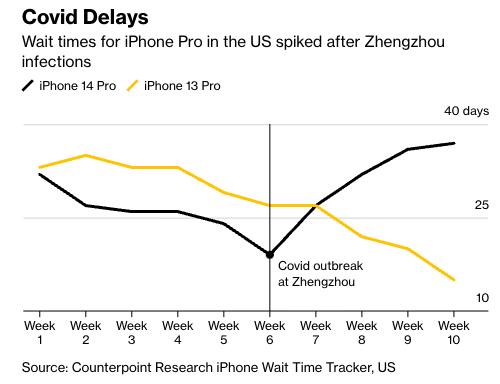
Counterpoint Research's new report on delivery times shows Apple's iPhone 14 Pro models are taking longer than ever to arrive in customer's hands because of zero Covid disruptions in China at a key manufacturing plant.
Customers buying Apple's most premium devices in the US this year can now expect to wait as long as 37 days, according to Counterpoint Research, which monitors delivery times every year. That's far higher than the predecessor iPhone 13 Pro family and longer than the initial launch of the current generation. Delivery days are "increasing significantly" for iPhone 14 Pro and Pro Max models across all markets, Counterpoint analysts said. -- Bloomberg
Source: Bloomberg
The main issue is zero Covid disruptions and unrest at Foxconn's massive iPhone factory in Zhengzhou, central China.
"The zero China Covid policy has been an absolute gut punch to Apple's supply chain with the Foxconn protests in Zhengzhou a black eye for both Apple and Foxconn.
"We estimate that Apple now has significant iPhone shortages that could take off roughly at least 5% of units in the quarter and potentially up to 10% depending on the next few weeks in China," Dan Ives of Wedbush Securities said.
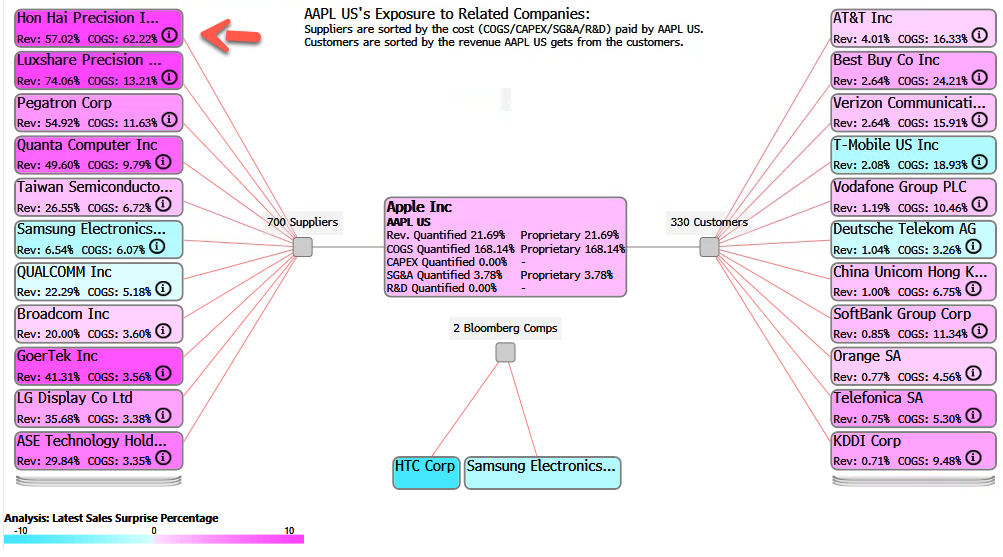
Bloomberg's breakdown of Apple's supply chain shows that Foxconn (Hon Hai Precision Industry Co., Ltd.) is a top supplier. Any manufacturing disruption in China could leave Apple, AT&T, Best Buy, and Verizon stores with limited supplies of the new iPhones.
On Monday, Bloomberg sources said Apple could wind up with a 6 million iPhone Pro production shortfall by the year's end, adding that the situation remains fluid and lost production numbers could change.
"It's unfortunate for Apple to be short of its flagship Pro series going into the holiday season, especially if buyers end up pivoting to a competing product.
"The good thing for Apple is that it has plenty of ecosystem stickiness to contain most of the leakage and satiate this demand in the following quarters," IDC's Bryan Ma said.
Wedbush's Ives said Apple stores could see iPhone Pro shortages of up to 35%-45% of typical inventory heading into December.
Apple is caught in production hell in China, with waning consumer demand for upgrading iPhones. Couple this all together, which might indicate revenue from its iPhone sales may slide this quarter.