(ZH) The Rise And Fall Of Inflation Risk Factors

The Rise And Fall Of Inflation Risk Factors

This week we will all focus on CPI on Tuesday and the Fed on Wednesday. What Chair Powell says and does on Wednesday will reverberate through the markets. For the record, I expect 50 bps and he will keep a rate hike on the table for the February 1 st announcement.
Rather than attempting to estimate this week’s CPI data (which will be important), today’s report will focus on what will drive inflation (and the economy/markets) after the Fed decision.
We have seven weeks between this FOMC decision and the next one. Seven weeks feels like a lifetime in a market that is prone to large daily and weekly swings. Even the views on the economy are shifting rapidly as more economists seem to be heading in our direction, which is that the recession will start sooner (Q1) and be deeper than most people previously thought.
If anything, the market is pricing in a Squishy Landing. That report tried to define a “squishy” landing and also tried to figure out why markets may misinterpret data as indicating a “soft” landing when the worst is yet to come. Finally, we re-iterated our more pessimistic outlook in that report.
Inflation Factors versus Inflation
Rather than just trying to “estimate” inflation, we examine the factors that “drive” inflation. While we could just estimate various inflation components such as rent, in this report, we will try something different. We will lay out the factors that drive inflation. We believe that these factors do a good job of predicting where inflation and the economy are headed
In theory this is what many do, but we hope that today’s analysis makes it clear how these factors have been behaving (and how they will behave). That will go a long way in explaining why our current outlook is more pessimistic and is strongly in the camp that “the Fed has gone too far already.”
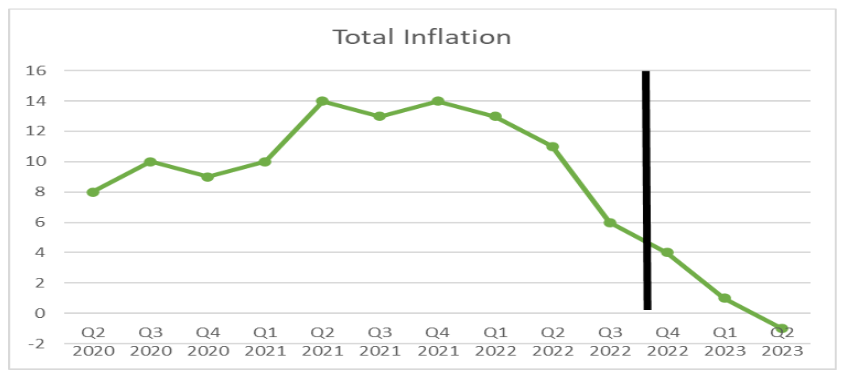
We will address the individual components that go into this model. This model shows the highest inflationary pressures were from Q2 2021 to Q4 2021. It remained elevated for that extended period of time due to a variety of factors (the importance of which changed within that period). The factors have been pointing to steadily declining inflation and growth pressures ever since.
If anything, the factors point to deflationary pressures in Q1 and Q2 next year – which is another way of reaching our conclusion that the economy and markets are in jeopardy of a large “risk-off” trade that will break 2022’s lows on stocks (while yields plummet).
The Inflation Factors
We will use 5 factors. The factors are somewhat broad and the influence that they have on inflation is just an estimate. Yes, inflation and the economy are closely linked. No, our model is not tested and is both arbitrary and subjective. Nonetheless, it seems logical and almost elegant. The explanation fits the narrative of what has been going on, and some version of this “model” has been influencing my thoughts on inflation, the economy, and markets. It is a good starting point for this overall discussion and what to expect in terms of economic data and corporate reporting over the next seven weeks.
The factors that we use are:
  • The Fed. This is primarily focused on rates and the balance sheet. Lower rates are stimulative and higher rates act as a headwind. Balance sheet expansion (QE) is stimulative while balance sheet reduction (QT) is contractionary. Other “extraordinary” measures are included as well.
  • Stimulus. This includes a range of items such as checks sent to individuals, moratoriums on rent/student loans, PPP, and government spending programs like the “Inflation Reduction” Act.
  • Supply Chains. This attempts to broadly incorporate supply chain issues from the actual inability to produce goods to the costs of shipping and transporting. It is difficult to get an exact definition, but we all know it when we see it.
  • War. Russia’s invasion of Ukraine and the sanctions are also factors.
  • Disruptive. Another broad topic and not only is it extremely important, but it has been overlooked by many. It does not just include the wealth gained and lost by investors or the impact on the economy. The spending generated by “disruptive” companies (and even units of larger/more “traditional” organizations) was quite simply massive. This segment can easily include crypto as well as disruptive companies (some of which were already public or recently went public, and others largely benefitted from PE/VC investments). This may be the most contentious factor, which likely makes it the most important in terms of explaining why our outlook remains so pessimistic.
We did not treat wage inflation as an inflation factor. This is a tricky and almost circular issue. Is wage inflation a factor? Certainly, the Fed focuses on wage inflation because it could potentially create “sticky” (or rather “non-transitory”) inflation. From that perspective, it is a factor rather than an output. However, we will treat wage inflation as another output (wage inflation will respond to the other factors, making it okay to ignore in the factor model). It is somewhat circular, which is why we highlight it.
The Fed
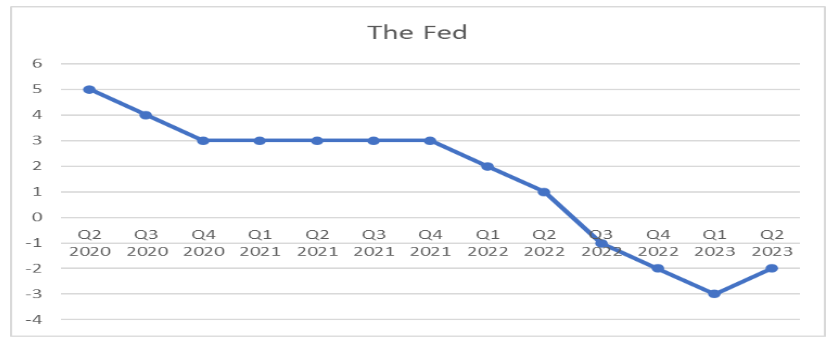
The Fed did everything it could in the immediate aftermath of COVID and the COVID lockdowns. They bought corporate bonds/ETFs, backstopped money markets and corporate new issuance, expanded their balance sheet, and cut rates to zero.
Over time they pulled back on that support. By Q3 of 2022 we saw them acting as a moderate headwind. We should not just expect higher rates for now because the Fed is telegraphing higher rates into the future (while ramping up QT) as well.
By early 2023 the Fed will be a deflationary pressure.
That will start to reverse course as the Fed backpedals (likely smaller QT before rate cuts). In any case, on a standalone basis this might be the right policy, but given how the other factors are behaving, it may be a mistake.
Stimulus
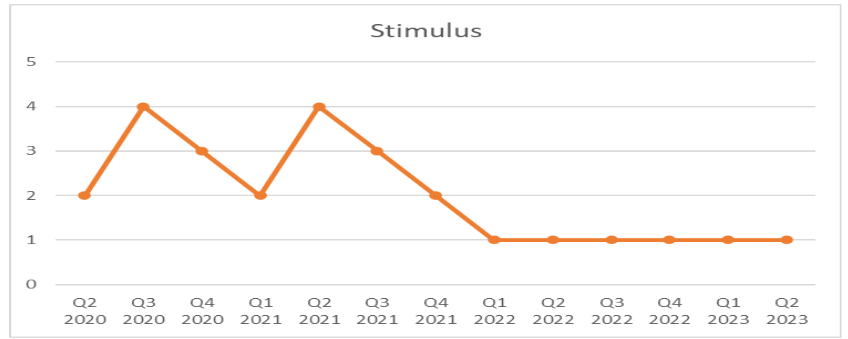
Stimulus started slowly, ramped up, tailed off, ramped back up again, and is now in the process of declining. We’ve left it as a small positive factor for much of this year and next year.
The bump in Q2 2021 may have been the most awkward of the inflation drivers as yet another stimulus package was passed long after there was an obvious need for it (the very nature of inflationary).
We didn’t get a “bounce” in the factor when the so-called “Inflation Reduction Act” was passed, because it wasn’t heavily front loaded, but it is why we leave stimulus as a positive factor going forward.
Supply Chain
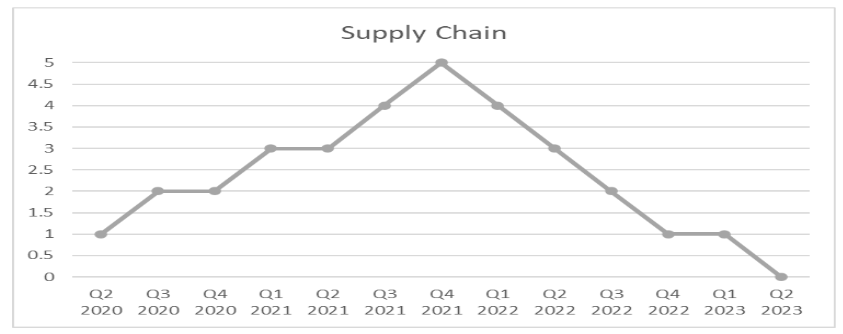
The supply chain issues didn’t manifest themselves right away. In Q2 2020 oil (WTI) futures briefly traded negative. Yes, there were all sorts of weird shortages and mismatches during that time. You could get rolls and rolls of industrial grade toilet paper if you could figure out where to go, but it was virtually impossible to get high quality toilet paper (I’m sure there were other initial issues, but that one sticks out).
It was only over time as we re-opened and inventories got whittled down that supply chain issues started to mount. Add to that the fact that there weren’t enough workers at the docks to unload (let alone ship) things. Supply chain constraints were off the charts (as was the cost of shipping). However, those costs have since come down.
There are still some supply chain issues. Shipping isn’t great, but other issues are much smaller now. Offsetting that pressure further are the inventory builds that we’ve seen across so many industries. It is still a moderately inflationary factor, but should go away by Q2
War
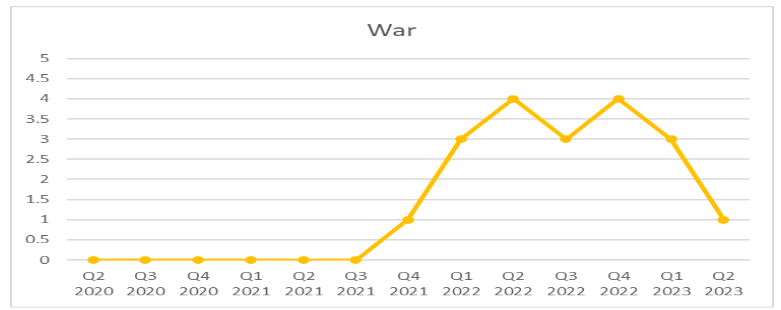
Russia invaded Ukraine in Q1 2022, but as troops were building up before that, we started to see some pressure on commodity prices that could be attributed to the war risk. That escalated post invasion as sanctions took hold. It abated a little in the summer on the energy front (seasonal) and as some deals were attempted on the commodity front. It has ramped back up and that will continue into Q1 of next year and then it should subside into the summer again.
Disruptive
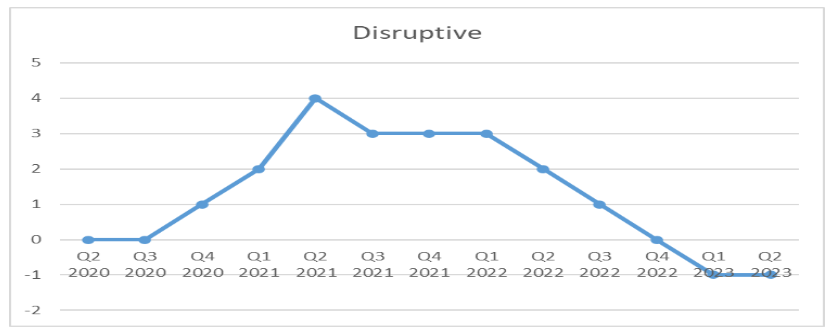
This doesn’t exactly follow the chart of bitcoin, ARKK, or SPAC issuance, but it is probably somewhat linked. Were those just a factor of the other factors, or a factor in their own right?
The wealth created and spent in this subset of the universe (which was unique to this period) is its own driver. It ties into my argument that jobs lost will NOT be the metric of this recession, rather it will be jobs lost multiplied by average pay that will define this recession.
I’m hearing this from programmers, software and hardware sellers, and event planners. The wealth created and spent was enormous, concentrated, and inflationary.
The Whole Picture
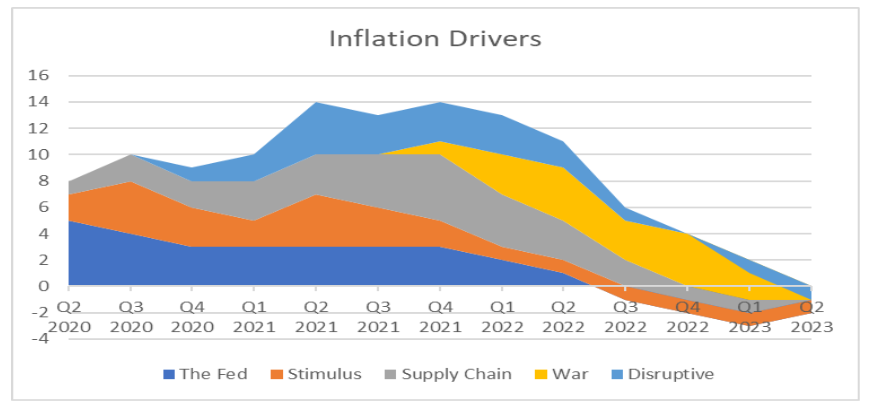
This chart might be a little bit messy, but it is a useful illustration of how these various factors have worked to drive inflation.
Thinking about these factors and when they started to turn down (and how inflation/the economy have followed) sends a somewhat chilling message if they are correct.
We are seeing little to no inflationary (growth) pressures in the economy in Q1, yet we are behaving as though fighting inflation is still job number 1.
Bottom Line
Look for growth and inflation to slow, regardless of what the Fed does going forward. Inflation was driven by many factors, most of which are receding on their own.
We have seven weeks of data after this Fed meeting and will be entering into Q4 earnings. I have little reason to be optimistic unless something about these risk factors change. It would be great to have discussions on the appropriateness of these factors and their relative importance.
This model may have many errors, but I welcome the opportunity to discuss/refine it and hopefully it gives you some food for thought on why our inflation and growth projections are on the pessimistic side of consensus.
Good luck on Wednesday and get ready for the next 7 weeks!


(ZH) Dupe Or Designated Defendant? The Criminal Case Against Jack Dorsey

Dupe Or Designated Defendant? The Criminal Case Against Jack Dorsey

The latest Twitter disclosures have raised potential legal liability for Twitter and its executives. No one appears more at risk than Twitter’s former CEO Jack Dorsey
It is an ironic turn of events since Dorsey supported the takeover by Elon Musk and has called for all files to be released without filtering. Dorsey has the feel of a “designated defendant,” someone who was pushed forward by others to take any legal hit.
On its face, Dorsey has vulnerability after the latest release. He was repeatedly asked by members of Congress about censoring and shadow-banning, which has now been confirmed in these files.
In September 2018, Dorsey testified under oath and denied what these files appear to now confirm. Rep. Mike Doyle, D., Pa., asked, “Social media is being rigged to censor conservatives. Is that true of Twitter?”
Dorsey responded, “No.”
Doyle then asked “Are you censoring people?”
“No,” Dorsey said.
“Twitter’s shadow-banning prominent Republicans… is that true?” Doyle asked.
Dorsey again said no.
Dorsey was also asked about my prior testimony on private censorship in circumventing the First Amendment as a type of censorship by surrogate. Dorsey and the other CEOs were asked about my warning of a “‘little brother’ problem, a problem which private entities do for the government that which it cannot legally do for itself.” In response, Dorsey insisted that “we don’t have a censoring department.”
It now appears that the entire company was operating as a censoring department. However, there were in fact super-censors. Dorsey did not mention the Strategic Response Team-Global Escalation Team (SRT-GET), which operated above what journalist Bari Weiss described as “a level beyond official ticketing, beyond the rank-and-file moderators following the company’s policy on paper.”
That group reportedly included Vijaya Gadde, head of Legal, Policy and Trust; Yoel Roth, the global head of Trust and Safety; CEOs Jack Dorsey and Parag Agrawal, and others.
Notably, others at the company made similar denials as Dorsey but may not have done so under oath. In 2018, Gadde and head of product Kayvon Beykpour expressly declared, “We do not shadow-ban. And we certainly don’t shadow-ban based on political viewpoints or ideology.”
Even if untrue, lying in public is generally not a crime. However, when you repeat a lie to federal investigators or Congress or the courts, it becomes a federal offense.
The question is whether Dorsey was left in the dark on these decisions. He was reportedly a member of SRT-GET. However, some of the files indicate that these decisions may have been made without his knowledge. That includes the decision on the Hunter Biden laptop scandal, which Dorsey called a “total mistake.”
Dorsey could quibble over the term “shadow-banning” but the question was obviously meant as a follow-up to the inquiry over “rigging” discourse on the platform. He could also stress other answers, where he tied “shadow-banning” to a more subjective notion of political bias. For example, Dorsey also repeated these statements in public, including an appearance with Sean Hannity on Fox, when he was asked if “Twitter has ever been involved in shadow-banning, Dorsey again categorically denied such practices: “We do not shadow-ban according to political ideology or viewpoint.”
For most people, Dorsey’s comments clearly suggested that there was no shadow-banning. However, he could claim that he knew that they were shadow-banning but that they were not doing so “according to political ideology or viewpoint.” That is clearly refuted by the new files showing a hair-triggered censorship system directed against conservative and Republican posters.
The other defense is lack of knowledge but, even if accepted, that will raise the question of whether this was a case of a designated defendant or willful blindness.
In some cases, there is a suspicion that corporations will assign some executive to sign off on compliance or certifications as the fall guy or designated defendant if things go wrong. The chump is often a junior lawyer or executive who takes personal responsibility for certifying a false fact.
Dorsey is clearly no chump or junior executive. The question is then whether this was a case of willful blindness or an attempt by other executives like Gadde or Roth to give him plausible deniability by keeping him in the dark. He then became the public face in unequivocally and confidently denying practices like shadow-banning.
The greatest defense for Dorsey may be found in the Justice Department itself. Any prosecution of Twitter executives could prove a hard sell for Attorney General Merrick Garland, whose department has been repeatedly accused of pronounced political bias.
While Garland has aggressively pursued contempt sanctions against Trump associates, it is not clear if he would prove as aggressive with Democratic allies like Dorsey or other Twitter executives. He could face that question if the House under the GOP pursues perjury or contempt sanctions.
Dorsey once said about Twitter that “It’s really complex to make something simple.” He may now be hoping that his answers before Congress were simple enough to make any prosecution complex.

(ZH) The Twitter Files: The Corporate Media Ignores The Biggest Story Of The Dec

The Twitter Files: The Corporate Media Ignores The Biggest Story Of The Decade
BY TYLER DURDEN
SUNDAY, DEC 11, 2022 - 09:00 PM
The biggest story of the past decade is not the covid pandemic, the January 6th protests, the war in Ukraine, the BLM riots, or even the stagflationary crisis in the US. Behind these major events is another story, one that connects them all together in a disturbing way. Even more important than the effects of geopolitical and economic chaos is the effect of mass censorship; without the free exchange of information and debate the public remains ignorant. And if the public remains ignorant, crisis events have an increasing potential to explode.
Public perception of national and international affairs is a key determinant of the outcome of disasters and conflicts. This is why governments and elitists from around the world often seek to manipulate the ways in which people digest information. The idea is rather simple – They believe that 'we the people' cannot be allowed to come to our own conclusions. They think we cannot be trusted to develop the “proper” viewpoints and we are not smart enough to understand the implications of governmental decisions.
In other words, they believe the exact opposite of what is outlined in the US Constitution. The establishment will give numerous reasons why they need to censor, suppress, spin and misrepresent the facts of any given situation, but in the end the real rationale is that they have a vision for society that is contrary to our foundations. They have appointed themselves the arbiters of reality to see that vision done. As Edward Bernays, the “father of public relations” once stated in his book 'Propaganda':
“The conscious and intelligent manipulation of the organized habits and opinions of the masses is an important element in democratic society. Those who manipulate this unseen mechanism of society constitute an invisible government which is the true ruling power of our country. ...We are governed, our minds are molded, our tastes formed, our ideas suggested, largely by men we have never heard of. This is a logical result of the way in which our democratic society is organized. Vast numbers of human beings must cooperate in this manner if they are to live together as a smoothly functioning society. ...In almost every act of our daily lives, whether in the sphere of politics or business, in our social conduct or our ethical thinking, we are dominated by the relatively small number of persons...who understand the mental processes and social patterns of the masses. It is they who pull the wires which control the public mind.”
This is pure authoritarianism. It's the stuff of nightmares and revolutions. But for many years now a large subsection of the world has denied such a dynamic exists. It's “conspiracy theory” and “tinfoil hattery” to claim that a small number of elites work together in secret to control public perception and govern our society from the shadows. After all, where is the proof?
Of course, this kind of argument is a coping mechanism for the mentally deficient. Proof of such secretive governance and control is everywhere these days, but some people prefer willful denial. Take for example the ongoing data drops for what is now being called “The Twitter Files.”
The mainstream media is barely responding to the information dump initiated by Elon Musk. They seem to be far more interested in Donald Trump's tax records. When they are forced to acknowledge the story, they are hostile, calling the information “boring” or unimpressive. It's a classic psychological tactic of typical narcissists and criminals – When they get caught, they act indifferent, as if neither the evidence nor their crimes really matter. If getting caught doesn't matter to them, then their crimes must not be all that bad, right?
The content of these files is astonishing, but at the same time it is true that the conclusions are not surprising.
The files simply confirm almost everything conservative and libertarian commentators have been saying for years; all those “conspiracy theories” about Big Tech censorship of conservatives turned out to be true. Not only that, but the theory that government agencies and officials from the DNC worked with Big Tech to silence and undermine their political opponents was also true.
Twitter has long denied that they “shadow ban” users, but this was a lie. The data shows that small groups within Twitter called “strategic response teams” suppressed up to 200 accounts per day. Usually these were accounts of larger and more influential conservative politicians and celebrities. And, these teams operated in coordination with Democrat officials and agencies like the FBI. In some cases the goal was to mute a particular individual. In other cases the goal was to steer national elections.
Internal Twitter communications show that SRT groups spent most of their time fabricating reasons why certain information was subject to TOS. In other words, if Twitter's rules were not being violated, they made up new rules.
The exposure of Twitter is the biggest story of the decade because it provides proof of a hidden cabal. It shows the ugly mechanics behind the scenes and exposes a network of elites and their errand boys who were involved in direct operations to destroy the 1st Amendment for the sake of ideological supremacy.
It's the classic definition of fascism, a definition that Benito Mussolini reiterated when he argued: “Fascism should more properly be called corporatism because it is the merger of state and corporate power.”
And, if this brand of Fascism was happening within the halls of Twitter, then there is little doubt it is also happening at companies like Google/YouTube, Apple, Facebook, etc. Before we had evidence, now we have confirmation.
The corporate media argues over relevance instead of morality because they benefited from the censorship. It's important to remember that one of the first measures Big Tech companies applied after suppressing the alternative media during the pandemic was to then amplify the corporate media. These companies are floundering with dismal audience numbers and dwindling profits. No one listens to them anymore. Yet, as long as they promote the establishment narrative their opinions and disinformation are given priority on nearly every search engine and social media platform.
Of course they aren't interested in the Twitter Files, liars are often “bored” by honest commentary and factual information. Also, their continued existence relies on the censorship of their competition in the alternative media.
The bottom line is this: According to the Bill of Rights, it is illegal for agents of the US government to obstruct the free speech of law abiding American citizens. It does not matter if the action is done by using “private businesses” as middlemen. And, if a private business is colluding with government to implement political policy then it is no longer a private business. Twitter was participating in a form of treason, along with the agencies that they cooperated with. It's a huge story, and one that should lead to punishment for those involved.

Business Of Fashion : How Hedi Slimane Doubled Celine Sales

How Hedi Slimane Doubled Celine Sales
The brand, which has surpassed €2 billion in annual revenue, celebrated its momentum with a fashion show-meets-concert in Los Angeles, where the biggest rock star was arguably the designer.

LOS ANGELES — On Thursday night, as a cold(ish) spell passed through Southern California, the designer Hedi Slimane lit up the facade of the Wiltern, an art deco theatre in Hollywood, with the name Celine, manufacturing a fashion show-meets-rock concert straight out of 2005.

The crowd consisted not of fashion industry people, but friends-of-the-house types. Iggy Pop, Interpol and The Strokes all performed. The Kills’ Jamie Hince and Alison Mosshart DJed. The White Stripes frontman Jack White created the “original soundtrack” that ran on repeat during a runway show populated with idealised takes on the looks that epitomised the era, from kneecap-tight skinny jeans to slouchy boots and ruffled blouses — even a version of the dropped-hem mini so ubiquitous at the time. (Only Pete Doherty, one of the period’s most memorable, and maniacal, rock stars, was missing.)

Slimane called the outing the “Age of Indieness.” Back in the mid-aughts, the then-Dior Homme designer’s skinny silhouettes were made for men, even if they were also worn by adventurous women. Now, he’s mining the look — rebranded “indie sleaze” by the TikTok generation — to create women’s pieces he might have dreamed up 20 years ago.

But Slimane’s continuous playing of the same backbeat has proven to be a valuable asset. For this performance, he once again sold the audience — including several rows of celebrities, from Sonic Youth’s Kim Gordon to “Top Gun: Maverick” star Miles Teller to Dustin Hoffman — on sequined gold dresses, little collarless jackets and military capes, now inflected with the 1970s bourgeois sensibilities in the DNA of Celine, where Slimane has more than doubled sales since his arrival.

Celine doesn’t have as rich a history, nor as many recognisable brand signifiers, as Saint Laurent, the Kering-owned house that Slimane rebuilt in the 2010s. And yet, this year, it is expected to generate at least €2.2 billion ($2.3 billion) in annual revenue, according to analysts, just meeting the target set by LVMH chief executive and chairman Bernard Arnault in 2018. That’s despite a rocky start — Slimane’s radical overhaul of the brand upset devotees of former designer Phoebe Philo — and the shock of the pandemic.

While LVMH does not break out revenue figures for its brands, Celine did share that revenue has multiplied 2.5 times since Slimane’s arrival, with growth across all categories and regions, even in struggling China. In mature markets like Europe and Japan, sales have doubled. In the United States, where the brand was historically unrepresented, they have tripled. And not only are there more customers, but they are younger than they used to be.

“He’s consistent, and the customer today values consistency more than ever,” said Robert Burke, a retail advisor. “They don’t want to look like a fashion victim. There’s some certainty, stability, with Celine.”

For Slimane, there’s no other way of working. “You can only be one thing and only want to be one thing or remembered for one thing … you can only be lucky enough to have one style, a style of your own that becomes a caricature of you, your own ‘sound,’” the designer told journalist Lizzy Goodman during a November 2022 conversation that appeared in a hard-cover pamphlet sent out by the brand. (He also collaborated with Goodman on a poster for the documentary based on her book, “Meet Me in the Bathroom: Rebirth and Rock and Roll in New York City 2001-2011.”) “I’m probably synonymous [with] punk rock and indieness in fashion, beside being known for my androgynous models. I have been precisely this in fashion for more than 20 years. This is the caricature I gladly own.”

At Celine, Slimane’s insistence on consistency is evident in the way he has developed each category. The brand’s handbag offering still includes successes from Philo’s tenure — her Belt bag remains the best seller at Neiman Marcus, for instance. But from removing the accent on the “e” on each bag’s name stamp, to introducing new styles that look at once familiar and fresh, every little bit now reflects his exacting vision.

Burke cited the Ava, a banana-boat shoulder bag that starts at just $990, as a standout, although the Triomphe line, a series of flap bags with a double-C clasp — featured heavily in the show — is now the brand’s top-selling leather-goods range. Part of the allure may be Celine’s relatively low reliance on logos, especially as some shoppers back away from obvious branding: the Triomphe symbol, which has been inserted into sunglasses and belts, too, has a vintage, fairly understated quality.

“Our customer is embracing the idea of a more subtle logo,” said Lana Todorovich, chief merchant at Neiman Marcus.

But it’s not only the bags that are selling. Women’s ready-to-wear has also grown significantly this year in particular, according to multiple retailers. At Neiman Marcus, for instance, sales of Celine ready-to-wear have tripled since 2019.

“When we came out of the pandemic, there was a desire to celebrate in an extroverted way,” Todorovich said. “Now, a normalised way of approaching fashion is coming back.”

Slimane’s talent is in making the best-in-class version of “normal,” everyday items — vintage Levi’s, a trench, a blazer — or the types of things that most luxury shoppers don’t have the patience, or acumen, to thrift. At Celine, he has restructured the atelier into two divisions — tailoring and flou — to allow for the development of couture-level garments, which account for roughly 20 percent of the overall runway collection.

And like most other top-tier fashion brands, Celine has ventured further and further into the highest end of pricing, not only with accessories — such as the personalised Haute Maroquinerie Triomphe, with hardware made of 18k gold — but also through the couture-like pieces it designs for its growing list of private clients.

A show in Los Angeles, where Slimane lived for almost a decade until 2016, highlights the importance of the US market, which has played an outsized role in top-line growth for luxury brands in recent years. But it was also something of a celebration of Celine’s momentum.

“Where Celine is today and where it was a few years ago is night and day,” Burke said. “They’ve nurtured it, and now it’s able to stand on its own.”

>>> Europe : Brokers Upgrades & Downgrades - 12th of December 2022 V2(+)

>>> Up
* Adevinta Raised to Neutral at Citi; PT 73 kroner
* Air France-KLM Raised to Hold at Stifel; PT 1.20 euros
* Alcon Raised to Buy at Citi; PT 78.67 Swiss francs
* Bakkafrost Raised to Buy at Nordea (+)
* Beiersdorf Raised to Sector Perform at RBC; PT 98 euros
* Gap Raised to Buy at Goldman; PT $18
* IAG Raised to Hold at Stifel; PT 129.04 pence
* S Immo Raised to Accumulate at Erste Group; PT 14.50 euros
* Under Armour Raised to Buy at Stifel; PT $12
* Wood Raised to Buy at Jefferies; PT 190 pence

>>> Down
* Bystronic Cut to Market Perform at ZKB (+)
* Capgemini Cut to Equal-Weight at Morgan Stanley; PT 221 euros
* Celon Pharma Cut to Hold at Erste Group; PT 17.50 zloty
* Dalata Cut to Hold at Jefferies
* Deutsche Boerse Cut to Neutral at JPMorgan; PT 186 euros
* Fresenius SE Cut to Hold at M.M. Warburg (+)
* Hexatronic Cut to Hold at Pareto Securities; PT 175 kronor (+)
* IDS Cut to Hold at HSBC; PT 215 pence
* Leroy Raised to Buy at Nordea; PT 55 kroner (+)
* L'Oreal Cut to Underperform at RBC; PT 290 euros
* Melia Hotels Cut to Hold at Jefferies
* MFE Cut to Underweight at JPMorgan; PT 58 euro cents
* Micron Cut to Hold at Deutsche Bank; PT $55
* PPHE Hotel Cut to Hold at Jefferies
* ProSieben Cut to Neutral at JPMorgan; PT 11 euros
* Salmar Raised to Buy at Nordea; PT 400 kroner (+)
* TeamViewer Cut to Underweight at Morgan Stanley; PT 12 euros
* Valoe Cut to Sell at Inderes; PT 2 euro cents

>>> Initiation
* Ageas Reinstated Sell at Goldman; PT 39.50 euros
* Amplifon Reinstated Neutral at Citi; PT 28.50 euros (+)
* Bankinter Rated New Outperform at Autonomous; PT 7.60 euros
* Coinbase Rated New Sector Weight at KeyBanc
* Coloplast Reinstated Neutral at Citi; PT 900 kroner (+)
* ConvaTec Reinstated Neutral at Citi; PT 245 pence (+)
* Demant Reinstated Neutral at Citi; PT 220 kroner (+)
* Elekta Reinstated Sell at Citi; PT 57 kronor (+)
* EssilorLuxottica Reinstated Buy at Citi; PT 210 euros (+)
* Fresenius SE Reinstated Buy at Citi; PT 34 euros (+)
* Fresenius Medical Reinstated Neutral at Citi; PT 32 euros (+)
* GN Store Nord Reinstated Buy at Citi; PT 235 kroner (+)
* Philips Reinstated Neutral at Citi; PT 14.50 euros (+)
* Haypp Group Rated New Overweight at Barclays; PT 60 kronor
* NN Reinstated Buy at Goldman; PT 53.50 euros
* Otovo Rated New Buy at Fearnley; PT 28 kroner
* OVS Cut to Neutral at Banca Akros (ESN); PT 2.40 euros (+)
* Siemens Healthineers Reinstated Buy at Citi; PT 61.50 euros (+)
* Smith & Nephew Reinstated Buy at Citi; PT 1,275 pence (+)
* Sonova Reinstated Sell at Citi; PT 220 Swiss francs (+)
* Straumann Reinstated Sell at Citi; PT 88 Swiss francs (+)

>>> Call
* Accor, Dalata, Melia Cut at Jefferies on Cautious Hotel Outlook
* Ageas New Sell at Goldman on China Exposure, NN Group Rated Buy
* Bank of America expects a recession next year, Moynihan says
* Deutsche Boerse Downgraded at JPM With LSE, Euronext Preferred (+)
* Sanofi Likely to Rise After Walking Away From Horizon: Barclays
* Wood Upgraded to Buy at Jefferies on Stronger Cash-Flow Outlook
* LSE’s Microsoft Partnership Boosts Growth Potential, MS Says (+)
* L’Oreal Cut at RBC as ‘Cracks’ Appearing; Beiersdorf Upgraded (+)
* Morgan Stanley Positioning Defensively on EU Tech Stocks in 2023
* Morgan Stanley’s Wilson Says Stocks Don’t Reflect Earnings Risk

WWD : Intermix Asking Brands for Deep Cuts on Their Outstanding Payments on Curr

WWD : Intermix Asking Brands for Deep Cuts on Their Outstanding Payments on Current and Future Merchandise
The multibrand retailer has a new owner, Regent L.P.

Under new owners Regent L.P., Intermix has been asking brands to take a steep cut in what they’re owed on current merchandise and future orders through the second quarter, wreaking havoc on some small brands that were expecting payments, WWD has learned.

Brands began complaining in November that Intermix had paused payments when the retailer was experiencing financial problems. Last week, WWD reported that Intermix was sold to private equity firm Regent L.P., and that 60 employees were let go, according to informed market sources.

WWD has now learned that Intermix has asked some brands for a 50 percent reduction on outstanding payables on current merchandise and a 50 percent discount on future orders for the first and second quarters. Intermix did not respond to a request for comment Friday.

Several brands contacted declined to discuss the offer on the record, but were clearly upset about the predicament. One brand owner said that Intermix isn’t even offering to give the merchandise back for their own direct-to-consumer channels and sold thousands of units on markdown.

That source said that Intermix is not taking care of its vendors, particularly small vendors that were expecting those funds from merchandise they shipped back in October, and the payment terms were clear. The brand owner feels this move will put a lot of brands in a bad financial position, and does not reflect a good partnership. “You don’t want to build a business in today’s culture if you’re putting people out of business. Pay the bills and cut the deals for the future,” said the vendor.

The source speculated Intermix is testing their loyalty, hoping that if they agree to the terms and business turns around by the third quarter next year, the vendor would be in good stead. However, if they refuse the offer, they might end up in court suing Intermix for what they’re owed, and then they will never be carried again.

Gary Wassner, chief executive officer of Hilldun Corp., the factoring firm, said he’s heard from several of his clients that Regent is asking for a 50 percent discount on payables currently owed, as well as future orders through the second quarter. “What I’m hearing is the response is ‘No.’ Those who have contacted me said it’s not feasible,” said Wassner.

Wassner said that Hilldun’s clients are covered, but others in the market, if they don’t have factor or credit insurance, have a decision to make. “It’s up to the brands to make their independent decisions,” said Wassner.

“It would be a shame for the company [Regent] not to move forward. My belief is we need stores like Intermix in the market. They have to come up with a viable plan in order to move forward,” Wassner said.

According to one financial source, the big problem Intermix had was massive corporate overhead, which they accumulated under Gap ownership. “There’s need for a store like Intermix. There’s no Barneys and we need a showcase store. Half of their business was online,” the source said.

Intermix carries brands such as L’Agence, A.L.C., Cinq a Sept, Altuzarra, Retrofete, Victoria Beard, Ronny Kobo, Farm Rio, LaQuan Smith, Frame, AGoldE, Jonathan Simkhai, Ulla Johnson, Sam, LoveShackFancy, Zimmermann, Jimmy Choo and more.

Jeff Rudes, chief executive officer of L’Agence, said his brand is a top-five brand at Intermix and his business is strong there. “Our finance team said we could be shipping them by the end of the year,” said Rudes. The company had stopped shipping Intermix in early November.

He said Intermix hasn’t come to his firm with the 50 percent offer. He said he believes that only those brands which are heavy with inventory and don’t have good margin results have been approached.

“It’s a reorganization. We have to work with the new organization so they could be profitable. If they have goods that aren’t turning, people have to be responsible for that,” he said.

He said Regent has to have a long-term plan and that he believes the firm is trying to turn all that inventory that’s not turning. For some brands, he said, it makes sense to take that offer because to sell the merchandise to a T.J. Maxx or another discounter and with all the paperwork and shipping costs is not worth it.

“People have a decision to make. It’s different for every vendor. This 50 percent is the worst,” he said. “This is one of those times that if Intermix has a good plan, they should get the support from everybody. Intermix has a lot of good history. Business is not that great. The top five are doing 75 percent of the business.”

He said a lot of the brands “are not carrying their weight in a bad market.”

He said he believes that if the retailer can come back and shrink the business, “Intermix is a powerhouse and will always be.”

Karen Katz stepped down as interim chief executive officer of Intermix last month, and was replaced with James Rushing as interim CEO.

Reports were circulating in the market last week that Altamont Capital Partners had sold Intermix to Regent L.P. A spokeswoman for Intermix said Dec. 3 that a formal announcement to the press wouldn’t be coming out about the sale. But informed sources have confirmed it’s a done deal.

WWD : Della Valle Family Abandons Project to Delist Tod’s Group

WWD : Della Valle Family Abandons Project to Delist Tod’s Group
Chairman and CEO Diego Della Valle said the family is taking the market’s message “carefully and as an incentive to pursue our plans.”

MILAN — Plans to delist the Tod’s Group have come to a halt.

The luxury group will remain a public company for the time being as the Della Valle family said late Friday that its plan to delist through a merger of Tod’s SpA and DeVa Finance, the latter entirely held by DI.VI. Finanziaria di Diego Della Valle & C., is no longer in the cards.

“The price of 40 euros per share offered to the market was the result of a careful analysis carried out with correctness and transparency. However, we noted that some of our shareholders believed the value of the Tod’s group to be significantly higher than our valuation and preferred to remain in possession of their shares,” said Diego Della Valle, sole director of DeVa Finance as well as chairman, chief executive officer and controlling shareholder of Tod’s.

As reported in August, the Della Valle family said it was planning to launch a tender offer to delist the group from the Italian Stock Exchange after 22 years. The owners launched a tender offer to acquire 25.55 percent of the company’s shares at 40 euros per share, with the goal to reach a 90 percent stake for a total of more than 338 million euros.

The move was geared at investing in each brand it controls — Tod’s, Roger Vivier, Hogan and Fay — in the medium and long term without having to report quarterly results.

However, the public offer in October did not fulfill the 90 percent threshold.

During a conference call with analysts to present figures for the first nine months of the year last month, chief financial officer Emilio Macellari noted that although the family had not made a final decision yet, “the transaction is not market-friendly and their attitude is to remain friendly and keep a fair behavior as 54 percent of the market preferred to keep their shares and see what’s next and what kind of value [the Della Valle family could bring to the table].”

In the statement released Friday, Della Valle echoed that sentiment.

“We are taking this message carefully and as an incentive to pursue our plans, which go through the development of the individual brands and their capital enhancement, which we believe have huge growth potential in the medium term,” he said.

As reported, the Italian luxury company posted a 16.4 percent increase in revenues to 724.9 million euros in the first nine months of the year, putting it on track to meet the top-line consensus of a turnover of 974 million euros to 975 million euros in 2022.

In the 12 months ended Dec. 31, group revenues amounted to 883.8 million euros, up 38.7 percent versus 2020.

WSJ : Fast-Fashion Giant Shein Explores Becoming Online Marketplace

WSJ : Fast-Fashion Giant Shein Explores Becoming Online Marketplace
The fast-growing company founded in China has also begun diversifying its supply chain to Europe, according to memo to investors

SINGAPORE—Shein, one of world’s largest online fashion retailers, is exploring moving beyond its conventional business of selling its own brand apparel into a marketplace platform that will enable other merchants to sell directly to customers, according to a memo to investors viewed by The Wall Street Journal.

The fast-growing company, now based in Singapore, is also diversifying its supply chain away from China, where Shein was founded. It has started manufacturing in Turkey since midsummer, and has leased and operated warehouses in Poland to store merchandise and ship to customers in Western Europe, according to the memo.

The company’s supply chain is largely rooted in China’s southern Guangdong province, the country’s major manufacturing hub where it has a network of more than 3,000 suppliers.

“The marketplace platform makes available a range of additional merchandise and shipping options, and we expect it to result in increased customer engagement and satisfaction,” the memo said.

Shein has grown rapidly into one of the world’s top online retailers based on a business model offering a large assortment of apparel at ultralow prices tracking quickly shifting fashion trends. Valued at more than $100 billion and backed by big-name investors such as Sequoia Capital China and General Atlantic, the company is on track to generate revenue of $24 billion this year.

Creating a marketplace would put Shein in more direct competition with e-commerce giants such as Alibaba Group Holding Ltd. ’s international shopping site AliExpress and Amazon.com Inc., at a time when retailers globally are seeing growth slow amid economic uncertainty and consumer spending is weakening in some markets.

Shein didn’t immediately respond to a request for comment.

Shein, founded in Nanjing in China’s Jiangsu province in 2012, moved into its new global headquarters at Marina Bay Financial Centre in Singapore in February 2021. Since then its head count has increased from five people to about 100, including senior executives taking global and regional roles, the memo said.

Shein currently sells and ships products to more than 150 countries and carries pricier clothes such as evening gowns as well as household goods. It has become a major rival to European fast-fashion giants including Inditex SA’s Zara and H&M Hennes & Mauritz AB, which sell apparel and accessories in stores and online. Shein differentiated itself from its competitors with an “on demand” manufacturing model that uses proprietary software to track production in real time and gauges customer preferences and demand using algorithms that incorporate sales, browsing behavior on its app and other data.

Given its heavy reliance on Chinese suppliers, Shein has also faced increasing questions in the U.S. over its use of cotton from China’s far-western region of Xinjiang, where authorities are accused of suppressing the Uyghur Muslim population.

A new U.S. rule took effect this year called the Uyghur Forced Labor Prevention Act that allows American customs officers to seize shipments of any goods that are made in Xinjiang unless companies can prove their supply chains aren’t tainted with forced labor.

In its memo, the company told investors that Shein doesn’t have any suppliers located in the Xinjiang region, and it is company policy not to work with any of the entities identified on the act’s Entity List. The company regularly checks that its suppliers meet the requirements, it said. China has denied forced labor and suppression of the Uyghurs.

FT : Bulb sale to Octopus risks breaching EU state aid rules, Centrica warns

Bulb sale to Octopus risks breaching EU state aid rules, Centrica warns
British Gas owner says contentious deal may lead to test of Northern Ireland protocol

The government’s sale of nationalised energy supplier Bulb may be in breach of EU state aid rules in Northern Ireland, Centrica has said, risking one of the UK’s first significant showdowns with the bloc since Brexit.

Companies challenging the sale to Octopus Energy have focused on the government’s alleged provision of state funds to smooth the sales process, which they warned may lead to a test of the so-called Northern Ireland protocol, given Bulb’s operations in the region.

The sale of Bulb, which received the biggest state bailout since the financial crisis, has become increasingly contentious as rival energy suppliers led by British Gas owner Centrica have moved to block the sale in court.

The companies claim the deal, which would create one of the largest retail energy suppliers in the UK, could distort competition in the UK energy market and cost taxpayers and households more than if a transparent sales process had been followed.

In court documents filed last week Centrica cited “serious public interest issues” regarding the deal including “the UK’s compliance with its international obligations under the UK/EU Trade and Cooperation Agreement” and the “Ireland/Northern Ireland protocol”.

“This is one of the most politically sensitive subsidy cases to have emerged since Brexit and the Northern Ireland aspect of the claim compounds that,” said Ben Rayment, competition expert at Monckton Chambers. “It’s interesting to see the Northern Ireland/EU dimension being used tactically to exert more pressure.”

The question of whether an unlawful subsidy has been granted under post-Brexit UK legislation will be decided in the domestic courts but if EU state aid rules also applied, the bloc’s approval would be needed, said Rayment.

While the EU has not intervened in the case, legal experts and academics said the chance of the European Commission doing so was growing. 

“In a time where national measures to support energy companies are causing so many concerns in the EU, this is going to be a case closely monitored in Brussels as well,” said Andrea Biondi, director of the Centre of European Law at King’s College London.

In its post-Brexit deal with the EU, the UK agreed to introduce domestic rules that regulate subsidies that have, or could have, an effect on trade with the EU.

Under the separate Northern Ireland protocol to the Withdrawal Agreement, EU state aid rules could also continue to apply if a UK subsidy affects trade in goods or wholesale electricity between Northern Ireland and the continental bloc. 

Centrica has alleged in court documents that the EU regime applies in addition to the domestic rules as Octopus owns a company that manufactures heat pumps in Northern Ireland, and the subsidy to Octopus could affect rival suppliers that trade with the EU. 

State aid — or government financial help for a business — is normally prohibited if it threatens to distort competition between companies unless there is a public interest justification.

The government has not revealed the terms of the deal but the three companies challenging the sale believe Octopus may be receiving about £1bn from taxpayers to cover the cost of buying power for Bulb’s 1.5mn customers. The transfer of Bulb’s customers is due on December 20, but a hearing to review the process is expected in February.

The Office for Budget Responsibility has estimated that the cost to consumers of the Bulb bailout could rise to £6.5bn or roughly £200 per household. Although the expense is currently being paid for by taxpayers, the Treasury is intending to pass the costs on to households via their energy bills next year.

Centrica and Octopus declined to comment.