The Murdoch family trust: how the scions could battle for control
The proposed Fox-News Corp merger could portend a realignment of the interests of Rupert Murdoch’s children
We need to pay more attention to misaligned signals on the global economy
Investors should be wary of a repeat of last year’s ‘transitory inflation’ type of mistake
Inflation was the dominant economic and financial issue of 2022 for most countries around the world, particularly for those advanced economies that have consequential impact on the global economy and markets.
The effects were felt in worsening living standards, higher inequality, increased borrowing costs, stock and bond market losses and the occasional financial accident (fortunately small and contained until now).
In this new year, recession, actual and feared, has joined inflation in the driver seat of the global economy and is likely to displace it. It’s an evolution that makes the global economy and investment portfolios subject to a wider range of potential outcomes — something that a growing number of bond investors seem to realise more than many equity counterparts.
The IMF is likely to soon revise down its economic growth projections again, expecting that “recession will hit a third of the world this year”. What is particularly notable to me in this deteriorating global outlook is not just that the world’s three main economic areas — China, the EU, and the US — are slowing down together, but also that this is happening for different reasons.
In China, the messy exit from a misconceived zero-Covid policy is undermining demand and causing more supply disruptions. Such headwinds to domestic and global economic wellbeing will continue as long as China fails to improve the coverage and effectiveness of its vaccination efforts. The strength and sustainability of the subsequent recovery will also require that the country more aggressively revamps a growth model that can no longer piggyback on greater globalisation.
The EU continues to deal with energy supply disruptions as Russia’s invasion of Ukraine persists. Strengthened inventory management and the reorientation of energy supplies are well advanced in many countries. However, they are not yet sufficient to lift the immediate constraints on growth let alone resolve longstanding structural headwinds.
The US has the least problematic outlook. Its growth headwinds are due to the Federal Reserve’s scrambling to contain inflation after having grossly mischaracterised price increases as transitory and then been initially too timid in adjusting monetary policy.
The Fed’s shift to an aggressive front-loading of interest rate hikes came too late to prevent the spread of inflation into the service sector and wages. As such, inflation is likely to remain stubborn at around 4 per cent, be less sensitive to interest rate policies and expose the economy to a higher risk of accidents induced by additional policy mistakes undermining growth.
The uncertainties facing each of these three economic areas suggest that analysts should be more cautious in assuring us that recessionary pressures will just be “short and shallow”. They should keep an open mind, if only to avoid repeating the mistake of prematurely dismissing inflation as transitory.
This is particularly important as these diverse drivers of recession risk make financial fragilities more threatening and policy transitions harder, including Japan’s likely exit from its interest rate control policies. The range of potential outcomes is unusually large.
On the one hand, a better policy response, including to improve supply responsiveness and protect the most vulnerable segments of the population, can counter the global economic slowdown and, in the case of the US, avoid a recession.
On the other hand, additional policy errors and market dislocations can lead to self-reinforcing vicious cycles with high inflation and rising interest rates, weakening credit and pressured earnings, and market functioning stress.
Judging from market pricing, more bond investors are understanding this better, including by refusing to follow Fed’s guidance on interest rates this year. Rather than a sustained path of higher rates for 2023, they believe that recessionary pressures will lead to cuts later this year. If right, government bonds would offer the returns and portfolio risk mitigation potential sorely missed in 2022.
Parts of the equity market, however, are still pricing in a soft landing. The reconciliation of these different scenarios is of importance to more than investors. Without better alignment within markets and with policy signals, the favourable economic and financial outcomes we all desire will prove not just less likely. They will also be challenged by the risk of more unpleasant outcomes at a time of lower economic and human resilience.
Government forced to pay Atos £24mn over Met Office supercomputer procurement
French group claimed its bid was unfairly rejected
The UK government was forced to pay out £24mn to Atos in an out-of-court settlement after the French IT group challenged the award of an £850mn contract to develop a supercomputer for forecasting weather and climate change to US rival Microsoft.
The French company, which was the only other shortlisted bidder, filed a lawsuit in May last year alleging breaches in the government’s obligations under the public procurement regulations but it was settled before it went to court.
The new supercomputer, which will be managed by the Met Office, is expected to be one of the most advanced in the world for weather prediction and climate change analysis. The cost of the overall project is put at £1.2bn.
The terms of the settlement were not disclosed at the time but the latest annual report of the Department for Business, Energy, and Industrial Strategy reveals there was a payout of £24mn to Atos without an admission of liability.
The opposition Labour party accused the government of wasting taxpayers’ money. “This is yet another example of the Conservatives failing to take care of public money. While families are counting every penny, the Tories are shelling out taxpayers’ cash to pay for their own mistakes,” said Angela Rayner, Labour’s deputy leader.
The government said: “The proceedings regarding supercomputer procurement have been resolved with no admission of liability from any party. This settlement is in the best interest of taxpayers.”
It added that an “independent review has assured that all procurement processes were followed and there were no failures associated with governance or lack of controls”.
In its lawsuit, Atos alleged the procurement process was not managed properly after its tender was non-compliant with technical specifications. The dispute centred on requirements to supply two test supercomputers and a development supercomputer in addition to the main supercomputer system, where the systems were all required to be “architecturally equivalent”.
Atos alleged that the government rejected its bid as “non compliant” on the basis that its proposal for a smaller development computer system used different processors in the main supercomputer, according to court documents.
The company claimed that the government made “obvious errors in the evaluation” of the bid and that the “Met Office has chosen a final tender which scored lower in quality, transferred more commercial risk to the Met Office and is more expensive”.
The Met Office and BEIS denied the allegations, and alleged that Atos proposed a non-compliant solution and that its offer was not “the most economically advantageous”.
Atos said in a statement that it was “pleased to have resolved this matter”.
The new computer is expected to be in the top 25 supercomputers in the world and will be used to more accurately predict storms as well as help select the most suitable locations for flood defences and predict changes to the global climate.
The new supercomputer will also provide detailed information for the energy sector to help it take action against potential blackouts and power surges.
Our Top 7 Predictions For What 2023 Has In Store For The Startup World
Coming off a record-breaking 2021 for startup investment, this year has marked a hard reset to more normal times. As we head into 2023 with recession fears top of mind, here are a few of Crunchbase News’ top predictions for what the new year has in store, based on our reporting.
1) IPO markets will remain sluggish, but if anybody is going public it could be these companies. While market conditions remain crummy, there’s also a huge backlog of late-stage startups that have to find an exit at some point. With that in mind, we offered up ideas for 15 companies — ranging from logistics unicorn Flexport to grocery delivery app Instacart — that could be public-market candidates if and when the IPO markets open back up.
2) Expect more M&A as companies go bargain shopping: Speaking of exits, we could see more mergers and acquisitions in 2023, dealmakers predict. Although rising interest rates make capital more expensive, there are plenty of deep-pocketed buyers who already have money to spend and could go bargain-hunting as startup valuations drop, sources told Senior Reporter Chris Metinko.
3) Cybersecurity valuations will come back to Earth: Even the well-funded cybersecurity sector isn’t protected from valuation drops. Industry experts who spoke with Chris about the outlook for cyber startups in 2023 say they expect fundraising and valuations will continue to soften. That’s despite 2022 easily being the second-best on record for VC funding to cyber companies.
4) Fintech will remain hot, despite the crypto crash: Fintech was the largest recipient of venture dollars in 2022, despite an overall drop in VC funding this year and despite high-profile crypto companies going bust. Next year will likely see continued investment in fintech companies, particularly in the B2B payments and business services space, though we should expect to see a pullback in crypto funding in the wake of FTX’s collapse, Senior Data Editor Gené Teare reports.
5) Investors may be losing their appetite for plant-based meat: Investment into plant-based meat startups has come to a standstill, Keerthi Vedantam reports, noting that funding into the sector fell from almost $2 billion in 2021 to around $800 million this year. The challenges are likely to continue next year as startups try to find a way to deliver plant-based meat products at a reasonable price to consumers, who mostly are not vegan or vegetarian. Still, the alternative meat industry did end the year on a good note, with the FDA in November approving California-based Upside Foods’ lab-grown chicken as safe for human consumption.
6) Biotech offers a rare bright spot: One area that could see continued investment even during a downturn? Biotech, specifically those companies involved with the so-called “omics” — think genomics, transcriptomics, metabolomics and proteomics. That’s because, as Keerthi notes, “many of these startups can turn a profit long before they actually make and sell a drug, simply by licensing out their platform to other biotech companies and employing a fee-for-service model.”
7) Novelty is in, copycats are out: Expect to see fewer startups position themselves as the “Uber of X” or the “Shopify of Y” next year, contributing reporter Joanna Glasner writes. While during times of easy money, VCs tended to glom on to follow-on startups riding a hot trend, that era is likely now over. Instead, “startup investors will be looking for novelty in the companies they back,” Joanna predicts. “Out with the me-too business plans. In with those quirky or differentiated enough to stand on their own.” And what are some of those startups? She offers a few picks, from bee startups to a defense tech unicorn.
The Week’s 10 Biggest Funding Rounds: SpaceX Takes Off In New Year; Netskope Secures $401M
Despite last year’s decline in venture capital investment, the first week of the new year saw some sizable deals. Three were more than a quarter-billion dollars, and the top seven made it into the nine-figure realm. This week may be more of an outlier than a harbinger of things to come in light of recent headlines of layoffs and a looming recession, but it still is a big kickoff to the new venture year.
1. SpaceX, $750M, space: Elon Musk’s rocket and satellite company raised a lot of cash in 2022, and this year may be more of the same. SpaceX is looking to raise a fresh $750 million round at a $137 billion valuation, CNBC reported. The report also said an email revealed a16z will likely lead the new funding round — the same VC firm also helped Musk in his $44 billion Twitter buyout. The Hawthorne, California-based startup raised $1.68 billion in June 2022 that valued it at more than $125 billion. The space startup quickly added another $250 million in July. It has raised a total of nearly $10 billion, according to Crunchbase data. Previous investors in the company include NASA, Stack Capital, Bracket Capital and the United States Space Force, among others.
2. Netskope, $401M,cybersecurity: There must be something about cybersecurity startups and $401 million in convertible notes. In October, Eden Prairie, Minnesota-based Arctic Wolf raised $401 million in convertible notes led by existing investor Owl Rock. This week another startup, Santa Clara, California-based Netskope received a $401 million convertible note investment led by Morgan Stanley Tactical Value. Both Netskope and Arctic Wolf are companies that have been rumored to be IPO candidates for the past few years, so such financings make sense with the path to the public market blocked. Convertible notes work like a short-term loan, but are repaid to the investor at a later point in equity — i.e. after an IPO — typically at a discount and can also include an interest rate. Founded in 2012, Netskope has now raised $1.4 billion, per Crunchbase.
3. Silicon Ranch Corp., $375M, renewable energy: Silicon Ranch Corp. actually announced a $600 million raise this week, but only the initial funding of $375 million has closed, with the additional $225 million expected to fund in early 2023. Founded in 2011, Silicon Ranch provides customized renewable energy, carbon and battery storage solutions for a variety of partners across North America. Last year, the company installed 11 new solar facilities that produce nearly 700 megawatts of new generating capacity. Silicon Ranch is no stranger to large raises; it raised $775 million early last year. The company has now raised about $1.6 billion, per Crunchbase.
4. Asimov, $175M, biotech: Biotech was big in a slow week, and Boston-based Asimov led the way with a $175 million Series B led by Canada Pension Plan Investment Board. The startup is developing a synthetic biology platform to design and manufacture next-generation therapeutics, including biologics, cell and gene therapies, and RNA. It currently partners with more than 25 companies that include pharmaceutical companies, biotechs and manufacturing organizations. Founded in 2017, Asimov has raised more than $200 million, per the company.
5. (tied) Chronosphere, $100M, analytics: New York-based Chronosphere, which helps companies monitor their cloud-based applications, raised $100 million from GV, per a report in The Information. Founded in 2019, the startup has now raised more than $350 million, according to Crunchbase.
5. (tied) Metagenomi, $100M, biotech: Metagenomi apparently was in no rush to close its Series B. Almost a year after announcing it had raised $175 million, the biotech company decided to add another $100 million in a Series B extension financing, co-led by Novo Holdings A/S, Catalio Capital Management and Symbiosis. The Emeryville, California-based genetic medicines company has raised more than $450 million, according to Crunchbase data. The startup uses metagenomics and machine learning to discover genome editing systems for therapeutics.
5. (tied) Synthekine, $100M, biotech: Menlo Park, California-based biotherapeutics startup Synthekine closed a $100 million Series C led by The Column Group. Founded in 2018, the company has raised nearly $290 million, per Crunchbase.
8. Ensoma, $85M, biotech: Boston-based genomic medicines company Ensoma closed an $85 million financing co-led by Arix Bioscience and 5AM Ventures. Founded in 2019, the startup has raised $155 million, per Crunchbase.
9. Perceive Biotherapeutics,$78M, biotech: South San Francisco, California-based Perceive Biotherapeutics raised a $78 million Series B led by Johnson & Johnson Innovation. It is the company’s first announced round, according to Crunchbase data.
10. (tied) Belharra Therapeutics,$50M, biotech: San Diego-based Belharra Therapeutics came out of stealth this week in a big way — securing $130 million. First, the startup — which has developed a chemoproteomic-based drug discovery engine — locked up a $50 million Series A from founding investor Versant Ventures. It also announced a multiyear collaboration with Genentech that will provide the startup with $80 million in upfront capital.
10. (tied) Nano-C, $50M, advanced materials: Boston-based Nano-C, a chemical company involved in energy and electronics applications, received $50 million from COTE Capital. Founded in 2001, the company has raised more than $67 million, according to Crunchbase.
Big global deals
With so many big rounds in the U.S. this week, only one from abroad cracked the top five.
- U.K.-based Upstream Health, which provides technologies for health and social care teams, raised a $140 million Series B.
Americans Extremely Pessimistic About US Prospects in 2023: Gallup
Coming off several challenging years, Americans enter 2023 with a mostly gloomy outlook for the U.S. as majorities predict negative conditions in 12 of 13 economic, political, societal and international arenas.
When offered opposing outcomes on each issue, about eight in 10 U.S. adults think 2023 will be a year of economic difficulty with higher rather than lower taxes and a growing rather than shrinking budget deficit. More than six in 10 think prices will rise at a high rate and the stock market will fall in the year ahead, both of which happened in 2022. In addition, just over half of Americans predict that unemployment will increase in 2023, an economic problem the U.S. was spared in 2022.
On the domestic front, 90% of Americans expect 2023 will be a year of political conflict in the U.S., 72% think the crime rate will rise, and 56% predict there will be many strikes by labor unions.
Regarding world affairs, 85% of U.S. adults predict the year ahead will be fraught with international discord rather than peaceful. And while 64% think the United States’ power in the world will decline, 73% think China’s power will increase. However, 64% of Americans expect Russia’s power in the world will decrease in 2023, likely a reflection of that country’s recent setbacks in its war against Ukraine.

These findings are from a Dec. 5-19 nationally representative web survey of U.S. adults who are members of Gallup’s probability-based panel.
Gallup has asked Americans for their predictions for the coming year intermittently over the years starting in 1960. The prior surveys were conducted by in-person or telephone interviews, and the results are not directly comparable to the current data collected by self-administered web survey.
However, historical data have generally shown that Americans’ forecasts for the coming year are largely dependent on their views of the domestic and international climates at the time. Likewise, recent Gallup polling underscores the public’s gloomy outlook in their 2023 predictions on domestic issues.
- The government, the economy and inflation dominated as the most important problems facing the U.S. in 2022, and confidence in the economy remains among the worst readings measured since the Great Recession.
- This decreased confidence is largely due to the highest inflation in the U.S. in more than 40 years, which a majority of Americans say is causing financial hardship in their household.
- In addition, the public’s perceptions of local crime reached a record-high level and national crime perceptions edged up in October.
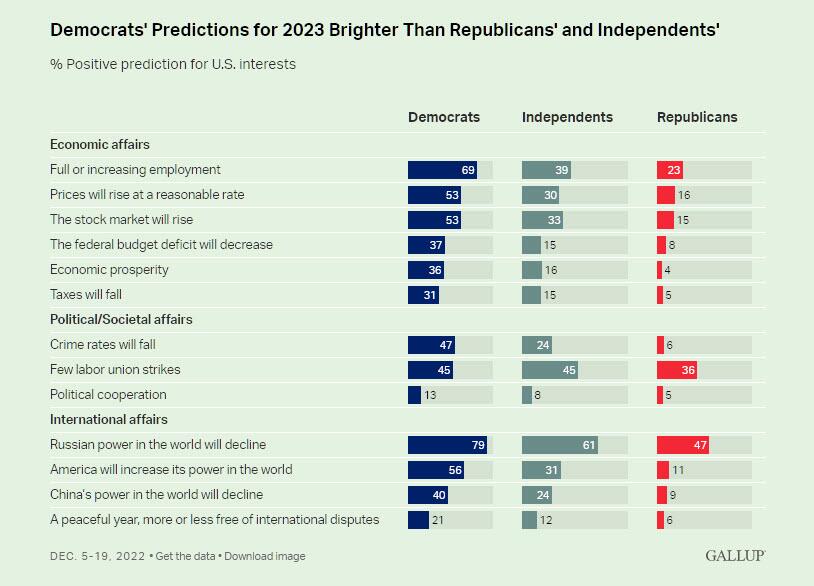
Democrats More Hopeful About 2023 Than Republicans, Independents
Party identification is the greatest demographic differentiator in predictions for 2023, with Democrats more likely than Republicans to offer positive predictions for all of the dimensions. This is a typical phenomenon whereby Americas who identify with the sitting president’s party are more positive in general in their outlook for the year ahead.
Majorities of Democrats foresee five positive developments in 2023. These include full or increasing employment (69%), a reasonable rise in prices (53%), a rising stock market (53%), an increase in U.S. power (56%) and a decrease in Russian power (79%). Democrats are least likely to predict political cooperation (13%) and a peaceful year mostly free of international disputes (21%).
Meanwhile, 61% of independents and 47% of Republicans expect Russian power in the world will decrease. Aside from the 36% of Republicans who expect few labor union strikes in the year ahead, no more than 23% of Republicans expect a positive outcome for any of the other 11 dimensions.
Bottom Line
Americans are greeting 2023 with great skepticism and little expectation that the economic struggles that closed out 2022 will abate. Few U.S. adults also predict the partisan politics that plague the nation will improve, not an unreasonable expectation given that there will be divided government in 2023 after Republicans won control of the U.S. House of Representatives. The public’s predictions for international affairs are similarly pessimistic. However, with their party controlling the White House, Democrats are more hopeful about the year ahead.