U.S. Leans on Turkey to End Russian Flights With American-Made Planes
Pressure campaign is a test of whether Washington can enforce sanctions
ISTANBUL—U.S. officials are pressuring Turkey to stop Russian airlines from flying American-made airplanes to and from the country, said officials familiar with the talks, signaling a new push in Washington to persuade countries to enforce sanctions imposed on Moscow after its invasion of Ukraine last year.
Senior American officials warned last month that Turkish individuals are at risk of jail time, fines, loss of export privileges and other measures if they provide services like refueling and spare parts to U.S.-made planes flying to and from Russia and Belarus in violation of export controls imposed last year, the officials said. Assistant Secretary of Commerce Thea Rozman Kendler delivered the message to Turkish officials during a December visit to Turkey, the officials said.
The warning to Turkey is a key test of whether the U.S. and its allies can succeed in isolating Russia over the long term, or whether Moscow can find a way to continue economic activity with the help of third countries that are central to the Kremlin’s strategy of finding partners outside of the West. The Turkish Foreign Ministry didn’t respond to a request for comment on the warning.
“At a certain point, they will have to take an enforcement-related action,” said Emily Kilcrease, a former deputy assistant U.S. trade representative and currently a senior fellow at the Center for a New American Security in Washington. “Otherwise the whole kind of thing falls apart, if it turns out they have knowledge of violations and they haven’t been able to do anything to address it.”
A Department of Commerce spokesman said the agency couldn’t comment on specifics. He said the agency’s Office of Export Enforcement recently warned overseas aviation companies about complying with U.S. export controls involving the servicing of Russian, Belarusian and Iranian commercial aircraft.
“This action and ongoing engagement like Assistant Secretary Kendler’s visit is important to U.S. efforts to ensure understanding of our controls, encourage partnership and compliance, and to share information,” the spokesman said.
The Biden administration imposed export controls barring Russia from using U.S.-made aircraft last February in response to the attack on Ukraine. The export controls now bar any aircraft made in the U.S. or those that include more than 25% U.S.-controlled parts from flying into Russia or Belarus without a license issued by the Commerce Department’s Bureau of Industry and Security.
Russian airlines have continued flying Boeing Co. jets in defiance of U.S. and European Union efforts to ground them, including sanctions that restrict the entry of Russian-operated jets to Western skies, the supply of spare parts needed to safely maintain the aircraft and the revocation of aircraft-leasing contracts.
Russian and Belarusian airlines, including Moscow’s majority state-owned Aeroflot, have operated more than 2,100 flights using U.S.-made planes including Boeing 777s, 757s and 737s to Turkey since Oct. 1, according to data from aviation-analytics firm Cirium. The flights include regular trips from Moscow to Turkish destinations including Istanbul, Izmir and the Mediterranean resort city of Antalya.
The warning comes as the U.S. government moves to shore up sanctions against Russia nearly a year after it began its full-scale assault on Ukraine. U.S. officials are aiming to prod countries with economic ties to Russia—like Turkey and the United Arab Emirates—to do more to comply with the sanctions, which are intended to starve the Russian government of funds and key technologies it could use to wage war.
The continued Russian flights have raised safety concerns since Washington’s export controls ban the sale of spare parts needed to repair Russia’s civilian airline fleet.
Most of Russia’s civilian aircraft are manufactured by Boeing and Airbus SE and leased from companies in Ireland and Bermuda. Last March, Russian President Vladimir Putin signed a new law allowing airlines to re-register planes in Russia, making them harder to repossess. Multiple planes operated by Russian airlines on flights to and from Turkey changed their registration numbers last year, according to international aviation records.
The planes flying to Turkey include at least one that is owned by an Irish company that said last year that it stopped all leasing activity with Russia, in effect ordering the return of the plane. The aircraft, a Boeing 757, last flew to Turkey on Jan. 13, landing in Antalya, according to data compiled by FlightRadar24, an aircraft-tracking service.
“These planes are technically stolen,” said Yoruk Isik, the head of Bosphorus Observer, an Istanbul-based consultancy monitoring air and maritime activity, who helped verify the flight records.
Flight records show that the same planes flying to Turkey have also traveled to India, Thailand and other destinations. The flights to Turkey could draw particular international scrutiny because of its membership in the North Atlantic Treaty Organization and status as a major tourism and transit hub. Istanbul’s airport is among the busiest in Europe and a key transit point for Russians who can no longer fly directly to the continent and elsewhere in the world.
Turkish President Recep Tayyip Erdogan has sought to deepen economic ties with Russia in a bid to stabilize his country’s struggling economy, while also staking out a unique role as an intermediary among Russia, Ukraine and the West. As part of the growing economic relationship with Russia, oligarchs have been mooring yachts and parking jets in Turkey, and buying up millions of dollars in real estate there, raising alarms in Washington that Ankara is damping the impact of sanctions. Turkish officials say the sanctions are ineffective and that Turkey is playing an important role as an interlocutor with Russia.
“Turkey is testing the waters one more time,” said Mr. Isik.
Aeroflot resumed flying to Turkey in May after suspending most international flights in March following the invasion. Millions of Russians flew to Turkey last year, some as tourists and others fleeing conscription and a crackdown on dissent.
Russia’s second-largest carrier, S7, along with Azur Air, Utair and Belarus’s Belavia also flew to Turkey last year, including using U.S.-made Boeing aircraft, flight records show.
S7, Azur and Belavia didn’t respond to requests for comment. Utair couldn’t be reached for comment.
Russian emigres and tourists have been a key source of foreign currency for Turkey, which suffered a destabilizing currency crisis in late 2021. Russians represented the second largest number of tourist arrivals in Turkey from January to August last year, with more than three million Russian visitors, a 23% year-on-year increase, according to Turkish government statistics.
Who’s Thinking About a Trip to Europe This Winter? You and Everyone Else
In many top vacation spots, there is no such thing as an offseason this year
Mykonos in the winter? More travelers are opting to travel trans-Atlantic before summer.
Europe is top of mind for U.S. travelers this year, and they are making trips well ahead of high season, travel advisers say. Normally, trans-Atlantic trips to Europe pick up as weather warms in spring and run through the summer months.
Travelers are booking on both ends of the summer peak season, say airlines and hotel companies. Vacationers in early spring are taking advantage of expiring travel vouchers, cheaper hotel rates and the chance to work remotely in the first quarter before in-office policies change. If vacationing in Europe turns into a year-round affair, it will make it harder to find off-peak deals in 2023, says travel advisers.
Costs range greatly based on the destination, but the average flight from the U.S. to Europe in March costs $857, a 40% increase compared with 2019, according to data from the travel search-engine Kayak. The average flight for June is $1,284, a 27% increase compared with last year.
Demand for travel to Europe is increasing in the midst of rising concern over a potential recession and layoffs. Some travelers headed abroad this spring were priced out of summer trips, travel advisers say, adding that some are motivated by pandemic flight vouchers that will finally expire, and by a desire to avoid the summer heat and airport trouble that occurred last year at several European hubs.
On an earnings call earlier this month, Delta Air Lines President Glen Hauenstein said March is “getting to be a peak month these days” for trans-Atlantic travel this year.
“That leaves you really the nonholiday weeks in November and the nonholiday weeks in January and February as really your lull periods,” he said.
Airline executives said on recent earnings calls that they expect summer 2023 to be a record season. Delta, United Airlines and JetBlue Airways are adding new trans-Atlantic routes ahead of summer.
Travel to Europe from the U.S. has steadily grown since last year. Free of Covid-19 travel restrictions and eager to go on vacation, U.S. tourists flocked there in 2022. The typical summer travel season extended well into the fall months.
Many families traveling now are seeking more than just sightseeing, travel advisers say. Tina Messamore, owner of Latitudes Travel in Murfreesboro, Tenn., says her clients are asking about Europe trips that include cooking classes and educational tours.
“I have had more requests for Europe in the last 12 months than I have in 23 years,” she says. “I had the busiest year ever for Europe in 2022, and 2023 is starting out the same way.”
She and other travel advisers recommend traveling during slower times, such as the fall, if possible.
So far, there are 23% more bookings from the U.S. to Europe for February compared with February 2022, according to Airlines Reporting Corp., which processes tickets sold by travel agencies. It is likely that travel to Europe in 2023 will exceed 2022 levels, says the company.
France, Italy and the United Kingdom are among top destinations for U.S. travelers this coming year, as they have been in the past, says Eduardo Santander, chief executive of the European Travel Commission.
Adam Morvitz, founder and chief executive of point.me, a points and miles search aggregator and booking service, says Greece is among the most popular destinations in both winter and spring, let alone the peak summer period. Mr. Morvitz says his company has already booked as many points and miles redemptions for April trips to Greece as it typically does for June or July.
“It could be in the 60s, there could be a chance of rain and we’re still booking trips to Mykonos,” he says.
Travelers using vouchers that will expire can get more value when pairing points redemptions for an offseason trip. Good redemption rates on nonstop flights to major European cities in business class are available in March, says Mr. Morvitz.
Hannah Gowans and her husband plan to travel to the U.K. this spring after finding a Cyber Monday deal for MileagePlus members on a nonstop United Airlines flight. They will fly from Los Angeles to London for 60,000 miles and $385 in taxes. Typically, she wouldn’t choose to travel in March, but there were limits on travel dates from the sale, and the trip seemed to be a good excuse for the 33-year-old ad tech professional and her husband to take a delayed honeymoon.
Ms. Gowans says her husband has never been to London, and she hasn’t been since 2014. They chose to add Edinburgh to the weeklong trip, and plan to visit a classic summer European city on a different trip.
“I can play tour guide and show him around, then we’ll go enjoy the quieter atmosphere of Edinburgh and enjoy some Scotch,” she says.
If You Are Going to Europe This Year
- Set expectations for offseason travel. Some smaller hotels, restaurants and shops close for the winter, says Ms. Messamore. But she says there is still a lot to do between museums and other attractions.
- Be flexible. Look to travel any time from late March through the end of October to find better availability, says Damian McCabe, chief executive of McCabe World Travel in McLean, Va.
- Build in time. There will be delays, according to a report from Europe’s air-traffic manager, Eurocontrol. The report says it will be difficult to manage airspace issues as the war in Ukraine continues. If you plan to visit several cities by air, make sure you leave plenty of time to get to and from destinations, travel advisers say.
Early premarket gappers
- Gapping up:
- XM +31.6%, DV +8.5%, STX +7.8%, TSLA +7%, LEVI +5.6%, STM +4.9%, LTRX +4.5%, ETD +4.4%, NOK +3.2%, CVX +2.8%, NKLA +2.6%, URI +2.4%, TSCO +2.4%, TGNA +2.3%, XEL +2.1%, HXL +2%, AXS +2%, CALX +1.8%, BHLB +1.7%, LVS +1.3%, AXTA +1.2%, PLUG +0.9%, MUR +0.9%, ET +0.8%, META +0.7%, LBRT +0.7%
- Gapping down:
- FNA -10.1%, FNA -10.1%, SNX -8.7%, WOLF -8%, DEO -6.2%, AZPN -5.3%, LC -4.9%, SAP -4.1%, VIRT -3.6%, FLEX -3.5%, CCI -3.3%, PLXS -2.9%, TER -2.8%, CLS -2.7%, IBM -1.9%, BOOT -1.8%, NOW -1.6%, LRCX -1.5%, LCII -1.2%, STLD -0.6%, CSX -0.5%, ALK -0.5%
LVMH Looks to Renewed China Luxury Spending for Earnings Bump
Bernard Arnault’s conglomerate has soared in valuation, but the industry faces headwinds from lower global growth
PARIS— LVMH LVMUY 0.45% Moët Hennessy Louis Vuitton SE is scheduled to report fourth-quarter and full-year 2022 results later Thursday, as it rides a surge of demand for luxury goods that China’s recently loosened Covid-19 restrictions could extend into this year.
Postpandemic demand for LVMH’s dozens of brands, including fine wine, jewelry and fashion labels and upscale hotels, has cemented the group’s position as the most valuable listed company in Europe. It has also helped its chief executive and controlling shareholder, Bernard Arnault, overtake Elon Musk as the world’s richest person.
LVMH’s stock price has recently taken off anew, as China, one of the luxury industry’s biggest markets, drops many of its pandemic-era restrictions. For more than two years, those restrictions have kept Chinese tourists far from Paris, London and Milan, where they once snapped up shoes, purses and jewelry.
Thursday’s results will also come shortly after the company said it would embark on one of its biggest management shake-ups in years. It involved a number of the company’s top managers as well as Mr. Arnault’s daughter, Delphine Arnault, and some of its biggest brands.
Many of the world’s best-known luxury brands have been able to raise prices steadily through the pandemic. Shoppers, many of whom had saved up money as they stayed indoors during lockdowns and other restrictions, have let loose. High-end shoppers have also proven more resilient to the steep inflation that Covid-19 restrictions gave way to. Luxury-goods supply chains, often highly local, weren’t disrupted as much by the pandemic and later the war in Ukraine.
That has all helped LVMH emerge from the pandemic as Europe’s largest company by market value, outstripping the continent’s industrial stalwarts, such as Shell PLC, Airbus SE and Volkswagen AG, which have all struggled with a series of shocks to their businesses.
Questions remain, however, about how long this postpandemic boom for luxury goods will last, as economic prospects in the U.S. and Europe remain uncertain. In a recent report, consulting firm Bain & Co. forecast that sales of personal luxury goods would rise between 3% and 8% in 2023, a sharp slowdown from last year’s estimated 22% growth.
A poll of analysts’ estimates compiled by FactSet estimates the French luxury-goods conglomerate will book quarterly sales of 22.44 billion euros, equivalent to about $24.5 billion, in last year’s final quarter, up from €20.04 billion during the same quarter the prior year. Net profit is expected to come in at €14.61 billion for the full year, up 21% from the previous year.
British fashion house Burberry Group PLC and Cartier owner Cie. Financière Richemont SA said last week that sales to Chinese shoppers were starting to pick up after fourth-quarter lockdowns dragged them down. That could be an early sign of recovery in what was the luxury industry’s biggest market before the pandemic.
“The market is likely to look past any Covid-19 setback in China in [the fourth quarter] to focus on the country’s reopening tailwind for the sector this year,” Stifel analyst Rogerio Fujimori wrote in a research note this week. January sales growth will have turned positive for LVMH in China, also helped by the earlier start to the weeklong Lunar New Year holiday, Mr. Fujimori added.
Amid China’s Covid-19 hibernation, the U.S. emerged as the luxury industry’s biggest market. Americans accounted for between 32% and 34% of global luxury spending last year, a sharp increase from the 22% they represented in 2019, prepandemic, according to the Bain report.
While LVMH doesn’t typically break out the financial performance of its individual brands, investors will be looking for clues about the performance of the likes of Louis Vuitton and Dior, which together account for around 70% of the company’s core profit, according to the estimates of analysts at UBS.
Pietro Beccari, who currently runs Dior, will take the helm of Louis Vuitton next month. At Dior, Mr. Beccari opened a new flagship store that extends over five levels in Paris’s luxury shopping district. He has also pushed an array of high-visibility marketing projects around the globe.
Mr. Arnault tapped his daughter Delphine to succeed Mr. Beccari at Dior. The change marks a homecoming of sorts for Ms. Arnault, who worked for 12 years at Dior before joining Louis Vuitton, where she was in charge of all product-related activities. She was recently responsible for a collaboration between the brand and reclusive Japanese artist Yayoi Kusama for a new collection.
Dior’s revenue has more than tripled over the past five years, analysts say. How Ms. Arnault handles her first job as a brand CEO could have bearing on whether she is seen as a possible successor to her father.
Germany Still Years Away From Replacing Russian NatGas, Official Admits To "Unspoken Strategy To Pay Crazy Prices"
Some European politicians and economists are breathing a sigh of relief after mild temperatures, increasing liquefied natural gas shipments, and above-average natural gas stockpiles have so far averted a worsening energy crisis this winter. Other politicians believe the energy crunch won't be over for many years.
"Gas storage is up and gas prices are down. Inflation is falling and uncertainty is declining," Deutsche Bank AG wrote in a note this week, adding, "We can afford to be more optimistic."
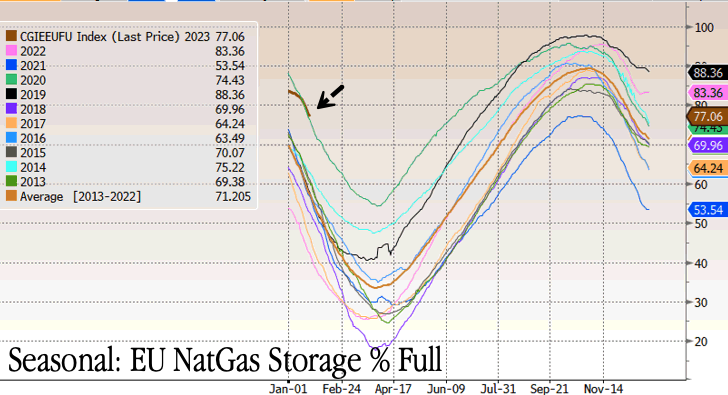
As of late, Europe's biggest economy, Germany, has seen an improvement in business outlook as recession fears recede, according to data from the Ifo Institute, a Munich-based economic researcher.
Ifo President Clemens Fuest told Bloomberg TV:
"The most important risk for the German economy was a gas-rationing scenario ... and that risk is off the table now."
There's a lot to be happy about in Europe: Dutch front-month NatGas, the continent's benchmark, slid as much as 5% to 55 euros a megawatt-hour today, the lowest level since late 2021. Prices have collapsed by more than 83% since peaking at 311 euros a megawatt-hour last August.
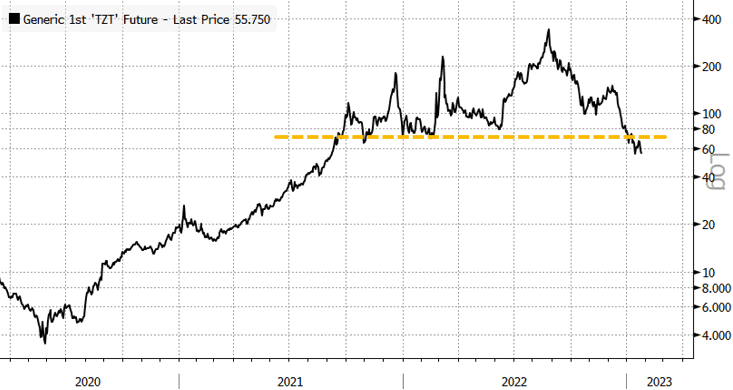
However, the optimism could be short-lived because Germany is years from entirely substituting Russian NatGas flows with LNG shipments.
Last week, Chancellor Olaf Scholz told Bloomberg that German learned a hard lesson in its addiction for cheap Russian NatGas. He said the country is now rejiggering supply chains that will increase capacity for LNG imports at major ports.
A new report via the country's Economy Ministry shows Germany will install 56 billion cubic meters of domestic LNG import capacity by 2026. By 2030, capacities will increase to 76.5 billion cubic meters or about 80% of total German NatGas consumption in 2021.
The ministry pointed out that even though current NatGas storage facilities are above normal levels, there are mounting risks later this year that storage could sink to dangerously low levels and result in shortages.
"The truth is, there won't be enough in the next three to four years of LNG production capacity in the world to meet the growing demand. So the unspoken strategy is that Germany will continue to pay crazy prices and other, less rich countries go empty-handed," Christian Leye, a Bundestag Left Party representative, told Bloomberg.
Germany has reduced its dependence on Russian NatGas by importing LNG from other EU countries and increasing NatGas pipeline flows from Norway and the Netherlands. Germany didn't have a choice after explosions rocked Nord Stream last year. An issue we see is that Germany's NatGas storage was filled last summer when Russian NatGas was still flowing -- not so much anymore.
Deutsche Bank expects EU NatGas prices to fluctuate between 50 and 100 euros a megawatt-hour this year. It's only a matter of time before the temporary relief evaporates and the energy crisis resurfaces.
>>> Up
* BAE Raised to Buy at SocGen
* Lonza Raised to Overweight at KeyBanc; PT 650 Swiss francs
* Sword Raised to Outperform at Oddo BHF; PT 50 euros
* Thales Raised to Buy at SocGen; PT 141 euros
>>> Down
* Thales Raised to Buy at SocGen; PT 141 euros
>>> Down
* Arjo Cut to Sell at Pareto Securities; PT 35 kronor
* Axfood Cut to Hold at Nordea
* Boohoo Cut to Underperform at RBC; PT 35 pence
* Grolleau Cut to Hold at Stifel; PT 7.30 euros
* Lonza PT Cut to 500 Swiss francs at Intron Health
* Lonza PT Cut to 500 Swiss francs at Intron Health
* Netcompany PT Cut to 260 kroner from 325 kroner at Citi
* Nibe Cut to Sell at Pareto Securities; PT 105 kronor
* Novartis Cut to Neutral at Citi After Revamp, Drug Headwinds
* Otovo Cut to Neutral at SpareBank; PT 19 kroner (+)
* Prodways Cut to Neutral at Oddo BHF; PT 3.40 euros
>>> Initiation
* Advanced Medical New Buy at Berenberg on Strong Growth Outlook
>>> Initiation
* Advanced Medical New Buy at Berenberg on Strong Growth Outlook
* Alstom Reinstated Outperform at Oddo BHF; PT 31.80 euros
>>> Call
>>> Call
* Daetwyler Falls as Berenberg Sees Short-Term Headwinds Ahead
* Lloyd’s Insurers Entering ‘Golden Era,’ Hiscox Raised: JPMorgan
* Mitie Revenue Beats, Outlook Tone ‘Upbeat,’ Jefferies Says (+)
* Netcompany Cut at MS, PT to Street-Low at Citi on Margins
* Ocado, Boohoo Both Cut at RBC on Cautious Internet Stocks View
* Saipem Top Oil Services Pick at JPMorgan, Subsea 7 Downgraded
* Soitec 3Q Sales In-line With Inventories a Concern: Berenberg
* Vonovia, LEG, TAG Property Headaches Might Have Only Just Begun
- Nokia (NOA3 TH) +5.6%
- Nokia Beats Fourth-Quarter Estimates Amid ‘Robust’ Demand
- STMicroelectronics (SGM TH) +5%
- *STMICROELECTRONICS SEES 1Q NET REV. $4.20B, EST. $3.81B
- Sartorius (SRT3 TH) +2.8%
- Sartorius FY Adjusted Ebitda Meets Estimates
- Leonardo (FMNB TH) +2.5%
- Evotec SE (EVT TH) +2.3%
- Evotec to Help Janssen Develop Immune-Based Cancer Therapies
- Prosus (1TY TH) +2.2%
- Imperial Brands (ITB TH) +1.7%
- Repsol (REP TH) +1.7%
- Oil, Gas Prices Set to Stay Elevated Despite Macroeconomic Drags
- Sabadell (BDSB TH) +1.3%
- Sabadell 4Q Net Income Beats Estimates
- SAP (SAP TH) -0.8%
- SAP Plans to Sell Qualtrics Stake, Cut Jobs in Profit Push
DAX:
- Sartorius (SRT3 TH) +2.8%
- Sartorius FY Adjusted Ebitda Meets Estimates
- Infineon (IFX TH) +1.6%
- STMicro’s 2023 Outlook Beats Estimates on Strong Auto Demand
- Deutsche Post (DPW TH) +1%
- Deutsche Post Workers to Strike Again Thursday, Union Says
- Zalando (ZAL TH) +0.9%
- Ocado, Boohoo Both Cut at RBC on Cautious Internet Stocks View
- SAP (SAP TH) -0.3%
- SAP Plans to Sell Qualtrics Stake, Cut Jobs in Profit Push
MDAX:
- Evotec SE (EVT TH) +3%
- Evotec to Help Janssen Develop Immune-Based Cancer Therapies
- Rheinmetall (RHM TH) +1.5%
- Aixtron (AIXA TH) +1.4%
- HelloFresh (HFG TH) +1.1%
- TeamViewer (TMV TH) -0.4%
- Ocado, Boohoo Both Cut at RBC on Cautious Internet Stocks View
SDAX:
- DIC Asset (DIC TH) +5.3%
- DIC Asset Prelim 2022 FFO ~EU114.2M, Sees 2023 FFO EU90M-EU97M
- Eckert & Ziegler (EUZ TH) +2.2%
- Hensoldt (HAG TH) +1.3%
- SFC Energy (F3C TH) +1.2%
- Nordex (NDX1 TH) +1%
- PNE AG (PNE3 TH) -1%
- Schaeffler (SHA TH) -1.1%
- Auto Suppliers Face Uncertainties, Schaeffler Cut at Berenberg
- ADVA Optical (ADV TH) -1.2%
British car production falls to lowest level since 1950s
Factory closures and supply chain shortages blamed for 10% drop in vehicle output
British car manufacturing fell to the lowest level in more than half a century during 2022, after a year tainted by supply chain disruption and a spate of factory closures.
The number of cars produced fell 9.8 per cent to 775,014, the worst year since 1956, according to figures released by the Society of Motor Manufacturers and Traders on Thursday.
While the worldwide industry is still hamstrung by a global semiconductor shortage and sporadic parts supplies from China, several UK plant closures during the past two years depressed the numbers further.
Honda’s Swindon facility, which produced about 100,000 models a year, closed in 2021 while the Stellantis site at Ellesmere Port ceased making the Vauxhall Astra last year, in order to prepare to make a new electric van, which will start this year.
Several plants were hit by supply chain problems during the year, with BMW’s Mini plant affected by supply of wiring harnesses made in Ukraine following Russia’s invasion. Several plants were also hit by parts shortages from China, where factories had to stop suddenly owing to Covid-19 shutdowns.
In addition, sales to Russia — which was in the top 10 export markets during 2021 — ceased earlier in the year following the invasion of Ukraine.
As carmakers have struggled to secure enough chips to make their vehicles, they have prioritised the most profitable models. While this helped some UK factories such as VW’s Bentley and BMW’s Rolls-Royce, it may have hurt Toyota, which makes its larger models overseas.
Production is expected to pick up again this year, as the global chip shortage eases, and as the Ellesmere Port plant comes back online.
But even with car output predicted to increase by 15 per cent, the overall volume will still be 40 per cent lower than before the pandemic, the SMMT said.
“We enter this year with a degree of optimism,” said Mike Hawes, SMMT chief executive. “2020 was bad, 21 was worse and 22 was even worse. The only way is up from here.”
UK van production, predominantly based at the Stellantis-owned Luton plant, was a bright spot last year, with a 40 per cent increase owing to strong global demand.
Electric and hybrid vehicles were another highlight and now account for one-third of overall production. Led by the electric Mini, the Nissan Leaf and the hybrid Toyota Corolla, the numbers of these low-emission models rose by 40 per cent to 234,000.
The SMMT forecasts that UK plants will not reach 1mn vehicles a year until at least 2025, based on independent projections.
The figure, which is still ambitious given last year’s numbers, is half the long term target of 2mn vehicles that the industry harboured back in 2015, when carmaking was at record levels.
The year also saw Nissan overtake Jaguar Land Rover to become the UK’s largest car producer, helped by both its electric Leaf car and a sharp slide in JLR’s own production.