>>> RheinMetall : American Rheinmetall Vehicles and GM Defense awarded multi-pha

American Rheinmetall Vehicles and GM Defense awarded multi-phase program to replace the US army's heavy tactical trucks with production of up to 40K new trucks valued at up to $14B

American Rheinmetall Vehicles (Sterling Heights, MI) and GM Defense LLC (Washington, DC) have won a contract for the first phase of the U.S. Army’s Common Tactical Truck (CTT) Program. The aim of the multi-phased program is to replace the Army’s family of heavy tactical trucks with production of up to 40,000 trucks valued at up to $14 billion. The two powerhouse defense companies formed a strategic collaboration in 2022 to compete in the program; bringing together two world-class engineering and manufacturing giants to deliver a modern, tactical truck that enhances Soldier capability through advanced technologies including advanced driver assistance systems (ADAS) for safety, increased off-road mobility, cybersecurity, machine learning, artificial intelligence, improved survivability and fuel efficiency, among other emerging technologies.

The team offered the HX3 Common Tactical Truck (HX3-CTT). The HX3 is the latest generation of trucks in the highly successful, combat proven, HX family of trucks which are in service with a number of NATO and U.S. allied nations. The HX family of trucks derives from MAN Truck and Bus commercial truck offerings bringing a high degree of commerciality to the fleet, a priority for the Army in the CTT program. The HX3-CTT next-generation system has enhanced on and off road mobility, integrated survivability, and an open digital architecture supporting ADAS and enabled for autonomous vehicle operation. Combined with the open architecture, the commercial backbone of the HX3-CTT will support persistent modernization and allow for rapid increases in capability as technologies mature. With a global footprint of both current military user nations and commercial dealer networks, the HX3-CTT provides a basis for optimized lifecycle costs and service support to the Army across the globe.

FT : Renault/Nissan: equal footing is the first step back to relevance

Renault/Nissan: equal footing is the first step back to relevance
Drastic measures to revive a venerable alliance are not the end of the road

Cars can register as classics after 20 years. But creaky auto alliances, such as Renault’s with Nissan of Japan, are another matter. A two-decade relationship designed to foster trust, co-operation and prosperity instead grew rusty. Drastic measures led by Renault chief executive Luca de Meo were formalised on Monday.

Renault’s dominance will be reined in. Its stake in Nissan will fall to 15 per cent or equal to Nissan’s cross holding in Renault. This ends a rivalry where the smaller manufacturer was viewed as too powerful. The balance of Renault’s 43.4 per cent stake in the Japanese company will go into a French trust. Economic benefits are maintained, but voting rights are neutralised. No commitment for a sale has been made.

Markets had begun to price in an improved collaboration between Renault and Nissan, hoping for more on electric vehicles and growth in emerging markets. Even after outperforming the global sector by 85 per cent since the start of last year, Renault shares remain historically cheap in Europe at about 4 times 2023 earnings.

If doubts remain they rest with Renault’s plans for its electric vehicle unit Ampere. Nissan promises to buy into its upcoming IPO late this year. Perhaps one-fifth of the shares would be sold. This will split Renault into EV and internal combustion engine makers, a first for the industry. Ampere could be worth €10bn, thinks Jefferies. Bulls expect at least double that based on Tesla’s past success.

Most important is the road directly ahead. New, more profitable models from next year should help boost operating margins above 5 per cent by 2025. These peaked at 6.5 per cent in 2017. More important, free cash flow of more than €2bn from this year to 2025 should begin to accumulate, thinks Bernstein.

Renault and Nissan deserve credit for achieving a compromise. Yet this one does not immediately simplify the structure — it leaves an overhang for lots of Nissan shares. The listing of Ampere is the next test for Renault.

(ZH) "Recession Is On Its Way" - Dallas Fed Shows Factory Activity Slumps For 9t

"Recession Is On Its Way" - Dallas Fed Shows Factory Activity Slumps For 9th Straight Month

While the headline Dallas Fed Manufacturing Activity Index printed better than expected (-8.4 vs -15.0), it remains in contraction (less than zero) for the 9th straight month (the longest streak since 2016)...
Source: Bloomberg
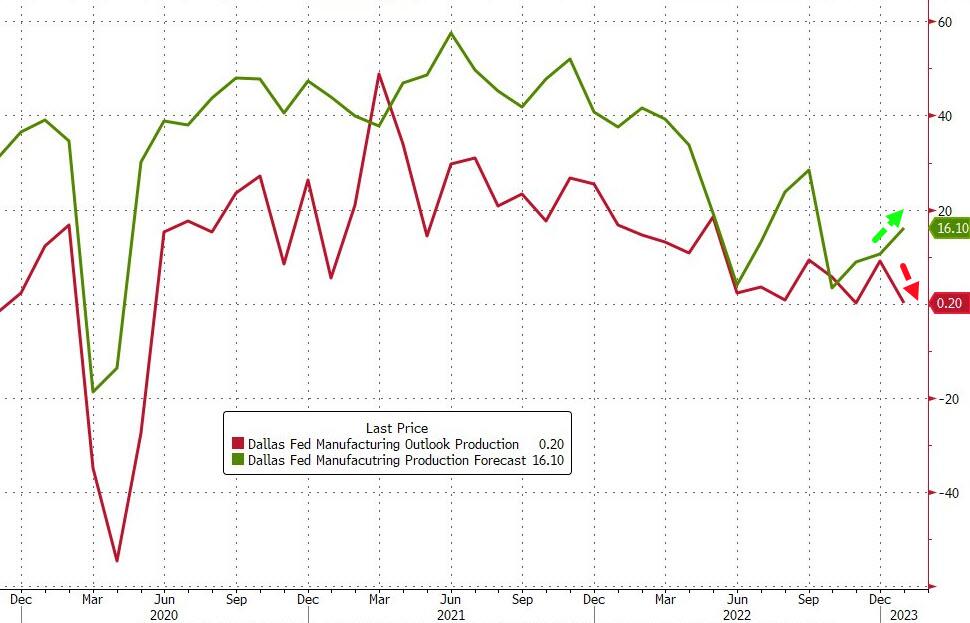
And in fact, the better than expected print was driven solely by 'hope' as current production tumbled in January but 'expectations' for future production rose...
Source: Bloomberg
Surprisingly, while the outlook for six-months ahead improved (but remains negative)...
...you wouldn't know it judging by the responses that The Dallas Fed decided to release for publication... notice a pattern?
Food manufacturing
  • We had a customer in the pet food segment significantly decrease its orders due to an inventory backlog.
  • Uncertainty from the overall economic downturn is affecting our long-term strategy.
  • Business is sluggish. We’re seeing increased illiquidity in our customer base.
Beverage and tobacco product manufacturing
  • We are still seeing input costs increase. We had let our gross margin erode over the last couple of years and are now playing catch-up. We are raising prices faster than our inputs increase in a bid to restore an acceptable gross margin. This is resulting in slightly increased dollar sales and increased gross margin, but decreased unit sales. We also had many of our older 3G-based [wireless] credit card readers that we mistakenly thought also had 4G capability stop working due to the phase-out of 3G. New 4G/5G radios are on a several-month back order. Some unknown share of our sales decline is due to lack of credit card readers at the point of sale.
Textile product mills
  • Uncertainty is high. Holiday sales were stronger than expected, but January is slow versus last year. Delivery times are down, but future demand and sales sentiment are low.
Paper manufacturing
  • Activity continues to slip, and selling prices are coming down. We still can’t find any workers and, with our six-month projection, we have quit looking.
Printing and related support activities
  • We have definitely seen a slowdown in activity compared to prior months. It's as if the spigot got turned off. All our supply-chain constraints are pretty much gone, with delivery times much more like prepandemic times. We have work coming up but right now are very slow and struggling to get our hourly workers even 32 hours per week.
Chemical manufacturing
  • Lost production due to Winter Storm Elliot caused tightening of our inventory levels.
  • We are seeing a slowdown in orders and clients unwilling to hold additional inventory.
Primary metal manufacturing
  • Recession is on its way.
  • The residential building and construction industry has seen a significant decrease in orders across the extrusion industry. Also, imports of aluminum extrusions from South America, Mexico, Malaysia, Vietnam, Turkey and India are at record highs. Mexico is gaining more and more business in the U.S. due to not having to pay Section 232 tariffs, whereas U.S. domestic extruders are paying the tariff via our raw aluminum or billet purchases. If action is not taken, the U.S. aluminum extrusion industry as we know it today will be shutting down capacity and plants.
Machinery manufacturing
  • We are seeing improvement in the business climate. Our competitors are coming to us to supply their customers. Additionally, we are purchasing new machines to add capabilities in our business and further vertically integrate our manufacturing. This will improve our profitability and reduce lead time to produce our products.
  • Order volume has been going down, and we expect the trend to continue. Raw material pricing seems to be stable at the present time.
  • Current federal policies are killing small businesses. From diesel prices to shortages, everything costs so much more.
Computer and electronic product manufacturing
  • We provided significant (10 percent or more) raises in December after a midyear raise in July 2022. We felt that this was essential in order to keep our employees, and we have successfully retained everyone we wanted to keep. We hope not to need to do another round of raises midyear. Since our employees are blue-collar workers, inflation hits them particularly hard, and they are more willing to look for another job for a 10–15 percent pay increase. We are investing in more automation and removing process bottlenecks to increase productivity and reduce lead time.
Transportation equipment manufacturing
  • We have a bleak outlook until the Federal Reserve stops interest hikes and the administration seeks energy independence.
  • We are starting to see some customers pushing delivery out due to market uncertainty.
Furniture and related product manufacturing
  • Requests for bids continue at a steady rate; we have not yet seen a contraction. The only change is, when posting job openings, we actually have people responding—this is a big change and likely a sign of some layoffs after the holidays from other companies. The biggest issues facing our company are increased regulations and contact from federal, state and local entities regarding a variety of topics. Often it feels as a small business that the government does not want us to succeed.
Miscellaneous manufacturing
  • We continue to see large fluctuations in raw material pricing from order to order. Pricing has not corrected from the metals market shutdown in March 2022. Most lead times for raw material remain longer than in previous years.
  • Order volumes remain flat across all markets we serve—automotive OEM [original equipment manufacturers], plumbing and ammunition. Raw material costs and lead times have declined since 2022.
Not exactly a picture of the 'strong as hell' economy we hear from The White House?

(ZH) Investors Have Become Super-Bullish On Oil, Pile Into Futures At Fastest Ra

Investors Have Become Super-Bullish On Oil, Pile Into Futures At Fastest Rate Since Dec 2020

By John Kemp, senior energy analyst at Reuters
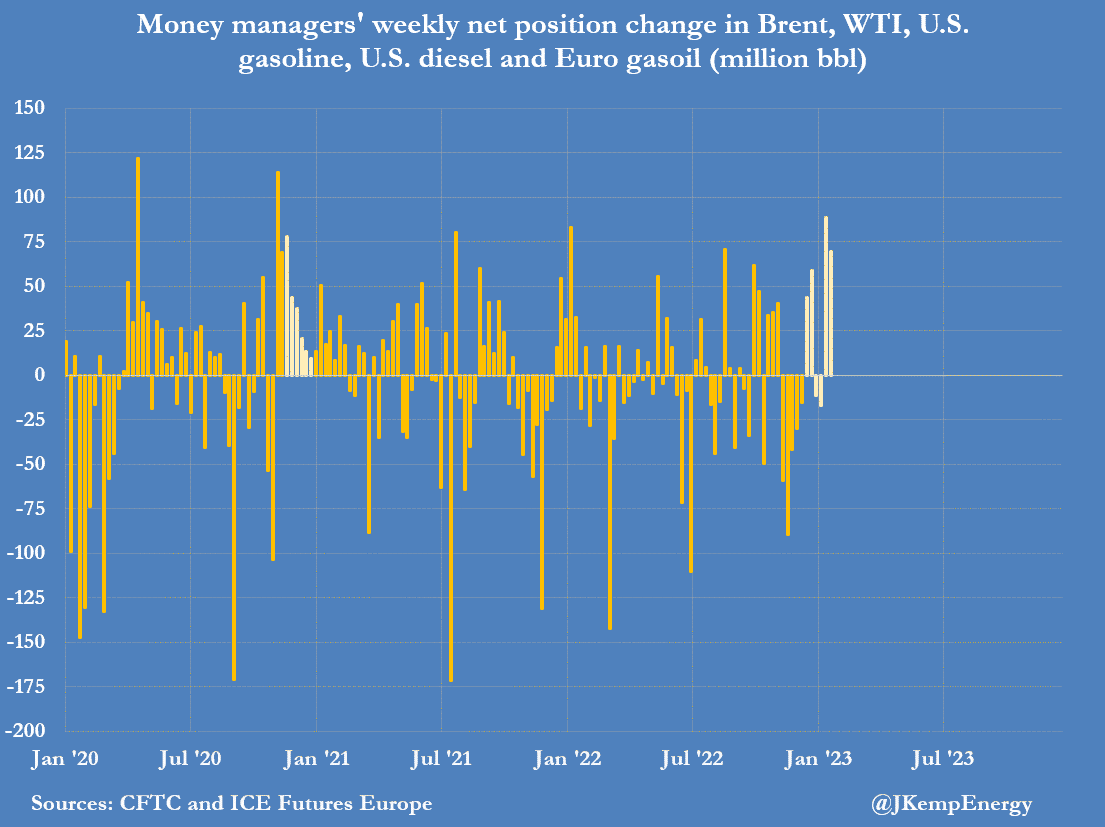
Portfolio investors have piled into petroleum futures and options at the fastest rate since the first successful coronavirus vaccines were announced in late 2020. China’s exit from a zero-COVID strategy, along with hopes the global economy can avoid a recession and low oil inventories, have contributed to an extraordinary wave of buying across the petroleum complex.
Hedge funds and other money managers purchased the equivalent of 232 million barrels in the six most important futures and options contracts over the six weeks ended January 24.
Purchases were the fastest for any six-week period since December 2020, according to an analysis of position records published by ICE Futures Europe and the U.S. Commodity Futures Trading Commission.
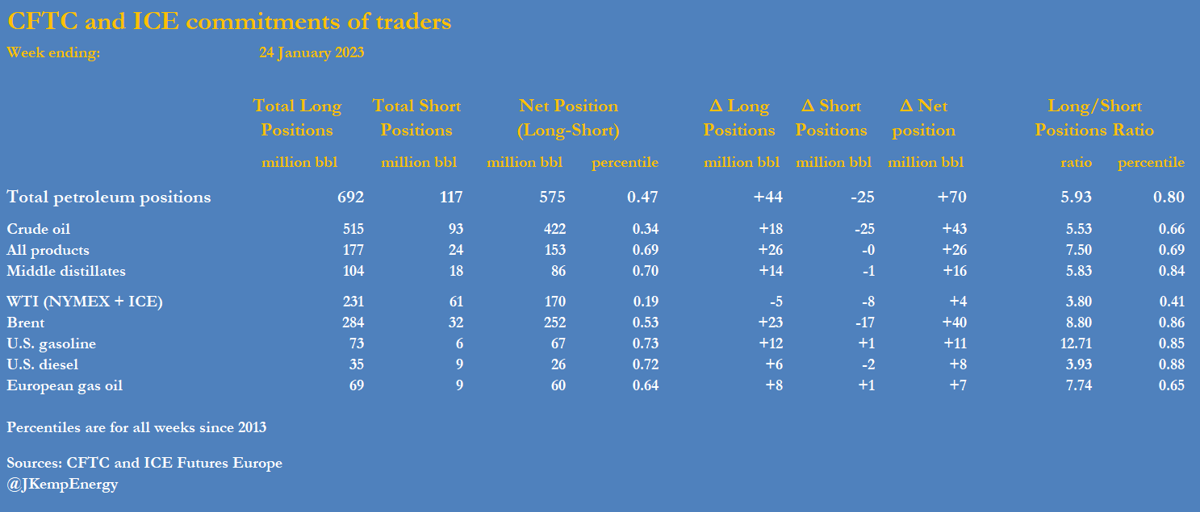
In the most recent week, fund managers purchased the equivalent of 70 million barrels, mostly in Brent (+40 million) and to a much lesser extent NYMEX and ICE WTI (+4 million).
But the wave of buying spread beyond crude to encompass U.S. gasoline (+11 million barrels), U.S. diesel (+8 million) and European gas oil (+7 million).
Refinery shutdowns linked to seasonal maintenance as well as sanctions on Russia’s diesel exports are expected to deplete fuel inventories further.
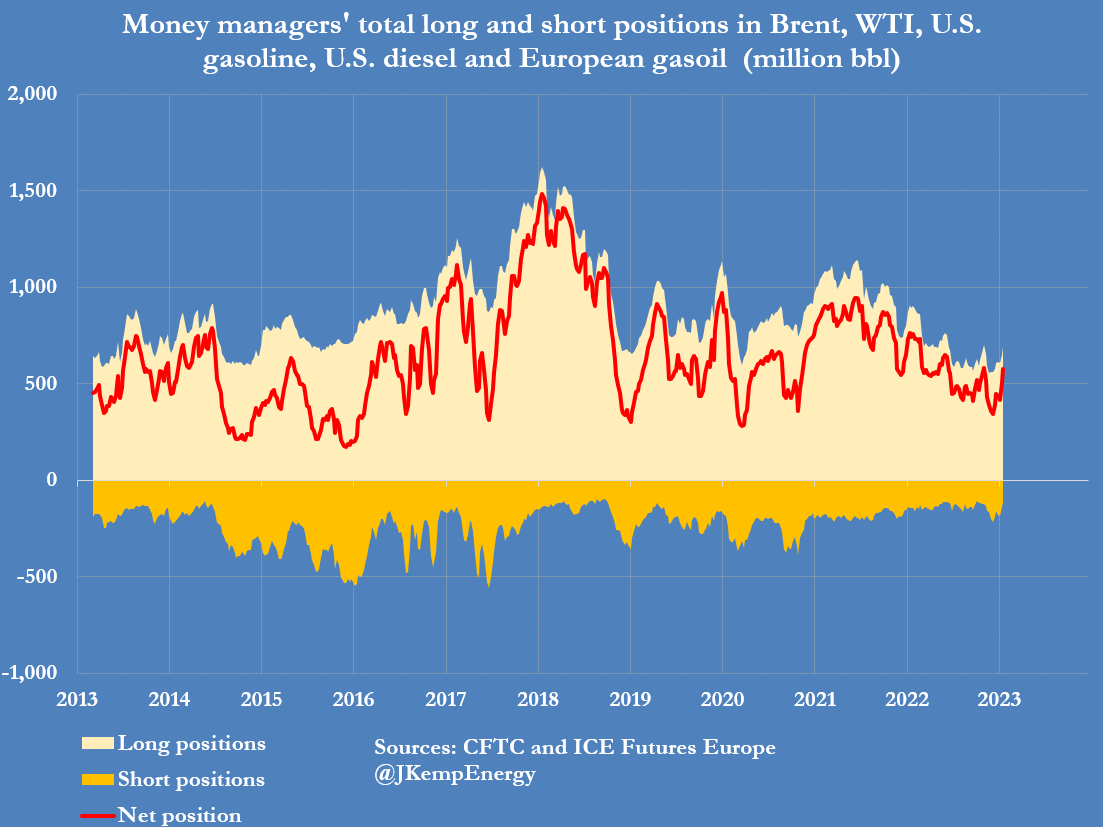
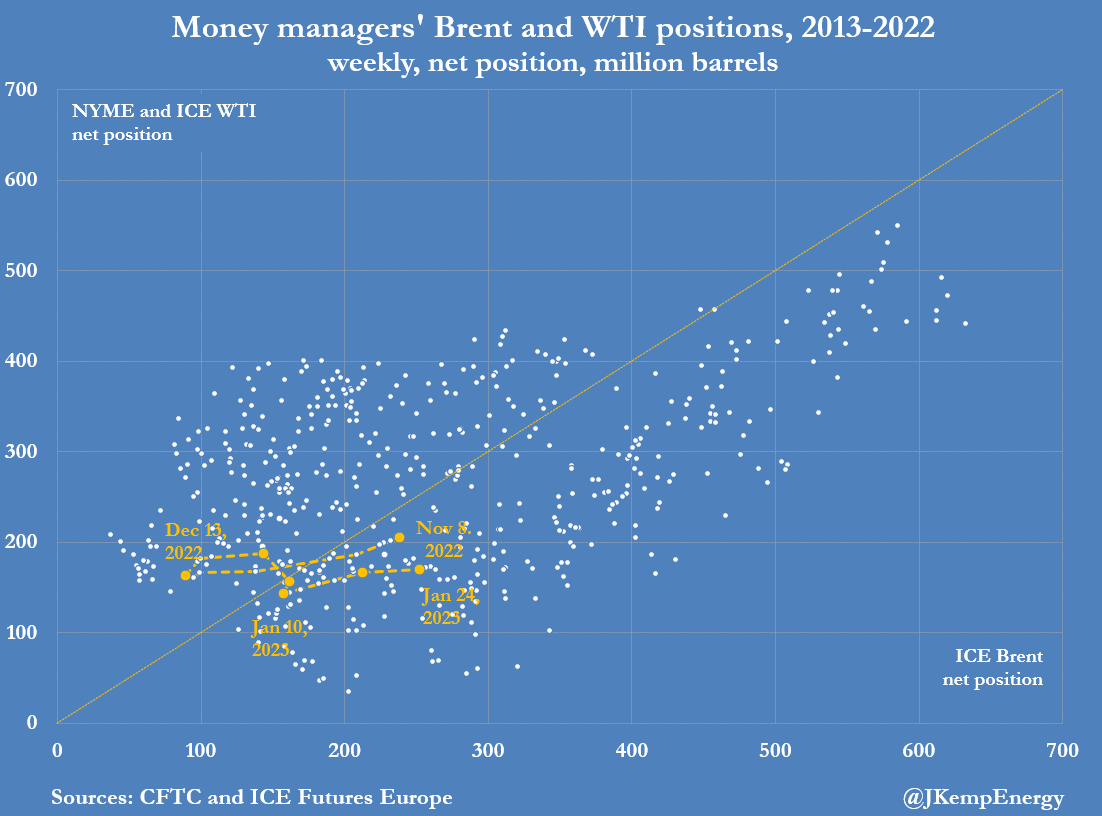
The net position across all six contracts climbed to 575 million barrels (47th percentile for all weeks since 2013), up from 343 million barrels (11th percentile) on December 13.
The net position is at highest since November 8 and before that June 14.
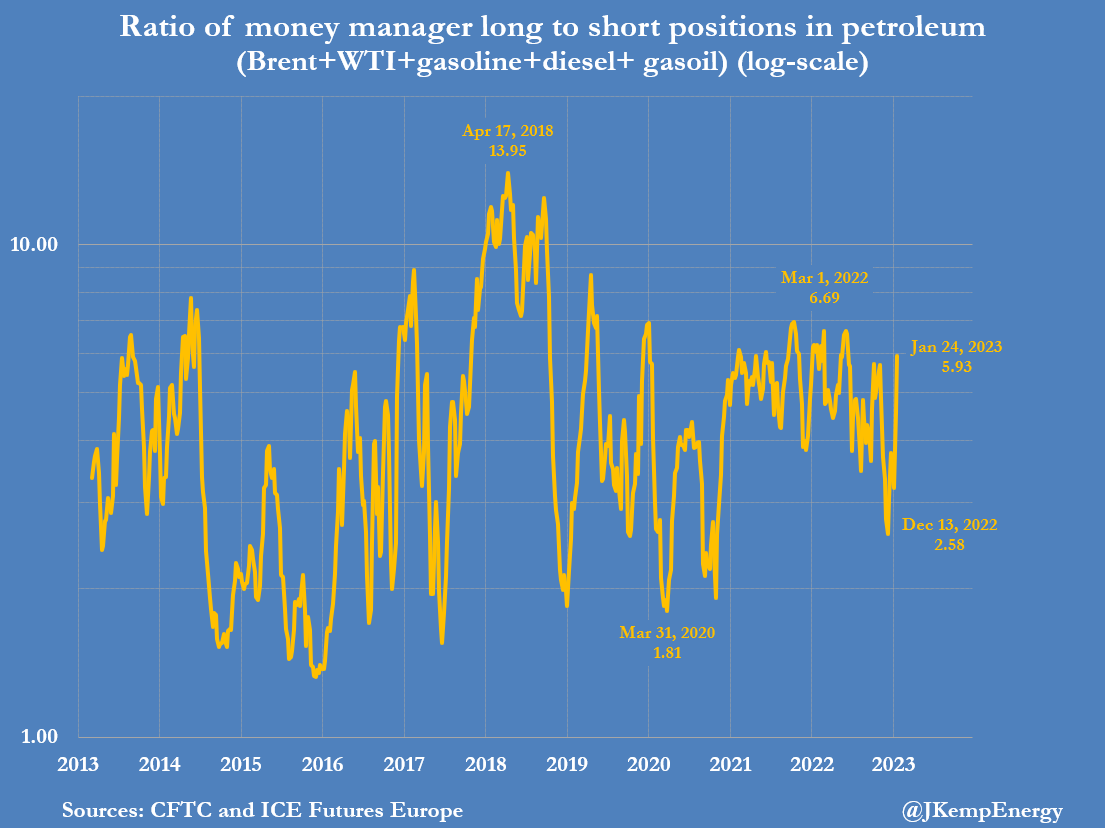
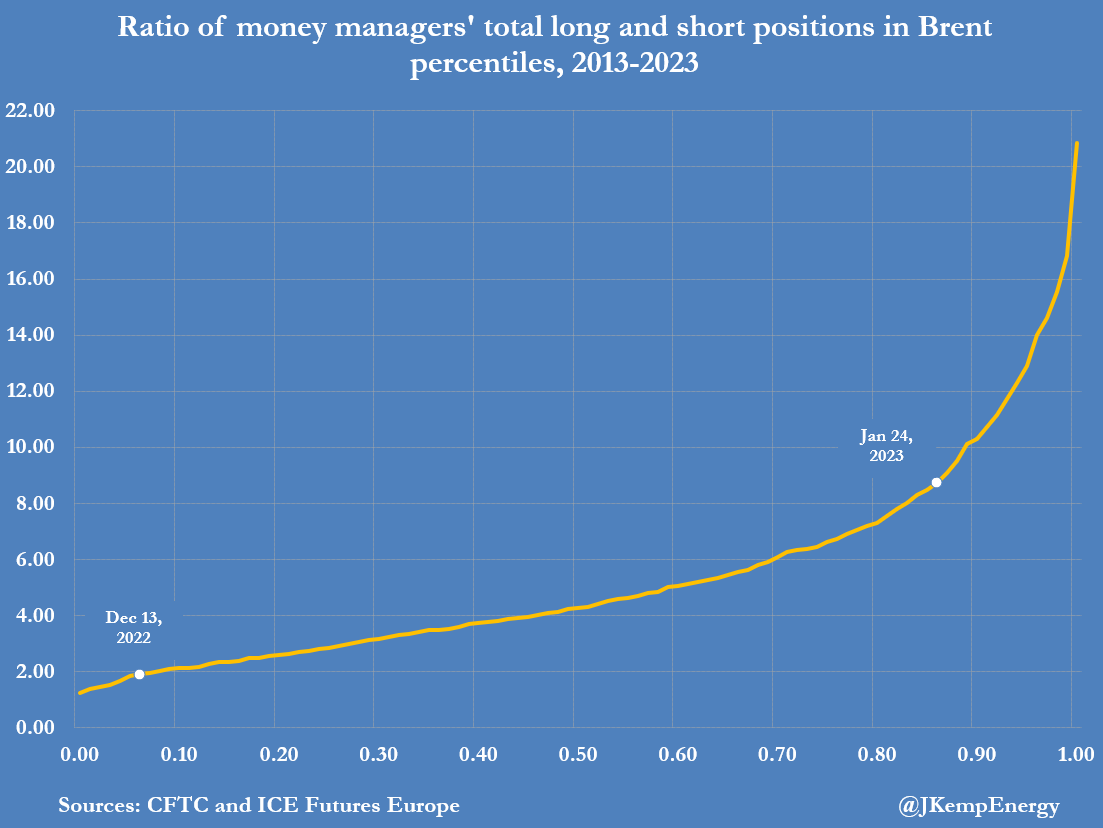
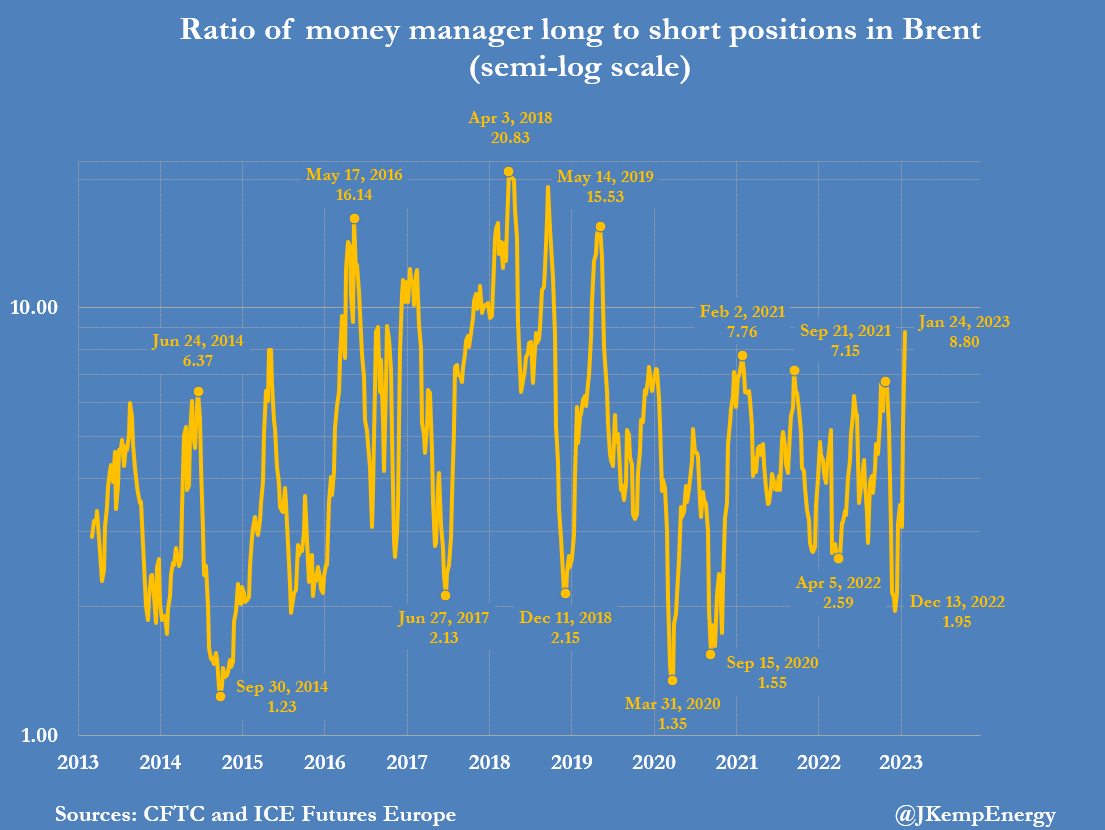
There was a strongly bullish orientation, with long positions outnumbering short ones by a ratio of 5.93:1 (80th percentile) up from 2.58:1 (23rd percentile) five weeks earlier.
The most bullish ratios are concentrated in Brent (86th percentile), U.S. gasoline (85th percentile) and U.S. diesel (86th percentile), with less optimism about European gas oil (65th percentile) and WTI (41st percentile).
Refinery maintenance in the United States is expected to deplete fuel inventories there but leave WTI prices trailing Brent, which probably explains the differential performance.

Hedge funds became more bullish about Brent than at any time since May 2019, before the pandemic erupted and upended the oil industry.
There is a growing tension at the heart of investor positioning. In the bond market, investors are increasingly confident inflation will moderate, allowing central banks to bring an early end to interest rate rises.
In the oil market, investors are increasingly sure continued growth will cause supplies to tighten and send prices higher. But that would be inflationary – and contradicts to the benign outlook assumed by the bond market.
Oil traders and bond traders cannot both be right.

WSJ : Russia Boosts China Trade to Counter Western Sanctions

Russia Boosts China Trade to Counter Western Sanctions
China has become a supplier of key technologies that can have a military purpose

Trade between China and Russia boomed last year, providing a lifeline to Russia’s beleaguered economy and showing the limits of Western sanctions, according to a new report.

Moscow boosted imports of technologies critical to its war in Ukraine including semiconductors and microchips from China, the report by the D.C.-based nongovernmental organization Free Russia Foundation said. China’s increased purchases of Russian exports, driven by energy sales, more than offset the declines from major Western trading partners including the U.S., U.K. and some European Union countries.

“As the U.S., EU, the U.K. have all scaled back operations with Russia, China has emerged, by a wide margin, to be Russia’s most important trade partner,” the report says.

Based on 40 million entries of customs records obtained by the Free Russia Foundation, the report offers a granular view of Russia’s trade, which was obscured after the imposition of Western sanctions. In April, Russian customs authorities suspended their monthly publication of data on exports and imports, among other statistics, saying at the time that it wanted to avoid “incorrect estimates, speculations and discrepancies in terms of import deliveries.” Its January 2022 data are the latest available.

Russian and Chinese trade authorities didn’t respond to requests for comment.

China has become a supplier of some key technologies that can have a military purpose despite the Western sanctions. China sold $3.3 million worth of unmanned aerial vehicles, or drones, to Russia last year, according to the data. The report noted that drone deliveries to Russia continued in November and December from the United Arab Emirates, Hong Kong, China and Singapore.

Russia last year increased its imports of semiconductors and microchips by around 34%, with China emerging as the major source. That has helped Russia increase its overall import of chips to $2.45 billion in 2022 from $1.82 billion in 2021, despite Western sanctions targeting that trade.

Russia and China have spent years forging stronger economic ties, including a $55 billion gas pipeline and Russia’s increased usage of China’s yuan. The economic relationship has deepened even as long-simmering concerns remain among officials in Moscow that Russia could become captive to China’s economic orbit.

The Free Russia Foundation obtained the data in coordination with Madrid-based IE University from a third-party data provider that offers value-chain analysis to companies. The team that worked on the report included Russian economists and former Russian officials based outside of Russia, including Sergey Aleksashenko, a former central bank deputy chairman, and Vladimir Milov, a former deputy energy minister and an opposition politician.

To verify its validity, the authors compared the data set with official Russian trade statistics published up to January 2022 and Russia’s trade partners’ 2022 data. One of the limitations of the data set, the report says, is that the records are partially redacted for military transactions.

Trade between Russia and China rose by roughly $27 billion between March and September of last year compared with the same period in 2021, according to the report, to reach $99 billion.

Much of the growth was because of higher sales of crude, which Russia began diverting to China and other markets such as India and Turkey as Western countries restricted purchases of Russia’s energy products.

Russia also grew more dependent on Chinese goods. About 36% of its imports were from China in the period from March to September. That is up sharply from 21% in 2021 in the same period.

After Russia’s invasion, the U.S., South Korea and Japan all banned the sales of high-tech products including semiconductors on which Russia relies.

As some of Russia’s traditional suppliers of high-tech goods, such as Germany, the Netherlands and South Korea scaled back their shipments, imports from China more than doubled. In the March to September period, the value of Chinese semiconductor exports to Russia jumped from $200 million in 2021 to over $500 million last year. The number of transactions rose as well, the report says.

Russia also imported semiconductors from Turkey, Kazakhstan and Kyrgyzstan. While these countries don’t have substantial domestic semiconductor industries, Russia can purchase widely accessible chips from distributors there, analysts say.

“China is capable of producing many types of lower-tech chips domestically, so it is unsurprising Russia is buying these,” said Chris Miller, associate professor at Tufts University who wasn’t involved in the report.

Still, Mr. Miller said, “military systems use a wide array of chips and so they could be facing shortages for specific chips even if they’re able to buy large volumes of other chips.”

>>> US Research Calls

Research Calls

  • Upgrades:
    • Axalta Coating Systems (AXTA) upgraded to Buy from Hold at Deutsche Bank; tgt raised to $40
    • Axalta Coating Systems (AXTA) upgraded to Buy from Neutral at Citigroup; tgt raised to $35.19
    • Colgate-Palmolive (CL) upgraded to Overweight from Equal-Weight at Morgan Stanley; tgt $82
    • Eagle Bulk Shipping (EGLE) upgraded to Buy from Hold at Fearnley; tgt raised to $66
    • Flowserve (FLS) upgraded to Buy from Neutral at BofA Securities; tgt raised to $40
    • G1 Therapeutics (GTHX) upgraded to Neutral from Underweight at JP Morgan; tgt raised to $10
    • Genco Shipping & Trading (GNK) upgraded to Buy from Hold at Fearnley; tgt raised to $22
    • Golden Ocean (GOGL) upgraded to Buy from Hold at Fearnley; tgt raised to $11.50
    • Kemper (KMPR) upgraded to Neutral from Underperform at Credit Suisse; tgt raised to $56
    • Lockheed Martin (LMT) upgraded to Buy from Hold at DZ Bank; tgt $523
    • Okta (OKTA) upgraded to Buy from Hold at Stifel; tgt raised to $90
    • Regeneron Pharma (REGN) upgraded to Outperform from Market Perform at Cowen; tgt raised to $875
    • Seanergy Maritime (SHIP) upgraded to Buy from Hold at Fearnley; tgt $0.70
    • Shopify (SHOP) upgraded to Buy from Neutral at ROTH Capital; tgt raised to $56
    • Star Bulk Carriers (SBLK) upgraded to Buy from Hold at Fearnley; tgt raised to $30
    • Stellar Bancorp (STEL) upgraded to Overweight from Neutral at Piper Sandler; tgt lowered to $34
    • Tesla (TSLA) upgraded to Buy from Hold at Berenberg; tgt lowered to $200
    • Xero (XROLF) upgraded to Conviction Buy from Buy at Goldman
  • Downgrades:
    • AZEK (AZEK) downgraded to Neutral from Buy at BofA Securities; tgt raised to $25
    • Boot Barn Holdings (BOOT) downgraded to Neutral from Outperform at Robert W. Baird; tgt $86
    • Celularity (CELU) downgraded to Underweight from Equal-Weight at Morgan Stanley; tgt lowered to $1
    • Eastern Bankshares (EBC) downgraded to Neutral from Buy at Janney; tgt $17
    • Eastman Chemical (EMN) downgraded to Sector Perform from Sector Outperform at Scotiabank; tgt lowered to $90
    • Edwards Lifesciences (EW) downgraded to Neutral from Overweight at Piper Sandler; tgt lowered to $80
    • First Interstate Bancsystem (FIBK) downgraded to Mkt Perform from Outperform at Keefe Bruyette; tgt lowered to $38
    • Fortune Brands Innovations (FBIN) downgraded to Underperform from Neutral at BofA Securities; tgt lowered to $60
    • General Motors (GM) downgraded to Hold from Buy at Berenberg; tgt lowered to $41
    • Kinross Gold (KGC) downgraded to Equal Weight from Overweight at Barclays
    • Lulu's Fashion Lounge (LVLU) downgraded to Sector Weight from Overweight at KeyBanc Capital Markets
    • Old Dominion (ODFL) downgraded to Underperform from Neutral at Credit Suisse; tgt $323
    • Saia (SAIA) downgraded to Neutral from Outperform at Credit Suisse; tgt raised to $288
    • Sherwin-Williams (SHW) downgraded to Hold from Buy at Zelman
    • Tanger Factory (SKT) downgraded to Neutral from Buy at Compass Point; tgt $21
    • Varonis Systems (VRNS) downgraded to Neutral from Outperform at Robert W. Baird; tgt $30
  • Others:
    • 4D Molecular Therapeutics (FDMT) initiated with an Outperform at BMO Capital Markets; tgt $50
    • Accenture (ACN) initiated with an Equal Weight at Wells Fargo; tgt $289
    • Apellis Pharmaceuticals (APLS) placed on 30-day Positive Catalyst Watch at Citigroup
    • BioMarin Pharmaceutical (BMRN) initiated with a Market Perform at BMO Capital Markets; tgt $107
    • BRP Inc. (DOOO) initiated with a Neutral at Citigroup
    • Dr. Reddy's (RDY) initiated with an Underweight at JP Morgan
    • Denali Therapeutics (DNLI) initiated with an Outperform at SVB Securities; tgt $50
    • DoorDash (DASH) initiated with an Outperform at MoffettNathanson; tgt $79
    • Federal Realty (FRT) upgraded to Buy from Neutral at Compass Point; tgt $125
    • Hilton (HLT) placed on 30-day Positive Catalyst Watch at Citigroup
    • Independence Realty Trust (IRT) initiated with a Mkt Perform at JMP Securities
    • Kohl's (KSS) initiated with a Sell at Goldman; tgt $27
    • Lyft (LYFT) initiated with a Market Perform at MoffettNathanson; tgt $15
    • Macy's (M) initiated with a Buy at Goldman; tgt $28
    • Nordstrom (JWN) initiated with a Neutral at Goldman; tgt $20
    • Penumbra (PEN) initiated with an Overweight at Piper Sandler; tgt $275
    • The Bancorp (TBBK) initiated with an Outperform at Raymond James; tgt $38
    • Tricon Residential (TCN) placed on 90-day Positive Catalyst Watch at Citigroup
    • Uber (UBER) initiated with an Outperform at MoffettNathanson; tgt $47

>>> USGapping down

Gapping down

Select index ETFs showing early weakness:

  • QQQ -1.2%,  IWM -0.9%,  SPY -0.8%,  DIA -0.6%

News:

  • MNSO -4.3% (CFO resigns; names Eason Jingjing Zhang as CFO)
  • XPEV -2.5% (names Fengying Wang as President)
  • DNA -2.1% (files for 7279426 share common stock offering by selling shareholders)
  • BX -1.4% (buyout fund plans were below expectation)

Analyst comments:

  • ODFL -2% (downgraded to Underperform from Neutral at Credit Suisse)
  • GM -1.7% (downgraded to Hold from Buy at Berenberg)
  • EBC -1.6% (downgraded to Neutral from Buy at Janney)
  • EW -1.5% (downgraded to Neutral from Overweight at Piper Sandler)

>>> US Gapping up

Gapping up
In reaction to earnings/guidance
:

  • SOFI +8.6%, PHG +5.4%, CINF +0.8%

Other news:

  • GMVD +101.7% (announced that it has received a patent issue notification from the United States Patent and Trademark Office for its monitoring products marketed in the United States)
  • ARLP +12.3% (increases its quarterly distribution by 40% to $0.70/unit; also reported earnings)
  • SCLX +10% (Sorrento Issues "FAQ" Regarding the Dividend of Scilex Holding Company (SCLX) Common Stock)
  • MLEC +6.2% (files for 35865887 share common stock offering by selling shareholders; relates to warrants)
  • EVOK +4.2% (announces joint stipulation of dismissal in GIMOTI patent infringement case against Teva Pharma)
  • XERS +4% (FDA granted its subsidiary Xeris Pharmaceuticals orphan-drug exclusivity for Recorlev)
  • VZLA +3.1% (upsizes private placement financing to $39 mln)
  • GH +1.6% (receives FDA approval for Guardant360 CDx as companion diagnostic for Menarini Group's ORSERDU for treatment of patients with ESR1 mutations in ER+ HER2- advanced or metastatic breast cancer)

Analyst comments:

  • FLS +1.1% (upgraded to Buy from Neutral at BofA Securities)
  • CL +1% (upgraded to Overweight from Equal-Weight at Morgan Stanley)
  • LMT +0.5% (upgraded to Buy from Hold at DZ Bank)