Should Kering make an acquisition to build scale in beauty?
Gucci owner Kering confirmed on Friday Miss Tweed’s November report that the French group was planning to create a beauty division from scratch and had recruited former senior Estée Lauder executive Raffaella Cornaggia to spearhead its growth. The question for investors now is: how will Kering build scale in beauty? Should it make a bid for Aesop, which has come onto the market and is expected to fetch around €2 billion?
Natura, which is selling Aesop, is said to be keen to retain a minority stake – depending on the price. But the Brazilian beauty company may have more faith to grow the business in giants such as LVMH, Estée Lauder, Shiseido or L’Oréal than Kering, which has no experience in the field, industry banking sources say.
“I think Kering buying Aesop is a long shot,” one former senior beauty executive told Miss Tweed on condition of anonymity. “Aside from Kering’s knowledge of retail, they have little with which to leverage the business and add value.” At the same time, if Kering wants to become a major player in beauty, it will need to make an acquisition to build scale quickly, he said.
Aesop may not be the ideal target for Kering in any case. Founded in Australia in 1987, the brand specializes in plant-based products for hair, skin and body. Its products are sold in its trademark black-and-white packaging in well-located boutiques around the world. Aesop is estimated to make around €500 million in annual sales and some 100 million in earnings before interest, tax, depreciation and amortization (Ebitda), bankers have said.
Big players such as L’Oréal, Puig, LVMH and Estée Lauder will be able to offer more money for Aesop than private equity firms because they can build synergies in terms of distribution, media buying and other costs, insiders say. Initial bids were submitted this week, with L’Oréal, Shiseido and LVMH assumed to be among them, one London-based M&A banker said. “The thing is: Aesop is not a must-own brand for these groups,” he added.
LVMH was the under-bidder to Natura when the Brazilian company acquired a majority stake in Aesop in 2012 for $71 million. Aesop has more than 200 stores around the world, many in prime retail locations with expensive leases. LVMH has more experience driving sales growth from mono-brand boutiques than L’Oréal, which depends more on third-party wholesalers, industry sources say.
Last year, Kering lost a bid to acquire the Tom Ford brand, which has a huge eyewear and beauty business. It also failed to snap up Byredo, acquired instead by Spain’s Puig in May.
Regarding its own beauty plans, Kering said it would start by developing the fragrance businesses of its fashion brands Bottega Veneta, Alexander McQueen and Balenciaga. In preparation for this move, Kering has let their license with U.S. beauty company Coty expire.
Some in the industry regret that Kering could not find a way to get Balenciaga perfumes off the ground while the brand was strong. They think Balenciaga could have generated hundreds of millions of euros in perfume sales. Today, its appeal is not so great after controversial ad campaigns that critics said sexualized children.
Kering said on Friday it also wanted to develop the fragrance of its jewelry brands Qeelin of China and Pomellato of Italy. The group also owns French jewelry brand Boucheron. In 2022, Boucheron fragrances generated €17.7 million in sales, up 15 percent year on year, according to results from Interparfums with which it has a licence valid for another three years. Since Boucheron’s perfume business is small, and it has good relations with Interparfums, Kering may be able to take it in-house relatively smoothly, a senior source close to the French perfume company said.
So Kering will kick-start its new beauty venture with a handful of fashion and jewelry brands and add more along the way. Another possible license acquisition is for Brioni, which also belongs to Kering.
The perfume license for the Italian tailor – with crystal maker Lalique – ends in 2024. Add Boucheron and Brioni and Kering will have a total of seven perfume brands. None is a megabrand, though, with the power to drive fast growth and push into the fierce jungle that is the fragmented global retail landscape of beauty products.
Concerning the top job, Kering said Raffaella Cornaggia would be CEO of the newly created Kering Beauté division and join the group’s executive committee. Cornaggia has more than 25 years’ experience in the beauty sector, having worked for L’Oréal, Chanel and Estée Lauder.
Announcing the new beauty venture now is part of Kering’s carefully calibrated strategy to get investors to focus on its growth potential instead of lost revenue due to the Balenciaga scandal, management changes and uncertainty about Gucci’s turnaround. A spokeswoman promised more concrete details about the beauty plan at the annual results on Feb. 15.
“Overall, we view the decision to progress with Kering Beauty as positive on a mid-term timeframe,” Piral Dadhania, luxury goods analyst at RBC Capital Markets, wrote in a note on Friday. “It should provide Kering with sufficient time to build and develop its in-house capabilities with smaller brands in the category and, over time, offer an alternative in-house option for Gucci Beauty (fragrances and make-up) for when the Coty licence expires. Near-term revenue contribution is not likely to be meaningful, given the initial scope of brands within its remit.”
Kering believes it can replicate with beauty the success it has had with eyewear. Launched in 2014, Kering Eyewear now generates more than one billion in annual sales. It reached that size thanks to acquisitions and organic growth.
“We are building this new area of expertise within our group to ensure that our brands can fulfil their potential in this category,” Kering Managing Director Jean-François Palus said about Kering Beauté. Palus, Kering’s troubleshooter and operational head, will be overseeing the expansion into beauty, not Kering CEO François-Henri Pinault, industry sources have said.
BARRIERS TO ENTRY
Kering’s entry into the beauty business will not be easy, industry veterans warn. It will take at least two to three years for the French group to build a sizeable business and make recurring sales. “The barriers to entry are very high,” the CEO of a major perfume company told Miss Tweed privately. “Partly because the supply chain is already fully booked with orders. You have to fight to get ingredients, to get bottles. There are bottlenecks everywhere.”
With Kering struggling to get its perfume products produced quickly, it may take the group at least a year before it can launch its first fragrances. And since none of Kering’s perfume brands are strong, it will have a hard time getting decent terms from major retailers with regards to display and margins. These include LVMH’s Sephora, Douglas in Germany, L’Étoile in Russia, Chalhoub Group in the Middle East and department stores in the United States and Japan.
The beauty business is very different from fashion in terms of distribution, marketing and production cycles. To make it big in fragrance, you need a hard-hitting marketing campaign that is easy to understand and identify with. Kering has little experience in that domain. In the past, it made the mistake of letting Gucci designer Alessandro Michele influence the name, look and marketing campaigns of its new fragrances. That gave us Gucci’s “Mémoire d’une odeur,” a fragrance that flopped in 2019. You do not need to be a linguist to understand that the word “odor” has negative connotations!
Investors will be hoping that professional perfume creatives drive Kering’s new fragrance products, not designers who have a different mindset. They should get concrete assurances from the group that the influence of designers over fragrances at Balenciaga, Bottega Veneta and Alexander McQueen will remain limited.
Kering will also need to build a strong commercial team, made up of people who have good relations not only with all the major department stores and perfume chains but also with retailers at airports around the globe. We are talking here of thousands and thousands of points of sale. Such a team cannot be brought together overnight.
Kering will need to poach people from rival beauty companies such as Coty but many may be hesitant, given the group’s lack of track record in the field. With the easing of Covid-19 restrictions, travel retail has picked up and boutiques are struggling to recruit enough sales staff to keep up with the traffic.
GUCCI
Kering is entering the beauty and fragrance business without its star brand Gucci, the license being with Coty until the end of 2028, as Miss Tweed already revealed last year. Kering will probably want to wait for its own beauty business to grow and have the right teams in place before it starts discussing the possibility of buying the license back. “Since they are going to start without the locomotive that is Gucci, it’s going to be complicated for them,” the perfume CEO said.
Kering announced last week that it had hired Sabato de Sarno as Gucci’s new creative director, ending weeks of speculation around who would replace Michele, who left abruptly in November. Sarno, 39, was head of ready-to-wear for both men and women at Valentino. He is reputed to have talent but little experience designing handbags – Gucci’s bread and butter, industry sources say.
Valentino creative director Pierpaolo Piccioli wished Sarno “good luck” on Instagram with a photo of the two designers together. Gucci has been trying to fill the void left by Michele by publishing rather dull ads for its Jackie 1961 bag, featuring American actress Dakota Johnson. Such campaigns do more harm than good.Regarding Gucci and its ambitions in beauty, Kering will need to show it can live up to its motto “empowering imagination”.
Everything You Need to Know About the Lab Leak
Between 2014 and 2019, US tax dollars were funneled to the Wuhan Institute of Virology via EcoHealth Alliance. Given that US scientists have far more virology expertise than the Chinese, this begs an obvious question: what type of research were US tax dollars paying for in Wuhan, China? Dr. Fauci’s surprising statement in an interview might provide the short answer to this question: “You don’t want to go to Hoboken, NJ or Fairfax, VA to be studying the bat-human interface that might lead to an outbreak, so you go to China.”
Given what we’ve endured for the past three years, Fauci’s “so you go to China” comment suggests that he hadn’t considered the global implications of a highly transmissible coronavirus leaking from a Chinese lab plagued by serious safety issues.
Unwilling to admit that he, EcoHealth Alliance, and their Chinese collaborators, are suspects in one of the largest crimes against humanity, Fauci instead opted to conspire with his boss, Francis Collins, to declare “lab leak” a “destructive conspiracy” that must be “put down.” Sadly, it’s clear that from the beginning, these two distinguished scientists made up their minds about virus origin without evidence from both sides of the debate.
Even worse, renowned scientists that rely on Fauci for their research funding, fearful of sanctions being placed on their life’s work, rallied around the “anti-lab leak” stance. One of the premier scientific journals, Science, whose political bias has become very apparent, attempted to provide legitimacy to Fauci’s position by publishing a paper by authors that claimed “dispositive evidence” that SARS-CoV-2 emerged from an animal at the Wuhan market. This paper allegedly “crushed” the lab-leak hypothesis, despite leaving much room for debate.
The good news is that Big Tech, scientific journals, and most media sources were forced to stop censoring countervailing evidence as it reached critical mass and began spilling over into the public domain. Far from being a “conspiracy,” there is a lot of evidence that strongly suggests SARS-CoV-2 is an engineered virus that spread from a Wuhan virology lab. Before getting into the evidence that SARS-CoV-2 was engineered and leaked from a lab, let’s start a debate around the “dispositive evidence” that SARS-CoV-2 is natural and emerged from the Wuhan market.
The “market origin hypothesis” is based on four debatable premises
The entirety of the “dispositive evidence” for market origin cited by Dr. Fauci and others can be summed up as follows: 1) “Early” cases allegedly lived near the market, 2) “early” SARS-CoV-2 lineages were allegedly associated with the market, 3) wild animals susceptible to COVID-19 were sold at the market, and 4) positive SARS-CoV-2 samples were found in the environment around the market and were allegedly “linked to human cases.” For many reasons, some of which are discussed here, none of this evidence is anywhere near “dispositive.” This is why reviewers forced the authors to remove the phrase “dispositive evidence” as a requirement for publication.
Did “early cases” really live near the market?
The Science paper relied on a joint World Health Organization (WHO)-China report to define “early cases” as those that occurred in December 2019. However, the joint WHO-China report also states: “Based on molecular sequence data, the results suggested that the outbreak may have started sometime in the months before the middle of December 2019.”
This statement seems more in line with other evidence that the pandemic started earlier than December 2019. Urgent communications from the highest levels of the Chinese government circulating at the Wuhan Institute of Virology in November 2019 reported a “complex and grave situation” at the lab. Was this “grave situation” the start of a SARS-CoV-2 “lab leak” unfolding in real -time, weeks before the rest of the world was made aware of the imminent pandemic?
There were also multiple reports from Chinese media and even the venerable Lancet that documented initial cases started before December 2019, as well as lab-based evidence of international spread as early as November 2019. Furthermore, shouldn’t we be alarmed that a group led by Chinese military scientists applied for a COVID-19 vaccine patent in February 2020?
If the first COVID-19 cases really were in December 2019, this means that inexperienced Chinese military researchers somehow managed to produce a COVID-19 vaccine based on traditional, less efficient methodology, in a little over a month. For comparison, it took vaccine giant Pfizer about 9 months to produce their vaccine based on more efficient mRNA methodology. Accurately pinpointing the true start date of the pandemic would allow us to assess how meaningful the “early cases” data are. If countervailing evidence is correct and cases that preceded December 2019 were missed or ignored, then a dataset beginning in December would most likely lead to flawed conclusions about pandemic origin.
Were “early virus lineages” really associated with the market?
In perhaps the clearest evidence of a crime scene coverup, Chinese scientists quietly removed from public databases at least 13 genome sequences representing the earliest SARS-CoV-2 strains. There is no legitimate reason for doing that. Fortunately, the files had been backed up before they were removed, allowing Dr. Jesse Bloom to be the first to retrieve them from Google Cloud and analyze them.
This is proof that the Science paper many claimed to have “crushed” the lab leak was unlikely to be fully representative of the viruses spreading at the start of the pandemic. Adding to the intrigue, one of the authors of the Science paper attempted to intimidate Dr. Bloom so he would not publish his findings. If the evidence for a natural origin of SARS-CoV-2 is so “dispositive,” why would anyone feel the need to censor an expert like Dr. Bloom?
Animals susceptible to COVID-19 were sold at the market but none tested positive.
Some of the animals trafficked at the market had been experimentally infected with SARS-CoV-2 in labs or deemed theoretically susceptible based on the presence of compatible receptors. However, the WHO-China Report revealed that none of the 457 samples taken from 188 animals at the market tested positive for SARS-CoV-2. A criticism of these negative results is that the market was “under-sampled.” The SARS-CoV-1 pandemic of 2003-2004 spread around the world causing about 8,000 documented infections, resulting in about 800 deaths. Chinese scientists mobilized immediately and within a few months discovered an identical virus that naturally occurs in palm civet cats that were sold in Chinese markets.
Yet here we are, three years later, thousands of additional animals have been sampled, millions of genomic sequences analyzed, and nothing close to SARS-CoV-2 has yet to be detected in nature. Why is that?
Positive environmental samples found at the market were taken too late to infer virus origin
SARS-CoV-2-positive environmental samples were detected at the market. However, the samples were taken between January and March 2020. By January, the virus had likely been spreading in Wuhan for more than a month, and had already spread internationally, so how much can we deduce from these samples taken from the heavily trafficked market, weeks after the pandemic started? In fact, those responsible for collecting the samples concluded, “Tthe market might have acted as an amplifier due to the high number of visitors every day.”
In other words, infected people most likely entered the crowded market and spread the virus. It’s notable that many of the positive samples came from vendor stalls in which “aquatic products,” seafood, and vegetables were sold. None of these products could be a natural reservoir for SARS-CoV-2. In fact, the WHO-China report concludes that many of the environmental samples reflect “contamination from cases” (i.e., infected people) given how widely distributed the virus was by then.
The following is a review of some of the lab-based and circumstantial evidence supporting “lab leak.” Hopefully, this analysis will lay the foundation for honest, thoughtful discussion, leading to a true understanding of the origin of SARS-CoV-2. If we can’t have honesty, how will we ever minimize the chances of this happening again?
Early strains of SARS-CoV-2 were unnaturally human adapted
The “natural origin” hypothesis contends that SARS-CoV-2 spilled over into humans from an animal in December 2019. A virus that so recently jumped to humans from an animal should not bind to human cells with higher affinity than the animal host it came from. However, at the beginning of the pandemic, Dr. Nikolai Petrovsky’s lab made the startling discovery that the earliest known strains of SARS-CoV-2 were unnaturally human-adapted.
In fact, these strains showed highest affinity for human cell receptors over receptors from bats, pangolins, and about eleven other animals known to harbor coronaviruses. Dr. Petrovsky submitted this important research to a top journal, Nature, in August 2020. In an egregious example of censorship, Nature delayed publishing the paper until June 2021, corresponding to when Dr. Fauci finally admitted that a lab leak could have started the pandemic.
There was financial motivation and established methodology for creating pandemic viruses
A rejected 2018 grant proposal submitted to DARPA that includes EcoHealth Alliance and Wuhan Institute of Virology (WIV) collaborators gives us enough information to figure out the motivation and methodology that likely created SARS-CoV-2. The primary goal of the grant was to create a “complete inventory” of SARS-like coronaviruses taken from several bat caves in China.
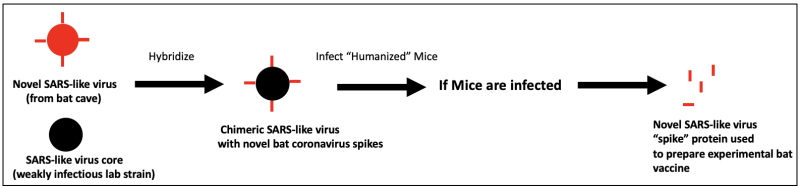
What follows is a streamlined version of the workflow proposed by the researchers: 1) add the spike proteins from these novel bat coronaviruses to a previously characterized SARS-like bat coronavirus core, and insert genetic modifications to spike proteins for enhanced infectivity if necessary, 2) infect “humanized” mice with these lab-made viruses, 3) flag chimeric viruses capable of infecting the mice as potential pandemic strains, and 4) prepare “spike” protein vaccines from these potential pandemic strains and use them to “immunize” bats in caves (Fig. 1).
Fig. 1. Risky research methodology used by EcoHealth Alliance, WIV, and their collaborators to attempt to create bat vaccines. There’s no way of knowing in advance the pandemic potential of unnatural, chimeric SARS-like viruses created in this workflow.
The authors of the DARPA proposal discuss the importance of spike protein cleavage by human enzymes such as furin in the ability of coronaviruses to spread optimally and become pandemic strains. Notably, they proposed to insert “human-specific cleavage sites” (e.g., furin cleavage site, FCS) in spike proteins that lack the functional cleavage sites and then “evaluate growth potential” of the modified viruses in human cells.
They further proposed to modify cleavage sites in highly abundant, low-risk SARS-like viruses taken from Chinese bat caves. These studies are precisely the type of work that could accidentally or intentionally create pandemic viruses. Although the proposal states that chimeric virus work would be done at the University of North Carolina, by Fauci’s own admission, “I can’t guarantee everything that’s going on in the Wuhan lab, we can’t do that.” Furthermore, whenever a proposal this large (i.e., a $14 million request) is submitted, a great deal of the work will have already been done in advance to provide the “proof of concept” needed to sway reviewers.
The unique furin cleavage site in SARS-CoV-2 is evidence of genetic engineering
Many natural coronaviruses contain an FCS, so why is an FCS in SARS-CoV-2 so suspicious? The answer is that the genomes of thousands of coronaviruses from hundreds of different animals have been sequenced, and it’s clear that only distant relatives of SARS-CoV-2 have an FCS (see Fig 1A, Table 1).
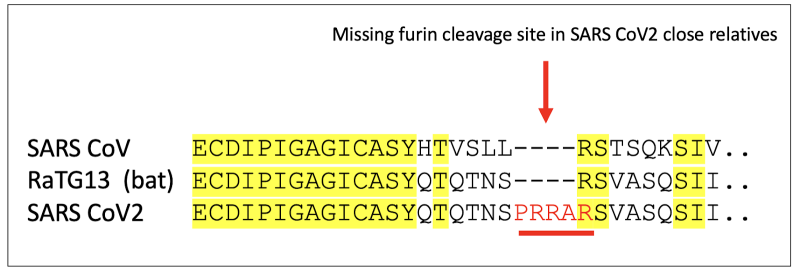
The closest known sibling of SARS-CoV-2, a bat coronavirus named RaTG13, at best weakly infects human cells and lacks an FCS. SARS-CoV is another sibling of SARS-CoV-2, and like all the other known siblings, also lacks an FCS. Without an FCS, SARS-CoV-1 spread around the world in 2003-2004 but fizzled out after infecting about 8,000 people. A comparison of the short stretch of amino acids in the spike protein clearly reveals the missing FCS in these SARS-CoV-2 siblings (Fig. 2).
Fig. 2. Comparison of partial spike protein amino acids showing the FCS of SARS-CoV-2 (i.e., “PRRAR”), and the lack of FCS in two of its siblings. Different letters represent unique amino acids. Identical amino acids in all three viruses are highlighted in yellow; dashed lines indicate the missing FCS.
The unique genetic code of the SARS-CoV-2 furin cleavage site is evidence of genetic engineering
In coronaviruses, the blueprint for assembling proteins such as the surface spikes needed for infection lies in their RNA genome. The specific genomic sequence that encodes the short, all-important FCS within the SARS-CoV-2 spike is: CCU CGG CGG GCA CGU. Each three-letter bit of code (i.e., codon) dictates the specific amino acid to be used in building the FCS. Thus, CCU encodes “P” (for proline), CGG encodes “R” (for arginine), GCA encodes “A” (for alanine), and CGU also encodes “R.”
As you can see, there is redundancy in the genetic code (e.g., there are six different codons that a virus can use to encode arginine). The odd feature of the SARS-CoV-2 FCS is the double CGG codons. In fact, CGG is one of the rarest codons in human coronaviruses, yet there just so happens to be two right next to each other in the FCS, one of the most important sequences in the entire 29,903 “letters” making up the SARS-CoV-2 genome.
In fact, these are the only two CGG codons out of the 3,822 “letters” encoding the SARS-CoV-2 spike protein, and they are the only instance of a CGG-CGG doublet in any of the closest relatives of SARS-CoV-2. Notably, an arginine-rich FCS enhances the ability of coronaviruses to infect cells. At this point, it should not surprise anyone that CGG codons are the preferred code for genetic engineers who wish to produce an arginine-containing protein in human cells. It’s hard to deny that the CGG-CGG in the SARS-CoV-2 FCS is “smoking gun”-level evidence of genetic tampering.
Suspicious cut sites in the SARS-CoV-2 genome are evidence of genetic engineering
One method to create chimeric viruses utilizes specialized genome-cutting enzymes called “Endonucleases.”
Endonucleases can be used to cut virus genomes in specific places, then the pieces can be strategically recombined to create chimeric viruses. Cut sites are randomly distributed in the genomes of natural viruses, but they can be precisely inserted or removed by scientists to make chimeric viruses in a laboratory. BsmBI and BsaI are two examples of endonucleases that co-authors of the DARPA grant used in previous work to make chimeric coronaviruses.
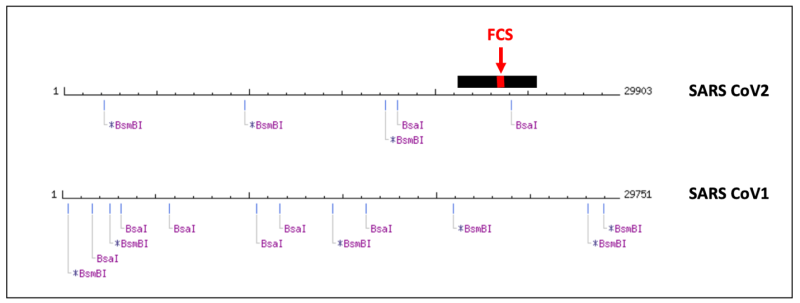
When present, the distribution of BsmBI and BsaI cut sites in viruses isolated from nature (e.g., SARS-CoV-1) are randomly distributed throughout the genome. Meanwhile, the distribution of cut sites in SARS-CoV-2 appear to be non-random and suggest genetic manipulation in a laboratory (Fig. 3). Curiously, a previous study involving EcoHealth Alliance described the insertion of two BsaI cut sites in a bat coronavirus called “WIV1” (i.e., Wuhan Institute of Virology 1), allowing scientists to make changes to the spike protein (see S9 Fig. Spike substitution strategy).
Two BsaI cut sites can be found in the SARS-CoV-2 genome (Fig. 3) in the same location as BsaI cut sites engineered into WIV1 back in 2017. The astronomical odds of this being coincidence cannot be overstated. According to the authors, “BsaI or BsmBI sites were introduced into the [spike]. Then any spike could be substituted into the genome of [lab engineered WIV1] through this strategy.” The same strategy might have been used in the construction of what would become the SARS-CoV-2 genome.
Fig. 3. Distribution of BsmBI and BsaI cut sites in the genomes of the two pandemic SARS viruses. SARS-CoV-1 is a natural virus with cut sites that are randomly distributed, while distribution of cut sites in the SARS-CoV-2 genome appear to be non-random. The black bar represents the location of the spike gene; the FCS region is highlighted in red. BsaI can be used to cut out and replace most of the SARS-CoV-2 spike, including FCS, to alter virus infectivity.
Strong circumstantial evidence supports the lab- leak hypothesis
Three years into the current pandemic, with thousands of animals sampled and millions of genome sequences analyzed, nothing close to SARS-CoV-2 has been found in nature. In stark contrast to 2003-2004, China’s early response to COVID-19 was “disappearing” scientists and journalists, obfuscation, and deflecting blame for starting the pandemic away from themselves onto everything from the US Army to imported frozen fish. This is exactly the type of behavior you might expect from a guilty party.
No one (except maybe the dishonest Chinese government) has ever denied that the epicenter of the COVID-19 pandemic is Wuhan, China. But what are the odds that such an explosive outbreak originated at the Wuhan market? This is just one market out of about 40,000 markets scattered around China, and it happens to be a few miles away from a lab that in 2017 became the first high-security virology lab on the Chinese mainland.
Here, a counterargument is that SARS-CoV-1 was a natural spillover from a market, so there’s precedence. But even the far less transmissible SARS-CoV-1, not long after being brought into the lab for study, eventually “leaked” with fatal consequences.
The origin of SARS-CoV-2 is the most important question of the pandemic, with implications that extend exponentially beyond scoring political points. At the start of the pandemic, even the journal Nature was sounding the alarm about the increasing role China’s military has been playing in secretive biomedical research in China. Yet, three years later all we have is obfuscation from China and Fauci and nothing even close to a natural ancestor of SARS-CoV-2. Throughout the pandemic, people parroted empty phrases like “Follow the science” without really following the science. So, let’s do that, let’s “Ffollow the science” (and the logic), because the genetic and circumstantial evidence for lab leak is impossible for any reasonable person to deny.
Italy's TIM suffers internet connection problems
ROME, Feb 5 (Reuters) - Thousands of Telecom Italia (TLIT.MI) (TIM) customers across Italy complained of internet outages and glitches on Sunday which the company blamed on problems with an international link.
Users from the northern city of Milan to the Sicilian capital Palermo reported problems, with the issue mainly focused on fixed-line internet services.
Some soccer fans bemoaned interruptions to their streaming of the Serie A game between Spezia and league leaders Napoli.
"An international interconnection problem impacting the service at national level was detected. Analyses are underway to resolve the problem," a TIM spokesperson said.
There was no indication that the problems were caused by hackers, Italy's ANSA news agency reported.
TIM, the former national telecoms monopoly, is at the centre of a takeover struggle, with private equity group KKR (KKR.N) having made a non-binding bid to buy its network.
Breakdown of gas storage talks leaves UK exposed to price surges, say experts
Impasse over subsidies increases country’s dependence on expensive LNG imports
Britain will be vulnerable to gas shortages and high energy prices next winter because of the failure of the government and Centrica to reach agreement on expanding the UK’s largest gas storage site, energy experts and MPs have warned.
Centrica, which owns British Gas, partly reopened the Rough gas storage site off the Yorkshire coast, at the government’s request last October — five years after it was closed to new injections. But the site is operating at only a fifth of its previous capacity.
The company had been lobbying the government for consumer-funded minimum revenue guarantees that it says it needs if it is to invest the £150mn required to double Rough’s capacity to 60bn cubic feet by next winter.
Talks between the government and Centrica over the new funding mechanism have collapsed in recent weeks and Centrica has warned that it will not be able to expand the capacity in time for next winter.
Dieter Helm, professor of economics at Oxford university and a former energy adviser to the government, said the UK was failing to develop its gas storage with the “urgency that is now needed”.
“Storage is part of security of supply and a public good but the market won’t deliver on its own. Relying on LNG tankers on the high seas comes with a price that explains why the UK was hit so badly by rising gas prices, despite importing so little from Russia.”
One source close to the government said that “Centrica was too greedy”, adding that the discussions had become increasingly heated and acrimonious.
“They couldn’t get the added facilities up and running in time for next winter and the supply constraints have eased; the government just walked,” the source added.
The shortage of gas storage can contribute to rising energy bills by leaving the UK reliant on LNG imports during the winter when the cost is higher, an issue that has become particularly critical since Russia invaded Ukraine.
Michael Bradshaw, global energy professor at Warwick Business School, said the “lack of storage capacity in the UK exposes customers to security of supply risks next winter”.
“This leaves the UK dependent on having to attract LNG cargoes during winter months when prices tend to be high and competition is greater; a situation exacerbated by the lack of firm long-term contracts that would guarantee deliveries to UK terminals.”
Centrica said in October that the UK’s nine days of gas storage was far behind Germany at 89 days, France at 103 days and the Netherlands at 123 days.
A Centrica spokesman said “talks had not progressed but the door is always open”.
“We have done as much as we can but this is a long-term strategic decision and to do more we need a regulated model so it underpins the investment for years to come,” he said.
The Department for Business, Energy and Industrial Strategy said it “was a matter for Centrica”.
Darren Jones, chair of the business select committee, said: “We have precious little time to prepare for next winter. This winter has shown how expensive it is to not have sufficient storage of gas.”
In the long term, Centrica is lobbying for government support for its £2bn plan to turn the site into a hydrogen storage facility in line with the UK’s green ambitions.
Gary Smith, general secretary of the GMB union, said: “This looks like another energy failure from the government. Our country needs all the gas storage we can get. So, what are we waiting for? For years the UK has suffered from the disastrous decision to close Rough. Rishi Sunak needs to put this right and fast.”
Can the pioneer of blockchain gaming survive the crypto winter?
Yat Siu has become the pre-eminent investor in this hyped field. But as well as the slump in crypto assets, he faces questions from regulators
Yat Siu is no stranger to controversy. Over the years, the serial technology entrepreneur has been kicked off the App Store, delisted from a stock exchange and has clashed with his auditors.
But Siu, through his Hong Kong-based Animoca Brands vehicle, has become the pre-eminent investor in the world of blockchain-based gaming, presented by its promoters as the next big thing in the global games industry.
He has sold his backers a vision of digital property rights in video games, where players can own their in-game items as non-fungible tokens (NFTs) recorded via blockchain, earn as they play, and profit from trading with other players. The collision of crypto and gaming has been one of the most-hyped potential uses for blockchain technology.
As crypto boomed in 2021, the 49-year-old rode the speculative wave as Animoca sold NFTs linked to a portfolio of investments in almost 400 start-ups. A funding round in 2022 featured a $5.9bn valuation and the backing of some of the leading names in the investment world.
But as a “crypto winter” set in over the industry following a string of corporate disasters and a collapse in asset prices last year, Siu still faces serious questions over Animoca’s business model, regulatory compliance and governance.
The company has become a test case for whether any of the potential innovations from blockchain will survive the crypto sell-off. If it stumbles, so too may the industry that Siu has helped will into existence .
“When the predominant business is issuing tokens from zero and selling them to retail, it’s not an easy business to sustain long term,” says Antonas Guoga, a former Animoca investor. “Probably 99 per cent of the tokens are going to zero.”
But if Siu proves his sceptics wrong, Animoca’s hundreds of investments could put it at the centre of what some think will be a revolution in gaming that proponents claim will take power away from distributors and put it in the hands of players.
“He’s proven again and again to be the guy who can get out of any situation,” says another associate more bullish about Siu’s prospects.
The story so far
When the pandemic hit in 2020, Siu was at the helm of a little-known Hong Kong app developer that had just been delisted from the Australian Securities Exchange.
Animoca, perennially lossmaking, had meagre revenues and a record of churning out largely forgettable mobile games, along with a grab-bag of investments in unloved blockchain ventures.
Its mainstay for years had been mobile games based on well-known franchises like Garfield or Thomas the Tank Engine. Animoca would license the intellectual property rights and package them into free-to-play games.
Siu, cheerful and self-deprecating, has been a fixture of the Hong Kong start-up scene for decades. He was born and raised in Austria, trained as a musician before becoming a programmer and then began launching companies after moving to Hong Kong in 1996. One former employee calls him down-to-earth. “A lot of people in crypto buy Lambos . . . he goes hiking with his wife.”
As dotcom mania ramped up he launched an online messaging service called Outblaze, later described by BusinessWeek as a venture that had “outlasted the bubble”. Siu sold the messaging assets to IBM in 2009 and along with a core of Outblaze lieutenants, pivoted to mobile games.
Animoca punched above its weight partly by playing the App Store’s rankings. “What we figured out is that if we launch an app every week, and cross promote, we’ll always be the top,” he says. The games often appeared to users under different publisher names.
Apple viewed the tactics as manipulation and removed the company’s apps in 2012. Even though Animoca was allowed back in by 2013, the reputational effects lingered. “We actually became, a little bit, pariahs,” he says.
The following year, he listed Animoca by reversing into a listed shell company in Australia and by late 2017 was experimenting with investments in AI and crypto tokens. Siu was an early investor in the company behind the original NFT bubble, CryptoKitties, which involved trading virtual cats.
He describes his investing strategy as ecosystem building — the more blockchain-based businesses he backs, the more likely it is that the market as a whole will grow. He acquired one start-up, Leade.rs, in an all-share deal in part to evangelise about digital property rights to its backers, who included LinkedIn founder Reid Hoffman.
Besides the CryptoKitties supernova, Siu’s esoteric investments seemed unlikely to ever pay off. Animoca lost money and was constantly fundraising small amounts. To preserve cash, Siu generally structured investments as share swaps or threw in crypto tokens as consideration. “He’s incredibly creative and flexible in his ability to make deals,” says Mikhael Naayem, the co-founder of Dapper Labs, the company behind CryptoKitties.
But when Covid-19 arrived, prompting governments and central banks to inject trillions of dollars into the global economy, crypto speculation boomed and suddenly Animoca had hit the big time.
The boom, and bust
In the seven months to April 2022, the company reported $721mn in income from NFT sales and gains on investments. It valued its start-up portfolio at $1.5bn and said it had a further $4.2bn of “digital asset reserves” not counted on its balance sheet.
“Was it smart? . . . We were just lucky,” says Siu. “We were just executing the business, and it just happened. I would love to take credit.”
The bonanza was largely down to a few bets that Animoca made back in the doldrums of 2018 and 2019. These included OpenSea, an NFT trading platform, the SandBox, a virtual world where players can buy “land” and build their own games, and Axie Infinity, the token-based game that critics claim is akin to a pyramid scheme.
Siu had been among a handful of backers of start-ups that were suddenly popular with investors. For founders, funding from Animoca was a sign of credibility, that “you’re tuned into the ecosystem”, as one mobile gaming executive puts it.
Animoca further boosted its revenues by issuing new tokens or acquiring tokens issued by its portfolio companies cheaply and then selling them at high prices.
“If you got into crypto with some sort of dollars behind you in 2017 and 2018 . . . you did insanely well by no fault of your own,” notes one banker who works with crypto companies. “You could have thrown a dart at a token and gotten 20x.”
Siu raised hundreds of millions of dollars from high-profile investors on the back of that dart throwing. Multiple funding rounds culminated with the two-tranche deal in 2022 that valued the group at $5.9bn and was backed by Sequoia China, Winklevoss Capital, London’s Kingsway Capital and Soros Fund Management.
Animoca also created NFTs from traditional franchises and brands, a skill Siu had been “honing . . . for many years in free to play [gaming]”, the mobile gaming executive says.
One project involved Formula 1 NFTs tied to a game called Delta Time launched in 2019. Players could buy their own virtual cars. A big buyer was Guoga, a poker player and Lithuanian politician who spent an in-game token worth $77,000 on a single car in December 2020.
But the collapse in the crypto market was as dramatic as its rise, and the impact has been clear in the token markets on which Animoca built its success. Delta Time closed last year after Formula 1 declined to renew the rights. The virtual cars are all “worthless” now, says Guoga, adding that he sold his own Animoca shares “at the top” last year. “The market seemed to be very inflated”.
Cryptocurrencies may have rallied so far this year, but of the 13 tokens Animoca lists on its website as those it issued, 11 are down by more than 90 per cent since their peak. The other two have fallen at least 30 per cent. OpenSea, one of the jewels in Animoca’s portfolio and valued at $13bn in January 2022, saw its NFT trading volumes also plummet 85 per cent last year.
Animoca shares, which had peaked in January 2022 at around A$4.60 a share on a secondary market for private companies, PrimaryMarkets, last traded at A$1.40.
The retreat of money from the speculative fringes of the technology sector also focused attention on how few people were actually participating in crypto. Sandbox, considered Animoca’s best shot at a breakout hit, said in December it had 30,000 daily users. Top mainstream games typically count their daily users in the millions.
Sandbox’s chief operating officer Sebastien Borget says the company has kept growing despite the crypto downturn. “The activity of the metaverse is not dependent on the cycle of the cryptocurrency markets,” he says.
Sandeep Nailwal, the co-founder of blockchain platform Polygon, says his industry is still “very very small, minuscule”, especially relative to valuations being secured in 2021 and 2022. “The valuations are way off . . . orders of magnitude overvalued,” he says.
In September, Siu announced a $110mn funding round that reflected new realities. Investors led by Singaporean sovereign wealth fund Temasek stumped up a convertible loan note rather than straight equity.
“Everyone basically got pretty terrified,” he says of last year’s crypto collapse. The note is a three-year loan at 10 per cent, according to Siu. “It’s not cheap, but it’s not crazy.”
Sailing close to the wind
But Siu’s enthusiasm for crypto and his freewheeling investment approach has also been a source of trouble for Animoca over the years.
In March 2020, the Australian Securities Exchange terminated Animoca’s listing. At the time, the company cited a letter from the exchange complaining of governance failings, novel financing contracts, and its heavy involvement in crypto.
But the letter, seen by the Financial Times, said Animoca’s disclosures and crypto investments had violated no fewer than 17 of ASX’s listing rules. The exchange accused the company of having a “wilful disregard” for its regulations, and expressed “serious concerns that [Animoca] does not have adequate systems and controls in place to manage its reporting and disclosure obligations”.
Siu says the ASX just “didn’t like crypto” and that “when they decided to go after us, they just threw the book at us”. He adds that a detailed response to its criticisms was met with a cursory reply. The exchange did not respond to a request for comment.
Though delisted, Animoca still has thousands of shareholders and is obliged to file public accounts in Australia. Its last set of numbers ran to the end of 2019 and it only filed them last year — shortly after being convicted and fined A$50,000 by the Australian Securities and Investments Commission for failing to do so previously.
Animoca had failed to respond to Asic’s complaint; Siu calls the oversight “a bit of a shitshow”. He says the Asic notice had not been collected from a service address because of Covid-related travel restrictions. The company has received an extension to the end of March for its 2020 accounts and says it will file its 2021 and 2022 figures “this year”.
The delays in filing stem in part from tussles with its auditors, disagreements that Siu blames on novel questions about accounting for crypto assets. Complaints from Animoca’s former auditors, Grant Thornton, appeared more prosaic, according to a March 2020 letter seen by the Financial Times, which was triggered by Animoca not “providing quality information in a timely manner” relating to the 2019 accounts
The accountancy firm, which had audited Animoca since it listed, painted a picture of undocumented and opaque dealings, including with related parties, and said there was “little if any documentary evidence available [to] support the investments made” by Animoca.
“Our audit procedures to date have indicated significant risks of management override of controls, potential for undisclosed related party transactions and undisclosed commitments for expenditure,” it added.
Animoca said it addressed the points to Grant Thornton’s satisfaction and that the Covid pandemic caused problems and delays with audits at many companies. But it still replaced Grant Thornton with DFK Collins, a smaller Australian accountant, at the end of 2021. “GT struggled with our business . . . they didn’t really understand it,” Siu says.
He acknowledges that Animoca didn’t have all the documentation the auditors wanted, but says that was to be expected given the nature and size of the investments he was making.
“It is not like we go through three months due diligence on a half a million dollar investment,” he says, arguing it’s natural that there’s no formal valuation report on such deals. “I don’t think if we were in America, dealing with a tech auditor, that we would have had these issues.”
But former employees, people who have run Animoca portfolio companies, and others with knowledge of the company gave similar accounts of a business with chaotic internal processes and weak governance, where decisions were made largely on the basis of Siu’s gut feeling.
Historically, Animoca has been staffed by long-time associates of Siu, they said. The company was incubated by Outblaze, where Siu’s wife had been head of HR. Its head of venture investing is James Ho, Siu’s brother-in-law, whose personal fund was among the co-investors in a start-up that Animoca backed in 2021. Animoca said such co-investments were common industry practice
In September, Animoca hired a new chief financial officer, group HR director and head of legal. Evan Auyang, who joined as group president of Animoca in 2021, says the company has significantly expanded its finance and legal capacity and professionalised its operations.
He says that when he joined, he asked Siu whether he was “ready to have a team around you who would challenge him, and he welcomed that.”
Confident in the future
Animoca is in the midst of trying to raise a venture fund as big as $1bn, though it’s unclear if there is enough demand. Siu says the fund could act as a follow-on investor in the deals that the company has already backed.
In November, after the FTX collapse, Siu released fresh financial details to reassure shareholders his company was solid. He said Animoca had $214mn in cash, digital assets of $940mn and “off-balance sheet digital reserves” of $3bn. He says it has no debt, is “cash flow positive” and is generating revenue from a range of activities.
In the coming 18 to 24 months, he claims Animoca’s blockchain-gaming bets will be vindicated by mass adoption.
Meanwhile, he is already pursuing new lines of business around his “big northstar” of digital property rights. One new push is NFTs created by teachers. “We’re trying to create a financial asset class out of content created by teachers so that they can participate in capital formation,” he says. Last month, Animoca also led a seed investment into the relaunched MoviePass, the cinema ticket service that collapsed in 2020.
Siu attributes his fascination with true digital property rights in part to his experiences with Apple back in 2012. “It’s definitely made me feel much more stronger about the risk of centralised platforms,” he says.
And despite the chaos in crypto markets, he’s outwardly unfazed. “It’s pretty chilly, but it’s not as cold as it was four years ago.”
The World’s Biggest Planes Are Finding Their Way Back Into the Skies
Airlines and lessors are snapping up wide-bodies as long-haul travel rebounds
The world’s biggest passenger airliners—many of which had been earmarked for the scrapyard—are being brought back into service as carriers rush to restore long-haul air travel.
Aircraft lessors said airlines are clamoring for their once-parked fleets of big jets, which typically each ferry hundreds of passengers on long-distance routes. The demand is limiting availability and pushing up the prices of rentals.
The wait for new aircraft, meanwhile, stretches for years. Sought-after wide-body planes, which contain seats spread across two aisles, include Boeing Co. BA -1.59% ’s 787, which has suffered production delays related to quality issues, and Airbus EADSY -2.09% SE’s A350, the plane maker’s biggest jet still in production.
“There has been a tremendous acceleration in the last eight to 12 months in the wide-body marketplace,” said John Plueger, chief executive officer of Air Lease Corp. AL -1.45% , one of the world’s biggest airliner-leasing companies.
Boeing and Airbus sales staff are chasing several big orders for new planes from carriers and lessors. Airlines including British Airways—owned by International Consolidated Airlines Group SA — Deutsche Lufthansa AG and Qantas Airways Ltd. are flying their double-decker Airbus A380 jumbo jets again, after mothballing the planes at the height of the pandemic.
“Knowing and working on the existing campaigns with customers around the world, I feel pretty good about the wide-body,” Airbus executive Christian Scherer said in a briefing.
The scramble for big planes has upended conventional wisdom in the industry. Even before the pandemic temporarily shut down most air travel, airlines had been shifting away from the biggest wide-body planes, convinced that smaller twin-aisles, or longer-range narrow-body jets, offered more flexibility with better fuel economy and cabins that are easier to fill.
When the pandemic hit, the shift toward smaller planes intensified. Airlines deferred and canceled orders for twin-aisle planes and moved to park the biggest, most fuel-guzzling jets, including dozens of the humpbacked Boeing 747s and Airbus A380s, permanently.
As travel restrictions started to lift, airlines initially sought to bring back only their smaller narrow-body jets. Demand for domestic and short-haul leisure trips, already serviced by smaller planes, started to return before long-haul international flights.
Wide-body flying is still short of a full recovery. The total number of flights operated on twin-aisle jets in January came in at 76% of the total flown in the same month in 2020, according to flight-data specialist OAG. Airbus and Boeing are being cautious about raising the production rates of their biggest planes, even as they chase orders for them.
They are already battling manufacturing pressures on their narrow-body output and are cautious about overwhelming already-stretched production lines. Any global economic softening could test the resilience of the recent surge in passenger numbers.
On Jan. 31, Boeing marked the delivery of its final 747 aircraft after more than five decades of production. The jumbo, which stretches 250 feet, has been an icon of long-haul air travel. The jet’s four engines and size had made it harder for airlines to justify keeping it in their fleets, ultimately relegating new deliveries of the plane to freighter-only variants.
Still, airlines for now are moving quickly to bring bigger planes back into service or fast-track replacements as passengers flock back to airports. The industry is also now betting on pent-up demand for foreign travel from China after that country dropped most pandemic travel restrictions.
Lufthansa said in January that in addition to its A380 fleet it was returning a handful of its decades-old, four-engine Airbus A340 jets to service as it deals with delays of deliveries of new 787 Dreamliners from Boeing. In addition, the U.S. plane maker’s newest entrant to the wide-body market, the 777X, is running about five years behind schedule. Lufthansa has ordered 777Xs to replace its remaining 747s.
The Irish leasing company Avolon Holdings Ltd. said it has placed almost all of its wide-body planes with airlines, with the exception of two Airbus A330neos. “The aircraft are getting deployed,” said Chief Executive Andy Cronin.
In a market forecast published in January, Avolon said it is expecting global traffic to recover to 2019 levels by June this year, spurred by a resurgence in long-haul travel and an expected recovery in China.
The return to the skies of bigger aircraft is driving new sales and campaigns for Boeing and Airbus after years of slumping demand. Last year Boeing and Airbus reported 301 gross orders for wide-body jets.
The combined orders marked a 64% jump from the 184 gross orders for bigger-model jets booked in 2021. The 2022 figure included part of a mega order for 100 Boeing 787s from United Airlines Holdings Inc., which also includes options to purchase 100 more.
Last year “was kind of the inflection point,” said Boeing’s vice president of commercial marketing, Darren Hulst. He said the sales bonanza was “a leading indicator of where the market’s headed.” In total, Boeing booked orders for 217 wide-body planes, including freighters, in 2022, the most it has taken since 2014.
So far this year, Airbus has booked an order from Air France-KLM Group for seven of its A350s, including four new cargo variants to replace the airline’s aging 747 freighters. The two plane makers are also on the cusp of signing a mega order from Air India Ltd., which is expected by analysts and industry officials to be one of the biggest combined orders in aviation history.
The deal is expected to be for some 500 jets split between Airbus and Boeing, and include orders for wide-bodies including the 787, Boeing’s in-development 777X and the A350.
China Aircraft Leasing Group Holdings PLC, the country’s biggest independent leasing company, is assessing new orders for Boeing and Airbus jets, according to the company’s CEO, Mike Poon.
“We don’t have the order book on wide-bodies. This year is the time to get,” Mr. Poon said at a recent conference in Dublin. “The top agenda this year is wide-bodies, wide-bodies, wide-bodies.”
How Sam Bankman-Fried’s Psychiatrist Became a Key Player at Crypto Exchange FTX
Hired as a coach at the Bahamas-based company, George Lerner was there for its dramatic downfall
Early last year, Sam Bankman-Fried told an FTX all-hands meeting about an addition to the company’s staff.
It wasn’t a head of accounting. It wasn’t a risk manager. Instead, it was a psychiatrist who would serve as coach for stressed-out employees at the fast-growing crypto exchange. Dr. George Lerner introduced himself on the video meeting and encouraged workers to consult with him, meeting attendees recalled.
FTX collapsed in November, brought down by revelations that it had misused billions of dollars of customer funds. Mr. Bankman-Fried is now under house arrest after pleading not guilty to fraud charges. FTX is in bankruptcy proceedings.
Late last month, FTX’s new management asked a judge to approve subpoenas to obtain a broad assortment of internal communications, including those between Mr. Bankman-Fried and Dr. Lerner, as part of its efforts to recover FTX assets.
Dr. Lerner isn’t accused of wrongdoing. A spokesman for Mr. Bankman-Fried declined to comment on the subpoena request. In an email, Dr. Lerner noted he wasn’t an attorney and said the request was “probably pretty standard for a bankruptcy case.”
Dr. Lerner relocated in June to the Bahamas, where FTX was based. The staff of FTX and its sister trading firm, Alameda Research, put in long, intense hours, and work and life were often blurred. Many of the employees, in their 20s and far from home, lived together in high-end company housing, and romantic relationships between executives were common.
The lines between the two companies, FTX and Alameda, were also indistinct. Mr. Bankman-Fried told investors that the two operated separately, a safeguard that should have protected customer money. But the two companies shared office space, employees and technology. Regulators say that Mr. Bankman-Fried treated FTX customer funds as a piggy bank. Mr. Bankman-Fried, who was chief executive officer of FTX and owned 90% of Alameda, has denied that any funds were stolen.
Dr. Lerner, who is 46 years old, said FTX hired him as a coach, not a psychiatrist. He said that after moving to the Bahamas, he worked 32 hours a week for the company. He saw about 100 of the company’s 300 employees for coaching, including 20 to 40 on a semiregular basis, he said.
Separately, Dr. Lerner said, about 20 FTX employees were patients in his private practice.
As a psychiatrist, Dr. Lerner is a medical doctor who can diagnose mental-health disorders and prescribe medicine. As a coach, he could offer advice and counseling.
Dr. Lerner said his main goal at FTX was creating “a more sustainable work environment.”
“They were amazing people—driven, brilliant, wanting to make a positive impact on the world,” Dr. Lerner said. “Conflict resolution was the toughest as most of my work has historically been with individuals.”
The Wall Street Journal spoke to former FTX employees about Dr. Lerner. Some welcomed his hire as a sign of the company’s progressive attitude to mental health. They said he skillfully cared for employees who became despondent when FTX was failing in November.
Dr. Lerner earned an M.D. in 2004 from the Baylor College of Medicine in Houston and completed his residency at the University of California, San Francisco, a top-ranked psychiatry program.
Before joining FTX, Dr. Lerner ran a psychiatry practice near San Francisco’s Union Square, where patients included executives from tech, crypto and venture capital, he said. He specialized in treating depression, anxiety and attention-deficit hyperactivity disorder, according to an old version of his website.
Dr. Lerner ended up at FTX, he said, because he had been treating some early employees of FTX and Alameda at his private practice.
One of his patients was Mr. Bankman-Fried, who started seeing Dr. Lerner in early 2019 and continues to be his patient today, receiving treatment for ADHD and depression, according to the spokesman for the former FTX CEO.
In draft testimony for a congressional hearing in December, Mr. Bankman-Fried said he had a decadelong prescription to the antidepressant Emsam. “I am, and for most of my adult life have been, sad,” he said. Mr. Bankman-Fried didn’t testify at the hearing because he was arrested the day before it took place.
At FTX, some employees worried about what they saw as Dr. Lerner’s closeness to Mr. Bankman-Fried, so much so that they said they held back from revealing too much in coaching sessions. Dr. Lerner said he kept coaching interactions in strict confidence.
Dr. Lerner also said he was careful to separate his medical practice from his FTX coaching. For example, employees who saw him for coaching were asked to sign a form stating that he was their coach and not their psychiatrist, he said.
For the employees who were patients in Dr. Lerner’s private practice, he would treat them during their trips back to California, he said. He treated about 10 for depression or anxiety and 10 for ADHD, he said.
Dr. Lerner isn’t registered as a physician in the Bahamas, according to the Bahamas Medical Council database. California’s medical board said it allows its doctors to treat patients via telehealth “from anywhere in the world,” as long as the patient is in California.
Some former employees who saw Dr. Lerner for coaching said he made it clear that he could help them get medications such as Adderall, used to treat ADHD, or Xanax, used to treat anxiety. Dr. Lerner said he didn’t offer such services to people he saw for coaching and prescribed medicine to patients only when medically necessary.
Danielle Cloud, a former employee in FTX marketing, described on Twitter several coaching sessions with Dr. Lerner. “After an initial ‘consultation,’ he informs me he can help with my underdiagnosed ADHD bc that’s his specialty,” she wrote.
Ms. Cloud declined to comment. Other former employees said Dr. Lerner took a measured approach to prescription medications.
Dr. Lerner said one of his goals at FTX was helping employees go out on dates.
“I was very concerned that people’s happiness would be reduced by lack of dating opportunities outside of a big city or that they would feel compelled to leave the company due to this,” he said.
Dr. Lerner said he tried to organize social mixers with other companies in the Bahamas but that people were too busy.
When FTX imploded in November, Dr. Lerner stuck around even as dozens of employees quit. He counseled those who remained, including senior employees struggling to keep FTX afloat, people familiar with the matter said.
When some distressed employees appeared to be at risk of suicide, Dr. Lerner organized efforts to care for them, encouraging them to get outside or urging others to keep an eye on them, these people said. He also helped some employees make travel arrangements to leave the Bahamas and get psychological care at home, the people said.
“People were devastated,” Dr. Lerner said. “They had lost their FTX family.”
Dr. Lerner said he is focused on rebuilding his private practice. His website has been stripped down, offering only some contact information.
N.Roubini
A bipolar currency regime will replace the dollar’s exorbitant privilegeThe greenback is bound sooner or later to feel the effects of intensifying geopolitical rivalry between the US and China
The US dollar has been the predominant global reserve currency since the design of the Bretton Woods system after the second world war. Even the move from fixed exchange rates in the early 1970s did not challenge the greenback’s “exorbitant privilege”.
But given the increased weaponisation of the dollar for national security purposes, and the growing geopolitical rivalry between the west and revisionist powers such as China, Russia, Iran and North Korea, some argue that de-dollarisation will accelerate. This process is also driven by the emergence of central bank digital currencies that could lead to an alternative multipolar currency and international payment regime.
Sceptics argue that the global share of the US dollar as unit of account, means of payment and store of value hasn’t fallen much, despite all the chatter about a terminal decline. They also point out that you can’t replace something with nothing — as former US Treasury secretary Lawrence Summers put it: “Europe is a museum, Japan is a nursing home and China is a jail.”
More nuanced arguments point out that there are economies of scale and network that lead to a relative monopoly in reserve currency status, and that the Chinese renminbi cannot become a real reserve currency unless capital controls are phased out and the exchange rate made more flexible.
Moreover, a reserve currency country needs to accept — as the US long has — permanent current account deficits in order to issue enough of the liabilities held by non-residents as a counterpart. Finally, such sceptics argue that all attempts to create a multipolar reserve currency regime — even an IMF Special Drawing Right basket that includes the renminbi — have so far failed to replace the dollar.
These points may once have had some validity, but in a world that will be increasingly divided into two geopolitical spheres of influence — namely those surrounding the US and China — it is likely that a bipolar, rather than a multipolar, currency regime will eventually replace the unipolar one.
Complete exchange rate flexibility and international capital mobility is not necessary in order for a country to achieve reserve currency status. After all, in the era of the gold-exchange standard the dollar was dominant in spite of fixed exchange rates and widespread capital controls.
And while China may have capital controls, the US has its own version that may reduce the appeal of dollar assets among foes and relative friends. These include financial sanctions against its rivals, restrictions to inward investment in many national security-sensitive sectors and firms, and even secondary sanctions against friends who violate the primary ones.
In December, China and Saudi Arabia conducted their first transaction in renminbi. And it is not farfetched to think that Beijing could offer the Saudis and other Gulf Co-operation Council petrostates the ability to trade oil in RMB and to hold a greater share of their reserves in the Chinese currency.
It is likely that the GCC countries, as well as many other emerging market economies, may soon start accepting such Chinese offers given that they do a great deal more trade with China than the US. Also, there is a clear so-called Triffin dilemma in a currency regime in which the reserve country runs permanent current account deficits that will eventually undermine its reserve status as the growth in its international liabilities becomes unsustainable.
Critics question whether the currency of a country running a persistent current account surplus can ever achieve global reserve status. But China may in any case be moving towards a growth model less dependent on trade surpluses.
It is also an anachronism that the US, whose share of global gross domestic product has halved to 20 per cent since the second world war, still accounts for at least two-thirds of all so-called vehicle currency transactions. The current system makes emerging market economies financially and economically vulnerable to changes in US monetary policy driven by domestic factors such as inflation.
Finally, new technologies including CBDCs, payment systems such as WeChat Pay and Alipay, swap lines between China and other countries, and alternatives to Swift, will hasten the advent of a bipolar global monetary and financial system. For all these reasons, the relative decline of the US dollar as the main reserve currency is likely to occur over the next decade. The intensifying geopolitical contest between Washington and Beijing will inevitably be felt in a bipolar global reserve currency regime as well.