FT : Beware the European optimism trap

Beware the European optimism trap
Many of the factors that have boosted the region’s equities in the year to date are likely to fade as 2023 progresses

The European Commission’s consumer confidence index could be seen as an economist’s attempt at dark humour — since it was launched in the 1980s, the gauge has always been negative, with fluctuations just reflecting relative shades of gloom.

While the commission’s index suggests that eurozone consumers today are only modestly downbeat (with a level of minus 19 points in February compared with minus 29 last September), other reflections of Europe’s macro picture have become positively sunny.

Europe’s double-digit equity market returns so far this year are handily outpacing developed-market peers. Meanwhile, economic data has sharply surprised expectations to the upside. Only months ago, most forecasts assumed a 2023 recession.

The growing risk today is that investors simply assume these trends will continue. While that’s always possible, the positive macro and market forces are likely to fade as the year progresses. For those investors who have benefited from strong gains this year, it makes sense to consider taking some profits off the table, for at least four reasons.

First, the bump in economic activity from China’s reopening after Covid-19 lockdowns is likely to prove a one-off rather than a sustained support for European growth. With Asia now representing more than 20 per cent of Euro Stoxx 600 revenues, according to JPMorgan, and China alone around 10 per cent of overall European exports, it is no surprise that the pent-up Chinese demand is helping European equity sentiment and regional activity.

But in contrast to much of the developed world, where a post-pandemic splurge in spending was reinforced by large fiscal transfers, Chinese consumers seem likely to quickly revert to a more cautious stance. They face uncertainty around the critical property sector that is the basis of much Chinese household wealth creation. At the same time, the government remains intent on pursuing policies to support the economy over the longer-term versus short-term “floods” of liquidity-fuelled growth.

Second, the monetary backdrop in Europe will be getting significantly tighter at a time when global liquidity is also being withdrawn. A run-off of the European Central Bank’s bond portfolio is set to begin this month. And given growth is resilient and inflation remains multiples above the central bank’s target, there is likely to be a continuation of rate rises to take monetary policy further into restrictive territory. The ECB is “catching up” to the Federal Reserve — with the impact of the tightening ahead to be increasingly felt as 2023 progresses.

Third, and part of the ECB’s challenge, will be the direction of natural gas prices, which remains highly uncertain. The region clearly benefited in recent months from milder than expected winter weather and business efforts to limit gas consumption.

That has led to high storage levels and influenced a sharp fall in prices. Benchmark wholesale gas prices in late February tipped below €50 per megawatt hour, their lowest level since September 2021 and a fraction of the all-time high of €320 reached last August.

Still, prices remain well above prewar long-term averages, and there is a wide cone of possible outcomes for prices this year as countries seek to replenish reserves. Will Russian gas deliveries fall further? How much will China compete for supply? This is not a macro support one should count on.

Fourth and finally, Europe — like the US — has a potential fiscal fight in store this year. The region’s stability and growth pact that requires fiscal prudence was suspended in 2020 but is set to come back into force in 2024.

There is hope that reform of the fiscal rules could help ease government burdens, especially for more indebted countries such as Italy where the debt-to-GDP ratio has risen to nearly 150 per cent (versus the bloc’s 60 per cent long-term target).

For now, though, there are proposals but no agreement. It’s reasonable to expect this to come to a head over the summer (possibly sharing headlines with US debt-ceiling deadlines) so any new framework is resolved in time for year-ahead budgetary discussions.

Even with modest reforms and potential economic support from the ECB through its transmission protection bond-buying instrument, probable fiscal belt tightening next year will coincide with higher interest rates and less external growth support from China and the US. That seems highly probable to get many investors in Europe gloomy again.

>>> Europe : Brokers Upgrades & Downgrades - 6th of March 2023

>>> Up
* Accor Raised to Overweight at Barclays; PT 36 euros
* B&M European Raised to Outperform at RBC; PT 550 pence
* Electrolux Raised to Buy at Longbow; PT 180 kronor
* EnQuest Raised to Equal-Weight at Barclays; PT 29 pence
* Kingfisher Raised to Buy at Jefferies; PT 330 pence
* Lufthansa Raised to Buy at HSBC; PT 13.60 euros
* LVMH Raised to Buy at HSBC; PT 999 euros
* Nichols Raised to Buy at HSBC; PT 1,200 pence
* Rathbones Group Raised to Hold at Jefferies; PT 2,000 pence
* Richemont Raised to Buy at HSBC; PT 180 Swiss francs
* SIG Group Raised to Buy at Goldman; PT 28.50 Swiss francs
* Tesco Raised to Buy at Jefferies; PT 310 pence
* Vir Biotechnology Raised to Overweight at JPMorgan; PT $34

>>> Down
* Bonheur Cut to Hold at ABG; PT 300 kroner
* Eurofins Scientific PT Cut to 50 euros at Jefferies
* Euronav Cut to Hold at Deutsche Bank
* Grifols Cut to Equal-Weight at Morgan Stanley; PT 14 euros
* H+H Cut to Sell at Nordea; PT 100 kroner
* InterContinental Hotels Cut to Equal-Weight at Barclays
* INWIT Cut to Neutral at Citi; PT 12.50 euros
* Kamux Cut to Hold at Handelsbanken
* KB Home Cut to Underweight at JPMorgan; PT $32.50
* Nestle Cut to Underperform at RBC; PT 95 Swiss francs
* Reckitt Cut to Hold at Deutsche Bank
* *TAYLOR WIMPEY CUT TO ADD VS BUY AT PEEL HUNT
* Telefonica Deutschland Cut to Neutral at Citi; PT 3.10 euros

>>> Initiation
* Bristol-Myers Rated New Hold at Jefferies; PT $62
* Eli Lilly Rated New Hold at Jefferies; PT $290
* ID Logistics Rated New Buy at Stifel; PT 350 euros
* Merck & Co Rated New Buy at Jefferies; PT $125
* Pfizer Rated New Hold at Jefferies; PT $43
* Wood Rated New Hold at Peel Hunt; PT 200 pence

>>> Call
* Grifols Downgraded at Morgan Stanley on Margin Recovery Caution
* Nestle Cut to Underperform as RBC Questions Investment Case
* Rathbones Loses Only Sell as Jefferies Upgrades on NII Outlook
* Telefonica Deutschland Cut at Citi, Risk Appears Balanced

>>> What to look at today - 6th of March 2023

A gauge of Asian shares advanced along with US and European equity futures while Chinese stocks fell, weighed down by a modest economic growth target that diminishes the prospect of more stimulus from Beijing. Gains in the region were led by Japan and South Korea, where benchmark indexes rose about 1%, following the lead from Wall Street on Friday. US stocks ended the week on a high note, driven by speculation that the Federal Reserve won’t raise interest rates beyond peak levels already priced in. Shares fluctuated in Hong Kong and dropped about 0.3% in Shanghai as investors digested the implications of China’s goal of growth around just 5%. This set the tone for commodities from iron ore to copper, which slid together with oil on expectations that demand may be softer than some investors had expected. Investors will continue to watch moves in Chinese equities closely for indications on the resilience of the recent upward momentum seen in the nation and more broadly across Asia. A gauge of Asia’s equities rallied 1.5% last week after a near 6% slump in February. Investors will continue to watch moves in Chinese equities closely for indications on the resilience of the recent upward momentum seen in the nation and more broadly across Asia. A gauge of Asia’s equities rallied 1.5% last week after a near 6% slump in February. This week brings a slew of key economic data and events for investors to consider. In Asia, eyes remain on the National People’s Congress in Beijing for any further policy announcements and details that may set the tone for how market friendly — or harsh — regulation will be through 2023. Friday comes the last Bank of Japan policy decision under the current governor Haruhiko Kuroda. Friday comes the last Bank of Japan policy decision under the current governor Haruhiko Kuroda. Investors will also be glued to their screens when Fed Chair Jerome Powell speaks before Senate and House committees this week.

Nikkei +1.11% Hang Seng +0.34% CSI -0.63% Shanghai -0.29% Shenzen -0.15%

Eur$ 1.0644 CNH 6.9169 CNY 6.9102 JPY 135.67 GBP 1.2034 CHF 0.9359 RUB 75.6625 TRY 18.8970 WTI$ 78.94 -0.93% Gold 1,854.34 -0.12% BTC 22,345 -0.63% ETH 1,558 -0.91%

S&P +0.15% Nasdaq +0.26% EuroStoxx +0.33% FTSE -0.02% Dax +0.17% SMI +0.03%

Macro :
- China Sets Modest Growth Target as Economic Risks Persist
- EU Seeks Trade Deal With US Next Week to Unlock EV Benefits
- Fed’s Daly Says More Rate Hikes Likely Needed to Cool Inflation
- EU Draft Fast-Tracks Five Clean Sectors for Shift to Net Zero
- David Einhorn's hedge fund crushed the S&P 500 last year. These are the 3 stocks he's counting on for continued outperformance.
- Hedge Funds Cut Brent Short Positions to 11-Year Low: Chart
- Alaska Lawmakers Lobby Biden for Oil Drilling as Decision Looms
- Germany and EU Pursue Talks on Deal to Ban Combustion Engines

Keep an eye on :
- AMZN US : Reportedly Elon Musk delayed Twitter's payment for Amazon Web Services in attempt to renegotiate the deal according to TheInformation
- ANIM IM : Anima Holding Feb. Net Inflows €383M
- AAPL US : Apple Supplier Foxconn’s Sales Decline Despite China Reopening
- ARM LN : British Chipmakers Held Talks With White House: Telegraph
- ARYN SW : Aryzta 1H Revenue EU1.04B Vs. EU835.3M Y/y
- BEAN SW : Belimo FY Ebit Meets Estimates
- EN FP : France Considers Putting its Biggest Sports Stadium on the Block
- CA FP : Carrefour Franchisee Names Orcet as East Africa Head: Daily
- CSGN SW : Credit Suisse First Boston Will Have Goldman Sachs-Like Partners
- CSGN SW : Harris Associates Sells Entire Credit Suisse Stake, FT Reports
- EAST SS : Eastnine AB Says Pact on Sale of Holding in MFG Is Terminated
- EDF FP : Fresh Wave of French Strikes About Pension Reform Cuts EDF Power
- ENEL IM : Italy’s Enel to Supply 5,700 Solar Panels to Ukraine by Summer
- ENI IM : Berlusconi’s Party Favors Descalzi Remaining as Eni CEO: Ansa
- EQNR NO : Equinor’s Hammerfest LNG Plant Detected Gas Leak Friday: Rtrs
- RACE IM : Porsche, Ferrari E-Fuel Push at Heart of EU Engine Debate
- FME GY : Rheinmetall to Replace Fresenius Medical in Germany’s DAX Index
- GAM SW : Swiss Fund Manager GAM Seeks to Find Buyer Before Results: FT
- HELN SW : Helvetia FY IFRS Net CHF614M Vs. CHF519.8M Y/y
- KOG NO : Kongsberg Gruppen CFO Gyrid Skalleberg Ingero to Resign
- MANU US : Ratcliffe, Qatari Sheikh Advance in Man United Bids: Telegraph
- PNN LN : Pennon Shares Jump After Betaville ‘Uncooked Alert’
- P911 GY : Porsche, Ferrari E-Fuel Push at Heart of EU Engine Debate
- RTN LN : Oasis Pushing for Sell-Off of Wagamama Owner’s Pubs, Times Says
- RHM GY : Rheinmetall to Replace Fresenius Medical in Germany’s DAX Index
- RIVN US : Rivian Tells Staff 62,000 EV Production Possible This Year
- SWTQ SW : Schweiter FY Ebitda Misses Estimates
- SHEL LN : Novatek Ready to Buy Shell’s 27.5% Sakhalin-2 Stake: Kommersant
- SNBN SW : SNB FY Loss CHF132.5B Vs. Profit CHF26.30B Y/y
- TSLA US : Tesla Cuts Prices of Model S, X in US For Second Time This Year
- TIT IM : Italy State Lender Counters KKR’s Telecom Italia Grid Offer
- TIT IM : Italy Said to Near Approval of CDP Bid for Telecom Italia Grid
- TIT IM : Italy’s State Lender, Macquarie Bid for Telecom Italia’s Network
- UBSG SW : UBS 2022 Bonus Pool $3.3B vs $3.7B for 2021
- DG FP : France Considers Putting its Biggest Sports Stadium on the Block
- VOW GY ; VW-Backed Scout to Build $2 Billion EV Factory in South Carolina
- VOW GY : Panic Over Metals for EVs Spreads to Automakers’ C-Suites
- WAND LN : WANdisco Preparing for Dual Listing in US, Sky News Reports

FT : Why Germany has blocked the road to banning EU combustion engines

Why Germany has blocked the road to banning EU combustion engines
Road rage

The tone was “constructive”, said European commission president Ursula von der Leyen of yesterday’s conversations with German cabinet ministers about Berlin’s threat to veto an EU ban on internal combustion engines by 2035.

But there was no sign of a breakthrough in a row pitting Germany and Italy, Europe’s big carmaking nations, against the majority of the continent, write Laura Pitel in Berlin and Alice Hancock in Brussels.

Context: Rome and Berlin last week demanded that the ban (which has already been agreed by member states and the European parliament) be watered down, forcing the EU to indefinitely postpone what was supposed to be a rubber-stamp vote tomorrow.

Officials in Berlin say they are waiting for a compromise proposal. That has gone down badly in Brussels. “I think this is Berlin trying to pin it on the Commission,” said an EU official, who said that the demands of German transport minister Volker Wissing to “go beyond” what had already been agreed would mean reopening the whole negotiation, adding: “That is impossible.”

Germany has demanded that cars using synthetic e-fuels, which are produced using electricity from renewable hydrogen and other gases and can be used in conventional engines, should be exempt from the ban. That would offer a lifeline to the German car industry, which is home to auto giants such as Volkswagen, BMW and Mercedes-Benz and generates about a fifth of the country’s industrial revenues.

Wissing, the free marketeer, pro-car Free Democrat who has spearheaded Germany’s opposition to the ban, said that Frans Timmermans, the EU’s commissioner for the Green Deal, should “simply exempt combustion engines . . . if they only run on synthetic fuels”. He told German tabloid Bild am Sonntag: “Then we would have a technologically-open solution.”

Von der Leyen (who joined a German cabinet away day at Schloss Meseberg, a baroque palace north of Berlin) said yesterday that Brussels was fully supportive of new technologies. But she stressed that those “must also always be in line with our climate policy goals”.

The row has caused splits in the German cabinet. But yesterday chancellor Olaf Scholz, who often plays umpire in his three-party coalition, praised Wissing as a “very, very good transport minister.”

Scholz voiced confidence that the gridlock could be eased. But there still seems plenty of mileage left in the dispute.

>>> Japan's Population In Freefall As Twice As Many People Die As Are Born

Japan's Population In Freefall As Twice As Many People Die As Are Born

Japan's population is in freefall.

In 2022, the number of births registered in Japan plummeted to another record low last year according to statistics released by the Ministry of Health - the latest worrying statistic in a decades-long decline that the country's authorities have failed to reverse despite their extensive efforts.

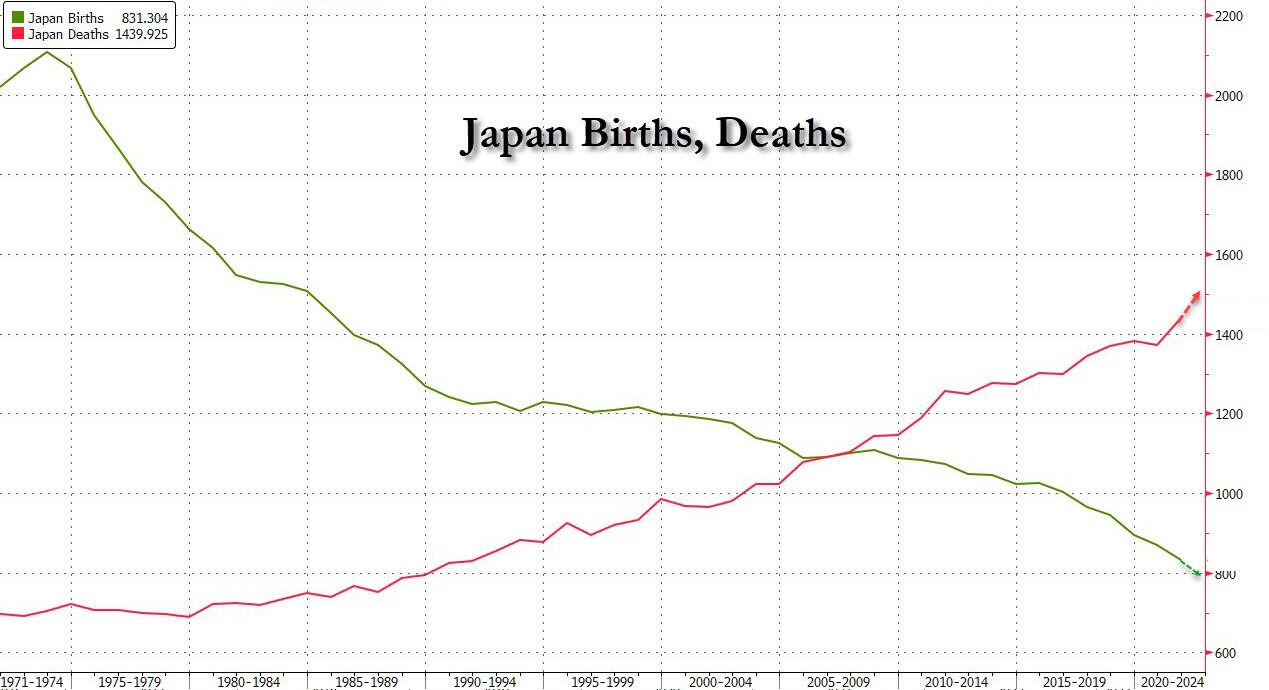
The country saw just 799,728 births in 2022 - the lowest number on record and the first ever dip below 800,000 - and about half of the number of deaths, which at more than 1.58 million, was a record high. The number of births in Japan has nearly halved in the past 40 years: in 1982, Japan recorded more than 1.5 million births, a number which was then more than double the number of deaths. This ratio has since reversed.
As shown in the chart above, deaths have outpaced births in Japan for the past 15 years - a trend which is unlikely to reverse ever again - posing an existential problem for the (aged) leaders of the world's third-largest economy. They now face a ballooning elderly population, along with a shrinking workforce to fund pensions and health care as demand from the aging population surges.

Japan's population has been in steady decline since its economic boom of the 1980s and stood at 125.5 million in 2021, according to the most recent government figures.

According to CNN, Japan's fertility rate of 1.3 is far below the rate of 2.1 required to maintain a stable population, in the absence of immigration.

The country also has one of the highest life expectancies in the world; in 2020, nearly one in 1,500 people in Japan were age 100 or older, according to government data.

These concerning trends prompted a warning in January from Prime Minister Fumio Kishida that Japan is "on the brink of not being able to maintain social functions."

"In thinking of the sustainability and inclusiveness of our nation's economy and society, we place child-rearing support as our most important policy," he said, adding that Japan "simply cannot wait any longer" in solving the problem of its low birth rate.

A new government agency will be set up in April to focus on the issue, with PM Kishida saying in January that he wants the government to double its spending on child-related programs. But money alone might not be able to solve the multi-pronged problem, with various social factors contributing to the low birth rate.

Japan's high cost of living, limited space and lack of child care support in cities make it difficult to raise children, meaning fewer couples are having kids. Urban couples are also often far from extended family in other regions, who could help provide support.

In 2022, Japan was ranked one of the world's most expensive places to raise a child, according to research from financial institution Jefferies. And yet, the country's economy has stalled since the early 1990s, meaning frustratingly low wages and little upward mobility: the average real annual household income declined from 6.59 million yen ($50,600) in 1995 to 5.64 million yen ($43,300) in 2020, according to 2021 data from the Ministry of Health, Labor and Welfare.

Attitudes toward marriage and starting families have also shifted in recent years, with more couples putting off both during the pandemic -- and young people feeling increasingly pessimistic about the future.

In 2022, Japan was ranked one of the world's most expensive places to raise a child, according to research from financial institution Jefferies. And yet, the country's economy has stalled since the early 1990s, meaning frustratingly low wages and little upward mobility.

The average real annual household income declined from 6.59 million yen ($50,600) in 1995 to 5.64 million yen ($43,300) in 2020, according to 2021 data from the Ministry of Health, Labor and Welfare.

Attitudes toward marriage and starting families have also shifted in recent years, with more couples putting off both during the pandemic -- and young people feeling increasingly pessimistic about the future. Who can blame them for not feeling frisky.

It's a familiar story throughout East Asia, where South Korea's fertility rate -- already the world's lowest -- dropped yet again last year in the latest setback to the country's efforts to boost its declining population.

Meanwhile, in January China just lost its title as the world's most populous country to India after its population shrank in 2022 for the first time since the 1960s.

FT : Swiss fund manager GAM rushes to find buyer before results

Swiss fund manager GAM rushes to find buyer before results
Investment firm seeks deal after share price collapse and delay to earnings report

GAM is scrambling to find a buyer ahead of results it has delayed by two months, five years after a scandal over private debt holdings that led to fines, the resignation of the investment firm’s chief executive and a collapse in its share price.

The Switzerland-listed fund manager recently postponed the release of its annual results to the end of April, hoping the extra time would allow it to strike a deal, according to several people familiar with the situation. GAM declined to comment.

GAM appointed UBS bankers at the end of last year to work on securing a sale of the firm after its share price dropped by 97 per cent from the start of 2018, pushing its market value below SFr100mn ($107mn) and sparking questions over its future as a standalone business. UBS declined to comment.

The urgent search for a buyer comes after a torrid period for what was once one of Europe’s biggest asset managers.

Its troubles arose in July 2018 when it suspended former star fund manager Tim Haywood with little explanation, leaving holders of his Absolute Return Bond funds rushing to the exits. It later transpired that Haywood had bought bonds relating to Lex Greensill’s now collapsed supply chain finance business Greensill Capital, which counted former UK prime minister David Cameron as an adviser.

Insiders at Zurich-based GAM had expressed concerns about the nature of Haywood’s relationship with Australian financier Greensill, which ultimately led to the liquidation of the funds. Chief executive Alexander Friedman stepped down. Haywood was subsequently fired and in 2021 GAM was hit with a £9.1mn fine by the UK’s Financial Conduct Authority for conflicts of interest.

GAM’s share price has plunged to SFr0.60 from nearly SFr18 before the Haywood scandal. Assets have dropped from more than SFr160bn at that time to SFr75bn today, making the manager vulnerable to a takeover approach. Losses at GAM are expected to widen to SFr42.8mn for 2022, from SFr9.6mn the previous year.

Still, its investment portfolios remain solid. GAM said in January that more than half of its largest strategies were ranked in the top decile among peers over three years, and two-thirds of its assets under management had outperformed their peer group, as measured by Morningstar.

Insurance company Generali was a potential suitor in 2019, people familiar with the matter say, although GAM said at the time that it was not in conversations with the Italian company.

GAM has since attempted to slash costs under chief executive Peter Sanderson, who came on board at the end of 2019, spending millions of Swiss francs on a partnership with software company SimCorp to try to consolidate its systems.

Some investors have shown signs of losing faith in the business. Bantleon, a German-based asset manager, has sold down its stake to less than 3 per cent from more than 10 per cent last year. Bantleon declined to comment.

However, New York-based investor Global Emerging Markets, one of GAM’s largest shareholders, last month increased its stake in the business to more than 5 per cent.

GAM said in January that the board was “constantly reviewing the progress of the firm to ensure that our strategy is appropriate” and that results would be delayed to allow time to provide an update on this strategy.

FT : How Citadel harnessed the weather to claim hedge fund crown

How Citadel harnessed the weather to claim hedge fund crown
Bold bet on commodities plays large part in lifting Ken Griffin’s firm to record $16bn profit

In 2018 Ken Griffin’s Citadel hired a group of scientists and analysts whose weather forecasts were more accurate than those of most meteorological offices.

The recruitment of the 20-strong team was unusual for a big hedge fund in a sector largely focused on stocks, bonds and currencies. But it has been a key part of a push by Griffin’s $54bn-in-assets firm to build out a wide-ranging commodities business encompassing both futures and physical trading.

The bold bet on raw materials has paid off, helping Citadel make a record $16bn in 2022 to displace Bridgewater as the most successful hedge fund of all time, according to research by LCH Investments.

When the historically subdued gas market exploded into life amid the lifting of Covid lockdowns then Russia’s invasion of Ukraine, Citadel was perfectly positioned to reap billions of dollars of trading profits.

“Citadel are very strong in gas and power,” said Pierre Andurand, founder of hedge fund Andurand Capital and one of the world’s top energy traders. “They do a lot of work on supply and demand. They take big bets and keep them for months.”

Even by the hedge fund industry’s standards, Citadel is secretive. Investors say privately that it has long been difficult to get detail on the firm’s trades while, compared with many hedge funds, the firm’s investor communications give relatively little information.

A spokesman said the firm conducts hundreds of one-on-one meetings with investors and holds investor calls.

Having such a large exposure to commodities has given Citadel an edge over rivals in recent years, according to people familiar with the firm who said its flagship funds can run a quarter or more of their overall portfolios in commodities.

“Citadel’s institutional energy trading and commodities operation was surely a big benefit to their eye-popping year,” said Jim Neumann, chief investment officer at Sussex Partners, which advises clients on hedge fund investments.

Most of the firm’s rivals have not built up in commodities to the same extent given the sector provided less attractive opportunities than equities or bonds for so long pre-pandemic, particularly when adjusted for the risk of big losses.

Many, including Brevan Howard, Astenbeck Capital and Armajaro, even shut commodities funds last decade against a backdrop of wild price swings and lengthy periods of falling prices. Most now only have commodities exposure of a single-digit percentage of their assets, if at all.


Citadel entered the commodities business in 2002, hiring a group of former Enron traders.

Its exposure is markedly higher than a decade ago, according to investor documentation seen by the Financial Times, so when commodity prices start to move it can gain a big advantage over rivals. It reaped billions of dollars in 2021 just from betting on gas and power, say people close to the firm.

Last year proved even more lucrative as Russia’s assault on Ukraine sent markets into panic about sanctions and energy shortages. The volatility — with prices spiking first in March and again to a record high in August — provided a wealth of trading opportunities.

The team of European head of gas trading Chris Foster, who has a reputation for punchy bets, has helped generate billions of dollars for the fund, according to people familiar with the firm, who say Citadel made $7bn-$8bn from commodities last year.

Griffin and his senior team are attracted by the size of the asset class, its low correlation with other markets and its complexity. In gas, supply can be mapped and analysed by his large teams of researchers while the many gas hubs across the US and beyond offer numerous prices that can be traded.

Forecasting demand is much harder. Weather heavily influences usage, which is higher during hot summers because of air conditioners and in cold winters as homes are heated.

This is where Citadel is seen as having a key advantage, with its traders fed information by a weather team that uses supercomputers to run forecasts and includes specialists in areas such as thunderstorm and tropical cyclone prediction. Much of the team is based in London — well placed to capitalise on volatile European gas and power prices.

It has been bolstered in recent years with hires out of academia. Head of weather Nicholas Klingaman, formerly at the UK’s National Centre for Atmospheric Science, specialises in “sub-seasonal” forecasts. Such predictions, typically for up to two months ahead, are far more difficult than shorter-term forecasts and highly lucrative if accurate.

Citadel’s physical commodities business — which trades the raw materials and is led by former Morgan Stanley head of commodities trading Jay Rubenstein — traded more than 1.1tn cubic feet of gas in 2021 and is now a major physical gas player in the US.

Citadel’s gains from gas and other commodities played a big part in its record 38.2 per cent performance last year, which brought its annualised return since launch in 1990 to 19.7 per cent. Around 70 per cent of Citadel’s investors are institutions, including universities and pension plans.

“Clearly 38 per cent a year is unsustainable,” said Andrew Beer, managing member at US investment firm Dynamic Beta. “On the other hand, if you have the best information, smartest people, locked up capital and nearly unlimited borrowing capacity from Wall Street, why not try to shoot the lights out?”

A Citadel spokesman said “unlike our competitors, Citadel’s commodities team invests globally across a diversified set of products . . . leveraging more than 20 years of long-term, steady investment in exceptional people, analytics and infrastructure”.

There are signs rivals want to get in on the act. Balyasny last year hired a tropical weather specialist and an expert in ocean warming.

Last year was strong for many of Citadel’s peers. Millennium Management, DE Shaw, Balyasny and Point72 all made double-digit gains, even as many equity funds were hit by the technology stock slump. Multi-strategy funds last year delivered their highest level of “alpha” — industry jargon for profits above and beyond the market — since the aftermath of the financial crisis in 2009, according to JPMorgan research.

“If you were less dependent on equity long-short and had more access to other assets you had a better shot,” said Neumann.

But industry insiders say Citadel did so well not only because of its diversification across assets offering some of the best trades in years but also thanks to the size of its bets, with traders encouraged to run positions rather than sit on the sidelines in cash.

“You feel like you always have to be risk-on, there’s pressure constantly from the top,” said one person with knowledge of the firm.

A Citadel spokesman said its investors “entrust and expect us to deploy their capital against the investment opportunities we identify in the market”.

Griffin gets to know his managers’ trades inside out, and will allow more risk to be allocated to a position when he sees a particularly attractive opportunity to profit.

The firm also has a large presence in fixed income and macro, a sector that last year enjoyed its best gains since the financial crisis, as government bond yields and the dollar soared while central banks raced to tame surging inflation.

Its fixed income and macro fund, which makes both directional and arbitrage bets, made 32.6 per cent, beating many specialist macro funds. The firm notched up record years in four of its five business areas — commodities, fixed income, equities and quantitative strategies.

“The inflation trade was the subprime of 2022,” said Dynamic Beta’s Beer. “Like the big winners back then, Citadel went all in and pushed its bet far more than some of its peers.” A person close to the firm said it had a diversified set of strategies in fixed income and macro, all of which did well.

However, some industry insiders believe the size of the bets multi-manager funds take can leave them vulnerable to extreme market events.

“The transparency into these sophisticated firms is not great and there is an acknowledgment that there is substantial risk, given the level of leverage, to black swan events,” said Neumann. “The confidence that central banks will provide relief to mitigate such a shock . . . is embedded in the investment decision.”

A person close to the firm disputed that this assessment applied to Citadel, pointing out that the hedge fund raised $2bn from investors in March 2020 as the coronavirus pandemic sent markets into turmoil.

Griffin has put the firm’s recent success down to returning to the office early in the coronavirus pandemic. Industry insiders also attribute it to Citadel’s size, which can offer top traders a bigger book to manage on day one, increasing potential payouts.

Its traders and analysts are now set to enjoy a bumper payday. Citadel last year charged $12bn in expenses and fees to its clients — more than a fifth of whom are employees — driven by the need to reward traders who had performed well.

Bonuses at the firm, announced to staff in late January with payments made last month, were in the multiple tens of millions of dollars for some traders. Expectations are for even bigger figures this year, with some star teams set for payouts of more than $100mn.

The fees are “astronomical”, said one investor — but without them firms like Citadel “cannot compete for talent”.
FT : Liberty Global plays down EU hopes of cross-border telecoms deals

Liberty Global plays down EU hopes of cross-border telecoms deals
Mike Fries says being in fewer, more lucrative markets is better strategy in struggling sector

The head of Liberty Global, once one of the most acquisitive global telecoms groups, said the European Commission’s interest in cross-border consolidation is “a dream that doesn’t reflect reality” as he extolled the company’s strategy of being in fewer and more lucrative markets.

Chief executive Mike Fries said even with recent indications that the EU is more favourable to mergers, such deals are “not going to happen” because it is “a dream that doesn’t reflect the reality of operating businesses”.

He added that the potential cost savings of being in multiple markets were marginal.

Liberty Global built a reputation under the leadership of “cable cowboy” John Malone for debt-fuelled dealmaking but the group has retrenched in recent years, exiting countries such as Germany.

Fries’ comments came a day after Thierry Breton, the EU’s internal market commissioner, said the commission needed to look carefully at the obstacles preventing cross-border consolidation which he saw as “holding back our collective potential compared to other continents”. 

Speaking at the global telecoms conference Mobile World Congress in Barcelona, Fries said that “you first need in-market consolidation before you can get anywhere near cross-market”.

Telecoms operators across Europe — which have suffered years of moderate returns and falling valuations — have long called for regulators to loosen their rules around mergers and acquisitions that would allow companies to grow.

But officials have tended to resist these moves, fearful that greater in-country consolidation will drive up prices and harm consumers.

The proposed merger of Orange and MasMovil in Spain is seen as a litmus test for whether regulators may be starting to change their tune and is being keenly watched by the industry.

Vodafone was one of the last bastions of the telecoms model of cross-border European expansion, having bought Liberty Global’s assets in Germany, the Czech Republic, Hungary, and Romania for €18.4bn in 2019.

But for the most part, as telecoms groups have struggled to capitalise on a digital revolution that has largely rewarded Big Tech, operators have sought to retrench.

Over the past six years, Liberty Global has slimmed down from owning 17 operators globally to just five today, in the UK, Holland, Belgium, Switzerland and Ireland.

“For the longest time we felt we could be a mile wide and an inch deep”, Fries said, but now “we’d rather be in a handful of markets and a mile deep”. 

Fries, who has been chief executive of the company since 2005, said he believed the fortunes of telecoms groups in Europe were starting to change.

“There’s going to be a good story over the next five years in this sector,” he said, pointing to evidence that companies have been able to increase prices in some markets, such as the UK, with limited pushback from the regulator.

Although politicians in Britain have railed against 14 per cent price rises this year, officials and regulators have not intervened to prevent the moves.

Fries also hit back against claims that some investors are taking advantage of weak European assets by buying stakes and angling for changes that may not be in the long term interest of the companies.

Franco-Israeli tycoon Patrick Drahi has built an 18 per cent stake in BT, while French billionaire Xavier Niel and United Arab Emirates telecoms operator e& have built a combined 16.5 per cent stake in Vodafone, on top of Liberty’s 5 per cent holding.

“These are not disinterested financial institutions. These are people who know the industry, know the assets, and that’s a positive thing,” he said, adding that Drahi, Niel and Liberty “come from the same DNA”.

FT : UK risks wasting huge wind power opportunity, energy boss warns

UK risks wasting huge wind power opportunity, energy boss warns
Scottish Power chief says urgent reforms to planning process are needed for shift to greener energy

The UK government risks squandering a “God-given” opportunity to kickstart the economy and accelerate the shift to renewable energy by failing to reform the planning process for big infrastructure projects, the head of Scottish Power has warned. 

Keith Anderson, chief executive of Scottish Power, said that almost two years into the energy crisis the government needed to focus on helping companies speed up the development of wind farms that can help replace expensive gas. 

“It only takes us two years to physically build an offshore wind farm but the planning process is fundamentally flawed and means it takes us more like 10 years,” Anderson told the Financial Times. 

“We have got a God-given project of work in this country that’s ready to go, the money is there,” he said. “It would kickstart the economy after Covid and the gas crisis and spread investment throughout the country, with money filtering down through local supply chains,” he added, describing it as “an absolutely colossal opportunity.”

The assessment from the head of one of the UK’s biggest energy suppliers comes after the National Audit Office this week warned that the newly formed Department of Energy Security and Net Zero was behind schedule in mapping out how to achieve a rapid expansion of offshore wind and nuclear power. 

The department and its predecessors had been too focused on mitigating the short-term pain of skyrocketing energy bills to the detriment of its long-term strategy, the NAO said.

Anderson, who was among the first to propose support for customers under a plan that eventually became the government’s energy price guarantee, said he had always cautioned this was just a “sticking plaster” for the immediate crisis and that a more enduring solution to support the vulnerable was needed.

The government needed to speed up the permitting process if it wanted wind power to rapidly replace gas in the system, and accelerate improvements in the network too, he argued. 

“The wind farms that are coming online today were approved when [former Labour prime minister] Gordon Brown was in power — that’s a long time ago and we need to be much faster to move beyond this crisis”, Anderson said.

The UK is targeting a more than tripling of offshore wind capacity to 50GW by 2030 as part of its energy security strategy following Russia’s full-scale invasion of Ukraine.

Scottish Power has more than 40 onshore wind farms and is developing several offshore projects in UK waters, including the 1.3GW East Anglia Three project as well as three sites in Scottish waters on which it is partnering with Shell that could produce up to 7GW.

Britain’s large coastline and relatively shallow waters make it one of the best sites for offshore wind developments and it already boasts the world’s biggest active farms.

Anderson conceded that the cost of developing wind farms had risen as the price of key commodities such as steel and copper had jumped. But unlike rivals Vestas and Orsted, which have warned they may need to shelve planned projects without additional tax breaks in the government’s March Budget, Anderson was more circumspect.

The next licensing auctions were likely to see higher prices, he cautioned, but wind power was likely to remain the cheapest form of new electricity.

“Onshore and offshore wind and solar are still the cheapest form of new electricity capacity for the UK,” he said. “If you look at what’s creating the cost pressure, it’s the rising price of steel and copper — that would affect new-build gas stations, carbon capture or nuclear too,” Anderson added. 

The chief executive said he broadly supported the government continuing to cap the typical UK household gas and electricity bill at £2,500 — as is being discussed by chancellor Jeremy Hunt and energy secretary Grant Shapps — given the recent sharp drop in wholesale energy prices.

The government’s price guarantee is currently slated to rise to £3,000 in April, a move campaigners have warned could double the number of people in fuel poverty. Household bills are expected to fall in the second half of this year as lower wholesale costs feed through.

“Obviously the cost of keeping it at £2,500 has come down massively so there’s a strong argument for doing it,” Anderson said.

FT : Kroll and Jones Day accused of conspiracy to protect Wirecard

Kroll and Jones Day accused of conspiracy to protect Wirecard
Short seller claims ‘campaign of harassment’ aimed to deter him from reporting on now collapsed German group

Law firm Jones Day and corporate intelligence group Kroll are facing accusations of an unlawful conspiracy and “campaign of harassment” to protect Wirecard, the now collapsed German financial technology group, in a lawsuit filed in the UK High Court.

The claim by short seller Matt Earl alleges that Jones Day and Kroll used hacked and stolen communications as a pretext for “overt surveillance” and “specious legal threats” designed to harass, distress “and ultimately to deter him from reporting on Wirecard’s criminal activities”. 

Earl is a prominent UK short seller at investment firm ShadowFall. His case concerns events in 2016 and 2017, when he was the primary author of a series of anonymous reports published under the name “Zatarra” and the “VisMas Files”, which accused Wirecard of fraud, money laundering and regulatory offences.

The lawsuit comes as campaigners and lawyers seek reforms to counter what they call strategic lawsuits against public participation (Slapp) tactics that exploit the threat of lengthy and expensive legal proceedings to silence and intimidate journalists, critics and watchdogs owing to the costs in defending such cases.

Kroll said it “denies Mr Earl’s claims in full”, and that it “acted entirely in accordance with all applicable laws and regulations”. It said it would fight the legal action and that “it was not — and of course would never be — involved in any way in any hacking, intimidation or other illegal acts”.

Jones Day did not respond to requests for comment.

Wirecard used multiple professional services firms in London to defend its reputation and investigate perceived opponents before the company collapsed in June 2020, when its accounts were exposed as fraudulent.

After its collapse, internal Wirecard documents became available that shone a spotlight on how the company responded to its critics, details normally shrouded by legal privilege and client confidentiality.

By August 2016 Kroll had tracked down Earl and taken a covert photograph of him at a London Underground station. In October 2016 Jones Day described potential legal measures against Earl in a memo to Wirecard.

Earl’s suit said his public anonymity “posed a problem for the aggressive litigation strategy” designed by Jones Day, which had only identified Earl from “extensive and unlawful surveillance” conducted by Kroll.

Earl’s identity was exposed on December 6 2016 in an anonymous dossier published online with the title “Zatarra RIP”. It included “verbatim extracts of Skype conversations”, other communications that were obtained unlawfully, and photographs that included one of Earl opening the front door to his house, according to the claim.

The RIP report accused Earl, without evidence, of membership of a “criminal insider trading and market manipulation organisation”.

Kroll said Wirecard used other investigative companies and that “naturally, as Kroll was not aware of their engagement by Wirecard, it is unable to comment on the propriety, or otherwise, of their conduct”.

Aviram Azari, an Israeli private detective, last year pleaded guilty in the US to involvement in a hacker-for-hire scheme used to target journalists and critics of Wirecard. There is no suggestion Kroll or Jones Day were aware of his actions.

Earl’s claim alleges that Kroll and Jones Day used the RIP publication to justify “overt surveillance” of his family home “calculated to cause distress”, and make unfounded legal threats “designed gratuitously and improperly to intimidate”. 

Alleging conspiracy, Earl’s claim said there was “a self-evident” synergy between the legal strategy developed on behalf of Wirecard by Jones Day, the “campaign of harassment” by Kroll, and publication of the report that identified him.

The claim said the actions of Jones Day and Kroll “corroborates the inference” that the Zatarra RIP report was written by Wirecard or individuals instructed by it, and that Kroll and Jones Day knew or suspected their client was involved.


Earl’s claim also said that in legal correspondence Jones Day misrepresented its knowledge of him before the publication of the RIP Zatarra report, in violation of UK regulatory principles that required solicitors to act with integrity. The claim said it “will rely upon the misrepresentations as evidence of consciousness, on the part of the defendants, of the wrongfulness of their conduct”.

His claim additionally alleged other misrepresentations and breaches of regulatory principles by Jones Day, and that he incurred significant expense responding to their “hostile, unreasonable and oppressive correspondence”.

The Solicitors Regulation Authority last year reminded UK firms of appropriate conduct during disputes and issued a warning notice about Slapps.

Earl also claims misuse of his private data, and in addition to aggravated damages is seeking full disclosure of all of his private information held by Kroll and Jones Day.

Kroll said it would take steps to have all of Earl’s claims “dismissed at the earliest opportunity”.