FT : UBS offers to buy Credit Suisse for up to $1bn

UBS offers to buy Credit Suisse for up to $1bn
Swiss authorities expected to change country’s law to bypass UBS shareholder vote

UBS has offered to buy Credit Suisse for up to $1bn, with Swiss authorities planning to change the country’s laws to bypass a shareholder vote on the transaction as they rush to finalise a deal before Monday.

The all-share deal between Switzerland’s two biggest banks is set to be signed as soon as Sunday evening and will be priced at a fraction of Credit Suisse’s closing price on Friday, all but wiping out the target’s shareholders, four people with direct knowledge of the situation said.

The offer was communicated on Sunday morning with a price of SFr0.25 a share to be paid in UBS stock, far below Credit Suisse’s closing price of SFr1.86 on Friday, the people said. UBS has also insisted on a material adverse change that voids the deal if its credit default spreads jump by 100 basis points or more, they added.

The situation is fast-moving and there is no guarantee that terms will remain the same or that a deal will be reached, all the people stressed.

Some of the people said that the current terms were unfair for Credit Suisse and its shareholders. Others criticised the plans to void normal corporate governance rules by preventing a UBS shareholder vote.

There has been limited contact between the two lenders and the terms have been heavily influenced by the Swiss National Bank and regulator Finma, the people said. The US Federal Reserve has given its assent to the deal progressing, they added.

While the current terms value Credit Suisse’s equity at up to $1bn, the figure does not reflect additional provisions the Swiss National Bank will make to ensure the deal is done.

Both sides have been locked in discussions with regulators since Wednesday, when Credit Suisse asked the SNB to provide it with an emergency SFr50bn ($54bn) credit line.

When this backstop failed to arrest a fall in its share price and stop panicked clients from withdrawing their money, the central bank stepped in to force a merger after becoming concerned about the viability of the country’s second-largest lender.

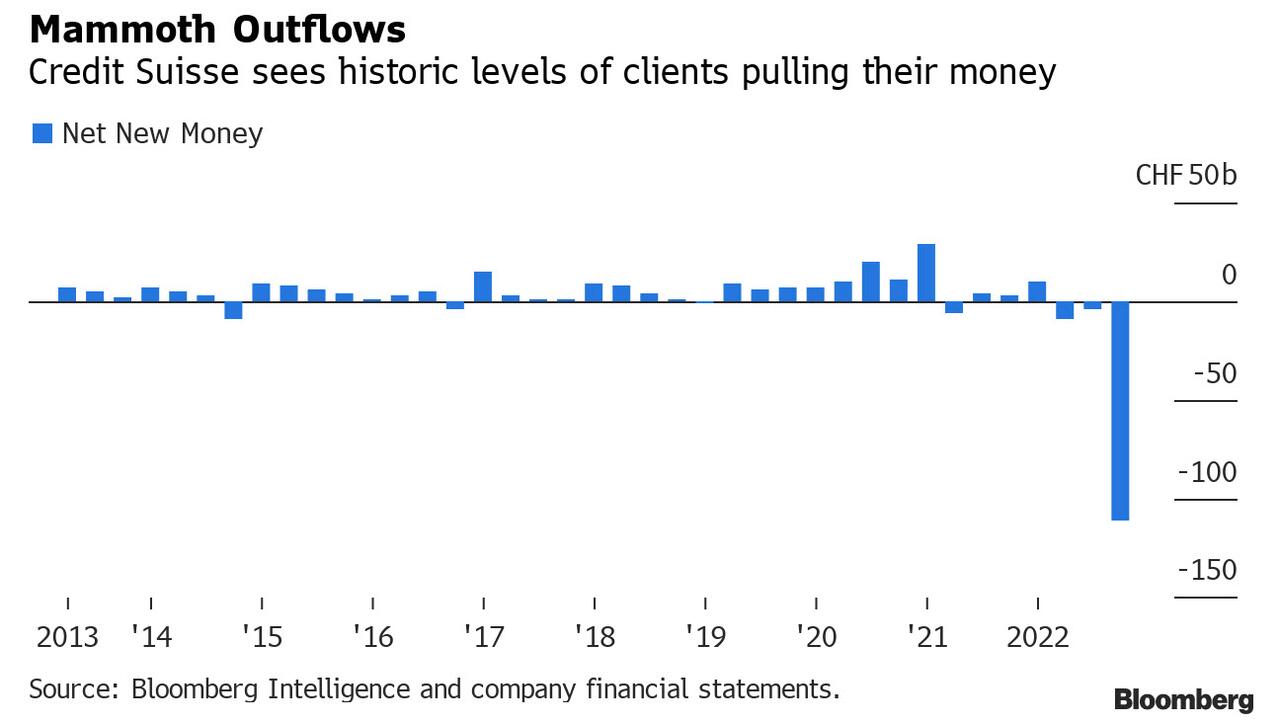
Deposit outflows from Credit Suisse topped SFr10bn a day late last week, the Financial Times has reported. Customers withdrew SFr111bn from the group in the final three months of last year.

On Saturday night, the Swiss cabinet assembled in the finance ministry in Bern for a series of presentations from government officials, the SNB, market regulator Finma, and representatives of the banking sector.

The government is preparing emergency measures to fast-track the takeover and plans to introduce legislation that will bypass the normal six-week consultation period required for UBS shareholders so the deal can be sealed immediately, the people said.

The framework of the deal has been designed by Swiss regulators to provide maximum stability to the country’s banking system, people briefed about the matter said. Swiss authorities have already secured preapproval from relevant regulators in the US and Europe which are expected to issue co-ordinated statements today.

UBS will dramatically shrink Credit Suisse’s investment bank, so that the combined entity will make up no more than a third of the merged group, two of the people said.

However, the current term sheet for the deal does not specify what will happen to Credit Suisse’s individual business divisions, and simply outlines a 100 per cent takeover of the group.

Negotiators have given Credit Suisse the code name Cedar and UBS is referred to as Ulmus, according to people briefed on the matter.

UBS is seeking concessions and protections from the government, particularly from any pending legal cases and regulatory investigations into Credit Suisse that could result in fines or losses, the FT has reported. However, it is unlikely it will get indemnity from any losses on assets, one of the people involved said.

UBS also wants to be allowed to phase in any extra demands it would face under global rules on capital that govern the world’s biggest banks.

The SNB, UBS, Credit Suisse and Finma declined to comment.

(ZH) UBS Seeks $6 Billion Government Backstop As It Rushes To Finalize Credit Su

UBS Seeks $6 Billion Government Backstop As It Rushes To Finalize Credit Suisse Takeover

Update (17:45ET): As negotiations drag on late on Saturday night local time, Bloomberg reports that liabilities at the Credit Suisse investment bank are proving to be a key sticking point in the takeover talks ("UBS is worried about the balance sheet risk associated with the investment bank, which has suffered a string of losses and scandals in recent years"), with Reuters adding that UBS is asking the Swiss government to cover about $6 billion in costs if it were to buy Credit Suisse. The $6 billion in guarantees "would cover the cost of winding down parts of Credit Suisse and potential litigation charges."

There are other snags: one sources cautioned that the talks to resolve the crisis of confidence in Credit Suisse are encountering significant obstacles, and 10,000 jobs may have to be cut if the two banks combine.

Meanwhile, with UBS facing pressure from the Swiss authorities to carry out a takeover of its local rival as soon as possible to get the crisis under control, the FT reported that Switzerland is preparing to use emergency measures to fast-track the deal, the Financial Times reported, citing two people familiar with the situation.

The banking sector's fundamentals are stronger and the global systemic linkages are weaker than during the 2008 global financial crisis, Goldman analyst Lotfi Karoui wrote in a late Friday note to clients (available here to pro subscribers). That limits the risk of a "potential vicious circle of counterparty credit losses," Karoui said.

"However, a more forceful policy response is likely needed to bring some stability," Karoui said. The bank said the lack of clarity on Credit Suisse's future will pressure the broader European banking sector.

A senior official at China's central bank said on Saturday that high interest rates in the major developed economies could continue to cause problems for the financial system.

Elsewhere, there were multiple reports of interest for Credit Suisse from other rivals.

Bloomberg reported that Deutsche Bank was looking at the possibility of buying some of its assets, while U.S. financial giant BlackRock denied a report that it was participating in a rival bid for the bank.

* * *

So much can change in just 48 hours.

Late on Thursday, just hours after the SNB had launched the first (of many) bailout attempts of Swiss banking giant Credit Suisse, Bloomberg blasted the following headline:

  • *UBS, CREDIT SUISSE SAID TO OPPOSE IDEA OF A FORCED COMBINATION

This lack of enthusiasm by UBS to acquire its struggling rival of course forced the Swiss National Bank to front CS a CHF50 billion credit line to hold it over for the next four days amid a furious bank run, one which we said would be woefully insufficient to restore confidence in the collapsing lender, and which we probably used up in just a few hours.

Then, late on Friday, both banks "unexpectedly" changed their minds and we got the following 180 degree U-Turn report from the FT:

  • *UBS IN TALKS TO ACQUIRE ALL OR PART OF CREDIT SUISSE: FT

So a deal is inevitable after all... but as always, there is a footnote one which we predicted yesterday when we said that a deal would only happen if the acquiring bank - in this case UBS - got a full central bank backstop.
That now appears to be the case with Bloomberg, Reuters and the WSJ all reporting that UBS is asking the Swiss government for a backstop to cover future risks if it were to buy Credit Suisse Group AG, after the Swiss National Bank and regulator Finma have told international counterparts that they regard a deal with UBS as the only option to arrest a collapse in confidence in Credit Suisse. The FT reported that deposit outflows from the bank topped CHF10bn ($10.8bn) a day late last week as fears for its health mounted.

According to the reports, UBS is discussing scenarios in which the government would take on certain legal costs and potential losses in any deal. Credit Suisse set aside SFr1.2bn in legal provisions in 2022 and warned that as yet unresolved lawsuits and regulatory probes could add another SFr1.2bn.

UBS also wants to be allowed to phase in any demands it would face under global rules on capital for the world’s biggest banks.

The backroom negotiations are taking place as the largest Swiss bank is exploring an urgent acquisition of all or parts of its smaller rival at the urging of regulators to halt a crisis of confidence, one which local authorities hope will be concluded on Saturday
Under one likely scenario, the deal would involve UBS acquiring Credit Suisse to obtain its wealth and asset management units, while possibly divesting the investment banking division, which has become the laughing stock on Wall Street after being one of the most iconic groups less than two decades ago. Talks are also still ongoing on the fate of Credit Suisse’s profitable Swiss universal bank.

According to the FT, the boards of the two banks are meeting this weekend as Credit Suisse’s regulators in the US, the UK and Switzerland are considering the legal structure of a deal and several concessions that UBS has sought.

UBS wants to be allowed to phase in any demands it would face under global rules on capital for the world’s biggest banks. Additionally, UBS has requested some form of indemnity or government agreement to cover future legal costs, one of the people said.

* * *

The time scale for agreement is fluid, according to Bloomberg which notes that the goal is for an announcement of a deal between the two banks by Sunday evening at the latest, while the Financial Times reported that a deal could emerge as soon as Saturday evening.

UBS executives had been opposed to an arranged combination with its rival because they wanted to focus on their own wealth management-centric strategy and were reluctant to take on risks related to Credit Suisse, Bloomberg reported earlier this week. Credit Suisse had 1.2 billion Swiss francs ($1.3 billion) in legal provisions at the end of 2022 and disclosed that it saw reasonably possible losses adding another 1.2 billion francs to that total, with several lawsuits and regulatory probes outstanding, according to Bloomberg Intelligence.

Credit Suisse has been unprofitable over the course of the last decade and has racked up billions in legal losses, while also suffering a historic bank run.


As we reported yesterday, the bank run spike late last week, and FT sources said deposit outflows from the bank topped Sfr10bn ($10.8bn) a day late last week as fears for its health mounted.

A government-brokered deal would address a rout in Credit Suisse that sent shock waves across the global financial system this week when panicked investors dumped its shares and bonds following the collapse of several smaller US lenders. A liquidity backstop by the Swiss central bank this week briefly arrested the declines, but the market drama carries the risk that clients or counterparties would continue fleeing, with potential ramifications for the broader industry.

The prospective takeover reflects the sharp divergence in the two banks’ fortunes. Over the past three years, UBS shares have gained about 120% while those of its smaller rival have plunged roughly 70%.

The former has a market capitalisation of $56.6bn, while Credit Suisse closed trading on Friday with a value of $8bn. In 2022, UBS generated $7.6bn of profit, whereas Credit Suisse made a $7.9bn loss, effectively wiping out the entire previous decade’s earnings.

* * *

Swiss regulators told their US and UK counterparts on Friday evening that merging the two banks was “plan A” to arrest a collapse in investor confidence in Credit Suisse, one of the people said. There is no guarantee a deal, which would need to be approved by UBS shareholders, will be reached the FT warned.

Negotiators have given Credit Suisse the code name Cedar and UBS is referred to as Ulmus, according to people briefed on the matter.

The fact that the SNB and Finma favour a Swiss solution has deterred other potential bidders. Earlier today the FT reported that BlackRock had drawn up a rival approach, evaluated a number of options and talked to other potential investors, but in the end withdrew from the process.

A full merger between UBS and Credit Suisse - whose headquarters face each other across Zurich’s central Paradeplatz square, would be an historic event for the nation and global finance and would create one of the biggest global systemically important financial institutions in Europe. UBS has $1.1tn total assets on its balance sheet and Credit Suisse has $575bn. However, such a large deal may prove too unwieldy to execute.

The Financial Times has previously reported that other options under consideration include breaking up Credit Suisse and raising funds via a public offering of its ringfenced Swiss division, with the wealth and asset management units being sold to UBS or other bidders.

UBS has been on high alert for an emergency rescue call from the Swiss government after investors grew wary of Credit Suisse’s most recent restructuring. Last year, chief executive Ulrich Körner announced a plan to cut 9,000 jobs and spin off much of its investment bank into a new entity called First Boston, run by former board member Michael Klein.

FT : Explosives shortage threatens EU drive to arm Ukraine

Explosives shortage threatens EU drive to arm Ukraine
Scarce gunpowder and TNT supplies delay shift to ‘large-scale war production’, defence industry and officials warn

Europe’s push to make arms for Ukraine has been hobbled by a shortage of explosives, which industry insiders fear will delay efforts to boost shell production by as much as three years.

Scarce supplies of gunpowder, plastic explosives and TNT have left industry unable to rapidly meet expected EU orders for Ukraine, regardless of how much money is thrown at the problem, according to officials and producers.

The supply chain constraints underline how Russia’s invasion of Ukraine has badly exposed Europe’s inadequate arms stocks and weak domestic production capacity, run down by decades of under-investment.

“The fundamental problem is that the European defence industry is not in good shape for large-scale war production,” said one German official.

Europe is trying to meet Kyiv’s war fighting needs by pumping cash into the defence sector, particularly to encourage expansion of 155mm artillery production. There is dire need for shells, both to restock national armouries and maintain supplies to Ukrainian forces.

But producers, industry executives and EU officials warn increased demand may only push up prices that have already jumped a fifth over the past year.

“It’s very difficult to increase production of artillery ammunition, especially the heavy, large-calibre ammunition, in a short time,” said Jiří Hynek, chair of the Defence and Security Industry Association of the Czech Republic. “A new artillery factory is very easy, but how to produce more artillery projectiles without raw materials?”

The comments come ahead of a meeting of EU foreign and defence ministers in Brussels on Monday to discuss a package of two €1bn proposals to speed up immediate 155mm shipments to Ukraine and incentivise countries to form joint artillery purchase contracts.

Defence industry officials say Europe has a limited supply of explosives such as gunpowder, TNT and nitrocellulose which are necessary to produce shells. “The bottlenecks for our capacity are mainly [explosive] powders, which are in short supply all over Europe,” said one.

“It’s not possible to increase, in a short time, nitrocellulose [production] . . . In Europe there are no important producers of the raw materials we need,” said Hynek, referring to a main ingredient of gunpowder. “If I want to increase production of gunpowder I need probably three years.”

Explosia, a Czech state-owned manufacturer that is one of Europe’s largest suppliers of explosives to ammunition factories, told the FT that its production of propellants used in 155mm artillery is “running at full capacity” and would not be increased until 2026.

“Investments are under way to further increase our production capacity, but this is a three-year project, not a few months’ job,” said Martin Vencl, the company’s spokesperson.

This week Romania’s government said it was in talks with US and South Korean companies to build a gunpowder factory in the country. Its last such plant was shut down in 2004.

Even EU officials who have championed the financial incentive packages privately admit that European artillery producers have made clear to them that scaling up output will not be an easy task.

“We’re in favour of strengthening the defence industry. But if the result of this EU initiative is that you have a second bidder for the same scarce resource, that will have an impact on price,” said one German official. “And the arms companies are getting rich enough already.”

“We have to tread with care . . . No one wants to subsidise companies that are already coining it in,” he added.

Fábrica Municiones de Granada (FMG), one of Spain’s two 155mm artillery producers, has been operating at full capacity since last October, producing shells for a trading company that sells them on to Ukraine. But Antonio Caro, FMG’s director-general, said it had taken four-to-five months to scale up because of the difficulty of obtaining basic materials and components.

“Our main problem is primary materials,” Caro said. “Supplies for ammunition are very strained around the world because all the factories, like us, are at 100 per cent.”

“There aren’t too many factories [producing materials like TNT and nitrocellulose] in Europe and they’re at 100 per cent too, so we have to start looking in India, in Korea, in other countries further away,” he said.

Gianclaudio Torlizzi, an adviser to Italy’s defence ministry, agreed, saying: “We need to find new sources of supply . . . from countries we had not traditionally approached,” he said. “Each European country wants to protect its availability of raw materials.”

The cost of basic materials had “doubled and in some cases tripled”, Caro said. Those increases and the surge in demand had led to higher prices for munitions, although the rise has been less pronounced. A typical shell today costs €850, roughly 20 per cent more than before the Russian invasion, he said.

For now FMG, which is owned by Slovak group MSM, has no plans to increase capacity further. “Hopefully the war will be over soon,” Caro said.

MSM also produces 155mm shells in Slovakia and said it “plans to build a new production hall” to increase artillery output, but declined to provide a timeline.

FT : Economists think Fed will keep raising rates despite bank turmoil

Economists think Fed will keep raising rates despite bank turmoil
Survey comes as trader’s scale back expectations of tightening amid worries about financial instability

The Federal Reserve will keep raising its benchmark policy rate, holding it above 5.5 per cent for the rest of the year, despite turmoil across the US banking sector, according to a majority of leading academic economists polled by the Financial Times.

The latest survey, conducted in partnership with the Initiative on Global Markets at the University of Chicago’s Booth School of Business, suggests the US central bank still has work to do to stamp out stubbornly high inflation, even as it contends with a crisis among midsize lenders following the implosion of Silicon Valley Bank.

Of the 43 economists surveyed between March 15 and 17 — just days after US regulators announced emergency measures to stem contagion and fortify the financial system — 49 per cent forecast the federal funds rate to peak between 5.5 per cent and 6 per cent this year.

That is up from 18 per cent in the previous survey in December and compares to the rate’s current level of between 4.50 per cent and 4.75 per cent.

Another 16 per cent estimated it would top out at 6 per cent or higher, while roughly a third thought the Fed would stop short of these levels and cap its so-called “terminal rate” below 5.5 per cent. Moreover, nearly 70 per cent of the respondents said they did not expect the Fed to deliver cuts before 2024.

The policy path projected by most of the economists is markedly more aggressive than current expectations reflected in fed funds futures markets, underscoring the uncertainty clouding not only the Fed’s rate decision on Wednesday but also the trajectory over the coming months.

Traders have since last Friday scaled back how much more the Fed will squeeze the economy given concerns about financial stability. They now wager the central bank will only lift its policy rate by another quarter of a percentage point before wrapping up its tightening campaign. That would translate to a terminal rate just below 5 per cent. They also increased bets the central bank would rapidly reverse course and implement cuts this year.

“The Fed is really caught between a rock and a hard place,” said Christiane Baumeister, a professor at the University of Notre Dame. “They have to continue fighting inflation but now they have to do that against the background of elevated stress in the banking sector.” 

Baumeister, who participated in the survey, urged officials against “prematurely” stopping their monetary tightening campaign, however, calling it a “matter of keeping the Fed’s credibility as an inflation fighter”.

Roughly half of the respondents said the events associated with SVB had led them to slash their forecasts for the fed funds rate by the end of 2023 by 0.25 percentage points. About 40 per cent were evenly divided between the rout causing no change or possibly more tightening in the end versus a half-points’ worth of easier policy from the central bank.

A majority thought the actions undertaken by government authorities were “sufficient to prevent further bank runs during the current interest rate tightening cycle”.


Jón Steinsson of the University of California, Berkeley was one of the panellists to conclude the Fed and its regulatory counterparts had successfully contained the turmoil and said it “would be a mistake to alter the tightening cycle appreciably”.

The more hawkish stance stems from a more pessimistic view about the inflation outlook.

Most of the economists surveyed expect the Fed’s preferred gauge — the core personal consumption expenditures price index — to remain at 3.8 per cent by year-end, roughly a percentage point lower than its January level but still well above the central bank’s 2 per cent target. In December, the median core PCE estimate for the end of 2023 stood at 3.5 per cent.

In fact, nearly 40 per cent of the respondents said it was “somewhat” or “very” likely that core PCE would still exceed 3 per cent by the end of 2024. That is roughly double December’s share.

Deborah Lucas, a professor of finance at the Massachusetts Institute of Technology who participated in the survey, said she holds a more benign view about the inflation outlook, but warned the Fed’s tools were largely ineffective to address what she sees as a problem stemming from supply shocks, “aggressive” fiscal policy and elevated savings among Americans.

“What the Fed will do if it raises interest rates too aggressively is it will cut off necessary investment and do very little about inflation,” she said.

One ongoing debate is how significant a credit crunch is under way across the country as the regional banking sector seizes up.


Stephen Cecchetti, an economist at Brandeis University who previously led the monetary and economic department at the Bank for International Settlements, said he expects to see demand on the whole “pull back”.

“Financial conditions are tightening without them doing anything,” he said of the Fed.

A slim majority expect the National Bureau of Economic Research — the official arbiter of when US recessions begin and end — to declare one in 2023, with the bulk holding the view it will occur in the third or fourth quarter. In December, a majority thought it would occur in or before the second quarter.

Still, the recession is forecast to be a shallow one, with the economy still growing 1 per cent across 2023. The unemployment rate, meanwhile, is projected to rise to 4.1 per cent by year-end, up from its current 3.6 per cent level. It will eventually peak between 4.5 per cent and 5.5 per cent, 61 per cent of the economists reckon.

WSJ : Why Is Credit Suisse in Trouble? The Banking Turmoil Explained

Why Is Credit Suisse in Trouble? The Banking Turmoil Explained
The Swiss bank has weathered a period of market crises, executive turnover and financial losses

Stress in the U.S. banking system jumped across the Atlantic this week, sparking turmoil for embattled Swiss bank Credit Suisse.

The European lender has long been dogged by issues. But on Wednesday, problems surrounding the bank exploded into plain view. After a whirlwind 24 hours marked by a dramatic fall in the bank’s stock price and financial contagion concerns, Credit Suisse said it would borrow cash from the Swiss central bank to shore up its liquidity. On Saturday, Credit Suisse’s larger rival, UBS Group AG UBS -5.50% , was in talks to take over all or part of the bank.

Here’s what you need to know on how Credit Suisse got here and what might happen next.

First things first: What is Credit Suisse?
Zurich-based Credit Suisse traces its history back to 1856, when it was founded to finance the expansion of Swiss railroads. Today, it stands as Switzerland’s second-largest bank by assets, trailing UBS.

The bank’s main business is managing money and creating investment products for wealthy clients around the world. Recently, Credit Suisse has been working to spin off its investment-banking arm as part of an attempt to move on from a long stretch of scandals and quarterly losses.

What caused the crisis at Credit Suisse?
Investors have been on high alert for signs of contagion following the rapid collapse of California-based Silicon Valley Bank last week. That led to a selloff in shares of banks around the world, including Credit Suisse’s.

But problems for the Swiss lender turned particularly acute on Wednesday, when its largest shareholder, Saudi National Bank, said in a Bloomberg TV interview that it wasn’t considering adding to its investment due to regulatory rules. Saudi National Bank owns 9.9% of Credit Suisse. Capital requirements often prevent banks from holding more than 10% of other banks.

How did investors react to Saudi National Bank’s statement?
The timing couldn’t have been worse. Investors were already jittery about other potential weak links in the financial system. The comments amplified their concerns about the bank’s ability to make money and raised the prospect that it might have to tap shareholders again for funds.

So-called credit-default swaps surged, as investors rushed to protect themselves against a possible Credit Suisse default. At the same time, the Swiss lender’s shares plunged, losing 24% on Wednesday—its largest-one day drop in recorded history. Prices on its bonds fell to distressed levels.

Traders rushed to scoop up options tied to Credit Suisse, with activity hitting its highest levels in recent history, according to data provider Trade Alert. Put options—or bearish contracts that typically profit as a stock falls—outnumbered bullish call options.

Credit Suisse clients and regulators were keeping close watch. European Central Bank officials called the banks it supervises to ask about their exposure to Credit Suisse, people familiar with the matter said. Meanwhile, some clients paused trades with the bank, The Wall Street Journal reported.

What happened after the market panic?
After the close of European markets on Wednesday, Swiss regulators said they would provide liquidity to Credit Suisse, if needed.

Within hours, Credit Suisse said it would tap a more than $50 billion lifeline from the Swiss National Bank. That sent Credit Suisse’s stock price up on Thursday, lifting other European banks alongside it.

Credit Suisse may not actually need the money, analysts said. Rather, it borrowed the money to reassure investors about their ability to get cash quickly.

Dan Davies, head of research at Frontline Analysts, said the bank likely won’t use the facility to cover operating costs. It has used the aid to buy liquid securities, which could be sold quickly if the bank ever needed the cash, improving its balance sheet, he said.

“They’ve mainly got that for the purposes of having it in order to wave it around and tell everyone, ‘Look at our strong liquidity ratio,’” he said.

It was likely intended as a show of force to investors who shorted Credit Suisse’s stock or sold credit-default swaps insuring against default, said Jérôme Legras, head of research at Axiom Alternative Investments.

Are some investors still worried about Credit Suisse?
Yes. The beleaguered lender’s bonds and other securities continue to show signs of stress.

Shares of Credit Suisse fell nearly 7% in Switzerland on Friday, meaning the stock has shed about a fifth of its value this week. Meanwhile, prices on Credit Suisse bail-in bonds, which get wiped out in case the bank runs into serious trouble, have made little recovery.

Investors also continue to buy protection against the bank defaulting on some of its debt. The cost of insuring against default on five-year Credit Suisse senior debt is double what it was at the start of the week.

How far back do Credit Suisse’s problems go?
For years.

The bank has weathered a period of market crises, executive turnover and financial losses. Most notably, it was burned by its connection to the separate collapses of now-bankrupt Greensill Capital and Bill Hwang’s Archegos Capital Management. In 2021, the Credit Suisse took a $5 billion hit due to the collapse of Archegos, which was equivalent to more than a year’s worth of profit.

More recently, the bank has been contending with customer withdrawals. In October, a social-media firestorm over the bank’s health drove outflows of rich clients, Credit Suisse executives have said.

The withdrawals continued through the end of the quarter and prompted the bank to reach out personally to more than 10,000 wealthy customers to reassure them of the bank’s health.

Deposits fell 40% last year to 234 billion Swiss francs, equivalent to $252 billion, while total assets dropped 30% to 531 billion francs, or about $571 billion, because the bank was, among other things, scaling back its businesses. Credit Suisse reported a 2022 net loss of 7.3 billion francs, after posting a net loss of 1.7 billion francs the year before.

Investors were already spooked by last year’s outflows. “Their investors and their deposit holders have been basically looking at this slightly on edge,” said Octavio Marenzi, chief executive of consulting firm Opimas.

Wealth-management clients are extremely conservative investors with very large amounts of money and they became concerned, he said. “It’s been a slow motion unfolding with CS that reached a breaking point and tipping point a few days ago.”

How is Credit Suisse different from Silicon Valley Bank?
Credit Suisse mainly manages money for people with millions of dollars to invest. The bank counts billionaires and sovereign-wealth funds among its biggest clients. Most of its loan portfolio is in ultraconservative Switzerland, where it is the country’s No. 2 bank by assets, serving savers and companies. It also has large investment-banking and asset-management arms.

It is considered a systemically important bank by global regulators given its size and interconnectedness with the financial system.

Silicon Valley Bank was a regional bank, serving U.S. venture capitalists and technology startups.

Credit Suisse, as is typical in the industry, has placed bets to hedge against rising interest rates; Silicon Valley Bank reported virtually no interest rate hedges on its massive bond portfolio at the end of 2022.

What happens now?
Swiss authorities are eager to arrest Credit Suisse’s slide by reaching some kind of deal with UBS—and soon. UBS’s balance sheet is twice as big as Credit Suisse’s, and it has proved a far stronger and more stable bank.

A transaction isn’t simple, though. Silicon Valley Bank’s parent company had some other businesses, but the biggest share was a domestic bank that did the straightforward work of banking—taking deposits and making loans.

Credit Suisse is vastly more complicated. It has a domestic (Swiss) bank, a global operation managing money of rich clients and an investment bank. UBS could take some or all of those pieces, or other bidders may emerge for parts—or a transaction may not come together at all.

What implications do Credit Suisse’s troubles have on the global banking system?
Credit Suisse is deeply integrated into the global financial system—working closely with a number of banks and institutional investors. European banking stocks tumbled this past week due in part to investor fears of contagion, investors said.

On a broader level, the problems of Silicon Valley Bank and Credit Suisse have led investors to believe that the Federal Reserve might pause or scale back its plans to further raise interest rates to tame inflation.
FT : Silicon Valley Bank was warned by BlackRock that risk controls were weak

Silicon Valley Bank was warned by BlackRock that risk controls were weak
Consultants said systems lagged behind peers more than a year before lender’s collapse fomented a banking crisis

BlackRock’s consulting arm warned Silicon Valley Bank, the California-based lender whose failure helped spark a banking crisis, that its risk controls were “substantially below” its peers in early 2022, several people with direct knowledge of the assessment said.

SVB hired BlackRock’s Financial Markets Advisory Group in October 2020 to analyse the potential impact of various risks on its securities portfolio. It later expanded the mandate to examine the risk systems, processes and people in its treasury department, which managed the investments.

The January 2022 risk control report gave the bank a “gentleman’s C”, finding that SVB lagged behind similar banks on 11 of 11 factors considered and was “substantially below” them on 10 out of 11, the people said. The consultants found that SVB was unable to generate real time or even weekly updates about what was happening to its securities portfolio, the people said. SVB listened to the criticism but rebuffed offers from BlackRock to do follow up work, they added.

SVB was taken over by the Federal Deposit Insurance Corporation on March 10 after it announced a $1.8bn loss on sales of securities, sparking a share price collapse and a deposit run. It accentuated fears over larger paper losses the bank was nursing in long-dated securities that lost value as the Fed raised interest rates.

The FMA Group analysed how SVB’s securities portfolios and other possible investments would respond to various factors including rising interest rates and broader macroeconomic conditions, and how that would affect the bank’s capital and liquidity. The scenarios were selected by the bank, two people familiar with the work said.

While BlackRock did not make financial recommendations to SVB in that review, its work was presented to the bank’s senior leadership, who “confirmed the direction management was on” in building its securities portfolio, said one former SVB executive. The executive added that it “was an opportunity to highlight risks” that the bank’s management missed.

At the time chief financial officer Daniel Beck and other top executives were looking for ways to increase the bank’s quarterly earnings by bolstering the yield of securities it held on its balance sheet, said people briefed on the matter.

The review looked at scenarios including interest rate rises of 100 to 200 basis points. But no models considered what would happen to SVB’s balance sheet if there was a sharper rate rise, such as the Federal Reserve’s swift increases to a 4.5 per cent base rate over the past year. At the time, interest rates were rock bottom and had not been above 3 per cent since 2008. That consultation concluded in June 2021.

BlackRock declined to comment.

SVB had already begun to absorb large interest rate risks to bolster profits before the BlackRock review began, said former employees. The consultation did not consider the deposit side of the bank, so did not delve into the possibility that SVB would be forced to sell assets quickly to meet outflows, several people confirmed.

The FDIC and California banking regulators declined to comment. A spokesperson for SVB group did not respond to a request for comment.

While the BlackRock review was going on, technology companies and venture capital firms were depositing a flood of cash into SVB. The bank used BlackRock’s scenario analysis to validate its investment policy at a time when management was focused closely on the bank’s quarterly net interest income, a measure of earnings from interest bearing assets on its balance sheet. Much of the money ended up in long-dated mortgage securities carrying low yields that have since lost over $15bn in value.

The Financial Times previously reported that in 2018, under a new regime of financial leadership led by CFO Beck, SVB — which historically held its assets in securities maturing in under 12 months — shifted to debts maturing 10 years or later to bolster returns. It built a $91bn portfolio carrying an average interest rate of just 1.64 per cent.

The manoeuvre bolstered SVB’s earnings. Its return on equity, a closely watched profitability measure, increased from 12.4 per cent in 2017 to more than 16 per cent in every year from 2018 through 2021.

But the decision failed to account for the risk that rising interest rates would both lower the value of its bond portfolio and lead to substantial deposit outflows, said insiders, exposing the bank to financial pressures that would later lead to its downfall.

“Dan [Beck]’s focus was on net interest income,” said one person familiar with the matter, adding, “it worked out until it didn’t”.

FT : Switzerland prepares emergency measures to deliver UBS takeover of Credit S

Switzerland prepares emergency measures to deliver UBS takeover of Credit Suisse
Daily deposit outflows at troubled Swiss bank topped Sfr10bn last week as fears for its health mounted

Switzerland is preparing to use emergency measures to fast-track the takeover by UBS of Credit Suisse, according to three people familiar with the situation, as the banks and their regulators rush to seal a merger deal.

Under Swiss rules, UBS would typically have to give shareholders six weeks to consult on the acquisition, which would combine Switzerland’s two biggest lenders.

Three people briefed on the situation said UBS had indicated that emergency measures would be used so it could skip the consultation period. The details are still being worked out, one of the people said.

Switzerland’s regulators and its finance ministry did not immediately respond to requests for comment. The Swiss central bank, Credit Suisse and UBS declined to comment.

The Swiss National Bank and regulator Finma have told international counterparts that they regard a deal with UBS as the only option to arrest a collapse in confidence in Credit Suisse and are working to reach regulatory agreement by Saturday night.

Deposit outflows from the bank topped SFr10bn ($10.8bn) a day late last week as fears for its health mounted, according to two people familiar with the situation.

Boards at the two banks are meeting this weekend. Credit Suisse’s key regulators in the US, the UK and Switzerland are considering the legal structure of a deal and several concessions that UBS has sought.

UBS wants to be allowed to phase in any demands it would face under global rules on capital for the world’s biggest banks. Additionally, UBS has requested some form of indemnity or government agreement to cover future legal costs, one of the people said.

Credit Suisse set aside SFr1.2bn in legal provisions in 2022 and warned that as yet unresolved lawsuits and regulatory probes could add another SFr1.2bn.

UBS’s leadership team have concerns about taking on Credit Suisse’s investment bank, which has been the source of many of its scandals and losses in recent years, according to people familiar with their thinking. They would want to reassess the case for spinning off the bulk of the business into a new CS First Boston division.

The race for a deal comes days after the Swiss central bank was forced to provide an emergency SFr50bn ($54bn) credit line to Credit Suisse.

This failed to arrest a slide in its share price, which has fallen to record lows after its largest investor ruled out providing any more capital and its chair admitted that an exodus of wealth management clients had continued.

Shares of other European banks were also hit hard by the crisis in confidence which was triggered by the collapse of Silicon Valley Bank last weekend.

The prospective takeover reflects the sharp divergence in the two banks’ fortunes. Over the past three years, UBS shares have gained about 120 per cent while those of its smaller rival have plunged roughly 70 per cent.

The former has a market capitalisation of $56.6bn, while Credit Suisse closed trading on Friday with a value of $8bn. In 2022, UBS generated $7.6bn of profit, whereas Credit Suisse made a $7.9bn loss, effectively wiping out the entire previous decade’s earnings.

Swiss regulators told their US and UK counterparts on Friday evening that merging the two banks was “plan A” to arrest a collapse in investor confidence in Credit Suisse, one of the people said. There is no guarantee a deal will be reached.

Negotiators have given Credit Suisse the code name Cedar and UBS is referred to as Ulmus, according to people briefed on the matter.

The fact that the SNB and Finma favour a Swiss solution has deterred other potential bidders. US investment giant BlackRock had drawn up a rival approach, evaluated a number of options and talked to other potential investors, according to people briefed about the matter.

A full merger between UBS and Credit Suisse would create one of the biggest global systemically important financial institutions in Europe. UBS has $1.1tn total assets on its balance sheet and Credit Suisse has $575bn. However, such a large deal may prove too unwieldy to execute.

The Financial Times has previously reported that other options under consideration include breaking up Credit Suisse and raising funds via a public offering of its ringfenced Swiss division, with the wealth and asset management units being sold to UBS or other bidders.

UBS has been on high alert for an emergency rescue call from the Swiss government after investors grew wary of Credit Suisse’s most recent restructuring. Last year, chief executive Ulrich Körner announced a plan to cut 9,000 jobs and spin off much of its investment bank into a new entity called First Boston, run by former board member Michael Klein.