Glencore’s bid for Teck Resources revives animal spirits in race for copper
Mining M&A is back with copper driving deals as cash-rich companies anticipate shortfall of the metal later this decade
After a long period of relatively small deals, mining M&A is back. Glencore’s unsolicited offer for Teck Resources, announced on Monday, has revived the animal spirits of the resources sector.
The burst of activity goes beyond Glencore’s eye-catching bid for Teck, an all-share offer that values the latter at about $23bn. The spree extends to BHP’s $6.5bn bid for Oz Minerals, Rio Tinto’s recent takeover of Turquoise Hill, and Newmont’s unsolicited $17bn offer for Newcrest.
All these deals have something in common: copper. The world’s need for copper is driving a surge of interest from miners that anticipate a shortfall later this decade, and have plenty of cash to spend after years of high profits.
Copper’s essential role in electrical wiring, grid infrastructure, wind turbines and even electric vehicles makes it indispensable for the energy transition. Demand for copper is forecast to rise to 40mn tonnes a year by 2030, up from 25mn tonnes a year in 2021, according to estimates from S&P Global. Given that it takes up to a decade to open a copper mine, that shortfall might as well be tomorrow, on the mining timescale.
However, much of the world’s most accessible, high-grade copper deposits have already been mined, leaving relatively few high-quality copper resources still available. Among miners, competition for these dwindling resources is growing more fierce.
For Glencore and Teck, the copper behemoth created from their union would be the world’s third-largest copper miner, producing 1.4mn tonnes of the metal a year.
The two companies also share some adjacent copper assets — Teck’s flagship copper mine Quebrada Blanca is located just 40km from the Collahuasi mine, in which Glencore holds a 44 per cent stake — and Glencore envisions the mines sharing processing facilities, if the deal goes forward. Glencore and Teck both have stakes in the Antamina copper mine in Peru as well.
Underscoring the value of this copper business, Glencore proposed that after acquiring Teck it would spin out “MetalsCo”, headquartered in Canada and listed in London. MetalsCo, also dubbed “GlenTeck”, would run the combined metals mining and trading operations of the two companies — and derive 60 per cent of its earnings from copper and its byproduct, cobalt. Meanwhile both companies’ coal assets would move a new “CoalCo”, listed in New York.
The drive for copper lies behind the biggest mining deals of recent months. Rio Tinto’s takeover of Turquoise Hill will extend its control over the Oyu Tolgoi copper mine in Mongolia, set to be the world’s fourth-largest copper mine when completed.
BHP’S bid for Oz, which has been recommended by the latter’s board and goes to vote by Oz shareholders on April 13, will give it access to the West Musgrave copper deposit. And Newmont’s bid for Newcrest would have boosted its copper exposure significantly. That bid was rejected by Newcrest, though some analysts expect Newmont may yet raise its offer.
Teck, recognising the value of its metals business, was already planning to separate itself into two: a metals company producing copper and zinc, and a coal company. This division, announced earlier this year, will go to a shareholder vote on April 26. Before Glencore’s offer, that looked certain to pass. But now the Teck vote is set to become an unofficial referendum on whether shareholders might prefer Glencore’s offer.
One shareholder who has made his view very clear is Teck’s former chair, Norman Keevil, who controls 55 per cent of Teck’s supervoting class A shares, which carry 100 votes each. He immediately rejected Glencore’s bid, subsequently telling Canada’s The Globe and Mail that “we are not about to be swallowed up by them”, and that “it’s not a matter of price”.
It is not the first time that Keevil has dismissed an offer from Glencore — the two sides held inconclusive talks three years ago. But such is the value of the copper assets Teck holds that it is unlikely to be the last.
Keevil’s supervoting shares will sunset in six years, under the proposals that Teck shareholders vote on at the end of this month. Given the world’s need for copper, the mining majors may not wait that long, until they swoop on Teck again.
EU housing market boom ends with first quarterly price fall since 2015
Prices fall in 15 of the bloc’s 27 member states as rising borrowing costs and tighter lending standards hit demand
House prices in the EU have suffered their first quarterly fall since 2015, as rising borrowing costs bring an end to an almost decade-long boom in residential property markets.
Eurostat, the EU’s statistics office, said on Tuesday that house prices dropped 1.5 per cent in the final three months of 2022 after declines in 15 of the bloc’s 27 member countries. The biggest declines were in Denmark and Germany, where house prices fell 6.5 per cent and 5 per cent respectively.
Higher interest rates and the soaring cost of living are deterring many Europeans from buying a house, leading to a sharp drop in demand for mortgages, which is putting downward pressure on property prices.
More recent data published by individual countries indicate the decline is likely to have continued during the opening months of this year. Dutch house prices fell 1.5 per cent between January and February, according to figures from the national statistics agency CBS last month.
There were some bright spots, such as Croatia, where rising demand from foreign buyers ahead of the country’s introduction of the euro in January drove house prices up by 4.7 per cent in the final quarter of last year.
But the surge in house prices witnessed over the past decade has now gone into reverse in much of the EU.
While prices remain more than 50 per cent higher than in early 2014, a series of interest rate rises by the European Central Bank and other rate-setters are expected to continue to affect the market.
“We expect a further deterioration in house price momentum in the coming quarters,” said Anja Heimann, an economist at S&P Global Market Intelligence, adding that a lack of investment from the construction sector would eventually stabilise prices by limiting supply.
The ECB last month raised its deposit rate by half a percentage point to 3 per cent, taking borrowing costs in the eurozone to their highest level since the 2008 financial crisis and some policymakers have said another rise is likely in May.
Banks have tightened credit conditions in response and analysts think they could retreat further after the turmoil of the past month in the sector, triggered by the collapse of Silicon Valley Bank in the US and the forced sale of Credit Suisse by its rival UBS.
“We are likely to see a further increase in banks’ cost of funding, a tightening of credit standards and a deceleration in the growth of lending volumes,” Luis de Guindos, vice-president of the ECB, said in a speech at the weekend.
Total lending by banks to eurozone customers fell for the third consecutive month in February, taking the total three-month decline to €72bn and ending nearly five years of consistent growth, according to figures published by the ECB last week.
Sweden’s housing market suffered one of the biggest falls in Europe with prices falling 15 per cent over the past year. This decline continued after Swedish house prices fell 0.8 per cent between February and March, according to data from mortgage lender SBAB Bank on Monday.
The UK has also suffered a sharp downturn in its housing market, where prices fell 0.8 per cent between February and March, according to data released by mortgage provider Nationwide last week. That continued an uninterrupted decline in UK house prices since last summer and led to a year-on-year drop of 3.1 per cent, the biggest since 2009.
L’Oréal/Aesop: deal tags premium beauty as absolutely fabulous
For all the glitz and glamour of this sector, L’Oréal is not overpaying for the Australian brand
Knights of old risked life and limb for the promise of eternal youth. The embattled shoppers of today are willing to pay up for soaps and unguents that promise them young-looking skin. Premium beauty is one of the fastest-growing segments of the consumer goods market. L’Oréal’s $2.5bn acquisition of luxury beauty brand Aesop is right on trend.
For all the glitz and glamour of this sector, L’Oréal is not overpaying for the Australian brand. The transaction values Aesop at 4.5 times last year’s sales, and 23.4 times ebitda. That is a pretty penny, to be sure. But, to paraphrase the L’Oréal strapline, Aesop should be worth it.
The brand has increased sales by almost 20 per cent a year since 2016, according to Bernstein Research. That is an impressive rate. And Aesop’s rosiest patch may be ahead. Its focus on clean, sustainable ingredients is beloved by millennials, its first shop in China has been doing brisk trade, and it now has L’Oréal’s might behind it. Aesop’s new owner thinks it can double sales, from the current €502mn to a billion or above.
Meanwhile, it turns out that pricey soaps — typically costing about £30 for a 500ml bottle — are not all that expensive to make. Aesop’s gross margin is a staggering 87.1 per cent, higher even than L’Oréal itself.
On these numbers, the transaction does not look out of whack with valuations in the sector. L’Oréal is buying fast-growing and profitable Aesop at a discount to its own trailing multiple of 5.55 times sales, and broadly in line with that of chocolatier Lindt. Lindt, however, is only increasing revenues in the high single digits and has much lower gross margins.
The Aesop acquisition, touted as L’Oréal’s largest to date, adds just over 1 per cent to the beauty behemoth’s sales. It is hardly going to be transformational. But it should further strengthen L’Oréal’s record as a canny spotter of high-potential brands — a key ingredient of its own, luxurious, valuation.
From: Laurent Chekroun (MAKOR CAPITAL MARKET) At: 04/04/23 08:00:10 UTC+2:00
Subject: WSJ : Signature Bank Insiders Sold $100 Million in Stock During Crypto SurgeSignature Bank Insiders Sold $100 Million in Stock During Crypto Surge
Sales went largely unnoticed by investors due to securities rules and filing method
Insiders at collapsed Signature Bank SBNY -7.16% sold more than $100 million of shares in the years after the bank pivoted to attract cryptocurrency companies and became a stock-market darling, according to a Wall Street Journal analysis.
Sales over the past three years by the bank’s chairman, its former chief executive officer and his successor accounted for about half of the amount sold, according to the Journal’s analysis of company filings. All three served on the board committee tasked with overseeing the bank’s risk profile over the past year.
The insider transactions at Signature weren’t widely known because of where they were filed and how the transactions were described in the documents.
New York regulators put Signature into receivership on March 12 after having “a crisis of confidence in the management team” during a run on its deposits triggered by the collapses of Silicon Valley Bank-parent SVB Financial Group SIVBQ 8.85% and Silvergate Bank days earlier. SVB and Signature were respectively the second- and third-largest bank failures in U.S. history after Washington Mutual.
Signature Bank didn’t reply to a request for comment. New York Community Bancorp’s Flagstar Bank, which will assume all of Signature Bank’s cash deposits, didn’t comment.
It was a steep and sudden fall for Signature, a nearly 22-year-old bank that was one of a small number of lenders to embrace the cryptocurrency industry. Cash from the sector helped drive up deposits by 68% in 2021 and launch the bank’s shares to a 140% gain that year. Insiders reaped $70 million from stock sales that year, selling twice as many shares as they did in 2020.
The executives sold many of their 2021 shares in the spring at around $220. The stock continued to rise throughout the year, hitting an all-time high of $366 in early 2022.
In a hearing last week, members of the Senate Banking Committee were critical of the bank’s executives, saying they sat by while risks at their banks grew unchecked.
Karen Petrou, managing partner at bank-consulting firm Federal Financial Analytics, said in an interview that someone at the bank should have called for a pause and asked, “‘Do we have the right kind of brakes for this speed? Can we steer the car?”
At Signature, the executives responsible for overseeing the bank’s risk were also champions of its courting of the crypto industry. That strategy focused on an internal payments platform called Signet that was used by crypto companies to manage their cash. Signature didn’t hold or lend cryptocurrency itself.
Chairman Scott Shay called himself a “crypto enthusiast” at a conference in 2022. It was Mr. Shay who had sketched out the initial idea for Signet by hand on a piece of paper that he kept framed in his office.
Mr. Shay also chaired the risk committee of the bank’s board of directors. He sold $5.4 million of stock in 2021, according to the bank’s disclosures. He sold almost none in 2020 or 2022. He also bought $1.5 million of shares over those three years, and around $644,000 in 2023, before the bank’s collapse, the disclosures show.
Joining Mr. Shay on the bank’s risk committee were Joseph DePaolo, the bank’s chief executive, and Eric Howell, its chief operating officer, who joined the board and risk committee last April. Mr. DePaolo sold $13.9 million of shares in 2021, the disclosures show. Mr. Howell sold $14.9 million that year, according to the disclosures. Messrs. DePaolo and Howell sold another $9.2 million shares between them in March of 2022, the disclosures show.
From 2004 to 2019, Mr. DePaolo sold shares most years around the same time, netting about $39 million. Mr. Howell sold about $23 million of stock over the same period.
All three men advocated for doing business with cryptocurrency companies and investors, according to speeches and other statements they made. At a conference in 2021, Mr. DePaolo talked of the bank potentially lending against crypto assets, an idea that was later scrapped.
The three had been at the bank since it launched in 2001 and suffered big losses on their stockholdings when the bank collapsed. On the last business day before it was closed, Mr. Shay’s equity stake was worth $35 million, Mr. DePaolo’s about $15 million and Mr. Howell’s about $3 million, according to company filings and the closing share prices the last day before the bank was seized.
Mr. Howell, Mr. Shay and Mr. DePaolo declined to comment.
The extent of the executives’ sales was hard to determine in part because Signature filed the documents with the Federal Deposit Insurance Corporation, rather than the Securities and Exchange Commission, which is typical for companies of its size.
Most banks of this size are regulated by and file the forms to the SEC.
Signature was one of only two companies in the S&P 500 that didn’t file insider-trading transactions to the SEC. The other was First Republic Bank, which was rescued by a $30 billion deposit by a group of large banks.
Filings with the FDIC typically escape notice from investors and services that track insider trades, according to professors who studied the disclosures. The FDIC website hosting the filings only allows filings to be viewed one at a time.
The bank also appeared to miscategorize some of its FDIC filings as dispositions to the company, meaning the shares were sold to the company, rather than sales on the open market. It isn’t clear why the sales were described this way, but the result was that they weren’t picked up by websites that track insider selling for investors. Investors closely monitor these sites for insights into executives’ views on their companies’ prospects.
Alan L. Dye, an attorney at Hogan Lovells and co-author of a book on disclosure rules for corporate insiders, reviewed a representative sample of Signature’s filings. He said he believed the reports don’t follow the instructions on the forms or the SEC staff’s position on how they should be filled out.
“At a minimum, the information they report, including the footnotes, make it difficult to determine the nature of the transactions,” he said.
Signature’s crypto bet soured in 2022 as some cryptocurrencies imploded and the price of bitcoin crashed. The company’s shares were dragged down with it, falling 64% on the year, while the bank’s deposits shrank by 17%. Signature’s price drop far outpaced the 15% decline in the SPDR S&P Regional Banking ETF over the same period. Signature Bank’s risk committee met four times in 2022, according to a company filing to the FDIC.
In December, Signature announced that it planned to significantly lower its exposure to the crypto industry. The bank had already lost billions of dollars of crypto-related deposits, the bank’s executives had said. In February, the bank announced that Mr. DePaolo would be stepping down as the bank’s president and chief executive officer. Mr. Howell was named as his successor.
Signature didn’t have the balance sheet losses that other struggling banks faced, but about 90% of its deposits weren’t insured by the FDIC, meaning customers had an incentive to flee. The crypto meltdown that began late last year dinged confidence in the lender. The demise of Silvergate Capital Corp., another bank that had bet on crypto, and the seizure of Silicon Valley Bank came before the collapse of Signature.
Signature’s executives continued to back the bank. Silvergate collapsed on March 8. That day and the next, Mr. Howell bought about $960,000 of Signature’s preferred equity.
On Friday March 10, regulators said they were closing SVB. Signature’s customers withdrew $18 billion from the bank—about 20% of the lender’s total deposits. The same day, Mr. Shay bought about $414,000 of shares, according to a filing.
Over the following weekend, withdrawal requests continued to pile up while the bank looked for a buyer or capital infusion. In the early evening of Sunday, March 12, the New York regulators said they were closing the bank and had removed its senior leadership. Equity holders, like the executives, were wiped out.
At the Senate hearing, Martin Gruenberg, chairman of the FDIC board of directors, told the committee that the agency was performing a required investigation into the banks’ directors and officers for their management and conduct that could result in civil monetary penalties, restitution or professional bans. The bank’s executives declined to comment.
Stellantis, BMW in Talks With Panasonic Over New EV Battery Plants
Cylindrical batteries used by Tesla get a closer look from other car makers
Stellantis STLA +0.25% NV and Bayerische Motoren Werke AG are talking to Panasonic PCRFY -0.38% Holdings Corp. about teaming up to build electric-vehicle battery plants in North America, people familiar with the talks said.
Panasonic specializes in cylindrical batteries, which resemble an oversize version of the AA batteries commonly used in consumer devices. Over the past decade, Japan-based Panasonic has churned out billions of cylindrical cells for its main car-making customer, Tesla Inc.
Car and battery makers are spending tens of billions of dollars to build capacity for EV batteries and making choices on technology now that could shape the future of the industry. One choice is between cylindrical batteries and the rectangular pouch or prismatic shapes preferred to date by most legacy auto makers.
Cylindrical batteries tend to be smaller, meaning that thousands need to be strung together to power a vehicle. That can raise costs and the potential for manufacturing defects. On the flip side, the cylindrical type can pack more power and is seen as relatively safe.
Panasonic and others are working on larger versions of cylindrical batteries that have caught the attention of car makers, said Ram Chandrasekaran, who until last month led road-transportation research at Wood Mackenzie.
“Recent interest shows we’re at a time in the evolution of EV technology where cylindrical cells work pretty well,” Mr. Chandrasekaran said.
Stellantis, whose brands include Chrysler and Jeep, has said it plans to make an announcement about a third North America EV battery factory during the current April-June quarter. It has already started building two—one with LG Energy Solution Ltd. in Canada and another in Indiana with Samsung SDI Co.
Stellantis is talking to Panasonic as a possible partner for the third factory, said people familiar with the discussions, although they cautioned that discussions are at an early stage and issues remain to be worked out.
Panasonic manufactured around 7% of all EV batteries deployed in 2022, behind Contemporary Amperex Technology Co. ’s 37% and LG Energy’s 14%, according to SNE Research.
Recently the Japanese manufacturer has been planning an expansion in the U.S. and working on a more powerful cylindrical cell. Panasonic’s 4680 battery, which is 46 millimeters in diameter and 80 millimeters high, is larger than cells it has supplied to Tesla, and Elon Musk has touted the larger size as the key to unlocking lower-cost EVs.
In addition to Stellantis, Panasonic’s batteries have drawn the attention of BMW. BMW +1.83%
Last year, BMW said its new class of EVs to be released from 2025 would use large cylindrical batteries instead of the rectangular prismatic ones that it used in previous models. On a recent earnings call, BMW executives cited cost savings, improvements in vehicle range and faster charging as reasons for the shift.
BMW has said it plans to build six new EV battery plants in Europe, China and the North America free-trade area that includes the U.S., Canada and Mexico. The company said in September it had awarded contracts in the “two-digit billion-euro range” to Chinese battery suppliers CATL and Eve Energy Co. to build two factories each in China and Europe.
The following month, BMW said it would source batteries in the U.S. from Envision AESC, a unit of Chinese renewable energy company Envision Group.
More recently, political tensions have made it difficult for Chinese battery makers to operate in the U.S. That is one reason BMW is talking to Panasonic, according to people familiar with the companies.
Peter Lamp, BMW’s head of battery-cell technology, said the company was in talks with potential suppliers for additional battery projects but no contracts had been signed. He declined to name specific companies.
Mr. Chandrasekaran, the transport analyst, said the technology behind the rectangular-shaped batteries was also advancing and there wasn’t likely to be a single winner soon.
BYD Co. , a Chinese maker of both batteries and EVs, has developed a prismatic model it calls a blade battery that contains long, flat blade-like cells slid into a battery pack. BYD says the structure maximizes use of space and energy density.
Mr. Chandrasekaran said auto makers would likely stick to prismatic batteries for certain vehicle types such as lower-cost, moderate-performance models.
Germany Considers Banning ChatGPT Over Data Privacy Issues
The decision by Italy's data protection authority to block access to Microsoft-backed OpenAI's ChatGPT last Friday, citing alleged privacy violations, may have kicked off a trend of European countries banning the AI chatbot.
Reuters reports a spokesperson for the German Federal Data Protection Commissioner told the German-language business newspaper Handelsblatt that temporarily blocking the use of ChatGPT in Germany due to data security concerns could be possible.
"In principle, such action is also possible in Germany," Ulrich Kelber said. He mentioned that data security issues could be subject to state jurisdiction but did not elaborate on immediate plans to ban ChatGPT.
Kelber said German officials requested further information from Italy on its ban. Officials in France and Ireland have already contacted Italy about their findings.
"We are following up with the Italian regulator to understand the basis for their action and we will coordinate with all EU data protection authorities in relation to this matter," said a spokesperson for Ireland's Data Protection Commissioner.
On Friday, the Italian National Authority for Personal Data Protection said ChatGPT violated the EU's General Data Protection Regulation in multiple ways, including unlawfully processing people's data and failing to prevent minors from accessing the AI chatbot.
Calls to suspend new ChatGPT-4 have been increasing by the week. Last week, the tech ethics organization Center for Artificial Intelligence and Digital Policy filed a complaint with the Federal Trade Commission, asserting the new chatbot violates federal consumer protection law and asked for future chatbot releases to the public to be halted.
The FTC complaint comes days after Elon Musk, Steve Wozniak, AI pioneer Yoshua Bengio and others signed an open letter calling for a six-month pause of new AI chatbots more powerful than ChatGPT-4.
As of writing this, Italian users don't have access to ChatGPT.
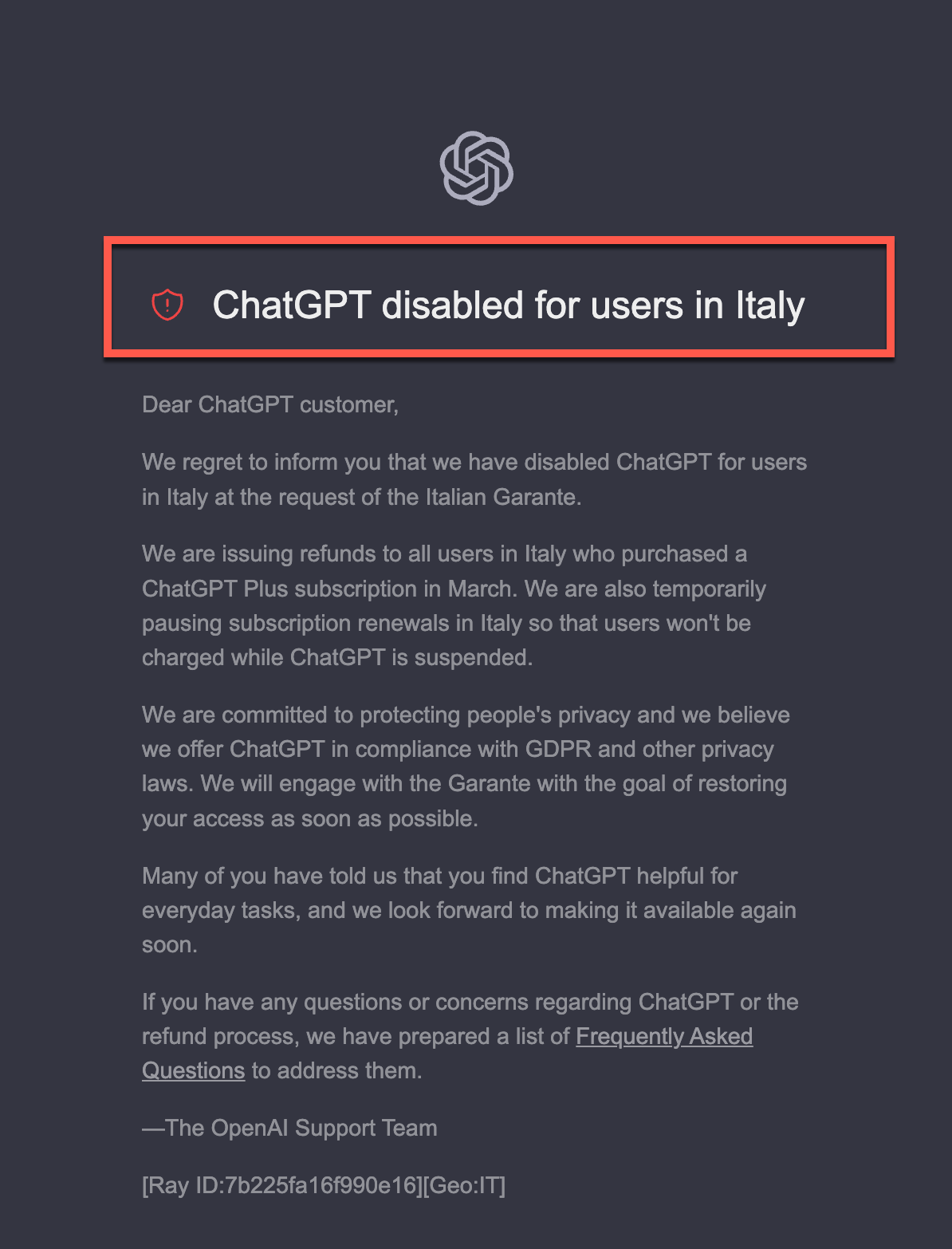
A European crackdown on AI chatbots is in progress.
Research Calls
- Upgrades:
- Burlington Stores (BURL) upgraded to Buy from Hold at Loop Capital; tgt raised to $225
- Chevron (CVX) upgraded to Neutral from Underperform at Exane BNP Paribas; tgt $200
- Comcast (CMCSA) upgraded to Overweight from Sector Weight at KeyBanc Capital Markets; tgt $44
- Corebridge Financial (CRBG) upgraded to Buy from Neutral at Goldman; tgt lowered to $23
- CSX (CSX) upgraded to Equal-Weight from Underweight at Morgan Stanley; tgt $24
- Etsy (ETSY) upgraded to Overweight from Neutral at Piper Sandler; tgt raised to $140
- Evotec SE (EVO) upgraded to Equal-Weight from Underweight at Morgan Stanley; tgt raised to $12
- Health Catalyst (HCAT) upgraded to Overweight from Equal Weight at Wells Fargo; tgt raised to $16
- Norfolk Southern (NSC) upgraded to Equal-Weight from Underweight at Morgan Stanley; tgt $177
- ONEOK (OKE) upgraded to Buy from Neutral at Citigroup; tgt raised to $72
- Prudential (PRU) upgraded to Overweight from Neutral at JP Morgan; tgt $114
- ServiceNow (NOW) upgraded to Outperform from Neutral at Robert W. Baird; tgt raised to $548
- WideOpenWest (WOW) upgraded to Overweight from Sector Weight at KeyBanc Capital Markets; tgt $14
- Downgrades:
- Ascendis Pharma (ASND) downgraded to Equal-Weight from Overweight at Morgan Stanley; tgt lowered to $108
- Boeing (BA) downgraded to Neutral from Buy at Northcoast; tgt $180
- Charter Comm (CHTR) downgraded to Sector Weight from Overweight at KeyBanc Capital Markets
- Equinor (EQNR) downgraded to Underperform from Neutral at Exane BNP Paribas
- IdaCorp (IDA) downgraded to Neutral from Buy at Mizuho; tgt lowered to $107
- nCino (NCNO) downgraded to Equal-Weight from Overweight at Morgan Stanley; tgt lowered to $25
- Stem (STEM) downgraded to Underperform from Neutral at BofA Securities; tgt lowered to $5
- Others:
- A10 Networks (ATEN) initiated with a Neutral at BTIG Research
- Ameris Bancorp (ABCB) initiated with an Equal-Weight at Stephens; tgt $41
- Atlas Energy Solutions (AESI) initiated with an Overweight at CapitalOne; tgt $25
- Capital Bancorp (CBNK) resumed with an Equal-Weight at Stephens; tgt $19
- City Holding Co (CHCO) initiated with an Equal-Weight at Stephens; tgt $89
- Corcept Therapeutics (CORT) initiated with an Overweight at Piper Sandler; tgt $27
- Crane (CR) initiated with a Buy at DA Davidson; tgt $90
- Crane NXT (CXT) initiated with a Buy at DA Davidson; tgt $70
- Fastenal (FAST) initiated with a Buy at Stifel; tgt $61
- F.N.B. Corp (FNB) initiated with an Overweight at Stephens; tgt $15
- Franklin BSP Realty Trust (FBRT) initiated with an Outperform at Raymond James; tgt $13.50
- Haleon plc (HLN) initiated with an Outperform at Bernstein
- Primis Financial (FRST) initiated with an Overweight at Stephens; tgt $13
- Sandy Spring Banc (SASR) initiated with an Equal-Weight at Stephens; tgt $28
- Sarepta Therapeutics initiated with a Buy, added to Focus List, and opened an Upside 90-day Catalyst Watch at Citigroup; tgt $179
- United Bankshares (UBSI) initiated with an Equal-Weight at Stephens; tgt $32
- United Comm Banks (UCBI) initiated with an Overweight at Stephens; tgt $34
- Vodafone PLC (VOD) resumed with a Neutral at Citigroup
- WesBanco Inc (WSBC) initiated with an Equal-Weight at Stephens; tgt $28
- WSFS Financial (WSFS) initiated with an Overweight at Stephens; tgt $47