Electrek : Xiaomi reveals 990-horsepower YU7 GT performance SUV with 186 mph top

Xiaomi has officially filed for the YU7 GT, a nearly 1,000-horsepower performance version of its popular YU7 electric SUV that will hit a top speed of 300 km/h (186 mph), making it one of the fastest electric SUVs ever built.

The filing appeared today in China’s Ministry of Industry and Information Technology (MIIT) regulatory catalog, revealing a widebody beast that positions Xiaomi squarely against any high-performance SUVs.
And it’s not even an “Ultra.”

Nearly 1,000 horsepower from dual motors
The YU7 GT packs a dual-motor powertrain with a 288 kW (386 hp) front motor and a massive 450 kW (603 hp) rear motor, combining for a total output of 738 kW, that’s 990 horsepower.

For context, that significantly exceeds the standard YU7 Max’s 508 kW (681 hp) dual-motor setup, which already hits 0-100 km/h in 3.23 seconds. The YU7 GT’s additional 230 kW is expected to push acceleration times approaching 2 seconds to 100 km/h.

The 300 km/h top speed puts it in rare company among production SUVs.

Widebody design with serious hardware
The YU7 GT isn’t just a software tune, it’s a proper performance variant with:
  • Widebody kit: 16mm longer and 11mm wider than standard YU7
  • Dimensions: 5,015mm × 2,007mm × 1,597mm (3,000mm wheelbase)
  • Staggered 21-inch wheels: 265/40R21 front, 295/35R21 rear (vs. standard 245/55R19)
  • Red brake calipers (likely carbon-ceramic brakes)
  • Large rear diffuser and prominent “GT” badge
  • All-black exterior versus the YU7’s colorful options
  • CATL ternary lithium battery (capacity not yet disclosed)

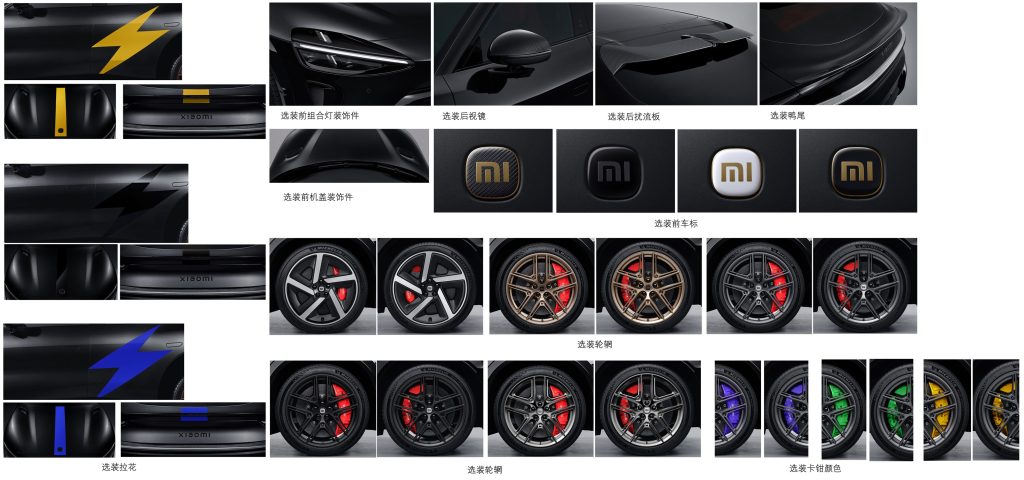
The MIIT filing shows extensive customization options including different wheel designs, caliper colors, spoiler configurations, and body decals.
Here are all the images from the filing:


Pricing and positioning
Market speculation puts the YU7 GT between 450,000-500,000 yuan ($60,000-70,000), positioning it below the SU7 Ultra sedan (which starts around 500,000 yuan with its tri-motor 1,526 hp powertrain).
Xiaomi still hasn’t confirmed if an Ultra version of the YU7 is coming or if the GT is going to be the top-of-the-line for the SUV.
The bigger picture: Xiaomi’s rapid expansion
The YU7 GT joins an aggressive 2026 lineup that includes:
  • YU9: Large flagship SUV
  • SU7 L: Long-wheelbase sedan
  • YU7 GT: Performance SUV (this filing)
The standard YU7 has been a hit, delivering 39,089 units in December alone and 153,673 total in 2025. In January 2026, Xiaomi delivered over 39,000 vehicles again, with YU7 dominating sales.

For a company that only started delivering cars in April 2024, this trajectory is remarkable.

Electrek’s Take
990 horsepower in a likely ~$60,000 SUV is absurd, and I mean that as a compliment.
Xiaomi is doing what Tesla did a decade ago: using performance halo cars to build brand credibility while volume models pay the bills. The SU7 Ultra put Xiaomi on the Nürburgring leaderboard. The YU7 GT will put them on the radar of every performance SUV buyer in China.
The question is whether there’s actually a market for $60,000+ Chinese performance SUVs outside of China. In Europe, where Xiaomi is eyeing expansion, the competition is brutal, you’re up against Porsche, BMW, Mercedes, and Tesla, though to a lesser degree in that segment.
But if they can deliver this kind of performance at even 80% of what German rivals charge, they’ll find buyers.

Fortune : What caused the massive Bitcoin crash? Clues point to a blow-up at Hon

What caused the massive Bitcoin crash? Clues point to a blow-up at Hong Kong hedge funds

Crypto prices got absolutely rocked this week with Bitcoin falling nearly $15,000 in 24 hours—a bloodbath not seen since the collapse of crypto conman Sam Bankman-Fried’s empire back in 2022. On Friday, Bitcoin had clawed back most of those losses, and is now trading around $70,000, but the episode has left even longtime crypto insiders asking each other “What just happened?!” There are plenty of theories swirling around, but one is particularly compelling: The cause of the crash lies with Hong Kong traders who placed high-leverage Bitcoin bets that went horribly wrong.

That theory was put forth on X by Parker White, a former equities trader who is now COO at a crypto firm called DeFi Development Corporation. In a long thread, White said there is evidence pointing to the sudden implosion of Hong Kong hedge funds that held call options in BlackRock’s IBIT, which is the world’s biggest Bitcoin ETF.

White suggests that the hedge funds used the Yen carry trade (a form of interest arbitrage) to finance big positions in out-of-the-money IBIT options. This amounted to a risky bet that Bitcoin prices, which have been slumping since a big sell-off in October, would recover. The hoped-for rally didn’t arrive, however. Meanwhile, White speculates that the Hong Kong funds also got pummeled by headwinds in the Yen-carry trade—which made their financing more expensive—and exposure to recent convulsions in the silver market.

The upshot is the hedge funds faced a perfect storm and, as the crypto market slumped further this week, the value of their holdings declined until they got liquidated—forcing the mass sell-off of IBIT shares and a calamitous fall for Bitcoin. Here is how White explained what happened in trader-speak:

Now, I could easily see how the fund(s) could have been running a levered options trade on IBIT (think way OTM calls = ultra high gamma) with borrowed capital in JPY. Oct 10th could very well have blown a hole in their balance sheet, that they tried to win back by adding leverage waiting for the “obvious” rebound. As that led to increased losses, coupled with increased funding costs in JPY, I could see how the fund(s) would have gotten more desperate and hopped on the Silver trade. When that blew up, things got dire and this last push in BTC finished them off.

In his post, White also pointed out that the Hong Kong hedge funds, whose Bitcoin trading occurred only in the form of ETF shares, are not part of the traditional crypto ecosystem. This means that chatter about their predicament did not bubble up on “Crypto Twitter”—which is the go-to forum for industry news—and nor did it create counter-parties who incurred big losses, and would be likely to warn others.

White’s theory is just that, of course: no more than a theory. Meanwhile, history shows that major Bitcoin crashes have typically been touched off by multiple factors, not a single event. And indeed, this week’s crypto crackup coincided with a broader AI-related asset sell-off, uncertainty over the fate of a key blockchain bill, as well as crypto names appearing in the Epstein files—factors that all likely contributed to Thursday’s meltdown.

Still, White’s explanation is the most persuasive, and is further supported by other circumstantial evidence, including a recent decision by the Securities and Exchange Commission to lift limits on trading Bitcoin options.

Meanwhile, other longtime crypto figures expressed cautious support for the Hong Kong hedge fund theory. That included the respected venture capitalist Haseeb Qureshi who described the theory as plausible, but added that it may take months to wait for regulatory filings that could help confirm it, and that in some cases a key crypto player can “blow up” without anyone ever learning their identity. But for those who are confident that a hedge fund is at the root of this week’s market troubles, there is already a Polymarket forum to bet on the culprit.

The Information : Microsoft Sales Chief Responds to Potential Rivalry with OpenA

Microsoft Sales Chief Responds to Potential Rivalry with OpenAI’s New Agent Product

The Takeaway
  • Microsoft sales chief positions company against OpenAI’s new Frontier AI agent product.
  • Microsoft emphasizes platform strength, diverse AI models, and enterprise security.
  • OpenAI and Anthropic AI agents may threaten traditional enterprise software market.

Microsoft’s top sales executive told staff on Friday that the company was uniquely positioned to compete against a new OpenAI product aimed at helping businesses automate office tasks across different software applications—including Microsoft’s own apps.

In an email, Microsoft Chief Commercial Officer Judson Althoff provided talking points salespeople could use in selling Microsoft’s tools for managing so-called AI agents, including highlighting their potential advantages over OpenAI’s new product, known as Frontier, according to two Microsoft employees who received the email.

Althoff’s effort to rally his troops shows how quickly new AI announcements are impacting the enterprise software industry. Over the past few weeks, public market investors have sold off software stocks on fears that AI—including agents made by Anthropic and OpenAI—will make traditional enterprise software apps less valuable and impact their growth.

It’s not the first time Microsoft has found itself in competition with OpenAI after investing $13 billion in the startup in exchange for the right to use OpenAI’s technology in its own products. As both companies sold similar AI products to businesses, Microsoft has repeatedly told salespeople to tell customers that Microsoft could provide more security and compliance guarantees than the younger startup.

Newfangled AI agents developed by firms such as OpenAI and Anthropic are still rife with security vulnerabilities, limited in their capabilities and make mistakes, but AI leaders including Nvidia CEO Jensen Huang increasingly describe a future in which AI agents themselves will use traditional enterprise apps to perform tasks currently handled by people. That could put the enterprise app business in a precarious position.

Microsoft, the No. 1 seller of enterprise apps, is trying to get ahead of AI upstarts like OpenAI by releasing its own products for workers to create and direct AI agents. Microsoft’s Agent 365 aims to help companies keep track of different AI agents—including those offered by OpenAI—and connect those agents to other applications so they can reorganize files or create forecasts based on data stored in those applications.

Microsoft is also developing Windows-based AI agents that could perform tasks and use applications on a customer’s computer the way a human would, The Information reported last week.

Microsoft is far from alone. Other enterprise software firms like ServiceNow, Salesforce, and Amazon have recently debuted products meant to help customers keep track of and direct agents from a range of different AI providers.

The traditional enterprise firms are keeping a watchful eye on both OpenAI and Anthropic, from which many of them buy AI models to power features in their enterprise apps.

Using a technique known as reinforcement learning, OpenAI and Anthropic have been training AI to be able to use enterprise apps as a “digital coworker” alongside humans for the better part of a year. Now, they are trying to get such AI in the hands of businesses.

OpenAI said a customer could use Frontier, which it announced on Wednesday, to create multiple “AI coworkers” and assign them different tasks that involve pulling in data from various applications: one AI agent could research potential sales leads while another could take that agent’s findings and check it against existing customer accounts stored in a company’s sales database and send sales pitches to customers that aren’t already in the system.

Ominous Chart?

OpenAI didn’t specify which well-known enterprise apps its AI would use to perform these tasks. But it included a graphic in its blog post about Frontier, showing how OpenAI’s technology for directing these agents would sit on top of companies’ “systems of record.” That term describes applications made by firms such as Microsoft and Salesforce that store corporate data customers trust to be accurate.

Some executives at traditional enterprise application firms said they viewed the graphic as OpenAI’s way of showing the heavy influence it wants to have over the way businesses use and pay for software and AI. (An OpenAI spokesperson did not immediately respond to a request for comment.)

To be sure, OpenAI isn’t arguing that the AI itself will work out of the box. It’s hiring AI specialists to work deeply with customers to reorganize their IT systems and make their existing software work better with AI. Anthropic also has such employees, which work with companies such as Cox Automotive to develop AI agents to power new products.

In the Friday email, Althoff said OpenAI is a worthy competitor that deserves respect, but he also urged sales teams to stay the course and keep in mind the advantages Microsoft has as it competes with the startup, said a current employee.

One of these advantages, Althoff said, is that Microsoft is a “platform” company that offers many different AI models and has longstanding relationships with enterprise customers. OpenAI, in contrast, is an AI developer that has yet to show it can be a platform company, especially since it has no infrastructure of its own in place, Althoff said in the email. (OpenAI relies on cloud providers such as Microsoft to run its technology and business.)

Application Scaffolding’

Althoff emphasized that Microsoft’s Azure cloud server business—which also powers OpenAI’s technology—already offers access to a wide range of models, making Microsoft a more logical destination for directing multiple AI agents, the people said. Microsoft offers OpenAI’s models as well as those of other providers like Anthropic, Mistral, and xAI.

Althoff also said Microsoft has experience working with large enterprises with complex security and compliance needs, which made it better positioned to win business, the people said.

OpenAI’s Frontier release came several weeks after its archrival Anthropic released Cowork, a product that also aims to automate workplace tasks by taking over a user’s computer to perform work on their desktop like a human would.

Microsoft leaders almost immediately discussed how Cowork stacked up against Microsoft’s AI products like 365 Copilot—which uses models from Anthropic and OpenAI to automate tasks in its flagship Office 365 and Outlook software—and how Microsoft could potentially compete with the Anthropic product.

Microsoft CEO Satya Nadella has previously said that the company’s strategy is to develop “application scaffolding”—software that helps customers use AI models to automate tasks across various applications and data they use. He argued that AI models themselves could become “commoditized,” meaning value would flow to firms like Microsoft that give customers useful tools to connect the models to applications and data.

WSJ : Why a 175-Year-Old Glassmaker Is Suddenly an AI Superstar

Why a 175-Year-Old Glassmaker Is Suddenly an AI Superstar
Everyone told the company to sell its unprofitable fiber-optic business. Now that division is powering its stock to all-time highs.

The company that once made glass bulbs for Thomas Edison lost money on fiber-optic cables for nearly 20 years.

Now, in the global race to build enough computing power for a future driven by artificial intelligence, Corning’s GLW 8.31%increase; green up pointing triangle cables have become the connectors of choice. The Cinderella story for a relatively unflashy but high-tech component has been a boon to the 175-year-old company, and a lesson in how being willing to lose money on new ideas for a long time can pay off.

Corning stock is hovering around its all-time high, boosted by a recently announced $6 billion deal with Meta to supply fiber-optic cable for the company’s rapidly growing array of AI data centers. Corning said it is in talks with others for more such deals. It’s also working on what could be its next big act—fiber that goes inside servers, instead of just connecting them to each other.
Clearer than crystal
Corning’s cables are suddenly in demand because of physics: Data can be sent far more quickly and with less energy using light (which is made of photons) than with electricity (made of electrons). The cables themselves often contain dozens or hundreds of flexible, ultrathin glass fibers to carry signals.

Until recently, fiber optics have primarily been used to connect nodes of the internet—sometimes spanning thousands of miles underground and beneath the waves.

“Over even short distances, transmitting data with photons is three times as efficient as electrons,” says Wendell Weeks, Corning’s chief executive since 2005, who came from the fiber-optic division. “And over long distances, it’s more like 20 times.”

About half of Corning’s manufacturing remains in the U.S., a feat, given how many others have offshored high-tech manufacturing. In a North Carolina factory, it pulls glass strands as thin as a human hair, yet upward of 30 miles long. They’re so transparent, if you filled an ocean with them, you could see straight to the bottom.

Corning’s success in this space wasn’t guaranteed, says Mike O’Day, who heads its fiber business. Until recently, the company was still making a product that hadn’t changed much since its introduction in 1970.

In 2018, Weeks and O’Day went to Dallas to tour a data center owned by Meta, then known as Facebook. They marveled at the demand for fiber-optic cabling to connect all the servers inside that giant warehouse. Facebook was using a mix of copper cables and existing fiber optics, but found both ill-suited to the task.

This spurred Corning’s engineers to make their cables thinner, but also tougher, so they could withstand tight bends, says Claudio Mazzali, Corning’s head of research.

Five years later, ChatGPT made its debut, and demand for fiber-powered data centers exploded.

“We’re thankful that we made the trip in 2018 and thankful that we made the bet,” says O’Day. At the time, they had no idea whether it would be a good investment or a dud, he adds.

The ‘Corning Way’
What made Corning’s fiber reinvention possible is that the company outsources almost nothing, says Mazzali. It even designs the machines used to manufacture its optical fiber and cable.

Weeks says this is part of the “Corning Way.” That self-containment also applies to the workforce, says the CEO. When the company shifts direction, it reassigns engineers rather than laying them off, so they accumulate expertise over decades, across different projects. “The things our engineers do, you can’t learn them from a textbook,” says Weeks.

After the onset of the pandemic, Corning endured six consecutive quarters of shrinking revenue, its lengthiest drop since the 2001 telecom crash. Instead of laying off workers and shrinking factories, the company gave employees the option to take some of their compensation in stock.

“We were probably carrying 4,000 to 5,000 more employees than our revenue could support,” says Weeks. Corning currently employs about 56,000 people worldwide.

Now that demand for fiber is booming, the company needs all of those workers and capacity—and more.

Supply and demand
Corning is the biggest fiber-optics maker by a number of measures and has the lion’s share of the North American market. Fiber for data centers is the fastest-growing part of Corning’s revenue, says O’Day. Its continuing good fortune is contingent on big tech firms continuing to build at the rates they have indicated, say analysts.

“The level Corning’s stock is at today is baking in everything going right, and nothing going wrong,” says William Kerwin, a senior equity analyst at Morningstar.

Like many providers to data centers, Corning is already selling all that it can make. “I think demand for Corning’s fiber is going to be above supply for the foreseeable future,” says Kerwin. “It’s safe to say that if they could produce more, they could ship more.” Another factor: fiber-optic installation is facing a labor shortage.

Whether or not the AI industry meets its targets for growth, businesses both established and emerging will continue to seek optical fiber of the caliber coming from Corning and a handful of global competitors. And Corning already has its next growth business lined up: Nvidia is exploring servers that directly incorporate the glassmaker’s “co-packaged” optics.

It took nearly half a century for Corning to produce a billion miles of optical fiber. The second billion took eight years, a milestone reached last year. The next billion will arrive much sooner.

In part, that’s because more of that fiber is making its way to the dense networks within data centers, enough to soon surpass the long-haul business in terms of miles delivered, says O’Day. And then there’s the fiber that will go inside computers.

While Weeks is optimistic about the relationship with Nvidia, he says he has yet to be invited to Nvidia CEO Jensen Huang’s famous fried-chicken-and-beer summits. The development of co-packaged optics requires patience and capital, Weeks says, just like Corning’s past innovations.

“Once we actually deliver, I guess that’s when you get invited to beer and chicken,” says Weeks.

WSJ : Big Tech’s AI Push Is Costing a Lot More Than the Moon Landing

Big Tech’s AI Push Is Costing a Lot More Than the Moon Landing
As a percentage of GDP, the projected 2026 spending of four tech giants rivals the most momentous capital efforts in U.S. history


It’s bigger than the railroad expansion of the 1850s, the Apollo space program that put astronauts on the moon in the 1960s and the decadeslong build-out of the U.S. interstate highway system that ended in the 1970s.

We’re talking about the data centers now being built and financed by some of the world’s biggest companies in the artificial-intelligence boom.

Four U.S. tech giants—Microsoft MSFT 1.90%increase; green up pointing triangle, Meta Platforms META -1.31%decrease; red down pointing triangle, Amazon AMZN -5.55%decrease; red down pointing triangle and Alphabet’s GOOGL -2.53%decrease; red down pointing triangle Google—are planning to spend up to $670 billion to build out AI infrastructure this year alone as they scramble to increase the computing power needed to operate and scale their AI-related endeavors.

It has become an increasingly expensive project, one that the companies finance with their billions of dollars in advertising, cloud and subscription revenue. And if you compare this spending to some of the biggest capital efforts in U.S. history by percentage of gross domestic product, you can see exactly how staggering the figures are.

In fact, it’s dwarfed only by the Louisiana Purchase, completed in 1803, which doubled the size of the U.S.


The companies’ capital spending has been increasing as a percentage of their annual revenue the past few years. In 2026, Meta’s spending could amount to more than 50% of its sales for the first time ever, according to analyst projections.

Investors and analysts initially expressed concern about Meta’s spending plans for 2026 but gave the company a reprieve after it posted record quarterly earnings attributed to AI-driven improvements, and forecast even bigger potential growth in the current quarter.

Amazon’s investors, however, didn’t take kindly to its plans to ramp capital spending up by nearly 60% to $200 billion this year: On Friday, the company lost $124 billion in market value.

WSJ : The Weight-Loss Price Wars Are Breaking Big Pharma’s Business Model

The Weight-Loss Price Wars Are Breaking Big Pharma’s Business Model
Prices for GLP-1s are falling fast and forcing companies to adapt

Two years ago, a GLP-1 prescription could cost an uninsured patient more than $1,000 a month. Today, Novo Nordisk’s NOVO.B 5.29%increase; green up pointing triangle Wegovy pill starts at just $149 through cash-pay programs.

In the world of Big Pharma, this is unheard of.

Typically, drug prices climb or plateau until generics arrive years later. That trend should be even stickier in a duopoly. Yet the obesity market has turned traditional pharma economics upside down. As Leerink analyst David Risinger notes, there isn’t a comparable precedent for this level of price erosion in the industry’s history.

This past week investors have seen the cost of this price war. Novo Nordisk, maker of Wegovy and Ozempic, forecast a sharp sales decline for 2026, sending its stock down nearly 20% in the days that followed. The outlook for Eli Lilly LLY 3.66%increase; green up pointing triangle, which makes Zepbound and Mounjaro, remains brighter, but only because a strong surge in volume is expected to offset the drag of recent price cuts.

Eli Lilly’s outlook remains brighter, but only because a strong surge in volume is expected to offset the drag of recent price cuts. Then on Thursday, shares of both companies fell sharply after Hims & Hers Health HIMS -1.96%decrease; red down pointing triangle announced a $49-a-month compounded version of the Wegovy pill. They rebounded Friday after the Food and Drug Administration chief threatened action against the mass marketing of copycat drugs.

The wild week for GLP-1 makers was a stark reminder of how unusual this market has become, operating more like a high-growth consumer business than a traditional drug market. In recent years, demand spread through TikTok, Instagram, and word-of-mouth, often before patients ever saw a physician. Unlike treatments for conditions such as high blood pressure, the impact of GLP-1s isn’t measured only in lab results: it’s visible. That viral demand overwhelmed manufacturing capacity and outpaced employers’ willingness to cover the drugs.

As insurers and employers moved slowly, patients bypassed the system entirely, turning to cash payments. This shift—combined with persistent brand-name shortages—opened the door for telehealth firms and compounded “copycats,” introducing cutthroat price competition years earlier than the industry expected.

Drugmakers were ultimately forced to respond with lower prices. They needed cash prices low enough to fend off compounders and to reach uninsured patients at scale. They also later reached a deal with the Trump administration to lower prices in exchange for broader access, including Medicare coverage for millions of seniors.


The question both companies are now racing to answer is just how elastic consumer demand is in the obesity market. Lower prices are clearly unlocking growth in demand, especially in the cash-pay market. As Novo Nordisk Chief Financial Officer Karsten Munk Knudsen argued in an interview this week, this isn’t a price war, so much as a search for the price points that open the floodgates of access.

While Eli Lilly is thriving under the new logic, Novo Nordisk is struggling to keep pace. Both companies are projecting net price declines this year, but Lilly is aggressively capturing market share. Lilly says it recently surpassed a 60% share of the U.S. GLP-1 market, and it now expects 2026 revenue to climb about 25% to more than $80 billion. As for Novo Nordisk, the company is cutting prices, but volume hasn’t yet made up the difference. Sales are expected to fall between 5% and 13% in 2026. The company is hoping that—longer term—volume will bounce back enough to make up for the price pressures.

Lilly’s primary advantage is clinical: Zepbound is simply seen as more effective than Wegovy. But the Indianapolis-based company was also quicker to realize that a direct-to-consumer, cash-pay model was the future. More than 30% of Zepbound prescriptions now flow through LillyDirect. The company is already preparing to launch its own daily pill, Orforglipron, at a similar price point to Novo Nordisk’s $149 entry-level oral Wegovy.


Novo Nordisk was slower to embrace the cash-pay pivot, but it is making up for lost time. In just a few weeks since launching the Wegovy pill, it has already added 170,000 patients onto the treatment—most of whom are paying out-of-pocket through portals such as NovoCare or telehealth partners such as Ro.

This weekend’s Super Bowl will codify the shift. One of the most talked-about ads could be from Ro. Featuring Serena Williams, the spot aims to dismantle the “willpower” stigma around weight loss. As Ro Chief Executive Officer Zach Reitano puts it in an interview: “No one in the world has more willpower than Serena Williams.” By positioning GLP-1s as a tool for an elite athlete’s health—not a “cheat code” for the lazy—Ro is attempting to accelerate the consumerization of the category.

The weight-loss market is a special case shaped by conditions that don’t exist elsewhere in the drug industry, not least of which is the mass appeal of the product. But it also reveals what happens when consumers have more agency and more transparent prices. It is a lesson pharmaceutical companies are unlikely to forget.

WSJ : China Is Going All-In to Beat the U.S. on Humanoid Robots

China Is Going All-In to Beat the U.S. on Humanoid Robots
Beijing is showering companies with support, but some fear a bubble

  • China is rapidly developing its humanoid robotics industry, with over 140 companies emerging and significant government investment exceeding $26 billion.
  • The Chinese government is actively promoting the industry through subsidies, favorable loans, and early adoption by state-owned entities, mirroring its EV industry strategy.
  • While the U.S. leads in foundational AI, China’s extensive supply chain and manufacturing capabilities allow for rapid, low-cost innovation in humanoid robot components.

SUZHOU, China—Elon Musk has been telling investors for months that Tesla’s Optimus humanoid robot will revolutionize the world and create a new mega-industry. But most of it could belong to China, he has warned.

“China is an ass-kicker, next level,” Musk said in January. “To the best of our knowledge, we don’t see any significant [humanoid robot] competitors outside of China.”

China is moving quickly to try to dominate the industry. Humanoid-robotics companies are sprouting up from Shenzhen to Suzhou, with more than 140 and counting. Tapping a vast ecosystem of parts suppliers and engineering talent, they are starting to produce humanoid robots at scale and actively introducing them into real-life scenarios in factories, hotels and offices.

Setting the broader industry direction is Beijing, which has identified “embodied AI”—the fusion of artificial intelligence with physical systems—as a cutting-edge technology area China wants to own in the coming five years.

Local governments are showering companies with land and discounted office rent. Banks are offering favorable loan terms. Since late 2024, Beijing, Shenzhen and other cities have established investment funds totaling more than $26 billion to inject capital into the industry, Morgan Stanley calculates.

Government agencies and state-owned companies are also serving as early adopters, buying up humanoids and deploying them in museums, at events and on the street as robocops performing traffic control. The deployments are helping firms to build a market and collect data to make the robots work better.

Some local governments are offering subsidies to buyers, paying around 10% of the price of humanoid robots to lower the bar for customers to try them.

The moves closely track the way in which China built up other industries, such as electric vehicles, which benefited from incentives for buyers to help stimulate demand. Now China has many of the world’s most notable EV makers, including brands that are eating up the market shares of General Motors, Volkswagen and others in China, Europe and elsewhere.

With humanoid robots, “China is once again mobilizing state support, supply-chain depth, and rapid commercialization to build a new strategic sector,” said Sunny Cheung, a fellow for China studies at the Jamestown Foundation. Success will depend on who can best solve the myriad technical problems associated with humanoid robots, he said.

China’s push has come with lots of hype. A 13-mile humanoid marathon featured a robot that finished in under three hours with human help, but others sat down and refused to move.

U.S. worries
Even so, China’s momentum is a source of concern for U.S. policymakers and tech leaders. The White House has been working on an executive order aiming to boost the development of the American robotics industry, people familiar with the matter said.

Among the U.S.’s concerns: Many American robotics companies will rely on China’s supply chain. Tesla’s Optimus will count on Chinese suppliers for components such as roller screws for robot joints and motors for robot hands for mass production, people familiar with the matter said.

The U.S. still leads in one key area: the foundational AI models that serve as the brains of humanoids. Companies including Tesla, Boston Dynamics and Agility Robotics have made advances tapping cutting-edge technology from the likes of Nvidia and Google.

But China has a broad supply chain of manufacturers that make the nuts and bolts of humanoids, including sensors, batteries and other components. With the ability to source so much locally, Chinese humanoid companies are able to make design changes easily and at low cost, driving innovation.

Chinese makers of humanoid robots—which include humanlike machines with wheels as well as those with legs—announced orders worth more than $300 million in the second half of 2025. Shenzhen-based UBTech is selling humanoids to companies including Texas Instruments and Airbus.

Morgan Stanley predicts that up to 100,000 humanoids could be shipped in 2026, with adoption faster in China than in the U.S.

“Although we’ve heard of American robot companies, they’re not in the market,” said Jonathan Beh, a representative from an industrial park in Singapore that has been exploring ways to introduce humanoid robots to its operations.

“Chinese companies have great products, and they’re the only available option.”

Adjusting bedsheets
On a recent weekday at UniX AI, a Chinese robot maker in the city of Suzhou near Shanghai, founder Fred Yang showed a group of investors how its wheeled humanoid Panther could adjust messy bedsheets, pick up trash and place dirty clothes in the laundry machine and start the wash.

The company, with about 100 employees, has developed three versions of its humanoid robots, with a starting price of around $12,600 each. It has deployed hundreds in places such as hotels, mostly in China.

Yang said it helps that UniX AI can secure about 80% of its components from suppliers within a one-hour radius. It can communicate immediately with the supplier to work out any problem.

Yang, who studied at the University of Michigan and Yale University, returned home to China to start UniX AI a year and a half ago. He said China’s deep bench of technical talent and government support help to make it a good place to launch. Some local governments offer free land and office space for three years, followed by three more years at half price, he said.
“Policy is one of the decisive reasons that embodied AI is doing so well in China,” Yang said in August. “I treat the government policy as a force to crack the market, and our embodied AI startups are the force to push.”

‘Robot Valley’
Other cities and provinces have set up their own action plans and embodied AI funds to provide capital for the industry.

In Shenzhen, home to Tencent, Huawei Technologies and EV maker BYD, a so-called “Robot Valley” is emerging, with around 15 robotics firms. Shenzhen has said it was setting up a roughly $1.4 billion fund focused on AI and robotics industries, and another valued at around $640 million focused on AI models.

One humanoid robotics firm there, AI² Robotics, enjoys subsidized rent as well as access to interns from nearby universities. Their costs are also subsidized.


AI²’s founder, Eric Guo, holds a Ph.D. from Purdue University and worked previously at Microsoft. The firm’s general-purpose humanoid, called AlphaBot, is currently used in factories including LCD television panel maker HKC. In late 2025, some Chinese airports started deploying AI²’s robots for services such as pushing and managing luggage carts, a spokesman said.

“Our primary focus is to figure out how to make robots usable and operational, even when they haven’t yet achieved full, 100% perfection in technology,” Guo said in September.

Beijing also has an economic development zone with humanoid robot startups, and funds totaling $14 billion to support AI and robotics industries.

Hints of hype
China’s recipe of government support, low-cost supply chains and technical talent worked wonders for the EV industry. But it also led to hundreds of brands crowding the market and severe price competition, with many companies unprofitable. As more robot firms emerge, fears of a bubble have risen.


FT : Buy European and the French paradox

Buy European and the French paradox
French ideas are often in the ascendant in EU policy-making just as the country’s government grows weaker

A good bet
The Buy European push is being spearheaded by industry commissioner Stéphane Séjourné, a Frenchman. Paris has for decades pressed the EU to level the playing field with China and the US given the protections afforded to their domestic companies. But the free-trading nations of northern Europe, led by Germany, resisted. That has changed.

As my colleagues Alice Hancock and Andy Bounds explain in this comprehensive analysis, there is wider acceptance of the need for some European preference in some areas to safeguard the EU’s place in manufacturing value chains. The argument is over the scope.

Séjourné’s early discussions included a 70 per cent local content requirement for electric vehicles purchased or leased with a public subsidy.

The FT’s Alan Beattie said he was prepared to bet a year’s lease on a BYD Dolphin (one of the carmaker’s bestselling models) that nothing like this would actually come to pass, because “70 per cent is prohibitively high and would make EU products so expensive relative to Chinese products that they would require more tariff protection”.

Details, details
No wonder European automakers, who are supposed to be the big beneficiaries, declined to join over 1,100 business leaders in signing a letter with Séjourné calling for European preference. They want to see precise details first. And the commissioner’s letter was anything but precise:

“Whether a public auction, direct state aid support or any other form of financial support, the beneficiary company will have to produce a substantial part of its output on European soil,” Séjourné wrote. “We must of course also apply this logic to foreign direct investments.”

The Buy European principle begs many questions. Which industries count as strategic? Germany for example has suggested it should include low-carbon cement and low-carbon steel, sectors that are in theory already protected by the Carbon Border Adjustment Mechanism, a levy on carbon-intensive imports.

Should content requirements target whole products or critical components? What kind of timescales and transition periods? What counts as European? What are the additional costs for business, and can Brussels avoid creating a bureaucratic monster to implement the rules?

Exception not the rule
Free trade advocates argue that European preference, if needed to sustain the EU’s capacity to innovate and add value in critical industries, should be exceptional and precisely targeted. 

Former European Central Bank president Mario Draghi calls for “reinforced European preference principles” for defence, satellites and semiconductors in his 2024 competitiveness report. He was otherwise quite sparing.

There may also be smarter, more practical ways of achieving the same industrial objectives than blanket Buy European provisions. 

As Sander Tordoir and Brad Setser pointed out in this piece, France has adopted EV subsidy rules that penalise long-distance, high-polluting transportation as well as production using electricity from coal, in effect excluding Chinese cars. The rest of the EU should follow France’s example, they said.

European preference rules for foreign direct investment, compelling technology transfer and use of local labour and supply chains, are also likely to be contentious. Proponents say new FDI requirements would prevent low-valued added Chinese-owned assembly plants in Europe from flooding markets with essentially Chinese products. But national governments are likely to see this as an EU intrusion into national sovereignty.

German revolution
Germany’s stance is likely to be key to the shape of the Buy European campaign. Berlin is a lot more open to the principle than it was before. There are many German companies among Séjourné’s co-signatories. Finance minister Lars Klingbeil, a Social Democrat, has given his backing. Insiders say this has demanded a revolution in thinking inside an orthodox finance ministry. But the Christian Democratic Union-controlled economy ministry is more cautious, insisting that European preference rules should be exceptional (although also applicable to low-carbon cement and steel). 

Chancellor Friedrich Merz is also reportedly supportive of the idea of limited European preference rules. But it was not mentioned at all in a joint paper on the EU he presented with Italian prime minister Giorgia Meloni last month. For Merz, the priorities are deregulation and reducing the burdens of decarbonisation on business.

French paradox 
Writing in Internationale Politik Quarterly, Andreas Rinke notes the increasingly warm relationship between the Christian Democrat Merz and radical right Meloni is an example of the German chancellor’s pragmatism towards the EU. Whereas Berlin once prioritised EU unity and the primacy of Franco-German leadership, Merz sees the value of progress through coalitions of the willing and new alliances. There is a perception in Berlin that Macron is now so weak at home that he can no longer deliver on his EU promises, Rinke says, coupled with fear that he may be succeeded by a far-right, anti-EU president next year.

In a commentary for the European Council on Foreign Relations, Giorgio Rutelli reckons the Italy-Germany relationship is now better placed to build the “cross-regional coalitions capable of breaking recurring deadlocks” than the Franco-German one. 

The tussle over Buy European is emblematic of what Charles Grant describes as the “paradox of French power”. French ideas, whether on industrial policy or defence, are in the ascendant or even dominant in EU policy-making, just at the moment when France’s president and government have never seemed weaker.