WWD : L’Oréal Groupe to Sponsor French Challenger for the America’s Cup

L’Oréal Groupe to Sponsor French Challenger for the America’s Cup
The beauty giant is also a sponsor of the French Youth and Women’s America’s Cup teams.

PARIS — L’Oréal Groupe and Orient Express have become joint sponsors of the French Challenger for the 37th America’s Cup sailing competition that takes place in Barcelona, Spain, in 2024.

The beauty giant is a sponsor of the French Youth and Women’s America Cup teams.

Nicolas Hieronimus, chief executive officer of L’Oréal, in a statement called it a “historic moment [that] sees female athletes competing in their own Women’s America’s Cup for the first time, bringing fresh energy and determination to the sport.”

“Proud of our French heritage, we are delighted to partner with Orient Express in support of the entire French team competing in the America’s Cup, reinforcing our shared values of diversity, innovation and teamwork combining seamlessly in the pursuit of excellence,” he continued.

“As an avid sailor, I am enthusiastic about L’Oréal Groupe’s sponsorship of the French America’s Cup team. In doing so, we share a love for maritime sports with new audiences and place the magnificence of the sea into sharper focus,” said Christophe Babule, chief financial officer of L’Oréal. “The America’s Cup is as much a prestigious sailing contest as it is a powerful reminder of our responsibility to protect the planet and our oceans, and the need to preserve its beauty for future generations.”

“Like Orient Express, L’Oréal is an iconic French brand that embodies our country’s expertise and excellence around the world. Our three teams — Challenger, Youth and Women — share this ambition,” said Stephan Kandler, CEO of Orient Express Racing Team.

The debut Women’s America’s Cup and relaunched Youth America’s Cup are scheduled for September and October 2024. The Challenger will take place in October 2024, as well.

The Youth and Women’s America’s Cup teams will be called Orient Express-L’Oréal Racing Team. Both are to compete in the AC40 sailing yacht, while the Challenger will race the AC75.

The America’s Cup has been running since 1851. The 36th America’s Cup, in 2021, garnered an audience of 941 million people.

WWD : Influencer Agencies Be Social and Socialyte Merge as The Digital Dept.

Influencer Agencies Be Social and Socialyte Merge as The Digital Dept.
The company is owned by Dolphin Entertainment.

Be Social and Socialyte have merged to create The Digital Dept.

The two influencer agencies were acquired by Dolphin Entertainment — a marketing, publicity and production company headquartered in Florida — in 2020 and 2022, respectively. The new branch will be overseen by co-chief executive officers Ali Grant, founder of Be Social, and Sarah Boyd, formerly the president of Socialyte.

“In building this group of world-class marketers over the past six years, we have continuously held that the future of marketing is in creating and influencing culture, sparking two-way conversations and earning a place in consumers’ lives,” said chief executive officer Bill O’Dowd, who founded Dolphin Entertainment in 1996. “That is impossible to achieve today without the best leaders, tastemakers and relationship builders in the creator economy — and the merger of Be Social and Socialyte does just that, by creating an influencer relations powerhouse.”

The TikTok Influencer Creating Custom, Thrifted Wardrobes
In unifying, the aim is to “facilitate brand partnerships and creative strategy across diverse social media verticals,” according to Dolphin Entertainment, connecting pop culture and entertainment across industries.

With PR houses 42West, The Door and Shore Fire Media as subsidiaries, Dolphin Entertainment services brands in film, television, music, gaming and hospitality. The Digital Dept. will be able to tap into Dolphin Entertainment’s network. Meanwhile The Digital Dept., which now has a portfolio of more than 200 creators with a combined social reach of more than 200 million, provides Dolphin Entertainment with access to influencers and know-how in social media.

“Uniting our teams will deliver continued growth and immediate value to our creators and brands,” said Boyd. “Together, we will have even greater capabilities such as organic and paid influencer strategy for brands, coupled with production, marketing, earned media and crisis management offered by many of the Dolphin subsidiaries. Match that with a diverse talent management roster and additional experiential and event capabilities to continue to reinvent the approach to digital awareness and advance our overall company agenda and mission.”

“By coming together, we are creating and extending new opportunities in the way of brand relationships, connections and reach for our collective partners and creators,” added Grant. “Our growing team and roster paired with our Dolphin portfolio of agencies allows us to better serve our client’s needs in ways that simply haven’t existed before.”

The Digital Dept. has offices in Los Angeles, New York, Nashville and Miami.

>>> House Speaker McCarthy (R-CA) says he will bring GOP stopgap govt spending

House Speaker McCarthy (R-CA) says he will bring GOP stopgap govt spending measure to house floor on Thursday to avert a shutdown
- The bill is meant to be a compromise among Republican factions, but has drawn reservations from some GOP caucus members and, even if it passed the House, it is unlikely to make any headway in the Democratic controlled Senate
- Will fight all the way through to avoid federal govt shutdown

FT Lex : Private equity consolidation: mega manager may go the way of Big Tech

Private equity consolidation: mega manager may go the way of Big Tech
Dearth of M&A and IPOs have kept managers from returning cash to their limited partners

When will regulators turn their collective gaze from Big Tech to Big Private Equity?

The so-called alternative assets industry has muddled through a difficult year to date. The dearth of M&A and IPOs have kept managers from returning cash to their limited partners. In turn, those LPs are proving unwilling to commit new money to funds. According to data from Preqin analysed by Bain & Company, the funds attempting to raise $3tn from investors will only raise $1tn.

More ominously, that crunch could affect the viability of some private capital managers. One industry luminary, Partners Group which manages $142bn, says that a broader shift is accelerating. According to Partners, the industry will contract to just 100 “next generation” firms.

Every maturing industry experiences concentration. The question is whether asset allocators will be truly satisfied sending cash to a handful of fund complexes.

For junior and mid-level executives, the wealth opportunity in private equity is not likely to be at these big firms, either. Money incentivises and retains up-and-coming stars. But senior managers who arrive early will not be quick to give up their equity stakes. In his late 70s, Stephen Schwarzman still earns $1bn a year from Blackstone in dividends and carried interest. Pay-focused professionals can likely make far more money by launching their own fund than just climbing the ladder at an incumbent. 

In fact, the fastest growing strategies of alternative assets such as credit, real estate, and infrastructure came via start-up firms. Many of these pioneers have been acquired by big players but still several remain independent.

High concentration could also become an issue for regulators. As with the tech sector, they may decide to crack down on further consolidation among asset managers. Preserving a landscape of innovation should be a priority. Do not discount the opportunity for entrepreneurship and innovation from upstart funds.

FT : Saudi Arabia’s energy minister says oil cuts not about ‘jacking up prices’

Saudi Arabia’s energy minister says oil cuts not about ‘jacking up prices’
Prince Abdulaziz bin Salman defends lower output as crude nears $95 a barrel

Saudi Arabia’s energy minister has defended the kingdom’s decision to extend oil production cuts, insisting the move was not about “jacking up prices” even as crude futures push towards $100 a barrel. 

Riyadh and Moscow earlier this month announced they would prolong cuts to production and exports to the end of the year. Brent crude, the international oil benchmark, has since increased more than 5 per cent and on Monday rose another 1 per cent to almost $95 a barrel, a new 2023 high. 

“It’s not about . . . jacking up prices, it’s about making the decisions that are right when we have the data,” said Prince Abdulaziz bin Salman, the energy minister, on Monday in his first public comments since the decision.

He insisted a global economic recovery that has fuelled a surge in oil demand was not certain.

“The jury’s still out about what will happen to Europe in terms of growth,” he told industry leaders gathered for the World Petroleum Congress in Calgary, Canada. “The jury’s still out about what the central bankers will do in terms of additional interest rates . . . The jury’s still out about how the US economy will fare within the context of what’s happening globally.”

Many analysts expect that oil prices will continue to rise as the production cuts limit supply at a time of accelerating global demand. Mike Wirth, chief executive of US energy major Chevron, became the latest high-profile figure on Monday to predict that oil would soon break $100 a barrel.

The International Energy Agency expects global oil consumption to average a new record of 101.8mn barrels a day this year, led by a surge in Chinese demand, and that the Saudi-Russia cuts will leave global oil markets in a “substantial deficit” for the remainder of the year.

Prince Abdulaziz, the half-brother of Saudi Crown Prince Mohammed bin Salman, also hit out at the IEA, escalating a war of words with the agency, as he said it should be “ashamed” of some of its previous comments criticising the Opec+ cartel led by Saudi Arabia and Russia over reductions in supply.

“None of the things that they were warning about — and maybe anytime that they forecast — were as accurate as one would have hoped,” he added. “They have moved now from being a forecaster and assessors of the market to one of creating political advocacy.”

He said that the kingdom could adjust the cuts as necessary, but that “we should be cautious about these things”.

“It is not our wish to see the situation as it is today because it is not bad yet,” the minister said. 

Rising prices have increased pressure on US President Joe Biden as he seeks re-election next year. Washington has been hesitant to publicly criticise Riyadh over the cuts as it pursues a deal to “normalise” relations between Saudi Arabia and Israel.

Bin Salman’s comments come during a week when a high-level delegation from the kingdom is visiting New York for the UN General Assembly.

(ZH) Thanks Joe... Gas Prices Have Never Been This High This Time Of Year

Thanks Joe... Gas Prices Have Never Been This High This Time Of Year

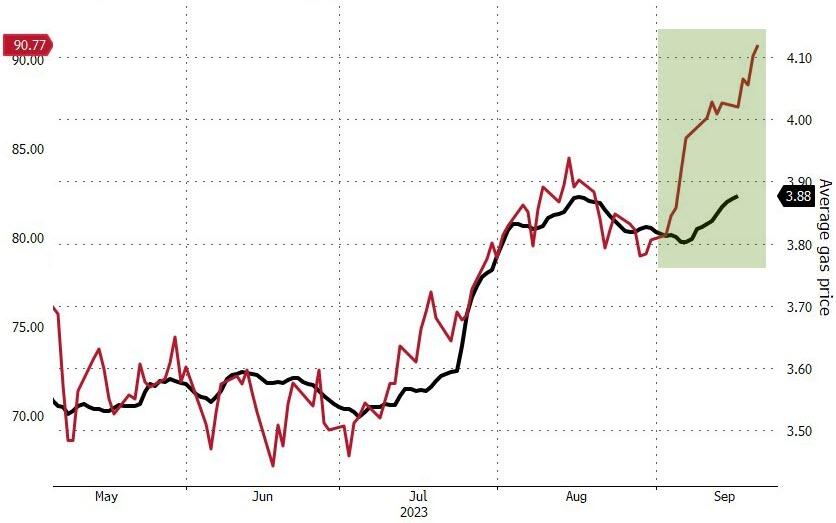
Oil prices in the US jumped back above $90 a barrel for the first time since November 2022, sending worrying signals to The Fed and The White House.
The surge in WTI has dragged gasoline prices at the pump dramatically higher and worse still, given the lag in the supply chain, pump prices look set to go higher...
Source: Bloomberg
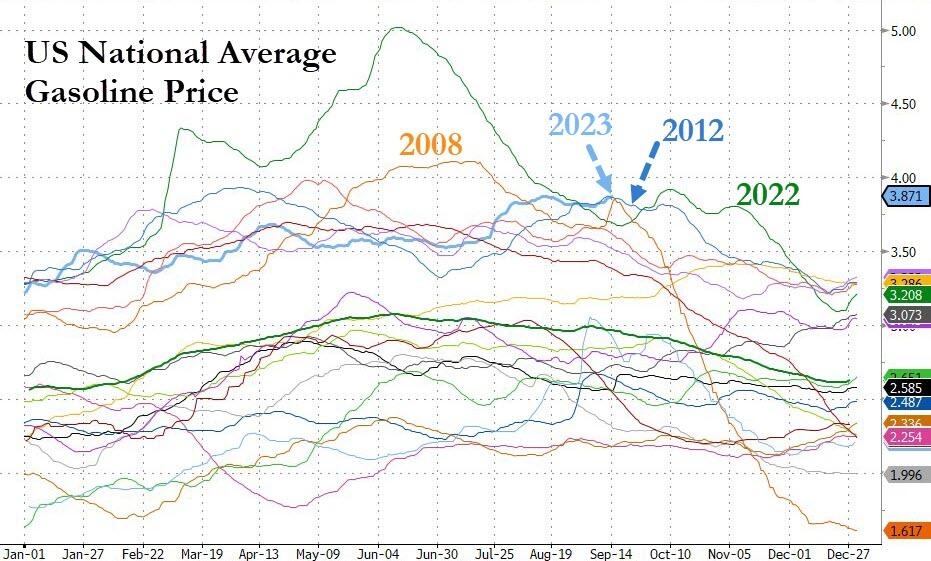
Despite the end of the peak summer driving season, gas prices, which were already a factor in pushing up inflation in August, will likely continue rising through next week because of the spike in oil prices.
In fact, prices at the pump are at a record high for this time of year, surpassing prior seasonal highs in 2022, 2012, and 2008...
Source: Bloomberg
According to AAA, at least a dozen states have gas prices averaging $4 a gallon or higher, including Colorado, North Dakota, and California.
President Biden acknowledged the spike in gas prices, in a press statement on Sept. 13.
“Overall inflation has also fallen substantially over the last year, but I know last month’s increase in gas prices put a strain on family budgets. That’s why I remain laser-focused on cutting energy costs, including by investing in clean energy to bolster our energy security,” said the president.
His administration's green energy policies have not helped matters, with the White House terminating oil drilling contracts on Federal lands in Alaska.
Compounding higher gasoline prices is a simultaneous spike in diesel costs. Diesel prices often climb in the fall due to seasonal consumption from farmers, who use the fuel for harvesting, and as demand for heating climbs. But this year, the prices are still much higher than usual.
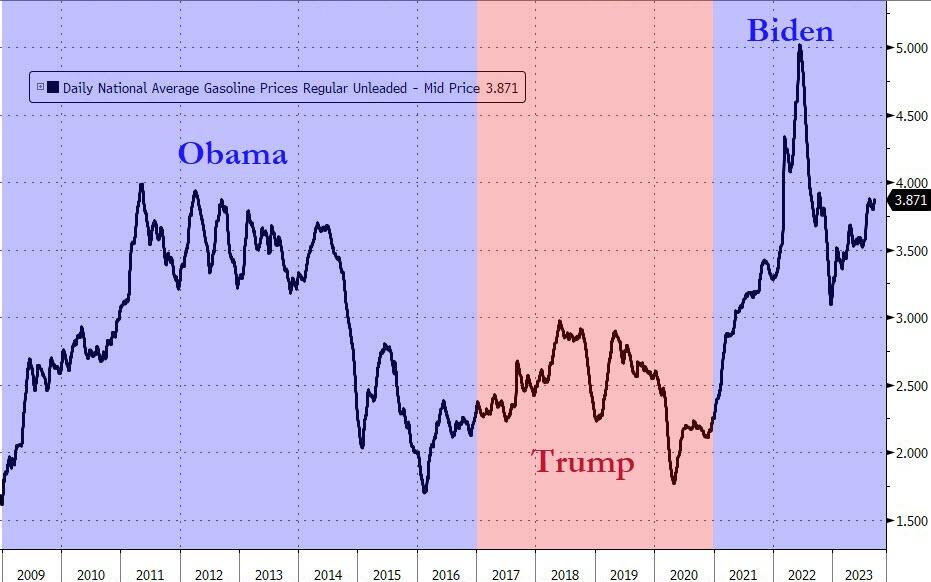
Thanks Joe!
Of course, none of that should be a surprise to anyone...
Source: Bloomberg
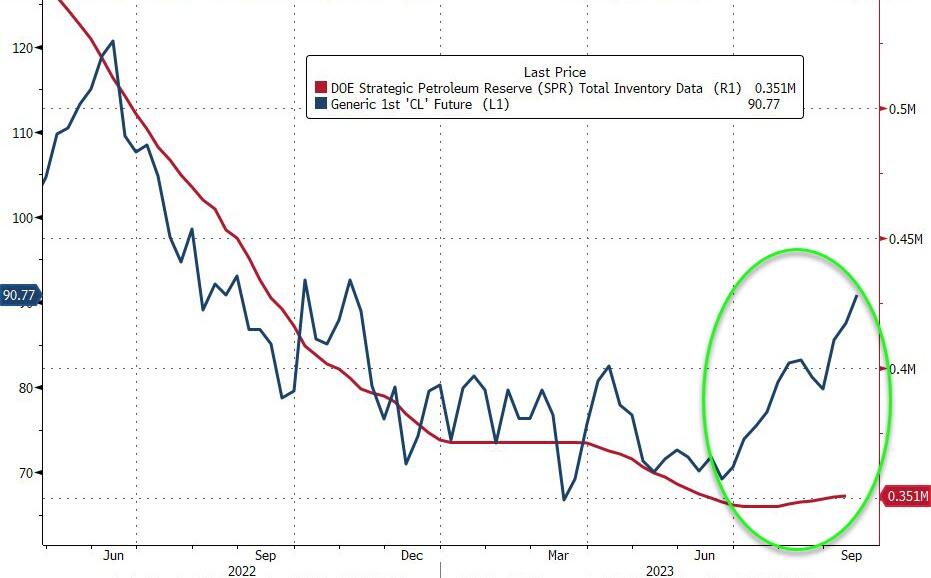
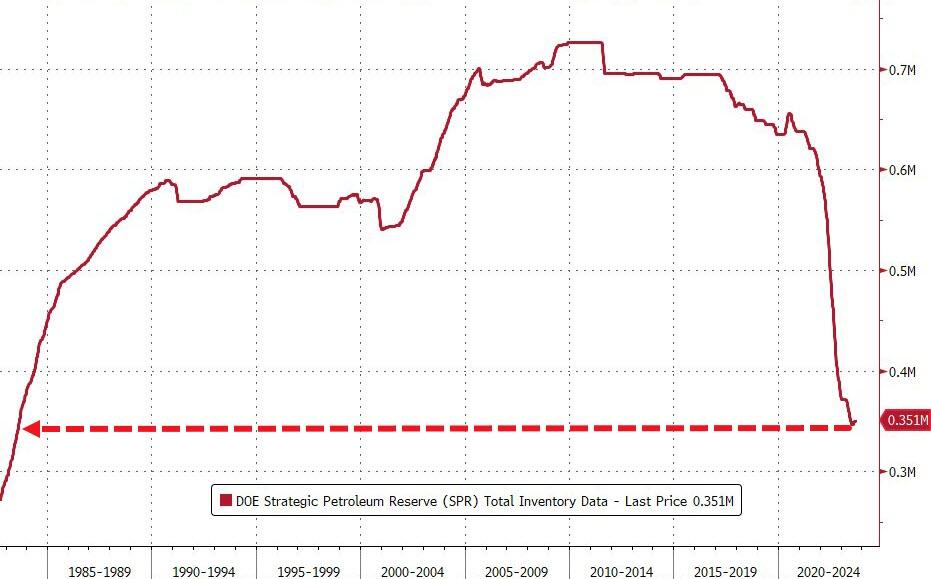
But that 'laser-focus' may have a problem, as since the administration stopped draining the Strategic Petroleum Reserve, gas prices have risen...
Source: Bloomberg
...and they simply don't have the room to start draining it anymore - even for its 'strategic election' purposes.
Source: Bloomberg
Hope remains but our 'buddies' in the Mid-East don't seem so friendly anymore. Time to start blaming "Big Oil" again, stat!!

NY Post : Billionaire GOP donor Ken Griffin says he’s ‘on sidelines’ of primary

Billionaire GOP donor Ken Griffin says he’s ‘on sidelines’ of primary in apparent DeSantis snub

Ken Griffin, the billionaire hedge fund manager who founded Citadel, said he was undecided as to whom he would support in the Republican primary — a sign that he was no longer backing Florida Gov. Ron DeSantis for president.

“I’m still on the sidelines as to who to support in this election cycle,” Griffin, the longtime GOP donor, told CNBC in an interview that will air at 8 p.m. Eastern time on Monday.

Griffin has indicated his preference for Republicans to nominate someone other than 77-year-old former President Donald Trump, who remains the clear front-runner despite mounting legal woes.

A recent Quinnipiac poll found that Trump was ahead of DeSantis among GOP voters by a margin of 62% to 12%.

“Look, if I had my dream, we’d have a great Republican candidate in the primary who was younger, of a different generation, with a different tone for America,” Griffin told CNBC, alluding to Trump.

“And we’d have a younger person on the Democratic side in the primary, who would have his message for our country,” the mogul, who has a reported net worth of $35 billion, said.

As things stand now, it appears the country will have to decide next year between Trump and the incumbent, 80-year-old President Joe Biden.

Biden’s age and apparent loss of mental acuity has Democrats ringing alarm bells as polls show voters are concerned about the president’s stamina.

If both parties opted for someone younger, “we’d have a debate around ideas and principles and policies to make this a great nation,” Griffin told CNBC.

“We’re not having that dialogue right now.”

Last year, Griffin, who relocated his hedge fund’s headquarters to Florida from deep-blue Chicago due to the surge in crime and a decrease in the quality of life in the Windy City, endorsed DeSantis, insisting that the Republican governor was “going to run on a record of just unbelievable accomplishment.”

Griffin donated $5 million to DeSantis’ successful re-election bid last year.

He told Politico in November that “our country would be well-served by him as president.”

But the initial enthusiasm among the GOP donor class that greeted the prospect of a DeSantis candidacy has evaporated.

The Florida governor’s ineffectual campaign as well as his ongoing battle with Disney has rankled pro-business Republican donors.

“[As a] first-term governor — [DeSantis did] just a phenomenal job,” said Griffin. “But that hasn’t been how this last few months has played out.”

“The ongoing battle with Disney I think is pointless,” Griffin continued. “In fact, it doesn’t reflect well on the ethos of Florida.”

Disney’s opposition to the so-called “Don’t Say Gay” law which bars sex and gender identity education for elementary school students prompted DeSantis to retaliate by stripping the Mouse House of its semi-autonomous status over its theme parks in and around Orlando.

Disney has filed suit against the Florida governor, accusing him of violating the company’s First Amendment rights.

DeSantis also recently signed into law a sweeping measure which limits services for undocumented migrants and imposes penalties on businesses that employ them — a move that the conservative Wall Street Journal editorial board called “a misfire.”

Griffin later issued a statement to CNBC, saying: “As the presidential campaigns unfold, I am assessing how the policies of each candidate will address the challenges facing our country.”

“I care deeply about individual rights and freedom, economic policies that encourage prosperity and upward mobility, all children having access to a high-quality education, ensuring our communities are safe, and a strong national defense.”

The Post has sought comment from DeSantis.

TechCrunch : iOS 17 includes these new security and privacy features - Today dwn

iOS 17 includes these new security and privacy features
Image Credits: Apple
Apple’s long-awaited iOS 17 update for iPhones lands today with a number of new and improved security features. Many of the new features are aimed at protecting iPhone owners who are at greater risk of cyberattacks and spyware, like journalists, activists and human rights defenders. Other iOS 17 features are better suited for the wider population, including anti-web tracking and safely storing passwords and the easy sharing of newer phishing-resistant passkeys.
Here’s what we’ve seen so far.
New protections in Lockdown Mode
The biggest addition to Lockdown Mode is that it now runs on Apple Watch, not just iPhones, iPads and Macs. It can’t come soon enough, given that recent exploits used to plant spyware have been capable of compromising Apple Watch owners.
Lockdown Mode works by selectively turning off certain iPhone (and Watch) features that have been abused by spyware makers in the past, such as iMessage and HomeKit, making it far more difficult to break into a device and steal its data.

Lockdown Mode in iOS 17. Image Credits: Sarah Perez / TechCrunch

Lockdown Mode in iOS 17 also automatically removes the geolocation data from photos by default when sharing photos with other people, such as where the photo was taken, which could reveal where a person is located.
Another nifty feature means iPhones in Lockdown Mode will block automatically joining non-secure Wi-Fi networks that could allow a person on the same network to analyze the iPhone’s network traffic. Lockdown Mode also blocks connections to 2G cellular networks. This aims to block a range of cellular-based exploits that are often used by cell site simulators, or “stingrays,” which law enforcement use to trick nearby phones into connecting to fake cell base stations and track phone locations and snoop on calls and messages. Stingrays are controversial because they work over a wide area and are indiscriminate in which devices they ensnare.
More anti-web tracking features
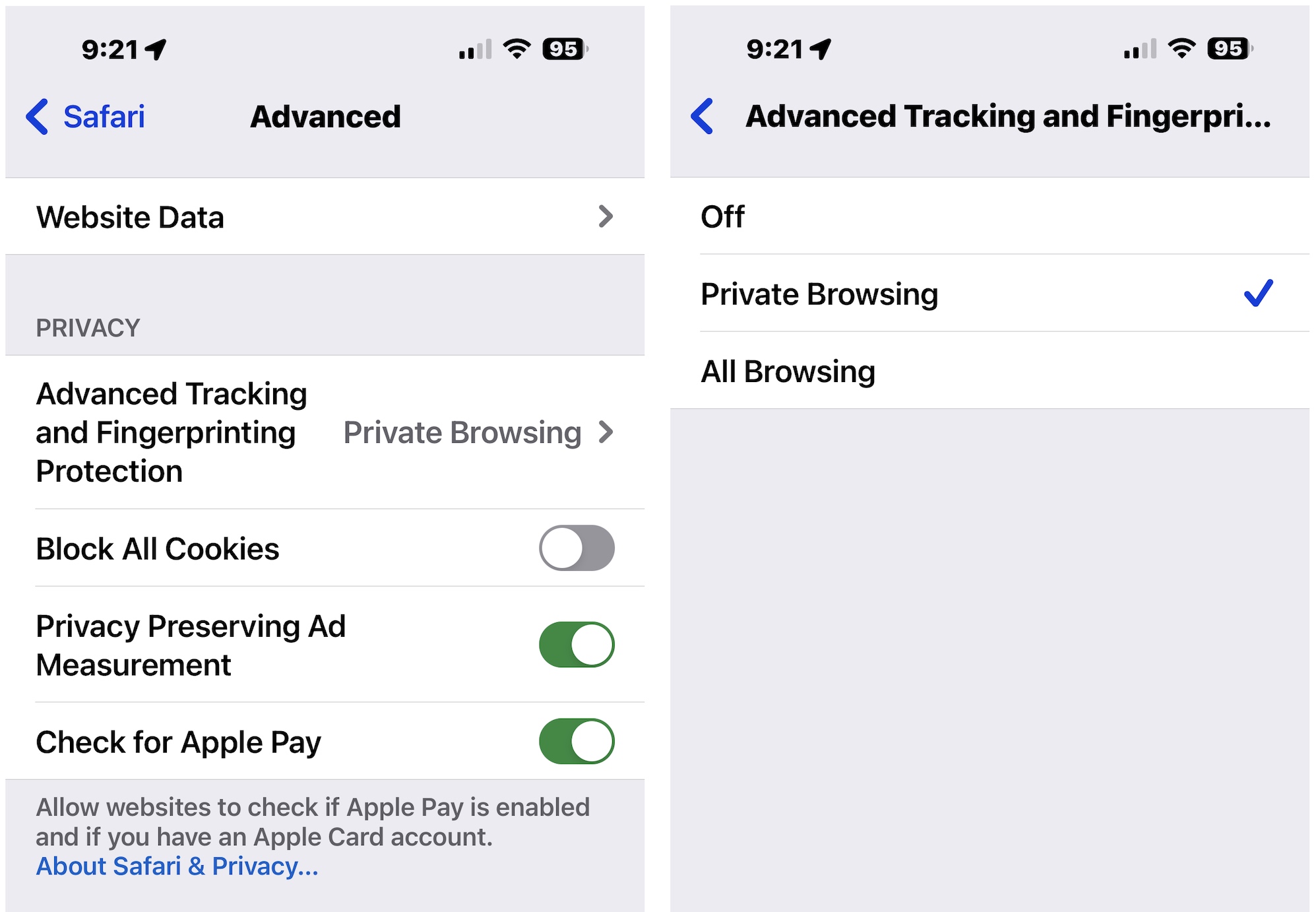
iOS 17’s Safari browser now strips tracking information from web addresses that can be used to uniquely identify your device and track you across the web. This makes it more difficult for websites and advertisers to see which other sites you access.
You can select this feature in your Safari settings on iOS 17 to work when you’re using private browsing, or you can apply it to all browsing sessions to really make a dent. This shouldn’t affect or break your day-to-day browsing experience.

Safari settings, including anti-tracking and fingerprint protection in iOS 17. Image Credits: Sarah Perez / TechCrunch

Private browsing will also lock by default, prompting the device owner to scan their face or fingerprint before their private tabs will open.
Check-in safety features and avoiding scammers
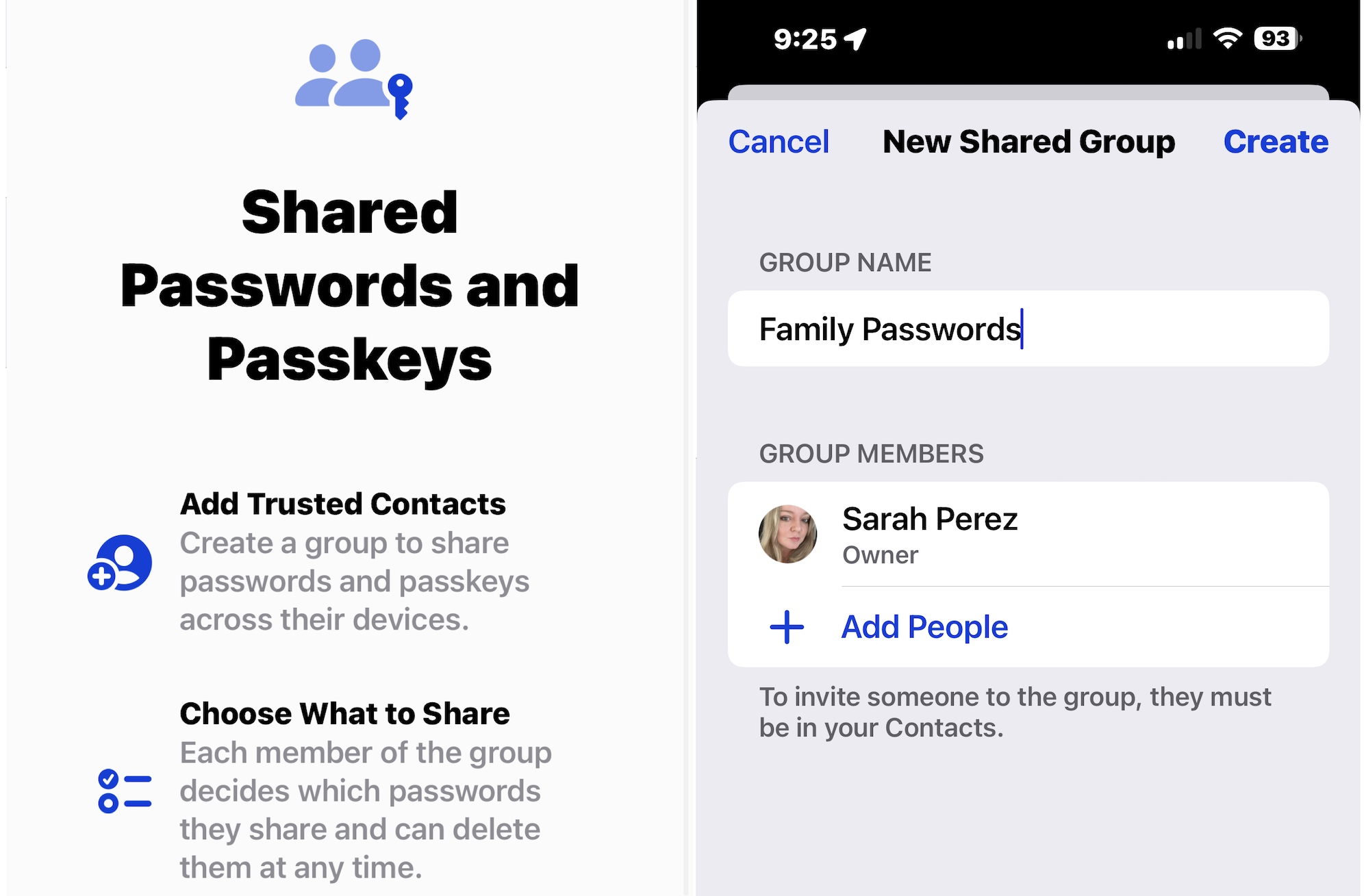
Passkeys, the phishing-resistant password replacement that allows you to log in without worrying that your passwords might get stolen, are getting an update. Tons of sites and services already support passkeys — Apple, Google, Microsoft, PayPal and plenty of others. Before long, you’ll be password-free for good. You can now share passkeys (and passwords, if you must) with friends and family. Passkeys and passwords are shared using end-to-end encryption, so nobody other than those in the group can access them, not even Apple.

Sharing passwords and passkeys in iOS 17. Image Credits: Sarah Perez / TechCrunch

Check In is a new feature that lets iPhone owners share with friends when they plan to arrive at their destination safely. The feature monitors the person’s real-time location and will alert the friend if something seems wrong. This location data is end-to-end encrypted, negating the need for third-party apps that have sold your location data to advertisers and data brokers.
And, finally: Live Transcription is an added bonus for folks who never want to be bothered by a spam or scam call again. Instead of answering (or declining) the phone — both can notify the caller that the line is active — live transcription converts the caller’s voice into text displayed on the screen in real time.

FT : German companies must cut exposure to China, warns Bundesbank

German companies must cut exposure to China, warns Bundesbank
Central bank says operations susceptible to trade disruption as foreign minister backs Brussels’ electric vehicle probe

Germany’s central bank says an excessive dependence on trade with China is one of the main reasons why the country’s “business model is in danger”, adding that high energy prices and labour shortages are also weakening Europe’s largest economy.

The Bundesbank warned on Monday that 29 per cent of German companies import essential materials and parts from China, exposing their operations to “significant” damage if this trade route was disrupted as a result of “increasing geopolitical tensions”.

“The past few years have revealed the risk to economic development that comes from strong one-sided dependencies on primary products from abroad,” the central bank said in its monthly report. “There is still a need to reduce dependencies on China — especially for primary products that are very difficult to replace.”

The stark warning came as Germany’s foreign minister Annalena Baerbock called on Europe to reduce its reliance on China, voicing her support for the EU’s investigation into electric vehicle subsidies by Beijing.

“If you are bound too closely it can endanger yourself,” Baerbock told Bloomberg TV on Monday.


Her remarks echoed the new China strategy adopted by Berlin in July, when companies were told to reduce their dependence on Beijing and warned that the government would not pick up the tab if they fell victim to mounting geopolitical risks.

Faltering trade with China, Berlin’s biggest trading partner, is one of the reasons Germany’s economy has contracted or stagnated for the past nine months and the IMF predicted it would be the worst performing major economy this year, forecasting growth to shrink by 0.3 per cent. 

In a weekend interview with Welt am Sonntag, Chancellor Olaf Scholz blamed Germany’s stagnation on the “weakness of a few of our export markets, particularly China”, adding: “For an export nation like ours, that has an effect.”

He also cited high inflation including a surge in energy prices after Russia’s full-scale invasion of Ukraine in February 2022, higher interest rates that had hit Germany’s construction industry and the lingering disruption that the Covid pandemic had wrought on global supply chains. 

Scholz said his government was trying to ease the cost burden on companies by rapidly expanding wind and solar energy. But he acknowledged that excessive bureaucracy was slowing down the push to expand renewables.

China is an important market for German cars and machinery. But exports to China only amount to 3 per cent of German value-added, while the country’s imports from China are much greater.

“A sudden unbundling from China would probably be associated with far-reaching disruptions to supply chains and production in Germany, at least in the short term,” the German central bank said.

China ranked third, behind the US and Luxembourg, as a destination for direct investment by German companies, accounting for 6 per cent of the total in 2022, the Bundesbank said. But this has doubled since 2010 and China accounts for a bigger share of direct investment in certain sectors, such as 29 per cent in carmaking.

“In view of increasing geopolitical tensions and the associated risks, it is necessary for companies and politicians to rethink the evolved structure of supply chains and the further expansion of direct investment in China,” it warned.

German companies relying on critical imports from China generated a quarter of all sales in the country’s manufacturing sector last year, it found.

China accounts for a large proportion of German imports of intermediate goods, such as batteries and electric components, as well as capital goods such as data processing and telecoms equipment and consumer electronic goods. China also dominates the global supply of materials for electric vehicle batteries, such as lithium and cobalt.

A recent Bundesbank survey found that while 40 per cent of industrial companies relying on critical imports from China had cut their exposure, and another 16 per cent were considering such action, more than 40 per cent of China-reliant companies had taken “no action”.

It called for more free trade agreements to diversify supply away from China, improved integration of immigrants into the labour market and a speeding up of state bureaucracy to “increase the attractiveness of Germany as a location”.

“Politicians are currently taking some steps in this direction,” it said. “However, these must be implemented and continued.”

Event details and information
Growing for Good: