(ZH) Large US Banks Saw Over $7BN Deposit Outflows Amid NYCB Chaos Last Week

Large US Banks Saw Over $7BN Deposit Outflows Amid NYCB Chaos Last Week

With the imminent expiration of The Fed's bank bailout facility (reminder they were 12-month collateralized term loans), and the ongoiong liquidity suck from The Fed's reverse repo facility, the last two weeks' excitement over at NYCB again is sure to have seen some depositors questioning their decisions (but we won't know about that for a couple of weeks as The Fed needs time to 'manage' the data).
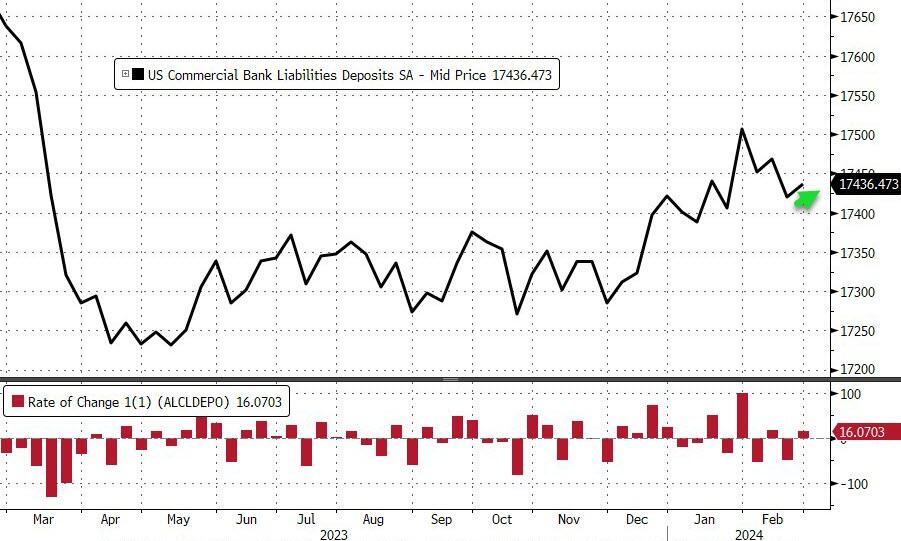
It turns out no... as The Fed claims that - on a seasonally-adjusted basis - total deposits rose by $16BN last week...
Source: Bloomberg
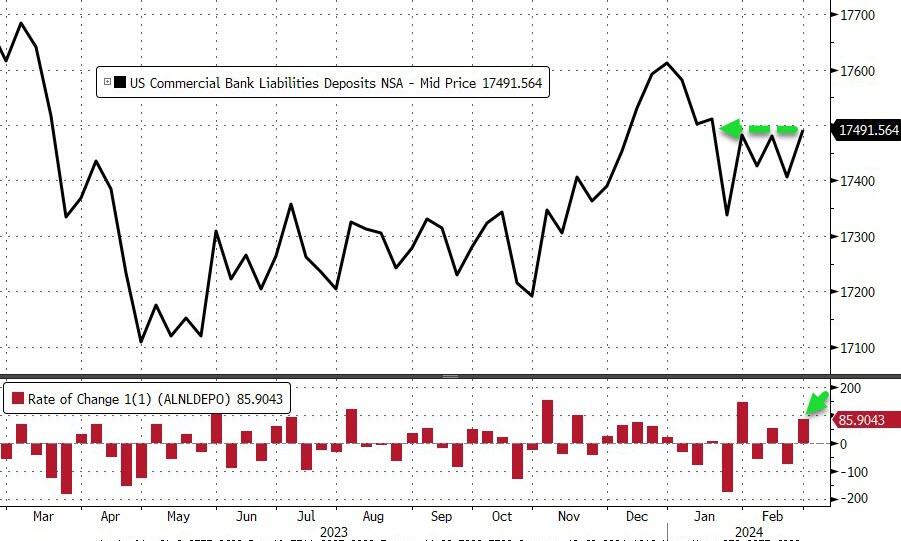
And while we question what a "seasonally-adjusted deposit" actually is, un-adjusted deposits rose by an even more impressive $86BN last week to the highest in six weeks...
Source: Bloomberg
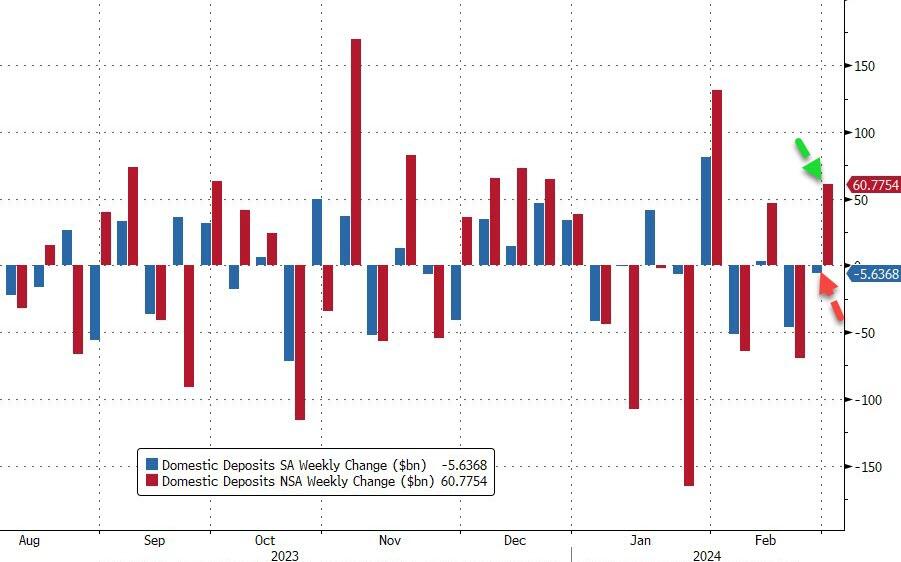
But, things get a little more complicated when we remove foreign bank deposits, as while non-seasonally-adjusted deposits rose $61BN (large banks +$35BN, small banks +$26BN), seasonally-adjusted domestic bank deposits fell $5.6BN (large banks -$7.4BN, small banks +1.8BN)...
Source: Bloomberg
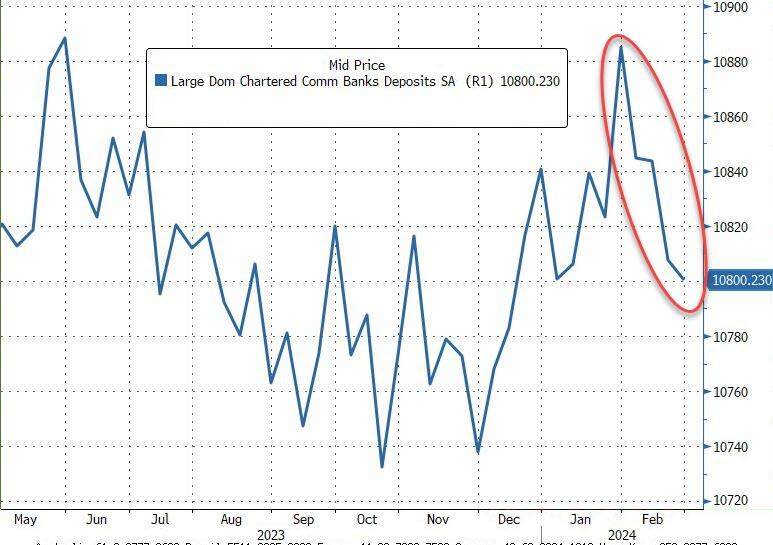
On an SA basis, it's not been a good run for domestic banks (or it has been a good 'run')...
Source: Bloomberg
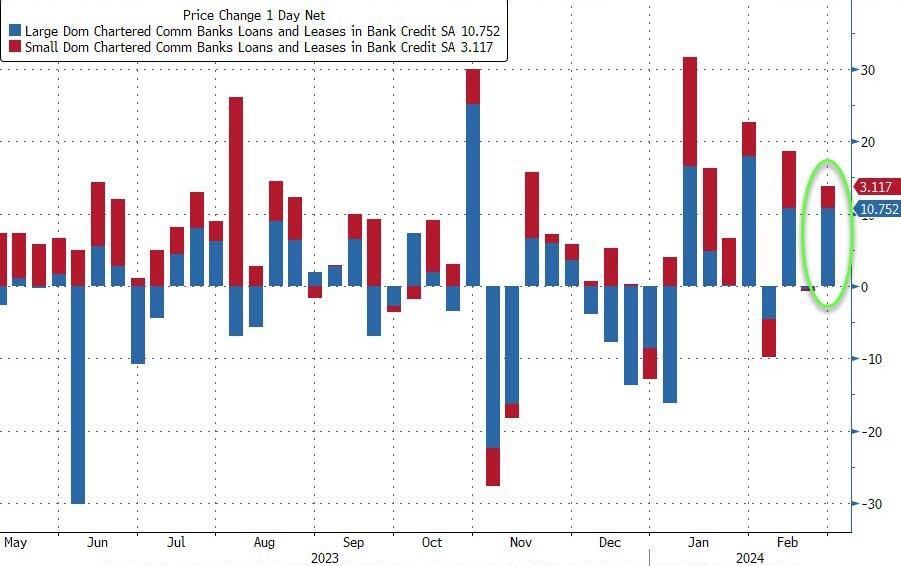
On the other side of the ledger, loan volumes re-accelerated last week, with large bank loan volumes rising $10.7BN and small bank loan volumes up $3.1BN...
Source: Bloomberg
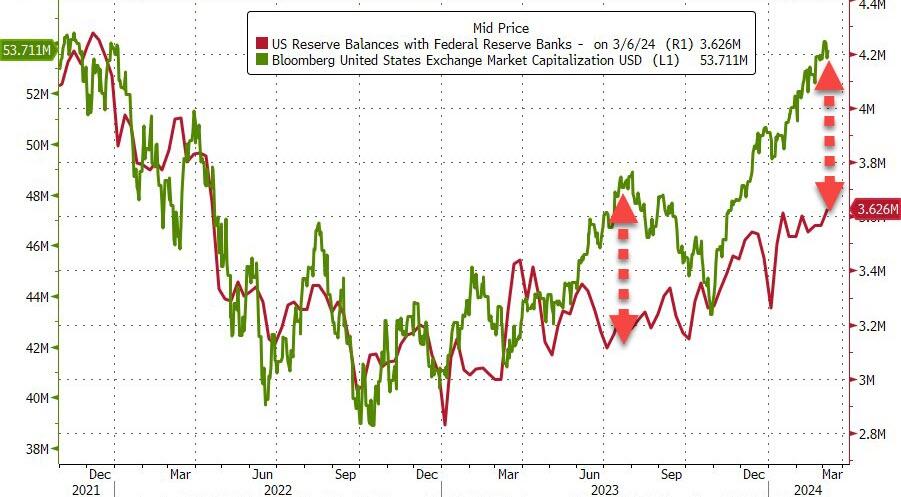
US equity market cap remains dramatically decoupled from bank reserves at The Fed (which ticked up last week). The last time it was this decoupled did not end well for stocks...
Source: Bloomberg
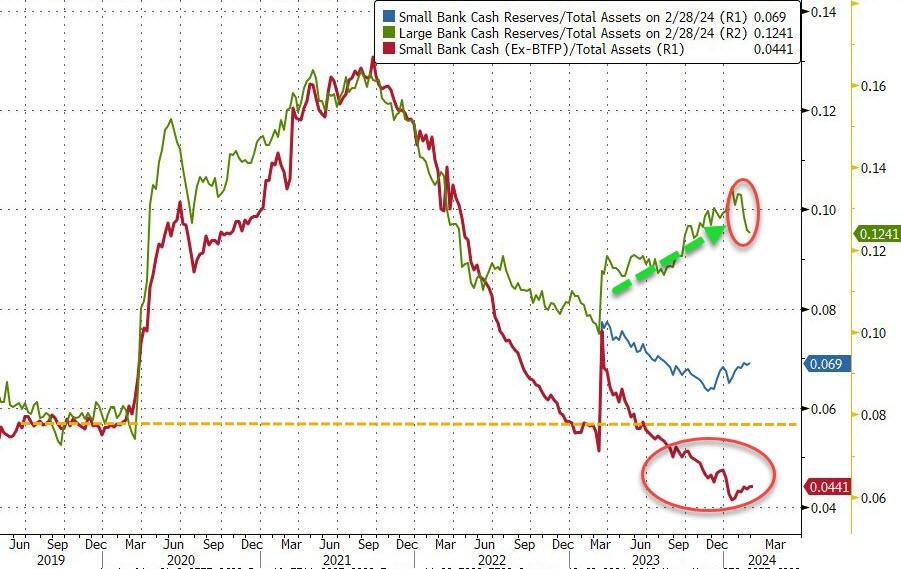
And finally, as if you needed a reminder after this week's NYCB debacle - despite the rebound off the lows again this week in regional bank shares, which must mean everything is awesome, right? - the regional bank crisis is still very much alive as evidenced by the red line below (without The Fed's imminently expiring BTFP facility)...
Source: Bloomberg
...what else are big banks (green line) going to do with all that cash burning a hole in their pockets (although we do note a big cash drop at large banks - which includes NYCB).
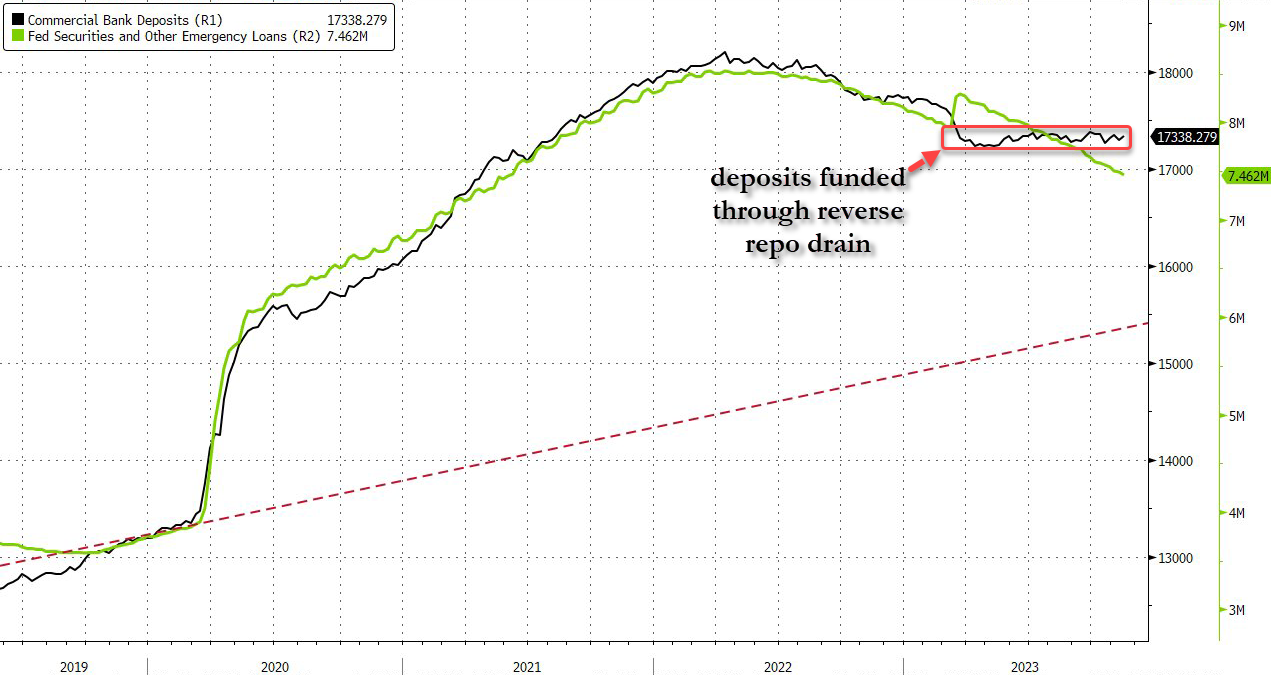
As one veteran Fed watcher remarked "this is such a clusterfnck... deposits should be $500BN lower"
Source: Bloomberg
The bottom line is - this looks a lot like a 'Small Bank' crisis. The last time this happened, the crisis sparked a sudden $300BN 'run' in small bank deposits (this time it's bigger!).
Is The Fed 'hoping' for a controlled bank-run this time - so as many small bank deposits are drained voluntarily, before they are drained all at once in a panic (and the Reverse Repo facility is empty, unable to provide any cushion)?

The Information : Sam Altman to Return to OpenAI Board of Directors

Sam Altman to Return to OpenAI Board of Directors

In a surprise move, OpenAI CEO Sam Altman is rejoining the board of directors of the non profit that oversees the artificial intelligence developer, according to a person with knowledge of the situation. The decision to reinstate Altman to that position comes four and a half months after the board fired and rehired him in a matter of days, triggering an employee revolt that nearly collapsed the ChatGPT creator.

Also on Friday, OpenAI was getting ready to announce the appointment of three new directors: Sue Desmond-Hellmann, a former CEO of the Bill and Melinda Gates Foundation; Nicole Seligman, a former president of Sony Entertainment; and Fidji Simo, CEO of Instacart. The new appointments would increase the number of directors at the nonprofit to seven.

Ilya Sutskever, the OpenAI chief scientist and co-founder who was one of four board directors to fire Altman in November over the CEO's alleged lack of candor with other directors, is still in talks about remaining at the company, executives told staff on Friday. Sutskever is credited with many of OpenAI's technical breakthroughs and has been concerned about the dangers posed by advanced AI. He has been nearly absent from company affairs since the drama in November, leading to speculation he may depart.

FT : Luxury gym chain Equinox raises $1.8bn to avert cash crunch

Luxury gym chain Equinox raises $1.8bn to avert cash crunch
Indebted New York fitness group needed to refinance $1.2bn in debt after pandemic closures led to a liquidity crunch

Luxury gym chain Equinox has raised $1.8bn from a group of private capital investors to refinance $1.2bn in debt maturing on Friday, winning it financial breathing room after the pandemic pummelled its business.

Sixth Street, one of the largest private lenders globally, and existing investor US private equity group Silver Lake, are leading the group. They would pump in $1.8bn in debt to refinance maturing loans and fund working capital and the growth of new clubs, Equinox said in a press release on Friday.

The refinancing would be done in two tranches of loans and does not include any preferred equity, or other debts that can be converted into equity and dilute Equinox’s existing equity owners, according to two people familiar with the matter.

Equinox, which is owned by the founders of real estate group Related Companies, faced a liquidity crunch as a result of the 2020 pandemic when it was forced to close gym chains for many months and saw its membership decline. Since then, its financial health has improved, but rising interest rates and its high debt level limited its options to refinance the loans, amplifying fears it would face a liquidity crunch.

Earlier this week, rating agencies S&P Global and Moody’s put Equinox on watch for downgrades deeper into junk territory, fearing that it could face a restructuring if it were unable to refinance the loans.

S&P noted in a March 5 note that the company had just $44mn left of cash on hand and it expected Equinox “to be unable to generate sufficient cash flow over the next year to cover fixed charges” if it were to refinance its debts at prevailing rates.

But a consortium of private capital groups and some of Equinox’s existing investors averted the crunch by arranging the refinancing.

The investor group also includes private credit groups Ares Management and HPS, and L Catterton, a private equity group that invested in Equinox in 2017. Executives of Related are also investing in the deal.

Equinox said the refinancing had come as its financial picture is recovering. Its revenues increased 27 per cent last year and the group is building 25 new clubs, expanding its footprint by about 20 per cent.

“We are seeing record performance in revenue growth and member engagement, which demonstrates our position as the global leader in high-performance luxury lifestyle,” said Harvey Spevak, executive chair of Equinox.

FT : Israeli cyber start-up in talks to raise funds valuing it at over $10bn

Israeli cyber start-up in talks to raise funds valuing it at over $10bn
Success for cloud security group Wiz in gleaning new capital would show sector’s resilience


Cyber security startup Wiz is in talks to raise funds at a valuation of more than $10bn, underscoring the sector’s resilience and signalling a revival in venture capital markets.

Founded just four years ago, Wiz is in talks with investors including Thrive, Light Speed Venture Partners and G Squared to raise hundreds of millions of dollars, according to people familiar with the matter.

The company could seek to raise roughly $800mn, one of the people said, adding that Sequoia and the Israeli cyber venture group Cyberstarts were also in talks to participate in the fundraising.

The terms have not been finalised and details could still shift or breakdown, the people warned.

While Wiz has a healthy cash position, new funding would help the company finance future acquisitions of other tech group to bolster its offering, one of the people said.

Wiz, Thrive, Lightspeed, G Squared, Sequoia and Cyberstarts declined to comment.

Wiz, led by former Microsoft executive Assaf Rappaport, focuses on providing cyber security in the cloud. Earlier this year the group said it was now generating the equivalent of $350mn in annual recurring revenue, a metric commonly used by fast-growing start-ups.

The company also appointed Dali Rajic, formerly a senior executive at cyber company Zscaler, as president and chief operating officer to help lead the company toward an eventual initial public offering.

Headquartered in New York and led by Israeli founders, Wiz’s fundraising, would if completed also signal the continued strength of Israel’s technology sector even amid its war with Hamas.

Rappaport has been among the most outspoken tech executives in Israel, protesting last year when Israeli Prime Minister Benjamin Netanyahu sought to curb the powers of the country’s judiciary.

Start-ups have faced a difficult few years as rising interest rates have made large fundraising rounds more challenging, after proliferating during the pandemic.

However, Wiz has continued to raise new funding at a steady pace. Last February it said it had raised $300mn at a $10bn valuation in a round led by Lightspeed.

Other previous investors in Wiz include Index Ventures, Greenoaks Capital Partners and Blackstone.

Wiz helps companies secure programs built and operated in the cloud, at a time when corporations are increasingly shifting their software online. The startup has said that it works with customers including Salesforce, Mars and BMW, and that it has more than 900 employees.

>>> US Close Dow -0.18% S&P -0.65% Nasdaq -1.16% Russell -0.10%

Closing Stock Market Summary
The stock market opened to broad buying activity that had the major indices building on yesterday's gains. The initial upside moves were driven by ongoing strength in the mega cap space, along with some relief that the February employment report went the market's way in terms of corroborating the soft landing narrative.

Nonfarm payrolls increased by a better-than-expected 217,000 following a downwardly revised 229,000 increase in January, the unemployment rate rose to 3.9% from 3.7%, and average hourly earnings growth was smaller than expected at 0.1% month-over-month.

The major indices quickly rolled over, though, coinciding with some mega cap names gave back their early gains due to profit-taking activity. NVIDIA (NVDA 875.28, -51.41, -5.6%), which had been up as much as 5.1% in the early going, and Meta Platforms (META 505.95, -6.24, -1.2%), which had been up as much as 2.2%, were losing standouts in that respect.

Weakness in the semiconductor space also contributed to the index level rollover. The PHLX Semiconductor Index (SOX) declined 4.0% today, due in part to the loss in NVIDIA, along with a sharp earnings-related decline in shares of Broadcom (AVGO 1308.72, -98.29, -7.0%).

The "rest" of the market held up better than the mega cap and semiconductor spaces, but many stocks finished lower after selling picked up the afternoon. The Invesco S&P 500 Equal Weight ETF (RSP) registered a 0.1% decline.

The increase in selling activity was related to a lingering sense that the market is due for a pullback with major indices and many individual names trading near all-time highs.

Still, selling was relatively modest and the A-D line was positive at the NYSE. Six of the 11 S&P 500 sectors finished lower and four of them logged a gain. The real estate (+1.1%) and energy (+0.4%) sectors saw the largest gains while the information technology sector was the worst performer by a decent margin, falling 1.8%.

The next worst performer was consumer staples, which fell 0.8% due in part to a loss in shares of Costco (COST 725.56, -60.03, -7.6%) after reporting quarterly results.

The 2-yr note yield declined two basis points today, and four basis points this week, to 4.49%. The 10-yr note yield was unchanged today, but declined nine basis points this week to 4.09%.

  • S&P 500: +7.4% YTD
  • Nasdaq Composite: +7.2% YTD
  • S&P Midcap 400: +6.1% YTD
  • Dow Jones Industrial Average: +2.7% YTD
  • Russell 2000: +2.7% YTD

Reviewing today's economic data:
  • February Nonfarm Payrolls 275K (consensus 195K); Prior was revised to 229K from 353K; February Nonfarm Private Payrolls 223K (consensus 150K); Prior was revised to 177K from 317K; February Avg. Hourly Earnings 0.1% (consensus 0.3%); Prior was revised to 0.5% from 0.6%; February Unemployment Rate 3.9% (consensus 3.7%); Prior 3.7%; February Average Workweek 34.3 (consensus 34.3); Prior was revised to 34.2 from 34.1
    • The key takeaway from the report, accounting for the fresh data and the revised data, is that it fits the soft landing/no landing narrative that is integral for a positive earnings growth outlook. In that regard, then, it has provided some validation for the stock market's run to record highs.

Looking ahead, there is no US economic data of note on Monday.

CrunchBase : The Week’s 10 Biggest Funding Rounds: Alumis Leads Big Biotech Week

The Week’s 10 Biggest Funding Rounds: Alumis Leads Big Biotech Week

Another week with more big rounds. However, this week it was clearly biotech leading the way, with three startups from the sector nabbing spots in the top five. March seems to be picking up where February left off as far as investors being more willing to write big checks for even bigger rounds.

1. Alumis, $259M, biotech: This week saw the biggest biotech raise of the year thus far. South San Francisco-based Alumis raised a $259 million Series C led by Foresite Capital, Samsara BioCapital and VenBio Partners. The startup is developing oral therapies for patients with immune-mediated diseases. Founded in 2021, the company has raised $529 million, per Crunchbase. While this was the biggest biotech raise of the week, it is by no means the only one on this list.

2. Axonius, $200M, asset management: The week also saw a big extension of a round. New York-based Axonius, a cybersecurity and SaaS asset management startup, secured a $200 million Series E extension led by Accel and Lightspeed Venture Partners. The company had originally raised another $200 million in the Series E in 2002 at an announced $2.6 billion valuation. Asset management is big for companies that want visibility into what they have so they can find security gaps, risks, misconfigurations and cost inefficiencies. That need is obvious as Axonius just surpassed $100 million in annual recurring revenue. Founded in 2017, the company has raised $865 million, per Crunchbase.

3. Sionna Therapeutics, $182M, biotech: Yet another big biotech raise as Boston-based Sionna Therapeutics locked up a $182 million Series C. The startup, which is developing treatments for cystic fibrosis, raised the new cash for the clinical development of small molecules designed to fully restore the function of the cystic fibrosis transmembrane conductance regulator protein. The round was led by Enavate Sciences. Founded in 2018, the company has raised $292 million, per Crunchbase.

4. Rakuten Medical, $119M, biotech: Rakuten Medical is the third biotech firm on this list. The San Diego-based startup raised a $119 million Series E — which included $45 million in new capital and the conversion of $74 million of convertible notes. Lead investors were not named, but the company did say both Hikma Pharmaceuticals and the Rakuten Group were “major investors.” Rakuten Medical will use the cash to further develop its proprietary Alluminox cell targeting therapies platform. Founded in 2010, the company has raised nearly $738 million, per Crunchbase.

5. Claroty, $100M, security: Not long ago, industrial cybersecurity — the promise of securing older industrial control systems that were designed decades ago, long before cyberattacks were a reality — was one of the next big areas of security. Funding in that space has died down somewhat, but New York-based Claroty secured $100 million in strategic financing this week. Delta-v Capital was the lead equity investor in the round, which also included debt/credit. Founded in 2015, Claroty has raised a whopping $735 million, per the company.

6. RapidSOS, $75M, public safety: The public safety sector usually doesn’t see big raises, but when you mix in AI that changes everything. New York-based RapidSOS, an “intelligent” safety company, closed another $75 million for its latest raise led by funds and accounts managed by BlackRock. The new cash brings the round’s total to $150 million. The company uses AI to help emergency response teams through its platform that’s able to collect data from connected devices to help them get to locations quicker. Founded in 2012, the company has raised nearly $356 million, per Crunchbase.

7. Nocion Therapeutics, $62M, biotech: Watertown, Massachusetts-based Nocion Therapeutics, a clinical-stage biopharmaceutical company, raised a $62 million Series B led by Arkin Bio Capital and Monograph Capital. The firm is developing sodium channel blockers that selectively silence activated nociceptors for the treatment of serious conditions involving cough, itch and other pain. Founded in 2018, Nocion has raised $122 million, per the company.

8. Overjet, $53M, artificial intelligence: Boston-based Overjet locked up a $53.2 million Series C led by March Capital at a $550 million valuation. The startup uses AI to help interpret X-rays and review dental insurance claims. Its platform can be used to detect, outline and quantify instances of oral disease — with millimeter-level precision. Founded in 2018, Overjet has now raised approximately $133 million, per the company.

9. Dtex Systems, $50M, cybersecurity: San Jose, California-based Dtex Systems, a cybersecurity company that focuses on insider threat detection and workforce monitoring, closed a $50 million Series E led by CapitalG. Founded in 2000, the company says it has so far raised $138 million.

10. Argonaut Manufacturing Services, $45M, manufacturing: Carlsbad, California-based Argonaut Manufacturing Services, a manufacturing firm serving the biopharma and life sciences industries, raised a $45 million round led by NewVale Capital. Founded in 2016, the company has raised $67 million, per Crunchbase.

Big global deals
Once again the biggest round of the week came from a Chinese startup.
  • AI startup MiniMax raised a $600 million round led by Alibaba Group Holding.

FT : Novo Nordisk chief seeks more deals to cement weight-loss lead amid ‘hype’

Novo Nordisk chief seeks more deals to cement weight-loss lead amid ‘hype’
Drugmaker releases promising trial results for a pill and expects to enter China this year

Novo Nordisk is seeking deals to cement its global lead in weight loss after outlining promising trial results for anti-obesity pills that would extend the Danish drugmaker’s portfolio beyond its injectable Wegovy and Ozempic bestsellers.

Speaking at the company’s headquarters in Bagsværd on the outskirts of Copenhagen, chief executive Lars Fruergaard Jørgensen said potential targets for acquisitions or partnerships included biotech companies with assets in mid-stage trials.

“You can assume that we look at everything or at least most of it,” he said.

David Moore, vice-president for corporate development, added that the company would focus on acquisitions in diabetes and obesity, ideally in the early stage of development.

“Valuations have gone up . . . it’s about making the investments that we believe are going to serve a patient population in the future. The later it is in development, the higher the valuation will be,” said Moore.

The comments came after Novo Nordisk shares hit a record on Thursday, when the Danish group revealed early stage results for an experimental new weight loss pill that appeared to offer better results than its blockbuster Wegovy. Europe’s most valuable company with a market capitalisation of DKr4.1tn ($602.7bn) also said it expected China to approve Wegovy for sale later in 2024.

Investors and analysts are looking for the next producer of “small molecule” drugs — synthetic drugs that are easily reproducible as pills — rather than the complex and usually injectable drugs made from living cells, such as Novo Nordisk’s Wegovy, which imitates a hormone called GLP-1.

Fruergaard Jørgensen said that a tablet product from the acquisition last year of a Canadian biotech, Inversago, could be a scalable weight-loss pill and alternative to the popular GLP-1-based drugs.

“It’s interesting how much interest there is in small molecule GLP-1s. If something has a different name, different combination of letters, by default the interest is lower but we think it’s actually more exciting,” said Fruergaard Jørgensen.

The company is aiming to develop a wide range of drugs and use its manufacturing scale to stay ahead of pharmaceutical rivals seeking to profit from consumer “hype” for weight loss products, he added.

Companies including UK’s AstraZeneca and Swiss group Roche have recently acquired or licensed weight-loss drugs in an effort to enter a market that analysts expected would exceed $100bn by 2030.

But the companies do not have a history of protein manufacturing used by Novo Nordisk and its US rival Eli Lilly to make their diabetes and weight-loss products.

Fruergaard Jørgensen warned that new entrants faced a long road to catch up with Novo Nordisk and its US rival Eli Lilly, because of the innovation required to develop safe, effective products and the manufacturing power needed to market them.

“There are many companies that can build space over time. They might not go as wide or as broad as the two companies that have been in this for 100 years,” he said.

“For a new entrant . . . getting a small space of this in the low end of the market is better than not being there,” he added.

The company has struggled with its own supply issues. It recently acquired three sites from contract manufacturer Catalent for $11bn to enhance its ability to fill injection pens, as part of a three-way deal led by its controlling shareholder Novo Holdings.

Fruergaard Jorgensen also said that Novo Nordisk’s efforts to develop some of its oral drugs would require much more active pharmaceutical ingredient than injectables. The company also believes some users would prefer once weekly injections to daily pills.

“If you look at how we are scaling up API capacity, we’re scaling to serve many more patients,” he said. “The more we go oral, the less we can give injectables.”