A Royal Mail bid will only deliver controversy
Stock reflects the burden that an obligation to deliver letters six days a week has become
Daniel Křetínský’s reputation for mystery suggests he is difficult to understand. The Czech billionaire’s investment approach seems pretty straightforward: target very well-known, very underperforming companies.
Royal Mail owner International Distributions Services, which the “Czech Sphinx” has approached with a takeover offer, certainly ticks the boxes. IDS shares jumped on Wednesday. Still trading almost a quarter below their 2013 privatisation price, the stock reflects the burden that an obligation to deliver letters six days a week has become.
For shareholders, including Křetínský who owns 27 per cent, much rests on the outcome of a plea to regulator Ofcom to lessen the universal service obligation, getting costs down and profits up. Even so, the benefits would not be immediate. For Křetínský, whose approach was rejected, unlocking value would surely require more radical surgery, breaking off the group’s international delivery business GLS.
That prospect would bring with it labour angst and political controversy, for a company whose initial public offering prompted a review of why it was sold so cheaply. Not any more. The business looks unsustainable in its current form, with letter volumes down to 7bn a year from its 20bn peak two decades ago. Suggested changes to its service obligations, such as a move to five-day or three-day per week deliveries, could save Royal Mail between £100mn-£200mn and £400mn-£650mn a year. None have proved acceptable to regulators.
The latest (perhaps more palatable) tweak being proposed is to move second-class deliveries to just three days a week and slow delivery of bulk business mail. IDS thinks this might reduce costs by £300mn a year. The figure is broadly in line with the operating loss that analysts expect at Royal Mail in the 12 months to March this year. Those losses were already expected to move to break-even over the following year.
Meanwhile, international delivery division GLS is expected to make £350mn in operating profits next fiscal year. That unit makes similar operating margins to Deutsche Post DHL. But at 9 times forward earnings, IDS as a whole trades at a 30 per cent discount. Even after the jump on Wednesday, valuing GLS in line with rivals would suggest a sale price of £400mn over the market value of the entire IDS business.
That still only implies a price of 300p a share — below the 330p IPO price and a sum that would in effect involve getting Royal Mail for free. The UK government in 2022 called off a national security probe into Křetínský’s stake building. This time it might want to send a different message.
>>> Up
* Akzo Nobel Raised to Buy at Jefferies; PT 79 euros
* AstraZeneca Raised to Buy at Intron Health
* Avance Gas Raised to Buy at Arctic Securities; PT 177 kroner (+)
* B&S Group Raised to Buy at ING; PT 7.25 euros
* Boliden Raised to Neutral at JPMorgan (+)
* Borregaard PT Raised to 247 kroner from 221 kroner at Carnegie (++)
* BW LPG Raised to Buy at Arctic Securities; PT 199 kroner (+)
* CLS Holdings Raised to Add at Peel Hunt
* Dorian LPG Raised to Buy at Arctic Securities; PT $45.20 (+)
* Elkem Raised to Buy at SEB Equities; PT 24 kroner
* Enagas Raised to Hold at Bestinver; PT 15 euros
* Endesa Raised to Neutral at BNPP Exane; PT 17.70 euros (+)
* Ericsson Raised to Buy at SEB Equities; PT 64 kronor
* Evonik PT Raised to 25 euros from 23 euros at Bankhaus Metzler (+)
* Frequentis Raised to Buy at BankM; PT 34.11 euros (++)
* Fresnillo Raised to Overweight at JPMorgan (+)
* Gjensidige Raised to Hold at SEB Equities; PT 175 kroner
* HMS Networks Raised to Buy at DNB Markets; PT 540 kronor (++)
* Kemira Raised to Buy at OP Corporate Bank; PT 21 euros
* Kemira Raised to Buy at OP Corporate Bank; PT 21 euros
* Naturgy Raised to Buy at Mirabaud Securities; PT 27.80 euros
* Peach Property Raised to Buy at M.M. Warburg (+)
* Pennon Raised to Outperform at RBC; PT 850 pence
* Picton Property Income Ltd Raised to Buy at Peel Hunt
* Unibail Raised to Buy at Citi; PT 85.20 euros
>>> Down
>>> Down
* Alfen Cut to Hold at Deutsche Bank (+)
* Ashmore Cut to Underperform at BofA; PT 170 pence (+)
* BayWa Cut to Hold at M.M. Warburg; PT 29.50 euros (+)
* Brooks Macdonald Cut to Add at Numis; PT 2,145 pence (+)
* Bucher Cut to Hold at Kepler Cheuvreux; PT 420 Swiss francs (++)
* Enel Cut to Neutral at BNPP Exane; PT 6.30 euros (+)
* Haypp Group Cut to Hold at SEB Equities; PT 80 kronor
* Haypp Group Cut to Hold at SEB Equities; PT 80 kronor
* LEG Immobilien Cut to Neutral at Kempen & Co; PT 80 euros (++)
* Orapi Cut to Reduce at Gilbert Dupont; PT 6 euros (++)
* SCA Cut to Underweight at JPMorgan; PT 142 kronor
* Tritax Big Box Cut to Hold at Peel Hunt
* VW Cut to Market Perform at Bernstein
>>> Initiation
>>> Initiation
* Bawag Rated New Outperform at Mediobanca SpA; PT 73 euros
* DiaSorin SpA Reinstated Buy at BofA; PT 110 euros (++)
* Heidelberger Druck Reinstated Hold at Kepler Cheuvreux (++)
* Next Rated New Neutral at Oddo BHF; PT 8,900 pence (+)
* NIBE Industrier Rated New Sell at Goldman; PT 43 kronor
* NIBE Industrier Rated New Sell at Goldman; PT 43 kronor
* Orange Resumed Overweight at JPMorgan (+)
* Schott Pharma Rated New Hold at Stifel; PT 40 euros
>>> Call
>>> Call
* Akzo Nobel Upgraded at Jefferies on Topline Progress in Paints
* AstraZeneca’s Catalyst Outlook Transformed, Intron Upgrades
* Derichebourg Stock Slumps as Oddo Notes Cyberattack, Macro Hit (++)
* Ericsson’s Outlook is Improving, Upgraded to Buy at SEB Equities
* Goldman Strategists Say Robust Macro to Lift Italy, Spain Stocks (+)
* Morgan Stanley Strategists See Healthier US Profits Through 2024 (+)
* Pennon Raised at RBC, Expects Clarity on Environmental Review
* Unibail Raised to Buy at Citi as Markets Hit New Stimulus Phase
* Unibail Raised to Buy at Citi as Markets Hit New Stimulus Phase
* Volvo 1Q Results Show Margin Resilience, Says Jefferies (+)
Czech billionaire Daniel Křetínský says Royal Mail owner rejected takeover approach
Shares in International Distributions Services jump 25% on energy tycoon’s interest
Royal Mail owner International Distributions Services has rejected a takeover approach by Czech billionaire Daniel Křetínský’s investment group.
Křetínský, a lawyer-turned-energy tycoon, is the largest shareholder in IDS with a 27.5 per cent stake and has been a prolific dealmaker in the UK with stakes in supermarket chain J Sainsbury and London football club West Ham United.
Křetínský’s EP Group confirmed on Wednesday that it had “submitted a non-binding indicative proposal” to IDS on April 9, in response to an earlier report by the Financial Times that he was seeking to take the business private.
IDS rejected the proposal, EP said without disclosing the terms of its approach. EP said it had sought the IDS board’s backing for a possible cash offer. IDS is comprised of Netherlands-based parcels business GLS and the UK’s Royal Mail.
Shares in IDS climbed as much as 26 per cent, before settling around 14 per cent higher in early afternoon trading, giving IDS a market capitalisation of £2.3bn. IDS has about £1.5bn of net debt.
EP now has until May 15 to table a firm offer under UK rules that govern takeover bids for public companies, though it said there was no guarantee it would do so. It is working on its approach with advisers from JPMorgan Chase and Citigroup, people close to the situation said. Both banks declined to comment. IDS did not immediately respond to a request to comment.
Royal Mail was privatised between 2013 and 2015 but has been grappling with the difficulties of maintaining its expensive delivery network in the face of a sharp decline in its traditional letter-delivery business.
The company delivered 20bn letters to 28mn addresses in the 2004-05 financial year, while this year it expects to deliver 7bn letters.
The postal business remains regulated. Royal Mail proposed last month that it should be allowed to deliver second-class letters only three times a week instead of six. The plans would reduce the burden of the universal service obligation, which forces the company to deliver items everywhere in the UK for the same price.
It has been trying to resolve the problems partly by capturing a larger part of the UK’s fast-growing parcels delivery business, in which it is the market leader. However, it faces fierce competition from rivals such as Amazon Logistics.
EP said Royal Mail was in a “challenging situation”. “Weak financial performance, poor service delivery and a slow transformation, in the face of a market going through structural change, have put the business under unsustainable pressure,” it said.
These factors, along with rising competition, meant private investment in the business was “crucial”, it added.
In 2022, the UK government called off a probe under national security rules into Křetínský’s plans to increase his stake in Royal Mail to more than 25 per cent.
EP said on Wednesday that Royal Mail was “an important national asset” and that it would rebuild the business into a modern postal operator.
The Sunday Times reported in May 2023 that Křetínský’s had said in an interview that he had no intention of bidding for Royal Mail.
Research Calls I
-
Upgrades:
- Antero Resources (AR) upgraded to Overweight from Equal-Weight at Morgan Stanley; tgt raised to $36
- Commerce Bancshares (CBSH) upgraded to Outperform from Mkt Perform at Raymond James; tgt $61
- Danaher (DHR) upgraded to Buy from Hold at HSBC Securities; tgt $280
- e.l.f. Beauty (ELF) upgraded to Buy from Hold at TD Cowen; tgt lowered to $190
- Ericsson (ERIC) upgraded to Buy from Hold at SEB Equities
- Group 1 Auto (GPI) upgraded to Buy from Neutral at Guggenheim; tgt $305
- Hancock Whitney (HWC) upgraded to Buy from Neutral at Citigroup; tgt raised to $50
- Legend Biotech (LEGN) upgraded to Sector Outperform from Sector Perform at Scotiabank; tgt $65
- Medical Properties Trust (MPW) upgraded to Hold from Sell at Deutsche Bank; tgt $5
- Omnicom (OMC) upgraded to Overweight from Equal Weight at Wells Fargo; tgt raised to $106
- Strategic Education (STRA) upgraded to Buy from Hold at Truist; tgt raised to $125
- Toronto-Dominion Bank (TD) upgraded to Sector Outperform from Sector Perform at Scotiabank
-
Downgrades:
- EQT Corp. (EQT) downgraded to Equal Weight from Overweight at Wells Fargo; tgt lowered to $37
- Fortive (FTV) downgraded to Neutral from Overweight at JP Morgan; tgt lowered to $90
- Marsh McLennan (MMC) downgraded to Neutral from Overweight at Piper Sandler; tgt $211
- Urban Outfitters (URBN) downgraded to Underperform from Hold at Jefferies; tgt lowered to $32
- Volkswagen AG (VWAGY) downgraded to Mkt Perform from Outperform at Bernstein
-
Others:
- Achieve Life Sciences (ACHV) initiated with a Buy at JonesTrading
- Blue Owl Capital Corporation III (OBDE) initiated with an Outperform at Oppenheimer; tgt $16
- Canoo (GOEV) initiated with a Buy at The Benchmark Company; tgt $5
- Enphase Energy (ENPH) initiated with a Hold at DZ Bank
- First Solar (FSLR) initiated with a Buy at DZ Bank
- GE Vernova (GEV) initiated with an Outperform at Raymond James; tgt $160
- LeddarTech (LDTC) initiated with a Hold at WestPark Capital
- Mirum Pharmaceuticals (MIRM) initiated with a Buy at Stifel; tgt $48
- Nuvalent (NUVL) initiated with a Buy at Jefferies; tgt $97
- Orange (ORAN) resumed with an Overweight at JP Morgan
- Royal Caribbean (RCL) initiated with a Buy at Mizuho; tgt $164
- SolarEdge Technologies (SEDG) initiated with a Hold at DZ Bank
Gapping down
In reaction to earnings/guidance:
In reaction to earnings/guidance:
- JBHT -7.1%, ASML -4.8%, USB -3.7%, FULT -2.7%, TRV -2.6%, IBKR -1.1%
Other news:
- SAGE -19.8% (topline results from phase 2 precedent study of dalzanemdor)
- ADSK -4.6% (provides update on delayed 10-K filing; currently does not believe matters under investigation affect any previously issued financial statements)
- APG -4% (prices offering of 11.0 mln shares of common stock at $37.50 per share)
- MEG -2.3% (3 mln share offering)
- ACRV -1.9% (to Host Corporate R&D Event Highlighting AP3 and Pipeline Progress, Including Ongoing Prospective Validation of ACR-368 OncoSignature with Initial Phase 2 Data for ACR-368, and Preclinical Progress for ACR-2316)
- ITCI -1.1% (commences $500 mln stock offering; also files mixed shelf securities offering)
Gapping up
In reaction to earnings/guidance:
In reaction to earnings/guidance:
- UAL +5%, BKU +4.8%, FHN +4.7%, OMC +2.8%, HWC +2.5%, GAU +2.1%
Other news:
- VNDA +22% (Future Pak confirms proposal to acquire Vanda Pharmaceuticals for $7.25 to $7.75/share in cash)
- GENE +5% (established a precision oncology division and announced its highly anticipated portfolio of new diagnostic tests under its geneType precision oncology brand)
- ATHE +4.9% (announced that three posters were presented at the American Academy of Neurology)
- ATAI +4.7% (Announces the Publication of Beckley Psytech's Phase 1 Study of BPL-003 in the Journal of Psychopharmacology)
- RIO +3.4% (reports Q1 production)
- VALE +3.3% (reports Q1 production and sales)
- CDNA +2.7% (names new CEO)
- BCRX +2.6% (receives approval for ORLADEYO by the Brazilian Health Regulatory Agency)
- BVN +2.3% (Announces First Quarter 2024 Results for Production and Volume Sold per Metal)
- ALVO +2.1% (FDA approves Selarsdi injection as a biosimilar to Stelara)
- TCRX +1.8% (prices upsized $150 million public offering)
- AAL +1.8% (in sympathy with UAL earnings)
- DAL +1.7% (in sympathy with UAL earnings)
- XPEV +1.7% (XPeng and the Volkswagen Group (VWAGY) announce entry into the framework agreement on E/E Architecture technical collaboration)
- JBLU +1.5% (in sympathy with UAL earnings)
- GNL +1.4% (announces $462 million of dispositions closed or under agreement¹ as part of strategic disposition plan)
- TEVA +1% (FDA approves Selarsdi injection as a biosimilar to Stelara)
Nelson Peltz Got Crushed by Disney. Can He Recover?
After his Trian Partners lost its proxy fight, a big bet on Unilever comes into focus
Nelson Peltz’s proxy fight at Disney DIS 0.82%increase; green up pointing triangle had the potential to help turn around his hedge fund after a tumultuous stretch.
Instead, the activist investor’s unsuccessful quest for two seats on the media giant’s board could make a comeback even harder.
Trian Partners has been grappling with lackluster returns, an investor exodus and the acrimonious departure of one of its founders. The firm’s money under management ended last year at its lowest point since 2012, a previously unreported recent filing shows.
A Disney victory would have been a welcome win, but many of the big investors whose support Peltz needed sided with Disney Chief Executive Bob Iger instead. Trian had made roughly $300 million on its Disney investment when shareholders rejected its bid for board seats earlier this month. But that is in line with the market’s rise over the same period, a point that doesn’t go unnoticed by hedge-fund investors who pay hefty fees for outperformance.
All eyes are now on whether Trian will be able to make money on its biggest bet—on Dove-soap maker Unilever ULVR 0.11%increase; green up pointing triangle—and whether Peltz’s days as a fearsome activist are over.
Taking on another proxy fight could be harder after the 81-year-old failed to win crucial support from the big index funds, BlackRock, State Street and Vanguard, some of which had previously backed him.
He turned off some of their top decision makers while campaigning, people familiar with the matter said. Peltz raised eyebrows with an interview with the Financial Times days before voting ended in which he questioned why “woke” Disney made movies such as “The Marvels” and “Black Panther” with primarily female and Black casts, respectively.
Shrinking assets
Trian’s discretionary assets under management—those they have full control over—had been increasing steadily for years, reaching a peak of $12.5 billion in 2015. But they have declined in six of the past eight years, including each of the past four, hurt by soured bets such as a one on General Electric.
As of the end of last year, the firm managed $6.1 billion, a late-March filing with the Securities and Exchange Commission showed. (That excludes nearly $3 billion of nondiscretionary assets, primarily Disney shares owned by Ike Perlmutter, Peltz’s friend who entrusted his voting rights to Trian for the proxy fight.) Assets have since risen to about $7 billion.
The firm says it had more money come in than leave in the past two years.
Investors including California State Teachers’ Retirement System and the New York State Common Retirement Fund have been pulling out money, The Wall Street Journal reported last month. The full extent of redemption requests isn’t reflected in the latest number, people familiar with the matter said, given that money is typically returned over several quarters.
Trian typically uses investment vehicles focused on a specific stock or sector for its biggest bets.
While such vehicles offer investors lower fees than a typical hedge fund charges—often no management fee and around 10% of profits—they also lock up their money for several years.
Some haven’t lived up to Trian’s ambitions. In 2020, one such vehicle took simultaneous stakes in Janus Henderson and Invesco and unsuccessfully tried to get the asset managers to merge.
All eyes on Unilever
The last time Trian raised money from investors for a major co-investment vehicle was in 2022, when it made a big bet on Unilever, the London-based maker of household names such as Hellmann’s mayonnaise. Its $1.5 billion-plus stake is the firm’s largest position, dwarfing Trian’s own stake in Disney and consuming about 25% of its capital.
Unilever had been underperforming rivals including Procter & Gamble, which Peltz had helped streamline after he got a seat on its board in a previous proxy fight. Unilever’s shareholders were in open revolt after then-CEO Alan Jope considered a $68 billion purchase of GlaxoSmithKline’s consumer-health business that he ultimately backed away from.
Peltz joined Unilever’s board a few months after Trian bought its shares. Investors hoped Peltz would work his magic like he had at P&G, whose stock rose more than 50% during his board tenure.
While pitching its own investors, Trian said it was targeting an annual rate of return of around 17% over four years, people familiar with the matter said.
The stock was trading around 37 pounds in London—equivalent to about $46 currently—when Trian arrived. That is roughly where it is now.
Peltz and Trian could yet achieve the success they had envisioned. Jope left last year, and Hein Schumacher, the head of a dairy cooperative who’d sat on Unilever’s board, took over. Last month, he detailed a strategic plan that is expected to eliminate some 7,500 jobs and save about $870 million over the next three years.
A centerpiece of the plan is spinning off or selling Unilever’s ice-cream business, which in addition to Ben & Jerry’s includes Breyers, Talenti and Klondike. The unit had revenue of $8.6 billion last year but was the company’s slowest-growing. Unilever shares rose 3% the day the company shared the news.
Trian 2.0
Trian has been working to steady itself after Ed Garden, one of its co-founders and Peltz’s son-in-law, left last year. Many had expected Garden to eventually take over. Instead, he is no longer speaking to Peltz after a power struggle within the firm.
At the time, Trian elevated Matt Peltz, Nelson’s son, and another partner, Josh Frank, to the roles of co-chief investment officers.
“Since the promotion of Trian’s two new co-CIOs and the new head of research, performance has improved and performance of recent positions has been particularly strong,” a spokesperson said.
Still, some on Wall Street wonder if Peltz will take on any more proxy fights.
Others say he could lay low for a bit, taking a page out of Bill Ackman’s comeback playbook, and return as fierce as ever. Carl Icahn, another activist, fell prey to a short-seller attack last year that shaved billions off the value of his firm. After spending much of the past year doing damage control, he recently struck a deal with JetBlue Airways for seats on the airline’s board.
Peltz has hinted that he has a new target in mind, saying on CNBC recently that he needed to finish buying his shares before revealing the company’s name. In the same appearance, he fawned over Elon Musk. The Tesla chief has become a close friend and gave Peltz an 11th-hour endorsement on his social-media platform, X, ahead of the Disney vote.
“I think the world of him,” Peltz said of Musk. Some read it as a sign that the two could join forces on an investment some day.
Biden's New Student Debt Relief Will Add Up To $750 Billion To The Budget Deficit
The Biden Administration recently announced a new plan to cancel student debt for up to 30 million borrowers and released a preliminary rule this morning detailing parts of this plan. The proposal, which is being introduced through the rule making process, would replace the Administration’s initial proposal to cancel between $10,000 and $20,000 per person of debt, which was struck down by the Supreme Court.
Elements of the plan in today’s proposed rule would cost nearly $150 billion, according to the Department of Education. However, this excludes a proposal to allow the Secretary of Education to cancel debt for those facing hardship or likely to default. Including this provision, we estimate the plan could cost $250 billion to $750 billion, depending on how the additional cancellation is designed.
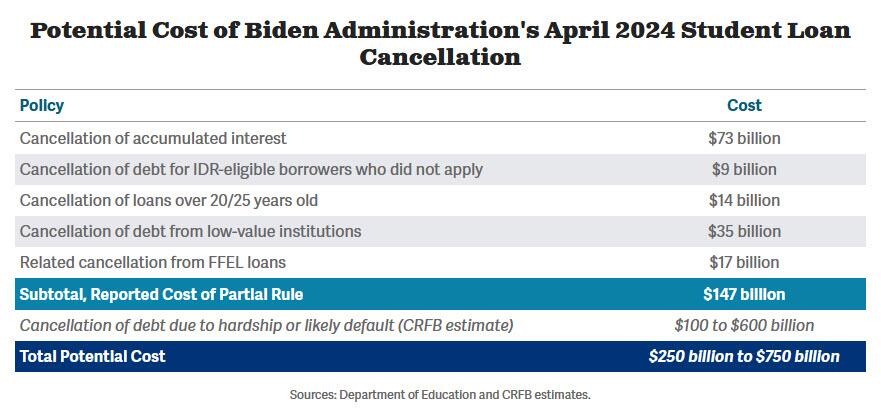
The plan itself has five major components. It would:
- Cancel accumulated interest for borrowers with balances higher than what they initially borrowed, capped at $20,000 for those in standard repayment and uncapped but restricted to individuals making less than $120,000 annually or couples making under $240,000 enrolled in an income-driven repayment (IDR) plan.
- Automatically cancel loans for borrowers in standard repayment who would be eligible for cancellation had they applied for programs such as Public Service Loan Forgiveness (PSLF) or the new IDR program, Saving on a Valuable Education (SAVE).
- Automatically cancel loans for borrowers who have been repaying undergraduate loans for over 20 years or graduate loans for over 25 years.
- Cancel debt of those who attended low-financial-value programs, including those that failed accountability measures or were deemed ineligible for federal student aid programs.
- Forgive debt of borrowers who are “facing hardships” or are likely to default on their loan payments.
The Department of Education has estimated the first four components of the plan would cost $147 billion over a decade, with half the cost stemming from the cancellation of accumulated interest. This is in line with estimates we are currently producing, though well above estimates of $77 billion from the Penn Wharton Budget Model (PWBM). A huge source of uncertainty is how these provisions would interact with existing IDR programs and how much of the debt would otherwise be cancelled under current policy.
Importantly, today’s rule does not include the Administration’s hardship cancellation plan, which would “authorize the automatic forgiveness of loans for borrowers at a high risk of future default as well as those who show hardship due to other indicators.”
This is by far the most unclear and potentially the most costly part of their proposal, since cancellation could be both wide-ranging and ongoing. We estimate this proposal could cost between $100 billion and $600 billion over a decade. However, there’s a tremendous amount of uncertainty, with design choices possibly resulting in much lower costs than our range – for example, PWBM estimates this provision would only cost $7 billion.
It is unclear how the Administration will define hardship, but they discuss 16 possible criteria such as other consumer debt, age, and health care or housing expenses and also declare hardship could be defined based on “any other indicators of hardship identified by the Secretary.” In assessing default risk, the rule allows cancellation for cancellation for those with an 80 percent likelihood of default, as determined by the Secretary. Importantly, over $150 billion of debt is currently in default (and loans in default generally have around a 70 percent recovery rate). We also estimate that a further 6 million borrowers are over 90 days delinquent on their loans, which is another predictor of a high likelihood of default and would further push up the number. The historically high rates of delinquency appear to be related to challenges around restarting student loan repayments last year.
While the default provision would be limited to the next two years under the most recent draft of the proposal, the hardship component has no time limit and thus opens a new venue for a future administration to cancel large amounts of student loan debt. An analysis by FREOPP argues that it could cover over 70 percent of college students.
In total, our $250 billion to $750 billion estimate for the total cost of the plan would be in line with the cost of the Administration’s $400 billion blanket debt cancellation, which was ruled illegal by the Supreme Court. It would be on top of more than $600 billion of debt cancellation already enacted through unilateral executive action. As we have shown before, these policies would put upward pressure on inflation and interest rates by supporting stronger demand, and much of the benefits would accrue to high-income and highly-educated Americans. In the coming weeks, we will produce further analysis of the Administration’s latest proposal and continue to refine our cost estimates as more data is made available. These analyses will be available at our student debt cancellation resources page.
Dressed to Impress: A Look at the Uniforms Berluti Designed for French Olympic Teams
Created for the event’s opening ceremonies, the head-to-toe outfits will make their official debut on July 26 for the Paris 2024 Olympics and on Aug. 28 for the Paralympic Games.
MILAN — Olympic fever is getting higher and higher.
As sportswear brands have started to lay their cards on the table and reveal the gear they designed for national teams — including Nike’s kits for the U.S. athletes and Lululemon’s for Team Canada earlier this month — Berluti on Wednesday will officially unveil the uniforms it created for Team France to wear at the opening ceremonies of the Paris 2024 Olympic and Paralympic Games on July 26 and Aug. 28, respectively.
The LVMH Moët Hennessy Louis Vuitton-controlled brand, which chose the date for the reveal as it begins the 100-day countdown to the event, was guided by two key words in the creative process: elegance and comfort. Within these boundaries, the brand worked on a concept that could instantly project both French sophistication and its Made in Italy craftsmanship on a global scale.
“It is a unique opportunity for our group and one of our French maisons, Berluti, to dress the French athletes from head to toe for the opening ceremonies. This is one of the most watched events in the world, often with several billion spectators around the globe,” said Antoine Arnault, chairman of Berluti and head of communication, image and environment at LVMH.
A project like this comes along once in a lifetime and I hope that those who see the outfits now, on July 26 or on August 28 for the Olympic and Paralympic opening ceremonies, will recognize all the passion and craftsmanship of the Berluti teams who created this special order of 1,500 outfits with the same care as if they were making a 100 percent made-to-measure suit and shoes,” he said.
Berluti’s ready-to-wear collection and merchandising director Vanessa Le Goff said the team “had carte blanche about the concept of the uniforms, as long as they were realized in a spirit of sustainability.”
“We have always thought about excellence, so of course all fabrics are certified and the suppliers that produced the pieces are the same ones we work with for our own collections,” said Le Goff, describing the project as a “real moment of collective pride” for the company and its artisans.
For the occasion, the in-house team collaborated with Carine Roitfeld, who suggested the tuxedo as a starting point of the designs, since for the first time the opening ceremony won’t take place in a stadium but in the heart of the city, along the Seine river, at dusk. The festive mood and bold logistics promise to offer a not-to-miss moment, with the event likely to be the largest ceremony in Games history as it will be open to more than 300,000 ticketholder and plenty of onlookers, in addition to those tuning in remotely from the rest of the world.
“This has of course been an unprecedented project for me,” Roitfeld said about dressing the 1,500 athletes and coming up with outfits “worthy of such a historic moment.”
“I immediately opted for the tuxedo — a resolutely French garment — paired with a Berluti signature patina-effect shawl collar in the French national colors. All eyes will be on the athletes and coaches for the big day, so I hope that they will be feeling stylish,” she added.
The sartorial choice was tweaked into different versions to accommodate athletes’ demands and make them feel at ease. While male athletes will don a classic midnight-blue wool tuxedo, female competitors will have a sleeveless option and will be given the choice between wearing pants or a wrap-around skirt in silk.
Ditto for shoes, Berluti’s signature category, produced at its manufacturing plant in Ferrara, Italy. For the occasion, the brand reworked the Lorenzo loafer, traditionally for men, to adapt it to women’s sizing. Crafted from supple leather and with an extra flexible sole, the lightweight style comes in navy finished off with Berluti’s signature patina effect in black. Red stitching standing out on the side is an added detail, with the shade exclusive for the Games’ athletes.
Women will be able to choose between the Lorenzo loafer and the Shadow sneaker, which will be the go-to option for male athletes, too. The sporty style was first introduced by Berluti’s former designer Kris Van Assche — whose four-year tenure ended in 2021 — at the request of Arnault. The sneaker has since become one of the brand’s biggest hits, thanks to its mesh upper, rubber sole and Venezia leather details on the heel and shoe tongue.
In the version created exclusively for the opening ceremonies, the style is rendered in an all-navy design with black details. The upper is embroidered with the Berluti logo on the side as well as “Paris 2024” lettering on the ankle. Yet the main feat is its leather details, here revisited with a gradient effect mixing the French flag’s colors.
The national bleu, blanc and rouge were reprised in many details enriching the overall outfit. In addition to the shawl collars of jackets and vests, the colors also define pocket squares and scarves to tie around the neck. Leather belts with Berluti’s signature buckle were hand-painted to reprise the same effect, which in its own way nicely links to the blurred concept of the French team’s sport kits for the actual competitions designed by Pigalle Paris founder Stéphane Ashpool and supplied by Le Coq Sportif.
In Berluti’s outfits, references to the French flag were additionally made with subtle blue and red stitching on the eyelets of the white shirts or on the inside labels reading “Artisan of All Victories,” the tag line LVMH picked when signing on as a premium partner of the global sports event. An additional label stitched on linings reiterates the role of the house’s artisans in the creation of the garments and their proximity to athletes.
“It’s to show that we’re extremely proud to dress up our athletes and we want them to be super proud also,” said Le Goff, who is one the 180 people involved in the project.
The enthusiasm was an extra driver enabling the quick turnaround of the outfits’ creation, with the first sketches drawn in September and the final designs fine-tuned by November last year, also thanks to a constant dialogue between Berluti and the athletes.
Le Goff said the number-one priority was to shy away from costume-y uniforms and make the delegations feel comfortable, as most of the athletes “are used to be wearing sporty outfits most of the time, and they were a bit scared to look like stiff, maybe.”
The feedback the Berluti team received was pivotal in defining style decisions, especially those coming from the Paralympic athletes. For one, the idea of opting for full or pleated skirts was dropped after realizing how impractical it could have been for athletes in a wheelchair, while initial plans to offer the Lorenzo loafer in a mule version were scratched after athletes with artificial limbs found the original style more comfortable for its heightened grip.
Former French fencer and Olympic gold medalist Brice Guyart was among those facilitating these conversations due to his active role as part of the Games’ committee, in addition to bringing his own experience to the table.
“Usually you put the athlete in a uniform and that’s it. This time, it’s really tailor-made: We will have retouches and fittings until the last day for every athlete, so that they can really feel good in the uniform,” Guyart said. “Also for the Paralympics, there might be a lot of changes, because some of the athletes might want their handicaps to be seen, while others won’t. So [the outfit] is totally adjustable,” he added.
Guyart noted how this approach, in tandem with the handmade finishing on the leather details, contributes to make each piece unique, making athletes feel extra special on such an occasion. He also highlighted how noble fabrics like silk and wool were deployed in the outfits, making these different compared to sportier and more technical gear from the past or for other national teams.
“I remember my past opening ceremonies — when I used to see the American delegation, I was always [positively stunned],” Guyart recalled. “We will be more than usual because we’re the hosting country and there will be a bigger delegation, and to be also well-dressed is really important for the confidence and the impact we will have on others in that moment….There’s a mental aspect to it: the first medals will be won at the opening ceremony,” he concluded.