WWD : Frédéric Malle Is Leaving His Eponymous Fragrance Brand

Frédéric Malle Is Leaving His Eponymous Fragrance Brand
The executive will exit Editions de Parfums Frédéric Malle at the end of June.

PARIS — Frédéric Malle is poised to leave his eponymous niche fragrance brand, Editions de Parfums Frédéric Malle.

“A few words to let you know that today is an important step in my life and in the life of Editions de Parfums Frédéric Malle, as I have decided to part ways with the company at the end of June,” Malle said in a statement.

“Twenty-five years ago, I started working on Editions de Parfums in an attempt to create a direct link between the best perfumers in the industry and the most demanding public,” he continued. “In doing so, I created a platform where noses could express themselves fully and be so proud of their work that they would want to sign it with their names. I could not have foreseen that what became the first publishing house for ‘noses’ would reveal these artists to the world in such a powerful way, show the public that perfume can be an art form and lay the foundations of the artisanal perfumery movement.

“I owe this success to the talent and generosity of perfumers who followed me then and to the many others who have since enriched our eclectic collection,” Malle said. “I also want to thank all of the other artists as well as our staff, especially the perfume experts working in our stores, who help each visitor find a perfume that will echo their personality. Their daily work makes the total creative freedom that we give to perfumers possible. Last but not least, I want to thank the members of The Estée Lauder Companies, who have developed and protected Editions de Parfums Frédéric Malle since 2015, and who I know will continue to implement the founding principles that make the company I created unique.”

Stéphane de La Faverie, executive group president, The Estée Lauder Cos., said: “When Frédéric launched his brand in 2000, he disrupted the fragrance industry by giving a voice and platform to the world’s greatest perfumers. Frédéric’s avant-garde approach to restore freedom and creativity to perfumery resulted in the creation of a true luxury brand of fragrance masterpieces.

“We are proud to have grown Editions de Parfums Frédéric Malle alongside Frédéric and will continue to honor his inspiration and uncompromising dedication to perfumery into the future,” continued de La Faverie. “We are so grateful for his collaboration, creativity and vision, and wish him much success.”

Malle indeed pioneered the niche fragrance business, which today — a quarter of a century later — drives the red-hot perfume category.

In 2000, when he decided to open a fragrance store, Malle didn’t just create another luxury brand emporium. Instead, he conjured up a new idea: a fragrance publishing house. Rather than selling books, the boutique carried scents blended by some of the world’s best-known perfumers, and he put their names on each of his namesake brand’s fragrances. Prior to that, perfumers were kept behind the scenes.

The first, 670-square-foot Editions de Parfums Frédéric Malle boutique was located in Paris on Rue de Grenelle. From its name to the tomes of Proust and Wilde lining the walls, the publishing theme could not be missed.

Malle gave carte blanche to seven perfumers, including Pierre Bourdon, Jean-Claude Ellena and Michel Roudnitska, to design their dream scents. No one contacted turned down the offer to work with him.

In-store, Malle made choosing a perfume a real experience. Customers could try out the scents the same way professionals do while creating a juice. After being asked about their fragrance preferences by young perfumers employed as sales staff, they can sample scents in columns designed by Malle. Those were hollow, with air jets into which his fragrances can be spritzed.

In June 2000, Malle told WWD, “there is a real market for real perfumery.”

He was right. Editions de Parfums Frédéric Malle became a trailblazer.

The brand’s allure was not lost on the Estée Lauder Cos., which announced in November 2014 it had signed to acquire the brand. At the time, the Malle collection had grown to comprise 21 fragrances created by 12 master perfumers worldwide. The brand had just opened its second New York store and counted three in Paris.

“Editions de Parfums Frédéric Malle represents the epitome of elegance,” Fabrizio Freda, president and chief executive of Lauder at the time of the acquisition’s announcement, told WWD in November 2014. “Malle’s uncompromising dedication to pure perfumery has established him as the most sought-after collaborator by the world’s most talented perfumers. He has created a true luxury brand that augments our portfolio of prestige beauty products.”

In the niche segment, Lauder had just purchased Le Labo in October 2014. Two years later, it added another French label to its coffers — By Kilian — expanding the group’s collection of luxury fragrances.

Malle, whose creative tie-ins have included ones with the late Alber Elbaz and with Pierre Hardy, was granted the 2018 Game Changer award by The Fragrance Foundation in the U.S.

In 2020, to help celebrate the first two decades of his brand, Malle came out with a book of his various inspirations and creations, called “Editions de Parfums Frédéric Malle: The First Twenty Years.”

Most recently, in another first, Acne Studio’s debut perfume was created with Malle. The fragrance, Acne Studios par Frédéric Malle, which launched on April 17, was a meeting of minds — and aesthetics.

As Malle leaves Editions de Parfums Frédéric Malle, he join the ranks of others who have exited the niche perfume brands they founded. Among them are Eddie Roschi and Fabrice Penot from Le Labo, and Sylvie Ganter-Cervasel and Christophe Cervasel, from Atelier Cologne, which was acquired by L’Oréal in 2016.

WSJ : Millennium Parts Company With Senior Event-Driven Portfolio Manager

Millennium Parts Company With Senior Event-Driven Portfolio Manager

A senior portfolio manager at Izzy Englander’s Millennium Management has left the firm, according to people familiar with the matter, after bets on deals and other corporate events went awry.

Millennium, one of the world’s biggest hedge-fund firms, shut down a team led by Omar Sayed earlier this month. Sayed had overseen an events-driven portfolio for Millennium. In that role, he placed wagers on prospective deals such as Tapestry’s planned $8.5 billion takeover of Versace owner Capri Holdings, and Nippon Steel’s attempt to buy U.S. Steel.

Some of Sayed’s bets recently misfired, the people said. Shares in Capri and U.S. Steel have fallen 25% and 20% respectively this year through Wednesday on concerns both proposed takeovers could be blocked.

More broadly, it has been a comparatively thin year for event-driven investing—taking positions tied to coming deals and other corporate events such as bankruptcies and spinoffs.

Event-driven hedge funds have returned an average of 3.4% in 2024, according to indexes compiled by hedge-fund research firm PivotalPath. That contrasts with a 4.5% return for so-called global macro strategies, while funds that bet on and against global stocks are up 7.2%.

New York-based Millennium, which manages more than $63 billion, has developed a reputation for delivering high returns with low volatility and tight risk controls.

A so-called multimanager firm, Millennium splits money across many specialized investment teams—a departure from the traditional hedge-fund model, which relied on the vision of one star trader. Multimanager firms are known for quickly cutting losses by firing underperforming investment teams.

Sayed joined Millennium’s London office in 2020, his LinkedIn profile shows, after previous stints at P. Schoenfeld Asset Management and Deutsche Bank.

FT : Private equity gears up for potential National Football League investments

Private equity gears up for potential National Football League investments
NFL-only funds are being set up in anticipation of potential rules that will govern institutional money in the sport

Private equity firms are quietly preparing funds to invest exclusively in the US National Football League, according to people familiar with the matter, as a potential precondition for being allowed to hold stakes in teams that make up the world’s richest professional sports league.

A special committee of NFL owners has been reviewing ownership policy rules since last summer, with the goal of developing bylaws that would govern potential private equity stakes. One requirement being explored by owners is the stipulation that institutional investors set up NFL-specific funds, according to three people briefed on the matter.

At least two firms have begun exploring investors’ interest in an NFL fund, these people say. The gridiron football league is the only North American sports organisation that has not yet opened itself to institutional investment. Major League Baseball became the first top-tier US league to do so in 2019, and the NBA, NHL, and MLS soon followed suit, spurred by a need for liquidity during the coronavirus pandemic. 

NFL owners are expected to approve institutional investment as soon as next month. They are still debating the structure of the funds and specific restrictions that would be placed on investors. 

The NFL declined to comment.

The NFL remains the richest and most exclusive group of sport owners in the US, and league bylaws restrict the amount of debt held by each club as well as the percentage owned by controlling and minority investors, respectively.

The league’s 11-year, $110bn media rights deal and generous revenue-sharing agreements among its 32 teams have sent valuations soaring. Last year’s $6bn sale of the Washington Commanders to former Apollo Global Management co-founder Josh Harris set a record for most expensive sports team sale ever. 

People familiar with the matter said the NFL is asking for investment groups to create American football-only funds that would preclude them from investing in sports teams from other leagues. The concept would mirror an existing fund set up by Blue Owl, the asset manager of Dyal HomeCourt Partners, to invest exclusively in National Basketball Association teams. 

The NFL is also considering whether it will only allow minority common-equity investments, and not a more senior security that has a higher priority or receives a special coupon or dividend, said two people briefed on the matter. The percentage stake that a team can sell to outside investors is still under discussion, as are issues such as whether a fund can hold interests in multiple teams and guidelines for potential investment exits, said the people. 

Harris’s acquisition of the Commanders opened many owners’ eyes to the amount of money involved in buying a team — the financier had syndicated about half of the equity from a broad group of investors, including billionaire healthcare executive Mitchell Rales, private capital executives Marc Lipschultz, Doug Ostrover and David Blitzer and former Google chief executive Eric Schmidt, among others.

US professional sports team valuations have risen dramatically in recent years, driven in part by rising media rights contracts. The phenomenon in turn has meant that both majority and minority shareholders in clubs have a shrinking pool of financially qualified candidates to whom to sell their stakes.

Many owners face succession challenges or want to raise new capital to finance improvements to their stadiums and surrounding real estate. It has led to an increased recognition that minority stake sales to passive private investors could create liquidity many owners may need as valuations continue to climb.  

FT : Hipgnosis agrees $1.4bn sale to Concord Chorus

Hipgnosis agrees $1.4bn sale to Concord Chorus
Struggling music rights business strikes deal with US rival

Hipgnosis Songs Fund, the listed UK music rights investment company, has agreed to a $1.4bn takeover from US rival Concord Chorus.

The deal follows a strategic review by the company’s board after it lost a shareholder vote in October that put its future in doubt.

The takeover values each Hipgnosis share at 93p, roughly a third above the group’s closing price on Wednesday and a small premium to the latest valuation of a music portfolio that includes the Red Hot Chili Peppers and Shakira.

The deal has already been backed by a number of top shareholders, representing about 29 per cent of Hipgnosis’ issued share capital. Shares in the group rose 30 per cent on Thursday to trade at 92p.

Hipgnosis was founded by music executive Merck Mercuriadis in 2018 to turn music rights into a mainstream asset class, using the rising royalties from streaming, radio play and performances to provide income for investors and boost valuations. 

But the appeal of the asset class has been hit by higher interest rates. Hipgnosis has been forced to slash the value of its music portfolio and has faced questions over its governance and levels of debt.

Concord, which is controlled by investor Alchemy Copyrights and is ultimately majority owned by US pension fund Michigan Retirement, has been an acquirer of music rights and companies. It said US asset management group Apollo had committed to providing financing for the acquisition through debt and a minority stake in the bidding vehicle.

However, the Hipgnosis board is still seeking to terminate its agreement with Mercuriadis, who continues to run Hipgnosis Song Management, the company’s investment adviser. Up to $25mn would be available to shareholders should the investment manager agree to terminate its contract. Hipgnosis Song Management, which declined to comment, could hold out for a termination fee as well as a 12-month notice period.

Robert Naylor, chair of Hipgnosis, said: “The acquisition represents an attractive opportunity for our shareholders to immediately realise their holding at a premium, mitigating the risks we see ahead to achieving a material improvement in the share price.”

Naylor said he hoped to encourage Hipgnosis Song Management and Blackstone, the majority owner of the company’s investment adviser, to agree an orderly termination of its agreement. 

“This would enable the payment of a larger consideration under the agreed transaction with Concord and bring to an end a period of uncertainty for all Hipgnosis stakeholders,” he added.

The Hipgnosis board on Thursday said it had considered all options for the future of the company, but the alternatives carried “significant risks, uncertainties and limitations”.

It said the share price was unlikely to increase to reflect the adjusted net asset value or deal price “in the medium term as a result of numerous company-specific and certain market issues”.

Substantial financial and governance changes would be necessary to improve its financial performance, it added.

The board had spoken to a number of potentially interested parties during the strategic review, it said, adding that it had received a number of indicative and preliminary proposals, all of which were less certain and came in at a lower value.

Since 2015, Concord, a music and theatrical rights company with a new release artist and writer programme, has invested more than $2.8bn in over 100 transactions to grow its business.

Bob Valentine, chief executive of Concord, said: “We believe we can integrate Hipgnosis’ catalogues into our wider portfolio of 1.2mn songs in a way that will deliver benefits for composers, performers and all our stakeholders.”

The Information : $10 Billion Security Startup Wiz in Talks to Acquire Lacework

$10 Billion Security Startup Wiz in Talks to Acquire Lacework for $200 Million

Cybersecurity startup Wiz is in advanced talks to acquire Lacework, one of its largest private competitors, according to two people with direct knowledge of the talks. The deal values Lacework at between $150 million and $200 million, according to one of the people, a sharp decline from the company’s 2021 valuation of $8.3 billion.

The talks come as small cybersecurity firms offering individual products are facing a tougher competitive environment, as customers shift to bigger companies offering suites of products. The deal isn't done and could still fall apart, however.

Wiz, which was founded in 2020, was last valued at $10 billion in 2023 from investors including Lightspeed Venture Partners, Greenoaks Capital Partners and Index Ventures. It had a run rate of $200 million as of last year, according to someone familiar with the matter.

In a statement, a Wiz spokesperson said that the company is “always exploring compelling M&A opportunities." A spokesperson for Laceworks couldn't immediately be reached for comment.

Laceworks is the company’s closest rival. Founded in 2015, it was valued at $8.3 billion in 2021 from investors including Sutter Hill Ventures, Altimeter Capital and Tiger Global Management. The company cut staff in 2022, citing a plan to increase runway and strengthen the firm’s balance sheet.

TechCrunch : Tesla Semi charging corridor project is still alive despite Biden a

Tesla Semi charging corridor project is still alive despite Biden admin funding snub
Tesla is pushing forward with a plan to build an electric big rig charging corridor stretching from Texas to California, despite being snubbed by a lucrative federal funding program that’s part of Biden’s Bipartisan Infrastructure Law. But the original scope of the project could still change, TechCrunch has learned.

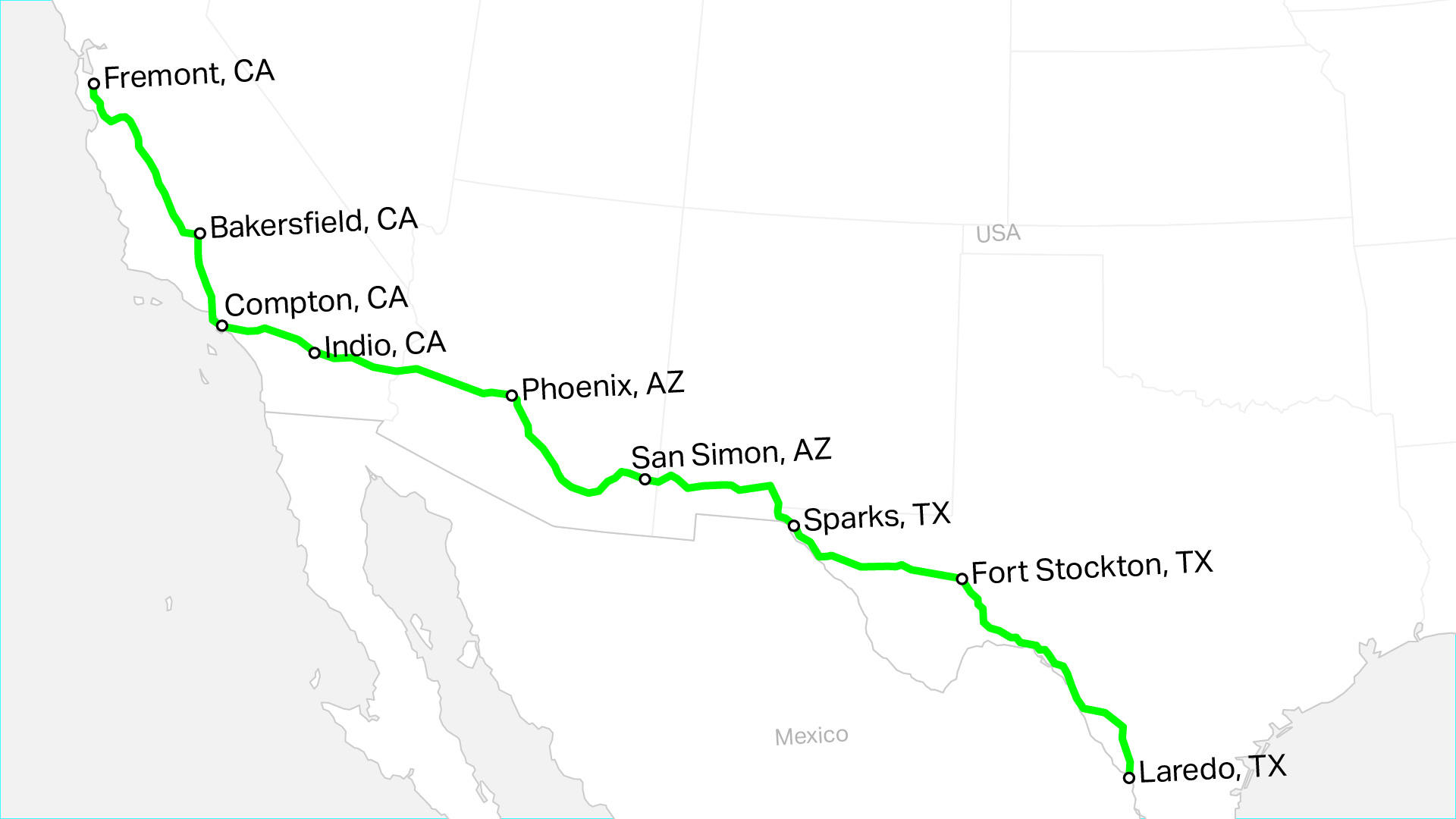
The company had been seeking nearly $100 million from the Charging and Fueling Infrastructure (CFI) Discretionary Grant program under the Federal Highway Administration (FHWA). Combined with around $24 million of its own money, Tesla wanted to build nine electric semi-truck charging stations between Laredo, Texas and Fremont, California.

The corridor, if built, would be a first-of-its-kind charging network that could enable both long-distance and regional electric trucking and help clean up a big chunk of the otherwise dirty transportation sector. Without it, though, Tesla’s promise to electrify heavy-duty trucking could fall even farther behind schedule than it already is.

The project as pitched to the FHWA was called TESSERACT, which stands for “Transport Electrification Supporting Semis Operating in Arizona, California, and Texas,” according to a slide buried in a 964-page filing with the South Coast Air Quality Management District. (Tesla collaborated with SCAQMD on the application.)

But Tesla was not among the 47 recipients that the Biden administration announced in January. Collectively, those winners received $623 million to build electric vehicle charging and refueling stations across the country. This is despite Tesla winning around 13% of all other charging awards so far from the Infrastructure Act, though that has only netted the company around $17 million.

Rohan Patel, who left his VP position at Tesla this week as the company laid off 10% of its workforce, said in a message to TechCrunch that Tesla may turn to state funding opportunities, or future rounds of the CFI program. Some of the sites along the route “are no-brainers even without funding,” he said.

Image Credits: TechCrunch


The 1,800-mile route would theoretically connect Tesla’s two North American vehicle factories, as well as one that is planned — but delayed — in Mexico. Each station was originally slated to be equipped with eight 750kW chargers for Tesla Semis, and four chargers open to other electric trucks. It’s unclear how effective it would be if the company was unable to build all nine stations, which are situated at roughly equal distances along the route.

About half of the Biden administration’s choices for the CFI funding focused on building out EV charging infrastructure in “urban and rural communities, including at convenient and high-use locations like schools, parks, libraries, multi-family housing, and more.”

The other half was dedicated to funding 11 “corridor” projects, including a number on the same I-10 corridor that makes up part of Tesla’s proposed route. That includes $70 million to the North Texas Council of Governments to build up to five hydrogen fueling stations for medium and heavy-duty trucks in the Dallas, Houston, Austin, and San Antonio areas.

“The project will help create a hydrogen corridor from southern California to Texas,” the Department of Transportation wrote in a statement in January.

“Funding hydrogen stations will go down as purely wasted money,” Patel told TechCrunch this week.
While he no longer speaks on behalf of Tesla, he also criticized funding hydrogen infrastructure when he was still with the company.

“Governments around the globe are wasting tax dollars on hydrogen for light/heavy duty infrastructure,” he wrote on X in February. “Like smoking, it’s never too late to quit.”

Funding isn’t the only challenge to the project. Another complicating factor could be Tesla’s recent restructuring.
Tesla CEO Elon Musk has said the company is now “balls to the wall for autonomy,” and has reportedly already sacrificed a planned low-cost EV in favor of making a purpose-built robotaxi the company’s priority. The Semi is years behind schedule, and Tesla has only built around 100 to date.

Despite all this, the Tesla Semi program is still slowly attracting customers. Just a few days after the restructuring, the head of the Semi program Dan Priestly announced via social media a new potential customer for the trucks. Priestly also said in March that Tesla has been using Semis to ship battery packs from Nevada to the Fremont factory.