The Musk Whisperer
Investor Shaun Maguire has become a crucial but controversial part of Sequoia Capital, thanks to his staunch pro-Israel stance and his relationship with one of the world’s richest people.
On Oct. 17, several executives in tech contacted Sequoia Capital managing partner Roelof Botha, all making the same simple demand: Fire Shaun Maguire.
Maguire, a 38-year-old partner at Sequoia, had spent the past 10 days posting fierce defenses of Israel on X (the social media platform he had helped steer Sequoia money into). He often wrote multiple times a day in the wake of the Oct. 7 attacks, offering his own analysis of the war’s grim events. “Just so you understand why Israelis have been so vigilant in the past…it was living with knowledge that there were barbarians at the gates,” he wrote on the day of the Hamas raids.
Then, on Oct. 17, he was among the earliest on X to cast doubt on a New York Times article about a blast at a Gaza Strip hospital. On the Times website, the piece appeared with a banner headline saying the explosion came from an Israeli strike, citing sources in the Hamas government. (The Israelis, in turn, blamed it on an accidental rocket launch from the Palestinian group Islamic Jihad.) On X, Maguire took issue with the Times for relying on Hamas sources for the headline and labeled the paper’s coverage “shameful.”
His quick dismissal of the Times and of the claim that it was an Israeli strike was the final straw for a handful of tech executives who had grown tired of his pro-Israel tweeting, which often involved defending the aggressive military strategy of the Israel Defense Forces in Gaza. When those executives urged Botha to fire Maguire, the Sequoia leader listened but didn’t take any immediate action. “Roelof has a lot of practice in dealing with contentious situations,” said a person close to the firm, who described Botha’s mindset on the blowback against Maguire as “stay calm and let the facts come out.” (Neither Botha nor Maguire agreed to be interviewed for this story.)
Firing Maguire would have been a painful decision for Botha. Maguire is both a rising star at Sequoia—particularly because he is pushing it in the burgeoning field of defense tech—and an important connection for the company to Elon Musk. He and Musk are close, and Sequoia and Musk are close, with the venture firm holding stakes in X, SpaceX and The Boring Company, Musk’s tunneling startup.
Still, Maguire’s brash persona stands in stark contrast to Sequoia’s preference for stately silence. His has become the loudest voice at the venerable firm—certainly far louder than Botha’s. “When he first joined, I fully anticipated him to just go quiet and do Sequoia things,” said Austen Allred, co-founder of BloomTech, the coding school backed by Maguire when he worked at Google Ventures. “It’s both very intentional and strategic on Shaun’s part that he feels the need to speak up about things that need to be spoken up on. He feels the need to be more transparent than Sequoia has been in the past.”

The aftermath of the explosion at Al-Ahli Arab Hospital in Gaza. (Getty Images)
So when those calls to fire Maguire came in, Botha was left to calculate the trade-offs in his mind: Maguire’s activism has placed Sequoia at the red-hot center of one of the world’s most complicated conflicts—yet Maguire has already proven himself a promising investor as well as an key link to one of the world’s richest people.
With those considerations in front of Botha, Maguire kept his job. Soon additional reports about the hospital have offered him a degree of vindication. While the exact facts around the bombing remain foggy, a Washington Post report using visual forensics yielded some evidence that supported Israel’s claim. And a subsequent Human Rights Watch investigation found that the explosion was likely from the type of rocket used by Palestinian militant groups.
In the months since, he has kept up his barrage of pro-Israel sentiment on X. It certainly earned him some powerful allies: In addition to Musk, venture capitalists Joe Lonsdale, Keith Rabois and David Ulevitch have commented in agreement with Maguire’s posts. “Shaun’s fortitude in speaking up for Israel and the West in the fight against terror, antisemitism and misinformation has been greatly appreciated and admired by many across the tech ecosystem here,” said Ariel Sterman, an Israel-based partner at Bessemer Venture Partners.
But it’s also earned Maguire the enmity of some Arabs working in tech and others who are pro-Palestinian. “Shaun Maguire’s consistent Islamophobia, his dehumanization of Palestinians, and his support for the ongoing genocide in Gaza should be deeply shameful to him, his employer, Sequoia and people publicly associated with him, like Patrick Collison, CEO of Stripe,” said Paul Biggar, co-founder of Tech for Palestine, a coalition of people in tech who support Palestinian causes. “That he is not denounced for this hate speech points to a serious problem in the tech industry. We should be advocates for humanity, not dehumanization.”
Collison, a years-long friend of Maguire, is determined to stand by him. “Shaun is going to be one of the best investors of this generation,” he said in an emailed statement. “Besides being a genius, he's a high-integrity and brave human.”
As Maguire attracts strident supporters and detractors alike, one Sequoia portfolio founder sees two possible paths ahead for him at the company—with little middle ground between them. “I think Shaun’s either going to be running the firm,” the founder said. “Or he’s going to get rejected from the system at some point.”
Maguire’s passion for technology began at age seven, when his cousin showed up to Thanksgiving dinner with a bag of scrap metal. The two spent the holiday huddled in the basement, constructing a computer from spare parts. It was the first of many makeshift computers for Maguire, who discovered he had a knack for computer science.
He grew up in Irvine, Calif., before moving to Newport Beach, Calif., when he was eight. His father was a salesman for Atari and Activision before he started a chain of gyms. Growing up in a part of the country full of millionaires and billionaires, Maguire became fascinated by how fellow Newport Beach residents like Broadcom Corp. co-founder Henry Samueli or Arnold Beckman, founder of Beckman Instruments, were able to spin scientific talent into great wealth. He saw their success as a road map.
Maguire entered high school with a passion for mathematics and little patience. After he didn’t show his work for a math test, his teacher assumed he had cheated and failed him. Maguire responded by refusing to continue going to class. (“I was 14 years old and arrogant and hadn’t yet learned empathy,” he recalled in an interview posted to Sequoia’s website in 2019.) When he got a perfect score on his math SAT, the school accused him of cheating. His teachers were baffled about how Maguire, who had poor grades, had managed it. Frustrated, he dropped out, got a GED equivalent and enrolled in community college.
Later, Maguire transferred to the University of Southern California. He went on to earn a master’s in statistics at Stanford University, followed by a doctorate from the physics department of the California Institute of Technology, where he felt at home among fellow math- and science-obsessed classmates. “I felt like Harry Potter transitioning from Muggle life to the world of wizardry,” he wrote in his 2018 thesis.
While still working on his doctorate, Maguire joined a team of Caltech scientists to found Escape Dynamics in 2010. The company was developing rocket systems powered by microwave propulsion, and through its work, Maguire briefly encountered someone who would later become a major part of his life: Musk. Maguire and the Escape Dynamics team presented their idea to Musk, at the suggestion of an investor who thought he might be a useful connection. Musk promptly called the idea “horrible,” according to someone close to the company. (Escape Dynamics shut down in 2015.)
That same year, Maguire took a fateful trip to Washington. There, according to fellow Caltech student Joseph Meyerowitz, he met the Department of Defense’s Regina Dugan, who was the director of the Defense Advanced Research Projects Agency (DARPA). Dugan pitched Maguire on a radical experiment: What if the government plucked scientific talent from the lab, including graduate students from elite universities, and sent them to Afghanistan, where they would use their expertise to help the troops?
By 2011, Maguire and Meyerowitz had left their doctorate programs and were preparing to descend into a war zone, a decision Meyerowitz attributed to a quote by Greek mathematician Archimedes: “Give me a lever long enough and a fulcrum on which to place it, and I shall move the world.”
For the two men, “this was our one chance to stand on the lever and move the world,” Meyerowitz said.
During Maguire’s three-month stint in Afghanistan, soldiers escorted him across the country by armored vehicle and Black Hawk helicopter. He spent his time, among other things, sifting through money transfers to find terrorists and training machine-learning models. Maguire’s team would later win a Joint Meritorious Unit Award for their work.
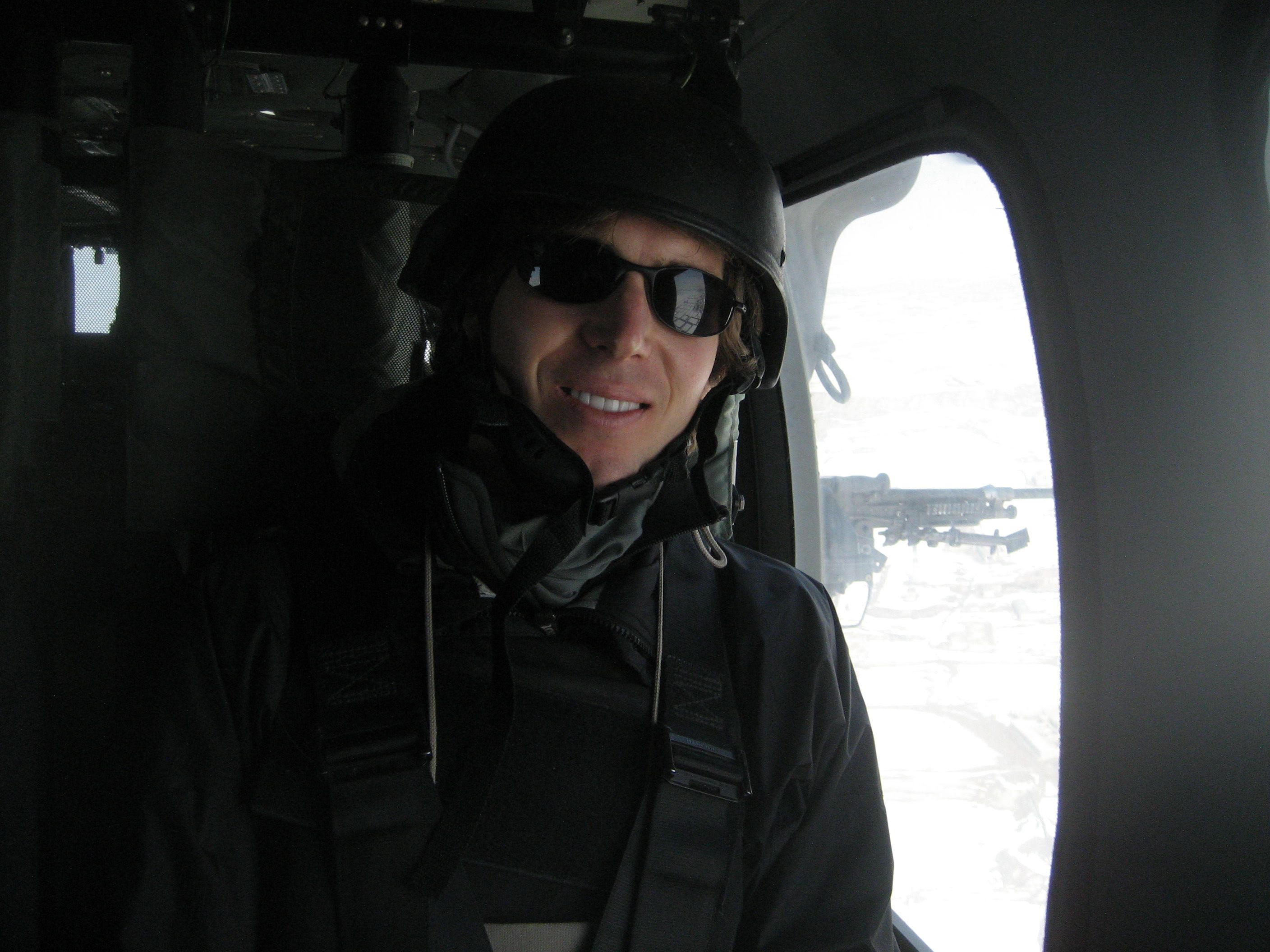
Shaun Maguire posted this picture of himself in a Black Hawk helicopter to his X account in October with this caption: "I would die for Freedom."
He would also wake up to war outside his bedroom. In May 2012, a group of suicide attackers infiltrated the compound where Maguire was staying. When the bombs exploded, the snapping of bones sounded like popcorn. A dazed Maguire woke up, wandered outside and wondered aloud what happened, before two soldiers ushered him into a sheltered corner.
The attack killed at least eight people and left behind a two-foot deep crater of rubble. “Everyone that I went over there with, or that was sent over there, came back differently one way or another,” said Chris White, now the managing director of Microsoft Research Special Projects, and previously the lead researcher of Maguire’s DARPA program. “The environment was very severe.”
Maguire was hooked by his cybersecurity work abroad. When he returned to California in 2012, he continued his doctorate while also co-founding Expanse, formerly Qadium, a cybersecurity startup that audited companies for any server vulnerabilities, as well as scoring government contracts. Expanse raised $136 million from investors including Founders Fund and TPG before Palo Alto Networks acquired it in 2020 for about $1 billion.
In 2015, Founders Fund invited Maguire, along with 50 other founders, to an island in British Columbia. As the founders mingled, Maguire overheard Anduril’s Palmer Luckey arguing with Stripe founder Patrick Collison about quantum computing in a “really arrogant way,” Maguire recalled later in an interview with the Caltech Heritage Project, a Caltech initiative that interviews alumni.
“I jumped in the conversation, because honestly I didn’t like the way the guy was talking to Patrick, and Patrick was right,” Maguire recalled in the interview. The exchange won him a lasting ally in Collison.
Maguire, now more deeply integrated into the venture capital world, began discussing potential opportunities at firms. He was in the running for a job at Founders Fund, but, according to a person familiar with the discussions, he had a disagreement with partner Brian Singerman during the interview process and didn’t get the job. (Founders Fund denies this.) He instead landed at Google Ventures in late 2016, after the firm promised him he could do the job part-time in order to continue his doctorate and keep working at Expanse. At Google Ventures, his Collison connection immediately paid off.
During Maguire’s first week, the partners met and listed their regrets, sharing which companies they wished the firm had invested in. Collison’s Stripe was at the top of the list.
“Shaun went, ‘Hey, by the way, I just texted Patrick Collison and they’re actually raising a round right now. We should just talk to them,’” a former Google Ventures partner recalled. “That’s a classic Shaun superpower.”
Collison gave the firm a $100 million allocation in a $150 million round later that year; Google Ventures invested $20 million, while CapitalG, Alphabet’s growth fund, put in $80 million. Maguire spent almost three years at the firm, leaning on his background in quantum information from his time at Caltech to invest in companies like IonQ, which went public in 2021, and on his experience in space tech at Escape Dynamics for investments like SpinLaunch, which is developing a centrifuge mechanism to hurl rockets into space.
Despite scoring some prominent investments for Google Ventures, Maguire didn’t spend long at the firm and departed in 2019. (He later said he chafed against Google’s diversity initiatives, and said he wasn’t able to get promoted as a white man. Google Ventures denied this, saying promotions are based on merit.) As Maguire left Google Ventures, Collison helped his friend find a new home, shooting off emails to then–Sequoia partners Mike Moritz and Michael Abramson, whose firm had backed Stripe from its inception. Collison had a straightforward message: “You guys should hire Shaun.”
Maguire has long been enamored with space technology—he named his first child Leo after “low Earth orbit”—and when he joined Sequoia, he was determined to get the firm to back Musk’s SpaceX.
Sequoia had previously backed Musk with its initial 1999 investment in PayPal, but the firm hadn’t yet invested in the hard tech ventures that followed, like Tesla. When Maguire brought up SpaceX at Sequoia, “it was unbelievably controversial,” recalled a person close to the firm: Although SpaceX had already raised billions and generated revenue from its rocket launches, Musk’s next big bet was that Starlink would be a key moneymaker for the company. At the time of Maguire’s pitch, SpaceX had just started launching Starlink satellites, and it wasn’t yet clear that Starlink would work.
While the prospect of investing in SpaceX excited some partners, others were highly skeptical. At Sequoia, every partner votes on a proposed investment from one (the lowest) to ten (the highest). Two partners gave SpaceX a two. Another partner scored it a one.
Maguire had a handful of Sequoia partners fly to Los Angeles to tour SpaceX’s factory. Any skeptics were sufficiently impressed and the firm agreed to a $20 million investment in 2019. Less than a year later, the firm led a $1.9 billion funding round for SpaceX that valued it at $46 billion. “He’s definitely butted heads on decisions with the old guard of Sequoia,” a Sequoia-backed founder said. “He’s proved himself as a result in doing so.”
The investment helped Maguire gain prominence within the firm, and Maguire became one of the partners closest to Musk. He went on to lead the firm’s 2022 investment into The Boring Company and later joined forces with Botha and Doug Leone, former managing partner of Sequoia, to back Musk’s bid to buy Twitter. Maguire is now the partner who works most closely with the social media company.
When not on Musk duty, Maguire spends most of his time on early-stage investments, like recycling sortation startup Amp Robotics, and has demonstrated a willingness to back founders considered young even by Silicon Valley standards. In 2019, he invested in Vise, a fintech started by a pair of 16-year-olds, Samir Vasavada and Runik Mehrotra. Later, he helped them steer through layoffs and allegations that the firm was misleading the public about the size of its assets under management.
“When times got tough, Shaun stood by us when others might not have,” said Vasavada. (A company spokesperson denied that the company had ever inflated its metrics and said it had always been honest with its stakeholders.)
Maguire has also backed Neros Technologies, an El Segundo, Calif.–based company developing drones for defense purposes, started by a 19-year-old Soren Monroe-Anderson. Anderson, who participated in drone-racing competitions as a high schooler, had impressed Maguire by jumping on a plane to Ukraine in 2022 to speak with Ukrainian troops directly about the technology they were using.
Another Southern California defense tech startup has caught Maguire’s attention: Mach Industries, the creation of 19-year-old Ethan Thornton. Before Mach Industries became Sequoia’s first defense tech investment, part of Thornton’s due diligence was ensuring the firm had no Chinese investors. “I obviously went and made sure all the capital was clean,” Thornton said. “It was also an interesting dynamic. Because we’re their first defense investment, they have a huge incentive to help us as much as they possibly can.”
But Israel is never far from Maguire’s mind. In November, for instance, he spent one evening convincing the Israeli government to let Elon Musk’s private jet land; Maguire had gotten to Israel about a day earlier and, from the home of a family member, managed Musk’s arrival. Maguire plans to live in Israel during June and July. In effect, he seems to be positioning himself to help fill an important role: maintaining Sequoia’s connection to Israel, long established by investments in companies like Wiz, an Israeli cybersecurity unicorn.
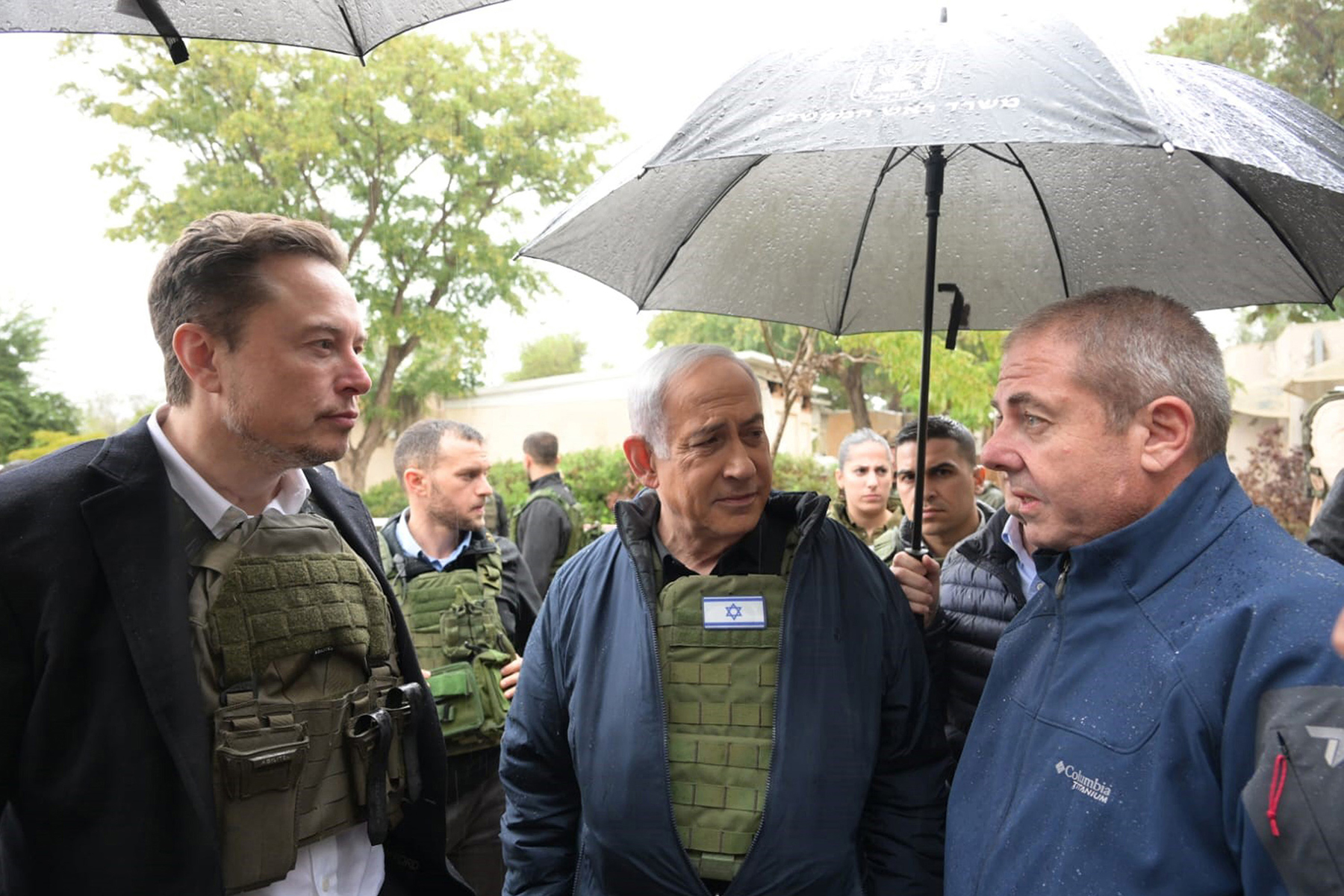
Elon Musk (left) with Israeli Prime Minister Benjamin Netanyahu in Israel. (Getty Images)
Perhaps unsurprisingly, controversy continues to follow Maguire. Earlier this year, students had invited him to speak at Oxford University’s Saïd Business School, named after Syrian billionaire Wafic Saïd.
But shortly before the event’s date, Maguire claimed, the school abruptly canceled his lecture. The students who invited Maguire emailed him and told him he was “being investigated” by school officials, Maguire said on X. (“Free speech is dying,” he wrote.) The Saïd Business School denied that Maguire was uninvited.
Maguire’s post on X elicited a sympathetic response from Musk—and inspired another organization in the Oxford area to offer to host Maguire’s lecture on how disinformation spreads. The event sold out.