9to5 : What is Apple Intelligence? Here’s how iOS 18’s AI features will change t

What is Apple Intelligence? Here’s how iOS 18’s AI features will change the way you use your iPhone, Mac, and iPad

The biggest news on one of Apple’s biggest days of the year was Apple Intelligence, a new suite of AI features coming later this year to iOS 18, iPadOS 18, and macOS Sequoia.

Apple’s WWDC presentation covered a lot of ground as it outlined what Apple Intelligence can do. Since then, we’ve gained even more details.

Here is everything you should know about Apple Intelligence, including the features it will bring to your iPhone, Mac, and iPad when it launches.

What is Apple Intelligence?
Apple Intelligence is Apple’s unique branding for its suite of AI features debuting later this year across iPhone, iPad, and Mac.
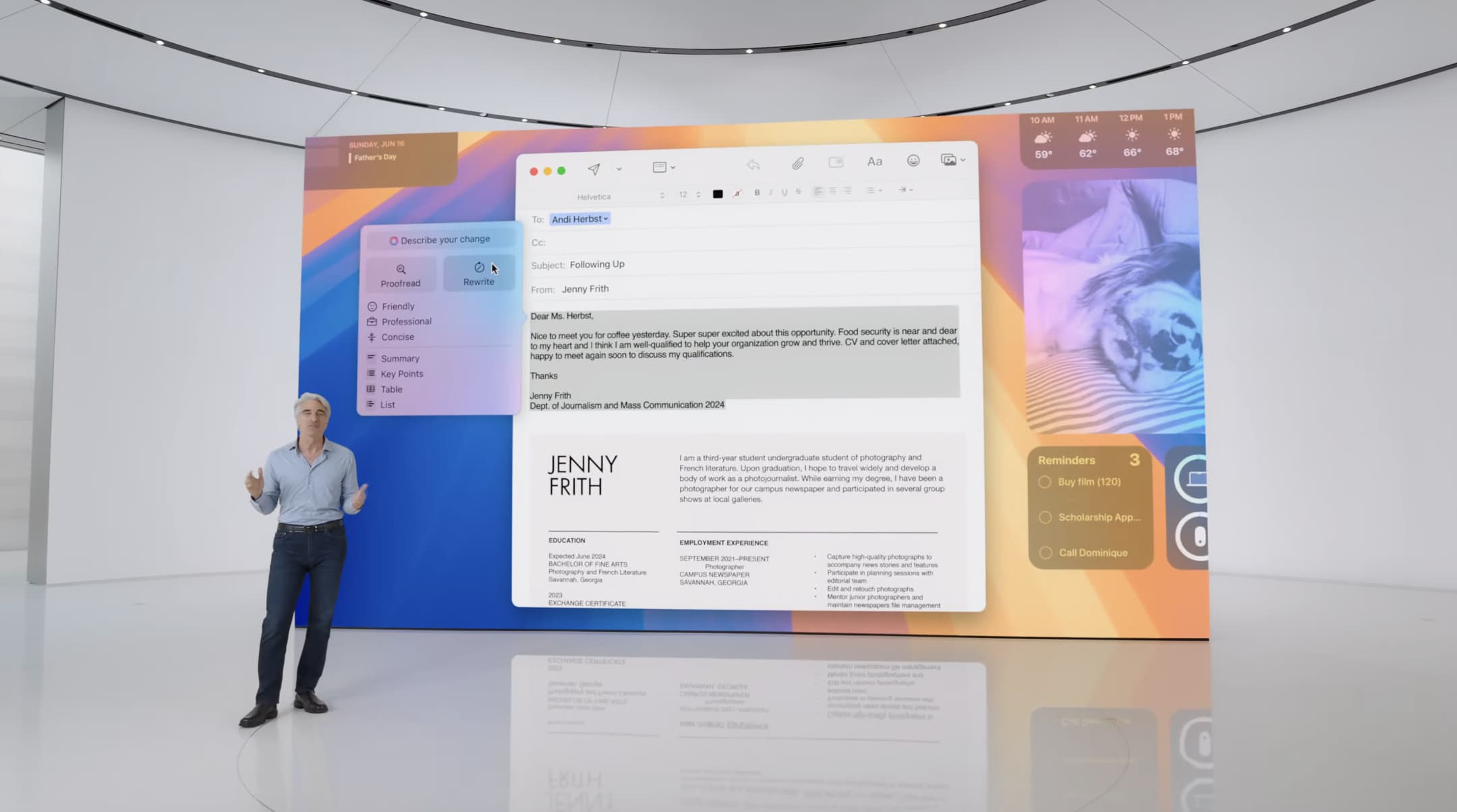
Craig Federighi summed it up this way during the WWDC keynote:
Apple Intelligence is the personal intelligence system that puts powerful generative models right at the core of your iPhone, iPad, and Mac.
There are five key pillars of Apple Intelligence that, in combination, distinguish it from other AI (artificial intelligence) tools that already exist.
  • Powerful: Capable of offering truly useful help
  • Intuitive: Easy to use and accessible
  • Integrated: Baked into the core of your devices
  • Personal: Understands your personal context
  • Private: Built from the ground up for privacy
Apple believes no one else has an AI offering that checks all these boxes—and they certainly seem right.
The goal of Apple Intelligence? Tim Cook put it well in the keynote: “to make your most personal products even more useful and delightful.”
What can Apple Intelligence do?
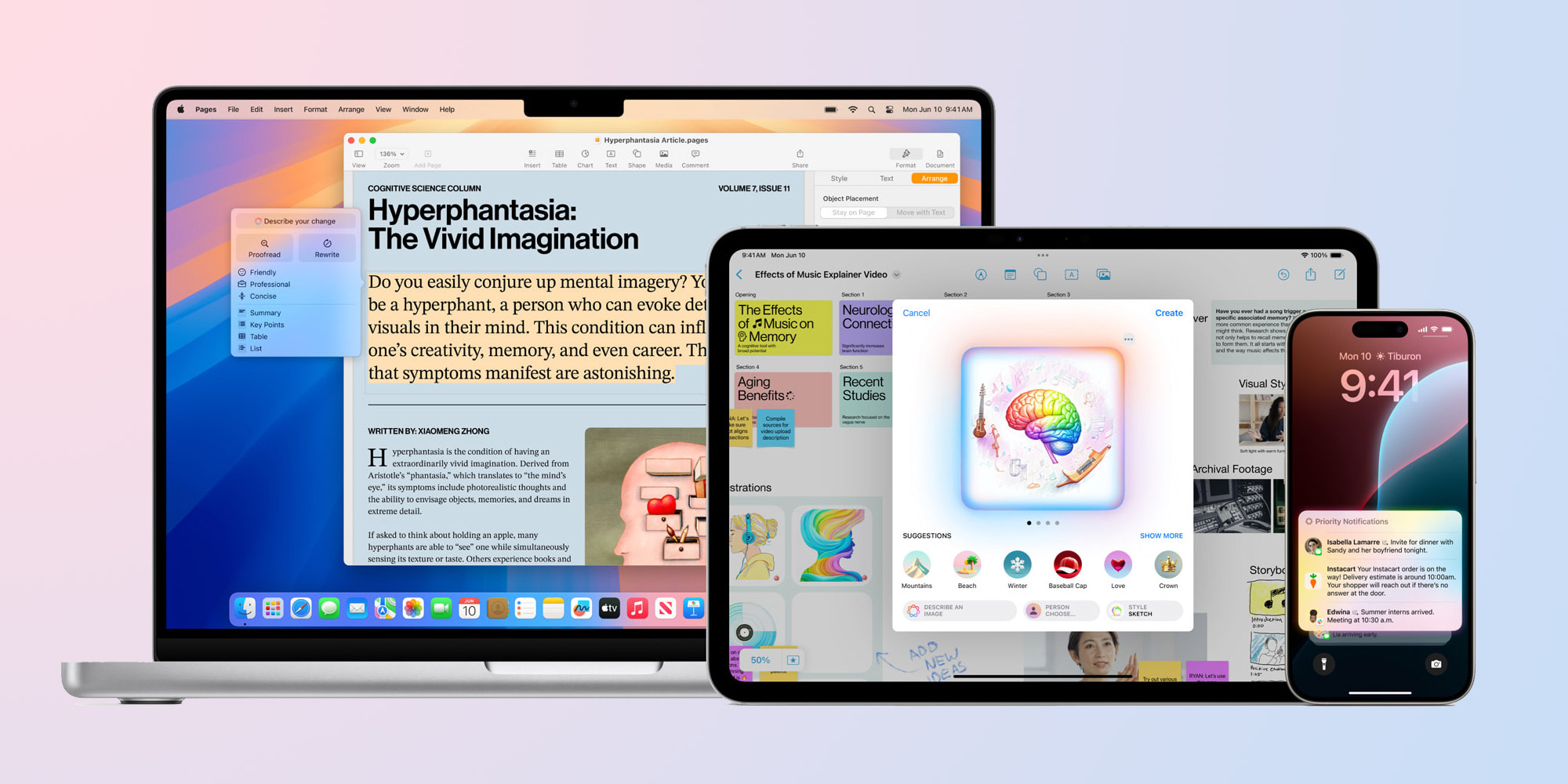
Here’s what Apple Intelligence will enable your iPhone, Mac, and iPad to do once it ships later this year.
Language tools
  • Writing Tools: AI will be able to rewrite and proofread your text anywhere you write it, even third-party apps. This will be especially useful when sending an email or writing an article or social media post.
  • Priority notifications: AI will understand from context which notifications are most important and surface those to the top for you.
  • Priority messages in Mail: Similarly, AI will prioritize the email messages that most merit your attention.
  • Smart Reply: AI will generate email replies for you, offering them up for your approval before being sent.
  • Reduce Interruptions: This new Focus mode works like Do Not Disturb, but intelligently allows important notifications to break through.
  • Summaries of content: Whether in a transcript from a meeting or when viewing an email, AI will summarize content for you.
Image tools
  • Image creation: Create totally original images with a simple typed request, even ones that feature a loved one.
  • Genmoji: Create totally original emoji on demand for any occasion.
  • Clean Up: Remove unwanted objects from a photo with ease.
  • Powerful search: Find exactly the photos you’re looking for in the Photos app.
  • Image Wand: Use the Apple Pencil to draw a circle in a Note and AI will automatically create a new image with its awareness of the other note contents.
  • Create Memories movies: Type a request in the Photos app to have a new Memories video created using the best-matching images in your library.
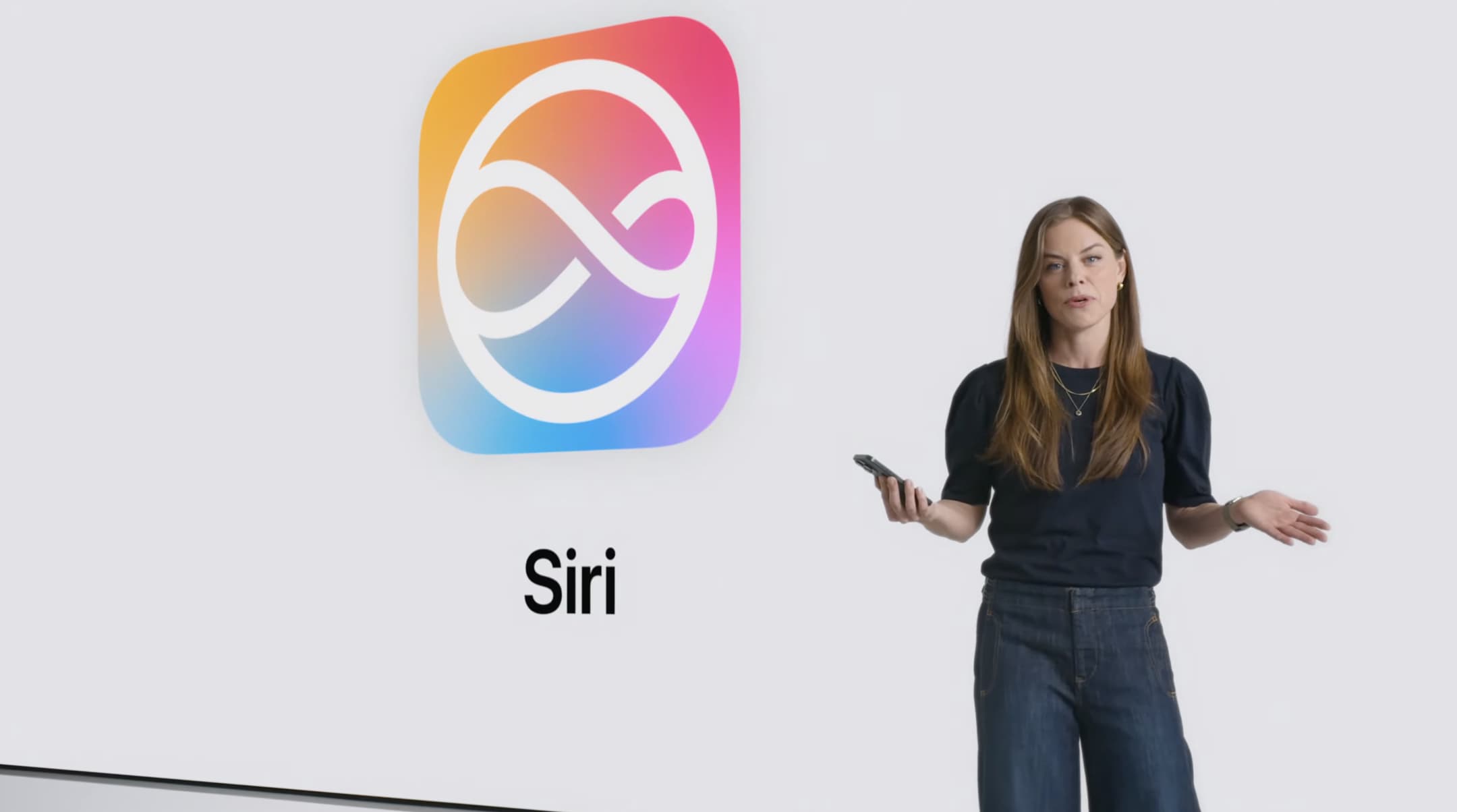
New and improved Siri
  • Richer language understanding: Siri with Apple Intelligence is far more forgiving of clunky requests. For example, you can say, “Siri, set an alarm for — oh wait no, set a timer for 10 minutes. Actually, make that 5.”
  • Personalized assistance: Siri can perform new actions with a deep awareness of your personal context. For example, you can say, “Play that song my wife sent me the other day.”
  • Onscreen awareness: Now Siri will know what’s on your screen and can assist accordingly. For example, you might say, “Add this address to their contact card.”
  • Take action across apps: Siri can now perform cross-app actions that save you time. For example, you could ask, “Siri, add this location to my Road Trip note.”
  • Fresh look: Activate Siri, and rather than popping up in one place, the assistant will instead animate all around the borders of your device with a beautiful glowing light.
  • Quick typed requests: With a quick double tap at the bottom of your iPhone or iPad’s screen, a keyboard will pop up so you can type a request to Siri rather than speaking it.
  • Deep Apple product knowledge: Now you can ask Siri questions about any of your Apple devices and OS features and it can provide the info you need.
ChatGPT integration
Apple has officially partnered with OpenAI to integrate ChatGPT deeply into the iOS 18, iPadOS 18, and macOS Sequoia systems.
With ChatGPT from OpenAI integrated into Siri and Writing Tools, you get even more expertise when it might be helpful for you — no need to jump between tools. Siri can tap into ChatGPT for certain requests, including questions about photos or documents. And with Compose in Writing Tools, you can create and illustrate original content from scratch.
For more info, check out the following from my colleague Zac:
ChatGPT will not require an OpenAI account, nor will any of the information it processes be saved or shared with others. Apple is maintaining its privacy standards with this integration rather than depending on OpenAI to do so.
Which devices will support Apple Intelligence?
Because of the advanced computing resources necessary to properly power these features, Apple Intelligence is limited to a select number of modern devices:
  • iPhone 15 Pro and Pro Max
  • iPads with M1, M2, or M4 chip
  • Macs with M1, M2, or M3 chip
Top comment by NS
Liked by 1 people
Doubt the part about deep Apple products knowledge. Even when searching for solution and came to the support forum attended by human staff, they only gives template answer that doesn’t even touch the problem, and obviously not solution (and they won’t just cut the chase and admit when it’s impossible to do).

As for the other AI feature, even after AI is growing like now, still can’t find a scenario to use it. But this is a personal use case problem.
View all comments
This means on the iPhone, only the newest and highest-end phones will support these powerful AI features—at least for now. The iPhone 16, 16 Plus, and 16 Pro models are all expected to support Apple Intelligence.
Wrap-up
If your device supports Apple Intelligence, all the features outlined above will make for a whole new computing experience later this year.
Apple seems set to truly take AI mainstream, and in its own unique way.

Which AI features are you most looking forward to? If your device doesn’t support Apple Intelligence, do you plan to upgrade soon? Let us know in the comments.

>>> US Close Dow -0.17% S&P +0.23% Nasdaq +0.34% Russell -0.88%

Closing Stock Market Summary
The S&P 500 (+0.2%) and Nasdaq Composite (+0.3%) added to their record closing highs today, but market breadth was negative and other major indices closed with losses. The Dow Jones Industrial Average fell 0.2% and the Russell 2000 settled 0.9% lower.

Some normal consolidation efforts drove the underlying negative bias following a big run in many stocks. Decliners led advancers by a nearly 2-to-1 margin at the NYSE and at the Nasdaq.

Dropping market rates and solid gains in some mega cap stocks were not enough to offset the downside bias.

The 10-yr note yield fell six basis points to 4.24% and the 2-yr note yield declined six basis points to 4.69%. This price action was in response to a cooler-than-expected inflation reading in the form of the May Producer Price Index, a weaker-than-expected initial jobless claims report, and today's $22 billion 30-yr bond reopening, which was met with solid demand.

Broadcom (AVGO 1678.99, +183.48, +12.3%) was a standout from the mega cap space following its better-than-expected earnings report, outlook, and 10-for-1 stock split announcement. NVIDIA (NVDA 129.61, +4.41, +3.5%) logged a solid gain in sympathy.

Super Micro Computer (SMCI 871.10, +96.36, +12.4%) also registered an outsized gain in sympathy with AVGO. Gains in the aforementioned names boosted the information technology sector (+1.4%), which was the top performer among the 11 sectors. The rate-sensitive real estate sector (+0.5%) showed the next largest gain, benefitting from the drop in market rates.

  • Nasdaq Composite: +17.7% YTD
  • S&P 500:+13.9% YTD
  • S&P Midcap 400: +5.5% YTD
  • Dow Jones Industrial Average: +2.5% YTD
  • Russell 2000: +0.6% YTD

Reviewing today's economic data:
  • Weekly Initial Claims 242K (Briefing.com consensus 224K; Prior 229K; Weekly Continuing Claims 1.820 mln; Prior was revised to 1.790 mln from 1.792 mln
  • The key takeaway from the report is the upward drift in jobless claims, as that will be construed as a loosening of labor market conditions that fits the Fed's script for eventually cutting rates.
  • May PPI -0.2% (consensus 0.1%); Prior was revised to 0.1% from 0.5%; May Core PPI 0.0% (consensus 0.3%); Prior 0.5%
    • The key takeaway from the report is that it will factor favorably in the PCE Price Index, which is the Fed's preferred inflation gauge. In other words, it is a report that is pleasing in the market's mind as providing a stepping stone to a Fed rate cut.

Friday's economic calendar features:
  • 08:30 ET: May import prices (prior 0.9%) and nonfuel import prices (prior 0.7%); May export prices (prior 0.5%) and nonagricultural export prices (prior 0.7%)
  • 10:00 ET: Preliminary June Univ. of Michigan Consumer Sentiment (consensus 73.0; prior 69.1)

>>> Dyne Therapeutics Presents New Preclinical Data for its Facioscapulohumeral

Dyne Therapeutics Presents New Preclinical Data for its Facioscapulohumeral Muscular Dystrophy Program During the FSHD Society International Research Congress
WALTHAM, Mass., June 13, 2024 (GLOBE NEWSWIRE) -- Dyne Therapeutics, Inc. (Nasdaq: DYN), a clinical-stage muscle disease company focused on advancing innovative life-transforming therapeutics for people living with genetically driven diseases, today highlighted new preclinical data for DYNE-302, its product candidate for facioscapulohumeral muscular dystrophy (FSHD), that demonstrated robust and durable DUX4 suppression and functional benefit. The data were presented during the 31st Annual FSHD Society International Research Congress, being held June 13-14, 2024, in Denver, Colorado.

FT : Mission Impossible: how talks to sell Paramount turned into a Titanic flop

Mission Impossible: how talks to sell Paramount turned into a Titanic flop
Early affinity between billionaire scions Shari Redstone and David Ellison devolved into stony silence as deal collapsed

After more than six months of gruelling negotiations, David Ellison thought he was on the verge of clinching the deal of a lifetime: taking over Paramount, the century-old Hollywood studio.

Ellison got word on Tuesday morning in Los Angeles from an adviser to Shari Redstone, the heiress who controls the media group behind classics including The Godfather, Chinatown and Titanic, that all the financial details of the deal had been ironed out. At a 2.30pm (New York time) meeting on Tuesday, Paramount’s special committee planned to greenlight the proposal from Ellison’s company, Skydance Media.

And then came the plot twist. Minutes before the independent advisers evaluating the Skydance bid were set to recommend it, Redstone’s lawyers Ropes & Gray sent a terse email to the special board committee saying the deal was dead. “While it is true we’re agreed on all material economic terms, there are other terms outstanding, and we are basically backing away,” the message said, according to a person with knowledge of the matter, who paraphrased its content.

“Shari effectively killed a deal that was fully negotiated, fully done on all key economics two minutes before the special committee meeting,” the person added. “That was that.”

It was an abrupt, bitter ending to a story whose two protagonists had formed an unlikely bond. Both are children of hard-charging billionaire fathers: Redstone, 70, is the daughter of Sumner Redstone, who built the media and entertainment empire that is at the core of Paramount — a group that also includes the CBS television network, MTV, Comedy Central and Nickelodeon. Ellison’s father, Larry, is the billionaire co-founder of Oracle, the software group.

David Ellison also has a deep connection to Paramount, having produced a number of blockbusters alongside the studio, including Top Gun: Maverick.

But in recent weeks, their bond weakened as they clashed over the details of the deal — and speculation swirled that Redstone was having doubts about letting go of the family business. When it was all over, exasperated advisers said they could not recall a messier process. And observers from Wall Street to Hollywood were left wondering what Redstone’s next move will be.

Paramount presented a rare opportunity for Ellison to gain control of one of Hollywood’s crown jewels, rich in history with its iconic lot on Melrose Avenue and century-old library of films.

The studio has struggled to adapt to the digital era but Ellison, 41, believed he could fix the group’s mounting problems. Its once-mighty, generation-defining television channels such as MTV are in long-term decline while the Paramount+ streaming service is losing money.

Paramount, valued at less than $8bn on the stock market, has more than $14bn in debt, which was recently downgraded to junk. Investors have lost faith that the company can compete on its own, making it the subject of takeover speculation for several years. Shares have declined 30 per cent this year, including a nearly 15 per cent fall since talks were called off.


The deal was never going to be easy to pull off. Ellison’s plan had two steps: First, his company would buy National Amusements (NAI), the Redstone-controlled group which holds 77 per cent of Paramount’s voting shares. Then Paramount would acquire Skydance in a stock deal.

The first cracks emerged in May when Ellison’s consortium, which included private equity groups RedBird and KKR as well as his family’s fortune, adjusted its offer after it became clear Paramount’s common shareholders were planning to fight back. Several holders of Paramount’s non-voting stock publicly threatened to sue if the deal went through, saying all of the value would go to Redstone, who holds the majority of the voting shares.

So the Ellison team decided to pay NAI — and by extension, Redstone herself — less than originally proposed to sweeten the deal for Paramount’s B shareholders.

After Skydance decided in May to reduce its offer to NAI from $2.5bn to $2.3bn, including debt, Redstone stopped talking to Ellison, said people briefed about the matter. Others involved said the decision to stop communication was out of respect for the negotiation process with the special committee. These people added that ultimately NAI agreed to the lower offer of $2.3bn.

Nonetheless, Redstone had started to lose trust in Ellison following the adjusted offer, people close to her said. The same people added that despite Redstone’s changing perception of Ellison, the founder of Skydance was highly respected by NAI and Paramount’s advisers for his integrity throughout the process.

It was only after Ellison was told the deal was dead that Redstone informed him that she was upset by the reduction in the cash offer for her stake, said a person close to her. “She was unhappy that she didn’t get more,” the person said.

Other people close to Redstone disputed this, saying the deal collapsed because Ellison’s camp resisted calls to allow non-voting shareholders to register their “consent” — or lack thereof — for the transaction through some kind of tally. “Obviously that would have provided protection against shareholder litigation,” said another person familiar with Redstone’s thinking.

People close to Skydance and Paramount said Redstone decided to use the “consent” vote as a last-minute excuse to kill the deal; the matter had been cleared at the very start of the negotiation.

There were other signs of friction as Redstone pursued the sale. In April, Redstone fired her longtime trusted chief executive, Bob Bakish, who had made little secret of his opposition to the Skydance deal and pursued talks with other potential suitors. She replaced Bakish with three Paramount executives who formed an “office of the CEO”. Four board members also left this spring.

Throughout the process, other potential bidders came and went. Paramount shares declined in December when it emerged that Bakish had met his counterpart at Warner Bros Discovery, David Zaslav. Private equity group Apollo approached Paramount twice, most recently with Sony as a partner. And this week Edgar Bronfman Jr, the Seagram heir, made an approach alongside Bain Capital.

Multiple people who were directly and indirectly involved in the process said there was more than money that persuaded Redstone to walk away from a deal with Ellison that she had initiated months ago.

Several people said Redstone could not get her head around parting with a company that had been founded by her grandfather and built into a global force by her father, with whom she had a fraught relationship.

Redstone appeared to have warmed to the turnaround plans drawn up by the three members of the office of the CEO — a group many had expected to be mere placeholders until the Skydance deal was completed. But last week they rolled out a plan to cut costs and reorganise the group, and she has given them her blessing.

“If all Skydance is going to do is take costs out of the business and streamline the streaming business, we could just do that ourselves without the litigation risk and 12 to 18 months [to get to] closing,” said one person familiar with the strategy.

However, some investors seem baffled by the idea. “It could be OK as a caretaker model,” said John Rogers, chair and co-CEO of Ariel Investments. “But I have not experienced anything where you had a long-term arrangement with three leaders. It just is not normal.”

Multiple people, including former and current board members, said another factor playing against Skydance was the role played by Charles Phillips, a Paramount board member who tried to torpedo the deal throughout the process.

Phillips, who worked at Oracle up to 2010, was against the deal and spoke out against it frequently, said former and current board members at Paramount. He did so by putting numerous roadblocks to a deal with Skydance and by talking negatively about the Ellison family to Redstone, the people said.

A number of people involved in the process said Phillips should have recused himself from the process as he was personally against the Ellison family because of their history. Phillips did not immediately respond to a request for comment; a person close to the board disputed the assertion, saying he “has deep respect for the Ellisons.”

Pushing from the other direction was another Oracle veteran: Larry Ellison himself, who became more involved as the negotiations drew to a close. Some in the Redstone camp pointed to Larry Ellison’s participation as a reason that tensions rose over the past week. “The more Larry gets in it, the more the relationship deteriorates,” said one person familiar with the situation. “There had been a fondness for David, but Larry is more pointy elbowed.”

Another person involved in the deal talks dismissed such concerns. “Larry was obviously involved,” he said. “Larry was writing a big check.”

Whatever the tensions, David Ellison believed he was going to sign a deal to acquire Paramount this week. “Everything was resolved,” said one person involved.

Like a classic Hollywood cliffhanger, the collapse leaves Redstone in a bind with no obvious way out. Paramount is small, struggling and twisting under a mountain of debt, and the stock price is in free fall. Her family’s wealth is strained by financial pressures linked to her father’s death. And NAI has its own debt burden. Yet even after months of negotiations, people close to Ellison’s bid say they are unsure of what motivated Redstone to pull the plug.

“Ultimately, [maybe] she got to the finish line and decided that she couldn’t sell her legacy,” said one.

FT : Swiss Re says industry failed to estimate impact of extreme weather

Swiss Re says industry failed to estimate impact of extreme weather
Global insured losses from natural catastrophes exceeded $100bn for fourth consecutive year in 2023

Swiss Re, one of the world’s biggest reinsurers, has said the industry significantly underestimated the fallout from recent natural disasters across Europe and warned that some areas have become “uninsurable”. 

“Whether it’s the Turkey quake . . . or the floods in Germany or the hailstorms in Italy, models were off by factors as opposed to 10 or 20 per cent,” said Gianfranco Lot, the group’s chief underwriting officer for property and casualty reinsurance.

Global insured losses from natural catastrophes exceeded $100bn for the fourth consecutive year in 2023, the group has said, including $6.2bn of losses from the earthquake that hit Turkey. 

Lot told the FT Global Insurance Summit on Thursday that Swiss Re was investing heavily on feeding more data into its hundreds of natural catastrophe models. This could make it “more accurate in predicting the impact of these scenarios and events”.

Swiss Re said that underestimating the cost of extreme weather events was “an industry-wide issue and comes down to a lack of data about the up-to-date exposure and the current risk values”.

Global warming has made extreme weather events such as storms, flooding and wildfire more frequent and more intense, pushing up costs for the insurance and reinsurance industry.

Millions of homeowners around the world are having to pay higher premiums for cover or are finding it difficult to obtain insurance at all, raising questions about how much governments should intervene to prevent the costs of climate change from being passed directly to consumers.

Lot said that in areas that had become uninsurable because of high risk, “that’s where government intervention is necessary and very very helpful”.

The debate about who pays to repair damage from disasters has been particularly contentious in the US, as some home insurers have started to pull out of the highest risk areas such as parts of California.

Home insurers in the US often have to get pricing changes signed off by local regulators, leading to accusations from the industry that they are unable to keep up with the rising cost of claims.

A senior executive from the American Property Casualty Insurance Association told the summit that the decision by some US insurers to restrict coverage for homes in states that were more regularly hit by natural disasters had been caused by “excessive government interference”.

Robert Gordon said that intervention to stop the cost of home insurance from rising too fast had “critically injured” parts of the insurance market.

Higher insurance costs could help dissuade people from buying or building homes in areas more vulnerable to fire and flooding, he said.

“That’s where you’re seeing in the US, the markets where you’re having a real availability crisis, it’s because the government is trying to suppress those [premiums].”

WSJ : Medicare Will Recalculate Quality Ratings of Medicare Advantage Plans

Medicare Will Recalculate Quality Ratings of Medicare Advantage Plans
Plans with high ratings can get lucrative bonus payments. A redo would mean hundreds of millions of dollars in additional payments.

The federal government plans to redo this year’s quality ratings of private Medicare plans, according to people familiar with the matter, a move that would deliver hundreds of millions in additional bonus payments to insurers next year.

The decision by the Centers for Medicare and Medicaid Services could be announced as soon as Thursday. It comes in the wake of two court rulings that faulted the agency’s ratings, in cases filed by insurers SCAN Health Plan and Elevance Health.

By paving the way for higher payments, the CMS move would provide a win for Medicare insurers at a time when their business is under pressure from rising healthcare costs and rates for next year that came in lower than investors had expected.

At issue are quality ratings of privately run Medicare Advantage health plans, which CMS ranks on a scale of one to five stars. Higher quality by CMS measures equals more stars.

Plans with high ratings get bonus payments that can have a major impact on their financial success. The star bonuses are important to the Medicare Advantage plans’ competitive positioning, because the money can be used to bolster benefits that entice seniors to enroll.

Industry officials said the impact of the recalculation would vary by plan, but they expected the overall effect would be to raise bonus payments.

“Plans are going to go to market this fall with more generous benefits and field products that will be more attractive to seniors because they will have access to higher-quality bonus payments,” said SCAN Chief Executive Sachin Jain.

SCAN, a nonprofit, and Elevance, one of the biggest Medicare insurers, won their challenges of CMS’s ratings calculations last week.

A federal judge first ruled in the SCAN case that the Medicare agency had erred in implementing certain technical changes for this year’s quality ratings, which affect payments in 2025. The judge ordered the agency to recalculate SCAN’s ratings, a move the company said would raise its 2025 Medicare payments by about $250 million.

A different federal judge made a similar finding a few days later in a case brought by Elevance, though the judge limited its impact to one particular Elevance plan. The company has said the decline in its 2024 Medicare quality ratings would reduce its bonus payments by about $310 million.

Under the new decision, the Medicare agency would be expected to do a similar recalculation across the entire industry. Betsy Seals, chief executive of Rebellis Group, a Medicare Advantage consulting firm, said that when she analyzed the impact of a redo for clients, she found all of their bonuses increased.

SCAN executives estimated that such a move could result in more than $1 billion in additional payments to insurers, affecting about 60 Medicare contracts covering more than a million members. The executives said the impact will vary by insurer, but the changes shouldn’t decrease any plan’s bonus payments.

Raymond James analysts estimated the current star ratings cost Humana about $150 million in bonus payments and UnitedHealth Group $70 million in bonuses.

However, the timing of the CMS decision would probably create headaches for both the insurers and the agency. Insurers have already submitted their Medicare plan bids for 2025, and they would have to be tweaked and resubmitted to account for the new quality ratings.

WSJ : Apple Sued by Employees Alleging Unequal Pay for Women

Apple Sued by Employees Alleging Unequal Pay for Women
Lawsuit claims the company’s hiring and performance-review practices routinely slant toward men

Two female Apple AAPL -0.18%decrease; red down pointing triangle employees filed a proposed class-action lawsuit Thursday alleging the company pays women lower salaries than men for similar work.

The suit, filed in a San Francisco state court, targets Apple’s hiring practices used to set compensation, as well as the company’s performance-review policies. It is the latest in a series of pay equity lawsuits against major corporations, including large tech giants, that allege they underpay women and minorities.

The lawsuit seeks to represent a class of 12,000 women employed at Apple across several departments who have worked there since 2020. The plaintiffs allege that the company is violating the California equal pay, employment, and unfair business practice laws. The business practice law limits claims to a four-year period.

Apple didn’t immediately return a request for comment.

Google and Oracle settled similar claims in California in recent years, pushing similar arguments about pay policies for new hires. Google agreed to pay 15,500 women $118 million to settle its case in 2022 and Oracle agreed to pay $25 million for 4,000 female workers earlier this year. The companies didn’t admit wrongdoing.

One of the lead attorneys on those cases is also representing the plaintiffs against Apple.

Central to the new lawsuit is how Apple sets a new hire’s compensation. Prior to 2018, Apple asked applicants to provide their previous salaries to determine pay, the suit says.

When California passed a 2018 law that banned employers from considering prior pay to set compensation, Apple asked applicants about pay expectations instead, the suit says. The plaintiffs’ lawyers argue that the practice of asking about pay expectations perpetuates gender discrimination because women have historically been paid less than men.

“If you do pay women less, you can’t defend it by saying they were willing to take less money,” said James Finberg, one of the plaintiffs’ attorneys.

One of the plaintiffs, Justina Jong, said she discovered a male co-worker’s W2 left behind on a printer in Apple’s Sunnyvale, Calif., branch. Though she had the same responsibilities as her male co-worker, she saw his base salary in the tax filing was $10,000 more than what she made, she said. She discovered the discrepancy several years ago, about midway through her decade-plus career at Apple, where she held several roles in sales, training, and marketing.

“I felt terrible and was shocked as well. I saw myself as a hardworking person, and collaborative, providing a lot of solutions for the team,” Jong said in an interview. “I thought to myself, ‘Maybe if I work harder, they will see that I’m worth just as much or more.’”

The lawsuit alleges that when Apple hired Jong in 2013, it paid her the same base salary she earned at her previous job. In the years following, the company never gave her the kind of raise that put her on equal footing with her male peers, the suit says.

Jong said it took her years to decide to challenge the discrepancy and sign onto the lawsuit. She said she was spurred by stories about unequal pay from other women at the company.

During the Covid-19 pandemic, Apple faced a rise in employee activism. Apple workers organized to form a group called Apple Too to mirror the #MeToo movement, which gathered stories of discrimination and pushed the company to change its pay practices. The movement led to some retail stores forming unions.

The other named plaintiff, Amina Salgado, has worked at Apple since 2012 in various roles, including as a manager in the AppleCare division in the company’s office near Sacramento. She discovered she was paid less than men in similar roles, and she complained several times about the discrepancy, according to the lawsuit. Apple hired a third party to investigate, and after the report concluded she was right, the company increased her pay. She didn’t get back pay, the lawsuit says.

The suit also claims that Apple uses biased criteria in its performance-review system. Men routinely receive higher ratings for the discretionary categories of leadership and teamwork, leading to better reviews for men, the plaintiffs’ lawyers argue.

TechCrunch : GPTZero’s founders, still in their 20s, have a profitable AI detect

GPTZero’s founders, still in their 20s, have a profitable AI detection startup, millions in the bank and a new $10M Series A
Here’s how VC Nikhil Basu Trivedi beat out hoards of other VCs to win the deal

Among all the young AI startups being ruthlessly pursued by VCs these days, GPTZero has already grown into profitability in its first year and a half of life, generating millions in revenue. Founded by 24-year-old Edward Tian and 26-year-old Alex Cui, who’ve been friends since high school, GPTZero offers a detection tool that helps identify whether a piece of content was AI generated.

The founders have chosen to take a $10 million “preemptive” Series A led by Footwork co-founder Nikhil Basu Trivedi, the team has exclusively told TechCrunch. (“Preemptive” is VC-speak for when an investor nabs a deal before the founders were trying to raise.)

This is quite the coup for Basu Trivedi. GPTZero has been watched by top VC firms practically since Tian launched an initial version as a web app in December 2022, and 30,000 people instantly swarmed it, crashing its Streamlit-hosted website. (Adrien Treuille, Streamlit’s co-founder, who sold to Snowflake for $800 million, later became an angel investor, Tian says.) The company formally launched in January 2023.

Throughout 2024, as its customer base grew, the young founders fielded four to five calls from VCs per week, they said.

GPTZero grew 500% in ARR in the last six months, the founders told TechCrunch, adding that its user base has grown from 1 million to 4 million in the last 12 months. This makes it one of the fast-growing consumer apps of the year, by some measures.

The company has been profitable for the last several months, they said, adding that they have more money in the bank than the total raised in the lifetime of the company. To put a number to that: more than $13 million between its $3.5 million seed and the new $10 million.

And the growth continues. Users and revenue have “more than doubled, maybe even tripled, since January,” Basu Trivedi said. While they didn’t comment on valuation, based on a typical 20% Series A round, the deal has valued the company somewhere around the $50 million mark pre-money. Other investors in the round include education-focused (and women-led) Reach Capital; Jack Altman’s Alt Capital; Uncork Capital (Jeff Clavier’s fund); and Neo (Ali Partovi’s fund).

How the VC won the deal
Basu Trivedi, a Princeton alumni, won the lead on this deal by playing the long game. He met Tian in 2022, before GPTZero craziness, during an annual event where a small group of Princeton students visit Silicon Valley companies. Basu Trivedi always takes the group on a hike of the Stanford Dish.

Tian developed GPTZero while he was studying computer science, natural language processing and journalism at the Ivy League school. During internships for the BBC, and later at The New York Times, he wrote code that helped journalists identify AI-generated content.

After the wild response his initial web app got, Tian reached out to his buddy, Cui, for help. Cui has a master’s in machine learning from the University of Toronto and dropped out of his doctorate program to become a co-founder.

The two rewrote the app into its current standalone platform and raised the $3.5 million in seed after reaching about 1.5 million users in its first five months. This came mostly from angel investors like Tom Glocer, former CEO of Reuters; Russ Salakhutdinov, Carnegie Mellon University professor and ex-director of AI research at Apple (after he sold his startup, Perceptual Machines, to Apple in 2016); and Mark Thompson, CNN’s CEO and former New York Times CEO.

Basu Trivedi saw how GPTZero was gaining press and impressive angels — and heard the rumblings about it among the VC scuttlebutt. As a seed investor who backed companies like Canva, ClassDojo and Frame.io, he knew a hot company when he saw one.

He texted Tian in January 2023 to check in. He wooed the founders with his network and product know-how from his fast-growth companies like Canva, and with the background of his fund’s co-founder, Mike Smith, former COO of Stitch Fix and Walmart.

Investors with both product and operations experience were what the two 20-something founders were “craving, especially as Alex and I are learning how to build a big company,” Tian said.

To prove the point, shortly after they closed the round, Footwork organized a networking event with AI leaders, including Basu Trivedi’s college classmate Jack Altman, who joined the A round and is brother to OpenAI’s Sam Altman, and Nvidia founder CEO Jensen Huang

“A big data advantage“
GPTZero is far from the only company working to identify AI-generated content. Others include AI Writing Check, Copyleaks, GPT Radar, CatchGPT and Originality.ai.

But many in the AI-detection industry have abysmal accuracy, researchers find. So much so that OpenAI, which was pressured by AI-industry paranoia into launching its own AI detector at the start of 2023, shut the tool down about seven months later in July, after it was widely criticized for how poorly it worked.

Interestingly, when TechCrunch’s Kyle Wiggers did his own experiment with these tools, all of them flunked except GPTZero.

Naturally, GPTZero has its own benchmarks, particularly through a partnership with Penn State researchers, that help it make its case that its tech works well, despite the industry’s general reputation.

Cui says GPTZero is more accurate because it has access to more data and has built its own LLM models using the most advanced open source tools, which it won’t disclose.

“We have a big data advantage. We have millions of examples of text that is human versus AI,” Cui said. “We’ve also combined this with some of the best-in-class models and deep learning. We’re actually using language models to detect language models.”

While the startup may be best known for helping teachers detect AI-generated student work (in October, GPTZero landed an agreement with the American Federation of Teachers), its customer base has expanded. It now includes government procurement agencies, grant-writing organizations, hiring managers, and — especially interesting — AI training data labelers.

It turns out, using AI-generated data for AI training “causes model collapse,” Tian says, because teaching a model using fabricated examples isn’t the best way to get it to function in the real world.

Naturally, the young founders have a more grandiose long-term vision. They want to create a new, independent layer of the internet that performs accountability, ensuring that human and AI content is properly attributed.

To that end, the team is currently working on AI hallucination detection. Hallucinations, where the AI presents AI-generated fiction as if it were fact, are the bane of the GenAI industry. The company’s first step toward addressing this is a newly available free AI text copyright check for LLM training datasets. This will help them generate the training data for broader hallucination detection.

“We’re just trying to avoid a world where the entire internet is AI-generated content,” Tian said. “An internet where everybody uses AI doesn’t preserve the opportunity for people to continue contributing creative and original content.”