Caroline Spiegel’s Porn Revolution
Can the 24-year-old sister of Snapchat CEO Evan Spiegel create the Peloton of audio porn? First, she has to turn listeners on to the joys of aural sex.
Birds chirp and wind rustles through leaves—the sounds of early fall.
“Man, it’s beautiful out here,” remarks a deep, crackly male voice. “All the trees, the green. The leaves are just starting to turn colors.
“What are you looking at me like that for?” he continues, chuckling. “No, I know that look. You are up to something naughty.
“Whoa, whoa, hang on,” he says with mock resignation. “There are people over by the edge of the lake. You don’t think they’re going to see us?”
The birds continue to sing. Leaves crinkle.
“Wow, OK.” The voice deepens. “If you want to.”
I hit pause on this audio narration and take a deep breath, glancing over at my officemates in The Information’s New York newsroom. I hope nobody can see me blushing, as I stream the audio clip “On the Lake” on Quinn, the three-year-old audio erotica app founded by Caroline Spiegel, a 24-year-old Stanford University dropout and the younger sister of Snapchat founder Evan Spiegel.
The mystery man I’m listening to goes by the name of Bad Influence, and he is one of Quinn’s most popular creators. In real life, B.I., as I’ll call him, lives in Brooklyn, working behind the camera in the (traditional) film industry. He stumbled across the world of audio porn through an open casting call, and is now one of Quinn’s most popular creators. His top episode, a 10-minute steamy reunion called “Rough Return,” has been played over 33,000 times.
While some of B.I.’s relatives and close friends know about his career as an audio porn performer, he prefers to keep an air of mystery around his actual identity. “I think that sometimes it’s better for my listeners to imagine me exactly how they’d like,” he says.
And imagining B.I. is what I’m trying to do as I timidly hit play again. Checking over my shoulder roughly every two seconds, I listen as B.I.’s 11-minute audio quickly escalates from a tame day in the park into a crescendo of moans, growls and assorted sucking and slapping noises. On the Quinn app, the clip’s description reads, simply, “I’m gonna make you shake until we capsize.”
I turn off the audio somewhere around “I want to taste you,” feeling deeply awkward about my setting, though fairly impressed by the production quality of the clip itself. I appreciate the story’s narrative arc and how transporting the audio format is. I am there—in the boat, on the lake, with the birds chirping away, just me and B.I. (who in my head resembles a young Hugh Grant), reassuring me that no one is watching.

New York’s Crosby Street Hotel is known for its afternoon tea, the servers pouring loose-leaf blends out of silver teapots into delicate, flower-adorned white china. On a pre-Omicron afternoon in November, patrons sit at marble tables, munching on tiny sandwiches and warm scones. It’s here that I meet Quinn’s founder, Spiegel—blond, chic and affable—who after ordering tea and showing me photos of her Bernedoodle, turns to the subject of porn.
Spiegel started Quinn in 2019 as an alternative to the dominant forms of pornography familiar to anyone with an internet connection. To Spiegel, standard-issue porn was inhospitable to a female audience, not to mention responsible for a long history of trauma and abuse for performers. Her platform is built around a simple if counterintuitive notion: that pornography need not feature explicit visuals to be arousing. “I think audio porn is actually more visual than visual porn,” she has said.
Spiegel phrased it succinctly on Quinn’s TikTok account: “What is Quinn? Quinn is audio porn for women. I like to think it’s the easiest way to get off. 10 minute audios designed to make you orgasm, and they’re not like audio book stories. They’re…like the kind of good sex people want.”
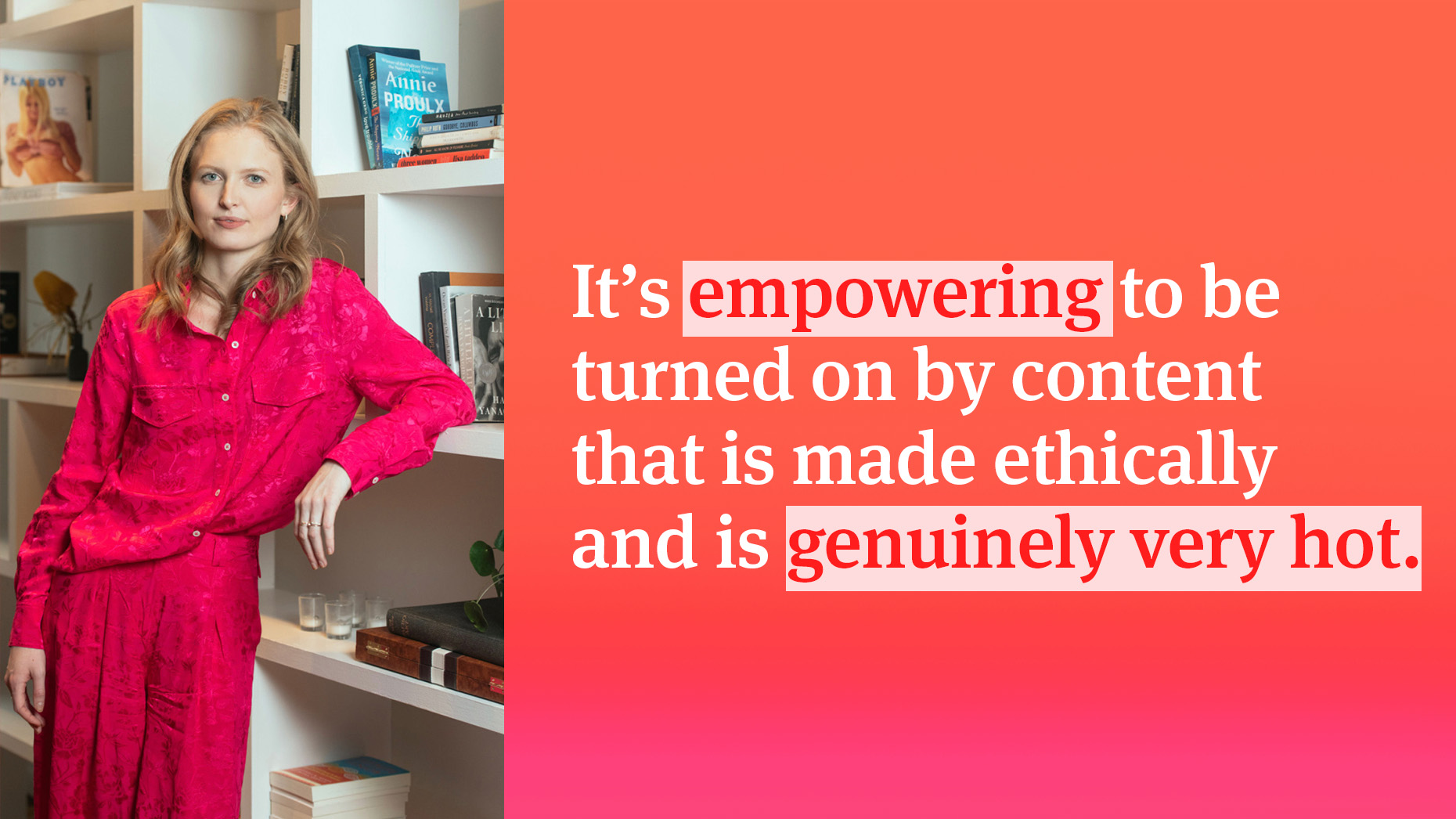
Quinn charges subscribers $4.99 per month, and they are logging in excess of 300,000 monthly sessions on the service. Quinn also has over 100,000 TikTok followers and a branded podcast called The Quinn Show, which covers issues like body image, dating and women’s rights from a feminist point of view. “The reason why I feel Quinn is empowering—it’s not because of ‘p*ssy power’ or like, ‘You should love your v*gina,’” Spiegel tells me. “It’s more about how I think it’s empowering to be turned on by content that is made ethically and is genuinely very hot. It’s not watered down. It’s not what people think women want. It’s made directly in response to what women want—and that is something new.”
Art by Haejin Park.
Spiegel discovered audio porn while she was an undergrad at Stanford University, where she studied computer science and joined the Kappa Alpha Theta sorority. She was recovering from an eating disorder, which led to sexual disfunction, and felt frustrated by her inability to get aroused or orgasm easily. At the beginning of her senior year, she stumbled upon audio erotica on Reddit and Tumblr and something clicked. She then made a (now defunct) blog of her favorite audios from across the internet, and shared it with her friends and sorority sisters, who responded enthusiastically. The blog would morph into an early iteration of Quinn (she borrowed the name from a male friend, who had just met his dream girl—a woman named Quinn).
“I was like, ‘I just don’t think the current erotic content is working and I think this is an opportunity,’” she says. “And obviously, at Stanford, there’s this idea that you are able to change a broken, old industry.”
Eventually Spiegel began spending more time on Quinn than on her classes and made the decision, like her brother Evan before her, to drop out of college. She spent the first year and a half after the company’s founding testing different user interfaces and business models. Would there be a monthly subscription fee or ads? Would content be produced by Quinn or generated by users? Would Quinn have editorial oversight over the audios or would it be, like Pornhub, essentially unmoderated? And how was it going to grow?
She also found a mentor in Erika Nardini, CEO of digital media company Barstool Sports, which had already developed its own hit female-hosted sex-positive podcast, Alexandra Cooper’s “Call Her Daddy.” When Nardini met Spiegel, she initially wanted to bring Quinn under the “Call Her Daddy” umbrella, but when the podcast left Barstool (moving to Spotify for a reported $60 million), the plan dissolved. Still, Nardini remained one of Spiegel’s advisers.
When asked for her top reasons for championing Quinn, Nardini lists three: “One, erotica has not been reimagined for women at all. Two, erotica and porn is really, by definition, from a masculine gaze. And three, how interesting to have this woman who’s willing to put herself out there in advocacy of a product that she thinks can help other women achieve pleasure and happiness.”
Quinn ran through a series of beta models that Spiegel coded herself. But in June, the now-expanded Quinn team (four plus the founder) landed on its current product, one that Spiegel says is “built to last.” It’s a website and app with a subscription model and a vibrant look reminiscent of Instagrammable book covers. As the company nears a Series A financing round, which Spiegel expects to close next month, Quinn is trying to thread the needle between two standard models of porn production. It’s neither the lawless frontier of homemade filth nor the uncanny valley of studio produced erotica, but a new invention somewhere in between.
Two corporations are now synonymous with modern-day erotic content: MindGeek, the parent company of the world’s most popular video-sharing services, including Pornhub and YouPorn, and OnlyFans. The former is marred by its appalling track record of allowing users to upload revenge porn and scenes of rape, child pornography and sex trafficking. The latter, while far more creator friendly and not always explicit, is also entirely dependent upon content made by users.
Quinn first had success with user-generated audio during the early months of the pandemic (partially because everyone was quarantining…often alone). But Spiegel quickly realized that the lack of control over Quinn’s recordings was making it more of an audio porn Tumblr and less of what she believed women really wanted: a curated collection of fantasies.
“When anyone can upload, it might as well be Reddit,” she says. “You don’t know what you’re going to get, which is the peril of user-generated content in general. So that’s when we were like, let’s do something different—let’s make this more like Headspace, Peloton vibes.”
So Spiegel came up with a compromise: Quinn approves every audio creator on the site, sometimes giving them creative ideas and production oversight, but the creators (referred to as Voices) make content on their own and maintain autonomy over the final product. The company makes sure the recording itself is high quality and does not feature anything off-limits (no nonconsensual sex or rape; no incest, minors or zoophilia). Spiegel also wanted creators to have distinct landing pages (à la Spotify’s artist pages) to encourage Voice loyalty. “Girls are fans of Quinn but they’re not really fans of Quinn,” she says. “They’re fans of the creators that they love.”
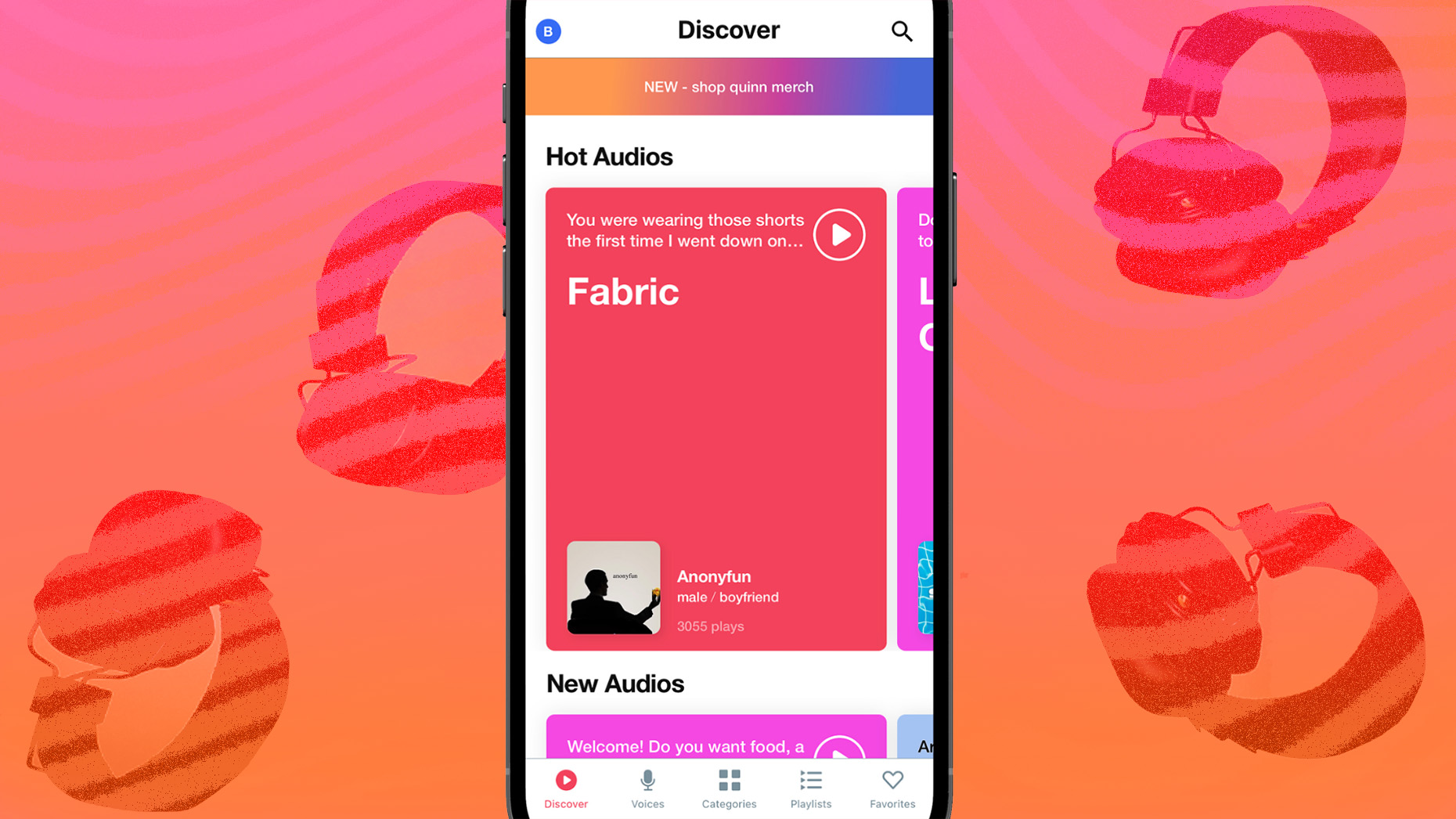
The app’s Spotify-like setup allows users to sort through audio porn tracks like they’re Top 40 songs—filtered by Voice, category or playlist. But instead of musical genres, audio porn categories range from mild (romance, storytelling) to spicier fare (“butt stuff.”) Collections of audio tracks are displayed as playlists with punchy titles like “Happy Ho-lidays” and “Daddy? Sorry…Daddy?”

The Quinn app offers a Spotify-like audio experience, but for porn.
Art by Haejin Park.
Spiegel and her team recruit new voices from all corners of the internet, scouring Reddit, TikTok, voice actor databases and Patreon for talent. The ratio of Quinn’s creators is roughly five male to one female—Spiegel found that her predominantly female audience generally prefers male-voiced audios—and most use audio porn as supplemental income. It’s just one more facet of the sex-work gig economy, Spiegel explained, absent the stigma that comes with appearing in visual porn. Some of the site’s part-time audio creators are making up to $5,000 per week, she claims.
A Quinn producer approached Danny Diamond (aka Danny) three months ago to record stories. He was already creating erotic audio for his OnlyFans subscribers, but says Quinn allowed him to upgrade the quality of his content. Neither Diamond nor Bad Influence writes detailed scripts—rather, they outline and improvise. “I don’t write stories, per se, but they do all come from me,” Diamond says. “I come up with a scenario”—for instance, sex in a movie theater, in a mall, at the gym—“flesh out the details in my mind and record the audio as if I were there. The dialogue typically isn’t an issue.”
Diamond notes, however, that Quinn audios have a recommended structure. “Quinn does like a certain ratio of ‘setup’ to ‘sex,’” he says. “I’d say 30% setting up the scene, the rest primal.”
“I’ve had real-life encounters that mirror some of the public and some of the rough-play scenarios in my work,” says B.I., who wants his “dom S&M-based audios” to be authentically intense. “In real life, whenever it gets rough, and we both reach that level of ‘literally nothing in the world exists except you and how much I need to f*ck you senseless’—that kind of neighbor-waking, hypnotic state—it’s intoxicating. And I really love exploring that feeling when I make those audios.”
As Spiegel sits in her yellow flannel button-down, sipping peppermint tea, she does not seem like a stereotypical porn executive. So how does she keep it all above board? How does she make sure that, in a field defined by the male gaze, Quinn’s version of pornography offers something better?
“This question of empowering versus exploitative—I fall asleep every night thinking about it,” she says. “And I think it’s really one of the central questions of the young female experience right now.” She cites a passage from feminist activist Andrea Dworkin’s 1987 paper “The Woman-Hating Left and Right,” which describes the ways in which liberals and conservatives misunderstand sex. “[Dworkin] says conservatives get it wrong because they say no one should have sex—no one should use prostitutes, no one should do sex work, no, no, no,” Spiegel said. “And liberals get it wrong because they say everything’s fine. As long as it’s not hurting anyone, everything is fine. And they don’t really critically define what hurting someone means or what consenting means. And there are very real questions of what is consent in a society in which one group of people, women, have not had the same rights as the other.”
Spiegel continues, “Even if [porn features] super–sex-positive sex workers and they consented to it and everything is by the book, I think it still leaves some haunting questions: Should someone be able to consent to this? Can you consent to abuse? Does that make the abuse not real? You know, those are some of the biggest philosophical questions of our time.”
With its contracted, solo-operating performers and allowance of anonymity, audio porn seems to be at least a partial workaround to these complicated questions. And audio porn, more than any other medium, prominently features discussions about sex, a logical bridge to conversations about consent. “I think that a lot of what goes wrong in sexual encounters, whether they be a one-off thing or something with one’s partner, is that there isn’t a lot of talking, both about sex and during sex,” says Professor Nancy Bauer, dean of academic affairs for arts and sciences at Tufts University and author of the book “How to Do Things With Pornography.”
Bauer favors the idea of audio pornography as a counter to the flagrant misogyny of traditional porn. “I think that what [audio] pornographers can do is promote egalitarianism in porn. They can show that saying to somebody, ‘May I touch you here?’ is sexy,” she says. “And it’s also respectful of another human being.”
Art by Haejin Park.
Quinn is still a relatively new, small startup, and how Spiegel will tackle these issues on a larger scale is still to be determined. However, Nardini believes there is a solid path to growth. “Caroline needs to grow her audience. She needs to secure talent. She needs to keep refining the product. So she needs a combination of technology and audience at this point,” Nardini says, emphasizing that the caliber of talent will make or break the business. “That’s why I felt ‘Call Her Daddy’ was so interesting, because we did a good job of building characters. So it’s like, all right, how do we make ‘Sexy Voice Guy’ the guy, you know?”
Spiegel also happens to have an expert in social content a phone call away. Her brother, Evan, is one of the most successful entrepreneurs of his generation, but Caroline is quick to note that his involvement in Quinn is negligible. “He’s more of a friend and a brother and a family member than he is a business partner,” she says. “He’s definitely a mentor in my life, but he didn’t invest in Quinn. He’s very supportive and often gives me advice, but I don’t think he’s particularly involved more than any other member of my family.”
Evan expressed a similar sentiment. “Caroline embodies an entrepreneurial spirit and I’m really proud of her," he wrote in a brief statement.
This hasn’t stopped some people from approaching Caroline with the conspiracy theory that Evan is actually the brains behind the operation. When I express shock at this notion, she responds, “You’d be surprised.” Her response to the doubters: “I’m leading the ship. He’s not,” she says, with finality.
Funded through an initial seed round with investments from Babel Ventures, Adrien Grenier’s DuContra Ventures, and Scooter Braun’s TQ Ventures according to Pitchbook data, Quinn faces a competitive environment as it approaches its Series A. And not just from audio-porn repositories like Reddit and Tumblr, but also from another audio erotica startup that’s perhaps a few steps ahead of Quinn. Dipsea, founded in late 2018, defines itself as “an ever-growing collection of sexy audio stories, wellness sessions, and dreamy sleep scenes.”
Like Spiegel did with Quinn, Gina Gutierrez and Faye Keegan started Dipsea to meet a need they saw among their female friends—the desire for high-quality, compelling, woman-centered erotic content. The Dipsea app has had over 2 million downloads, and the company raised $13.2 million in its seed and Series A funding rounds. It now has 24 employees.
Though Dipsea is also a subscription-based platform, charging users $59.99 annually, the process behind creating the content itself differs from Quinn’s. Dipsea envisions “an HBO model” for its audio programs, says Gutierrez, employing writers, editors, audio producers and directors as part of its in-house “story studio.” Instead of relying on individual personalities, Dipsea works with a paid network of professional freelance voice actors. Gutierrez also emphasizes that over 50 percent of its characters are voiced by people of color. “We want to create really premium content,” she says. “We believe we are the best central team of makers” in the audio porn space.
If Dipsea is HBO, with its high-production, professionally shepherded content, then Quinn’s likely path is to become a porn Spotify, with individual creators whose work is filtered by taste, curated into playlists and shareable across the platform. “We think that the more options for people who haven’t had options, the better,” says Gutierrez. “There is space in the universe for both an HBO and a YouTube. And so there’s certainly space for that in the erotic context, too.”
Barstool’s Nardini believes the best model for the audio porn market can be found not in entertainment, but in fitness. “I think whoever creates the Peloton of porn is going to have a really great business,” she says. “I don’t know if that’s going to be Quinn’s business, but I think that’s an interesting business personally.”
As Spiegel works to scale Quinn, she’s thinking broadly. She’s about to start season two of her podcast, “The Quinn Show,” where she discusses sex with the likes of TikTok influencer Christina “Tinx” Najjar and therapist Dr. Emily Morse. And she continues to make content for the app’s TikTok account.
“I think that Quinn is a media company. It’s a tech company. It’s a content company,” she says. “I’m always looking for new opportunities to find our user through content she’ll enjoy.”
And it does seem like her users are enjoying the content. Perhaps the only thing more passionate than the audios themselves are the app’s comments.
“Your voice is like melody to my ears…listening to you my legs were shaking,” writes one user in response to an audio called “Switching Up Your Roommate Fantasy.”
“Well, this unlocked like, 6 new kinks I wasn’t aware I had,” said another.
And, finally, succinctly, “Leaving instructions for this to be played at my funeral.”