AI’s Unexpected Consequence: Meta, Google and Big Tech Finally Appreciate Art
Silicon Valley once wasn’t as interested in art as Wall Street and other firms. Now, they’re buying AI art and establishing themselves as the new corporate Medicis.
On an unseasonably warm May afternoon in Manhattan’s bustling Rockefeller Center, the designers Wade Jeffree and Leta Sobierajski stood a few yards in front of a large, colorful sculpture—a “vibrant mirrored maze,” as a nearby placard puts it—that they’d spent the past year building. Billed as a Google Labs Collaboration, the project, per the tech giant, was spurred by the question, “How can generative AI expand the creative process?” Google equipped the Brooklyn-based couple with its latest tool, Whisk, a “generative media experiment… designed for rapid visual ideation,” which the pair then used to help create the structure.
For the tourists traipsing by to behold the enormous work, snap a selfie or spin the fluorescent disc incorporated in the design, AI’s influence in its creation may not have been immediately evident. The two designers, both clad in sunglasses and exuding cool in the sweltering heat, described Whisk as a “third partner” that aided their creative process. “We used Whisk as more of a mood board or helping us with ideation,” Sobierajski explained. “Essentially, our process, along with sketches, was speaking with Whisk, typing in prompts, getting feedback, getting imagery, and using that as a jumping-off point to design something. This design did not immediately come out of the system.”
As much as the project was devised to represent the frontier of AI and art and how they intersect, humans were still the driving force in its ultimate realization, Jeffree made sure to stress. “We had to get to a point where we had to make it for people, and that’s where we had to take over and curate the base idea and then bring it to life: How does it spin? How would a kid use it? How would an adult use it?”
Tech companies are increasingly playing an instrumental role in promoting AI art, as evidenced in partnerships like the one that resulted in the Rockefeller Center sculpture. At the same time, Steve Sacks, who owns bitforms gallery in Manhattan’s Lower East Side, said he has recently been working with some high-profile tech companies on specific purchases and commissions, indicating that there are several players looking to purchase and invest in AI art. (He wouldn’t comment on the specific companies.)
The Takeaway
While Silicon Valley has generally shown little interest in art, big tech firms are newly interested in collecting AI art and providing new AI tools to artists.This marks a notable shift in tech companies’ engagement with the arts, as tech firms historically haven’t been major art world players in the way that banks and other major corporations have. Sacks, for instance, once owned a gallery in San Francisco which he had to close after two years because it “wasn’t doing enough business,” in part due to lack of activity from the major tech companies in Silicon Valley.
“A big chunk of my collector base has been corporate collections over the past 20-something years, but these collectors or corporations are very, very traditional, old school, UBS, Bank of America, Chase, Fidelity. They have legit collections with art handlers, curators, registrars, big budgets, and they fill all of their millions of square feet with incredible art,”Sacks said. “But there are very few companies from the kind of post-internet generation that have this mentality of collecting for corporate culture.”
The relationship between the companies and the artists interested in AI is often more than one of collector and creator. In many cases, the businesses resemble latter-day corporate Medicis, serving as the artists’ patrons—handing them AI tools to develop their work and then using their feedback to perfect the software, which might then have broad commercial appeal. By buying and promoting AI art, Silicon Valley is broadly promoting AI itself, the industry’s foremost concern at the moment. It’s a quiet, intriguing corner of this moment of AI mania.
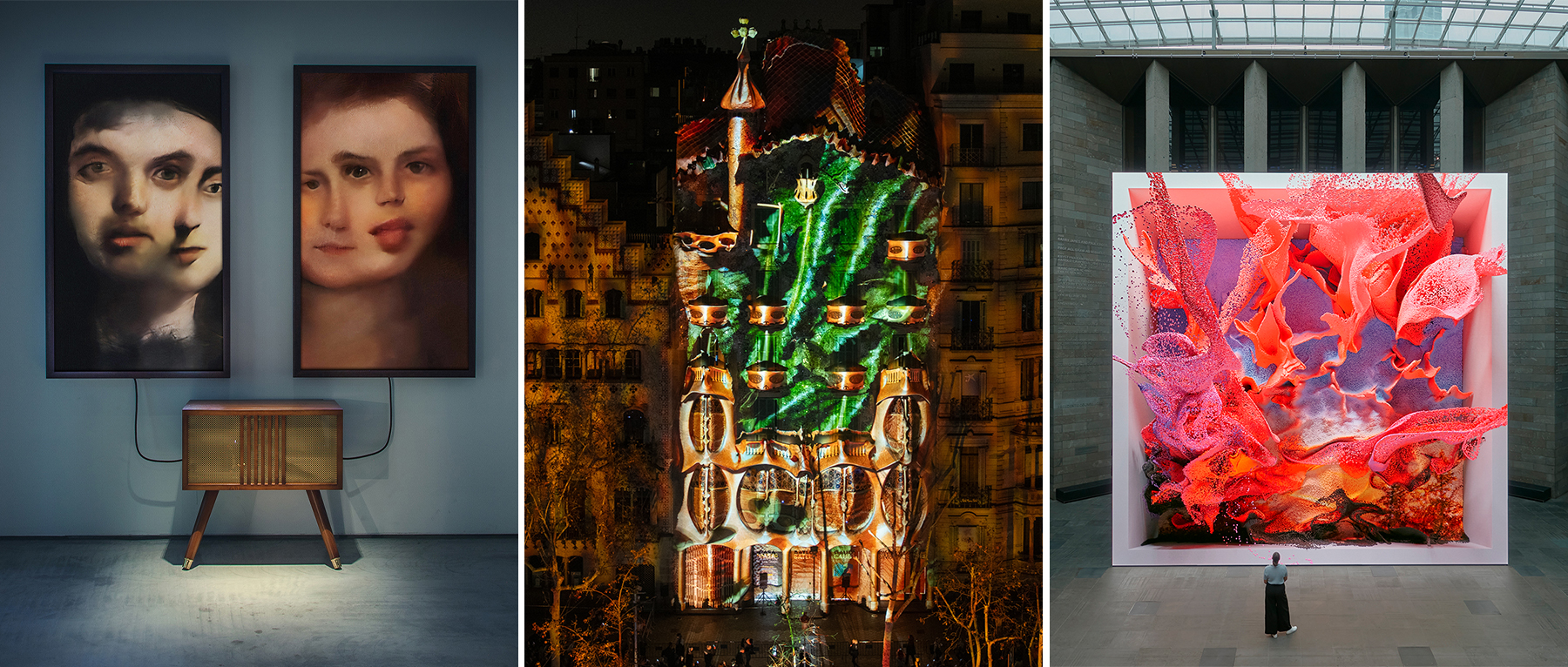
Art by Mario Klingemann, Sofia Crespo and Refik Anadol. (Courtesy: artists)
AI Artists to Know
Here are some of the most prominent artists experimenting with the frontier technology.
- Refik Anadol: Exhibited at MoMA in 2023; led Sotheby’s auction in February. (Location: Los Angeles)
- Sofia Crespo: Exhibited at the Victoria & Albert Museum. (Lisbon, Portugal)
- Stephanie Dinkins: Senior fellow at Eric Schmidt’s AI2050. (New York City)
- Mario Klingemann: Exhibited at MoMA and the Met; former artist-in-residence at Google. (Munich, Germany)
- Alexander Reben: OpenAI’s first artist in residence. (San Francisco)
Mira Lane, Google’s senior director of technology and society, said the company looks for a back-and-forth exchange with artists, and this has been a focal point in the company’s thinking about how to invest in AI art: “You don’t want it to be a one-way relationship. There should be a feedback loop between them.” Lane said the company is reliant on the artists’ input in its development of tools. “Artists play a really big role in that,” she said. “It’s not, ‘Just help us develop our creative technologies.’ It’s, ‘Help us push the frontier in ways we hadn’t thought about.’”
All creative fields and industries, of course, are currently grappling with AI-prompted change. Visual artists have had access to AI tools for a long time, but never to the extent of the past year, as AI has greatly proliferated.
In February, Christie’s held what the preeminent auction house billed as the “first-ever artificial intelligence-dedicated sale” (including works from artists such as Refik Anadol, Charles Csuri, and Claire Silver). Artsy, an industry bible and news site, deemed it a “huge success,” with Christie’s selling 28 of 34 lots for a total of $728,784. The sale received particular attention for the younger collectors who were brought into the fold: 48% of those who purchased work were either Millennials or Gen Z—very much not the usual crowd for Christie’s—and 37% of those who bought works were new to Christie’s entirely.
In February, Christie’s held what the preeminent auction house billed as the “first-ever artificial intelligence-dedicated sale” (including works from artists such as Refik Anadol, Charles Csuri, and Claire Silver). Artsy, an industry bible and news site, deemed it a “huge success,” with Christie’s selling 28 of 34 lots for a total of $728,784. The sale received particular attention for the younger collectors who were brought into the fold: 48% of those who purchased work were either Millennials or Gen Z—very much not the usual crowd for Christie’s—and 37% of those who bought works were new to Christie’s entirely.
Sarah Meyohas, a visual artist who has worked in film, photography, virtual reality and sculpture—and received much acclaim for projects including her “BitchCoin” release in 2015—said she has been encouraged by the way Google has engaged with artists. She pointed to a recently announced collaboration between Google and the director Darren Aronofsky. (Google is offering AI tools for Aronofsky’s production company to utilize with a group of his company’s emerging filmmakers.)
Meyohas recently has spent time exploring Google DeepMind’s latest Veo model, which generates videos from image and text prompts. “I’m super impressed with the results,” Meyohas said of the Veo model. “I can see how this is a creative medium now, more than in the past. And I can see that Google wants that to happen. I was talking to Darren, and I’ve been meeting with people at Google, and it seems like they’re really excited about the model: I can now see that authorship is possible with the video models.”
Sacks, whose bitforms gallery has worked with a slew of artists incorporating AI tools in the development of their art, said that two of the artists featured in his gallery recently completed “residencies” at Meta. The artists partnered with the company’s R&D and New Technologies departments “to evolve their art practice, which was kind of interesting,” Sacks said.
Lane explained that Google feels strongly that, in addition to supporting artists individually, putting their muscle behind these AI art initiatives helps to set a broader example. “I think it’s important for Google, and a lot of the big companies, to be supporting the humanities,” she said. “And if there’s going to be disruption in this space, part of responsible innovation involves, ‘Hey, what does it look like to bring that industry along?’”
The way in which corporations—tech and otherwise—invest in art, both internally and externally, has evolved in recent years. “I think a lot of industries struggle with how to engage with the arts and they don’t know how,” Lane said. “And so I think Google showing, ‘Here’s how we do it,’ gives people a little bit of a playbook on how they might do it so it doesn’t feel extractive.”
For those who still have PTSD from the NFT craze of a few years ago (now viewed as a since-popped “bubble”), it’s important to note the differences in this current AI moment. As Artsy noted, “the frequent conflation of AI-generated art with NFTs can confuse collectors,” and this has been an obstacle, more generally, in perceptions of AI art. Put overly simply, “AI-generated art” is made by artists using AI tools (like ChatGPT or DeepAI), whereas NFTs are digital objects defined by their ownership, as they’re acquired by their purchasers via blockchain technology.
There does remain controversy, however, about the way in which AI art has been accepted in the larger community. When the Christie’s AI art sale was announced in February, a petition asking for the auction house to cancel the sale garnered 6,500 signatures. This letter set forth, “these models, and the companies behind them, exploit human artists, using their work without permission or payment to build commercial AI products that compete with them.” (Christie’s responded at the time: “The artists represented in this sale have strong, existing multidisciplinary art practices, some recognized in leading museum collections. The works in this auction are using artificial intelligence to enhance their bodies of work.”)
Sacks explained that this is, in his mind, a new undulation in the evolving terrain. “We’ve been doing new media experimental art and technology at the gallery for 25 years. So this is just another tool that’s being utilized,” he said. “For us, I don’t like using the terms ‘AI art’ and ‘digital art’ because they’re really just tools that are being utilized. And, of course, they’re being exposed and exploited in different ways via auction houses.” He added later, of the “AI art” moniker, “It’s like saying you’re an acrylic artist. It’s too specific.”
Nonny de la Peña—founder and CEO of the digital media company Emblematic Group—said she doesn’t even like to engage in arguments related to the question of whether “AI art” qualifies as art. “Frankly, as far as I’m concerned, the debate itself is a non-starter,” she said. “Most of my work is thinking in three and four dimensions, and in no way could I do the work I’m doing now without the AI components that drive the technology. It’s an unbelievable amount of hard work.”
At Rockefeller Center, standing in front of their shimmering achievement amongst the throngs of tourists, Jeffree and Sobierajski reflected on the future of AI and art.
Sobierajski assessed the state of play: “We’re constantly trying to expand the way that we think, and we want to adapt. We want to utilize new options. I think it’s something that we can use as a supplementary tool. I don’t think it’s a tool that we say, ‘Here, go do it. It’s done.’”
While Google Labs’ Whisk served as the “third partner” for the pair in the creation of their sculpture, they noted, Whisk couldn’t have done it all on its own. “I think what makes this feel so monumental and exciting for us and other people is that there is still the human thought involved,” Sobierajski said. “I think that until something like AI can actually program empathy, we still really need to be a part of that process.”