Apple is recruiting experts in automotive technology and vehicle design to work at a new top-secret research lab, said several people familiar with the company, pointing to ambitions that go beyond the dashboard.
Friday’s news of a secret research lab in the FT there, which stirred the froth around Tesla, the electric car company run by Elon Musk. A $75bn takeover target for Apple, anyone?
The problem with the theory, aside from Tesla’s mere $25bn market capitalisation, is that nobody really needs to buy Tesla. Might someone? Sure, but a glance at the company’s history shows just how little cash it took to build.
The first vehicle was the Tesla Roadster, a proof of concept sports car. Total capital expenditures and research and development costs from inception to the day of the first delivery ran to about $125m.
Production of a high-end sedan followed, and the development of manufacturing facilities in Palo Alto, California, was helped by a $465m loan facility from the Department of Energy, agreed in 2010 and drawn down in stages.
Tesla also struck deals with Daimler and Toyota to help fund the development of what is known as powertrain technology — the combination of battery, engine, gearbox, clutch and management software that makes an electric car move — and with Panasonic for batteries.
One thing to realise, however, is the simplicity of the electric motor invented by Nikola Tesla compared to an internal combustion engine. The challenge is transferring the power to the wheels smoothly, as well as managing and prolonging the battery life. So far as engineering problems go, it is more a question of people and resources than reinventing the wheel. Tesla has also offered to share patents with the industry on fair terms.
So let’s say you wanted to start an electric car company (or division) from scratch. Here is what Tesla has spent on research and development and capital expenditures:
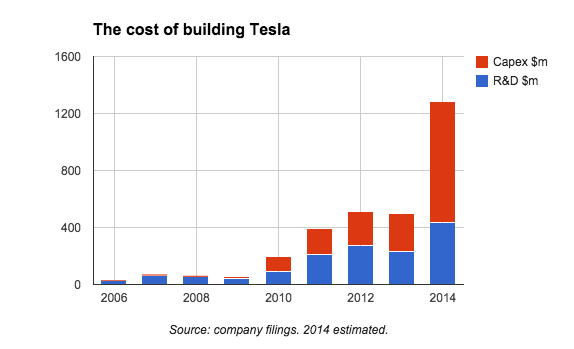
The 2009 R&D figure includes a $23m contribution from Daimler, but that makes little difference to the overall total of $3.1bn.
More spending is in prospect, with a planned battery “Gigafactory” expected to cost $4bn to $5bn by 2020, of which Tesla will contribute about $2bn, or about $400m a year. Also remember that Tesla was helped out early on by taking over a factory formerly owned by General Motors and Toyota, and you wouldn’t have Elon Musk running the show.
Still, if you think all cars will one day be electric (and driverless), there is time to catch up.
You would have to find staff, but assuming you are a well resourced multi-national company to start with, the numbers aren’t daunting. At the end of 2009, Tesla had 514 full time employees: 142 in manufacturing, 120 in research and development, 71 working on vehicle design and engineering, 83 in sales and marketing, 35 in services, and 63 general and administrative staff. Four years later the total had grown twelvefold to almost 6,000 employees.
Set up your secret research lab and start writing cheques. Lets say you want to do it fast (four to five years) and can throw money at the project. Do you plan to spend double what Tesla did to get to this point? Triple? Even if you did (and weren’t able to find supportive governments, carmakers and battery makers to get involved) you’d still have spent less than a third of what it would cost to buy Tesla outright.
A budget of $1bn to $2bn a year is not exactly small, but aluminium milling specialist Apple already spends $6bn a year on R&D. Google, the online advertising company with a sideline in driverless car technology, spends $10bn annually. In 2013 Volkswagen invested €11bn ($13bn) in property, plant and equipment, and capitalised a further €4bn ($5bn) of research spend.
Or to put it another way, Tesla is a good electric car brand but is unlikely to be the only good electric car brand come 2020. While it has a head start, buying it would be an expensive and unnecessary way to catch up.