(GS) The new oil order: Finding a new equilibrium (interesting read)

1.The decline in oil prices continues unabated. We believe the oil market is experiencing a cost re-basement which makes determining when the market is oversold extremely difficult, as the price at which rebalancing occurs is now a moving target to the downside. For the market to be oversold, it requires prices to be far below costs, which are in flux as much as the oil price given the sharp declines in other commodities, currencies, rig rates and oil services costs. On top of downward cost pressures, efficiency is being forced on the industry with evidence of ‘high grading’ where rigs in non-core areas are being re-directed towards core, lower-cost resource plays. All this suggests that costs are falling nearly as fast as the price, which means oil producers can spend less to get the same or potentially even more in terms of production.
2.Although we are not willing to take a strong directional view at current price levels, there is some evidence of rebalancing beginning to happen, and it is trending faster than our forecast which was based upon $70/bbl. But the rebalancing is far from sufficient which creates more downside risks. While the overall rig count in the US dropped by 29 last week, this was almost entirely in vertical rigs, not the horizontal rigs used in shale production. Since early November, 12 US producers representing an estimated 8% of 3Q 2014 US oil production have issued 2015 capex/production growth guidance. Weighted average capex budgets are down 12% yoy. However, each is still forecasting production growth on average in 2015 vs. 2014, except one which is guiding to flat yoy production. So while reductions in capex are coming faster than expected, it is unlikely to translate into less supply than expected, highlighting both the rapid cost reductions with rig rates already down by 15-20% and efficiency gains through high grading.
3.Slowing the rebalancing and creating further downside risk is a very strong consensus view that this pull back is temporary and that oil prices will quickly rebound as they did in 2009. According to a recent Bloomberg survey, the median WTI forecast for 2016 is $86/bbl (even we forecast it going back to $80/bbl). All of these forecasts are based upon now outdated cost data that is shifting as fast as the price. It is precisely this strong view for a rebound in prices and the behavior it creates, that not only suggests that oil prices can go lower for longer, but also that the new normal is far lower than we thought just one month ago. Instead of optimizing against a lower price environment, many oil producers are trying to position themselves for the rebound in prices. There are many options available to an oil producer than just simply cutting production in response to lower oil prices – lower costs and increase volumes, sell more equity, tap a revolver or preserve liquidity to survive until another player with deeper pockets buys them even if the cost is more leverage.
4.As we argued several months ago, this sell-off has been driven by long-dated prices (a proxy for the normal price) as opposed to a weakening in the forward curve timespreads as in past bear markets. The current shape of the forward curve does not incentivize the storage of oil. Although the spot price is only at $58/bbl, the 5-year forward oil price is already lower today at $69/bbl than it was in December 2008 ($70.50/bbl) when spot WTI prices fell to $33/bbl. The reason that the forward curve was in such a deep “contango” in 2008 was that OECD inventories had swelled by 60 million barrels on a seasonally adjusted basis in October and November of that year. This October and November, the seasonally adjusted build was only 18 million barrels – far from being a significant surplus that challenges storage capacity and requires a deep contango. It is instead the expectation for forward balances to be in severe surpluses that is driving the longer-dated price decline and will ultimately help rebalance the market. We have used the phrase “long-term surpluses create near-term shortages” to characterize this trading pattern i.e. sell the forward prices on concerns of long-term surpluses that can make the reality of surpluses self-negating.
5.While this is the first time we have seen a backend driven bear market, the bull market of the 2000s was also backend driven but with weak timespreads, i.e. “long-term shortages create near-term surpluses” – the near opposite of what we are seeing today. As low-cost oil supplies were exhausted in the early 2000s the market turned to higher cost resources and input costs escalated quickly as demand increased. The higher oil prices resulting from higher costs slowed US growth, weakened the US dollar which in turn strengthened the commodity producer currencies which further drove up the cost of producing other commodities that were inputs into oil. It was a reinforcing dynamic to the upside that created cost inflation that drove up the long-dated (normal) oil price. Now it is all working in reverse as the market searches for a new equilibrium – lower oil prices, weaker commodity currencies, lower material and oil service costs and increased efficiency are all reinforcing to the downside.
6.The natural gas experience of 2011-13 is the rule, not the exception. Despite the collapse in natural gas prices several years ago, US natural gas production has continued to grow above expectations. It is often cited as an exception as the higher oil prices subsidized the associated gas output and new low-cost fields such as the Marcellus and Utica were available. In other words, the industry just shifted its activity to the lower part of the cost curve and continued to grow output. The reasons we see this as the rule, and not the exception is that we have seen this in iron ore, coal and gold as well. So there is a likelihood we could see this in oil as producers shift all their efforts to the lower part of the cost curve.
7.With no obvious new low-cost US shale oil field, beyond the high grading to each play’s sweet spot, we believe that the oil market’s Marcellus is most likely to come from abroad. Kurdistan and Southern Iraq will likely continue to grow production, with Iran potentially contributing medium term as well. Further, in a market anchored at shale’s marginal cost of production, it is in OPEC’s interest to maximize revenue through volumes, pointing to potential increases in production over time in core OPEC too. Russia could be the oil market’s Marcellus field as well. It is important to stress that the Russian ruble has weakened almost as much as the oil price has declined, leaving oil prices in Russian ruble near an all-time high. This is important as all costs are Ruble denominated while revenues are USD denominated, leaving Russian oil companies’ margins insulated despite the dollar decline in price. In addition, the Russian government is easing the export taxes which further improve the profitability of Russian oil.
8.While core-OPEC such as Saudi Arabia have substantial dollar reserves to weather low oil prices for a very long time, distressed-OPEC like Venezuela are in a very difficult position. In fact, these producers are some of the top candidates to aide in the rebalancing of the market in 2015. In addition, Libya has experienced setbacks with increased fighting over the weekend leading to another output loss to below 500 thousand barrels per day. While this may help keep the market from experiencing near-term surpluses, the temporary nature of it doesn’t help solve the longer-term imbalances.
9.While historically a 40% pull back in prices would stimulate demand by 50bp, the responsiveness of demand and global growth is likely far less than what it was historically. In the US, net imports are around 25% of demand, levels only seen during the depths of the early 1980s recession. In China and other emerging markets, governments are taking advantage of the decline in oil prices to reduce subsidies and/or introduce consumption taxes as nearly all developed markets have. Further, the sharp decline in nearly all commodity prices and the weakening in commodity currencies creates headwinds for oil demand in the commodity producing emerging markets in Latin America and the Middle East. Historically these regions didn’t contribute much to oil demand, today they do.
10.It is important to emphasize that this is a supply driven bear market and not demand driven. We have to go back to the mid-1980s to find another supply driven bear market. Because the surplus is supply driven it is easily observable in the future unlike demand shocks that are instantaneous, so the market is trying to rebalance the future, not so much the present. In the 2000s we forecasted severe supply driven shortages that never came, because long dated prices dragged the market high enough to slow demand and bring on marginal supplies –hence long-term shortages created near-term surpluses. Once again the market is trying to rebalance the future, by re-basing industry costs to take out the excess marginal production. As the industry takes the ‘fat’ out of the system that was built up over the past decade, the new equilibrium price is dropping sharply – where it settles is unknown right now, but we can comfortably say it is likely below our estimates from last month. Once we have cost data early next year from this time period we will have a better idea, but in the meantime volatility will likely remain high with risks skewed to the downside as the market searches for a new equilibrium.
TechCrunch : Snapchat Plans Music Feature, Acquired QR Scan.me For $50M And Verg

Snapchat Plans Music Feature, Acquired QR Scan.me For $50M And Vergence Eyeglass Cam For $15M,

Leaked emails from the Sony Pictures hack have uncovered several acquisitions made by Snapchat, as well as plans for a music feature and meetings to discuss partnerships with Twitter.
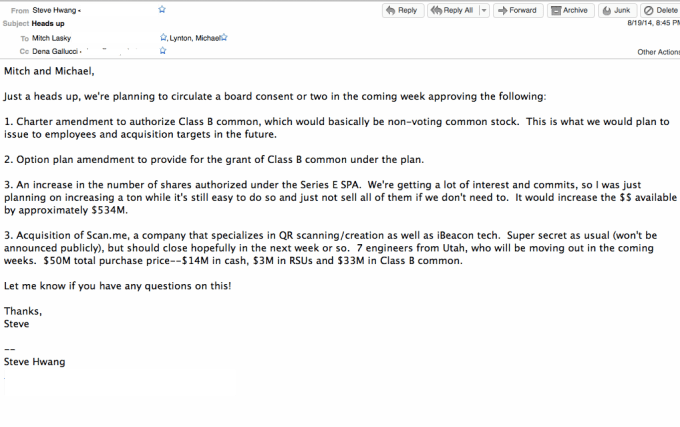
According to emails between Snapchat, Sony Entertainment CEO Michael Lynton, and Snapchat board member Mitch Lasky, Snapchat bought a QR scanning and iBeacon startup called Scan.me for $14 million in cash, $3 million in restricted stock units, and $33 million in Class B common Snapchat stock. It also acquired Vergence Labs, makers of an eyeglass video camera, for $11 million in cash and $4 million in stock.
Snapchat also apparently paid $10 million in cash and $20 million in stock and bonuses for AddLive, the startup Snapchat bought to power its real-time video chat feature but didn’t have the price for.
Other info in the emails include that Snapchat has recently been working on a music feature, and CEO Evan Spiegel has grand aspirations to promote artists through his app and capitalize on their success. Snapchat negotiated with Vevo for a feature that sounds like it would bring music video viewing inside Snapchat in August, but hit a snag over the revenue sharing on advertising. Valleywag reported earlier today that emails indicate the acquisition deal from Facebook that Snapchat turned down was more than $3 billion.
Scan.me
Snapchat’s Steve Hwang emailed Lasky and Lynton telling them the acquisition of Scan.me is “Super secret as usual (won’t be announced publicly)”, that the company “specializes in QR scanning/creation as well as iBeacon tech”, and that “7 engineers from Utah, who will be moving out in the coming weeks.”
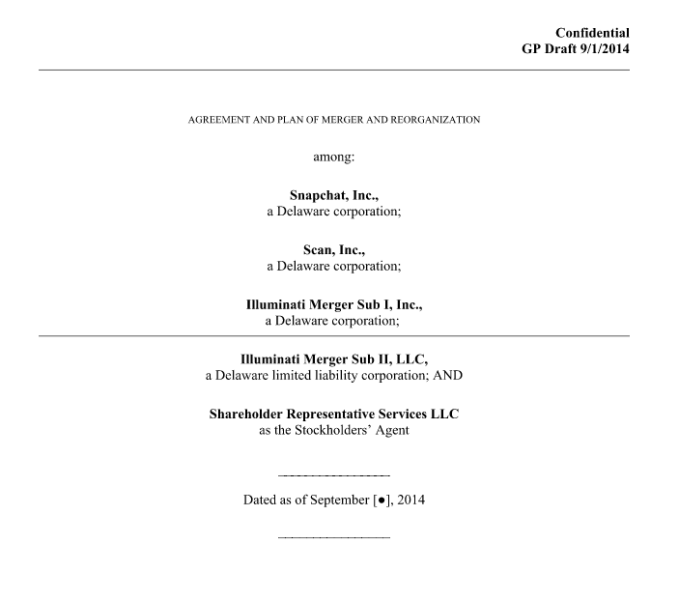
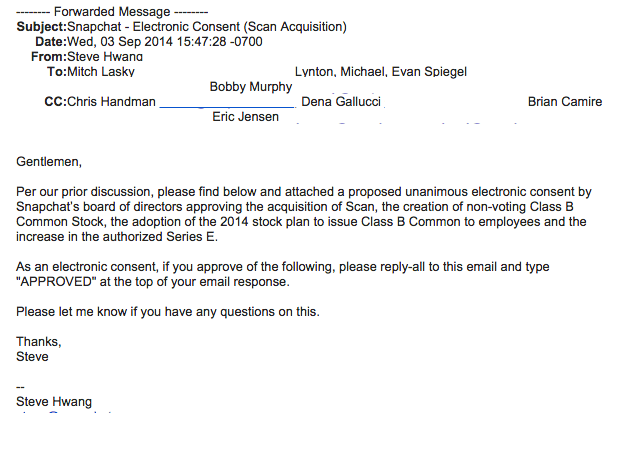
Scan.me acquisition consent form sent to Snapchat board members
Scan price details
Scan.me acquisition confirmation

>>> US Early premarket gappers

Early premarket gappers

Gapping up: ASPX +83.3%, VOLC +55.4%, CERS +23.6%, APP +20.7%, PTRY +9.3%, PLAY +9.1%, CYRN +5.7%, GFI +5.3%, PBR +4.8%, RIO +3.8%, SNE +3.4%, IDRA +2.8%, STO +2.8%, VALE +2.7%, SWC +2.6%, AREX +2.4%, RDS.A +2.4%, DRI +2.3%, TOT +2.2%, SDRL +2.2%, AUY +2%, NGG +2%, TRGT +1.7%, MTZ +1.7%, AA +1.6%, MGM +1.6%, ABX +1.5%,GG +1.4%, HAL +1.3%, GDX +1.2%, SLV +1.1%, MT +1.1%, BP +1.1%, HBAN +1%

Gapping down: NVGN -36.2%, POZN -19.2%, CLF -13.5%, FRO -11.4%, RT -3.9%, YGE -1.9%, CFX -1.7%, HEI -1.7%, PHG -1.6%, HSBC -1%, PNR -0.9%, TSLA -0.5%

>>> FedEx misses by $0.08, reports revs in-line; reaffirms FY15 EPS guidance

FedEx misses by $0.08, reports revs in-line; reaffirms FY15 EPS guidance

Reports Q2 (Nov) earnings of $2.14 per share, $0.08 worse than the Capital IQ Consensus Estimate of $2.22; revenues rose 4.4% year/year to $11.9 bln vs the $12 bln consensus.
  • Operating margin of 8.5%, up from 7.3% a year ago.
  • FedEx Express Segment: Revenue of $7.02 billion, up 3% from last year's $6.84 billion; Operating margin of 6.9%, up from 5.2% the previous year.
    • U.S. domestic package volume grew by 7%; FedEx International Economy volume grew 5%
  • FedEx Ground Segment: Revenue of $3.06 billion, up 8% from last year's $2.85 billion; Operating margin of 15.2%, down from 15.4% the previous year F
  • FedEx Freight Segment: Revenue of $1.59 billion, up 11% from last year's $1.43 billion; Operating margin of 7.1%, up from 5.8% the previous year.
    • Less-than-truckload (LTL) average daily shipments increased 8%, including a 10% increase in demand for Priority service. LTL revenue per shipment grew 3% due to higher weight per shipment, higher rates and increased fuel surcharges.
Guidance
  • Co reaffirms guidance for FY15, sees EPS of $8.50-9.00, excluding non-recurring items, vs. $9.11 Capital IQ Consensus Estimate. The outlook assumes continued moderate economic growth and a modest net benefit from fuel. The capital spending forecast for fiscal 2015 remains $4.2 billion.
Fuel Surcharges
  • FedEx regularly reviews its fuel surcharge tables and will update certain tables at FedEx Express, FedEx Ground and FedEx Freight effective February 2, 2015. Details on these changes will be available on fedex.com by December 23, 2014.

WSJ : Plunging Ruble Unsettles Russians, Poses Test for Putin

Plunging Ruble Unsettles Russians, Poses Test for Putin

Russians Rush to Buy Big-Ticket Items and Foreign Currencies as Ruble Hits Record Low

MOSCOW—As Russian President Vladimir Putin has ratcheted up the conflict with the West for most of the year, the economic fallout on ordinary Russians has been limited.

Suddenly, though, the plunging ruble is reawakening fears of rising prices and the kind of financial crisis Mr. Putin has sought to put behind his country. As the ruble hit a record low, falling as much as 20% against the dollar Tuesday, Moscow residents rushed to buy electronics and other big-ticket items and drained rubles from ATMs to swap them for dollars and euros—signaling a new feeling of vulnerability among Russians and a fresh challenge to their leader.

From St. Petersburg to Siberia, money changers ran out of foreign currency and were raising exchange rates. Sberbank , Russia’s state savings bank, and Alfa Bank, Russia’s largest private lender, said they were experiencing a rush for dollars and euros.


“The demand is enormous. People are bringing piles, huge piles of cash. It is madness,” said Kamila Asmalova, a manager at a Moscow branch of Sberbank. The branch ran out of foreign currency by 2 p.m., she said.

Lanta Bank, a midsize Moscow lender, said its foreign counterparts would be unable to send foreign currency Wednesday as aircraft that typically transport cash are full.

Apple Inc. said it halted online sales in the country because of the ruble’s volatility, and IKEA announced it would raise prices there.

The ruble’s continued fall despite the Russian central bank’s move to raise interest rates to 17% rippled across global markets Tuesday, fueling a selloff in emerging market currencies and stocks. In the U.S., the turbulence was more muted, as the Dow Jones Industrial Average closed down 0.7%. The yield on the 10-year Treasury, a traditional haven, fell to 2.07%, its lowest closing level since May 2013.

Abroad, Russia’s crumbling currency—driven by sanctions and eroding oil prices—raises the threat of a currency market contagion, particularly for emerging economies facing headwinds, such as Turkey and Indonesia.

At home, economists say the Russian central bank’s rate gambit is certain to push the country’s faltering economy into recession by raising borrowing costs. Even before the rate increase, the central bank estimated the economy could contract as much as 4.7% next year if oil remains around $60 a barrel. On Tuesday, Economy Minister Alexei Ulyukayev said that the government would introduce some “regulatory measures” on the foreign-exchange market, but that it wasn’t discussing any capital-control measures.

The big question is whether Russia’s economic troubles will turn into a real political challenge for Mr. Putin, whose approval ratings remain above 80% and who retains tight control over politics and the economy.

The faltering economy could fortify the already strong backing for the Kremlin in its confrontation with the West, since Moscow blames the problems on enemies.

As the White House said Tuesday that President Barack Obama would sign a bill turning Russian sanctions into law, Russian Foreign Minister Sergei Lavrov told television station France 24 that “Russia will not only survive but come out much stronger.”


Banks were already bracing for the impact of high interest rates. UBP fund manager Pavel Laberko said banks would be the first to be hit by the higher cost of borrowing, with weaker institutions having to halt operations.

“A lot of [market] participants are in serious condition because of these events,” Bank of Russia Deputy Chairman Sergei Shvetsov told reporters Tuesday. “The choice the central bank made [to raise rates] was between very bad and very, very bad.”

Global banks also have curtailed the flow of cash to Russian entities this week. Banks including Goldman Sachs Group have started rejecting requests from institutional clients to engage in certain ruble-denominated repurchase agreements and other transactions designed to raise cash, according to people familiar with the matter.

With credit more expensive after the rate increase, rising prices are set to hurt consumers. The Association of Retail Companies expects food and drink prices to rise by as much as 15% in the first quarter of next year, according to its spokesman.

Russians have in recent days rushed to spend their rapidly weakening rubles on electronics and cars before their prices are expected to rise. M.video, an electronics retailer, attributed around one-third of current sales to such purchases.

Shoppers reported long lines at IKEA stores in Moscow after the company announced price increases in the coming days. Last month, Apple raised the price of the iPhone 6 by 25% in its online store in Russia as the U.S. dollar continued to rise against the ruble.

Deputy Prime Minister Olga Golodets warned that rising prices would lead to an increased number of people living in poverty, a rare government acknowledgment of impending economic pain.

Maria Semyonova, a 30-year-old home maker from Nizhny Novgorod around 200 miles east of Moscow, said she was expecting tough times paying for her mortgage and baby on her husband’s salary and her maternity pay. She said the family was cutting back on New Year’s presents, buying theater tickets for her parents rather than spending thousands of rubles on gifts.

Still, Mrs. Semyonova said she and her husband agreed with Mr. Putin that the West was at fault for the crisis. “I think that Putin is acting appropriately given the situation,” she said.

Mr. Putin’s main supporters—poorer people and state workers—often don’t have savings and their expenses are mostly in rubles. The ruble’s slide is mostly hitting the middle classes who sometimes vacation abroad and have savings. Tatiana Boytsova, a 28-year-old finance professional from St. Petersburg, said her colleagues spent 40 minutes in line trying to exchange rubles. She said she and acquaintances were canceling trips abroad even if tickets couldn’t be refunded, since costs there would simply be too high.

Ms. Boytsova said she wasn’t expecting much of an end-of-year bonus, and was even thinking about trying to sell her ticket to an opera Friday. “At the moment, money feels better than the opera,” she said.

Some retailers were putting up prices on Tuesday after holding them steady for several weeks, so as not to scare customers while they sold off stock.

A store in central Moscow selling Apple products temporarily removed old price tags for computers and gadgets on Tuesday, while printing out new ones with prices higher by as much as $50 in ruble terms.

(TEL) Vladimir Putin Named Russia's 'Man of the Year' - for the 15th Time in...


Vladimir Putin Named Russia's 'Man of the Year' - for the 15th Time in a Row
2014-12-17 11:09:41.648 GMT


Andrew Marszal
Dec. 17 (Telegraph) -- Russian president proves too popular
yet again for his rivals, sweeping up 68 per cent of the public
vote in competition he has dominated since becoming prime
minister in 1999
He has overseen the collapse of the rouble, Russia's growing
isolation and a draconian clampdown on the press and freedom of
speech. But nothing, it seems, can dent Vladimir Putin's
popularity.
The Russian president has been named Russia's "Man of the
Year" for a remarkable 15th successive year, according to Russian
news agency Interfax.
Mr Putin, 62, retained his crown by an enormous margin,
securing 68 per cent of the public vote. His second-placed rival,
virulent Russian nationalist leader Vladimir Zhirinovsky, managed
a paltry four per cent.
Some 1,500 Russians from across the country were choosing
from a list of Russian politicians and public figures.
Mr Putin's popularity is currently soaring in Russia,
matching an all-time high of 88 per cent approval rating in
October following his annexation of Crimea earlier in the year.
The only previous time his popularity reached such heights
was following Russia's swift, successful military invasion of
Georgia in September 2008.
The Russian public, it would seem, approve of Mr Putin's
forceful approach to international relations.
Of course, it is not just his own subjects who are
vulnerable to Mr Putin's charms.
Hillary Clinton, the former US Secretary of State and
potential future presidential hopeful, spoke earlier this year of
Mr Putin's "very bright blue eyes", admitting that "when he wants
something from you... he can turn on the charm".
And Mr Putin was spotted in October paying a visit to his
old friend Silvio Berlusconi, leaving the former Italian prime
minister's Milan residence at 3.45am after late-night dinner.
And then there is Mr Putin himself, who - according to
former Soviet leader Mikhail Gorbachev - views himself as "second
only to God".

-0- Dec/17/2014 11:09 GMT

>>> Sanofi/Bayer - Anothe animal health deal --> Watch Zoetis (ZTS US)

ZTS is down 9% since high, almost back to levels before annoucment of Ackman's stake ($2b stake / 8.3% stake)
as we saw rumors of Valeant that could be interested in the name even with some bankers from the street were mentioning that there is a lack of synergies and its high valuation make the deal unlikely. Other rumors mentioned also before that Bayer could be interested by ZTS, these rumors came after Bayer announced plans to spin off its plastics unit to focus more on health care in mid-September and Bloomberg News reported that ZTS could be an attractive target for the diversified German company (after this Sanofi news could be take down and Sanofi maybe mentionned as a suitori) . And on 3Q14 earnings call, BMO Capital Markets’ Alec Arfaei wanted to know, since there have been a number of reports of possible buyers for ZTS and “this will become more of a factor [after June 2015]…how should we think about your position on being a target of a potential acquisition? ” Recall, ZTS was spun out from Pfizer in June 2013, making June 2015 the two-year anniversary that is widely held as the benchmark for when a tax-free spinoff can be acquired without incurring tax penalties. CEO Juan Ramon Alaix responded as one would expect, by defending ZTS’ value proposition as an independent company.

ZTS started to traded lower on the 9th after a Report on reuters quoting that Valeant Pharma is abandoning its acquisitions growth strategy for now to reduce debt, boost stock price. {http://reut.rs/1wK4z1B}

It looks now that Sanofi has also an interest in growing in the animal health business it's only €2.2b revenus ...

It could be interesting to keep an eye on that as rumors can re surface after this Sanofi / Bayer announcement


NEWS

Sanofi acquires Bayer's equine health products Legend/Hyonate and Marquis
Sanofi today announced that Merial, its animal health company, has reached an agreement with Bayer HealthCare to purchase two Bayer equine health products, Legend®/Hyonate® (hyaluronate sodium) and Marquis® (ponazuril).

Legend/Hyonate is an injectable solution that treats noninfectious joint dysfunction in horses; and Marquis Antiprotozoal Oral Paste is the first FDA-approved treatment for equine protozoal myeloencephalitis (EPM), a disease that affects the central nervous system in horses.

"We are pleased to add two top equine products to our global portfolio. Legend and Marquis are highly regarded by the horse community and further support our commitment to equine veterinarians, horse owners and trainers," said Merial CEO and Sanofi EVP Carsten Hellmann. "This addition is one example of our strategy to invest in business opportunities that enable us to deliver innovative solutions to veterinarians across animal species."

The purchase, expected to be finalized in early 2015, further broadens Merial's portfolio of leading products that improve the health and performance of horses. Legend/Hyonate is primarily sold in the US and Canada, but is available in more than 40 countries with the UK and Japan as important markets. Marquis is only sold in the US and Canada. Merial plans to make both products available to veterinarians in countries around the world. The acquisition is subject to customary closing conditions.

Merial is a global leader in advancing the health of pets, horses and production animals. The company's global equine portfolio currently includes products to treat and prevent Equine Gastric Ulcer Syndrome and to control parasites in horses, as well as vaccines to help prevent Equine West Nile Virus, Potomac Horse Fever, equine influenza, and rabies in horses. In October 2014, Merial launched its latest equine addition, with the EU approval of the updated equine influenza vaccine ProteqFlu®.