FT : How Heineken tapped into China’s beer market

How Heineken tapped into China’s beer market
The country’s biggest brewer is using its Dutch partner to reach more of the growing premium segment

Western consumer brands in China have long been coming to terms with the prospect of lower growth in the world’s second-largest economy. But demand for Heineken’s beers tells a different story.

In 2023, sales volumes for the Dutch lager maker’s various brands, including Amstel, rose more than 50 per cent. Last year, as the overall mainland China beer market shrank, its volumes increased nearly 20 per cent to just under 700mn litres — almost enough to serve a pint to everyone in the country.

Heineken’s growth comes after a deal agreed in 2018 with China Resources Beer, China’s biggest brewer, which gave the state-owned group rights to the brand on the mainland while Heineken took a stake in China Resources Beer and gets royalties from the deal.

The approach points to pockets of opportunity for well-known foreign names in China’s fast-evolving consumer sector, even if the wider markets in which they operate are saturated.

“This is a very healthy transactional relationship,” said Tristan van Strien, global investor relations director at Heineken of the relationship with China Resources Beer. “They need us and we need them.”


Heineken’s growth rates “have undoubtedly outperformed”, said Euan McLeish, an analyst at Bernstein. “None of the other premium brands have been talking about double digits.” 

China’s overall beer market is in decline. Sales fell an estimated 4 to 5 per cent last year amid concerns over consumer confidence.

But for China Resources Beer, whose sales dropped 2.5 per cent in 2024, Heineken is a pick-me-up.

Its deal with Heineken gave it rights to the Dutch beer in China for an initial 20 years, in exchange for a stake in one of its holding companies that gives Heineken an effective interest of about 21 per cent in China Resources Beer.

The lager, previously mainly sold in two southern provinces, was rolled out across the country. Growth has been rapid, helped by sponsorship of events such as the Shanghai Formula 1 grand prix in March, where 500ml servings were on sale for Rmb40 ($5.5).

A 500ml serving of Heineken in China costs an average of Rmb12-15 ($1.67-2.08), according to Morningstar, though prices vary significantly across regions and from bars to shops.

Heineken has grown by “leveraging the distribution network of China Resources Beer”, said Jacky Tsang, an analyst at Morningstar. 


China Resources Beer, whose local Snow beer is the country’s best-seller, is using Heineken to push into China’s premium market — often defined as beers that cost at least 20 per cent more than the average.

“The overall beer volume in China is on a gradual decline trend,” said Tsang, meaning China Resources had “to go after price growth to drive profit growth”.

Heineken’s growth, from a low base, contrasts with other western brands, which have also generally positioned themselves as premium options in China.

Danish brewer Carlsberg, which has about 10 per cent of China’s beer market, reported that sales edged 1 per cent lower last year. Jacob Aarup-Andersen, chief executive, said last month the market had been “structurally declining” for 15 years, but there were still “ample growth opportunities”.

Anheuser-Busch-owned Budweiser, which, unlike Heineken, has built a significant distribution network in China, has also reported declining sales.

Competition between the two “is viewed as a winner-takes-all celebrity death match in the mind of many investors”, said McLeish, in reference to the still-developing premium market.

It now takes just 37 minutes of work for the average Chinese to afford 500ml of premium beer, Bernstein estimated, compared with well over an hour a decade ago — close to a global definition of affordability.

“We think in 20-year cycles, and this is the premium development cycle that’s happening in China,” said van Strien, who added that “premium beer tends to do really well” in downturns.

“You’re not talking about a huge capital outlay for someone to have a nice sociable evening.”

For McLeish, China Resource’s strategy poses a risk to “brand positioning” if the rapid expansion has an adverse impact on price and its premium status.

China Resources Beer “does not really have experience building premium brands” but “if they had taken their time . . . the growth rates would never have been nearly as fast”, he said.

Kevin Leung, investor relations director at China Resources Beer, said there were some promotions but no “significant price drop on any Heineken product”.

There are other risks. Heineken’s exposure to China Resources Beer’s falling share price led it to take a €874mn impairment charge last year, even as its own volumes sharply increased.

The Dutch company does not disclose its dividends and royalty income from the deal, but said its share of income from China Resources Beer and its royalties from China equate to about 6 to 7 per cent of net income globally.

Van Strien said volumes grew faster than 20 per cent in the first quarter of this year, and that in the same period, volumes of its Amstel brand doubled.

The deal with China Resources had “no planned endpoint”, said van Strien. “The reality is, having a local ownership is often a good thing for us,” he said.

>>> Weekend Papers Summary

FINANCIAL TIMES
-President Donald Trump has significantly reduced the White House National Security Council by firing several officials, placing others on administrative leave, and ordering many secondees to return to their home agencies. The NSC, temporarily run by secretary of state Marco Rubio, retained some staff, mostly senior directors, while eliminating dozens of positions in the office. The move, described as a "liquidation," comes three weeks after the president fired Mike Waltz as his first national security adviser. The officials who lost their positions were notified on Friday afternoon. It was unclear if Alex Wong, the deputy national security adviser, had been dismissed. Laura Loomer, a right-wing activist who helped persuade Trump to fire Waltz, has also been gunning for Wong, who is well-regarded with hawkish views on China. Ivan Kanapathy, senior director for Asia, remained but his entire team, including his China staff, had been let go.
-In an editorial, former Israeli Prime Minister Ehud Barak Israel warns that Israel must decide to either end the war by bringing all hostages home, or launch a full-scale assault on Gaza for a "total victory" over Hamas. The government also has to decide whether to align with far-right ministers like Itamar Ben-Gvir and Bezalel Smotrich, who advocate for Gaza's reoccupation and resettlement, or turn towards the international community, US President Donald Trump's vision of regional peace and international law. Trump has warned Israeli Prime Minister Benjamin Netanyahu that he will be abandoned if the war continues. France, Britain, and Canada have demanded Israel renew humanitarian aid, and the UK has suspended talks on a bilateral trade deal. A deal would benefit Israel by bringing back remaining hostages, ending the fighting, and allowing Israel to integrate into a new regional architecture.
-Donald Trump has announced plans to impose a 50% tariff on imports from the European Union (EU) starting on June 1, 2025. The US president accused the EU of unfair trade practices and said negotiations over a new deal were failing. The EU responded by stating it would defend its interests and was committed to securing a deal that works for both parties. Trump's comments escalated the stand-off with the EU, just two weeks after the US agreed with China to slash tariffs in a pact that comforted global investors. Trump said he had set the deal at 50% and did not know if the EU could avoid the new levy, although he would consider a delay if European companies committed to moving manufacturing to the US.
- Donald Trump has endorsed Nippon Steel's $15bn deal to buy US Steel, a move that reversal of his opposition to a cross-border transaction blocked by Joe Biden on national security grounds. The partnership will create at least 70,000 jobs and add $14 billion to the US economy, with the bulk of the additional investment expected to be made within the next 14 months. Trump's post was considered "tacit approval" by the administration for the $15B takeover they agreed at the end of 2023. The US company will remain headquartered in Pittsburgh, Pennsylvania, where it has been based for over a century. Trump opposed Nippon Steel's planned takeover of US Steel in last year's presidential election campaign, stating it would be a "horrible thing" if sold to a foreign entity. More meetings are needed to formalize the president's approval.
- British security officials are investigating whether Russia may be involved in three arson attacks on properties connected to Prime Minister Sir Keir Starmer. The attacks occurred earlier this month at Starmer's family home in Kentish Town, north London, along with a car and a previously owned residential property. Two Ukrainian men and a Romanian national have been charged with conspiracy to commit arson with intent to endanger life. UK officials are investigating whether actors in Russia may have recruited the trio accused of starting the fires. Prosecutor Sarah Przybylska has said the alleged conspiracy is currently "unexplained", while counterterrorism police are keeping an open mind about motive.
- The EU is content with the economic status quo established by Boris Johnson's Trade and Cooperation Agreement of December 2020, and has viewed the default option as perfectly acceptable. This has allowed EU negotiators to hold London hostage over its desire for a deal on agriculture, insisting on a 12-year extension to current fishing quotas in return. Neither of the UK's key "asks" - access to the EU's defense procurement schemes or a deal on agricultural trade - were formally signed off. Brexit has not made Britain more prosperous, but both sides were wary of the optics of failing to agree anything. Geopolitics was a major issue in the bilateral talks, and failing to agree a security deal due to a row over fishing would not have been a good look. The UK government's pragmatism came as a shock after years of posturing and ridiculous claims that "no deal is better than a bad deal." Although acutely conscious of the political incentives to set clear limits to its ambitions, it was also aware of the need to reduce trade frictions and secure a tighter security partnership.
- South Africa has proposed legislation to meet Elon Musk's conditions for offering his Starlink satellite internet service in his birth country, following Musk's refusal to comply with Black empowerment laws he called "openly racist". Following a meeting between President Cyril Ramaphosa and US President Donald Trump, Pretoria loosened affirmative action laws requiring foreign telecom investors to sell 30% of equity in their local entity to historically disadvantaged groups. Communications minister Solly Malatsi proposed companies invest in "equity equivalence programs" such as signing up local suppliers, creating jobs, or financing small businesses. The proposal will be open to public comment for 30 days.
-Spain is the last major holdout on a NATO plan to announce that the entire alliance will spend 5% of GDP on defense by 2032, a target demanded by US President Donald Trump. Madrid is under pressure to commit to the target and enable NATO to announce that all its members will meet the pledge at a meeting of its defense ministers in Brussels on June 5. Diplomats are straining to secure unanimous NATO backing ahead of the alliance's leaders' summit in The Hague on June 24, where many hope Trump will accept the promises of increased spending and reaffirm US security guarantees to Europe. Spain has yet to confirm its support for the 5% pledge, potentially blocking a unanimous statement and undermining alliance unity.
NEW YORK TIMES
-Harvard University has been embroiled in a confrontation with the Trump administration, following a demand for data on international students. The Department of Homeland Security's secretary, Kristin Noem, sent a letter to Harvard requesting coursework and information on student visa holders involved in misconduct or illegal activity. Harvard rebuffed some of the request, and the Trump administration retaliated by stating that Harvard could no longer enroll any international students, who make up about one-fourth of its total enrollment. The government also expanded its request for records to include videos of international students involved in protests or illegal activities.
-The Trump administration has threatened to block Harvard from enrolling international students, potentially removing over a quarter of the university's student body and potentially impacting tuition revenue. The move, which was frozen within 24 hours by a federal judge, highlights the risk other universities face from an administration that has shown deep hostility towards higher education. N.Y.U., Johns Hopkins, Columbia, and Carnegie Mellon have even larger international student shares than Harvard. The share of international students studying at these colleges and across the United States has been growing for the past two decades due to rising incomes in countries like China and India.
-A federal judge has ordered the Trump administration to return a Guatemalan man, O.C.G., who was deported to Mexico despite fearing persecution. O.C.G., a gay man, is currently living in hiding in Guatemala, claiming he cannot be gay there. Judge Brian E. Murphy criticized the government for initially claiming O.C.G. was not afraid of being sent to Mexico, where he claimed he was raped and held captive. He also found that O.C.G. was likely to prove that his removal lacked due process. The ruling criticized the government's initial claim of O.C.G.'s fear of persecution.
-A federal judge has stopped the Trump administration's attempts to block international students from attending Harvard University, the nation's oldest and prestigious institution. Harvard sued the administration less than 24 hours after the Department of Homeland Security moved to bar international students. The Boston judge, Allison D. Burroughs, issued a temporary restraining order against the federal edict, agreeing that Harvard had shown that its implementation would cause immediate and irreparable injury. Harvard's response signified a dramatic escalation of the battle between the administration and Harvard, as it feared destabilizing the school.
-A bipartisan group of senators arrived in Ottawa to stabilize the US-Canada relationship, aiming to mend a once-tight alliance that President Trump has tested with tariffs and tough talk. The group, consisting of four Democrats and a lone Republican, met with Prime Minister Mark Carney and senior Canadian officials to defuse tension that has built up in recent months. Senator Jeanne Shaheen of New Hampshire, the top Democrat on the Foreign Relations Committee, emphasized the importance of Canada to both states and the US and Canadian relationship to both countries. The delegation included fellow Democrats Tim Kaine, Amy Klobuchar, Peter Welch, and Kevin Cramer, the sole Republican.
-President Trump has threatened to impose a 50% tariff on all goods coming into the United States from the European Union starting next weekend, the latest zig in a series of trade policy blunders that have been confusing financial markets, businesses, and political leaders worldwide. The economic fallout on the American, European, and global economies will be severe if Trump follows through. Carsten Brzeski, chief Eurozone economist at ING, warned that such tariff levels could lead to higher inflation and slower growth in the United States, pushing Europe into a recession, and global growth falling. Julian Hinz, a trade researcher at the Kiel Institute for the World Economy, calculated that U.S. economic growth would drop 1.5%.
-Marco Rubio, the secretary of state and national security adviser, has announced a significant restructuring of the National Security Council, reducing its staff size by at least half. The downsizing is due to President Trump's preference for a style of foreign policy debate, where advisers follow the president's desired outcomes and comply with them. The council, a coordinating body across departments, guides the president and his top aides on key policy decisions. Some National Security Council officials from other agencies are returning to their original offices, while others are placed on administrative leave. Some teams will be gutted, while others will be collapsed and folded into others. Some teams will cease to exist. The downsizing is expected to help Trump conduct foreign policy debates in his preferred style.
-China's logistics machine in Ho Chi Minh City, Vietnam, has been a significant source of employment for workers packing cosmetics, clothes, and shoes for Shein, a Chinese fast-fashion retailer. Recruiters are also interviewing candidates outside the industrial park owned by Alibaba's supply chain arm. This activity, powered by Chinese money, has made Vietnam a thriving destination for companies seeking alternatives to China's factories. However, as President Trump's trade war disrupts supply chains, China's role is becoming a significant obstacle for Vietnam in avoiding a 46% tariff.
-Two commercial flights were diverted from Ronald Reagan National Airport on May 1 due to a communications glitch between an Army Black Hawk helicopter and Pentagon air traffic controllers. The helicopter attempted to land on the helipad near the Pentagon but was asked to fly around and land a short while later. The request came from air traffic controllers at the Pentagon, who lost audio and visual contact with the helicopter just moments before it was set to land. The Federal Aviation Administration and the National Transportation Safety Board are also investigating the incident. The Army and the Associated Press reported details of the Army review.
-Iran and the US made some progress during talks in Rome over the future of Iran's nuclear program, according to an intermediary. The talks, which took place for less than three hours, had "some but not conclusive progress," according to Oman's foreign minister, Badr al-Busaidi. The main issue at stake was Washington's demand that Iran halt all nuclear enrichment and dismantle all of its centrifuges. Iran has insisted that it will not give up the right to nuclear enrichment at lower levels as guaranteed by the Nuclear Nonproliferation Treaty. President Trump's Middle East envoy, Steve Witkoff, is trying to find a formula that works, and the fact that the talks did not break up in acrimony was viewed as positive. Iran's foreign minister, Abbas Araghchi, will need to consult with Iran's leadership, including Supreme Leader Ali Khamenei, over how to proceed. Araghchi said that the negotiations were one of the most professional stages he has experienced so far, and that there is now a clearer understanding of the American side's positions.
-A knife attack at Hamburg's central train station injured 17 people, with four in critical condition. The police believe a 39-year-old woman acted alone in the attack, but the investigation is ongoing. The motive is still being investigated, but the police believe the woman might have been in a state of mental distress. Hamburg's mayor, Peter Tschentscher, confirmed that the perpetrator is in custody. The attack occurred at the station, and all victims have been hospitalized. The police are still investigating a possible motive, but the woman surrendered without resistance upon arrival.

NEW YORK POST
-Cryptocurrency investor John Woeltz, a Kentucky-based cryptocurrency investor, is suspected of torturing an Italian tourist with a chainsaw in a weeks-long extortion attempt to gain the password for his accounts at a Manhattan apartment. The 28-year-old man broke out of the SoHo house of horrors and ran to a police officer, who said he had been held prisoner for more than two weeks. Cops discovered multiple Polaroid photos showing the tourist being tied up with electrical wire and tortured, including one of him bound to a chair with a gun pointed at his head. Woeltz was taken into custody and charged with two counts of second-degree assault, first-degree kidnapping, first-degree, first-degree unlawful imprisonment, and criminal possession of a weapon. The nightmare erupted from a dispute over cryptocurrency, in which the suspect allegedly tried to extort millions of dollars from the man by unleashing a litany of horrific tortures.
-Boeing has agreed to pay over $1B but avoided prosecution over two 737MAX plane crashes that killed 346 people. The non-prosecution agreement allows the aerospace giant to avoid being branded a convicted felon and was criticized by many families who lost relatives in the crashes and had pressed prosecutors to take Boeing to trial. The Justice Department expects to file the written agreement with Boeing by the end of next week, and Boeing will no longer face oversight by an independent monitor under the agreement.

>>> Barron’s Weekend Summary

Cover:
-Kentucky's legal sports betting trend has been a significant one, with the state spending $2.4B on sports in the 12 months following Democratic Gov. Andy Beshear's first legal sports bet. The trend has continued across the US, where Americans now spend around $150B a year on sports. 48% of American men under 50 have an account on digital sportsbooks at sites like DraftKings, FanDuel, ESPNBet, and BetMGM. This has generated new interest in professional sports leagues, with state coffers filled with new tax receipts and struggling media companies filling commercial breaks with ads for betting apps. However, addiction experts warn that gambling on smartphone apps carries higher addiction risks than traditional wagers. Internet search queries related to gambling addiction have consistently increased since 2021. It takes around seven years for someone with a gambling problem to first present for treatment, meaning a wave of problem gamblers have yet to identify themselves. Kentucky has five counselors certified to treat an estimated 60,000 problem gamblers, but there is no accurate count of gambling counselors nationwide.

Interview:
-IonQ, a company aiming to become the industry leader in quantum computing, is aiming to follow in the footsteps of major semiconductor companies like Nvidia and Broadcom. CEO Niccolo de Masi told Barron’s believes IonQ will be the Nvidia player, with other companies following suit. The company aims to build the world's best quantum computers to solve complex problems. It offers a full stack of software, hardware, and applications, including quantum-computing power accessible over the cloud. IonQ is the largest publicly traded quantum-computing company by market capitalization, at around $8.75B. Its next-largest peer, D-Wave Quantum, has a market cap of $4.84B. Shares of IonQ surged 29% to $43.36 on Thursday, while the benchmark S&P 500 was up 0.1%. IonQ was one of the first quantum pure plays to go public, founded by Duke professors Christopher Monroe and Jungsang Kim. The company began trading on the New York Stock Exchange in September 2021, with De Masi heading the special purpose acquisition company that took IonQ public. Since its inception, IonQ has worked to build a presence outside the U.S. by snapping up start-ups and private companies around the globe. De Masi points to IonQ's acquisition of a controlling stake in ID Quantique, a Swiss quantum-cryptography company, among other deals.

Tech Trader:
-The rapid advancements in artificial intelligence have led to a significant challenge for large technology companies, with Google being the most prominent. The debate on Wall Street is whether Alphabet's Google search is being disrupted by AI-driven chatbots, and whether the company is capable of reversing this. Google has introduced a major change to its search engine, but the technology is not enough to overcome the "innovator's dilemma" of moving quickly to the next paradigm. Last year, Alphabet generated $100B in net profit, with the majority coming from its search engine. However, as information-related searches increasingly rely on AI apps, Alphabet investors have been cautious, with the company's stock down 10% this year. Google's I/O developers conference recently featured a new AI video-generation model called Veo 3, which impressed experts with features such as data visualization, better personalization, and AI agent capabilities that can book restaurants or sporting events for users.

The Trader:
-Despite the Trump administration's threats of more tariffs on the European Union and Apple, long-term bond yields rose, pressuring stocks. The Dow Jones Industrial Average was on track to fall 2.6% this week, while the Nasdaq Composite and S&P 500 index were sliding 2.7% and 2.9%, respectively. Despite this, stocks are still trading higher than before the president's flurry of tariff announcements on April 2. The speed of the bounce has been alarmed by strategists, who note that when the CBOE Volatility Index (VIX) closes above 50, the S&P 500 tends to have a median gain above 20% over the next 12 months. The market also looks vulnerable to more macro shocks, including deficit concerns after the House of Representatives passed Trump's "big, beautiful bill" and tariffs. The stock market could be stuck in place until these worries dissipate enough to get investors buying again. Anthony Saglimbene, chief market strategist at Ameriprise, says that positive trade developments are needed to get to new all-time highs in the near term. A prolonged period of trading sideways could take some of the froth out of the market.
-IBM stock has seen a nearly 20% increase in 2025, making it the best performer in the Dow Jones Industrial Average. The company is now recognized as an emerging leader in cloud computing and artificial intelligence technology, thanks to products and services like Granite and Watsonx. This has fueled growth in its software and consulting services businesses, and excitement for the stock. However, investors may have unreasonable expectations, as IBM is no longer being valued like a slow-growth old tech stock that often relied heavily on stock buybacks to boost earnings per share. Analysts are forecasting annual earnings-per-share increases of about 6% for this year and 2026, and about 7% for the next few years after that. This means that IBM is trading at 3.5 times its projected long-term growth rate, a richer price-to-earnings-growth ratio than Nvidia and Alphabet, and even slightly higher than Amazon.com.

Features:
-The House of Representatives' tax and spending bill, passed by President Donald Trump, is expected to negatively impact clean energy projects, such as solar and wind farms. However, the bill's impact is worse than expected, as it repeals tax credits that have been in place for decades and were expanded by the Inflation Reduction Act. This would result in a significant loss of incentives for projects, potentially jeopardizing over $500B of clean energy manufacturing projects. Heather Cooper, a lawyer at McDermott Will & Emery, warns that the bill would be devastating to the industry, as it would repeal the Inflation Reduction Act. Some clean energy industries, such as rooftop solar and electric vehicles, would be hit harder, while others, such as biofuels, nuclear energy, and carbon capture, have survived with less damage.
-Heart attacks and strokes remain the world's biggest killers, 40 years after the first statin drug started lowering cholesterol levels. This year, test results on new cardiovascular drugs are expected to show their effectiveness in reducing blood levels of "bad" cholesterol, LDL, which gunks up arteries over time. A pack of new cardiovascular drugs are being tried as pills, biweekly or semiannual shots, and even once-for-a-lifetime infusions. Successful trial results in the next few years could save thousands of lives and generate billions in new annual revenue for drugmakers. Companies working on these drugs range from pharmaceutical companies like Eli Lilly, Merck, AstraZeneca, biotechs like Amgen and Regeneron Pharmaceuticals, to gene-editing specialists like Crispr Therapeutics and Verve Therapeutics. Regeneron and Sanofi took the first big step beyond statins in 2015 with Praluent, a biweekly injection of antibodies that sop up the enzyme called PCSK9, which strongly effects blood levels of LDL. Amgen followed with the PCSK9 antibody Repatha, and Novartis launched Leqvio.

Europe:
-President Donald Trump has announced plans to impose a 50% tariff on the European Union starting June 1 and threatened 25% tariffs on Apple iPhones if they weren't made in the US. The move comes as the trade war continues on multiple fronts, with analysts worried that Trump could use the EU as an example to pressure other priority countries to commit to a framework agreement faster. The EU is particularly problematic for the Trump administration because they are not caving to pressure, and the two sides aren't closer to a resolution on longstanding issues, such as standards for agriculture and commodity purchases and a digital services tax. Trump's announcement on Truth Social cited the EU's "powerful Trade Barriers, Vat Taxes, ridiculous Corporate Penalties, Non-Monetary Trade Barriers, Monetary Manipulations, unfair and unjustified lawsuits against Americans Companies." The duties won't apply to any products manufactured in the US. The latest threats come as trade talks have dragged out on multiple fronts.

Emerging Markets:
-No update

Commodities:
-Platinum prices are starting to rise, and the rally could have legs. Platinum supply runs about seven million ounces annually from mining and recycling, compared with more than 100M ounces of gold. The World Platinum Investment Council estimates that the deficit will continue in 2025. More than half of mined platinum comes from South Africa, where mines are often old, deep, and expensive to operate. The WPIC sees mined supply falling 6% this year to 5.4M ounces. Unlike gold, platinum lacks central bank demand. Some 40% of demand comes from car catalytic converters, threatened by electric vehicles, which lack converters. However, EV sales have stalled, and popular hybrids use converters. Chinese buyers priced out of gold are turning to platinum. The largest platinum exchange-traded fund, Abrdn Physical Platinum Shares, hit a 52-week high this past week and is up 18% in 2025.

Streetwise:
-Big banks are mulling a joint stablecoin to increase adoption of crypto, according to The Wall Street Journal. This could justify higher Bitcoin prices due to finite supply, with 21 million Bitcoins being infinitely divisible and pegged to nothing. President Donald Trump attended a gala for big buyers of his memecoin, which has crypto bulls excited. Moody's US downgrade aligns with earlier moves from Standard & Poor's and Fitch, but it's more about repayment ability than repayment ability itself. A large deficit in the US implies greater bond supply and possibly inflation as the debt is monetized to avoid default. Bond investors have been balking in Japan, the United Kingdom, and Germany. To provide safety, investors should consider bonds, as they are supposed to provide a buffer. Russ Brownback, global head of macro positioning for fixed income at BlackRock, co-manages the $41B BlackRock Strategic Income Opportunities fund, which has made 2.5% year to date and ranks in the top quarter of nontraditional bond funds.

9to5 : Xiaomi overtakes Apple as the world’s top wearable vendor

Xiaomi overtakes Apple as the world’s top wearable vendor
Xiaomi has retaken the digital crown in the global wearable band market, surpassing Apple to become the top vendor in Q1 2025, according to new data from Canalys.

The research firm says Xiaomi pulled it with a more mature ecosystem strategy than the one it had back in mid-2021 (the last time it led the pack), while Apple’s wearable strategy has grown stale.

According to the Q1 2025 report, the wearable band market showed signs of strong recovery. Shipments rose 13% year-over-year to 46.6 million units, driven largely by demand for basic wearables, which are more appealing to emerging markets. And that’s where Xiaomi really pulled ahead.

As Canalys analyst Jack Leathem said:
Xiaomi has upgraded its Mi Band and Redmi Watch series with refreshed designs and advanced data capabilities, bringing comprehensive features down the price segments, boosting its value proposition. Its growth has also been supported by effective multi-category coordination and competitive pricing, particularly in emerging economies. (…) Samsung has also increased its focus on its basic bands to grow its presence in emerging economies.

Xiaomi shipped 8.7 million units this past quarter, up 44% from a year ago. The Redmi Band 5 played a key role, but Canalys says Xiaomi’s broader momentum comes from its HyperOS push, connecting phones, wearables, and home gear.
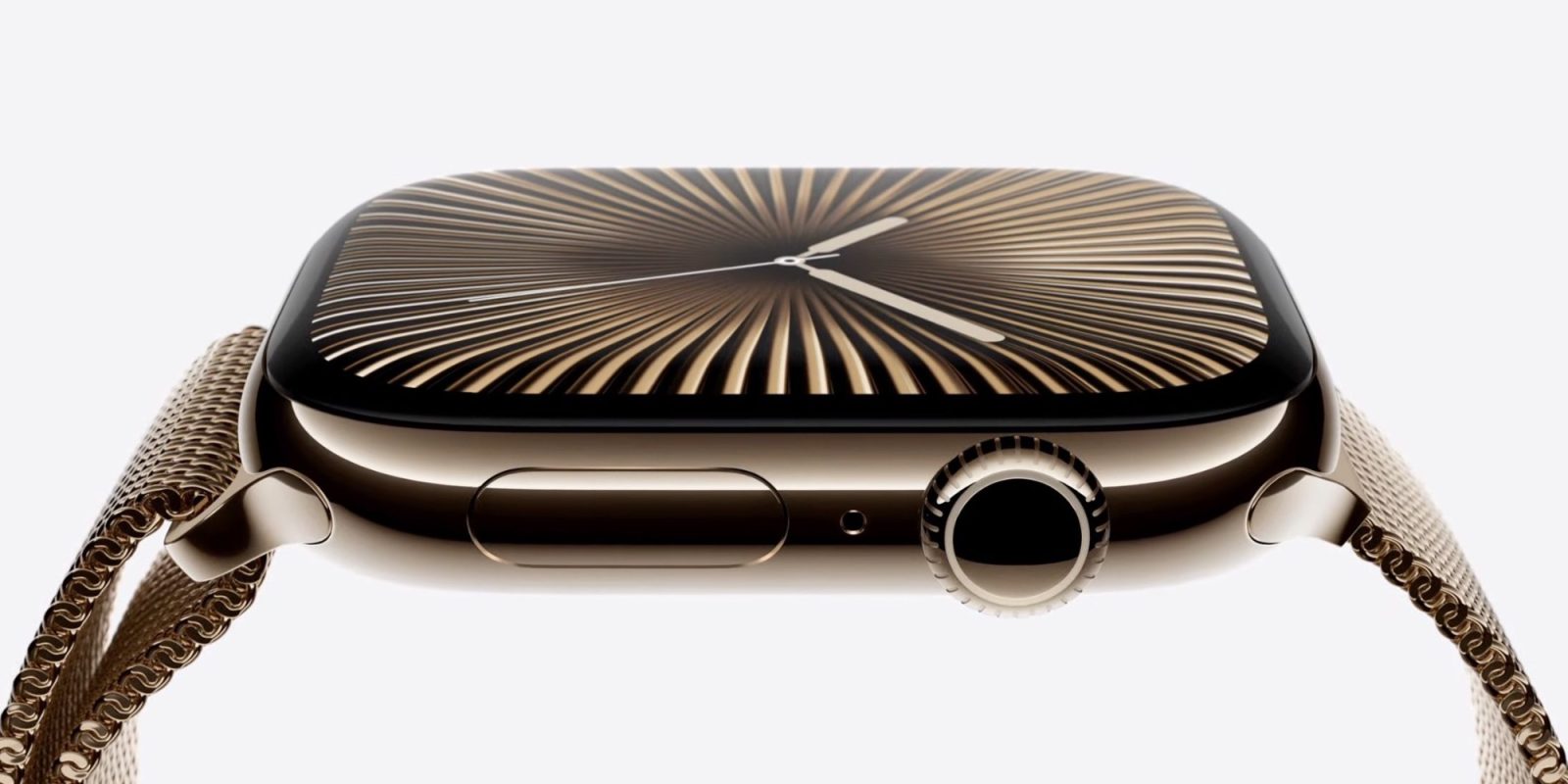
The Apple Watch, meanwhile, had a relatively quiet quarter. Shipments rose 5% to 7.6 million units, inching to 16% total unit share against Xiaomi’s 19%. These numbers echo a recent Counterpoint report, which highlighted the Apple Watch’s ongoing two-year global decline in 2024.

The report reads:
With 2025 marking the Apple Watch’s tenth anniversary, Apple is expected to regain momentum in the second half of the year with a big portfolio update, leaning on its mature and tightly integrated health-focused ecosystem.

As for the rest of the market, Huawei held onto third place with 7.1 million units, thanks to strong performance from its GT and Fit lines and the growing global footprint of the Huawei Health app.

Samsung, in fourth, saw the biggest jump among the top vendors, a whopping 74%, to 4.9 million units. The Korean company split its focus between basic bands for emerging markets, and higher-end smartwatches elsewhere. Garmin rounded out the top five with 1.8 million units and a 10% year-over-year increase.

9to5 : iPad Air vs reMarkable Paper Pro: Which tablet is best for note taking?

iPad Air vs reMarkable Paper Pro: Which tablet is best for note taking?
Over the past few months, I’ve had the pleasure of testing out the reMarkable Paper Pro. You can read my full review here, but in short, it gets everything right about the note taking experience.

Despite being an e-ink tablet, it does get quite pricey. However, there are certainly some fantastic parts of the experience that make it worth comparing to an iPad Air, depending on what you’re looking for in a note taking device for school, work, or whatever else.

Overview
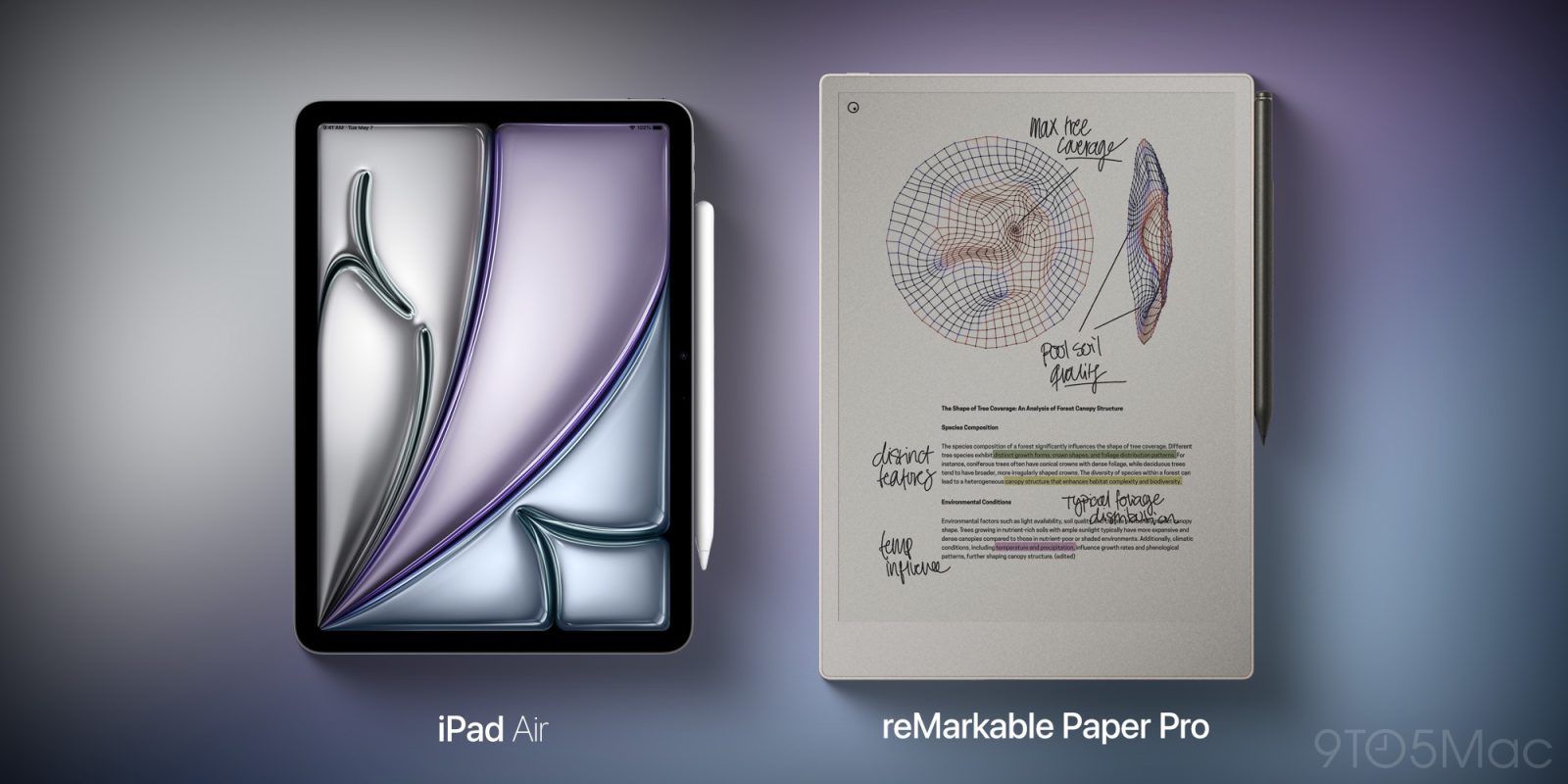
Since the reMarkable Paper Pro comes in at $629 with the reMarkable Marker Plus included, it likely makes most sense to compare this against Apple’s iPad Air 11-inch. That comes in at $599 without an Apple Pencil, and adding in the Apple Pencil Pro will run you an additional $129. Granted, the equivalent iPad setup will run you $100 more than the reMarkable Paper Pro.

Given the fact that iPad Air‘s regularly go on sale, and that reMarkable Paper Pro will be receiving an unspecified price hike on May 28th, it’d be fair to say they’re roughly on the same playing field.

So, $629 for a reMarkable Paper Pro setup, versus $728 for a comparable iPad Air setup. Which is better for you?
iPad Air advantages

Obviously, the iPad Air has one key advantage: It runs iOS, has millions of apps available, can browse the web, play games, stream TV shows/movies, and much more. To some, that might end the comparison and make the iPad a clear winner, but I disagree.

Yes, if you want your tablet to do all of those things for you, the iPad Air is a no brainer. At the end of the day, the iPad Air is a general purpose tablet that’ll do a lot more for you.

However, if you also have a laptop to accompany your tablet, I’d argue that the iPad Air may fall into a category of slight redundance. Most things you’d want to do on the iPad can be done on a laptop, excluding any sort of touchscreen/stylus reliant features.
iPads are great, and if you want that – you should pick that. However, I have an alternative argument to offer…

reMarkable Paper Pro advantages
The reMarkable Paper Pro does one thing really well: note taking. At first thought, you might think: why would I pay so much for a device that only does one thing?

Well, that’s because it does that one thing really well. There’s also a second side to this argument: focus.

It’s much easier to focus on what you’re doing when the device isn’t capable of anything else. If you’re taking notes while studying, you could easily see a notification or have the temptation to check notification center. Or, if you’re reading an e-book, you could easily choose to swipe up and get into another app.

The best thing about the reMarkable Paper Pro is that you can’t easily get lost in the world of modern technology, while still having important technological features like cloud backup of your notes. Plus, you don’t have to worry about carrying around physical paper.

One last thing – the reMarkable Paper Pro also has rubber feet on the back, so if you place it down flat on a table caseless, you don’t have to worry about scratching it up.

Spec comparison
Here’s a quick rundown of all of the key specs between the two devices. reMarkable Paper Pro‘s strengths definitely lie in battery, form factor, and stylus. iPad has some rather neat features with the Apple Pencil Pro, and also clears in the display category. Both devices also offer keyboards for typed notes, though only the iPad offers a trackpad.


Wrap up
All in all, I’m not going to try to convince anyone that wanted to buy an iPad that they should buy a reMarkable Paper Pro. You can’t beat the fact that the iPad Air will do a lot more, for roughly the same cost.

But, if you’re not buying this to be a primary computing device, I’d argue that the reMarkable Paper Pro is a worthy alternative, especially if you really just want something you can zone in on. The reMarkable Paper Pro feels a lot nicer to write on, has substantially longer battery life, and really masters a minimalist form of digital note taking.

WWD : Inside the Gucci Archive: A Living Legacy of Heritage and Innovation in Fl

Inside the Gucci Archive: A Living Legacy of Heritage and Innovation in Florence
Gucci displays its rich history and evolution at Palazzo Settimanni, where the brand paraded its cruise 2026 collection earlier this month.
FLORENCE – Those lucky enough to visit the Gucci Archive are in for quite a few surprises.

A Gucci paper knife? A lighter shaped as a tiny equestrian boot finely detailed with the GG logo? These are only a few of the discoveries elegantly displayed in one of the rooms of Palazzo Settimanni, where the archive has been located since 2021.

There’s plenty more in this area of the building, from shaving, beauty and sewing kits to desk sets and fountain pens, porcelain tea sets and hip flasks, to name a few.

Of course, these are dwarfed by the dizzying range of Gucci clothes and accessories present across the five floors of the building. Gucci exceptionally opened the archive for its cruise 2026 show on May 15, in a moment of transition following the exit of Sabato De Sarno in February and the arrival of newly appointed creative director Demna after his Balenciaga swan song haute couture show on July 9 and his start at Gucci shortly thereafter.

In fact, chief executive officer Stefano Cantino says “choosing Palazzo Settimanni for the cruise 2026 show is a deliberate gesture. The archive is a living testimony to over a century of creativity, craftsmanship, and innovation. It is where our roots and our future come together with clarity and purpose.”

The archive is not open to the general public because, Cantino says, this is “an intimate space, one that demands time, care, and emotion. We welcome passionate researchers and true brand connoisseurs, because entering the heart of Gucci isn’t something you purchase — it’s something you earn.”

The venue is open to guided tours, friends of the house, clients, celebrities and the press and to students in collaboration with Polimoda and Bocconi University, for example.

By contrast, Gucci has a dedicated public exhibition space in Palazzo Gucci in the city’s Piazza della Signoria, the former Gucci Garden. Guccio Gucci founded the brand in 1921 in Florence, which remains central to its identity.

Palazzo Settimanni, on Via delle Caldaie, dates back to the 15th century and is nestled in the Santo Spirito neighborhood, in the area known as “Oltrarno,” on the left bank of the Arno River. This is where artisans and artists had their workshops, and by the 16th century, following the Medici family’s move to Palazzo Pitti, they had established themselves near the residences of the aristocratic families gravitating around the political and banking dynasty.

Despite its grandeur, over the centuries the palace proved to be a flexible structure, capable of accommodating additions, splits, partitions, changes of ownership and use. The building was acquired by Gucci in 1953 — a milestone year for the company, which saw the death of its founder. That year, Gucci also opened its first store outside Italy, in New York, and launched its first moccasin.
Palazzo Settimanni

Over the years Palazzo Settimanni became an integral part of the brand, serving as a factory, a workshop and a showroom. Conservatively restored starting in 2018 under the lead of former president and CEO Marco Bizzarri and then-creative director Alessandro Michele, it has housed the Gucci Archive since June 2021, helping to mark the house’s 100th anniversary celebrations that year.

The archive now comprises 46,000 pieces plus documents, look books and editorials — both physical and digital.

“What struck me the most when I first visited Palazzo Settimanni was how tangibly you can feel the soul of Gucci,” says Cantino of his first visit to the location. “It’s a layered narrative, where history and passion, beauty and creativity, past and future continuously intertwine.”

Cantino believes the archive is “first and foremost, a place of belonging.” Asked what kind of emotions he thinks the location triggers, he says “it conveys a sense of deep affection for our heritage and a forward-looking perspective. It is a shared legacy for all those who have shaped Gucci’s story over time.”

A memorable comment that stayed with him once came from an Italian visitor who said “they had never experienced a place where culture, fashion, beauty and history coexisted in such perfect harmony.” This remark “speaks to the unique emotional balance of the space,” Cantino says.

Of the curatorial approach, the executive says the archive “is shaped by a continuous process of research and renewal. The displays evolve regularly to highlight different facets of Gucci’s identity — bringing forward elements that resonate with the present while remaining deeply rooted in our heritage. It’s never static: each object contributes to a narrative that is always moving forward.”

The work of all creative directors, from Tom Ford through Frida Giannini and Michele to De Sarno, are represented in the archive, which “reflects Gucci in its entirety, and that means honoring every creative director who has contributed to making our legacy contemporary and relevant. It’s a dynamic evolution, and just as we preserve the work of the generations of artisans who have shaped Gucci’s identity, we also celebrate the creative visions that continue to define our journey,” Cantino says.

Incidentally, the first Gucci menswear show by Ford as creative director was held here in 1995.

Gucci Archive

Across the five floors, which include the ground floor and the basement, all the structures accumulated in recent times were stripped away during the restoration to reveal 19th century decorations, 18th century trompe l’oeils, late 17th century frescoes and even earlier ornamentation.

The main alteration was the restoration of the central portico to its original proportions, removing a canopy in the entrance hall that had been added in the 1990s, a move which allows for more light. Local specialists were recruited, who, for example, painstakingly produced each terracotta floor tile in wood-fired ovens — one by one. Intriguing details include handles that replicate a pair of scissors.

The archive is divided into themed areas. On the ground floor, in one room dubbed “the Swan” for its beautiful fresco depicting the waterbird, Gucci highlights three of its iconic bags — from the very first Bamboo dating back to the end of the 1940s to the first examples of the Jackie 1961, and the first Horsebit from 1955. Row after row they reflect the evolution of each of Gucci’s signature bags through the years, presented in different versions and materials, bridging the past with the present.

The oldest bag, a velvet clutch with a floral pattern, dates back to the end of the 1920s.

On the ground floor there is also a window display dedicated to its signature web motif in green/red/green and in blue/red/blue established in the mid-1950s.

Another signature code, the diamond pattern from the 1930s, first seen on hemp suitcases, evolved into the GG monogram in 1969. A fashion show of a men’s and women’s collection entirely embellished with the monogram was held that same year at the Smithsonian and those designs are also presented at the archive.

The display of Gucci archival foulards.

The GG logo has gone through changes over the years, from the rounded motif in 1971 on the Blondie bag to interlocking on the brand’s first fragrance in 1975.

Luggage is also part of the location’s treasure trove, from the trunk dating back to the end of the 1930s to the first printed canvas luggage and bags trademarked in 1959, and suitcases with the patterns of pinecones and pomegranates. Small leather goods and jewelry are on display in a salon near the suitcases.

Scarves, dresses, textile designs and footwear are shown on the first floor. There is a focus on the Flora scarf, which was created in 1966 when Princess Grace of Monaco put in a request for a colorful and exuberant design and Rodolfo Gucci, son of the founder, asked illustrator Vittorio Accornero de Testa to assist.

The motif was painted by hand, inspired by the flowers blooming naturally in Tuscany and by 15th-century artist Sandro Botticelli’s “Allegory of Spring.” The elaborate composition required 37 distinct colors, each applied through separate printing steps. The motif inspired the brand’s first silk dress in 1969 and has been reimagined by Gucci’s different creative directors over the years across the categories. There are also 58 original watercolor designs by Accornero de Testa on display.

Gucci Archive

Ahead of the cruise show, Cantino said returning to Florence and to Palazzo Settimanni was “both a tribute and a declaration of intent,” describing the archive “as not merely a repository of our past; it is a living space where Gucci’s identity codes are preserved and reinterpreted through an ongoing dialogue.”

The choice of the location in his view reaffirms Gucci’s “bond with the cultural and artisanal heritage that defines us, while projecting it into the future with coherence and ambition.”
Gucci Archive

WWD : The Art of Attolini

The Art of Attolini
Known for creating the Neapolitan-style jacket, the Naples-based brand credits its 140 highly skilled artisans with producing its luxury tailored clothing.

Far from the bustling restaurant and shop scene on Spaccanapoli and the endless lines of tourists waiting to board ferries to Capri lies a different Naples.

The third-largest city in Italy with a population of around 1 million, Naples has long been known as a luxury menswear Mecca, home to some of the world’s most prestigious tailoring brands including Kiton, Isaia and Mariano Rubinacci.

Lesser known, but no less distinguished, is Cesare Attolini. Its history dates to the 1930s when Vincenzo Attolini, a young tailor in Naples, broke with the Savile Row-inspired suit-making tradition and developed a new silhouette that eliminated the padding and shoulder pads, resulting in a new light and unstructured fit. His creation would eventually come to define Neapolitan style.

His son, Cesare Attolini, began working alongside him in the tailor shop as a young man, learning to cut fabrics and shape and construct his father’s distinct silhouette. He went on to study in Turin at one of the city’s most prestigious tailoring schools and then returned to Naples and the family business.

Today, the business is run by his sons, Massimiliano, president, and Giuseppe, vice president, who have remained true to the heritage of the company while also working to build a more-visible profile. Their game plan is open Cesare Attolini stores worldwide while carefully monitoring its wholesale distribution.

Unlike many brands that are aggressive in their expansion plans, Attolini is much more conservative. And that’s intentional — due to its limited production and high-quality standards. Each suit can take 25 to 30 hours to complete and no more than 35 pieces are produced daily.

The ready-to-wear jackets retail for $6,500 to $7,500 while suits sell for $7,500 to $9,500. Custom garments start at 30 percent more. Each fabric is exclusive to the firm — most are from Scotland — and no more than 15 pieces are made from each one.

Because of the detail and handwork in each garment, Cesare Attolini keeps its production limited to no more than 8,000 garments a year.

“It’s mind boggling,” said Massimiliano. “If an American entrepreneur heard this, they would say: ‘Let me run away from here, because this is not a business I’m interested in.’ That’s why I keep emphasizing to our clients that this is a mission, a passion of a family lineage. There’s no other way that someone in their right state of mind would choose this as a business model. But we inherited this business model, and we’re making it work. It’s a family affair — that’s the best way to describe it.”

Today, half of the production is ready-to-wear and the other half custom or bespoke. The core of the business remains jackets and suits but the firm also produces trousers, shirts and knitwear and outerwear in a knitwear-focused factory they purchased a decade ago in Umbria. There’s also a small factory in Naples that produces ties.


Maintaining the quality it has become known for remains paramount for the Attolini family, and its ace in the hole is the 140 artisans in its main workshop in Naples. These craftsmen and women are highly skilled in the distinct art of creating a Cesare Attolini Napolitan garment, using only needle, thread and scissors. Many specialize in just one part of the production process, such as cutting collars, sleeves or buttonholes, said Giuseppe, while the most skilled are able to work on all parts of the garments.

“Our workers are 100 Neapolitan — local people,” said Massimiliano, who added that many have worked for the family for generations. “To produce high-quality clothing like this, you need to have not only good tailors, but good relationships. We know the name of every employee, their daughters and sons, their husbands or wives. It’s like an extended family. We take care of them because it’s a very important asset. They are specialized for this kind of product. In other factories, there’s not as much handwork.”

But he admitted that it’s getting harder and harder to find tailors with the skill level needed to build an Attolini garment.

“We have a lot of people with white hair,” he said. “Probably in the future, we’ll have to bring in people from outside and teach them how to make Neapolitan style.”

It takes a special kind of person to be willing to spend the time it takes to master the art of tailoring at this level, they said. And while a lot of the workers are older, they have managed to attract some young people. But keeping them is a challenge and only three out of 10 apprentices typically remain.

“It’s too hard,” Massimiliano said. “They have to be patient. Young people come in and work, sometimes for years, next to a tailor so they can learn everything from the beginning. And then, step by step, we move them after one year to a different department of the workshop. The system we have to train young tailors depends a lot on what their sensibility, their passion, their talent and skills are. After five or six years, they are still learning.”

They bemoaned the fact that the government of Italy provides little support for young artisans, making it harder for companies like Attolini to sustain their craft. “Italy is the country of high-quality manufacturing and the politicians do nothing to protect this kind of business,” Massimilliano said. He suggested that the government offer incentives such as tax cuts or assistance in buying a home to young people who follow this path.

WWD : Hermès Launches Headphones as Its Bespoke Division Expands Into Sound

Hermès Launches Headphones as Its Bespoke Division Expands Into Sound
Ateliers Horizons creative director Axel de Beaufort talks about the making of the $15,000 headphones, which feature handstitched leather and metallic finishes inspired by the Kelly handbag.


At Hermès, there are personalized products — and then there is Ateliers Horizons.

Nestled behind a steel gate on a nondescript side street in the Paris suburb of Pantin, this discreet workshop houses unexpected treasures. A canoe? A foosball table? A jukebox? Horizons can customize all these, and more, not to mention the handbags that make up the bulk of its special orders.

Don’t even think of trying to bypass the French luxury house’s notoriously long waiting lists by tapping the workshop for a classic Birkin or Kelly. Instead, imagine bags shaped like a birdcage or a pineapple.

With a degree in naval design and architecture from the University of Southampton in England, de Beaufort has the chops to handle the atelier’s large-scale projects like boats, private jet interiors and cars.

He likes to stop by the Horizons showroom to admire the C28 Aérosport, made in 1935 by French manufacturer Avions Voisin, that takes pride of place on the ground floor. Working with a professional restorer, Hermès made the leather interiors of the silver Art Deco-style model, of which only a handful were produced.

Axel de Beaufort Lee Whittaker/Courtesy photo
“Before I met the owner of this car, I didn’t know about Voisin,” admits de Beaufort. “This is what we like at Horizons: to find ourselves in this kind of story.”

He’s just as enthusiastic about more offbeat projects. A fishing rod, boxing gloves and a disco ball are among the commissions the studio has received. “I’m as interested and happy about these little special orders as the seat of a plane,” de Beaufort says.

Capsule Collections
In the last decade the bespoke studio has also started to create its own capsule collections, available in selected Hermès boutiques. Initially it asked store managers for creative briefs, making items like a picnic hamper, a hammock and a kite. Now the unit generates its own ideas, adding surfboards, skateboards and speakers to the mix.

De Beaufort is part of a team of around 50 people at Horizons, including designers, engineers and artisans. Aside from a handful of bag specialists based at the Hermès headquarters on Rue du Faubourg Saint-Honoré in Paris, they’re all housed under the same roof.

The sound of hammering reverberates around the airy workshop. Two men are conferring around a brown leather airplane seat. In a corner, a young woman with headphones is handstitching a leather handle cover for a foosball table.

Creatives and makers work hand-in-hand to develop products that meld technical excellence with traditional craftsmanship — a balance de Beaufort perfected back when he worked on big yachting projects.

An Hermès connected speaker. Courtesy of Hermès
“Victor Hugo said: ‘The sea is a place of rigor and freedom.’ I like this because it’s really where we are. When you design a boat, you have to understand every part of the technicity of things and at the same time, it must be a nice object to go wherever you want,” he says.

“We need to be super creative and at the same time, as we are here to explore, we need to understand the engineering of things. It doesn’t mean that we do the engineering, but we need to understand and we need to be able to push boundaries,” he adds.


First Hermès Headphones
A case in point: the first Hermès headphones, which will hit stores this summer, 10 years after the luxury house created a sensation by partnering with Apple on its connected watch.

Ateliers Horizons has dabbled in sound before, developing a first jukebox in 2019, as well as a boombox housing a vertical turntable. Its latest collection also includes a cubic connected speaker, a lacquered mahogany DJ table and a new jukebox featuring the Cheval Néon design by Greek illustrator Elias Kafouros.

Creating the $15,000 headset was especially complex as the brand pursued an original “Hermès sound.” Adding leather and a logo to an existing product is never an option for Ateliers Horizons, which works with specialized manufacturers when it doesn’t have the expertise in-house.

“Being able to bring some proper Hermès work on industrial design is very interesting,” de Beaufort says. “The edge between industrial design and craftsmanship is so thin.”

The minimalist design of the headphones, designed for both Bluetooth and wired use, features signature touches like handstitched cowhide leather and metallic finishes inspired by the Kelly bag. Colors include “naturel,” black, chocolate, “rouge H” and Prussian blue.

An Hermès surfboard featuring Gianpaolo Pagni’s “Cheval Vague” design. Courtesy of Hermès
Like any Hermès product, the luxury is whispered.

“People don’t really need to know that what’s happening behind it is as authentic as stitching a Birkin in the workshop. There are people, there are hands, there is time. There are no shortcuts,” de Beaufort says.

“The idea is not to be able to replicate that 10,000 times as a big headset supplier would do. The idea is to have the few that we will do made perfectly, and that has been a very long learning process,” he adds.

It’s just as well the Paris-born designer is a connect-the-dots kind of guy, with a passion for problem-solving. “Finding solutions is always something amazing,” he says.

He has no set routine for tackling a blank page, instead drawing inspiration from conversations, surfing or playing with his kids. “I’m very curious, I like to ask questions wherever I am,” he says. “My brain is always on.”


De Beaufort lauds Pierre-Alexis Dumas, artistic director of Hermès, for giving his teams space to exercise their imagination.

Avions Voisin C28 Aérosport with leather interiors by Ateliers Horizons. Alexis Goure/Courtesy of Hermès
“He’s never telling you what to do. He’s more listening to you and giving you what the DNA of Hermès is,” he says. “It’s really a blessing because it’s pretty rare to be in this kind of situation.”

Bespoke objects are baked into that DNA. After all, Hermès was founded in 1837 as a harness workshop. Its most famous creation, the Birkin, was famously designed for actress Jane Birkin after she met Hermès executive Jean-Louis Dumas on a plane and lamented the lack of large handbags.

“It has never been marketing-driven. It’s always been something appealing to craftsmanship, appealing to stories, with values that we’re attached to, where we can recognize ourselves,” de Beaufort says.

Accordingly, he’s loath to turn down any request, no matter how outlandish. In fact, he frequently pushes clients to think even more outside the box.

“We are here to bring oxygen. We are here to bring the unexpected fun or nice situation in a super high quality. That’s what we try to do,” he says. “People are very happy about that because when they come to Hermès, they come for the entire Hermès [experience].”

An Hermès jukebox featuring the Cheval Néon design by Greek illustrator Elias Kafouros. Courtesy of Hermès

WSJ : Trade Between the U.S. and EU Is Massive. We Break It Down.

Trade Between the U.S. and EU Is Massive. We Break It Down.
Trump’s tariff threat against European Union hits a bloc that comprises the single-largest U.S. trade partner

President Trump is threatening to ramp up the U.S. trade war with Europe, and costs to move products like cars, pharmaceutical products and airplane parts across the Atlantic are at stake.

Trump on social media Friday called for a new 50% tariff on the European Union starting June 1 while saying trade discussions with the EU “are going nowhere.” He also called the large U.S. trade deficit in goods with the European countries unacceptable.

How much does U.S.-EU trade matter?
This marks a major new trade threat against a bloc of 27 countries that add up to the largest U.S. trade partner, ahead of Mexico, Canada and China. In 2024, the U.S. imported about $606 billion in goods from the EU and exported around $370 billion. This kind of imbalance is a major sticking point for Trump as he tries to use tariffs to revamp U.S. manufacturing.

Trade in goods and services with the EU accounted for around 4.9% of U.S. gross domestic product in 2024, according to Bureau of Economic Analysis data. That means trade with Europe is an even bigger part of the U.S. economy than trade with China, which accounted for 2.2% of U.S. GDP last year.

What major products does the U.S. import from the EU?
Pharmaceuticals are the single largest EU-produced product shipped to the U.S., totaling $127 billion in 2024. Europe is home to pharma giants like Bayer and Sanofi, but that’s only part of the story. A number of U.S. pharma companies have factories in Ireland, where taxes are low. In 2024, Ireland exported more goods to the U.S. than Italy and France.

Other top imports from Europe are cars ($45.2 billion) and various types of machinery. The U.S. also bought $5.4 billion worth of wine and $4.4 billion worth of perfume from the EU last year.

What are the top goods exports to the EU?
Europe is a big buyer of U.S. oil, gas, cars, airplanes—and human blood products like plasma. The U.S. also shipped $32.3 billion worth of airplanes and airplane parts, plus $12.4 billion worth of vehicles to the EU. Many of the cars shipped across the Atlantic are European brands, like BMWs and Mercedes made in American factories.

The U.S. is a big player in the global plasma trade and sent $5.2 billion in blood products to the EU last year.


How do services factor in?
While the U.S. ran a goods-trade deficit of $235.6 billion with the EU in 2024, including services shrinks that deficit to $161 billion, according to BEA data.

Counting services isn’t as easy as counting goods—work like business consulting and banking doesn’t go through ports and customs. The U.S. says it exported about $277 billion in services to the EU last year and imported $201 billion in 2024. The EU has hinted in the past that it might go after U.S. tech companies—a major source of services exports—in retaliation for tariffs.

How did the last U.S.-EU trade war end?
In 2018, during his first term, Trump slapped 10% tariffs on aluminum and 25% tariffs on steel. The official justification: national security. The EU hit back with tariffs on more than $3 billion worth of U.S. exports, including jeans, bourbon and Harley-Davidson motorcycles.

In 2021, the Biden administration reached a deal with the EU that effectively ended the spat. The U.S. agreed to let a quota of European steel and aluminum into the country duty-free, and in return the EU suspended its retaliatory tariffs.