>>> TradeGate Pre-Market Indications

DAX:
  • Deutsche Bank (DBK TH) -1.3%
    • Deutsche Bank Unit Plans Extra €50m IT Cost Savings From ‘26: FT
MDAX:
  • Hensoldt (HAG TH) +3%
    • Hensoldt Raised to Overweight at JPMorgan; PT 110 euros
  • RENK Group (R3NK TH) +2.6%
  • Stroeer (SAX TH) +2%
  • TUI (TUI1 TH) -1%
  • Jenoptik (JEN TH) -1.2%
  • Deutsche Wohnen (DWNI TH) -1.5%
  • Thyssenkrupp (TKA TH) -2.5%
SDAX:
  • LPKF (LPK TH) +1.7%
  • Indus Holding (INH TH) +1.4%
  • Patrizia (PAT TH) +1.1%
  • PVA TePla (TPE TH) -1.2%
  • Wacker Neuson (WAC TH) -1.6%
  • Grand City Properties (GYC TH) -1.6%
  • Heidelberger Druck (HDD TH) -1.9%
  • Salzgitter (SZG TH) -2.4%
    • NOTE: Salzgitter Ag: Der Konzern im Überblick 2025 05 30 SZAG Unternehmenspraesentation PDF

FT : Activist investor Farallon makes ‘final frontier’ bet on Japanese insurer T

Activist investor Farallon makes ‘final frontier’ bet on Japanese insurer T&D
San Francisco-based fund pushes for change with Japan seen as next leg of sector’s development

Activist investor Farallon Capital Management has taken a top-three position in one of Japan’s largest insurance groups and is pushing for rapid changes in investment and governance, as it aims to tap opportunities on the “final frontier” of the sector.

The San Francisco-based firm has built a stake of between 4 and 5 per cent in T&D Holdings and is pushing for it to reduce investment risk at a faster pace, concentrate on its core insurance business and address its conglomerate discount, according to people familiar with the matter. 

It has also proposed the appointment of two new external directors, say the people, arguing that the current board lacks sufficient experience and is ill-suited to judge its mergers and acquisitions push abroad.

However, the company, which has a market value of $12bn, has already declared its opposition to Farallon’s board candidates. Its annual meeting is set for June 26.

In a 63-page presentation, T&D has pushed back against many proposed changes, without naming the firm, and said its board could not confirm the candidates met the requirements for outside directors or “would contribute to enhancing corporate value”.

Farallon, which describes itself as an engagement fund, is understood to have had a constructive dialogue with T&D since 2023, but the people add that it believes the company could move faster to strengthen the business.

The fund, which declined to comment, has been a shareholder of varying sizes since 2008. T&D, whose share price has risen 14 per cent this year, did not immediately respond to a request for comment.

Farallon, with $42bn in assets under management, has been increasingly vocal in its shareholder activism in Japan, becoming emboldened by the Tokyo stock exchange’s own corporate governance reform crusade.

It made its name in the country with high-profile bets, including a contentious engagement with Toshiba, where it successfully installed an outside director shortly before the conglomerate was taken private. 

In its first big public move since exiting its roughly $800mn position in Toshiba in 2023, Farallon earlier this year announced a stake in Astellas, one of the country’s largest pharmaceutical companies.

Activists have targeted companies from across the tech sector to auto parts, but the highly regulated insurance sector has remained largely untouched.

Singapore-based fund Effissimo Capital Management is one of the big exceptions, having taken large positions in Dai-ichi Life and Life Net, in which Farallon was also the first investor.

Alongside what Farallon believes is a strong underlying business, particularly the fast-growing Daido Life unit, the fund believes T&D can capitalise on the growing interest from private equity in Japanese insurance liabilities.

Private equity firms can, for example, buy blocks of policies that have become costly for insurers to maintain, due to capital requirements and low interest rates. Buyout firms can better manage their cash flows by employing higher-yielding investment strategies. Apollo’s merger with Athene in the US in 2021 is seen as one template.

Many firms are hoping that Japan can provide the next leg in the industry's development. Apollo already has an office here, along with Athene, and KKR has a strategic alliance with Japan Post Insurance, through its Global Atlantic arm.

“Japan seems to be the final frontier of high-quality liabilities . . . it has a huge number and they are largely untapped,” said one senior person in the industry.

So far, most deals in Japan have been modest, with industry insiders citing regulatory caution as the reason why more aggressive moves, or complete takeovers of companies, have not happened.

One of Farallon’s other main concerns at T&D is that the company takes too much equity risk and thus prioritises investment over insurance, without making the returns necessary to justify that decision.

The fund, according to the people, believes T&D has greater cross-shareholdings than appreciated, as it has designated some of its stakes as “pure investments” — a classification with which the fund does not agree.

“The stocks reclassified from strategic shareholdings to pure investments are managed by the asset management division, which decides whether to continue holding or sell them,” said T&D in its presentation. “Under the equity risk reduction policy, approximately 39 per cent of the cumulative amount reclassified as pure investments has been sold to date.”

SCMP : Mainland Chinese market for weight loss and diabetes drugs to soon be mor

Mainland Chinese market for weight loss and diabetes drugs to soon be more crowded: report
Novo Nordisk’s semaglutide product to lose patent protection in China next year, according to L.E.K. Consulting

Competition in the mainland Chinese market for diabetes and weight loss drugs is set to intensify as more than 60 late-stage drug candidates are undergoing clinical trials, according to a recent report.
Up to 20 biosimilar or generic copies will vie for market share and add pricing pressure after Denmark-based Novo Nordisk’s semaglutide product loses patent protection in China next year, according to Boston-based global consultancy L.E.K. Consulting. Novo Nordisk’s patent will expire in 2031 in Japan and Europe and 2032 in the US, according to its latest annual report.

“The landscape in China is expected to become even more competitive than in developed markets, where the GLP-1 category is primarily dominated by leading multinational pharmaceutical companies,” said Helen Chen, L.E.K.’s global healthcare and life sciences co-head, in a report on May 15.

GLP-1 drugs mimic natural hormones, which signal the pancreas to release more insulin when blood-sugar levels are high, and also support weight loss by slowing digestion and reducing appetite.

Driven by sales growth of semaglutide, Novo Nordisk became the 10th largest drug company in the world in terms of revenue. London-based consultancy Evaluate said the firm’s revenue rose 25 per cent to US$42.1 billion last year.

Ozempic, a semaglutide formulated for diabetes, was approved in China in 2021. Wegovy, a treatment for weight loss, was approved last year.
Ozempic was the second best selling drug in the world last year, generating US$17.5 billion in revenue, after Merck’s blockbuster cancer drug Keytruda, Evaluate said.

“This growth trend is only just beginning as we enter a new era in metabolic disease management,” said Paul Verdin, Evaluate’s head of consulting and analytics, in an April report. “The companies marketing these game-changing products are set to dominate the rankings for years to come.”

In February, 60 to 70 drug candidates were in late-stage, meaning phase two or later, clinical trials in China. Some had the potential to directly compete with semaglutide and US-based Eli Lilly’s tirzepatide, which dominate the global market, L.E.K. said.

Among these candidates, around half were targeting the weight loss market, while eight were being developed as oral alternatives to injections. And around 20 aimed to mimic the actions of two or three hormones to achieve better clinical outcomes than single-medication treatments like semaglutide, L.E.K. added.

A potential rival that is undergoing clinical trials is mazdutide, whose development and marketing rights in China were licensed to Jiangsu province-based Innovent Biologics by Eli Lilly. It mirrors the effects of both a gut hormone and glucagon, which is produced by the pancreas.

Others include Jiangsu Hengrui Pharmaceuticals’ oral GLP-1 drug candidate; Hong Kong-based United Laboratories International’s treatment that targets two gut hormones and one pancreas hormone; and Hangzhou-based Ascletis Pharma’s GLP-1 obesity drug.

In October, Eli Lilly rolled out a 1.5 billion yuan (US$208 million) plan to expand a factory in Suzhou to meet rising demand for diabetes and obesity drugs in China and Europe.

“China – home to the largest diabetic and overweight populations – has become a critical battleground for both global pharmaceutical giants and local players,” L.E.K. said.

US-based Viatris, which led a group of generic drug makers that settled a patent dispute with Novo Nordisk on semaglutide last year, could launch a generic version of the drug around 2030, US brokerage Stifel said in a report in January.

Mainland China is the second largest drug market in the world and last year had 148 million adults with diabetes, more than any other nation, according to the International Diabetes Federation. Around half of these people were undiagnosed and the number of diabetics was projected to rise to 168 million by 2050.

According to a paper published in The Lancet, a medical journal, around 402 million people on the mainland over 25 years old were estimated in 2021 to be overweight or obese with a body mass index of 25 per cent or higher, accounting for 38 per cent of the population. That figure was up from 15.8 per cent in 1990 and it was expected to surge to 61 per cent by 2050.

The GLP-1 drug market in China was projected to triple in sales to US$4.7 billion by 2030 from US$1.43 billion last year, according to San Francisco-based Grand View Research.

>>> Xpeng : Reports May deliveries 33.5K, +230% y/y (update) - In May 2025, XPEN

Reports May deliveries 33.5K, +230% y/y (update)
- In May 2025, XPENG delivered 33,525 Smart EVs, representing growth of 230% year-over-year, surpassing 30,000 units for the seventh consecutive month. For the first five months of 2025, XPENG delivered 162,578 Smart EVs, marking a 293% increase compared to the same period last year.
- On May 28th, the Company launched the MONA M03 Max. MONA M03 Max lowers the entry barrier for urban AI smart driving to the 150,000 RMB range for the first time, making advanced vehicle technology more accessible to younger users. The MONA M03 Max is also the first XPENG model equipped with the AI Tianji XOS 5.7.0, offering over 300 new features.
- XNGP achieved a monthly active user penetration rate of 85% in urban driving in May 2025. Notably, the XPENG MONA M03 Max debuted the application of human-machine co-driving, enabling both ADAS and drivers to share control, providing a seamless collaboration between manual driving and smart driving.

SCMP : Ukraine claims to damage US$7 billion worth of Russian aircraft as Turkey

Ukraine claims to damage US$7 billion worth of Russian aircraft as Turkey peace talks loom
Zelensky said he will send a delegation to Istanbul for peace talks with Russia after a Russian missile strike killed 12 Ukrainian troops

Ukraine’s SBU security service said on Sunday it had hit Russian military planes worth a combined US$7 billion in a wave of drone strikes on Russian airbases thousands of kilometres behind the front lines.

“$7 billion: This is the estimated cost of the enemy’s strategic aviation, which was hit today as a result of the SBU’s special operation,” the agency said in a social media post.

Ukraine said on Sunday it launched a “large-scale” attack to destroy Russian bombers as it geared up for talks in Istanbul with Moscow counterparts to explore prospects of a ceasefire.

The spectacular US$7 billion damage claim came as Kyiv announced a Russian military strike killed at least 12 soldiers at an army training site.

Russia also said two bridges that collapsed in regions bordering Ukraine were brought down by explosions. Officials were treating them as “acts of terrorism” but had not immediately accused Ukraine.

The developments followed Russian ground advances in recent days in Ukraine’s border Sumy region, and both sides unleashing punishing aerial attack on the other.

Ukrainian President Volodymyr Zelensky said on Sunday he was sending a Ukrainian delegation to Istanbul led by his Defence Minister Rustem Umerov for the talks on Monday with Russian officials.

Turkey is hosting the meeting, which was spurred by US President Donald Trump’s push for a quick deal to end the three-year war.

Zelensky, who previously voiced scepticism about the seriousness of the Russian side in proposing Monday’s meeting, said he had defined the Ukrainian delegation’s position going into it.

Priorities included “a complete and unconditional ceasefire” and the return of prisoners and abducted children, he said on social media.

Russia has said it has formulated its own peace terms, but refused to divulge them in advance. Russian President Vladimir Putin ruled out a Turkish proposal for the meeting to be held at leaders’ level.

Russian news agencies said the Russian delegation was headed to Istanbul on Sunday for the talks.

The intensified strikes waged by each side came as Kyiv and Moscow each strived to show themselves coming from a position of strength.

A source with Ukraine’s SBU security service said the coordinated attacks inside Russia were “aimed at destroying enemy bombers far from the front”.

The source said Russian airbases in the eastern Siberian city of Belaya, in Olenya, up in the Arctic near Finland, and in Ivanovo and Dyagilevo, both east of Moscow, had been targeted.

More than 40 aircraft had been hit at the Belaya base, and a fire had broken out there, the source said, showing a video in which several aircraft could be seen in flames and black smoke rising.

The official, who spoke on condition of anonymity to disclose operational details, said the attack took over a year and a half to execute and was personally supervised by Zelensky.

Russia confirmed on Sunday that several of its military aircraft has “caught fire” after a large-scale Ukrainian drone attack, in which suspects were detained.

“In the regions of Murmansk and Irkutsk, several aircraft caught fire following the launch of FPV drones from a territory located in the immediate vicinity of the airfields,” the Russian defence ministry said on Telegram, referring to first-person view drones. It added that there were no casualties and that several “participants” had been arrested.

“It’s the first attack of this sort in Siberia,” the governor, Igor Kobzev, said, calling on the population to not panic. He posted an amateur video apparently showing a drone flying in the sky, and a large cloud of grey smoke.

The governor of the Murmansk region where the Olenya base was located, Andrey Chibis, also said “enemy drones” were flying overhead, and anti-aircraft defences were operating.

Russia has been announcing Ukrainian drone attacks on a near daily basis, usually saying they had all been shot down. But it was rare for such drone strikes to be reported so deep within its territory.

At the same time, Russia has been carrying out constant attacks on Ukraine.

On Sunday, the Ukrainian army – in a rare admission of its military losses – said Russia “launched a missile strike on the location of one of the training units” and killed a dozen soldiers, most of whom had been in shelters during the attack.

“As of 12.50pm, 12 people are known to have been killed and more than 60 wounded,” it said in a statement.

The commander of Ukraine’s land forces, one of the most senior positions in the country’s military, announced on Sunday that he was tendering his resignation, following the lethal strike.

Major General Mykhailo Drapatyi has been in charge of Ukraine’s vast wartime land army since November last year.

“This is a conscious step dictated by my personal sense of responsibility for the tragedy at the 239th training ground, which resulted in the deaths of our soldiers,” he wrote on Facebook.

“These are young guys from a training battalion. Most of them were in shelters,” Drapatyi wrote.

“They were supposed to study, live, fight – not die. My deepest condolences to the families of the victims and to all those who suffered.”

Separately on Sunday, the Russian army said it had captured another village in Ukraine’s northern Sumy region, where Kyiv fears Moscow could mount a fresh ground assault.

Russia claims to have captured several settlements in the region in recent weeks, and has amassed more than 50,000 soldiers on the other side of the border, according to Zelensky.

Authorities in the region have evacuated more than 200 villages amid intensified shelling.

Back in Russia, officials said a blast brought down a road bridge in the Bryansk region bordering Ukraine on Saturday, derailing a passenger train heading to Moscow and killing seven people.

A separate rail bridge in the neighbouring Kursk region was blown up hours later in the early hours of Sunday, derailing a goods train and injuring the driver.

Authorities did not say who was behind the explosions, but investigators said a criminal inquiry was under way.

The Kremlin said Putin was briefed on the incidents.

Russia has been hit by dozens of sabotage attacks since Moscow launched its full-scale military assault on its neighbour in 2022, many targeting its vast railroad network.

Kyiv says Russia uses railways to transport troops and weaponry to its forces fighting in Ukraine.

SCMP : Meet India’s answer to Pakistan’s Chinese jets: the AMCA fifth-generation

Meet India’s answer to Pakistan’s Chinese jets: the AMCA fifth-generation stealth fighter
The Advanced Medium Combat Aircraft marks a leap towards military self-reliance, but the jet faces a long runway before it’s combat ready

Published: 5:00pm, 1 Jun 2025

For decades, India’s most advanced fighter jets have borne the stamp of foreign origin. But the country’s quest for military self-reliance took a leap forward last week with the long-awaited go-ahead for its own stealth fighter jet.
The Indian government’s green light for the Advanced Medium Combat Aircraft (AMCA) is being lauded by analysts as a watershed moment for national security, as the country confronts mounting military pressures from both Pakistan and China.
New Delhi’s Defence Ministry announced on Tuesday that it had approved the “execution model” for the AMCA – a fifth-generation fighter jet project aimed at enhancing the Indian Air Force’s deep-strike capabilities – paving the way for prototype development and eventual production.
“This is an important step towards harnessing the indigenous expertise, capability and capacity to develop the AMCA prototype, which will be a major milestone towards Aatmanirbharta (a self-reliant India) in the aerospace sector,” the defence ministry said in a statement, referring to the government’s flagship initiative to boost domestic manufacturing and reduce reliance on imports.
The AMCA project is now entering a pivotal, action-oriented phase of development, said Antoine Levesques, senior fellow for South and Central Asian defence, strategy and diplomacy at the International Institute for Strategic Studies.
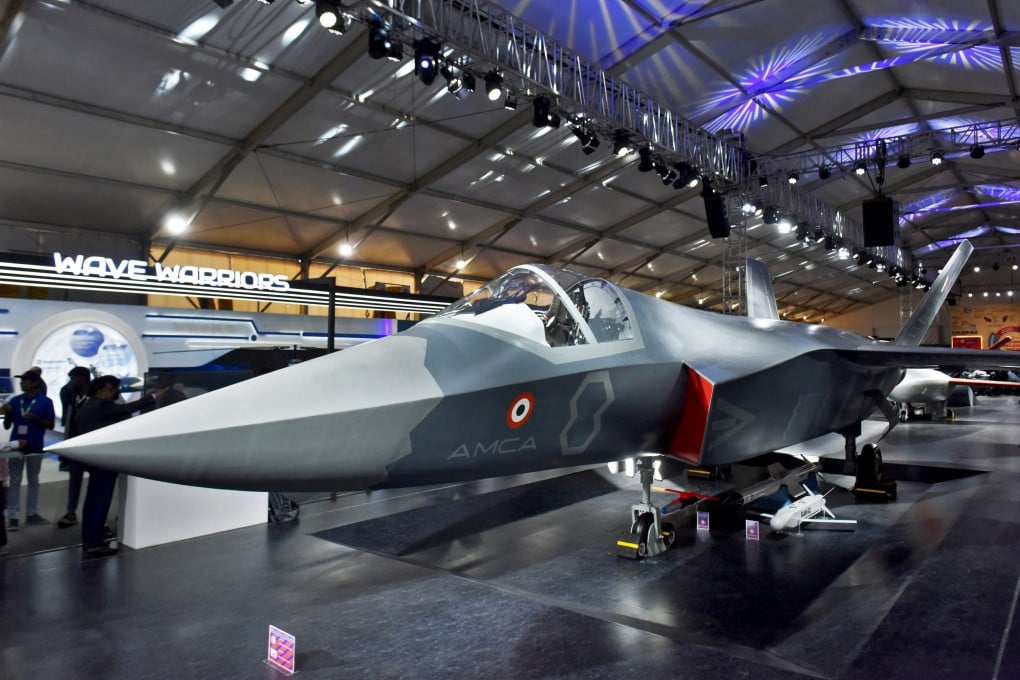
A full-scale model of the AMCA aircraft is displayed at the Aero India 2025 air show at Yelahanka Air Force Station in Bengaluru on February 14. Photo: AFP


The approval of an execution model for the fighter “is a golden opportunity for India to create a new defence industrial template for both its established public and insurgent private industry to work sustainably on a far more equal and efficient footing than any of India’s previous large-ticket, multi-decade defence industry projects,” Levesques told This Week in Asia.
“Already, minimising the long-evidenced distance between India’s public and private sector is a symbolic but real success of the AMCA programme and evidence of 2025 being India’s proclaimed ‘year of reforms’.”
As indigenous systems like the Very Short-Range Air Defence System (VSHORADS), man-portable anti-tank guided missile (MPATGM), and the HAL Tejas Mark 2 light combat aircraft approach induction, India’s defence industry stands on the cusp of an era-defining transformation.
That shift has also been accelerated by battlefield realities. During Operation Sindoor – India’s recent military response to a militant attack on civilians in Indian-administered Kashmir – Indian forces deployed the homegrown Akash and Akashteer air-defence systems to intercept Pakistani drones and missiles.
The operation revealed India’s need to not only counter Pakistan but also address indirect Chinese involvement, according to retired Air Vice-Marshal Kapil Kak, making locally developed defence systems a crucial part of operational readiness.
Indigenous capability has come to the forefront in our thought process in planning for the future as a result of our experience in Operation Sindoor

Kapil Kak, retired Indian air vice-marshal
“Indigenous capability has come to the forefront in our thought process in planning for the future as a result of our experience in Operation Sindoor,” Kak told This Week in Asia.
In the recent India-Pakistan clashes, China’s involvement extended to earlier supplying Islamabad with the military technology it used, such as PL-15 missiles and J-10C jets.
India had not initially planned to develop a fifth-generation fighter jet like the AMCA, Kak said, and was instead focused on the Tejas Mark 1A – a 4.5 generation multirole combat aircraft – and the Mark 2 “which is a more improved variant”.
The Mark 2 “was then to be followed by AMCA, largely 4.5 generation, not planned to be built fifth generation”, he said.

But experience and insights from the United States – and the study of Chinese systems – had shown India that the development, testing and production timeline for a fifth-generation fighter could, in fact, be shorter than that for a fourth-generation jet, Kak said.
“Chinese programmes are well known,” he said. “There are reports that China might provide Pakistan with the J-35, which will put us [India] in a disadvantage if there is a need of another operation like Sindoor.”
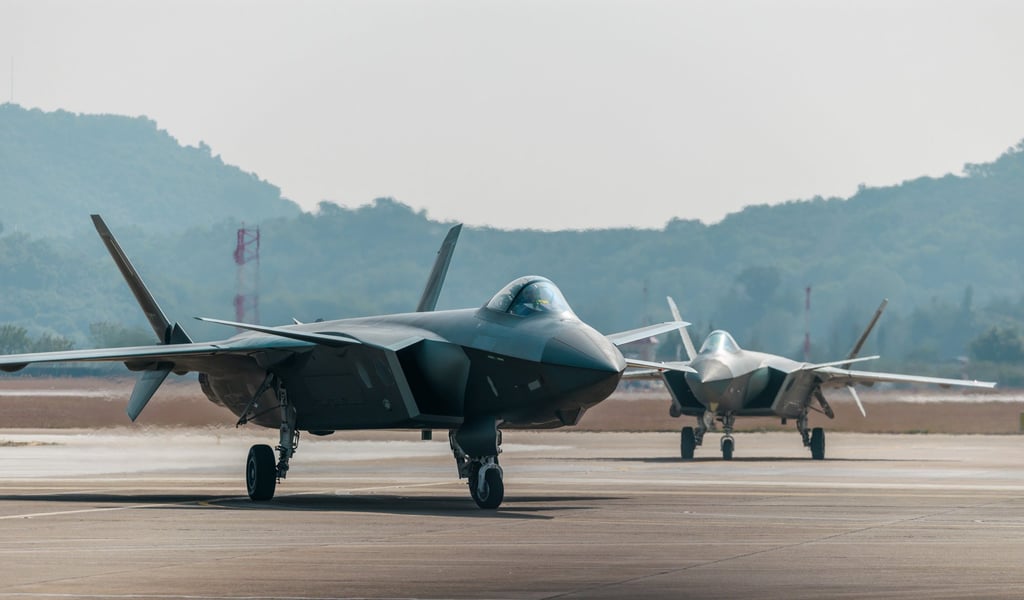
China’s new-generation J-35 medium multi-role stealth fighters are seen at Airshow China in Zhuhai in November. Photo: EPA-EFE

With the AMCA’s roll-out, India would join a select group of nations that have fifth-generation stealth fighters: the US’ F-22 Raptor and F-35, China’s J-20, and Russia’s Sukhoi Su-57.
In March last year, the Cabinet Committee on Security chaired by Indian Prime Minister Narendra Modi approved the full-scale design and development of five AMCA prototypes with an initial budget exceeding 150 billion rupees (US$1.8 billion).
The AMCA is envisioned as a twin-engined, medium-weight multirole fighter with advanced stealth features, including internal weapons bays and sustained supersonic flight.
The challenge for India will be quickly achieving reliable serial production of a packaged system that includes ancillary systems, data processing and advanced software – a level of complexity India’s defence industry has yet to achieve in a single product, according to Levesques.
“The competition for reliable foreign-origin engines is advanced and will help fast track the programme,” he said. “But consistency of political support, ability of industry to supply on time and to requirements, will be critical aspects of the implementation phase, once final execution plans are reached.”
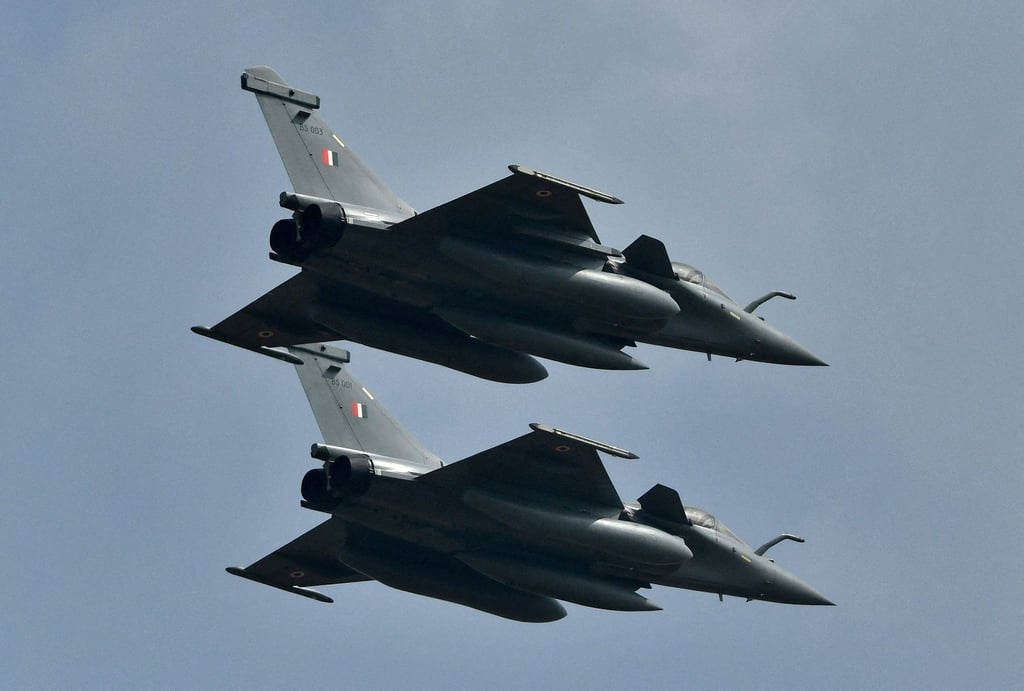
Rafale fighter jets of the Indian Air Force perform a fly past during Aero India 2021. Photo: Reuters

India currently operates French Rafale and Soviet-era MiG-29 fighters, alongside several other aircraft, including the ageing MiG-21, Jaguar and the Mirage 2000, as well as the domestically developed HAL Tejas.
“India is already in the process of developing fighter jet systems, and we have had reasonable success with the Tejas programme,” said Ajey Lele, deputy director general at the Manohar Parrikar Institute for Defence Studies and Analyses in Delhi.
“Now, from the fourth and 4.5th generation, it is logical that you will move to the fifth generation.”
Delhi was keen to reduce its dependency on other countries, particularly for fighter jets, Lele said. “So, it is technology progression which is already happening in India.”
Indian defence officials have previously said that they expect the AMCA to be delivered within the next decade, but Lele cautioned that it was too early to predict the exact timeline.
“It depends on how quickly the project takes shape and systems are put in place,” he said, noting that once a technology matures, progress can be rapid, as seen with BrahMos missile development.

Both India’s Defence Ministry and military would seek to keep AMCA development on track, Levesques said, to compensate for the retirements of older aircraft and boost the overall number of aircraft in active service.
Ensuring the technological relevance of new aircraft “is a common concern of military forces”, he said, adding that this was especially true for India given that China was potentially already working on aircraft that were a full generation ahead of the AMCA.
“With AMCA, India’s domestic technology attainment levels and overall wider defence industrial proficiency stakes can hardly be overstated,” Levesques said.

SCMP : China targets chip, quantum advances with 2030 metrology action plan in t

China targets chip, quantum advances with 2030 metrology action plan in tech race with US
Plan aims to tackle several ‘pain points’ or shortcomings in China’s metrological capabilities, official Science and Technology Daily says

China has released an action plan for “disruptive technological innovation” in metrology – the scientific study of measurement – within the next five years.
The 2030 action plan, released by the State Administration for Market Regulation, focuses on breakthroughs in chip technology and quantum-scale measurement, both critical to a wide range of industries.

According to a report by ministry newspaper Science and Technology Daily last week, the plan targets tackling several “pain points” or shortcomings in China’s metrological capabilities, including measurement capabilities that are missing or need to be improved.

Metrological applications relating to chips and rare earth magnets have been flashpoints in the US-China technological rivalry, as Washington continues to tighten controls on hi-tech chip exports to China citing national security while China leverages its dominance in rare earth metals with its own export restrictions.
As metrology is the foundation for all industries dependent on precise and dependable measurements, the expansion of such capabilities is a strategic priority for both countries.

“By 2030, basic metrology capabilities will be comprehensively improved, with key breakthroughs in more than 50 key core technologies of metrology,” the Chinese action plan released on May 16 says.

Aimed at helping to implement China’s 2021-2035 metrological development goals, the plan envisages building more than 20 world-class metrology benchmarks and developing at least 100 innovative devices and standardised materials.

This will benefit a range of fields such as trade settlement, healthcare, environmental monitoring, climate change, disaster prevention, food safety, criminal justice and maritime activities, according to the plan.

Metrology research will be carried out in fields including artificial intelligence, miniaturised sensing technology, robotics, material and additive preparation, measurement procedures and comparison technology, as well as the reproduction and quantum reform of the metric system.

One area prominently featured in the plan is strengthening and developing precision measurement and sensing equipment that leverages quantum physics phenomena, such as quantum gyroscopes for navigation.

China will develop quantum metrology devices and “distributable quantum measurement standard reference devices and instruments that break through the precision limits of traditional metrology”, the plan says.

Research on chip-scale metrology will also be expanded, including technology for nanoscale integrated circuits, neural network chip metrology, and on-chip frequency combs, which measure exact frequencies of light.

China’s plan comes less than a year after CHIPS for America – a US Department of Commerce office set up under the 2022 Chips and Science Act that aims to increase American leadership in semiconductor research and production – launched a new initiative to address challenges in metrology.

As semiconductor components shrink and become more complex, metrological precision becomes increasingly critical to manufacturing success.

Despite US-led export curbs aimed at limiting its access to advanced semiconductors and bans on advanced AI-powered chips made by Chinese companies, China continues to push forward with domestic semiconductor development, achieving notable breakthroughs.

The 2030 action plan also aims to develop metrology technology for rare earth magnets, which are powerful magnets made of alloys of a group of 17 elements that are predominantly mined and processed by China.

Earlier this year, Beijing added seven rare earth elements to its export control list following US President Donald Trump’s April 2 tariff announcements.
Rare earth elements are essential for an array of applications, including electric vehicles, electronics, and defence systems. Countries like the US, with lower rare earth reserves and production, have relied on China to supply these critical elements.

Beyond chips and magnets, the action plan calls for strengthening research in high-precision measurement technologies such as image detection, precise positioning, and metrology in complex environments like nuclear facilities and space.

To achieve these goals, China aims to establish a metrology science and technology platform and a collaborative innovation platform among its institutions and enterprises. It also plans to cultivate metrology projects and comparison centres while boosting industry and manufacturing capabilities.

NYT : What Does Ultra Wealth Look Like?

What Does Ultra Wealth Look Like?
In HBO’s “Mountainhead,” the “Succession” creator Jesse Armstrong uses subtle status symbols — and a secluded $65 million ski chalet — to convey hierarchy among the 0.001 percent.

When Paul Eskenazi, the location manager for “Mountainhead,” a new film from the “Succession” showrunner Jesse Armstrong, set out to find a house to serve as the primary setting for this satire about a group of ultrarich tech bros, he needed a very specific kind of extravagance. In the same way that “Succession,” which Eskenazi also worked on, reveled in “quiet luxury,” “Mountainhead” needed its moneyed protagonists to be living large but without flamboyance. Its characters are too wealthy for mere McMansions, and not any private residence would do.

Portraying how the ultrawealthy really live — with all their subtle signals and status cues — has become something of a specialty for Armstrong and Eskenazi. It’s about not just private jets and sprawling homes, but the quiet hierarchies within the top 1 percent. There’s a pecking order between the 0.01 percent and the 0.001 percent, the kind of distinction that insiders equate to owning a Gulfstream G450 versus a Gulfstream G700.

When Eskenazi found a lavish, 21,000-square-foot ski chalet built into a hill of Deer Valley in Utah, he knew it was the right fit — not because it was so large and impressive, though it’s certainly both, but because its extravagance had a subtlety that made it almost understated.

“There’s a kind of quiet wealthy embedded in that location that doesn’t necessarily scream at you. It reveals itself slowly,” Eskenazi said, pointing out that it has a private gondola with direct access to a nearby ski resort. “It’s not flashy, but it’s deeply exclusive — the kind of feature that signals a level of access and control money affords without ever needing to show off.”

“Mountainhead” is a tightly wound satirical chamber drama about four rich friends in tech who gather for a weekend of carousing while the world is plunged into chaos. There’s Venis (Cory Michael Smith), the founder of a Twitter-like app whose new A.I. creator tools have triggered a tidal wave of online disinformation; Jeff (Ramy Youssef), whose content-moderation software holds the key to resolving global strife; Randall (Steve Carrell), an elder plutocrat with a philosophical bent; and Hugo (Jason Schwartzman), whose meager $500 million net worth has earned him the nickname “Soups,” for “soup kitchen.”

Virtually the entirety of “Mountainhead” takes place within the palatial walls of Hugo’s mansion, which feels like a fifth character.

In real life, the house is on West Crestwood Court in Deer Crest, a gated community adjacent to the Deer Valley ski resort, where celebrities like Khloé Kardashian and Gwen Stefani have hit the slopes. Designed by the architect Michael Upwall, it has seven bedrooms and 16 bathrooms, as well as a two-lane bowling alley, a full-size basketball court, an indoor rock-climbing wall, and a spa with a steam room and sauna.

Outside, it features an infinity pool and a whirlpool bath, both built into a 5,000-square-foot heated patio. But it’s more than just well appointed. As Eskenazi pointed out, the house is “not nestled into a community flanked by neighbors” but is “set apart, elevated, with sweeping views that feel deliberately unobstructed.” That sense of “space, privacy and silence,” he said, provides “its own kind of luxury.”

This was a stark contrast to Armstrong’s “Succession” and its protagonists, the Roy family, who own the media conglomerate Waystar Royco. “That kind of media mogul wealth is about access and movement. It’s flashy, public, very performative,” Eskenazi said. “With ‘Mountainhead,’ it was the opposite. Jesse wanted just one main house — huge, remote and a little unsettling”

“It was more about isolation and privacy than prestige,” Eskenazi added.

The remote home is the “pinnacle of ultraluxury,” in the words of Engel & Volkers, the real estate firm that recently listed the property for $65 million. (It sold for a figure “in the high-50-million range,” a representative for Engel & Volkers said.)

“Mountainhead” wasn’t conceived with this specific property in mind. Instead, the crew was briefed to search for something elevated and isolated, ideally set against snow and ice. What Armstrong wanted “wasn’t about a specific architectural style so much as a feeling,” Eskenazi said. “The house needed to be remote and imposing, yes, but also strangely intimate — a place that could hold both grandeur and silence. It had to feel like it had a history, even if we didn’t spell it out onscreen.”

The search for the right setting started broad: The crew considered homes in Europe, while HBO urged it to consider locations in Canada, such as Whistler, British Columbia, because of the country’s ample tax credits for visiting productions.

An architectural profile in the magazine Robb Report clued the crew into the Deer Valley property. “The moment Jesse saw it, everything changed,” Eskenazi said. “That was when the location locked in and we knew: This is it.”

Stephen Carter, the production designer on the film, and the crew added faux-stone veneers and cedar paneling to cover up some of the house’s bare walls, and he was responsible for details like art and furniture, including a $300 toaster and “a lesser-known Jeff Koons.”

Some of these fixtures were meant to convey Hugo’s desperation to impress, as well as his status as the minor magnate. For example, the art: “While these items would auction in the six figures, they’re not quite at the level” of the others in the group, Carter said. (“Was your decorator Ayn Bland?” Jeff ribs Soups when he arrives.)

One of the wittiest touches? A work by Damien Hirst in the entry hall: “Beautiful Bleeding Wound Over the Materialism of Money Painting.”

The cumulative effect of these details and the property they’re situated in suggests a kind of gilded cage — the perfect place to sequester four rich tech bros as society starts to collapse all around them.

“The house didn’t just support the story,” Eskenazi said. “It became part of it.”

NYT : Ray Dalio’s Prescription for Avoiding Fiscal Catastrophe

Ray Dalio’s Prescription for Avoiding Fiscal Catastrophe
The hedge fund billionaire’s take on how to fix America’s fiscal woes is getting a warm reception in Washington, even as he suggests drastic changes.

Ray Dalio’s fix
Ray Dalio calls it the “3 percent solution,” and it’s gaining attention with White House officials and senior Republicans as a potential fix to America’s fiscal woes even as the party pushes ahead with a mega spending bill that’s roiling the bond markets.

For the past couple of weeks, advance copies of Dalio’s forthcoming book, “How Countries Go Broke: The Big Cycle” — and Dalio himself — have been making the rounds with policymakers in Washington and investors in New York.

The hedge fund mogul has been warning for some time that America’s soaring deficits risk economic calamity, and Dalio recently met with the chairman of the House Budget Committee, Representative Jodey Arrington of Texas, and its members.

What’s the solution? It aims to bring the annual deficit-to-G.D.P. ratio down to 3 percent, from around 7 percent. According to Dalio, this can be accomplished only by pulling “three levers” — cutting spending, raising tax revenue, and the corresponding lowering of interest rates.

“The 3 percent solution is very practical,” he told me by email. “It has worked many times in many places, most recently in the U.S. from 1991 to 1998.”

Dalio argues the interest rates lever is the most consequential.

The problem: Everyday interest rates are tied to the budget. We’re seeing that connection play out in real-time. The bond market has started charging a higher interest rate to buy U.S. government debt as confidence in the government’s fiscal discipline sours.

If Congress can get serious, Dalio argues, it will send a huge signal to the markets. Treasury Secretary Scott Bessent had made a similar argument. But he has recently gone quieter on that message as the bill, which is expected to add significantly to the deficit over the next decade, advanced through the House.

A fiscally responsible budget would ease volatility in the bond market. Any economic slowdown caused by reduced spending could be offset by lower interest rates, which is what a heavily indebted nation needs most.

The challenge: All three levers need to work in tandem. Both parties have shown little interest in meaningfully cutting spending. Raising taxes, too, is a nonstarter. The upshot is a stalemate in Washington and higher interest rates.

“All the political decision makers on both sides of the aisle that I spoke with agree that we are likely headed for a terrible outcome if the deficit isn’t cut down to about 3 percent of G.D.P.,” Dalio continued. “So I feel it’s like being on a boat headed for the rocks in which everyone agrees that we will crash if we don’t change our course, but they’re too hung up arguing which way to turn.”

The question is, even if he is right — which he probably is — what would actually push lawmakers to act and avoid the rocks?

“The forcing mechanism will likely be a debt crisis and all that goes with it,” he wrote.

The Information : What Anthropic’s Big Acquisition Could Mean

What Anthropic’s Big Acquisition Could Mean

Anthropic has a shiny new addition I can’t stop thinking about: Reed Hastings, who is joining the AI startup’s board. I wonder if his arrival might hold greater significance than we might think.

Previously, Hastings has held few corporate board seats beyond the one he retains at Netflix after stepping down as CEO a couple years ago. Aside from Netflix, he’s also currently on Bloomberg LP’s board, and in the past, he sat on Microsoft’s (2007 to 2012) and Facebook’s (2011 to 2019).

Plenty of bigwigs like Hastings treat board seats like country club memberships, accumulating a small stack of them, and view their directorships more or less with the same seriousness as they would an afternoon scramble. Hastings, by contrast, seems more mindful about the boards he picks, suggesting he tends to take a seat when he thinks he might actually have a worthwhile perspective to add. (He wouldn’t comment for this column.)

Hastings has plenty of experience with two elements Anthropic needs to figure out (and combining them might really, really help it draw even with OpenAI): video as well as the task of branding a consumer subscription business. Obviously, Hastings did quite well at both while running Netflix.

In the AI market right now, Google’s Veo and OpenAI’s Sora have assumed leading positions. (There’s also Runway, but that’s more for professionals, as we’ve previously explained.) Meanwhile, Anthropic is noticeably absent.

The branding problem, meanwhile, is a universal concern within AI. How is Anthropic different from OpenAI? How is it different from Gemini? Even the most enthusiastic denizens of Silicon Valley would struggle to come up with a cogent answer. The average person on the internet certainly couldn’t, and that’s exactly who Anthropic needs to win over. Reed, a little help there! (Here’s a freebie idea: I think one of the most interesting things Anthropic could build is an advanced version of the interactive entertainment system that powered the “Bandersnatch” episode from “Black Mirror.” The concept for a choose-your-own-adventure plot was clever, though obviously limited by how much content the filmmakers could produce. Think what it could be like powered by generative AI…)

From his time on Facebook’s board, Hastings must also have a keen perspective on the risks of warp-speed growth and of the proliferation of an entirely new form of the internet. But surely safety-focused Anthropic wouldn’t need his advice on that subject.