(Telegaph) Luxury penthouse snapped up in the record property deal of the year

Exclusive: Luxury penthouse snapped up in the record property deal of the year

Penthouse apartment in 77 Mayfair goes for £7,000 a square foot - and it's not even built yet

A luxury penthouse on Mayfair's South Audley Street has broken the price record for any residential property deal in London so far this year, after it was snapped up for an astounding £7,000 per sq ft.
This is the highest price per square foot achieved for any home in 2015, and previously beaten only by a handful of sales in Knightsbridge in 2013 and 2014. It is understood the penthouse sold for approximately £26m.
The penthouse at 77 Mayfair was one of six other apartments which have all sold off plan over the last seven months and totalled £100m in separate deals.
• The 200 home tower block that sold out in a morning
The high-end developer Luxlo confirmed the exchanges to the Telegraph yesterday and said that the average price per square foot for all six apartments was £5,500 - an all-time record for Mayfair.
For the casual observer there are no internal images and few details so far. The penthouse itself is understood to include car parking spaces and servants quarters downstairs. It has two floors, three bedroom suites, roof terrace and a cinema room.
The new block will be completed by 2016 and is next to Hyde Park and overlooks the Dorchester Hotel. It has underground parking and a luxury spa which is operated by the Harrods 24 hour concierge service.
• In pictures: The £10m villa behind the Bond baddie underwater lair
• Your own private island cheaper than the average London home
The last luxury apartment complex to spark a debate over the price of property in central London was Clarges Mayfair - built by the leading UK property group, British Land.
The average price per square foot achieved for the condiminium, which overlooks Green Park, exceeded the £5,000 mark and the penthouse was understood to have sold for close to £7,000 per square foot. However, it was was beated by the equivalent home in 77 Mayfair by a whisker.
Only last week an office-to-residential conversion on Mayfair's Upper Brook Street sold for £90m or around £4,285 per sq foot. It was proclaimed to be the "deal of the year", but was blown away by the price per square foot of the penthouse at 77 Mayfair. Apartments go for a premium over houses.
"Due to the proliferation of listed buildings in Mayfair, new build developments are a real rarity," said Richard Cutt, partner at Knight Frank.
Knight Frank and Wetherell were joint agents on the sale.

(Telegraph-AEP) Oil and gas crunch pushes Russia closer to fiscal crisis

Oil and gas crunch pushes Russia closer to fiscal crisis - http://bit.ly/1fr95Oe

'Russia is going to be in a very difficult fiscal situation by 2017. By the end of next year there won’t be any money left in the oil reserve fund,' says Unicredit

Russia has fallen into full-blown depression and faces a mounting fiscal crisis as oil and gas revenues plummet.
Output from country’s state-owned gas giant Gazprom has collapsed by 19pc over the past year as demand shrivels in Europe, falling to levels not seen since the creation of the company at the end of the Cold War.
A report by Sberbank warned that Gazprom’s revenues are likely to drop by almost a third to $106bn this year from $146bn in 2014, seriously eroding Russia’s economic base.
Gazprom alone generates a tenth of Russian GDP and a fifth of all budget revenues. It will be several years at best before the country benefits from a new pipeline deal with China.

Russia is already in dire straits. The economy has contracted by 4.9pc over the past year and the downturn is certain to drag on as oil prices crumble after a tentative rally. Half of Russia’s tax income comes from oil and gas.
Core inflation is running at 16.7pc and real incomes have fallen by 8.4pc over the past year, a far deeper cut to living standards than occurred following the Lehman crisis. This time there is no recovery in sight as Western sanctions remain in place and US shale production limits any rebound in global oil prices.
“We’ve seen the full impact of the crisis in the second quarter. It is now hitting light industry and manufacturing,” said Dmitri Petrov from Nomura.
“Russia is going to be in a very difficult fiscal situation by 2017,” said Lubomir Mitov from Unicredit. “By the end of next year there won’t be any money left in the oil reserve fund and there is a humongous deficit in the pension fund. They are running a budget deficit of 3.7pc of GDP but without developed capital markets Russia can't really afford to run a deficit at all.”
A report by the Higher School of Economics in Moscow warned that a quarter of Russia’s 83 regions are effectively in default as they struggle to cope with salary increases and welfare costs dumped on them by President Vladimir Putin before his election in 2012. “The regions in the far east are basically bankrupt,” said Mr Mitov.
Russian companies have to refinance $86bn in foreign currency debt in the second half of this year. They cannot easily roll this over since the country is still cut off from global capital markets, so they must rely on swap funding from the central bank.

The authorities can cover part of this from the country’s current account surplus, but a “financing gap” of $10bn to $15bn a quarter remains. This implies a slow depletion of the central bank’s foreign reserves.
The official reserves have dropped from $524bn to $361bn since the Ukraine crisis first erupted in late 2014. Unicredit said the true figure is nearer $340bn once other commitments are stripped out.
Companies and banks have already slashed their hard currency debt by $170bn in a drastic deleveraging over the past 18 months. This whittles away the dollar debt burden, but at a terrible long-term cost for Russia’s productive economy.
“Frankly, I don’t think they can weather this crisis. There has been almost no investment in new oil production except in Western Siberia. They are still relying on old Soviet wells,” said Mr Mitov. The depletion rates in the traditional fields of Western Siberia are running at 8pc-11pc a year.
“They can’t keep up production without access to foreign imports and technology, so we think there could be a fall in output of 5pc to 10pc by 2018,” he said.
Lukoil’s vice-president, Leonid Fedun, said in March that Russia’s oil output could fall 8pc by the end of next year, taking 800,000 barrels a day (b/d) out of global markets, with major implications for the balance of supply and demand.
Any such loss would be corrosive for Russia. It has not happened yet. Russian producers have taken advantage of a new tax regime to raise output this year to 10.7m b/d, close to the post-Soviet peak. But they are relying on legacy investments and imported machinery that must be replaced sooner or later.
Mr Putin’s long-term strategy depends on opening up the Arctic and the vast shale reserves of the Bazhenov basin and the Volga-Urals. Drilling in these regions is covered by sanctions, forcing Western firms to freeze joint ventures.
Russia lacks the technology to make these projects viable. Average fracking costs in Russia are three times higher than those of cutting-edge drillers in the US.
The oil slump is, in one key sense, worse than in January, when markets thought it was a short-term shock triggered by Saudi policy. This time futures contracts are factoring in no real recovery in prices for two to three years.
The Russian authorities have the crisis under control for now. They have allowed the rouble to fall rather than burning up reserves, providing a cushion for the budget and for oil and gas producers. But this policy is inflationary, and politically toxic.
The underlying strain remains. Russia bet its future on oil, gas and the commodity boom, letting its manufacturing base atrophy in the glory days of the strong rouble.

It has now been left high and dry by the commodity slump, a textbook case of the Resource Curse. Western sanctions have tightened the vice. “The real problem is that Russia’s economy is going nowhere,” said Mr Mitov.

(Manager-Mag) China crisis could cost Volkswagen a billion euro profit

The current weakness in demand in China could cost the automaker Volkswagen 2015, more than one billion euro profit. The yield on the Chinese joint ventures of the Group lie in the current year to date by about a quarter of the previous year's margin, Manager Magazin reported in its latest issue (release date: Jul 24th). If sales remain as low as in June, could at the end of a second billion is missing, according to group circles.
China is now the most important market for Volkswagen. Europe's largest carmaker sold there 40 percent of its vehicles. After regular double-digit growth in recent years, sales declined in the first half 2015, but up 4 percent. In the VW brand saw a decline of in the first six months almost 7 percent, even 22 percent in June.

The first official visit of the new VW-brand chefs Herbert Diess in the Chinese joint venture partners got so into a kind of crisis Visite. Diess and Volkswagen CEO Martin Winterkorn met at the edge of the guest performances of the FC Bayern München in China with Chinese partners and its own top management. Volkswagen China CEO Jochem Heizmann've even already prepared plans for an austerity program, there is at Volkswagen.

(BFW) Gucci to Open Outlets at Dover Street Market Locations, CEO Says

--> Big change in strategy...

BN 07/24 07:34 *GUCCI TO OPEN SHOP-IN-SHOPS AT DOVER STREET MARKET LOCATIONS

Gucci to Open Outlets at Dover Street Market Locations, CEO Says
2015-07-24 07:49:01.901 GMT


By Andrew Roberts
(Bloomberg) -- Move is emblematic of new vision for Gucci,
CEO Marco Bizzarri says in e-mailed statement.

* “Building unique and exciting collaborations with selected
specialty stores is a new page at Gucci. I am sure it will
be appreciated by our customers and those who are now
approaching the brand as it is becoming more intriguing and
fashion forward,” CEO says.
* First outlet will open tomorrow in Ginza, Toyko, followed by
DSM locations in New York and London on Sept. 10, and
Beijing in the fall.

Link to Company News:{KER FP <Equity> CN <GO>}

For Related News and Information:
First Word scrolling panel: {FIRST<GO>}
First Word newswire: {NH BFW<GO>}

To contact the reporter on this story:
Andrew Roberts in Paris at +33-1-5365-5015 or
aroberts36@bloomberg.net

To contact the editor responsible for this story:
Marie Mawad at +33-1-5530-6290 or
mmawad1@bloomberg.net

(Wolf Street) Americans’ Economic Confidence Gets Whacked

Americans’ Economic Confidence Gets Whacked

At first, we thought it might have been a blip, a short-term thing, something to do with the winter weather which was gorgeous in California, though some folks in the East were getting lots of exercise shoveling what seemed like endlessly renewable snow. And we might have blamed it on the margin of sampling error.
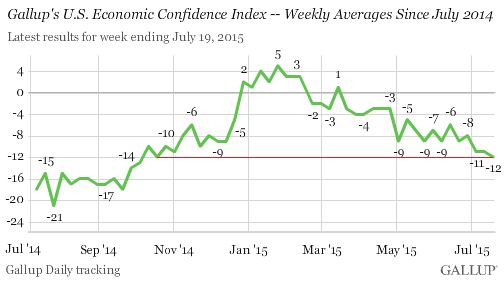
In early January, the economic confidence of Americans had reached the highest level since before the Financial Crisis, according to Gallup’s Economic Confidence Index. But then it began to drop. At the time, the weather was blamed for everything. But spring should have turned it around. Only it didn’t.
Economic confidence continued to zigzag lower in an orderly fashion, interrupted only by a sudden plunge and some upticks too. And today’s weekly index hit the worst level since October last year, with the three-day rolling average dropping to the worst level since September.
The index is a composite that tracks how Americans perceive current economic conditions and future economic conditions. It ranges from a maximum of +100 (everyone says the economy is “excellent” or “good” currently and is “getting better” in the future) to a minimum of -100 (everyone says the economy sucks and is going to suck even worse).
During the Financial Crisis, the bottom fell out of the index until it hit an all-time low of -65. Then “green shoots” started sprouting in the minds of more and more Americans, and by early 2011, the index reached -18 before re-plunging to -54 in the fall as a result of the debt-ceiling fight and talk of default. After the Congressional charade was over, economic confidence reemerged from purgatory.
By mid-2013, the index hit a lofty -3. But then another debt-ceiling charade kicked it back down to -39. This too passed. In 2014, the index wavered mostly between -21 and -14, until October when it began rising sharply. By early January, it hit +5.
And that was it. The weather or something was starting to get Americans down, and it wasn’t just for a week or two or a month a two, and it wasn’t within the margin of error, but it has lasted the entire year so far. The index has now dropped to -12, the lowest since October last year.
“This was the result of 25% of Americans saying the economy is “excellent” or “good” and 30% saying it is “poor,” Gallup explained. The three-day rolling average hit a low point of -17 during the July 12-14 period, the worst level since September.
This is the dismal trend so far this year of the Economic Confidence Index:
Gallup blamed Greece. The extortion racket over Greece was carried out in the media, with talking heads from one or the other side proclaiming on a daily basis the end of the world or of whatever, if they didn’t get their way. And this got Americans to think dreary thoughts about the US economy, apparently. But once the crisis was “resolved” with a deal that is totally unsustainable and makes no sense to anyone, and once the end of the world had been averted by Greece staying in the Eurozone for now, the three-day rolling average index ticked up a smidgen.
But the index is a composite of current conditions and future conditions. And the devil is in the details.
Turns out, the index measuring current conditions so far this year has dropped, but only a little, from +3 in early January peak to -5 now, and it actually ticked up this week. But the economic outlook index has swooned from its high in February of +7 to -18 now! That’s a 25 point plunge.
The current score of -18 is based on 39% of Americans saying the economy is “getting better,” and 57% saying it’s “getting worse.” A solid majority of Americans have once again turned bearish on the future of the economy, after all the hype and hoopla in December and early January.
So what painful things are these people seeing down the line? Higher interest rates, as 30-year mortgage rates have jumped well above 4% even before the Fed has begun raising rates? Tightening hiring conditions as companies come to grips with stagnant or declining sales and earnings? Whatever it is that causes Americans to turns bearish on the future of the economy, it has nothing to do with the weather or Greece.
These people are focused on the reality on the ground, and what that reality might look like for them in the future. They’re figuring out that, despite all the hype and proclamations and the record stock markets and booming housing market, reality for them personally simply doesn’t look all that enticing.
It takes a lot of market enthusiasm to just totally give up on the idea of net profits and focus instead on the hope that management comes up with some new and more palatable metrics. But that’s what’s happening

(Exane) Telecom Equipment : Doom and gloom is so last season

We have gathered data for over 50 operators across the world to gauge global trends in operator
spending, based on input from the Exane BNP Paribas Telecoms team and on the capex guidance
of operators. We forecast flat capex this year, with strength in the EU and weakness in the US.

We expect flat mobile capex in 2015 in local currencies (-6% in USD)
After a strong but uneven 2014 (+6% capex growth), the current-year capex plans of operators
suggest a more muted environment, with aggregate constant-FX capex broadly flat (-6% in USD).

European spending set to further expand (+7% in local currency)
Vodafone is no longer the only spender. Our analysis suggests Europe still has a long way to go to
catch up with advanced LTE markets, in terms of both population coverage and penetration. We
also doubt that Vodafone can afford to phase down its Project Spring aggressively in 2016. For
vendors, more margin-friendly capacity upgrades are clearly on the cards, as the rollout-intensive
modernisations to single-RAN are now over in Europe.

After a dismal H1, we expect a strong recovery in US capex in H2
US capex had an unusual seasonality in 2014 (H1 stronger than H2), a trend that is reversing this
year. In a contracting market (-6% in USD), H1 is showing steep capex declines (particularly at
AT&T, -40%), with stabilisation/recovery set to follow in H2. AT&T has scaled back on its
aggressive small cell programme and will instead add macro capacity starting this summer. The
newly acquired AWS-3 spectrum should be populated with fresh capacity in the course of 2016.

We reiterate our Outperform stance on European names; highest upside for Ericsson
After a difficult start to the year, Ericsson’s Q2 results corroborate our scenario of stabilisation and
improvement going into H2. Cost-cutting initiatives are well under way and the business mix should
significantly improve: we reiterate our SEK120 TP (12% LT margins). As for Nokia-ALU, we believe
the deal will go ahead as planned with little likelihood of parity revision. Value creation is a little
more remote: full synergies by 2019 vs the completion of Ericsson’s cost-cutting actions by 2017.

FT : World’s first malaria vaccine gets green light from Europe


European regulators have given their blessing to the world’s first vaccine for malaria after 28 years of development by GlaxoSmithKline and heavy investment from Bill Gates.
GSK, the UK’s biggest drugmaker, announced on Friday that it had received a “positive scientific opinion” from the European Medicines Agency for its Mosquirix vaccine.

The favourable view from the EMA could clear the way for a WHO recommendation and the vaccine’s eventual adoption in sub-Saharan Africa and other affected regions.
However, critics have questioned whether Mosquirix is effective enough to justify the cost of rolling it out and tough debate is expected among global health authorities in coming months over how widely the vaccine should be used.
In clinical trials involving 16,000 young people in eight African countries, malaria cases were reduced by almost half in children aged 5-17 months and by 27 per cent in infants aged 6-12 weeks over 18 months. However, it required three doses to achieve this result and the benefit dwindled over time.
While acknowledging its limitations, advocates for the vaccine say it has the potential to make a significant dent in the roughly 585,000 deaths recorded annually from malaria.
“There are some people who say there is room for improvement, Moncef Slaoui, head of vaccines at GSK, told the Financial Times. “But do we wait until something better comes along or do we do what we can now?”
The World Health Organisation is expected to discuss the vaccine at a meeting in October. If recommended by the global health body, it would then be up to individual governments in malaria-affected regions to decide whether to adopt it.
Ray Chambers, the UN envoy on Malaria, said the vaccine was a “historic achievement” but hinted at its imperfection by expressing hope that it would “open the door for further vaccine development”.
GSK began working on Mosquirix, also known as RTS, S, in 1987 and has since invested $365m with up to $250m more planned as it moves towards launch. A further $200m has come from the Malaria Vaccine Initiative, an offshoot of the Seattle-based Path medical charity, supported by the Bill & Melinda Gates Foundation.
David Kaslow, director of MVI, said Mosquirix proved it was possible for a vaccine to disable the Plasmodium parasite that causes malaria, establishing a foundation for further innovation.
GSK has made it clear it does not see Mosquirix as a money-spinner; the vaccine will be sold at cost plus 5 per cent, with the surplus reinvested in tropical medicine research. It has not revealed what price that would amount to.
Sir Andrew Witty, GSK chief executive, admitted the vaccine was “not the complete answer to malaria”, but said it could make “a very meaningful contribution”.
Dr Slaoui said GSK would be engaging with governments and health authorities to work out where and how the vaccine should be deployed.
Gavi, the international organisation which distributes vaccines to poor countries, said it was ready to supply Mosquirix but Seth Berkley, chief executive, warned that additional funding would be required from the global community to do so.
Great progress has already been made against malaria through increased use of bed nets, insecticide and antimalarial drugs. Incidence decreased by 47 per cent between 2000 and 2013 and by 54 per cent in Africa, where nine in 10 deaths occur.
Yet, the disease still imposes a heavy toll, with more than 400,000 under-5s killed by malaria in 2013 and direct economic costs from treatment and premature deaths estimated at an annual $12bn, according to the US Centers for Disease Control and Prevention.
A vaccine has long been seen as the Holy Grail for malaria prevention, offering the best route to eventual eradication. For all its limitations, David Schellenberg, professor at the London School of Hygiene & Tropical Medicine, said Mosquirix was a “true milestone” towards that goal.

FT : Sergei Pugachev: ‘I personally brought Putin to power’


It is a late May evening and Sergei Pugachev, the exiled Russian tycoon, is flicking through an old family photo album. In one photograph, Mr Pugachev’s son, Viktor, is captured with eyes downcast as Maria Putina, the Russian president’s daughter, leans to whisper in his ear. In another, Mr Pugachev’s other son, Alexander, is posing on a wooden spiral staircase in the Kremlin library with Vladimir Putin’s two daughters. At the edge of the photo is a smiling Lyudmila Putina, then still the president’s wife.
The two families were close. Mr Putin’s daughters would often come to the Pugachevs’ house from the president’s neighbouring residence outside Moscow after school.

As he thumbed through the pictures at his house in Chelsea, London, those days seemed long ago and very far away. But his past was catching up with him. The former billionaire, who left Russia in 2011, was hearing whispers that Mr Putin’s government was seeking to extradite him to stand trial in a criminal case in Moscow. Russian authorities accuse him of embezzling hundreds of millions of dollars from Mezhprombank, a bank he co-founded. He is also fighting a worldwide freeze on his assets issued by London’s High Court.
Just a day before, Mr Pugachev sought the protection of the UK’s counterterrorism squad after finding suspicious devices on his cars, including the vehicle used only to take his three youngest children to school. He feared they could contain explosives, though it emerged this week that some were tracking devices planted by UK private detectives working for the Russian state.
Fearing for his safety, Mr Pugachev fled to France, defying a UK court order to remain in the country. The High Court this week weighed whether he should be ordered to return.
For a long time, Mr Pugachev thought the legal campaign against him was being crafted by Kremlin underlings who he says systematically seized his former business empire — which spanned shipbuilding, energy and construction. But as the pressure intensified, he concluded it could only be coming from the top. “How could Putin behave like this?” Mr Pugachev says. “I did everything for him. I even made him president.”
Though some will question that claim, it is clear Mr Pugachev has undergone a remarkable transformation from consummate Kremlin insider to embattled exile. His case is the latest example of what happens to Russian oligarchs who fall out of favour with the Kremlin. Ever since Mr Putin arranged the detention of Mikhail Khodorkovsky in 2003 and took over his Yukos oil empire, the Russian courts have been used to pursue the Kremlin’s foes and reassign property. Mr Pugachev fears the UK courts are now unwittingly becoming an extension of that regime.
Burnishing Putin
For Mr Pugachev, 52, the legal battles are personal and laced with irony. Already established by the 1990s, Mr Pugachev aided Mr Putin’s rise to power. In interviews, Mr Pugachev described how he worked behind the scenes to help secure President Boris Yeltsin’s re-election in 1996 — and then smooth the way for Mr Putin’s ascension to the pinnacle of Russian power.

Mr Pugachev always kept a low profile, but now — with what remains of his fortune and his freedom at risk — he is beginning to tell his story. According to his account, he was one of the most influential actors at the Kremlin during Russia’s momentous power shift in the late 1990s. But he was always in the shadows, a tactician who forged close relationships with the people who ruled the Kremlin — some of the same people who would later cast him out in the cold.
Business rivals say they are sceptical of Mr Pugachev’s account. But through interviews and reviews of documents, photographs and other evidence, the Financial Times has confirmed many aspects of Mr Pugachev’s account of his rise and dizzying fall from grace.
For the Russian state agency pursuing Mr Pugachev, the former tycoon’s story is far different. The Deposit Insurance Agency calls him a “fraudster” and dismisses Mr Pugachev’s concerns for his safety as “an attempt to fabricate an excuse for his admitted contempt of court”. Mr Pugachev’s story that he is the target of a politically-motivated campaign is a “smokescreen that doesn’t justify him running away and hiding hundreds of millions of pounds”, a DIA representative says. “In the current climate, it’s a very attractive line to peddle. But it doesn’t answer the legal case against Mr Pugachev that he is a fraudster and a liar.”
The claims against Mr Pugachev date back to the financial crisis. Russian officials say he siphoned Rbs28bn from Mezhprombank in 2008, shortly after it received a $1.2bn bailout by Russia’s central bank. The DIA accuses Mr Pugachev of placing $700m of those funds into the Swiss bank account of a company where his son was a director. (Mr Pugachev has said the funds stemmed from a separate commercial loan.) According to a person close to the DIA, Mezhprombank was being operated like a Ponzi scheme, with the bank issuing new loans to shell companies in order to pay off previous loans.
Mr Pugachev insists he is not hiding funds and that he ceased all dealings with the bank’s operations after he divested his stake on becoming a senator in 2001. He says the Kremlin-led takeover of his business empire, combined with hefty legal fees, has all but wiped out his fortune, estimated by Forbes at $2bn in 2008. Recently, he cast a forlorn figure in London’s High Court, where he sometimes chose to defend himself instead of paying for lawyers.
Election success
The Leningrad where Mr Pugachev grew up was the epicentre of the underground movement that chafed against Soviet control. As Mikhail Gorbachev launched economic reforms in the 1980s, Mr Pugachev saw an opportunity, forming co-operatives to trade jeans, cars and cognac.

In 1991, he moved to Moscow where he co-founded International Industrial Bank, or Mezhprombank, which was among the first banks to be granted a hard currency licence. He also received permission to open a financial company connected to the bank in San Francisco, where he spent part of each year.
By his account, Mr Pugachev’s US connections played a decisive role in Yeltsin’s re-election in 1996 against stiff Communist opposition. Thanks to a connection with Fred Lowell, a San Francisco lawyer close to the Republican party, Mr Pugachev brought in a team of US spin-doctors led by George Gorton, a top strategist for the then governor of California, Pete Wilson. Holed up in Moscow’s President Hotel, Mr Gorton’s team worked with Yeltsin’s daughter, Tatyana Dyachenko, to launch a US-style election campaign, humanising Yeltsin and stressing the danger of a Communist return to power.
Moscow commentators still debate the importance of the US strategists in clinching Yeltsin’s victory. But it seems clear their contribution won Mr Pugachev the undying gratitude of Ms Dyachenko, whose role in running the country grew as the president’s health failed. “They were the last real elections in Russia,” Mr Pugachev says.
Mr Pugachev first met Mr Putin in the 1990s, when he was working in the office of St Petersburg’s mayor. But it was when Mr Putin moved to Moscow in 1996 that the two men became better acquainted, Mr Pugachev says.
Moscow legend has it that Boris Berezovsky was the oligarch who made Mr Putin king. But others say Mr Berezovsky, who later fled Russia and died at his home in England in 2013, was a mythmaker who exaggerated his role.

Mr Pugachev says he was the one who introduced the idea of Mr Putin as a potential successor to the Yeltsin family. His friendship with Ms Dyachenko and Valentin Yumashev, Ms Dyachenko’s husband and then Yeltsin’s chief of staff, has been confirmed by the FT.

He says he sensed that a “real coup” was under way as parliament prepared to impeach Yeltsin and criminal charges were prepared against his family. “I understood we were losing the country,” he says. “We had to try and keep what we’d fought for.”
Working alongside Mr Putin — then head of the FSB security service — Mr Pugachev helped fend off these threats. In his account, Mr Pugachev first proposed Mr Putin as a candidate to take over as prime minister and then called on Ms Dyachenko and Mr Yumashev to persuade Yeltsin to step down.“I personally brought Putin to power,” Mr Pugachev says. “I worked day and night for nine months to do this.”
Mr Pugachev says he believed then that Mr Putin was a forward-thinking force in Russian politics, a man known for implementing orders. “We needed someone who 24 hours a day was going to be working on developing the country,” Mr Pugachev says. But he now admits his initial assessment of Mr Putin was wrong. “This is the sorry story. I’m horrified myself.”
He believed Mr Putin was someone who could be controlled — a man who had come from such a poor background that it was easy to impress him with the trappings of presidential life. “Before the collapse of the Soviet Union, he lived most of his life in communal flats. He was 40 before he began to work in the mayor’s office. This is why he can’t give up all this now — he wants all these palaces and riches — because where he came from before he had nothing.”
At the beginning of Mr Putin’s presidency, Mr Pugachev drove the former KGB agent to his new residence in Novo-Ogarevo where a 50m swimming pool beckoned. “His eyes went so big and round. I understood that he wouldn’t need anything else in life. I thought this would be the limits of his dreams. But it turned out absolutely differently. His appetite was unbelievable.”
As oligarchs and allies from his St Petersburg days kowtowed to the new president, Mr Putin began to change. The inner circle of former KGB men from St Petersburg convinced Mr Putin it was time for the state to take back control of the economy, Mr Pugachev says. “After this takeover of power by the KGB I could not influence things any more. They had taken over like a tsunami.”
Battle for influence
For a long time, however, Mr Pugachev remained close to the president. “He was a very close friend of Putin,” says a senior Russian businessman. “He was in and out of the Kremlin as if it were his own home.” Mr Pugachev says he believed he had better chances of influencing policy to take a more progressive course if he stayed on the inside rather than in open opposition.
But as Mr Putin’s silovik, or “tough guy,” colleagues from the KGB strengthened their grip, his relationship with the Russian leader began to falter.
Mr Putin harboured a resentment of the man who had put him in power, Mr Pugachev suggests. “There was always this friction from the very beginning,” he says. While the rest of the Kremlin inner circle bowed to Mr Putin’s every word, Mr Pugachev spoke his mind. He was “a victim of his own tongue”, the Russian businessman says.
Some observers in Moscow claim Mr Pugachev relied too much on his relationship with Mr Putin to win business favours. The empire he acquired following Mr Putin’s rise spanned Russia’s biggest shipyards in St Petersburg, a multibillion-dollar coking coal producer in Siberia called EPK, and some of the capital’s most high-profile construction projects. But Mr Pugachev notes that Mezhprombank had been the country’s biggest private bank long before Mr Putin was president. “I never asked for anything in return,” he says.
Pushed out of projects
The first hint of trouble came in August 2008 when Alexei Kudrin, then the liberal leaning Russian finance minister and a long-time ally of Mr Pugachev, told him Mr Putin wanted to take back a project to develop a five-star hotel and residential complex on one of the city’s most prestigious sites, 5 Red Square. Mr Pugachev assented — as long as the price was right. But the project was seized without any compensation at all. Mr Pugachev’s attempts to file a suit for the Rbs3.6bn he had spent on the project and an estimated Rbs41bn in lost profits went nowhere. A spokesman for Mr Kudrin said the former minister would not comment on Mr Pugachev’s case

The same thing happened a year later when Mr Putin told him he wanted to take the St Petersburg shipyards for the newly-created state shipbuilding corporation, OSK. First, Mr Pugachev claims, he was promised $5bn for the yards. But he received nothing.
Then came a string of criminal charges over Mezhprombank’s bankruptcy. The central bank revoked its licence in October 2010 as it struggled to pay back $1.2bn in bailout loans. Mr Pugachev claims the bankruptcy was orchestrated so the state could take the shipyards, which were held as collateral for the loans, at a knockdown price.
“People within the state manipulated the rules against him in order to bring the bank down, unsurprisingly benefiting themselves,” says Richard Hainsworth, former owner of Rusrating, a Moscow-based bank rating agency.
Mr Pugachev says he is still struggling to understand why Mr Putin turned against him. The criminal charges were pressed in 2013, long after he left Russia and three years after the Mezhprombank bankruptcy. But after he settled in London Mr Pugachev sent a letter to Mr Putin in 2012 warning of legal action over the expropriation of his business.
Mr Pugachev says he should have known time was running out. The late Russian Patriarch Alexei II, with whom he had forged a close friendship, warned him of the threat posed by Mr Putin and his KGB men. As the patriarch’s health began to fade in the autumn of 2008, “he told me he may not live, but that I would be a witness to how the Chekisty [members of the secret police] would destroy the country”, he says.