>>> Street Pre- Market

ML
* DSV - Primary placement of 17.5m shs to fund UTi,DKK 275,NDA, ING & Danske.
DELTA LLOYD - +ve read from transitional rules benefit in NN's solv ratio.+6%
JMAT - In line, much better than feared, had de-rated 20%, 150p special...+5%
MOTHERCARE - underlying prft £7m with strong progress in UK.............+3-5%
BW LPG - Q3 EBITDA 15% ahead on a stronger TCE top line, v strong........+3%
SKY - Ofcom removes ‘wholesale must-offer’ for Sky Sports 1 and 2.........+3%
GRAINGER - Strong, NAV growth better than est, change of mgmt focus.....+2-3%
ROYAL MAIL - H1 adj EBIT a 3% beat, improved 2016 cost guidance, soild..+2-3%
CRH - In line and reiterates guidance, says sees positive momentum in US+2-3%
NN GROUP - Solv 2 atio 214% v 200% prev, increases cost savings target..+2-3%
QINETIQ - solid update, revs stabilising and new £50m buyback programme...+2%
MEGGITT - multi $m contract for Boeing 777X cargo smoke detection system..+2%
SENIOR - FY at low end of guidance but given weakness small d/g a relief..+2%
SHAEFFLER - EBIT a strong beat on better margins, guidance maintained.....+2%
BERENDSEN - Solid commentary around revenue ahead of CMD later today......+2%
VESUVIUS - Weak trading update implies 3-4% downgrade but in the price....+2%
UMICORE - Positive read from solid JMAT numbers, hasn't de-rated as much..+1%
TED BAKER - 13 wk group retail sales +18.1%, in line with forecasts.......+1%
NOVARTIS - Said to consider purchase of US generic biz of competitor Teva.u/c
SHIRE - Inversion news a double edged sword with Baxalta implications...-0.5%
SMITH&NEPHEW - Treasury dept plans anti-inversion tax rules this week.....-1%
INVESTEC - Net income +11% and non interest revs +27.4%, in line..........-1%
SWATCH - Swiss watch headlines, Oct -12% or 7.6% adj for less wrking days.-1%
BT - -ve read from Ofcom removing wholesale must-offer for Sky Sports 1-2.-1%
SODEXO - FY EBIT a 2% beat on solid margins, cautious rev outlook the -ve.-1%
THYSSEN - FY in line but guidance won't see u/gs and no restructuring...-1-2%
CLOSE BROS - Banking div solid but Winterfloods struggling, weak outlook..-2%
DOMINOS PIZZA - comfortable with current est for FY. CFO to step down.....-2%
PARAGAON/ALDEMORE - We DOWNGRADE both to UNDERPERFORM in sector piece...-2-3%
SHAWBROOK/VIRGIN MONEY - We DOWNGRADE both to Neutral in sector piece...-2-3%
MOTA ENGIL - Sales 3% light and EBITDA 7% below bbg cons, net debt higher.-3%
BOVIS - Lowers margin targets on delays to high profit margin sites.......-5%
POUNDLAND - Warning, rev growth 6.2% for H1 vs mkt at 18%, not good......-20%


CS
Barry Call M/P Signs licensing agreement with Naturex
Berendsen M/P No's inline with market expectations
BG +2-3% Shells Deal Cleared by Australian Competition Regulator
CRH +2% No's inline, Europe sluggish, US strong
Electrocomp M/P Numbers inline with market expectations
Enel -1% Consultation paper on power review slightly negative
Galliford +1-2% Several contract wins on the tape
Gimv M/P NAV at EU43.09 per share at end-Sept, vs 42.53 in June
Hastings +1% CS initiate with OUTPERFORM (Attractive Growth)
Johnson Mat +2-3% PBT 4% ahead of CS, special div 150p, FY inline
Miners +2% Copper -0.10%, Brent +1.8%, Iron Ore -0.75%, China +0.48%
Mota Engil UNCH 3Q EBITDA falls 9.8% YoY E107m cons E115m
Novo Nord +1-2% CMD today, also positive SUSTAIN 4 Trial released (insulin)
NN Group +2% CMD - progress on execution, SolvencyII ratio better
Poundland UNCH 1H revs slightly better, tough trading
Richemont -1% Swiss watch exports fall 12% in October
Swatch -1% Swiss watch exports fall 12% in October
QinetiQ UNCH Revs inline, op profit slightly light, FY unchanged
Royal Dutch +1-2% BG Deal Cleared by Australian Competition Regulator
Royal Mail +2-3% No's good, parcels slightly better, FY costs lower
SAP +1-2% US peer Salesforce +6% after hours on good earnings
Senior UNCH Small warning, 2015 adj PBT to be around the lower end
Sixt +2% Numbers better, increasing guidance
Sodexo +2-3% FY rev €19.8bn vs cons 19.7bn, op profit and divi better
Terna -1% Consultation paper on power review slightly negative
Thyssen -2% EBIT slight beat, sales slight miss, outlook ok
Vesuvius -2-3% Org sales light, outlook towards lower end of range

RBC
BATS/IMT 0% Note close of SOUZA CRUZ in Brazil - jumped 10% on the bell???
BERENSDEN +2% Q3 trading update solid, Op.Profit well ahead.
CONTINENTAL +1% SCHAEFFLER announce strong rev. Growth, reit '15 forecasts
CLOSE BROS. -2% Q1 conditions challenging but reiterating FY outlook
DFDS +5% Q3 EBIT ahead and raising EBITDA guidance for FY again.
DSV -2% ABB overnight to raise DKK5bln, priced @ DKK275 v 282 close
MEGGITT +1% Multi-million USD sole source contract with Boeing, no detail
NN GROUP +1% Capital Mkts day, positive progress on cost base.
ROYAL MAIL +3% H1 clean EBIT £348m v 327 exp. Cost savings improving.
SAP +1% SALESFORCE.COM (+5.83%) on better outlook in the US post hours
SENIOR -4% Trading update weak, '15 at lower end of exp., $90m acquisition
SODEXHO +3% FY EBITA 1.5% ahead, organic growth inline, guidance inline.
SWATCH/CFR -1% Weak swiss watch export data, -12.3% for Oct v -7.9% for Sep.
TERNA -3% Consultation paper overnight shows lower returns
THYSSENKRUP -3% Q4'15 beat on Industrial solutions but lower guidance.
VESUVIUS -5% Weak trading statement due to steel mkts, FY to lower end.

Investec
* DTEL- T-Mobile -2% o/night on big switch incentives offered by Sprint......-1%
* ENEL- may sell Spain renewables assets to ENDESA (Expansion)...............+1%
* NN GROUP- CMD-cost cuts ahead, solvency II ratio rises to 214%.............+2%
* NOVO NORD- CMDin US to focus on r&d, Tresiba to launch early 16..........+0.5%
* RICHEMONT/SWATCH- Oct Swiss watch exports fell 12%, 7.6% adjusted..........-1%
* SAP- positive read from Salesforce.com results, +5% after hours............+2%
* SCHAEFFLER- 9m no’s, first since IPO, hopefully no shocks................+0.5%
* SHELL- Aussie regulator clears BG deal, makes ‘material find’ in US Gulf...+2%
* SODEXO- FY org sales 2.5%(2.4%),div 5c ahead,FY16 guidance little light?...U/C
* TEF- may halt fiber investment(Cinco Dias), response to regulator y’day....U/C
* THYSSEN- FY ebit in line, div light, FY16 ebit guidance in line............-3%

(Exane) CAC 40 : Klepierre to Replace EDF

* EDF is the smallest CAC 40 constituent and is at risk of being removed
If deletion is confirmed, EDF could suffer from a supply of c.EUR112m, or 7m shares, equivalent to
three trading days of volume.

* Klepierre is the best ranked and balanced candidate and hence best poised for any addition
If added, Klepierre could benefit from a demand of c.EUR243m or 6m shares, equivalent to 6
trading days.

* The CAC Next 20 composition is likely to remain unchanged
Edenred seems to be the weakest constituent but should manage to stay in the CAC Next 20 in the
absence of an obvious candidate for inclusion. Eutelsat and Rexel will probably not be entering the
index at this review.

* SBF 120: Europcar and Worldline should replace Maurel et Prom and Solocal Group. If
eligible, Dassault Aviation may replace Montupet
Ipsos and Vicat are also at risk of deletion. The impacts should be quite small.

* We might see another case for composition change in the CAC 40 in March 2016
Alstom is likely to have a weaker ranking following the expected redistribution to shareholders.

(Musings on Markets) Value and Taxes: Breaking down the Pfizer- Allergan Deal


Value and Taxes: Breaking down the Pfizer- Allergan Deal

A week ago, I began my series of posts on the drug business, starting with my perspective on how the business is changing and then moving on to posts on Valeant's business model and therunaway story of Theranos. I am finishing this series with a post on Pfizer's plan to merge with Allergan and the economics of the merger. This deal, which will make one of the largest pharmaceutical companies in the world even larger has drawn attention not just because of its magnitude, but also for its motives. While there is some desultory chatter about synergy (as is the case with every merger), this deal seems focused on two specific motivations: the first is that this is a bid by Pfizer to buy Allergan's higher growth and the second is that this is a deal designed to save taxes. Not surprisingly, the latter is attracting attention not just from investors and financial journalists, but also from politicians.

Growth but at what cost?

One of the most dangerous maxims in both corporate finance and investing is that it is better to grow than to not grow, and that a company that faces stagnant or declining revenues (and income) should seek out higher growth (at any price). In a post from a long time ago, I looked at the value of growth and noted that the net effect of growth depends on how much you pay to get it, and that overpaying for growth will give you higher growth and a lower value. In the graph below, you can see the effect of growth on value for three companies, all of which grow, the first by making investments that generate returns that exceed the cost of capital, the second by making investments that earn the cost of capital and the third by making investments that earn less than the cost of capital.

It is this perspective on growth that makes me skeptical about companies that grow through acquisitions, especially when those acquisitions are big and are of public companies. Since you have to pay market price plus (a premium of 20-30%) to acquire a public company, for a growth-motivated acquisition to create value, you have to be able to find a growth company that is under valued by more than 20% or 30%, given its growth rate, at the time that you initiate the deal to be able to walk away with value added. Note that, much as I am tempted to do a riff about the wondrous benefits of bringing both Botox and Viagra under one corporate entity, I am deliberately keeping synergy out of the equation since it can justify a premium.

Let's consider then the proposition that the Pfizer deal for Allergan is driven by the motivation of buying growth. The basis for the story is visible in this comparison of Pfizer and Allergan's operating numbers over the last five years:

Over these five years, Pfizer's revenues shrank about 6% a year whereas Allergan's revenues grew at 40.62% a year. That makes the case for the acquisition, right? Not quite, because it depends on whether the market is already pricing in Allergan's growth. If it is, buying Allergan will allow Pfizer to grow faster, but not create value and may in fact destroy value if the premium paid is large enough. To examine whether Allergan offers growth at a bargain, I considered valuing Allergan, but very quickly abandoned the idea, because it reminded me of Valeant, insofar as it has grown rapidly through acquisitions, funded with significant amounts of debt and its financial statements are a mess. Thus, while it clear that Allergan has grown fast, the question of whether it has grown sensibly is a question that remains to be answered. Looking at the multiples at which Allergan was trading, prior to the Pfizer bid, there is almost no multiple on which it looks like a bargain.

Pharmaceuticals Allergan Allergan Premium
PE Ratio 31.24 NA NA
Price/Book Equity 4.11 4.37 6.33%
EV/EBIT 20.12 53.15 164.17%
EV/EBITDA 13.97 19.32 38.30%
EV/EBITDAR 9.71 16.58 70.75%
EV/Sales 4.71 7.85 66.67%

What is the bottom line? If I were a Pfizer stockholder, I would be concerned if buying growth were the primary reason for this acquisition, since the growth at Allergan is not only at a premium price but also untested (insofar as it is acquired growth rather than organic growth). I would be terrified, especially after recent scares, that the acquisition accounting at the company may be hiding bad surprises.

The Insanity of the US Tax Code

One of the most surprising aspects of this deal is how open the Pfizer management has been about the tax motivations for the deal, with Ian Read, the CEO of Pfizer, saying that "the company is at a tremendous disadvantage under the U.S. corporate tax code and that Pfizer is competing against foreign companies with one hand tied behind our back.” This planned "inversion", of course, has triggered a heated response, understandable (at least politically), though some of the critics don't quite understand the US tax law and what exactly Pfizer will gain by leaving behind its US incorporation.

I have vented extensively about the absurdity of US tax law and how it encourages perverse behavior from businesses (and individuals). Rather than repeat myself, let me focus in on the three aspects of the law that makes it so damaging:
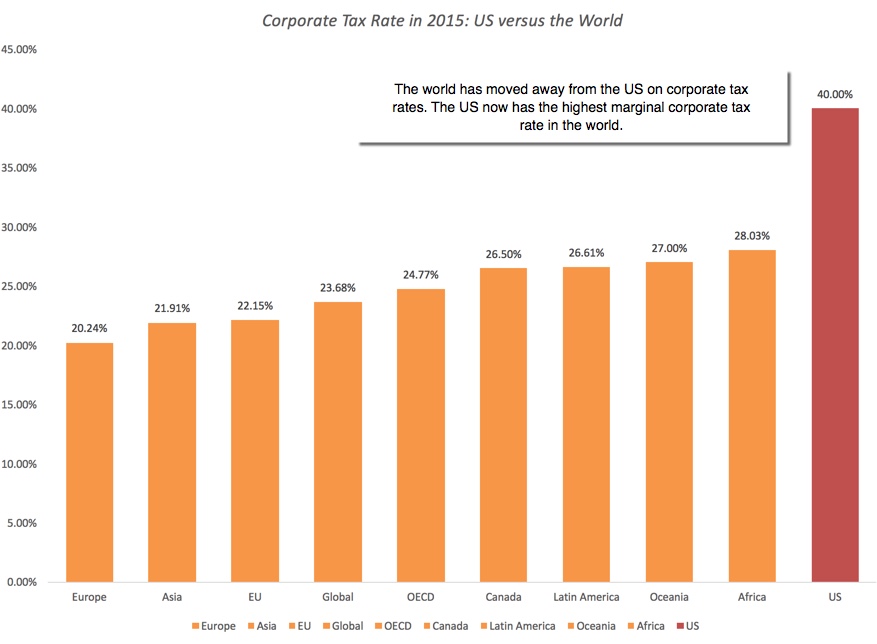
  1. The level of rates: There was a time four decades ago when the US federal corporate tax rate, at 40%, was in the middle of the global tax rate distribution, with many countries adopting a policy of punitive corporate taxation. The corporate tax rate in the US was last lowered in 1986 to 34%, then raised to 35% in 1993 and has remained unchanged since. With state and local taxes, it amounts to close to 40% in 2015. The rest of the world has moved away from the US and lowered corporate tax rates, leaving it with one of the highest marginal tax rates in the world in 2015. (See this KPMG site for tax rates around the world)
    Source: KPMG
  2. Global versus Territorial taxation: Adding to the US tax code's woes is the requirement that US companies pay the US tax rate not just on US income but on income generated elsewhere in the world. In 2015, it remains one of six countries that follow this practice, whereas the rest of the world has moved to a territorial tax model, where companies get taxed based on where they generate income (and are done). The Global tax model, which was born in an age when the US economy was the driver of the global economy and US companies were domestically focused, results in US multinationals facing much higher tax rates on world income than multinationals incorporated elsewhere. (Interestingly, Ireland is one of the six countries with a global tax model but with its low tax rate, the effect is muted.)
  3. The Repatriation Trigger: To cap off this trifecta, US tax law adds a clause that specifies that the “additional US tax” due on foreign income has to be paid only when that income is repatriated to the United States. In response, US companies have had the logical reaction and not repatriated foreign income, leaving that income “trapped” in foreign locales. In 2015, it was estimated that the trapped cash amounted to more than $2 trillion, money that cannot be used to pay dividends, buy back stock or make investments in the US, but can be used to make investments anywhere else in the world.
The benefit to a company of removing itself from US tax incorporation, i.e., inversion, is therefore two fold:
  1. No US taxes on foreign income: While the company will continue to pay the US tax rate on its US income, its foreign income will be taxed only at the foreign domicile's tax rate.
  2. Untrap cash: To the extent that the company has built up trapped earnings (in foreign locales) that it is restricted from using, it can release the cash without any tax penalties.
Given US tax law, the question is not why some companies seek to leave its tax jurisdiction, but why more of them do not, and the answer lies in an uneasy middle ground, a wait-it-out scenario that many US companies have adopted, where they let income accumulate in foreign markets and wait for one of two developments. One is a change in US tax law, which people on both sides of the aisle seem to agree is needed, but don't seem to want to bring to fruition. The other is that Congress will blink yet again and pass another one of its "tax holidays", a "once in a lifetime" chance (that shows up once every decade) that will be given to companies to bring their cash home with no penalties. The net effect is that the US ends up with the worst of all worlds: a tax code that is ineffective at collecting taxes (as evidenced by the drop in corporate tax collections over the last three decades) while encouraging companies to borrow more and more money (and save on taxes at the marginal rate).

Pfizer: The Numbers
To understand how exposed Pfizer is to the vagaries of US tax law, I started by looking at the geographical distribution of Pfizer revenues over time:
Note that Pfizer generated only 43.08% of its revenues in the first nine months of 2015. If Pfizer were to be taxed, at the marginal rate in each region, based on where it generated its revenues (regional tax), its tax rate in those nine months would have been 30.68%. As a US company, though, Pfizer would have to pay almost 40% of this income as taxes, translating into significantly higher taxes each period. Pfizer, of course, chose not to take this course, as manifested in two numbers. The effective tax rate that Pfizer has paid over the last five years has averaged to 23.45%, well below 40%, and a significant portion (my rough estimate is $12 billion) of Pfizer’s cash balance of $20.66 billion is trapped. Binging it back will result in a tax bill of $1.99 billion (using a differential tax rate of 16.55%, the difference between the US marginal tax rate of 40% and the effective tax rate of 23.45%).

Valuing Pfizer
To illustrate the impact that changing the tax code that governs Pfizer has on its value, I considered three scenarios.
  1. Patriot Games: In this scenario, I assume that Pfizer does its patriotic duty (as some critics would label it) and not only decide to bring all of its trapped cash home today (and pay the differential taxes) but repatriate all of its foreign income each year back to the US and pay a 40% marginal tax rate on that income.
  2. Wait-it-out (Tax Limbo): In this scenario, Pfizer will leave its trapped cash overseas, continue to pay taxes to foreign governments on foreign income but not repatriate the cash. That will leave their effective tax rate well below the US marginal tax rate and Pfizer will have to hope that US tax law gets fixed or that Congress does another one of its “once in a lifetime” tax holidays.
  3. Go Irish: In this scenario, Pfizer buys Allergan and meets the requirements for shifting its incorporation to Ireland. Note that doing so does not affect their taxes on US income but it will not only un-trap their cash but also remove the constraint they face today on foreign income.
The different assumptions that I make about taxes under the three scenarios are summarized:

Tax Model Marginal tax rate (for cost of debt) Effective tax rate (next 10 years) Effective tax rate (in stable growth) Trapped Cash
Patriot Games 40% 40% 40% Return immediately & pay taxes now.
Wait-it-out (Tax Limbo) 40% 23.45%, with taxes on deferred taxes paid in year 10. 40% Return in ten years & pay taxes then.
Go Irish (Invert) 40% 23.45% 30.68% No taxes due

In the table below, I value Pfizer under each scenario (see spreadsheet), first using the conventional accounting numbers (which treat R&D as an operating expenses) and next using adjusted numbers (where I capitalize R&D):

Patriot Games Wait-it-out Go Irish Effect of Inversion
R&D Expensed Equity Value $154,806.00 $176,047.00 $209,637.00 $33,590.00
Per share $25.09 $28.53 $34.39 $5.86
R&D capitalized Equity Value $121,074.00 $135,156.00 $162,309.00 $27,153.00
Per share $19.62 $21.91 $26.60 $4.69

The rationale for an inversion is that it will increase Pfizer’s equity value by $27.2 billion and its share price by $4.69 per share. This calculation, though, is based on the assumption that US tax law will never change, and that its dysfunctional components will continue in perpetuity. If you assume that the current bipartisan talk of fixing the law will result in changes (in either the corporate tax rate or in the global tax feature), the value increase will drop off substantially.

Deal or No Deal?
I applaud Ian Read's focus on shareholder value but will this deal create that value? I am skeptical and here is why. Even if you accept the upper limit of the value of inversion ($27.2 billion), that increase in value does not incorporate two potential costs associated with inversion.
  1. The new rules covering inversions will require that Pfizer go through contortions to qualify and some of these contortions will add to the cost of the deal.
  2. There is the possibility of a backlash, not so much from customers, but from politicians. There are senators who are already threatening the company with consequences, though I am not sure that any of them would actually go as far as to ban or restrict Pfizer product sales in the US (since that would hurt those who need the drugs the most). Even if they do, given that the US Senate is disproportionately composed of older men, I am confident that they will carve out a "Viagra exception" for themselves.
There is a second and even bigger concern that I would have as a Pfizer stockholder. If the rumors that Pfizer is planning to pay a 30% premium are right, that would translate into a premium of more than $30 billion over Allergan's market capitalization to buy the company. Since the growth is already priced in (at least in my view), the only way you can create value is to draw on synergy and nothing that either company has said suggests any concrete benefits from the combination.

The bottom line is that this looks like a bad deal for the wrong company, at the wrong time and at the wrong price, the wrong company because Allergan's accounting statements are a mine field due to acquisition accounting, the wrong time because we may actually be on the verge of a major change in US corporate tax code and at the wrong price because of the premium on an already large market capitalization.

The Morality Play?
As I was writing this post last week, I had a conversation with a friend about Pfizer. After I explained why I thought the Pfizer plan to acquire Allergan made sense, given the tax code and Pfizer's global exposure, her response was that Pfizer should not do this because “it is immoral". While I was floored initially by her assertion, it would be have been both futile and hubristic for me to try to prove her wrong. She is entitled to her moral judgments, just as I am entitled to mine, but it is moral, rather than economic, differences that usually lie at the heart of tax debates and that is perhaps why it is so difficult to get a consensus.

If you own a business that would benefit from shifting away from the US for tax reasons, and you have patriotic or moral reasons for not doing so, you are well within your rights in staying US-bound and I support you in your choice. If you are the manager of a publicly traded company and you face the same choice, I am afraid that you cannot impose your patriotic or moral judgments on your stockholders. Not only are many of them foreign investors (with a very different sense of what comprises patriotism), but quite a few of them will part ways with you on your judgment that maximizing taxes paid to the government is a moral calling.

>>> Syngenta considering tie-ups with rivals

Syngenta considering tie-ups with rivals

The Swiss crop chemicals business Syngenta is considering tie-ups with competitors, the Financial Times reported.

The newspaper quoted Syngenta chairman Michel Demare, who said that having rejected bid approaches from St Louis, Missouri-based competitor Monsanto, the Swiss company was now looking for deals that would combine its crop chemicals business with rivals’ agricultural seeds operations.

Demare said there is a widespread belief that the agricultural industry will undergo substantial change over the next six months and described discussions between leading agribusiness groups as “extremely active”.

Other than Syngenta, the sector's leading players include the agriculture businesses of Bayer, BASF and Dow Chemical, Dupont's seeds arm Pioneer and Monsanto, the item said.

Demare said Synenta has a strong leading position in crop chemicals, while Monsanto and Pioneer are the leading companies in seeds. A company that is strong in both crop chemicals and seeds will be the future leader in the sector, the chairman added.

Demare said the offers for Syngenta this year are likely to prompt further deals in the sector, according to the report.

Monsanto said on Tuesday, 17 November that it had reconsidered the potential acquisitions of competitors including Syngenta, the item noted.

Earlier reports had said ChemChina had tabled a bid for Syngenta at CHF 449 (USD 441) per share, or approximately USD 42bn, the article added.

Syngenta’s share price closed CHF 12.5 up at CHF 387.5 yesterday in Zurich, giving the company a market capitalisation of CHF 36.01bn.

(Exane) Milanese chic vs British flair

Milanese chic vs British flair

Two luxury stocks have lost much of their value in the past few months: Prada and Burberry. We
analyse the pros and cons of these possible investment cases in detail. We hope this will be of
help to investors inclined to "bottom fish". We conclude that uncertainty is still high and that,
despite more compelling entry prices, it may be too soon yet to pull the trigger on them.

Two mega-brand challengers...
Ten years ago, Burberry and Prada were both less than one-quarter the size of LVMH’s F&LG
business. The gap has narrowed, but only slightly: Burberry is at almost 30% and Prada at 27%.
However, they have both expanded significantly compared with Gucci, Burberry from 55% to 90%,
Prada from 55% to 83%.

...at polar opposites on some points, yet very similar on others
Prada and Burberry are moving in opposite directions in Beauty. In Digital, Burberry is the
European leader whereas Prada has traditionally pushed back on e-commerce. Both have raised
their core pricing, but Prada has run ahead of LV and Gucci while Burberry has been a
follower. Aggressive moves into retail have worked well for both, but their networks have matured
and LFLs have already or are now fading. And both companies have taken big hits from China’s
woes. Both seem to put brand first and business second, with implications for strategic decisions.

The big questions
Using our proprietary data we have screened for strengths and weaknesses at multiple levels:
brand temperature, desirability, exclusivity, mix, pricing and digital competitiveness. This leads us
to the big questions on management, leadership and strategic direction.

Burberry is moving, Prada is still thinking
Both shares have lost their vim, though Prada’s multiples remain a tad more expensive. In the
current market, we look for exposure to ill-valued self-help stories with a high probability of
success. Burberry’s apparent inclination “to do what is required to succeed”, albeit with “more of
the same”, wins us over against Prada, where management still seems in “diagnostic mode”.

WSJ : Starboard Urges Yahoo to Drop Alibaba Spinoff Plan

Starboard Urges Yahoo to Drop Alibaba Spinoff Plan

Firm says risk of tax hit from spinoff too high, pushes company to sell core business

Starboard Value LP is putting new pressure on Yahoo Inc., calling on the company to halt the spinoff of its stake in Alibaba Group Holding Ltd. and instead sell its beleaguered Internet business.

In a letter it sent Yahoo late Wednesday, the activist investor says Yahoo’s planned spinoff of more than $20 billion in shares of the Chinese e-commerce giant now carries too much risk. That represents a change from Starboard’s stance last year, when it urged Yahoo to make the separation.

The letter, which was reviewed by The Wall Street Journal, expresses frustration with Yahoo’s response to the activist. Shares of Yahoo, which is among Starboard’s largest positions according to people familiar with the matter, are down 35% this year.

Yahoo had no immediate comment.

The change in Starboard’s position follows the federal government’s decision not to rule on whether the Alibaba spinoff would incur billions of dollars in taxes.

Yahoo in September pulled its request for such a ruling from the Internal Revenue Service but said it would continue to pursue the transaction, as it believed the IRS would eventually side with it. Going forward without the earlier IRS approval raises the risk that the agency could challenge the spinoff in a future audit, putting shareholders on the hook for billions of dollars in taxes.

In October, Yahoo said it expected the spinoff to be completed in January of next year. Given Yahoo is already far along in the process and has signaled confidence about the outcome, it is unclear if the company would reverse course.

While Starboard also continues to believe the spinoff shouldn’t incur taxes, the letter says, it no longer feels comfortable with the risk that it will.

“If you stay on the current path, we believe the potential penalty for being wrong is just too great,” Starboard wrote.

Instead, Starboard is pushing another idea it floated previously: that Yahoo keep the stake in Alibaba and Yahoo Japan and sell the Web properties for which Yahoo is known. While that would incur its own taxes, the bill would be smaller given the massive gains on Yahoo’s Alibaba shares, Starboard’s letter said.

The activist had previously named AOL Inc. as a combination partner for Yahoo, but AOL has since agreed to a sale to Verizon Communications Inc. Starboard doesn’t name any new suggested merger partners in its letter.

The investor is ratcheting up pressure on Yahoo Chief Executive Marissa Mayer as her effort to turn around the aging Internet company enters its fourth year with few signs of progress. Ms. Mayer has tried to position Yahoo as a threat to Google Inc. in Web search and as a challenger to Netflix Inc. in the emerging area of online video content, projects that have cost Yahoo hundreds of millions of dollars but yielded little in the way of users or revenue.

Over the course of Ms. Mayer’s tenure, Yahoo’s core business has shrunk. In 2012, when she arrived, Yahoo sales totaled $4.5 billion. In 2014, they were $4.4 billion.

Yahoo’s share of digital ad spending world-wide is expected to slip to 2.0% this year, down from a 3.4% share in 2012, according to eMarketer Inc.

On an earnings call with analysts in October, Ms. Mayer signaled Yahoo will adopt a new strategy to “reset” the company’s focus on fewer areas and shift further into mobile. Ms. Mayer has said she plans to articulate the new direction when the company announces fourth-quarter earnings in January, if not sooner.