WSJ : Tesla Ramps Up Hiring as Rivals Loom

Tesla Ramps Up Hiring as Rivals Loom

Electric-car maker builds on CEO Elon Musk’s fame to recruit engineers through Twitter

A few weeks ago, Elon Musk put out a call on Twitter for “hard-core software engineers” to work on Tesla Motors Inc.’s autonomous car program. The company’s inbox was flooded.

While Mr. Musk was only looking for 100 prospects, he may want to keep the other applicants within ear shot. The electric-car company, which recently released its first sport-utility vehicle and will soon open a battery factory in Nevada, is looking to add thousands of employees in coming years just as an auto industry showdown for tech talent is brewing.

Tesla isn’t the only player in town. The 12-year-old company is tussling with a growing mass of auto makers crowding into California looking for people capable of helping develop software and other components needed to power electric or autonomous vehicles.

Several startups, including Chinese-backed Faraday Future Inc., Karma Automotive Inc. and Atieva Inc., have been luring people away from Tesla for their own electric-car ventures.

At the same time, established industry heavyweights are expanding offices in Silicon Valley, investing in new ventures to better combat Apple Inc. and Alphabet Inc.’s Google as those companies develop automobiles.

Ford Motor Co. and Toyota Motor Co. are among traditional auto makers placing big bets in Tesla’s backyard.

Palo Alto-based Tesla, which grew to 14,000 employees from just 899 at the end of 2010, plans to add 4,500 more workers in California alone during the next four years, according to terms of a $15 million tax credit awarded this year. Tesla currently has 1,600 open positions and is aggressively courting engineers for its autonomous car efforts, known as Autopilot.

Because the auto maker’s business model is built on explosive growth forecasts through the end of the decade, Mr. Musk needs to add head count faster than a typical auto maker with small volumes would.

Addressing his 3.1 million followers on Twitter, Mr. Musk said “no prior experience with cars required. Please include code sample or link to your work.” He then added, “I will be interviewing people personally and Autopilot reports directly to me. This is a super high priority.”

A Tesla spokeswoman said “we’re a career destination for extremely talented hard-core software engineers, and Elon’s tweet opened the gate to a new wave of exceptional candidates.”

Building on Mr. Musk’s fame may be a more cost-effective strategy than relying on outside firms. Fees paid to placement agencies for software engineers in the Bay Area have doubled to around $30,000 to $40,000 per employee in the past two years, said Paul Harty, president of Seven Step RPO, a recruiting outsourcing company.

Tesla’s $30 billion stock market valuation reflects Wall Street’s optimism about its growth prospects, but the company walks a financial tightrope as it continues to lose money and burns cash on multiple future product programs.

The company isn’t only outgrowing its pocketbook. Tesla is sprawling over the Bay Area due to explosive employment growth and its Palo Alto headquarters is proving to be too small.

There is a valet to park employee cars as the small parking lot at the headquarters is always full.

These days, many of the office and engineering functions are performed in Fremont at its factory.

Large sections of the plant have been taken over by offices and the parking area at the plant, which was once co-owned by Toyota Corp. and General Motors Co., is completely full.

“I think we will be building a consolidated headquarters at some point in the future,” Mr. Musk said in September. He said the company would remain in California, but the location of a new headquarters hadn’t been determined.

In all, Tesla has spread over eight buildings in the Bay Area. Recently, it moved into a former solar panel manufacturing center formerly owned by Solyndra LLC, which fell into bankruptcy in 2011 after getting a U.S. Department of Energy loan.

Tesla held a party in the building to unveil its Model X sport-utility vehicle earlier this year.

Tesla’s employment relative to vehicle production is relatively high compared with other luxury car makers. Jaguar Land Rover, the luxury auto maker owned by Tata Motors Ltd., is on pace to sell about 500,000 vehicles in 2015 and has 36,000 employees, or 13.8 vehicles per employee.

Tesla is on pace for 52,000 sales with 14,000 workers, or about 3.7 cars per worker.

The lower ratio of employees to production is partially because the company is still scaling up and planning for a much higher volume, and because Tesla does many functions in-house.

For instance, Tesla recently replaced a seat supplier for the Model X with an in-house production staff, something that is exceptionally rare in the auto industry.

WSJ : Key Funding Source for Miners Is Depleted

Key Funding Source for Miners Is Depleted

Companies that provide the majority of ‘streaming’ financing are running low on capital

For struggling mining companies, an important source of financing is growing scarce.

Contending with falling profits and hefty debt payments, mining firms such as Glencore PLC and Vale SA this year increasingly turned for cash to specialist lenders who pay large lump sums in exchange for metal deliveries.

But companies that provide the vast majority of this kind of financing through “streaming deals” are running low on capital after striking a record $4.07 billion worth of deals in 2015, nearly quintuple the level in 2014.

“We just don’t feel the pressure that we need to go out and duplicate our efforts that we did in 2015,” said Tony Jensen, chief executive of Denver-based Royal Gold Inc., one of the big streaming companies. He said the company has about $450 million available for new loans. That compares with about $1.3 billion for 2015, according to estimates by Canaccord Genuity, a financial-services firm.

Canadian streaming company Silver Wheaton Corp. in November paid Glencore $900 million in exchange for 33.5% of silver production from the Antamina copper mine in Peru. The cash infusion helped Glencore pay down its debt and stave off investor ire that had triggered big swings in the company’s share price.

Silver Wheaton, though, doesn’t currently have capacity for another blockbuster deal, said its chief executive, Randy Smallwood. The company has roughly $500 million left in its line of credit after doubling it to $2 billion earlier this year and is reluctant to sell stock or get deeper into debt, he said. Mr. Smallwood said he expects profits from operations to add an additional $500 million to Silver Wheaton’s arsenal by the end of 2016.

Silver Wheaton is studying sharing its deals with others in a process called syndication, but “we’re not quite convinced it’s the best thing for us yet,” Mr. Smallwood said.

Silver Wheaton, Royal Gold and Canada’s Franco-Nevada Corp. will start 2016 with an estimated $1.4 billion to deploy, according to an analysis of the companies’ financial statements by Canaccord Genuity analyst Peter Bures. That compares with an estimated $4.7 billion on hand in the first quarter of 2015. A representative of Franco-Nevada declined to comment. Mr. Bures said those three companies account for more than 80% of lending capacity.

“It’s not a bottomless pit, they’ve pretty much used up their capacity,” said John Bridges, mining analyst with J.P. Morgan Chase & Co.

The drop in lending capacity reduces mining companies’ lifelines as they contend with a protracted downturn. Tumbling metal prices and plentiful supply of everything from iron ore and copper to nickel and coal have reduced profits and mining companies’ ability to repay debts.

Meanwhile, traditional avenues for raising cash, like bond or stock sales, have essentially closed to all but the most well-capitalized mining firms.

Glencore’s troubles this year have been emblematic. Glencore’s shares have plunged 66% in 2015 on worries about its credit rating and ability to service its debt. Glencore declined to comment. Glencore’s management has previously assured investors of the company’s ability to pay its debts and has put mines and other assets up for sale to reduce debt. It also has said it might do more streaming deals in 2015.

Vale in March sold 25% of the gold produced by its Salobo copper mine in Brazil to Silver Wheaton for $900 million, doubling the streaming company’s share of the mine’s gold output. The deal buttressed Vale’s balance sheet when the price of iron ore, the company’s main product, tumbled to decade lows. The streaming deal helped put a value on the gold in the copper mine that the market hadn’t previously recognized, said Vale spokeswoman Patricia Malavez.
Streaming companies use the proceeds from share sales and borrowings from bank credit lines to provide financing to mining firms. The streaming company pays the miner a large sum upfront. In exchange, the company receives the right to buy, at below-market prices, a portion of the precious metals that usually come out of the ground during the mining of industrial metals.

Streaming companies often have the right for the life of the mine, meaning that they continue to get deliveries of metals long after they have recouped their upfront payment.

Executives at streaming companies said they are reluctant to raise capital by selling shares, which have slid together with precious-metals prices, and they already have hefty debt loads themselves.

Other firms have started to test the market for streaming deals. Blackstone Group LP’s Blackstone Tactical Opportunities and Orion Mine Finance Group, an investment firm focused on the mining sector, have this year teamed up on two streaming-finance deals valued at a combined $790 million, according to company filings.

“We’re able to drive some spectacular deals,” said Douglas Silver, portfolio manager with Orion.

Still, the largest three companies are currently considered the dominant source of future streaming deals.

“Mining is a capital-intensive business and at this point in time the options for capital are scarce,” said Andrew Kaip, analyst with BMO Capital Markets.

(Re/Code) What’s He Building in There? The Stealth Attempt to Defeat Aging at Go

What’s He Building in There? The Stealth Attempt to Defeat Aging at Google’s Calico.


Alphabet, Google’s newfangled conglomeration, arrived in August, but we will not see its first financial figures until January, when the company reports two sets of earnings — Google and the “other bets.” Each subsidiary will not break out its own performance, but the earnings reports will offer some view into their costs and output. Before then, Re/code is unpacking one Alphabet company a week*, presenting the facts, figures and, just maybe, the financials behind the silos of the world’s most ambitious company.
So far, we have:

* Nest
* Access and Energy
* Google Ventures
* Verily
* Google Capital.
Up next: Calico.

Talk about a headline that sings. “Google vs. Death.” The Time magazine cover story from September 2013 heralded the creation of California Life Company, or Calico, a new firm incubated by Google with the audacious aim to extend human lifespans.

Although Calico formed two years before Alphabet, it had many of the markers Google’s co-founders outlined as their rationale for the holding company. A startup staring down a moonshot issue? Check. A problem with a very long time horizon? Check. Google’s tech savvy applied to a market well outside its domain? Check. A venerated founder at its helm? Calico chief Arthur Levinson — former CEO and board chair of biotech firm Genentech, board chair of Apple — may be the biggest heavy-hitter among Alphabet’s execs.

Levinson did not speak to Time for its story. And he has said basically zilch publicly about his company since. Yet some of the hyperbole accompanying Calico (Google wants to disrupt death!) is just that. It is evident that Levinson’s secretive company is focused on medical solutions that fend off the illnesses that come with old age; it’s not trying to give us immortality.

Calico has announced six partnerships for research and drug development, linking arms with two universities, a nonprofit, a pharmaceutical company (AbbVie) and the genealogical data firm Ancestry. Like Verily, Alphabet’s other health unit, Calico seems to be operating as a high-tech research and development lab, creating medical products that its pharma partners will take to market.

So, one day you may be able to buy a pill that extends your life, dreamed up in a lab funded by a search engine. When and how those drugs will arrive — or be priced — remains unclear.

Unlike Verily, which is focused on various diseases, Calico has a singular mission: Extending life. Currently, the company has several research teams each experimenting with different avenues of longevity research, according to people who are as familiar with its operations as outsiders can be.

And unlike Verily, Calico has not plunged into Google proper to fill its roster. Instead, the biotech firm has hired medical experts primarily from academia and Levinson’s former company. Recent ones include David Botstein, a geneticist and former Genentech VP; Shelley Buffenstein, a physiologist who studies mammals with exceptionally long lives; and Dan Gottschling, a cell biologist with the baroque title at Calico of distinguished principal investigator.

What Calico’s staff investigated before joining Calico gives us some glimpse into the black box of the company. (Calico never comments beyond pointing to its bare-bones website.) Several of its scientists have backgrounds in cellular biology and genetics. So they are equipped to identify and manipulate genes tied to animal (and maybe human) longevity, and work with massive datasets, like the one courtesy of the Ancestry deal. Newer Calico staff arrived with training in emerging, more experimental methods, such as synthetic biology and optogenetics.

Calico has also hired several experts on cancer, one of its two stated targets, along with neurodegeneration or the loss of functioning neurons. This is familiar terrain for Levinson; Genentech’s largest sellers were cancer drugs, primarily Avastin, when it was acquired by Swiss pharma giant Roche in 2009, the year Levinson left. But Genentech was pushing treatment pills. It wasn’t tackling “one of life’s greatest mysteries,” as Calico’s slogan boldly declares.

As Time pointed out, most research in Calico’s orbit is within nonprofits; one for-profit that tried to market anti-aging drugs, Sirtris Pharmaceuticals, folded after failing to find a market. Calico does have some direct competitors, including Human Longevity Inc., a cell therapy firm backed by famed geneticist Craig Venter.

HLI announced a $70 million funding round in 2014. As of September, Google disclosed that it gave $240 million to Calico, in exchange for stock plus promised support of up $490 million should Calico need it.

Who to Know
Levinson was Genentech’s chief scientist, a veteran researcher with no business experience, when promoted to CEO in 1995 — a “nerd from central casting,” per an insightful 2000 New York Times article. He quickly proved his business chops. The biochemist helped steer Genentech out of financial entanglements with Roche, boosting its stock and moving several drugs to market. Sales grow from $918 million in the fourth quarter of 1995 to $2.45 billion in his final quarter as CEO.

Levinson also manages the astonishing feat of simultaneously being an executive within Google and an Apple board member. (He left Google’s board in 2009.)

His pick to build Calico’s bottom line is Jonathan Lewis, who spent ten years scaling up partnerships and investments for Genentech. After that, Lewis worked on mergers and acquisitions for Roche and business development for European pharma titan UCB.

David Botstein, Calico’s chief scientific officer, joined from Princeton with a curriculum vitae padded with awards. His colleague and fellow genetic researcher, Cynthia Kenyon, runs aging research for Calico. She’s credited with discovering a gene mutation in a roundworm that sparked the study of stretching our lives. From Calico’s website: “Her findings showed that, contrary to popular belief, aging does not ‘just happen’ in a completely haphazard way. Instead, the rate of aging is subject to genetic control.”

Off Kenyon and her cohort go, trying to turn that control into a biotechnology business. Somehow.

And here, from the inimitable Tom Waits, is the most appropriate soundtrack for the company cloaked in mystery.

(The Verge) New York is finally installing its promised public gigabit Wi-Fi

Today, workers began installing the first LinkNYC access points in New York. First announced in November 2014, the hubs are designed as an update to the standard phone booth, using upgraded infrastructure to provide gigabit Wi-Fi access points. This particular installation was spotted outside a small Starbucks at 15th St and 3rd Avenue, near Manhattan’s Union Square. 500 other hubs are set to be installed throughout the city by mid-July. LinkNYC anticipates one or two weeks of testing before New Yorkers will be able to use the hubs to get online.

The full network will install more than 7,500 public hubs throughout the city, each replacing a pre-existing phone booth. Once completed, the hubs will also include USB device charging ports, touchscreen web browsing, and two 55-inch advertising displays. The city estimates that ads served by the new hubs will generate more than $500 million in revenue over the next 12 years.

Emerging from the Reinvent Payphones design challenge under Mayor Bloomberg, the LinkNYC project has been the subject of significant controversy in recent months. Shortly after the initial buildout was announced, the Daily News reported that outer-borough hubs in Brooklyn and the Bronx were exhibiting speeds as much as ten times slower than equivalent hubs in Manhattan. One of the companies involved in the hubs, Titan, also drew controversy for implanting Bluetooth beacons in the test hubs, which could potentially have been used to track pedestrians and serve ads. The beacons were removed shortly after their existence was made public. This summer, Titan merged with Control Group to form a new company called Intersection, and Google's Sidewalk Labs purchased a non-controlling portion of the subsequent company.

When the project was announced in 2014, LinkNYC said it would begin construction "next year." This week's construction push allowed them make good on that promise just a few days before 2016. Other functionality may take longer to come online, particularly the built-in touchscreen-enabled tablet, designed for web browsing, maps, and free phone calls. On an accompanying pamphlet, those features are listed as "coming soon."

(The Verge) 2015: Apple's year in beta : Everything needs more focus and more ti

2015: Apple's year in beta : Everything needs more focus and more time

The Gizmodo headline last week was blunt, in the way that the best Giz headlines are blunt: Everything Apple Introduced This Year Kinda Sucked. It's worth reading; it is surprisingly easy to make the argument that everything on Apple's huge list of new products and features this year sucked a little bit.
But that's not actually true. All of Apple's products this year were just fine. You could settle yourself totally within the Apple ecosystem and use Apple Music and Apple News on your iPhone while taking Live Photos and you would be just fine. You wouldn't have the best time, but you wouldn't have the worst one, either. It would just be fine.
And that's really the issue. We're not used to Apple being just fine. We're used to Apple being wildly better than the competition, or sometimes much worse, but always being ahead of the curve on some significant axis. But what we got in 2015 was an Apple that released more products than ever, all of which felt incomplete in extremely meaningful ways — ways that meant that their products were just fine, and often just the same as everyone else's.
EVERY NEW APPLE PRODUCT OR FEATURE RELEASED IN 2015 WAS ESSENTIALLY IN BETA
I would go so far as to say every new Apple product or feature released in 2015 was essentially in beta. Apple released a lot of big new platforms that, by themselves, weren't nearly complete. Apple needed — expected, really — its vast army of dedicated and passionate third-party developers to come up with killer apps for things like the Apple Watch and iPad Pro. And when it wasn't releasing new platforms, Apple was adding new features to existing platforms like iOS in an attempt to create sticky new user behaviors which would reinforce their dominant status in the market — new features that all need far more time to develop into those powerful lock-in mechanisms.
To get a sense of what I mean, just consider the first iPhone, which introduced a new platform with two incredible killer apps: the Safari browser (which was revolutionary in 2007) and Maps. The next iPhone introduced the App Store with a laundry list of additional killer apps, and you know what happened next — the entire tech industry turned upside down. And eventually Apple introduced iMessage, a platform-level feature that creates and reinforces an extraordinary amount of value if everyone you know is an iPhone user — those blue bubbles mean something in the culture now.
And that's really the story of Apple in 2015. After years of promising investors new products, the implication over and over again was that the iPhone changed the world, and it would happen again with another new product. And while the company delivered on dazzle and hype — sometimes far more than usual — the products themselves often felt searching, waiting to be imbued with reason.
New platforms in search of a killer app


Apple Watch
The Apple Watch is by far Apple's most important new platform bet — it has the most potential and the most potential scale. But after launching in April with obviously incomplete software, the October release of WatchOS 2 did little to push the device forward. (Most people I know who are still wearing the Watch have basically turned most of its features off.) Without a robust app store, the Apple Watch offers little more than notifications and fitness tracking, and there are other devices that do a much better (and much more discreet) job of fitness tracking. That leaves telling the time and notifications as killer apps, and both of those could still be vastly improved. It will be shocking if the next version of the Watch doesn't have an always-on display, you know?
When I reviewed the Watch in April, I advised people against spending money on what it looked like until Apple could clearly articulate what it was for. With rumors of another Watch coming in March, that challenge should be first on the list.
THE WATCH'S KILLER APPS ARE TELLING THE TIME AND NOTIFICATIONS — AND IT COULD BE BETTER AT BOTH
Apple TV
Apple TV is another huge platform bet — Apple is all-in on the idea that the future of TV is apps, if its massive advertising campaign is to be believed. But I can't get over the feeling that the Apple TV was rushed to market in radically different form after Apple's attempts to launch a "skinny bundle" streaming TV service fell through. Siri didn't work with Music when it arrived; the iPhone remote app hadn't been updated to work with the new device. (Both are fixed now.) Simple problems, like having to repeatedly re-enter the same cable company login and password to multiple streaming apps, aren't solved. The Siri touch remote can be finicky and strange, and a traditional D-pad works better for the core streaming TV features. App Store search and discovery is a series of question marks waiting to be filled in. The thing just isn't finished.
And yet the Apple TV is by far the best streaming TV box on the market because it's a true computing platform in a way that the Roku and others are not. You can feel how much more powerful it is just by using it; the potential is almost overwhelming. But ported iPhone games and slightly faster HBO Go and Netflix apps aren't going to disrupt television — an entirely new kind of TV experience has to do that.
PS. Do you know anyone who's seriously into Plex? Make them get an Apple TV; it's a revolution. Piracy is the Apple TV's killer app right now.
Apple Music
I'm putting Apple Music in the platform category because it's not just a feature of OS X and iOS — it's on Android as well, and it'll work with Sonos soon. It's a complete music platform, where artists like Taylor Swift can launch exclusive concert videos alongside exclusive interviews with Zane Lowe on Beats 1 and snackable social content on Connect.
APPLE MUSIC IS, WELL, KIND OF A MESS
But Apple Music is, well, kind of a mess. It has multiple priorities and multiple personalities, and multiple points of failure. It wants to be everything to all people, instead of a focused experience that connects the dots between purchasing music from iTunes and streaming music from a subscription service. There is a huge — huge! — opportunity here, but Apple Music is entirely too hazy and complicated to capitalize on it right now.
iPad Pro
You can reasonably argue against the iPad Pro in the new platform category, but hear me out: the size and pen / keyboard capabilities of the iPad Pro are designed to unlock a new set of developers and customers that the traditional iPad can't reach, and that market will eventually mean that the iPad Pro is an entirely new platform unto itself. It's exciting! But it's strange that the Apple Pencil is an optional accessory with the Pro, instead of something developers can count on and build around. It's also strange that Apple didn't build a single first-party app that shows off the power of the large screen and Pencil, and it's further strange that Apple's (expensive) keyboard case is so mediocre. And developers are struggling to figure out how to make real money selling pro apps in the App Store — a problem so deep that Apple just shuffled its executive ranks to put Phil Schiller in charge of the App Store.
There's a chance we'll all be using huge iPads as our primary computers one day, but to get there the iPad Pro has to do something so much better than a MacBook that all the things it does worse seem irrelevant. What is that thing?
New platform features in search of sticky user behavior

3D Touch
Walt Mossberg noted that 3D Touch has mostly been a disappointment since it arrived on the iPhone 6S in September, but there are rumbles of progress — we rounded up a few interesting apps last week. But there's very little about 3D Touch in the ecosystem right now that justifies buying an iPhone all by itself, and certainly nothing that creates a sticky user pattern that locks you into Apple's ecosystem. It's right click for your phone. Hopefully in 2016 it becomes something bigger.
Live Photos
Live Photos could have been so great! They're so fun when you realize you have a little accidental video, and they're super fun for photos of kids and pets. It's basically your phone, making GIFs for you. Who doesn't love GIFs?
LIVE PHOTOS HAVE SO MUCH POTENTIAL BUT THEY'RE HIDDEN AWAY

But Apple gave Live Photos a weird proprietary format, buried it behind an obscure set of interface elements, and didn't give it the ability to export GIFs. (Did you know you can share a Live Photo to Facebook natively? I did not, and it seems no one else did either.) I am legitimately disappointed I don't see more Live Photos in the world, but until they stop being so hidden and wonky it doesn't seem likely.
Apple News
Like Music, you could argue that News belongs in the platform category — it is a publishing platform, after all. But I think it's really just a feature to enhance the overall iOS newsreading experience in a world where the mobile web sucks, not a huge platform bet. Apple isn't sharing too many stats, but early indications are that Apple News traffic isn't great, and the navigation patterns inside the app are all over the place. (If you're reading an article inside Apple News and click on a link to another article, you don't see the Apple News version — it opens an in-app browser instead of sending you to Safari. Insanity.) There is a world where clicking on Apple News to get a customized list of headlines every morning is a defining feature of the iPhone experience, but this is not yet that world.
One nice surprise
MacBook
Everyone loves the MacBook! You can worry that it's underpowered because of its weak Core M processor, but I've watched it slowly win over a number of Verge staffers in the past few months. It's tiny, it's beautiful, and OS X is so well optimized for it that it can run pro apps like Lightroom and not let you down. Looking at the Intel roadmap, it's hard to imagine an updated version coming out for a while yet, but man, the next iteration of the MacBook is going to be a generation-defining laptop.


If you're an Apple fan looking at this other list of products and worrying, I would suggest looking at the MacBook to calm your mind — when the company settles into the groove of refinement and polish, it still puts out products that blow the industry away. The MacBook isn't in beta — it's a complete thought about the future of laptops.
2015 WAS A YEAR OF BIG RISKY BETS FOR APPLE
But 2015 wasn't a year in the groove for Apple — it was a year of big, risky bets that need time to play out. But the rest of the industry isn't sitting still — and some of these bets will come due in 2016.
The Verge reviews Apple

For more from Verge Video, check out all of our Apple review videos from 2015 in this YouTube playlist, which includes the Apple Watch and the iPad Pro. Be sure to subscribe to The Verge's YouTube channel for more, and check out our archives while you're there to see How the iPad Pro compares to the Surface Pro 4.

(Re/code) New China Anti-Terrorism Law Confuses the Out of U.S. Tech Companies

U.S. tech companies are asking themselves what the heck happened over the weekend after China laid down a new anti-terrorism law that, among other things like creating its own version of James Bond, has given it powers to demand the decryption of electronic messages.

While China stopped short of mandating back-door access to encrypted communications, the new law published on Sunday raises fresh questions about what information U.S. tech companies will be required to turn over to the government.

“It’s entirely possible that what ends up happening is … They’ll just turn to us and say, ‘This is the information we want. How you procure it is your business,’” said one representative of a major U.S. technology company, who asked not to be identified.

Multinational corporations that do business in the region, including Apple, IBM and Cisco, had worried about an earlier draft of the law that would have required them to turn over source code, which would allow authorities to monitor users.

Chinese government officials have been quoted as saying companies operating in China won’t be forced to surrender their intellectual property or create back-door access to private communications. But they will be required to provide “decryption and other technical support” when the police or state agents demand it for investigating or preventing terrorist attacks.

“This rule accords with the actual work need of fighting terrorism and is basically the same as what other major countries in the world do,” Li Shouwei, deputy head of the parliament’s criminal law division under the legislative affairs committee, told reporters. This will not affect the normal operation of tech companies and they have nothing to fear in terms of having “back doors” installed or losing intellectual property rights, he added.

Throughout the tech industry, executives are struggling to understand what exactly the Chinese government means when it asks for help with encryption, according to several people who have been monitoring the proposed legislation for a year. It could take six months for regulations to emerge that make the government’s intent clear.

The larger concern is that the Chinese government might use the information to crack down on dissident groups, such as the Uighurs, an ethnic minority of largely Sunni Muslims, who have accused the government of restricting their ability to practice their religion.

The terrorist attacks in Paris and San Bernardino, Calif., have fanned concerns about encryption around the world, with legislators and members of the law enforcement community in the U.S. and Europe arguing these technological tools allow those planning acts of violence to evade detection.

In Britain, an investigatory powers bill would give the U.K. government power to demand that Apple alter the way its messaging service, iMessage, works. In the U.S., some politicians are turning up the heat on Silicon Valley over the issue of encryption.

Virginia Sen. Mark Warner and Texas Rep. Michael McCaul wrote an op-ed in the Washington Post Monday, calling for a national commission on security and technology to find a solution. They acknowledge that encryption is essential to global commerce, but add that the terrorist threat cannot be ignored.

“We cannot wait for the next attack before we outline our options, nor should we legislate out of fear,” Warner and McCaul wrote. “Instead, Congress must be proactive and should officially convene a body of experts representing all of the interests at stake so we can evaluate and improve America’s security posture as technology — and our adversaries — evolve.”

U.K. Property Sales-Tax Increase to Include Overseas Homeowners

U.K. Property Sales-Tax Increase to Include Overseas Homeowners
The U.K. government’s plan to increase sales taxes on second homes in Britain will also apply to people who live abroad. From April, buyers of second homes and buy-to-let properties in the U.K. will be subject to stamp-duty sales tax that’s 3 percentage points higher than those who are buying a home to live in, U.K. Chancellor of the Exchequer George Osborne announced in November.

>>> Musings on Markets : Intergalactic Finance: Valuing the Star Wars Franchise


Musings on Markets


Intergalactic Finance: Valuing the Star Wars Franchise

Posted: 28 Dec 2015 12:56 PM PST

I saw the newest Star Wars movie last week and it brought back memories that stretch back almost four decades. Watching Harrison Ford and Carrie Fisher on the screen reminded me of my age, though, once I learned how much Ford made for being in this episode, I understood the movie's story line much better. As I came out of the theater, though, I decided that it would be fun to update a valuation I did of the Star Wars franchise in 2012, when Disney acquired the rights from Lucas Films.


The Movies- Box Office Bonanza

If you are one of the few people on the face of the earth that has not followed the Star Wars story, it began in 1977 when George Lucas produced the first Star Wars movie, the fourth episode in what he saw as a six-episode series. That movie made history and remains one of the highest grossing movies of all time. It was followed in 1980 by the fifth episode, The Empire Strikes Back (my favorite), and in 1983 with the sixth in the series, The Return of the Jedi.  Those first three movies created an entire generation of Star Wars fans, who then had to wait 16 years for the first in the series, The Phantom Menace (my pick for the worst of the series), which was followed  by Attack of the Clones in 2002 and Revenge of the Sith in 2005. The six movies represent one of the most valuable movie franchises of all time, generating billions of dollars in box office receipts, with the appeal spreading globally.

The movies are shown in chronological order and the box receipts on the first three movies include the collections from their re-release in theaters in the 1990s.


The Add-Ons - Bigger than the Movies?
If you stopped just at box receipts, Star Wars might not be the most valuable franchise at all time, lagging the James Bond movies and perhaps even the Harry Potter and Lord of the Rings franchises. It is the magnitude of the add-ons to box receipts that make Star Wars unique and as someone who has partaken in all of them, I can attest to their power. I have owned the Star Wars tapes and DVDs, collected every Star Wars figure made, played Star Wars video games (very badly) and even used a GPS with a Yoda voice to drive from New York to Chicago (I love Yoda but he is a really bad navigator). The Star Wars empire stretches far and wide to include:

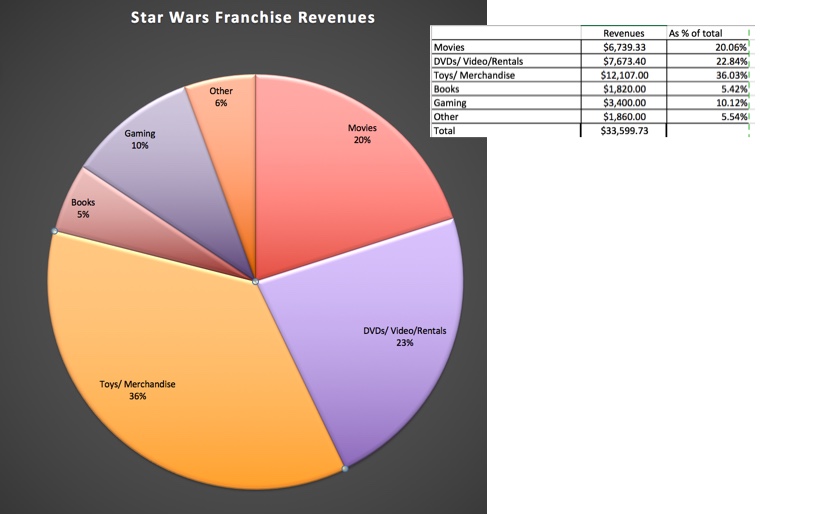
1.       VHS/DVD/Rentals: The additional revenue from this stream reflects as much the hold that Star Wars has had on our collective imaginations, as it does the changing of technologies for home video watching over the decades. Starting with video tapes (VHS) sales and rentals in the 1970s, morphing into DVD sales in the last decade and continuing into streaming in today's environment, this add-on has generated $7.7 billion (unadjusted for inflation) in revenues.

2.       Toys and Merchandise: This is the crown jewel of the franchise, as toy and merchandise sales have outstripped all other sources of revenue. The revenues from action figures sold by Kenner  (1978-1985) and Hasbro (1995-2011) amounted to almost $10 billion (unadjusted for inflation) and adding in other merchandise, the collective revenues from toys and merchandise over the history of the franchise is in excess of $12 billion. 

3.       Gaming: As with the video rentals, the Star Wars games track shifting technologies, starting with an unlicensed game for the Apple II on a cassette tape, followed by table-top game by Kenner and games for the Atari. Starting in 1992, the games shifted away from the films to the expanded Star Wars universe, first with the X-wing computer games and later with Dark Forces, a shooter game. In 2013, Disney revealed that Electronic Arts would retain the rights to produce games for PCs and consoles, while Disney would retain the rights for other platforms. The collective revenues from all of these games between 1977 and 2015 is $3.4 billion.

4.       Books: There have been almost 360 books, with 76 authors, in the Star Wars series and total sales have amounted to more than $1.8 billion. The staying power of the franchise is backed up by the fact that the first books were in print in 1978 and that there have been at least ten Star Wars novels a year, every year from 1991 to 2014.

5.       TV Series/Other: Given its success on so many dimensions, it is surprising that the Star Wars franchise has not spawned a higher profile TV series. The longest lived TV series, Clone Wars, has had seven seasons and a second one, Star War Rebels, produced by Disney, has had two seasons. There have been periodic rumors about other TV series in the works, with the latest one suggesting that Netflix is planning three live-action series

The collective revenues from these add-ons make the Star Wars revenue pie much larger than any competing movie franchise:

Note that the movie revenues in the table are not adjusted to 2015 $, since the revenues from the add-ons are not available in current dollars. In the table below, I scale the revenues from each of the add -ons to the box office receipts to get a measure of the value added from the rest of the Star Wars ecosystem:


In effect, for every dollar that Star Wars has made at the box office, it has generated four dollars in revenues from other sources. That number is a conservative estimate, since there have been undoubtedly others who have profited from the franchise unofficially (and illegally).


The New Series: Disney takes over

In 2012, Disney acquired the Star Wars franchise for $4 billion, from George Lucas, with plans to produce three more Star Wars movies. At the time of the acquisition, I argued that it was a fair price, given Disney's history with developing, maintaining and merchandising franchises, but had to draw on the potential for synergy to justify the number. With the release of Star Wars: The Force Awakens just about ten days ago, Disney seems to be more than delivering on its promise, as the movie has broken box office records and is on its way to delivering a global box office of $2 billion or more.


To the extent that this movie, like its predecessors, will generate add-on revenues, there will be substantially more money to be made over the next few years. The next two movies are scheduled for 2017 and 2019, and there will be three spin offs in the intermediate years, with less ambitious budgets. After 2020, Disney's plans are not specific, but if the appetite remains, there will be undoubtedly more movies in the pipeline. More importantly, the movies will not only create a new base of younger fans but augment the sales of merchandise, toys and games in the coming decade. The revenues that would have come from DVDs and video rentals will be replaced with streaming revenues and there will undoubtedly be games and apps directed at smartphones, devices and gaming systems. 


Valuing the Franchise

To value the franchise, I started with my estimates of worldwide box office receipts for Star Wars: The Force Awakens and the subsequent movies in the series. Though, the first two weekends have blown away expectations (with the movie making $1 billion), I will estimate $2 billion in revenues, for each of the three main movies, and half those proceeds for the spin offs, with an inflation adjustment of 2%.

As with the prior movies, the bulk of the revenues from the franchise will come from add-ons, and in assessing the potential, here are some of my assumptions:

1.       Streaming: As viewers increasingly turn to watching streamed movies from services (Netflix, Amazon Prime) on their televisions and devices, the revenues from streaming are quickly catching up with box office receipts for movies, and by 2017, the total revenues from streaming are expected to exceed box office revenues. I will assume that each dollar in box office revenues from the new Star Wars movies will generate $1.20 in additional revenue in streaming, slightly higher than historical numbers (1.14).

2.       Toys/Merchandise: The Star Wars movies have historically generated $1.80 in revenues from toys/merchandise for every dollar in box office revenues. Given Disney's prowess at merchandising, I would not be surprised to see this number go up, and I will assume that each dollar at the box office will translate into two dollars in merchandising revenues, a little higher than the historical value of $1.80 per box office dollar. Keep in mind that this franchise is a merchandisers' dream, with an almost endless potential for new opportunities in the Expanded Universe.

3.       Books and eBooks: This is the stream that is perhaps most at risk, and I will assume that while a way will be found to adapt the publishing stream to changing tastes in reading, the revenues from this books/e-books will drop to $0.20 per box office dollar (from $0.27, the historical number).

4.       Gaming: In keeping with the history of Star War games, I am convinced that that games will be adapted not only to gaming platforms (Xbox, Playstation and Nintendo) but also to smartphones and tablets. I will leave the gaming revenues at $0.50 per dollar in box office receipts.

5.       TV Shows/Other: This is the one add-on where I will assume a significant improvement over historical numbers, as Disney, Netflix and others find ways to adapt the franchise to television viewers. I will assume that the revenues from TV shows will increase to $0.50 per dollar in box office receipts.

To estimate the franchise value, I used the operating margins of the movie (20.14%) and toy/merchandise businesses (15%) and netted out taxes (at a 30% tax rate), before discounting back at a 7.61% cost of capital, the entertainment sector average. (Disney will probably license most of the merchandise, passing of the risk to others, but settling for a share of the operating income.) At least based on my projections, the value of the Star Wars franchise, if it can maintain my estimated numbers (for add-ons) and deliver at the box office, is almost $10 billion. The value is obviously a function of movie revenues and the add-on dollar values:


Not only does that make Disney's $4 billion investment three years ago a very good one, but any synergies that Disney can gain in its other businesses (like this one) will create more upside. As always, you are welcome to make your own assumptions and revalue the franchise, using this spreadsheet.

An Acquisition Model that works?
I am not a fan of acquisition-driven growth, primarily because the process so often leads to over paying for growth, but Disney may have found an acquisition model (albeit a limited one) that works with its Star Wars and Marvel acquisitions. In both cases, the company bought established movie franchises and has used its merchandising machine to generate value. Those results have already borne fruit with Marvel, especially with the Avenger movies, and we may be be seeing the beginnings of the Star Wars dividends this week. 


During the week, while I was in the city (New York), I saw at least three Stormtroopers and a Darth Vader on Times Square and every store that I went into had something related to Star Wars, on sale. If you are a Star Wars purist, appalled by the shameless merchandising of the movie, I am afraid that you ain't seen nothing yet. If you are a Star Wars collector, and think that you have the entire collection already (for you or your kids), here is something for you to ponder. If you are a Disney stockholder like me,  may the force be with you!

Attachments

1.       Star Wars: Valuing the Franchise (Spreadsheet)

2.       Star Wars: Franchise Value Picture (jpg file)


(BI) If you're in the stock market, beware January - http://bit.ly/1kpd1RK

Since the financial crisis, S&P 500 companies have spent trillions of dollars buying back shares of their own stock. In the third quarter alone, these companies gobbled up $156 billion worth of themselves.
Goldman Sachs' David Kostin estimates that these companies will spend another $608 billion in 2016 buying back shares, up from $568 billion in 2015.
It's important to note that these buybacks — which are enormous enough to sway markets — don't occur evenly throughout the year.
"Typically, we have a huge tailwind in December from buyback action," JonesTrading's Dave Lutz observed on Thursday. "Fascinating: November/December has combined for almost 23% of annual buyback budgets from '07-'14(ex-'08)."
Lutz referred to a chart, which he recently identified as one of the "Most Important Charts In The World," showing what percentage of annual repurchase spending occurs in each month.
"Beware January?" he asked.
Goldman Sachs
"As volumes decline, market performance appears more vulnerable to the seasonality of buyback activity," Goldman Sachs' Amanda Sneider observed in a note to clients in March.
"This tailwind vanishes quickly, as January only has 3% of the total buyback allotments spent," Lutz noted. "Watch out for [PowerShares Buyback Achievers ETF PKW] underperformance in the early months of 2016 — Buybacks collapse in January."