>>> Santander Consumer USA files to delay Form 10-Q

Santander Consumer USA files to delay Form 10-Q
The Company is in discussions with its current and former independent registered public accounting firms regarding certain accounting matters, primarily related to the Company's discount accretion and credit loss allowance methodologies, and the related control considerations. In connection with these matters, the Company also is in the pre-filing submission process with the SEC, Office of the Chief Accountant, regarding the Company's accounting treatment for consideration of net discount in estimating the allowance for credit losses. The resolution of these matters is expected to impact prior period financial statements. The Company will file the Form 10-Q as soon as practicable.

(Jefferies) Auto & Auto Parts : Looking Into The Next Cycle; Initiating on

Looking Into The Next Cycle; Initiating on Global Auto OEMs

We initiate coverage of eight OEMs. We don’t share the bear view on demand, forecasting 3%+ global unit growth mid-term, though the pace of Europe is at risk. 'New Autos' concepts stimulate demand, but required investments create material headwinds for returns. Growing earnings complexity depresses multiples. Attractive EV ratios mask lack of equity leverage and peak returns. We rate BMW, FCA, PSA as Buys and VW, Renault, Ford as Underperforms.

(JPM) UniCredit ▲ Neutral Previous: Underweight

UniCredit ▲ Neutral Previous: Underweight

Risk-reward more balanced ahead of strategy review -

We upgrade UCG to Neutral. With shares down ~60% absolute/~30% vs the
sector since our downgrade early Jan, we feel that a lot of the capital concerns
are priced in. We welcome the new CEO’s more prudent approach to CET1
calculation and pro-activeness in selling assets; we expect the group to address
the capital and balance sheet risks while mitigating the dilution via improved
efficiency and credit risk management. With UCG trading at 5.7x PE, 0.35x
NAV for RoNAV 6% in 2018e in our base case, including a €7bn rights issue
and 50% IPO of Pioneer, the valuation risk-reward looks more balanced.
 Asset quality – €12bn NPL disposals to reduce NPE ratio to 20%: Noncore
bank deleveraging is on track, but Italian NPLs remain stubbornly high
and the new CEO is targeting a more proactive approach to reducing NPLs.
We believe UCG could consider €12bn of NPL disposals to improve NPE
in Italy from 23.6% currently to 20% at a cost of 42bp of capital including
€1.2bn of additional provisions post tax to increase NPL coverage to 67%.
 Addressing capital position – €7bn rights issue and listing 50% of
Pioneer, a possible scenario: With Basel 3 CET1 FL at 10.65% pro forma
end Q2, the group could potentially raise €7bn of new equity and IPO 50%
of Pioneer to bring CET1 to 12.5%, in our view, more in line with peers.
 Improve efficiency – potential €0.5bn new net cost savings: While UCG
is on track to deliver on its €12.9bn cost target for 2018, revenues have not
grown and cost/income at 60% is far off the 50% target. We expect UCG to
announce further measures with possibly €0.5bn new net cost savings,
which would be equal to 4% of current cost base or 10% of PBT in 2018e.
 Valuation – risk reward more balanced: Based on our base case scenario,
2018e EPS impact would be ~27%, with the rights issue dilution and 50%
lower contribution from Pioneer IPO partly offset by net cost savings
(€500m pretax) and the lower provisioning run rate post €12bn NPL
disposal. UCG shares would trade at an undemanding 5.7x PE, 0.35x NAV
for RoNAV 6% in 2018e post money and clean up.
 EPS upgrades post Q2: We upgrade EPS by 10-14% in 16-19e, mainly on
higher NII and trading, but also a lower share count, as we remove the
dilution from scrip dividends and cut the dividend to zero. Thus, we increase
our Dec-17 SOP-based target price from €2.10 to €2.30.

(JPM) Meggitt (MGGT LN, N – 446p, 445p) (David H Perry, CFA)

Meggitt (MGGT LN, N – 446p, 445p) (David H Perry, CFA)
Upgrade to Neutral on news of activist shareholder involvement
Yesterday morning a well-known activist investor declared it had acquired a stake of just over 5% in MGGT. We upgrade the stock to Neutral
and increase our multiples-based Dec 16 price target to 445p from 395p, reflecting the higher possibility of either: (1) internal changes in
MGGT’s strategy; or (2) M&A activity. Table 1 shows how we derive our new price target.

>>> Main First Pre-Indications

MainFirst Pre Mkt Indications
*RANDSTAD-To buy Monster Worlwide for $3.40 a share($429m).........+2%
*GALENICA-Net 158.9m(163.5),Ebit 241.3m(246.3),Vifor FY Ebit up....+2%
*BPOST-Net 87.9m(94.1),Ebitda 159.4m(164),Rev 591.9m(589.1)........+1%
*NOKIAN-Sales 337.4m(339.5),OP 77.5m(76.1),6.3m provs,Reit f/c.....U/C
*ALTICE-Q2 Rev 5.83b(5.76),Adj Ebitda 2.27b(2.14),FY Rev better....+2%
*MUNICH RE-Prems 11.9b(12.45),II 2.75b(1.85),NI 974m(480).........+1%
*VOESTALPINE-Rev 2.8b(2.75),Ebit 167.6m(162.83),O/L poor,SI 2.4%...-1%
*ALSTRIA OFFICE-Rev 102m(102),FFO 57.4m(57.3),FY guidance ok.......+0.5%
*H&M-GAP Sales 3.85b(3.78),July Sales -4%(-1),stock -5.1% a/hrs....-1%
*PANDORA-Rev 4.33b(4.5),Ebitda 1.61b(1.71),NI 1.22b(1.25)..........-5%
*CASINO-Bids for Cnova at $5.50 a share vs a clse $4.76............-1.%

>>> What to look at today - 10th of August 2016

Dow -0.08% S&P -0.09% Nasdaq -0.15% Russell -0.07%
US market begin the week on a quiet note, with all index settling lower. WTI crude rallied 3.0% ($43.07/bbl; +$1.24) amid reports that several members of OPEC are attempting to revitalize a production freeze agreement. The energy component extended its August gain to 3.6%. Seven sectors ended in the red with heavily-weighted industrials (UNCH) and technology (UNCH) showing the slimmest losses. On the flipside, financials (+0.1%), materials (+0.2%), and energy (+1.2%) outperformed. On the M&A front, Mattress Firm (MFRM 63.75, +34.01) spiked after Steinhoff offered to acquire the company for $64 per share. Volume were below average with 772mil shares traded. US After Hours SINA +5%, MCHP +4.4% higher following earnings, CPS +1% on S&P SmallCap 600 addition news... TUBE -22%, MTW -12.8%, GPS -5.2% on earnings/guidance/SSS, BMRN -4% on secondary offer. Asian equity markets are gaining modestly despite incremental declines on Wall St as expectations of policy accommodation in the region continue to run high. China consumer inflation has met consensus estimates but slowed for the 3rd straight month to 1.8%, remaining well below the 3% target. GBP/USD tested below 1.30 level for the first time in nearly a month on comments from a BOE hawk McCafferty who acknowledged that further easing is likely to be necessary as it was difficult to forecast the headwinds from the Brexit vote on the economy. Japan Steel +9% on Q1 numbers,

Nikkei +0.69% Hang Seng -0.11% CSI +0.52% Shanghai +0.45%

Eur$ 1.1078 CNH 6.6705 CNY 6.6627 JPY 102.43 GBP 1.2984 CHF 0.9837 RUB $64.7559 WTI $42.64 (-0.88%)

S&P +0.02% EuroStoxx -0.20% Dax -0.18% SMI +0.01%

Macro :
- China July Retail Auto Sales Rise 23.3% on Year, PCA Says
- Atlante 2 Seen Having EU2.5b-EU3b Commitments End Sept: Quaestio

Keep an eye on :
- ABI BB : AB InBev Chief Supply Officer Kraemer Nets EU4.87m With Options
- AC FP : Colony Starwood 2Q Core FFO/Shr 39c Tops Est. 38c
- ALU FP : Alcatel Aims to Capture 10% of Pakistan Market: E.Tribune Link
- ATC NA : Altice 2Q Earnings Grow While Promotions Weigh on SFR Results
- BARC LN : Barclays Agrees to Pay $100m to Settle State Libor Probes
- BPOST BB : Bpost 2Q Adj. Ebitda Misses Ests.; Mail, Parcel Vols Top Ests.
- BMRN US : BioMarin Falls 4.1% After Announcing 7.5m-Share Stock Offering
- BP/ LN : BP Said to Hire Investment Bank to Sell 50% Secco Stake: Reuters
- CO FP : Casino Guichard confirmed the launch of offer for CNOVA @ $5.50 a share.
- DAI GY : Mytaxi to Expand to More Countries After Hailo Merger: Hailo CEO
- DOW US : Dow Chemical Sees $20b China Annual Sales in 20-25 Yrs: Nikkei
- EDF FP : EDF Renewable Energy Confirms 160 MW Turbine Order With Vestas
- FINGB SS : Fingerprint’s New CEO Sees Growth Prospects in New Segments: DI
- GALN SW : Galenica Raises FY Ebit Guidance for Vifor Pharma
- MUV2 GY : Munich Re 2Q Net Income Beats; Outlook Reiterated
- NRE1V FH : Nokian Renkaat 2Q Profit Beats Estimate; Forecast Reiterated
- OCDO LN : Morrison Said to Sign Home Delivery Deal With Ocado: Sky
- P1Z GY : Patrizia Immobilien Confirms 2016 Guidance on Operating Income
- RAND NA : Randstad to Buy Monster Worldwide for $429 Million
- SFR FP : SFR 2Q Rev., Adj. Ebitda Decline as Promotions Weigh on Results
- SL/ LN : Standard Life 1H AUA Rises 7%, Div. Increased 7.5%
- TEVA IT : Allergan Now Largest Teva Holder After Sale of Generics Business
- LANS NA : Van Lanschot to Buy Staalbankiers’ Private Banking Activities
- VOE AV : Voestalpine 1Q Profit Drops 64%; Sales Fall on Lagging Demand
- VOW3 GY : VW Plans 2-Day Production Halt at Emden Plant: Reuters
- VOW3 GY : VW Fined EU5m in Italy for Emissions Control Manipulation

>>> Europe : Brokers Upgrades & Downgrades - 10th of August 2016

>>> Up
*DASSAULT AVIATION RAISED TO ’OUTPERFORM’ AT MAIN FIRST BANK AG
*HECLA MINING RAISED TO OVERWEIGHT AT JPMORGAN
*PARAGON RAISED TO OUTPERFORM VS NEUTRAL AT MACQUARIE
*UNICREDIT RAISED TO NEUTRAL AT JPMORGAN

>>> Down
*AVIVA CUT TO NEUTRAL VS OUTPERFORM AT MACQUARIE
*CASINO CUT TO MARKET PERFORM AT BERNSTEIN
*METRO CUT TO NEUTRAL VS OUTPERFORM AT EXANE
*NOVO NORDISK CUT TO ADD VS BUY AT ALPHAVALUE
*NYRSTAR CUT TO SELL VS BUY AT CITI
*TEREX CUT TO HOLD AT JEFFERIES

>>> PT Change


>>> Initiation
*DET NORSKE RATED NEW BUY AT CITI, NOK135
*KINNEVIK RATED NEW HOLD AT JEFFERIES

>>> Call

>>> VXX Reverse Split Number 4—August 9th, 2016

http://sixfigureinvesting.com/2013/08/next-vxx-reverse-split/

Barclays’ announced 26-July-16 that it was going to reverse split VXX and its sister, medium term fund VXZ on August 9th, 2016. Both funds will be reverse split 4:1. This is the first reverse split for VXZ since its inception in 2009, but it will be the fourth for VXX. For details on how options are handled with reverse splits (it’s not pretty) see the bottom of this post.
For a security doomed to decrease in value over time Barclays’ VXX does amazingly well. Its volume averages over 65 million shares per day and its assets under management have stayed around $1.0 to $1.5 billion for the last couple of years. Not bad for a product that has averaged a 58% annual loss since its inception in January 2009. This works out to an average loss of almost 7% per month. See “Volatility Fund Monthly and Year Decay Rates” for a chart showing how these losses have varied over time.
According to its prospectus, Barclays can reverse split VXX any time after it closes below $25 and that reverse splits will always be at a four to one ratio.
History of VXX Reverse Splits
Event Dates Split Ratio Inception / close price right before reverse split (split adjusted) Months since inception /last split
Inception 30-Jan-2009 100 (6,400)
1st Rev. Split 8-Nov-2010 4:1 13.11 21
2nd Rev. Split 4-Oct-2012 4:1 8.77 23
3rd Rev. Split 8-Nov-2013 4:1 12.84 13
4th Rev. Split 8-Aug-2016 4:1 9.27 34

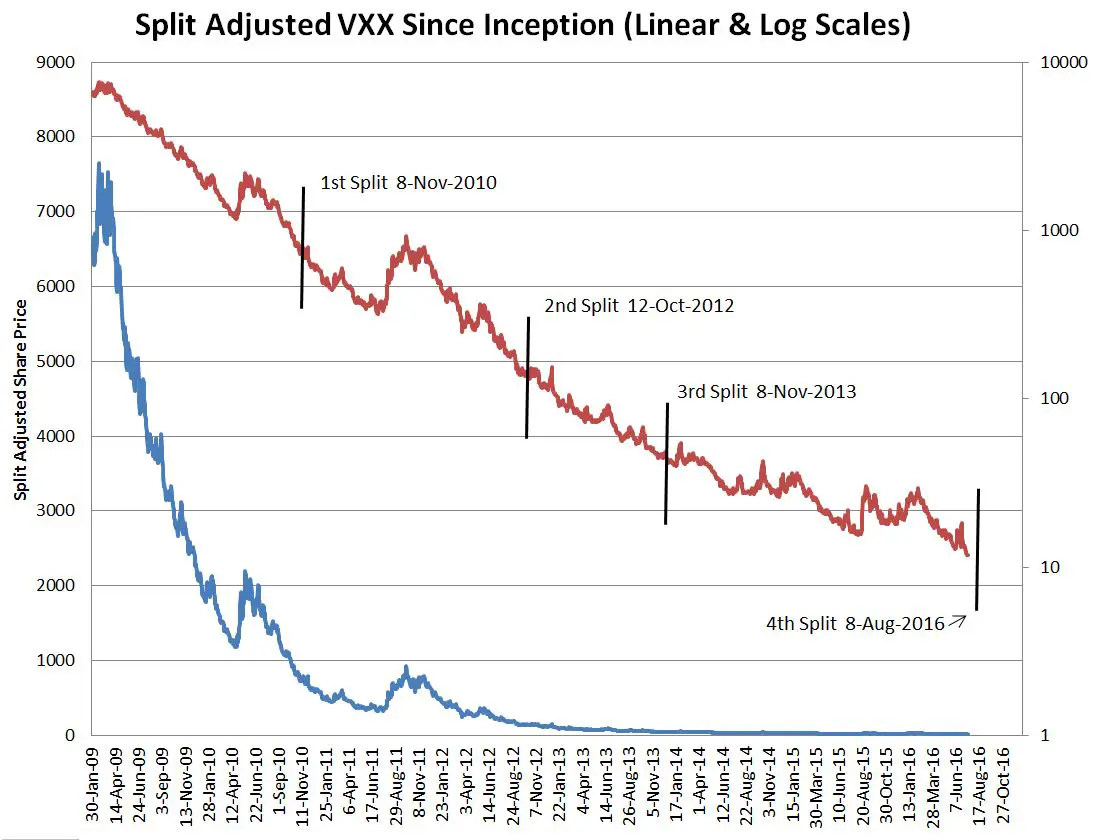
The first and second splits of VXX occurred after about 22 months, but 2012 did not have volatility bumps like 2010 and 2011, so the 3rdreverse split was only 13 months after the 2nd one. Volatility has kicked up quite a bit since 2014 so it took a record 34 months before Barclays reverse split this product again. The approximate decay per month has slowed down to “only” around 3.5% per month (35% per year).
The chart below, with both log and linear scales, shows VXX’s sordid split adjusted price history.
Given its horrid track record, it’s fair to ask why people keep investing in VXX. Some are just trying to profit from volatility spikes, hoping to catch the next big crash that somebody is always predicting to happen soon. Others are trying to hedge their equity holdings with VXX because it is one of the few securities that reliably goes up when the market is panicking. Unfortunately, this strategy rarely works well. Unless your timing is very good owning enough VXX to effectively hedge your portfolio is prohibitively expensive.
Specifics of the Split
If you hold shares of VXX there isn’t anything to worry about when it reverse splits. The value of your investment stays the same through the reverse split process. You just have 4X fewer shares that are worth 4X more each (assuming a reverse split ratio of 4:1). If your shareholdings are not a multiple of four, say 215 shares, you will get 53 reverse adjusted shares and a cash payout for the 3 remaining pre-split shares.
If you are short VXX, same story, no material impact.
If you were holding VXX options (long or short) when the reverse split occurred there’s still no material impact, however, the option chains are going to hurt your head for a while. This Options Clearing Corporationmemo describes the adjustments for the August 2016 reverse split. It adjusts the number of VXX shares per option on the pre-split contract from the usual 100 to 25. The option strikes are not adjusted and the underlying symbol that the options trade against is VXX1, a new symbol—which is set at 25% of VXX’s price. These contortions are required so that holders aren’t left with fractional contracts–something the options clearing house doesn’t want to deal with.
So, as an example, let’s say you hold ten pre-split options on VXX with an expiration date of August 19th and a strike price of $10. Each contract was worth around 0.19 ($19) at the close on August 8th (VXX’s closing price was 9.30) so your overall position value is around $190. After the reverse split your contracts are adjusted so each contract has 25 shares of the new reverse split VXX as its deliverable. The strike price, $10 stays the same, and the effective price of the underlying that the option is priced against is the current VXX value divided by 4. So, if on August 9th, right after the reverse split VXX’s price is $37.2 and VXX1’s price is 9.3. Your options will continue to be worth about $19 each, and you still own 10 contracts so your position is still worth around $190. The only difference is that if you exercise all your contracts you won’t get 1000 shares of VXX, you’ll get 250 shares.
New options created after the split will be generated with VXX as the underlying, but the old adjusted options will hang around until they expire. I’ve seen reports that the liquidity on the adjusted options is not good, so if you are planning on exiting your options, rather than just letting them expire you should consider closing out your positions and reestablishing them after the split.
For regular, forward splits things are more straightforward —the strike price of the options are divided by the split ratio, and the number of contracts is multiplied by the split ratio. See the OCC memo on SVXY’s 1:2 split for an example. This basic approach can’t be used on reverse splits (multiply the strike price and divide the number of contacts by the split ratio) because depending on the number of contracts held some customers would end up with fractional contracts—which is a no go.
The chart below uses my simulated data plus actuals to show VXX’s price history since 2004

WSJ : Are Negative Rates Backfiring? Here’s Some Early Evidence

Are Negative Rates Backfiring? Here’s Some Early Evidence

Economists worry that people and businesses are saving more, instead of spending

KORSCHENBROICH, Germany—Two years ago, the European Central Bank cut interest rates below zero to encourage people such as Heike Hofmann, who sells fruits and vegetables in this small city, to spend more.

Policy makers in Europe and Japan have turned to negative rates for the same reason—to stimulate their lackluster economies. Yet the results have left some economists scratching their heads. Instead of opening their wallets, many consumers and businesses are squirreling away more money.

When Ms. Hofmann heard the ECB was knocking rates below zero in June 2014, she considered it “madness” and promptly cut her spending, set aside more money and bought gold. “I now need to save more than before to have enough to retire,” says Ms. Hofmann, 54 years old.

Recent economic data show consumers are saving more in Germany and Japan, and in Denmark, Switzerland and Sweden, three non-eurozone countries with negative rates, savings are at their highest since 1995, the year the Organization for Economic Cooperation and Development started collecting data on those countries. Companies in Europe, the Middle East, Africa and Japan also are holding on to more cash.

Economists point to a variety of other possible factors confounding central-bank policy: Low inflation has left consumers with more money to sock away; aging populations are naturally more inclined to save; central banks themselves may have failed to properly explain their actions.


But there is a growing suspicion that part of problem may be negative rates themselves. Some economists and bankers contend that negative rates communicate fear over the growth outlook and the central bank’s ability to manage it.

“People only borrow and spend more when they are confident about the future,” says Andrew Sheets, chief cross-asset strategist at Morgan Stanley. “But by going negative, into uncharted territory, the policy actually undermines confidence.”

Going negative was a big bet by central banks faced with a sluggish recovery from the financial crisis. Whether negative rates succeed or flop has huge implications for the global economy. Japan and Europe are already doing large volumes of bond buying to spur their economies, and their central bankers have little left in their tool kits.

The U.S. Federal Reserve’s next move is likely to raise rates, but Chairwoman Janet Yellen has said negative rates could find a place in the Fed’s armory in any future crisis.

The Bank of England, shaken by June’s surprise vote to leave the European Union, cut interest rates to their lowest in its 322-year history last week but said it was reluctant to go negative. BOE Gov. Mark Carney said he is “not a fan” of a policy that has negative consequences for savers and the financial system. European banks say their profitability has been hit hard by low rates.

Negative Interest Rates: How Do They Work?
0:00 / 0:00
Central banks across the globe are trying a radical approach to boost economic growth: negative interest rates. But what are negative rates and will they work? Image: Adele Morgan/The Wall Street Journal (Originally published April 14, 2016)
Some central bankers say it is too early to judge negative rates. “The effect won’t be seen all at once, but it will gradually become clear,” said Bank of Japan Gov. Haruhiko Kuroda in a June news conference.

Benoît Coeuré, a member of the ECB’s executive board, in a July speech, said measures including negative interest rates, “are proving to be effective in lifting inflation toward its medium-term objective and reducing the overall level of risk in the economy.”

Low interest rates should encourage consumers and businesses to spend by depressing returns on savings and safe assets such as government bonds. Such spending should create demand for goods, help lift sagging inflation and boost economic growth.

Negative rates aren’t fundamentally different, in their day-to-day effects, for most people. Negative rates mean large commercial banks have to pay to park their money at central banks, which encourages them to lend it out instead. Banks spread those costs in various ways. For the individual or most corporate customers, the effect is to push interest rates paid on deposits, while still positive, even closer to zero.

Negative rates aren’t just aimed at spurring spending. Europe and Japan need weaker currencies to help exports and boost low inflation, and negative rates can help bring that about.

Some economists now believe negative rates can have an unintended psychological effect by communicating fear over the growth outlook and the central bank’s ability to manage it.

“The signal to the consumer is that something is wrong—it’s a crisis measure,” says Carl Hammer, chief currency strategist at Swedish bank SEB.

Lasse Bohman, a 63-year old newsstand worker from Stockholm, said the concept of negative interest rates is “weird” and makes him want to save more for retirement rather than spend. “I am just going to keep on putting money in the bank,” he says, or “put it under the mattress at home.”

In Germany, Europe’s largest economy and a nation known for thrift, savings as a percentage of disposable household income rose to 9.7% in 2015, according to preliminary data from the OECD. That is the highest rate since 2010, and the OECD expects the savings rate to rise further this year, to 10.4%.

Many Germans worry that negative rates pose a threat to their rainy-day funds. Four in 10 Germans cite the ECB’s monetary policy and low interest rates as their biggest concern when it comes to savings, according to a survey by the German Savings Banks Association last October.

In December, Ms. Hofmann, the Korschenbroich fruit vendor, used her Christmas bonus to buy two 10-gram bars of gold. She has since bought more and has put it, and every euro she can set aside, into a safe at home, saying she doesn’t trust banks. “Every time I check my savings account, it makes me want to cry,” she says.

In the broader eurozone, where saving isn’t as ingrained in the psyche as in Germany, the household savings rate has edged lower since negative interest rates were introduced in 2014.

The OECD forecasts the household-saving rate will increase this year in Japan, which introduced negative rates in February. Cash and deposits held by Japanese households were up 1.3% in the first quarter from the same period a year ago, according to the Bank of Japan.

In the U.S. and U.K., where interest rates are still positive but annualized growth rates in the year’s first quarter were slower than the eurozone or Japan, savings rates have been stable or trending lower.

Companies also are also holding on to funds, and some are forgoing cheap loans.

In Japan, cash and deposits held by nonfinancial corporations increased 8.4% in the first quarter from a year earlier, according to the Bank of Japan. That growth was the biggest since the 1990s.

Nonfinancial corporations in Europe, the Middle East and Africa had €921 billion in cash balances as of December 2015, according to a report from Moody’s Investors Service on the companies it rates, up about 5% from a year earlier. As a percentage of revenues, cash balances were 15% last year, versus 13% in 2014.

“This odd policy of negative interest rates hasn’t motivated us to invest more. On the contrary, it’s a signal that the economic situation isn’t improving,” says Hans-Gerd Wienands, chief financial officer of Messer Group, a German supplier of industrial gases.

The company has cut the amount it invests to 12.5% of revenue this year, from more than 20% in 2010, as it reduced debt.

In Japan, Tatsuro Takahashi, who sells barbecue pork from his food truck in Tokyo, said, “I’m not interested in borrowing money to expand my business, whether the rate is lower or not. It is riskier.”

Bank lending in Japan has expanded for 58 months in a row through July, but growth has slowed.

The Bank of Japan “failed to foresee people’s behavior,” said Noriko Hama, a professor of economics at Doshisha University in Kyoto, in the magazine Weekly Economist. “It’s simply rational for them to increase savings.”

Household spending in Japan jumped 1.2% in February, the month the BOJ introduced negative rates, but fell the following four months.

Some say other factors are contributing to increased savings. In Germany, for instance, low inflation stemming from cheaper oil and tepid growth means that people have more money to put away simply because the stuff they buy costs less.

ECB President Mario Draghi says that after accounting for inflation, the rate that savers earn today is higher than it was on average in the 1990s.

Peter Praet, the ECB’s chief economist, says the focus should also be on borrowers, who are more inclined to spend than savers, and are seeing a boost to their disposable income because ultralow rates reduce the cost of servicing debt.

Other central-bank executives concede negative rates may push some to save. Yves Mersch, a member of the ECB’s executive board, said in June that it is possible “households are hoarding even more” because they need to save more to build up the same amount of wealth over the same time span.

Household spending as percentage of gross domestic product has fallen slightly in Germany to 54% last year, from 55.4% in 2013, according to OECD data. It also has fallen in Sweden, and is relatively flat in Denmark and Switzerland.

Interest payments on savings accounts in the eurozone are at the lowest levels since 2000, according to ECB data. In the early 1990s, it took nine years for a German saver to double his or her capital as interest income piled up, according to Hans Joachim Reinke, chief executive of Frankfurt-based Union Investment. Now, savers like Ms. Hofmann would have to wait 500 years for that to happen.

Negative rates have also hit pension payouts, giving older savers another reason to squirrel away more cash.

Pension funds and pensioners typically invest in government bonds in a quest for reliable income. That income has never been smaller. About $12 trillion worth of bonds currently have negative yields, according to Bank of America Merrill Lynch European credit-strategy research, compared with almost none two years ago.

That is a problem for Henrik Olejasz Larsen, who as chief investment officer of Sampension manages pensions for Danish government employees. The return on assets that Sampension invests in has fallen as low as 0.2%, far from the 3.5% needed to maintain pension payouts at a level expected by their holders.

University of Michigan economist Miles Kimball believes rates should be lowered even deeper into negative territory. If people are getting scared by negative rates, he says, it is the fault of central banks’ inability to communicate effectively, not the policy itself.

“They should say that this is a normal tool of policy,” he says, “and then people wouldn’t freak out.”