FT : $10,000 for a single phone call with a bank analyst

$10,000 for a single phone call with a bank analyst
Asset managers and lenders in fierce negotiations over cost of investment research

Asset managers and banks are locked in fierce negotiations over how much fund companies should pay for investment research, with some lenders demanding $10,000 for a single phone call with their most senior analysts.

Banks have put forward quotes of as much as $10m a year to provide fund companies with complete access to their research, according to several asset managers and consultants that are involved in the negotiations.

Fund managers who want additional services, such as face to face meetings with analysts or invitations to events with companies, are being asked to pay more on top of the annual subscription fee to access banks’ research platforms.

A research expert at a large European asset manager, speaking on condition of anonymity, said his company had been asked to pay “mid single-digit millions” of dollars annually to access some banks’ research platforms.

He described the negotiations as a “phoney war” between sellside analysts and their asset management clients, with both sides waiting for the other to concede on price.

“The figures are all over the place at the moment. Some [quotes] are fair and reasonable, and [with others] we thought: there is no way we are paying that — they will have to recalibrate their business models or part ways with us altogether.”

The tense discussions over how much analyst research is worth have intensified since the start of the year as the investment industry readies itself for the introduction of new European rules, known as Mifid II, in 2018.

The rules will force fund companies to explain clearly to investors how much of their money is spent on research. Previously research was sent to fund managers for free in return for the business asset managers provided to banks and brokerages when they placed trades. The cost of the research was included in the price of trading.

The head of a boutique fund company, which has a yearly research budget of £1.1m, said brokers were now asking for $300,000 for an annual subscription to their research. “As a global house covering emerging and global markets, you might need a dozen brokers. That’s a huge bill,” he said.

“For smaller managers this is a big problem. They just don’t have the scale to put a cheque of that size through. We had one broker say it might be $500,000 [to access their research annually], but that’s a nonsense starting negotiation position.”

Brijesh Malkan, a former Legal & General fund manager and senior consultant at BCA Research, an independent research provider, said some of his clients have been asked to pay up to $10,000 for phone calls with top bank analysts.

Banks have also requested a $30,000 annual fee to provide an individual with access to their research platforms, and up to $10m to provide a fund company with the same level of access across its workforce, according to Mr Malkan, who has more than 2,200 fund management clients.

The new European rules have made fund managers question the true value of the vast quantity of broker notes and analyst reports they have received for free for decades. Many investment houses have already made drastic cuts to their external research spend.

Henderson, the FTSE 250 asset manager, has cut its external research spend by 50 per cent over the past three years.

Schroders, the UK’s largest listed fund company, said: “Our spend on external research has reduced substantially over the past five years and we continue to reduce the external research budgets.”

Globally asset managers are forecast to reduce their external research budgets by a third, although the cuts are likely to be much deeper in Europe. This is expected to force banks to make heavy cuts to their analyst workforce, although some lenders are fighting back in an attempt to protect their research departments.

Benjamin Quinlan, chief executive of Quinlan & Associates, the consultancy, and former head of Asia-Pacific equities strategy at Deutsche Bank, said some banks were adopting a “bait and hook” strategy: offering a lower annual subscription rate of around $300,000, in the expectation of raising the fee once asset managers are signed up.

The prices being put to asset managers are varied and very flexible at this stage, and often depend on the size of the fund company and the amount of trades they place with the bank, according to Mr Quinlan.

“This is the biggest problem,” he said. “It will cause a lot of problems in 2018 because no one has worked out how much the research is worth.

“There will be a lot of c**p that clients won’t pay for and that is when the big cuts [to the analyst workforce] at the global banks will come. The feedback from many [in asset management] is that the price of research is too high and not granular enough.”

FT : Asset managers turn against investment consultants

Asset managers turn against investment consultants
UK regulator seeks more control over ‘opaque’ and ‘uncompetitive’ advisory industry

Asset managers have called for stricter oversight of the UK’s hugely influential investment consulting industry after Britain’s financial watchdog warned of conflicts of interest and a lack of transparency in the sector.

The Financial Conduct Authority expressed concerns about “opaque fees” and a lack of competition in the institutional advice sector in a damning interim report on the asset management industry last November.

The regulator said it was considering seeking more regulatory powers over investment consultants, who advise on where £1.6tn worth of people’s savings should be invested. The FCA expressed concerns that a “very important part of the asset management value chain” is currently largely unregulated.

The FCA’s stance has been backed by asset managers, trade bodies and some consultants, which claim greater regulation of the institutional advice sector is vital to improve services and investment returns for pension funds and other big investors.

The Investment Association, the trade body for fund houses in the UK, said in its response to the FCA report: “Investment consultants play a central role in the institutional asset management market and the quality of their advice is likely to be crucial in determining outcomes for institutional investors.

“Ensuring that this element of the investment value chain works well for institutional investors is therefore highly important.”

The trade body added that it “strongly” supported proposals to bring institutional investment advice into the FCA’s regulatory perimeter and backed proposals to refer the investment consulting industry for investigation by the Competition and Markets Authority, a government department responsible for strengthening business competition.

The FCA’s spotlight on the investment consulting market comes as concerns mount about the influence of the sector.

In its 208-page report, the watchdog said consultants, on average, were unable to identify managers that offer better returns to investors and did not appear to have encouraged a rise in price competition between asset managers.

But investment consultants wield huge power in the UK due to rules that require pension funds to seek investment advice. With the exception of the largest schemes, most pension funds turn to investment consultants for this advice.

Consultants typically focus on helping pension schemes make decisions around asset allocation and risk, as well as suggesting suitable fund managers. In some cases, pension funds and other investors will entrust a consultant with the management of their assets, under a model known as fiduciary management.

Because consultants in the UK act as gatekeepers to more than a trillion pounds in assets, investment managers have traditionally been reluctant to condemn them publicly. In private, however, fund houses have been highly critical of the sector, especially its push into fiduciary management.

This move into fiduciary management has meant consultants are often in direct competition with the asset managers they are hired to assess independently.

The FCA said: “We heard a persistent concern from asset managers and institutional investors that once an investment consultant has developed its own product offerings, it will recommend its in-house propositions even if there are better investment products offered elsewhere.”

According to KPMG, the professional services company, three-quarters of all fiduciary mandates went to consultants last year.

One senior executive at a UK asset manager, speaking on condition of anonymity, says: “The problem [with consultants offering fiduciary management] is it creates a massive conflict of interest.

“[The consultants] have some clients who want to make their own investment decisions, but the consultant wants to push them down the route of fiduciary because it is hugely profitable.”

According to the FCA, the value of assets managed by investment consultants under a fiduciary arrangement has tripled in the past five years to almost £60bn.

While dwarfed in size when compared with the £1.6tn in assets under advice, the regulator said that on a per-client basis, fiduciary management generates much higher revenues than traditional advisory business.

The FCA said that of consultants that offer fiduciary management services, 41 per cent of their combined advisory and fiduciary management revenues came from fiduciary management, despite representing just 4 per cent of assets under advice.

The regulator also warned that performance and fees of fiduciary managers appear to be among the most opaque parts of the asset management value chain.

John Walbaum, head of investment consultancy at Hymans Robertson, an investment consultancy that does not offer fiduciary management, says: “We would be in favour of more separation of the two roles [fiduciary and investment consulting]. We think these conflicts are unnecessary and they are too big.”

The UK’s largest consultants, Willis Towers Watson, Aon Hewitt and Mercer, said on Friday said they had put forward a series of proposals to the FCA that are aimed at improving competitiveness and transparency in the investment consultancy and fiduciary management industries.

Over the coming months, the UK’s financial watchdog will have to decide whether to officially ask for regulatory powers over consultants.

Redington, one of the UK’s five largest consultants, backs this approach. It says: “We believe it makes sense to bring those areas of advice that are most meaningful to pension fund outcomes under the FCA regulatory perimeter.”

Patrick Disney, European managing director of the institutional group for SEI Investments, a fiduciary manager, argues that more efforts need to be made to ringfence consultancy work from fiduciary management. SEI stopped offering consultancy services in favour of focusing on fiduciary management because of concerns about conflicts between the two services.

He says: “More regulation is a logical next step, particularly if you have [companies] offering both [fiduciary and investment consulting] services.”

The IA says: “We are particularly keen that, where consultants provide asset management products and services, they compete on a level playing field with asset managers, both in terms of regulatory oversight and client scrutiny of their performance.”

The FCA will also have to decide whether to push the antitrust regulator to carry out a probe into the sector.

In its report, it raised concerns about the dominant “big three” investment consultants: Willis Towers Watson, Aon Hewitt and Mercer. It estimates that the trio collectively control 60 per cent of the market and take an estimated 71 per cent of revenues, down from 78 per cent in 2011.

Consultants have been quick to dismiss suggestions that the sector should be referred to the antitrust authority because of a lack of competition, arguing there has been an improvement over the past decade.

But others are less sure. The Transparency Task Force, a campaign group, believes a probe by the antitrust authority is a “good idea”.

“It will help to shine a light on the workings of the investment consultancy sector and it therefore has the potential identify and deal with issues that prohibit the efficient workings of the market, including conflicts of interest.”

It also backed more regulatory oversight of consultants. “The fact that the institutional investment consulting sector has not been regulated to date may explain many of the suboptimal market practices that have been taking place,” the group argues.


--> Game over for golf
Fund managers and consultants have a reputation for enjoying a game of golf together, but potentially not for much longer.
Last year, the UK’s financial watchdog warned that there is a strong culture of gifts and hospitality in the investment consultant industry, which could be seen to influence the ratings consultants give to asset managers.
In a far-reaching report on the asset management industry, the Financial Conduct Authority said there was no evidence that consultants receiving hospitality or gifts from fund houses benefited the end investors, arguing that it introduced conflicts of interest instead.
The FCA found there was a “statistically positive” relationship between the number of high ratings given to an asset manager and the level of gifts and hospitality received by the consultant.
The regulator said there were a number of factors that could explain the increased level of positive ratings, such as consultants spending more time with fund managers when considering their strategies. But it added: “We cannot rule out the possibility that consultants may have been influenced by their acceptance of gifts and hospitality.”
While the watchdog acknowledged that the value of gifts and hospitality accepted by consultants had fallen in recent years, it said it planned to investigate the possibility further that such benefits were influencing consultants’ ratings of asset managers.

WWD : Cock-a-Doodle-Doo: Year of the Rooster Sees China Luxury Rebound

Cock-a-Doodle-Doo: Year of the Rooster Sees China Luxury Rebound
Repatriation of luxury spending and improving consumer sentiment are seen as a boost.

This is the Year of the Rooster, which in the Chinese zodiac is also seen as exorcising evil spirits. And the New Year already seems to be working its magic on the luxury sector, which is beginning to see a rebound at last.

This story first appeared in the February 24, 2017 issue of WWD. See More.

To be accurate, signs of a turnaround actually started to emerge in the last quarter of 2016, as Chinese consumers at last began to open their wallets once again.

“Global demand from Chinese clientele started to pick up in the third quarter, then accelerated further in the fourth quarter with growth in the mid- to high-single digits,” said Thomas Chauvet, managing director for luxury at Citi. “At LVMH, at Kering, Chinese demand overall has recovered and is firmly on track going into 2017.”

Luca Solca, managing director, head of global luxury goods at Exane BNP Paribas, said in his report “The Red Dragon Comes Back” that a recent trip to China suggested “that Chinese demand is in good shape and even Hong Kong seems to be finally turning a corner. Consumer tastes and priorities are evolving fast, Chinese brands are emerging in the premium and bridge segments, digital is roaring in consumer goods and digital luxury should take off, while physical retail networks are being rationalized to increase space productivity. China and the Chinese should make a good contribution to global luxury spend growth in 2017.”

However, he urged companies to continue investing in brand development, product innovation, digital penetration and retail optimization as the Chinese market “remains the fastest paced and most demanding in the world.” Solca said that BNP regards the Swatch Group (with a 47 percent sales exposure to China); Burberry (40 percent); Compagnie Financière Richemont (36 percent), and Prada (35 percent) “given their exposure, as best positioned to benefit from this trend.

“Chinese authorities are likely going to be supportive of the economy and demand, as the five-yearly party conference is scheduled for autumn 2017,” continued Solca. He saw risks for the sector in 2017 as “political in nature. We think that the most important risk is by far an outright falling out in the Sino-American relationship, as this would likely puncture — as a third level effect — the Chinese consumer feel-good factor. A U.S. border adjustment tax, if somehow agreed with major trading partners like China, would be a negative — but of a significantly smaller magnitude.”

Citi’s Chauvet said that a return to growth in Mainland Chinese sales has largely been driven by factors that encouraged consumers to repatriate purchases, such as a weaker currency, efforts by brands to reduce the price gap between Asia and Europe, cutting prices in China and stricter enforcement of import duties when bringing luxury goods into the country.

However, he said, “Europe remains the cheapest place to buy luxury products, so at the moment, when Chinese tourists are ready to come back to Europe, this has a really positive impact on overall luxury demand.”

Flight reservations from China to Europe were up 68.5 percent compared with 2015 for the lunar New Year holiday from Jan. 18 from Feb. 1, according to travel intelligence firm ForwardKeys.

In Paris, “there is a sense that the Asian market is back ­with visitors from Japan increasing as well as Chinese,” said Christophe Laure, president of UMIH Prestige, the French trade association for luxury hotels. Luxury hotels in the City of Light saw a 25 percent drop in visitors from China in 2016 due to the terrorist attacks in Europe. Based on January’s results and reservations for the coming months, Laure estimates that the overall number of visitors to high-end hotels will be up 10 percent year-on-year in the first quarter, even if traffic has yet to bounce back to its 2015 peak.

“Inside that growth, we can safely say there is a strong increase in the Chinese segment,” he said. Security fears had been the principal issue keeping away Chinese tourists, but greater visibility of security forces are helping to make visitors feel safe. The Feb. 3 machete attack near the Louvre seems to have had “no impact” on reservations, according to Laure.

According to “Chinese Luxury Demand Momentum: A few original data points” conducted by Contactlab in collaboration with Exane BNP Paribas and presented this week in Milan, China represents around 16 percent of the total luxury business globally. The amount Chinese consumers spent on luxury goods grew by about 10 percent in 2016 compared with 2015, and 2017 is expected to continue to increase, the study said.

Chinese customers who buy locally represent 30 percent of the global luxury market. The study highlighted that shopping is increasingly consolidating locally, despite higher taxes on luxury goods in Mainland China. In the last quarter of 2016, local spending grew 25 percent compared with the same period in 2015 and double-digit growth locally is forecast for 2017, too.

“China is and will be for the next years the leading driver in the luxury sector,” said Marco Pozzi, senior adviser of Contactlab, and author of the study. He emphasized the strong digitalization of the country with increased penetration of the e-commerce channel. “For this reason, it is surprising that some of the main luxury brands still do not have a direct e-commerce channel, including Hermès, Louis Vuitton, Gucci, Prada and Tiffany.”

Actually, Gucci is launching its online store this year. Gucci president and chief executive officer Marco Bizzarri said business in China was “flying” in 2016. He attributed this to the brand’s “change of direction” under creative director Alessandro Michele. “Also, we satisfy the Chinese consumers’ desires and need for service. Now they want the story, the connection, the contact. And people buy more locally now.”

He said it was important to be able to attract the new, younger generation that has spending power. He admitted “Hong Kong was slow for a while” but it has “picked up and we had a strong rebound of local customers.”

Stefano Cantino, group strategic marketing director of the Prada Group, said, “China has started to grow again from the third quarter,” attributing this to a focused strategy on the territory for the Prada and Miu Miu brands, “against the background of a general positive trend due to the ‘shopping repatriation.’”

Cantino said the company has paid increased attention to each market and a “rebalancing” of prices that has reduced the difference [between countries], favoring local purchases.” Also, a new retail concept for both brands that offers “a new and exclusive shopping experience to customers increasingly more demanding has been very much appreciated.”

The company said it plans to roll out its e-commerce platform “giving priority to China, Hong Kong and Singapore with the objective of achieving global coverage within two years.”

Mario Ortelli from AllianceBernstein said he continued to see positive trends in Mainland China in 2016 and in the last quarter of the year. In 2017, for Greater China, “we expect the Year of the Rooster will usher in a rebound in Chinese spending.”

Ortelli attributed this to “improving consumer sentiments as Chinese consumers are more accustomed to volatility and uncertainty, continued repatriation of luxury spending back to China, minimal pricing cuts and moderation in the anticorruption campaign.”

There are even positive signs in China for luxury watches, which have dragged for the last few years to the point that some brands were either buying back excess inventory from retailers or literally destroying watches and breaking them down into their component parts. “We expect a strong finish to the reporting year for Richemont as we see the Chinese New Year [Jan. 28] sales to be particularly strong due to repatriation of sales back to Mainland China as well as waning anticorruption sentiments,” Ortelli said.

The industry is slowing down on the maturation of China, and the development of the online channel is decreasing the need for marginal stores, said Ortelli, who expects “reengineering” of the store network to continue over the next several years.

“Tier-2 Chinese cities have high store counts for the relative opportunities in these markets. While stores in these locations tend to offer inexpensive rents, being overstored in these cities represents a risk to perceived brand exclusivity and many companies have already declared the intent of net store closures in the Chinese market, including Louis Vuitton, Gucci and Burberry,” he said.

Huishan Zhang, a young Chinese designer who shows in London and manufactures his collections in China, said “Chinese consumption was never really ‘down’ — the Chinese consumer is always looking for new and exciting things, and today they have more choice than ever. I think that foreign brands are increasingly listening to the local Chinese market; they are relating to the customers. They are marketing from the inside out — rather than the other way around. China is changing so quickly and the sophistication of the Chinese shopper is much higher today than it ever was.”

Zhang, who is based between both countries, emphasized that it is important to get one’s marketing strategy right. “My collections sell at the department store SKP, and I am building a market with them. They have local expertise — even I need that. Every time I go to Beijing, I listen to what’s happening on the shop floor. I listen to customer feedback. I’m learning about the local lifestyle in Beijing — when and where do those customers travel? I want to be able to deliver the right product at the right time.”

Wendy Yu, a Chinese investor based between London and China, said the changes in Chinese consumer spending are due to a few factors. A big one, she said, is the government tax on spending abroad. Chinese tourists can’t bring more than 5,000 yuan, or about $725, worth of purchases home to China. Anything more and border officials will confiscate it as the government wants to encourage spending in China.

Yu said that in addition to the government tax crackdown, luxury brands such as Chanel have brought their Chinese pricing in line with that of other countries, so there is no incentive for the Chinese to hunt for bargains in Europe.

“They’ve made it easier to shop in China — there’s no longer a huge difference now with pricing, and you can have access to all the local customer services. The brands that are in China are focusing on bespoke experiences, such as personalization, monogramming and drawing,” she said. “They’re spending huge amounts on marketing and they’re respecting the Chinese market more and more.”

Yu added that the big brands such as Burberry, Dior and the other LVMH Moët Hennessy Louis Vuitton labels are going the extra mile for their VIP customers, with personal shopping events and “special experiences.”

Erwan Rambourg, managing director at HSBC in Hong Kong and the cohead of Global Consumer & Retail Equity Research, said China now is “booming for luxury, which sounds strange. Generally speaking, the entire luxury sector is picking up.”

He said there was a period of about 12 months between the summer of 2015 and the summer of 2016 when the Chinese “weren’t contributing much, they were pretty much flat year-on-year, linked to psychological issues.”

Many executives would point to August 2015 “as being the real step down because that’s when you had the steep deterioration of the renminbi that sent a message to wealthy consumers that the outlook was a bit blurred and obviously purchasing power took a hit and then you had a whole series of threats to travel — Paris, Brussels, geopolitical concerns in Asia, in Europe with the elections in Austria and the U.K., and a very intense campaign in the U.S.,” he added. “It basically just boils down to the reality that there was no rationale to purchase luxury products. The only rationale to purchase luxury products is what the company calls the ‘feel good’ factor. Well, you had a good period of time when people weren’t feeling good about themselves.”

Ivano Poma, founder and ceo of Retail Outlet Management, also pointed to a narrowing price difference between China and other markets as brands increasingly align their global pricing structures. “And you know, my old boss Victor Fung [Li & Fung] called it the wealth effect. The stock market goes up and things [stabilize]; you tend to spend more because you feel richer. And vice versa, you have things deteriorating even if it’s not touching you, it’s touching your perception. Chinese consumers are very price sensitive so they know exactly — and with today online you can check a bag in Florence and get somebody to ship it to you — now daigou is no longer that easy. They compare Florence with Milan with Paris with Korea with Japan and China. In China, you have the full collection.”

NYT : Warren Buffett, in Annual Letter, Offers Hymn to U.S. Economy

Warren Buffett, in Annual Letter, Offers Hymn to U.S. Economy

Warren E. Buffett, the billionaire investor, on Saturday lauded the “miraculous” qualities of the United States economy in highlighting another stellar year for his company, Berkshire Hathaway.

Mr. Buffett, whose record of beating the stock market over the past 50 years is unparalleled, is known for being persistently optimistic about the prospects of the American economy.

But his usual hymn to the dynamism of the American economy in his annual letter to Berkshire Hathaway shareholders that was released on Saturday morning reached new heights. “Americans have combined human ingenuity, a market system, a tide of talented and ambitious immigrants, and the rule of law to deliver abundance beyond any dreams of our forefathers,” Mr. Buffett wrote.

He was a vocal supporter of Hillary Clinton during last year’s presidential campaign and he did not mention President Trump in his letter. But his celebration of the American economy’s ability to deliver growth stands in stark contrast to President Trump’s darker descriptions of the country’s economic prospects.

That Mr. Buffett went out of his way to give credit to a “tide of talented and ambitious immigrants” was also worthy of note in light of the Trump administration’s crackdown on immigrants.

Last year was another outstanding one for the man known widely as the Oracle of Omaha. Berkshire Hathaway’s stock price was up 23 percent in 2016, about double the return on the Standard & Poor’s 500 index.

Berkshire’s operating companies, which include the insurance firm Geico, the railroad company BNSF and numerous others, also performed well in an improving economy, with operating earnings increasing to $17.5 billion in 2016 from $17.3 billion in 2015.

Mr. Buffett’s investment letters, which accompany Berkshire’s report, are highly anticipated. After all, he is 86 years old, sitting on a mountain of $85 billion in cash and, as a recent documentary about his life made clear, showing little sign of slowing down.

Mr. Buffett also revealed in his letter that a recent bet on Apple had paid quick dividends. He owns a 1.1 percent stake in the company that he purchased at a total cost of $6.7 billion. His 61 million shares are now worth over $8 billion.

Over the years, Mr. Buffett has had a complicated relationship with Wall Street. He has been a withering critic of the culture of high pay, group think and excessive fees yet he has also swooped in to buy big stakes in investment firms when they hit rough times.

In his 2016 letter, Mr. Buffett took special aim at hedge funds, which in recent years have faced persistent outflows of investor money because of poor performance, stubbornly high fees and a broad move toward cheaper, passive options like index funds and exchange-traded funds.

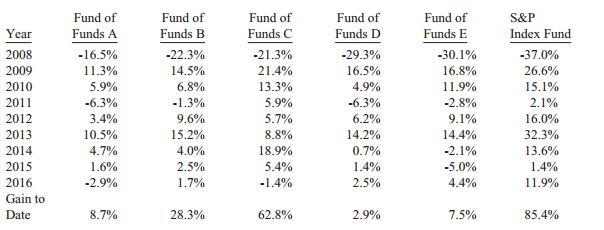
Underscoring his long-held thesis that, over time, highly paid hedge-fund hotshots lose out to a cheap index fund, Mr. Buffett presented the latest results of a bet he made nine years ago. Since then, a standard S & P index fund overseen by Vanguard is up 85 percent, easily outpacing the hedge funds’ return of 22 percent. Annually, the gap is just as wide: 7 percent for the index fund and 2.2 percent for the hedge funds.

As usual, Mr. Buffett did not mince words in expressing his astonishment as to how elite investment professionals could register such mediocre returns while raking in steep fees.

“I’m certain that in almost all cases the managers at both levels were honest and intelligent people. But the results for their investors were dismal — really dismal,” he wrote. “And, alas, the huge fixed fees charged by all of the funds and funds-of-funds involved — fees that were totally unwarranted by performance — were such that their managers were showered with compensation over the nine years that have passed.”

Barron's : Sunken Transocean Stock Could Gush 35% Higher

Sunken Transocean Stock Could Gush 35% Higher - http://bit.ly/2lbmRYb
Another uptick in oil prices could put the embattled deepwater driller’s rigs back in the water.

Transocean’s longtime shareholders have spent more time underwater than most of its deepwater drills. From a peak of $161 in 2008, the stock seemed to find a bottom below $50 amid the financial crisis of 2008-09. A sharp rally ended in 2010 when one of Transocean’s rigs exploded in the Deepwater Horizon disaster, killing 11 workers. The stock had settled at a new plateau below $40 by 2011. Knocked from that shelf by last year’s oil price decline, the shares bumped along near $9. A post-election spike to $15 has been followed by a slow drift down to $14. In all, Transocean’s market value has plummeted some 90%, to $5.4 billion.
Patient, value-oriented investors should feel safe to dip a toe back into Transocean (ticker: RIG), which analysts think can rise more than 35% over the next year or two as it navigates through lower revenues and higher losses toward a turnaround. Last Thursday’s stronger-than-expected earnings report was another sign of management’s ability to control costs.
Matthew Lloyd/Bloomberg
The Vernier, Switzerland–based company operates in the sharp end of the energy business. Transocean provides offshore contract drilling services to oil and natural-gas companies, often tapping wells in rugged or remote ocean environments. That means costs are higher than for onshore drillers, so demand for its services doesn’t kick in until oil prices are relatively high. In 2016, 28 of Transocean’s 57 rigs were either idle or completely mothballed.
HOPEFULLY, THE RECENT rise in oil prices will open a new and happier chapter for Transocean. Since 2013, the company has paid out about $1.6 billion to resolve environmental and other damage claims from the government, businesses, and individuals to start putting the Deepwater disaster, which also spewed 200 million gallons of oil into the Gulf of Mexico, behind it. In part through major layoffs, it has slashed costs by $3.9 billion, to an estimated $2.1 billion over the past four years, and new long-term contracts have allowed it to finance a more efficient, modern fleet.
Despite some encouraging signs, share prices of Transocean and its offshore peers suggest that investors believe they are “dead,” says Bernstein’s Colin Davies, who thinks otherwise. Transocean trades at $14, about a third of its estimated 2016 book value of $41, while other drillers trade at half of their book value. The drilling industry as a whole trades at a price/earnings ratio of 23, versus its long-term average of 18. Transocean’s trailing P/E is five, versus its long-term median of 19 times.
Key to reviving Transocean’s stock price is the price of oil, which has been moving in the right direction. From its bottom of $28 a barrel a year ago, Brent crude, the international benchmark, hit $56 last week. Whether onshore or offshore, producers have cut back their operations in the past year or two. The Organization of the Petroleum Exporting Countries agreed in November to reduce production by 1.2 million barrels a day to support oil prices.
There’s debate among experts about what oil price is needed for demand for offshore rigs to rise. In presenting third-quarter results last year, Transocean President and CEO Jeremy Thigpen said the return of $50-a-barrel oil has renewed interest from independent oil companies, but Transocean would need $60 a barrel to hit a sweet spot with major integrated oil companies. Others think $65 is a better estimate. Thigpen, who joined the company in 2015, expects continued volatility this year, with more positive improvements in 2018. Transocean declined to make management available.
In the interim, Thigpen, who came aboard from a customer, National Oilwell Varco(NOV), has emphasized efficiency. In his September presentation, he said Transocean had removed two layers of management “between myself and the rigs,” and “closed down facilities.” Future gains will come “from process enhancements,” such as shutting down and stowing rigs in 14 days versus the previous 60 days, thus saving personnel and fuel costs. Cost consciousness was evident in Thursday’s report, which showed fourth quarter operations and maintenance expenses were down nearly $500 million to $314 million. Earnings totaled 63 cents a share, versus Street estimates of 5 cents.

Thigpen has upgraded Transocean’s balance sheet, in part by buying back its distressed debt at big discounts. Net debt has dropped to $5.7 billion from $9.5 billion in 2011, and total liabilities have fallen 30%, to $11 billion. At the same time, Transocean has a massive $11 billion backlog, much of it with big producers like Shell. The backlog, more than twice that of its nearest rivals, means less risk of cancellation and provides security for loans. That, in turn, has helped it outfit 57 mobile offshore drilling units.
Relationships with the likes of Shell are a big advantage for Transocean, which was founded back in the mid-1950s. In putting a Buy on Transocean shares in early January, Norway’s Arctic Securities said they would help make the company the “best positioned in the offshore drilling sector.” Because of its size and relative stability, Transocean is a “lower levered bet on improved fundamentals,” says Arctic, whose research team devotes much of its effort to oil and shipping. It recently lifted its target price to $19, more than 35% above last week’s levels.
TRANSOCEAN IS A LIKELY survivor in a business still gripped by an oversupply of rigs and ripe for consolidation. Ocean Rig UDW (ORIG), Seadrill (SDRL), and Hercules Offshore are smaller, distressed firms that could need to sell assets or themselves.
Transocean’s tough times aren’t over. Analysts say it will lose $157 million, or 48 cents a share, on revenue of $2.87 billion in 2017, versus its 2016 profit of $199 million, or 54 cents a share, on revenue of $3.71 billion. Losses could be worse in 2018 as revenues finally bottom out near $2.8 billion.
That may make it seem that jumping in now is too risky. Gradually building a position is probably the best approach. Craig Hodges, who runs the Hodges Pure Contrarian fund (HDPCX), says that if investors wait until the price of oil is established in the $60s, they may be too late. “You have to position [yourself] beforehand, or you’ll miss the opportunity,” says Hodges. His target for the shares: $30, or more than twice last week’s price, over the next five years. If he’s right, Transocean could turn out to be a sunken treasure for investors.

Reuters - Buffett mulls change to canny Bank of America stake if dividend rises

Buffett mulls change to canny Bank of America stake if dividend rises
Warren Buffett said on Saturday he plans to stick with the shrewd bet that his Berkshire Hathaway Inc (BRKa.N) made on Bank of America Corp (BAC.N), but might eventually swap the preferred stock that Berkshire owns into common stock.
Berkshire bought $5 billion (£4.01 billion) of Bank of America preferred stock carrying a 6 percent dividend, or $300 million annually, in August 2011, when many investors worried about the second-largest U.S. bank's capital needs.
More importantly, Buffett also received warrants to buy 700 million Bank of America common shares at $7.14 each, roughly where the stock traded, by September 2021.
Many analysts thought the terms agreed to by Buffett and Bank of America Chief Executive Brian Moynihan were generous to Berkshire. And so far, they have been proven right.
Berkshire is now sitting on a $12 billion gain on the warrants because Bank of America's stock price has more than tripled, to $24.23.
That includes a more than 42 percent increase in the 3-1/2 months since Donald Trump won the U.S. presidential election.
In his annual letter to Berkshire shareholders, Buffett said if Bank of America's current 30 cents per share annual dividend rose above 44 cents before 2019, "we would anticipate making a cashless exchange of our preferred into common."
On the other hand, Buffett said that if the Charlotte, North Carolina-based bank's dividend stayed below 44 cents, "it is highly probable that we will exercise the warrant immediately before it expires."
Bank of America spokesman Larry Di Rita declined to comment.
Many U.S. banks, including Bank of America, were forced to slash their dividends because of the 2008 financial crisis.
Some have since boosted payouts after getting seals of approval through annual U.S. Federal Reserve "stress tests" that examine their ability to withstand major market shocks.
Bank of America last boosted its dividend 50 percent after passing its most recent stress test in June.
The preferred investment was among several totalling more than $25 billion that Berkshire made from 2008 to 2011 in Dow Chemical Co (DOW.N), General Electric Co (GE.N), Goldman Sachs Group Inc (GS.N) and other companies, when Berkshire was often seen as a lender of last resort.
Most have since been redeemed, and Buffett has lamented the loss of their mid- to high- single-digit or double-digit income streams.
The Goldman investment also included cashless warrants to buy common stock. Berkshire ended 2016 with 11.39 million Goldman shares, and assuming it still owns them is sitting on a nearly $2.2 billion gain.

WSJ : Buffett Assails Money-Manager Fees as Berkshire Reports Profit Rise

Buffett Assails Money-Manager Fees as Berkshire Reports Profit Rise
Billionaire also declares victory in his $1 million bet with another asset manager that low-cost index funds would out earn hedge funds over a decade

Warren Buffett intensified his attacks on Wall Street money managers Saturday, saying that investors wasted more than $100 billion over the last decade on expensive advice.

The billionaire devoted a large section of his widely read Berkshire Hathaway shareholder letter to arguments against stock pickers that charge high management fees and fail to beat the broader market.

He also declared victory in his $1 million bet with another asset manager that low-cost index funds would out earn hedge funds over the span of a decade.


“The bottom line,” Mr. Buffett wrote, is that “when trillions of dollars are managed by Wall Streeters charging high fees, it will usually be the managers who reap outsized profits, not the clients.”

The 86-year-old Mr. Buffett, whose shrewd investments have earned him the nickname “the Oracle of Omaha,” returned to several favorite topics with trademark folksiness in his 27-page letter. He reiterated his optimism about the future of America, rebuffed criticisms of share buybacks and declared that he has not committed to holding any of Berkshire’s stock investments forever.

His goal, he said, is to deliver significant earnings growth over time and predicted that will come in fits and starts. “Every decade or so,” he writes, “dark clouds will fill the economic skies, and they will briefly rain gold. When downpours of that sort occur, it’s imperative that we rush outdoors carrying washtubs, not teaspoons. And that we will do.”

Berkshire’s net earnings rose nearly 15% in the fourth quarter, boosted in part by the stock market’s end-of-year gains, but the conglomerate’s results were roughly flat for the full year. Net earnings were $24.07 billion in 2016 as compared with $24.08 billion in 2015.


Book value, a measure of assets minus liabilities that is Mr. Buffett’s preferred yardstick for measuring net worth, rose 10.7% in 2016, compared with a 12% total return in the S&P 500, including dividends.

One big reason for the flat performance was a decline in earnings for Berkshire’s BNSF railroad subsidiary. Net earnings at Berkshire’s railroad fell 16% in 2016 due largely to a drop in coal demand. Mr. Buffett didn’t mention BNSF’s top executives by name, as he has in past letter. Mr. Buffett tends to only name managers when he is praising them.

He did tout the performance of his insurance chief, Ajit Jain, widely considered to be one of the leading candidates to take the Berkshire CEO job when Mr. Buffett is no longer on the scene, and noted that “float” from the conglomerate’s insurance operations exceeded $100 billion for the first time in 2017. Berkshire can invest that money and keep any profits.

Investment gains declined for the year, partly because Berkshire recorded such a large one-time gain in 2015 due to holdings in Kraft Heinz Co. One of the biggest investments made by Berkshire over the past year was the amassing of a stake in tech giant Apple Inc., which then soared to a record high on better-than-expected iPhone sales and building anticipation for the next edition of the phone.

Mr. Buffett has long said his preferred time period for holding a stock is “forever” but he noted in the letter that there can be exceptions.

“It is true that we own some stocks that I have no intention of selling for as far as the eye can see,” he wrote. “But we have made no commitment that Berkshire will hold any of its marketable securities forever.”

Mr. Buffett took on the subject of share repurchases and dismissed arguments that buybacks are diverting funds from more worthwhile expenditures. Berkshire, he said, is still willing to buy back its shares if prices fall below 120% of book value. Based on his latest estimate of book value, the buyback threshold stands at roughly $207,000 per Class A share. Class A shares closed Friday at $255,040.

Mr. Buffett praised some companies, including Bank of America Corp., for buying back shares. “Some people have come close to calling [buybacks] un-American—characterizing them as corporate misdeeds that divert funds needed for productive endeavors,” Mr. Buffett said. “That simply isn’t the case.”

Berkshire has warrants to buy 700 million shares of Bank of America at $7.14 apiece. The stock closed Friday at $24.23, so Mr. Buffett is looking at a paper gain of about $12 billion. Mr. Buffett in his letter said he would consider exercising the warrants if Bank of America raises its dividend to 44 cents from 30, and would exchange Berkshire’s Bank of America preferred shares to fund the transaction. A Bank of America spokesman declined to comment.

There were a few topics Mr. Buffett avoided in his annual letter. He said nothing about potential successors or when he might step down as chief executive. The longtime Democrat also refrained from directly commenting on politics despite his criticism of President Donald Trump during last year’s campaign. He attributed America’s “miraculous” economic growth to “human ingenuity, a market system, a tide of talented and ambitious immigrants, and the rule of law.”

He instead saved his sharpest comments for pricey money managers who pledge to beat the market, saying that in his lifetime he has identified “ten or so professionals” who can do so successfully. Mr. Buffett became one of the world’s richest people by investing in undervalued stocks and buying companies.

“If 1,000 managers make a market prediction at the beginning of a year, it’s very likely that the calls of at least one will be correct for nine consecutive years,” he wrote. “Of course, 1,000 monkeys would be just as likely to produce a seemingly all-wise prophet. But there would remain a difference: The lucky monkey would not find people standing in line to invest with him.”

Invariably, he wrote, management fees eat into investors’ returns. He took aim at a popular target, the hedge fund “two and twenty” structure, where a manager charges an annual 2% of assets plus 20% of profits earned.

In 2007 Mr. Buffett bet $1 million that his chosen index fund, the Vanguard 500 Index Fund Admiral Shares, would outperform hedge funds over the next decade. The firm that took the other side of that bet, Protégé Partners, chose five funds of hedge funds. Such funds charge an additional layer of fees on top of those charged by each hedge fund.

None of those five funds outperformed the S&P 500 since the start of the bet, Mr. Buffett said in his letter. There is “no doubt” he will win the contest when it concludes Dec. 31, he added. The proceeds will go to the winner’s chosen charity.

More investors are heeding Mr. Buffett’s advice as they lose faith in traditional money managers. Investors pulled a net $342.4 billion from U.S.-based actively managed funds last year, according to Morningstar, while pouring a record $505.6 billion into U.S.-based passively managed funds.

The biggest beneficiary of this shift is Vanguard Group, which started the first index fund for individual investors 40 years ago. At the end of January its assets reached a record $4 trillion, following a year when Vanguard’s funds pulled in more new money than all rivals combined.

Mr. Buffett in his letter Saturday praised Vanguard founder Jack Bogle as a “hero.”

“If a statue is ever erected to honor the person who has done the most for American investors, the handsdown choice should be Jack Bogle.”

FT : Bain Capital tables rival €3.6bn bid for Stada

Bain Capital tables rival €3.6bn bid for Stada
German generic drugs maker enters structured bidding process after third bid

Bain Capital has made a €3.6bn offer to buy Stada, as the bidding war between private equity firms for the German maker of generic versions of drugs such as Viagra nears its climax.

The offer from the US-based buyout group values shares in Stada at €58 a share and comes two days after its rival Advent International also submitted an offer at that level, according to people close to the situation.

The differences between the two offers could put pressure on Stada’s board to make a decision in the next 48 hours because Advent’s offer, which is fully financed and includes a dividend payment to Stada shareholders, has a Monday deadline.

The Bain Capital offer does not come with a deadline, which may be preferable to the Stada board as they continue to receive interest from other parties. However, it also does not include the dividend payment, worth roughly €0.75, and is not yet fully financed.

The bids come two weeks after the Financial Times revealed that a third private equity firm, Cinven, had kicked off the battle with a €56 a share bid. Reuters subsequently linked Bain Capital to a €58 a share offer

Stada said on Saturday that it had now entered into a structured bidding process to ensure that all bidders received the same level of information. It confirmed three bidders had been invited to conduct due diligence.

It said: “In the interest of all shareholders and stakeholders of the company, further potential for value enhancement shall be presented in this process in order to be reflected in possible offer prices. Moreover, the value of the strategic concepts of the interested parties as well as their willingness to grant protective mechanisms for stakeholders will also be examined.”

Stada and Bain declined to comment on the Bain bid.

The bidding war follows a year-long campaign to improve Stada’s governance and profitability by one of its largest shareholders, the relatively unknown German activist investor Active Ownership Capital. The buyout groups believe there is further room for cost cutting and operational improvement at the drugmaker after years of poor management, marking a rare opportunity in Europe to find a takeover asset of scale.

Moreover, there appears to be limited interest from strategic bidders for Stada, allowing the private equity firms to compete in and auction where they will not get out bid by a company already operating in the segment that can afford to pay more because of synergy possibilities.

In its pitch to speed up the auction, Advent said it would boost the company’s growth by investing in new products and commit to keeping Germany as its industrial base. It also said it had no intention to sell or split off significant parts of the business.

Stada was founded in Dresden in 1895 as a pharmacists’ co-operative and is one of the last independent manufacturers of generics and non-prescription medicines. Its board has been dominated by doctors and pharmacists, something that critics have argued has resulted in it lacking the international experience needed to expand the business.

Matthias Wiedenfels, who in May took over from Stada’s longstanding chief executive Hartmut Retzlaff, admitted at the August shareholder vote that previous actions by the company had cost it “growth, profitability and also credibility”.

Shares in Stada, which are trading at their highest levels on record, closed at €57.74, giving it a market value of €3.58bn.

CNBC - Buffett slams Wall Street 'monkeys', says hedge funds, advisors have cost

Buffett slams Wall Street 'monkeys', says hedge funds, advisors have cost clients $100 billion

Warren Buffett on Saturday devoted more than four pages of his 29-page annual shareholder letter to criticism of active managers on Wall Street, excoriating what he perceived as exorbitant fees they charge for returns that fail to live up to lofty assumptions.
Meanwhile the legendary stock picker extolled the virtues of passive investing and its advantages for regular investors. The 'Oracle of Omaha' even compared active managers to monkeys, and estimated that financial advisors, in their futile search for ways to beat the market, had cost clients $100 billion in wasted fees in the last 10 years.
"When trillions of dollars are managed by Wall Streeters charging high fees, it will usually be the managers who reap outsized profits, not the clients," stated the widely-read letter released on Saturday morning. "Both large and small investors should stick with low-cost index funds."

'The results were dismal'
Buffett started this critical section of the letter with an update on a 10-year wager against Wall Street's active management he made nine years ago, with the proceeds going to a charity. This is how the billionaire described his original challenge:
"I publicly offered to wager $500,000 that no investment pro could select a set of at least five hedge funds – wildly-popular and high-fee investing vehicles – that would over an extended period match the performance of an unmanaged S&P-500 index fund charging only token fees. I suggested a ten-year bet and named a low-cost Vanguard S&P fund as my contender. I then sat back and waited expectantly for a parade of fund managers – who could include their own fund as one of the five – to come forth and defend their occupation. After all, these managers urged others to bet billions on their abilities. Why should they fear putting a little of their own money on the line?"
To his surprise, only one person stepped up to take the other side of the bet: Protégé Partners' Ted Seides, a 'fund of funds' manager. According to the bet, Seides selected five funds of hedge funds, whose results after fees would be averaged and compared to Buffett's selection, a Vanguard S&P index fund.
Here's what happened, according to the letter:
"The compounded annual increase to date for the index fund is 7.1%, which is a return that could easily prove typical for the stock market over time...The five funds-of-funds delivered, through 2016, an average of only 2.2%, compounded annually. That means $1 million invested in those funds would have gained $220,000. The index fund would meanwhile have gained $854,000."
In fact, none of the basket of funds came even close, according to Buffett:
"The results for their investors were dismal – really dismal. And, alas, the huge fixed fees charged by all of the funds and funds-of-funds involved – fees that were totally unwarranted by performance – were such that their managers were showered with compensation over the nine years that have passed," Buffett wrote. "As Gordon Gekko might have put it: 'Fees never sleep.'"
Investors seem to be heeding Buffett's anti-active advice, as more than $20 billion flowed out of U.S. active equity funds in January despite a rising stock market, according to Morningstar. In the last 12 months, more than half a trillion dollars have flowed into passive funds, while active funds have experienced outflows, Morningstar's data showed.
In his letter, Buffett criticized how the whole Wall Street complex is still set up to send pension funds, endowments and other investor types into under-performing active vehicles. He claimed that the wealthy investor classes are getting ripped off the most:
"In many aspects of life, indeed, wealth does command top-grade products or services. For that reason, the financial 'elites' – wealthy individuals, pension funds, college endowments and the like – have great trouble meekly signing up for a financial product or service that is available as well to people investing only a few thousand dollars. This reluctance of the rich normally prevails even though the product at issue is –on an expectancy basis – clearly the best choice. My calculation, admittedly very rough, is that the search by the elite for superior investment advice has caused it, in aggregate, to waste more than $100 billion over the past decade. Figure it out: Even a 1% fee on a few trillion dollars adds up. Of course, not every investor who put money in hedge funds ten years ago lagged S&P returns. But I believe my calculation of the aggregate shortfall is conservative."
Buffett stated that he knows of only 10 managers that he spotted early on who could outperform the S&P 500 over the long term, and they did so. He acknowledged there are more out there who may be able to beat the market, but they are the clear exception.
"Further complicating the search for the rare high-fee manager who is worth his or her pay is the fact that some investment professionals, just as some amateurs, will be lucky over short periods," Buffett wrote.
"If 1,000 managers make a market prediction at the beginning of a year, it's very likely that the calls of at least one will be correct for nine consecutive years. Of course, 1,000 monkeys would be just as likely to produce a seemingly all-wise prophet. But there would remain a difference: The lucky monkey would not find people standing in line to invest with him."
The billionaire heaped praise on Jack Bogle, the founder of the Vanguard Group who started the first index fund 40 years ago.
"If a statue is ever erected to honor the person who has done the most for American investors, the hands down choice should be Jack Bogle," the letter stated. "In his early years, Jack was frequently mocked by the investment-management industry. Today, however, he has the satisfaction of knowing that he helped millions of investors realize far better returns on their savings than they otherwise would have earned."
"He is a hero to them and to me," Buffett added.

>>> Vodafone might announce joint venture - speculative report

Vodafone might announce joint venture - speculative report
25 FEB 2017
Vodafone Group [LON:VOD], an FTSE-100 telecoms company, might disclose a cross-border joint venture, according to speculation cited by a market report in The Daily Telegraph. The newspaper did not cite a source for the rumour.
Vodafone’s share price closed 0.6p up at 202.85p in London on Friday, 24 February, giving the company a market capitalisation of GBP 53.99bn (EUR 63.73bn).