We raise our allocation to US equities by 1%, bringing it in line with Europe. Our overall equity weight is +4%, representing a modest OW. Japan remains our most favoured region, EM our least favoured one.
Raising the US: Top-down, global growth and financial conditions have been tracking better than we have been expecting. Bottom-up the price targets of our new US equity strategist, Michael Wilson, imply attractive returns and return skew. Tactically, the outcome of the first round of the French elections has been market-friendly and investor sentiment does not look extended. We add to US equities. We fund this by taking cash to neutral (+0%).
Applying our framework: Our framework weights long-run valuations, our medium-term cycle models and 12-month forecast risk/reward. US stocks score poorly on valuations, mixed on our cycle models, and well on our forecasts. We think that this is good enough to raise the weight, but it remains less attractive than Japan (which scores well on all three).
If we only follow the 12m forecasts? Exhibit 1 shows base case returns (x-axis), against bull versus bear skew (y-axis), volatility-adjusted, across key asset classes. Up-and-right is better. US equities score well.
The risks: US stocks are expensive. Sentiment is not very bearish. Nonetheless, we think that the 6-12m case supports a higher allocation to risk than we had before.
Implementation: Low volatility and a steep skew imply significant less upside for the S&P 500 than we forecast. We think that this makes owning calls (6m, 3% OTM) attractive.
(MergerMArket)
Chinese investors assess Alain Afflelou takeover this year, IPO not ruled out- sources
French eyewear retailer Alain Afflelou is in talks with undisclosed Chinese investors to explore a sale of the business this year after two IPO attempts in 1Q17 and 4Q16, two sources briefed on the situation and a banker following the situation said.
A person familiar with Alain Afflelou’s plans said there are several options on the table, including a sale, but declined to comment on what option is the preferred one, only adding more information will be disclosed before the end of June. The company has not completely ruled out another IPO attempt, the person added.
A spokesperson for Alain Afflelou declined to comment.
A Chinese buyer would likely seek to benefit from Alain Afflelou’s expertise and store network model and look to replicate it in the Chinese market, the first source briefed said. The Chinese offline eyewear retail market was worth EUR 5bn in 2016, according to the same source.
With revenues of EUR 344m, EBITDA of EUR 67.5m and net loss of EUR 9.1m in 2016, the company is likely to fetch a deal value of around EUR 1bn, both sources added.
Potential buyers are said to be considering options, the first source said. They can either meet the EV of around EUR 1bn, with EUR 300m debt included, or pay EUR 700m in EV and issue new bonds for EUR 300m in value, the first source added.
In the first scenario, buyers could expect net profit of EUR 55m-EUR 60m post-acquisition, while in the second one, buyers could expect net profit of EUR 45m-EUR 50m post-acquisition, the same source said.
The French eyewear retailer first announced plans to list towards the end of 2016 but decided to postpone its IPO plans at the end of November until 2017, due to market conditions at the time. Last February, Alain Afflelou confirmed that it had once again put its planned IPO on hold after the tie-up announcement between Luxottica [LUX:MIL] and Essilor [EPA:EI].
Growth prospects in the eyewear segment in France, which are threatened by an expected fall in the French healthcare system’s reimbursements for eyewear, may also play a role in the two previous failed attempts, as previously reported by this news service.
In the event of an IPO, Alain Afflelou could look at Grandvision [AMS:GNVN], Fielmann [ETR:FIE], and Luxottica as comparables, this news service previously reported, and could see a pre-money equity value between EUR 648m and EUR 998m.
As of July 2016 Alain Afflelou had 1,400 retail stores in 13 countries, of which 72% are in France (1016) and 28% in Spain (398), according to the company's website. The company announced its entry in the Chinese market in March 2016, with the first four stores opening in Chongqing and Chengdu in the Sichuan province, as per company reports.
The eponymous founder of Alain Afflelou still owns 14%, while Lion Capital holds 39% stake in the company. Lion Capital acquired its stake in 2012 and indicated an EV of EUR 800m, it was reported. The Caisse de dépôt et placement du Québec (CDPQ) owns 29%, Apax Partners owns 14%, and the remaining 4% is held by management, according to the company website.
Lion Capital and Apax Partners declined to comment. CDPQ did not respond to a request for comment.
Jupiter records strongest quarter of inflows as a public company
UK-listed fund manager boosted by demand from Asian and European clients
Jupiter Asset Management recorded its strongest quarter of fund inflows since the London-headquartered investment manager went public seven years ago on the back of an international expansion and buoyant stock markets.
The UK-listed fund house shrugged off the pressures facing active managers as it drew inflows of £1.3bn during the first three months of the year, reversing the company’s fourth-quarter slide when investors pulled money from its funds.
Jupiter’s total assets under management jumped by 7.4 per cent to £43.5bn on the back of new money from investors and strong investment performance.
Maarten Slendebroek, chief executive of Jupiter, which is the fifth largest listed fund house in the UK by assets, said: “The continued strategy to diversify our business by product, client type and geography and delivery of strong investment performance after fees across a broad range of strategies has resulted in good inflows both internationally and within the UK.”
In contrast, British rival Henderson, which is in the process of merging with Janus, the US asset manager, last week posted investor redemptions in the first months of 2017. Janus also posted outflows for the quarter.
Jupiter’s strong inflows, which beat the company’s previous record of £900m of new money during the first quarter of 2015, come at a time when the UK fund industry is under close scrutiny.
In an interim report into the asset management industry last year, the UK’s financial watchdog was sharply critical of business practices in the sector, including how much investors are charged for actively managed funds and a lack of relationship between fund fees and investment performance.
Active managers have suffered large redemptions in recent years as investors shunned higher fee products for cheaper passive funds.
But Jupiter, whose share price rose 2 per cent in morning trading, said the company was well positioned for growth. “Net inflows, underpinned by the delivery of strong investment outperformance after all fees to investors, affirm the confidence we have in our diversification strategy offering potential for further long-term growth.”
During the first three months of 2017, Jupiter’s high-fee generating mutual fund business drew in £1.4bn, in part following by an uptick in demand from Asian and European clients.
Jupiter said demand had been particularly high for its fixed income, absolute return, multi asset and global emerging market products. Institutional investors withdrew £93m from mandates to invest given to the fund manager, however.
Julian Bates, an analyst at Liberum, the investment bank, described the overall inflows as “impressive”.
“Jupiter has achieved more than half of our net inflow forecast for the full year of £2.4bn,” he said.
But Paul McGinnis, an analyst at Shore Cap, the broker, warned Jupiter could still come under pressure this year. “[It] retains a high exposure to a UK retail market [that is] under regulatory pressure to reduce the total cost of investment.”
Jupiter was one of the few UK-listed asset managers to post inflows in 2016. The fund house reported new money of £859m during the year, despite suffering £373m of outflows during the fourth quarter of 2016.
Instagram hits 700 million users, accelerating from 600M in December
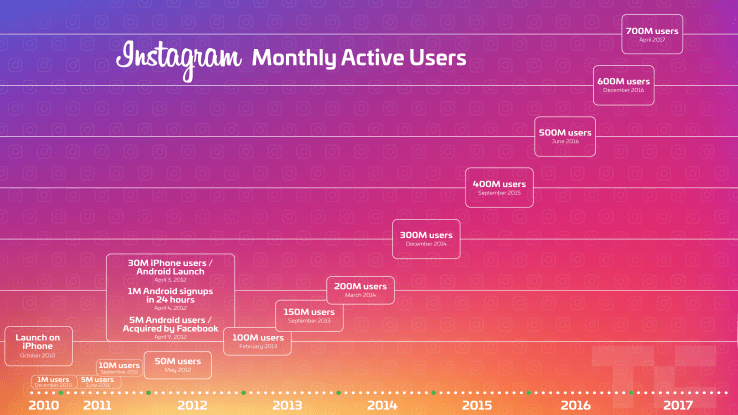

Instagram has doubled its user base to 700 million monthly actives in two years, fueled by Stories, web signup, and better onboarding on low-end Android phones. Instagram’s growth rate is actually speeding up. It took just four month to add the last 100 million users since hitting 600 million in December, while it took 6 months to go from 500 million to 600 million.
Here’s a breakdown of how long it took Instagram to add each 100 million users:
- October 6, 2010 – Launch
- February 26, 2013 – 100 million – 28 months
- March 25, 2014 – 200 million – 13 months
- December 10, 2014 – 300 million – 9 months
- September 22, 2015 – 400 million – 9 months
- June 21, 2016 – 500 million – 9 months
- December 15, 2016 – 600 million – 6 months
- April 26, 2017 – 700 million – 4 months
For reference, this makes Instagram more than twice the size of Twitter. Soon it might join Facebook’s other properties in the billion user club, since WhatsApp and Messenger have 1.2 billion users, and Facebook 1.8 billion.
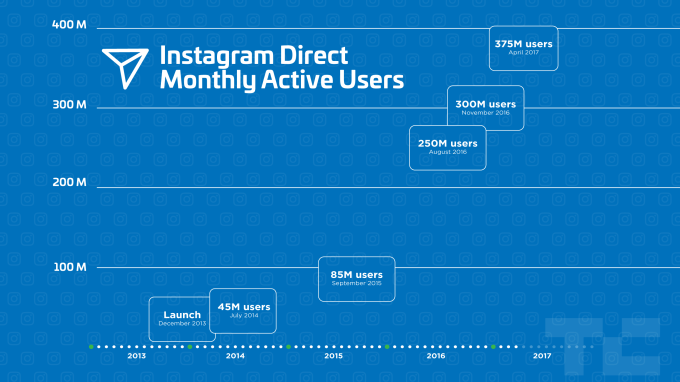
When asked if the launch of Snapchat clone Instagram Stories help boost the app’s user count, a spokesperson told me “Yes, it’s impacted growth and retention.” Instagram Stories reached 200 million daily active users earlier this month, ecclipsing the 161 million total daily users Snap Inc last announced. Instagram’s combined ephemeral and permanent messaging feature Direct that’s also inspired by Snapchat recently hit 375 million monthly users.
Instagram’s progress has come at the expense of Snapchat’s growth, which sank 82% since Instagram launched its Stories copycat in August. All eyes will be on Snap’s user count when it gives its first earnings report next month.
Meanwhile, as Snap deprioritized foreign markets with lower ad rates, Instagram has continued to push its international presence. “Developing markets have always been important at Instagram” says a spokesperson. “US is our biggest market, but Brazil has long been our #2 (currently with 45M users). Along with the UK and Japan, our other big markets include Indonesia, India and Turkey.” Now 80% of Instagram users are outside the US.
Instagram has been building products specifically for these users that can’t afford data plans or have weak connectivity. It just introduced offline mode on Android, and the company tells me it’s been focusing more on its mobile web experience as well as keeping the Android app’s file size to a minimum.
“Growth was driven by a number of factors, including our ability to better connect people with their friends on Instagram” said a spokesperson. “We also took steps to simplify and improve our sign-up process, which helped bring in new people from all over the world.”
With such a large audience, Instagram has the scale to appeal to top brands. The app now has 1 million active advertisers, up from 500,000 in September, with plans to offer them more data and flexibility.
It’s rare for a social network to stay as cool after 6.5 years. Even its owner Facebook was starting to look a bit old at that point. But by sticking to its roots of visual communication while shrewdly adapting to new trends, Instagram has managed to stay on top.
Maserati sales help drive Fiat to Q1 growth
Strong European sales and demand for its luxury Maserati SUV helped Fiat Chrysler post an 11 per cent rise in first quarter profits, in spite of falling sales in North America and a return to losses in Latin America.
Adjusted operating profit at the company that also owns the Jeep, Dodge and Alfa Romeo brands rose to €1.5bn, with sales up 4 per cent to €27.7bn.
In North America, its largest region, profits were down fractionally at €1.2bn, while revenues fell 3 per cent to €17bn and the number of cars it sold fell 6 per cent to 609,000, primarily due to lower sales to fleet operators such as hire car companies or businesses.
Profits in Europe, Middle East and Africa almost doubled, rising 85 per cent to €178m on sales that were up 12 per cent to €5.6bn due to customers buying more expensive cars, as well as cost savings from purchasing and manufacturing.
Maserati, its luxury brand, saw profits balloon from €16m to €107m after the release of the Levante SUV drove a near-doubling of sales to €949m and a rise in the brand’s margin from 3.2 per cent to 11.3 per cent.
The group returned to a loss in Latin America, booking a €20m loss compared to an €11m profit a year earlier, which it blamed on inflation and foreign exchange movements. It also booked a further €32m restructuring charge for the region, which is not included in the €20m loss figure.
Net industrial debt, which the company has pledged to reduce to below €2.5bn by the end of 2017, climbed €527m to €5.1bn.
Gapping down
In reaction to disappointing earnings/guidance:
In reaction to disappointing earnings/guidance:
- X -18.1%, SUP -9.9%, CREE -7.3%, (also forms JV w/ San'an Optoelectronics to produce and deliver to market high-performing, mid-power lighting class LED packaged products in an exclusive arrangement to serve the expanding markets of North and South America, Europe and Japan, and serve China), MTSI -7.3%, NUVA -4.8%, STX -4.5%, ULTI -4%,DFS -3.7%, COF -3.7%, DDR -3.2%, ILMN -3%, BABY -3%, ALK -2.6%, NYCB -2.5%, SAN -2.4%, CHRW -2.2%, CHRW -2.2%, EQR -1.9%, CVA -1.6%, GD -1.6%, JBT -1.5%, STL -1.3%, BXMT -1.3%, BAX -1.1%, MRCY -1%, ALGT -0.9%, MTL -0.9%, RNG -0.8%, PEP -0.8%, PG -0.7%
Select metal stocks trading lower in sympathy with X earnings:
- CLF -4.7%, STLD -4%, AKS -2.7%, CMC -2.4%, NUE -2.1%, MT -1.9%, RIO-1.3%, VALE -0.7%
Other news:
- FLXN -10.2% (commences $125 mln offering of convertible senior notes due 2024)
- MOMO -4% (still checking, hearing vague speculation of a possible investigation)
- MPW -3.7% (prices offering of 37.5 mln shares of common stock at $13.25 per share)
- NBIX -1.1% (to offer $450.0 mln aggregate principal amount of convertible senior notes due 2024; provides several updates in conjunction with the $450 mln convertible senior notes offering)
- CALI -0.9% (after closing near highs -- up 30% yesterday)
- BHP -0.7% (reports Q1 operational review)
Analyst comments:
- SHOP -1.1% (downgraded to Sector Perform at RBC Capital Mkts)