After Hours Summary: OKTA +6.5%, AGX +4%, VRNT +3% following earnings/guidance, VSTM +13.2% on DYNAMO study update... GEF -9%, CMTL -3% following earnings/guidanceAfter Hours Gainers:
Companies trading higher in after hours in reaction to earnings/guidance: OKTA +6.5%, AGX +4.1%, VRNT +2.9%, ONVO +2.8%, ABM +0.9% (also SVP/President of ABM Technical Solutions Scott Giacobbe elected EVP and will succeed James McClure as COO effective November 1)
Companies trading higher in after hours in reaction to news: INSG +37.8% (terminates TCL transaction to sell MiFi business, plans to restructure, changes leadership, details improved profitability outlook), DRWI +31.5% (seeing continued strength; also Nasdaq Panel granted request for continued listing), VSTM +13.2% (will present long-term follow-up data from the DYNAMO study at the ICML), SSTI +2.6% (today's IPO seeing continued strength), RGNX +1.3% (AveXis and REGENXBIO announce an exclusive worldwide license agreement for AveXis), TPX +1.2% (10% owner H Partners disclosed the purchase of 100K shares), CVNA +1.1% (extending today's earnings related move higher)
After Hours Losers:
Companies trading lower in after hours in reaction to earnings/guidance: DTEA -8.9%, GEF -8.8%, CMTL -3.3%
Companies trading lower in after hours in reaction to news: MSL -6% (ticking lower; announces public offering of $50 mln of common stock; to reduce the Company's quarterly cash dividend), CORT -3.2% (indicated lower in after hours -- being attributed to block trade pricing), BKCC -1.6% (commences offering of $125 mln of senior unsecured convertible notes due 2022), DECK -1% (downgraded to Neutral from Buy at Buckingham), HLT -0.6% (announces secondary offering of 15 mln shares of common stock by selling stockholders affiliated with The Blackstone Group), SNAP -0.6% (slowing growth discussed in NYPost article highlighting Instinet commentary), CAA -0.2% (announces offering of 42.8 mln shares of common stock, including 10 mln shares by MP CA Homes)
Closing Market Summary: Stocks Register First Win of the WeekThe stock market posted its first win of the week on Wednesday, however, several upcoming macro events held the major averages in check. The S&P 500 and the Dow added 0.2% apiece while the Nasdaq (+0.4%) finished a step above its peers.
Equities have been relatively flat all week ahead of tomorrow's full plate of events, which includes the UK general election, the latest policy decision from the European Central Bank, and the testimony of former FBI Director James Comey. Keeping in line with the week's sideways trend, equities opened Wednesday's session slightly higher, but were hovering at their flat lines by midday.
However, in the afternoon session, equities reclaimed their earlier gains after the prepared remarks that Mr. Comey will deliver before the Senate Intelligence Committee on Thursday were released.
The initial response was positive as market participants were seemingly heartened by the understanding that there wasn't any overt obstruction of justice claim in Mr. Comey's prepared statement. Nevertheless, the response overall was a measured one as participants were cognizant that more information will be forthcoming at the hearing itself.
Back on Wall Street, the energy sector (-1.5%) suffered at the hand of a bearish inventory report from the Energy Information Administration (EIA), which showed that both crude and gasoline inventories increased by 3.3 million barrels for the week ended June 2. Crude oil immediately plunged deep into negative territory following the EIA reading, finishing its day 4.9% lower at $45.49/bbl.
However, the heavily-weighted financial sector (+0.8%) helped to mitigate the energy group's bearish influence by providing solid sector leadership from start to finish. The top-weighted technology (+0.3%) sector also helped keep the bears at bay, thanks in large part to the outperformance of Apple (AAPL 155.37, +0.92) and chipmakers. AAPL added 0.6% while the PHLX Semiconductor Index increased by 0.7%.
The influential health care sector also outperformed, adding 0.3%, while the remaining advancers finished with gains between 0.1% (materials) and 0.5% (real estate). In addition to the energy group, the industrials (-0.1%) and consumer staples (-0.1%) sectors finished in negative territory.
Outside of the equity market, safe-haven assets like the Japanese yen (109.84, -0.4%), gold ($1,289.57/ozt, -0.6%), and U.S. Treasuries gave back some of Tuesday's gains on Wednesday. The benchmark 10-yr yield, which moves inversely to the price of the 10-yr Treasury note, finished three basis points higher at 2.18%.
Regarding tomorrow's events in Europe, the latest polling data indicates that Prime Minister Theresa May's Conservative Party has a strong lead against the Labour Party. Meanwhile, the ECB is expected to leave rates unchanged, however, reports suggest that the central bank will lower its inflation outlook due to weaker energy prices.
On the data front, investors received two economic reports--April Consumer Credit and the weekly MBA Mortgage Applications Index--on Wednesday:
- The Consumer Credit report for April showed an increase of $8.1 billion while the Briefing.com consensus expected growth of $15.0 billion. The prior month's credit growth was revised to $19.6 billion from $16.4 billion.
- The weekly MBA Mortgage Applications Index increased 7.1% to follow last week's 3.4% decrease.

Christopher Bailey Waives Bonus Again as Burberry Aims to Slash Pay
The long arm of austerity has stretched to executives’ perks and bonuses
LONDON — Austerity is biting top management at Burberry, which is in the thick of a cost-cutting and restructuring drive aimed at delivering at least 100 million pounds, or $129 million, in annualized savings by fiscal 2018-19, as the company reshapes itself in challenging times.
According to the annual general report published earlier this week, chief creative and chief executive officer Christopher Bailey waived his bonus for the second year running, although he still stands to collect about 10.5 million pounds, or $13.6 million when, part of a 1 million chunk of shares that he was awarded in 2013 vests next month.
Bailey turned down his bonus “in light of the underlying financial performance of the business for the year.” Burberry said the board “welcomed” and agreed with his decision.
The annual report also pointed out that adjusted profit before tax for the year was “just below” the bonus target resulting in a potential bonus payment of 46 percent maximum.
In the 2016-17 fiscal year, Bailey’s salary of 1.1 million pounds, or $1.4 million, was flat on the previous year. He received benefits and allowances of 469,000 pounds, or $614,390; 330,000 pounds, or $432,300, in pension contributions, and 240,000 pounds, or $314,400, as part of a share plan.
In addition, he scooped an exceptional share award of 1.4 million pounds, or $1.8 million, as part of a performance-linked bonus agreed in 2014, when he took on the added role of ceo. That 1.4 million pound payout represents a fraction of the share tranche that he received.
All figures have been converted at average exchange rates for the periods to which they refer.
Marco Gobbetti, who will take over the ceo position in July, will receive a similar base pay and salary package to Bailey’s, in addition to 4.3 million pounds, or $5.6 million, in share options, equal to the sum he was forced to forfeit on leaving his role as ceo of Céline, a division of LVMH Moët Hennessy Louis Vuitton.
While Bailey may have chosen to waive his bonus, other executives — and new hires — will likely see their perks automatically slashed in the current fiscal year, which ends in March 2018.
According to the report, Burberry wants to align the “long-term interests of executives with those of shareholders” and is therefore proposing a change to the remuneration policy. The company is recommending a reduction in the annual bonus policy maximum from 225 percent to 200 percent of salary, and also wants to slash the executive share plan awards from 400 percent to 325 percent of salary at the “normal” level, and from 600 percent to 375 percent at the “exceptional” level.
It is also proposing cuts to the maximum annual salary increase from 15 percent to 10 percent, and maximum relocation benefits that may be paid to current executive directors from 250,000 pounds, or $322,680 to 200,000 pounds, or $258,144.
Burberry is also looking to trim pension contributions from 30 percent to 20 percent of salary for new, external executive director appointments, and remove “sign on” bonus or share awards, other than buy-outs, on recruitment.
Goodbye, golden hellos.
The measures will be put to a shareholder vote on July 13 during the AGM in London.
As reported, profits for fiscal 2016-17, which ended on March 31, fell 7.3 percent to 286.8 million pounds, or $375.7 million, in line with analysts’ expectations, while revenue was down 10.4 percent on a reported basis, and 2 percent on an underlying one to 2.77 billion pounds, or $3.63 billion.
The year had been a tough one for Burberry, which in 2016 laid out a restructuring and cost-savings plan aimed at re-shaping the company for a future of slower growth in fashion and luxury goods and a digitally engaged, want-it-now customer base.
All the austerity has clearly not fazed Bailey, who remains committed to Burberry, and said last month that he cannot wait to get down to creative business and work alongside Gobbetti.
“I plan to redouble my focus on design, product and telling stories,” said Bailey, who will continue to hold the joint role of chief creative officer and chief executive officer until July 4, when he’ll also take on the new title of president.
He said he had “huge optimism” about the future, and that while the company was progressing on a variety of fronts, there was much more work to be done.
Burberry shares, which had climbed 0.7 percent earlier in the day, closed down 0.4 percent to 17.36 pounds on Wednesday.
- TURKEY APPROVES BILL ALLOWING TRAINING TO QATAR SECURITY FORCES
* * *
In the ongoing diplomatic crisis between Qatar and its Gulf/Arab peers, which is either the result of Saudi nat gas envy or - for those who watch CNN - Russian hacking, Turkey has emerged as a vocal supporter of the small but wealthy state. On Tuesday, Turkish President Recep Erdogan defended Qatar, saying he personally would have intervened if accusations that the tiny Gulf emirate supports "terrorism" were true and said he intends to "develop" ties with the embattled Gulf state hit by sanctions from Saudi Arabia and its allies.
"Let me say at the outset that we do not think the sanctions against Qatar are good," Erdogan said in a speech in Ankara."Turkey will continue and will develop our ties with Qatar, as with all our friends who have supported us in the most difficult moments," he added in reference to last year's failed coup. The support puts Turkey in a complicated position because while the NATO member has close ties with Qatar it also has good relations with the other Gulf states, especially Saudi Arabia.
Turkey's support for Qatar also has ideological reasons as in the past both both have provided support for the Muslim Brotherhood in Egypt and backed rebels fighting to overthrow Syrian President Bashar al-Assad.
Erdogan was careful not to criticise Riyadh, calling on the member nations of the Gulf Cooperation Council to "resolve their differences through dialogue".
"Efforts to isolate Qatar ... will not solve any problem," said Erdogan, praising Doha's "cool-headedness" and "constructive approach".
"Presenting Qatar as a supporter of terrorism is a serious accusation," the Turkish leader said. "I know [Qatar's leaders] well and if that had been the case, I would have been the first head of state to confront them" which of course is ironic coming from near-dictator, who last year cracked down on over 100,000 Turkish citizens accusing them of cooperating with Fethulah Gulen's "shadow state", and who has been accused of using false flag terrorist attacks to crack down on the Kurdish minority in his country.
On Wednesday morning Turkish support for Qatar escalated after the country's parliament was expected to fast-track a draft bill allowing its troops to be deployed to a Turkish military base in Qatar, officials from the ruling AK Party and the nationalist opposition said.
According to Reuters, lawmakers from Erdogan's AK Party have proposed debating two pieces of legislation: allowing Turkish troops to be deployed in Qatar and approving an accord between the two countries on military training cooperation, AKP and nationalist opposition officials said. The draft bills, which were drawn up before the spat between Qatar and its Arab neighbours erupted, are expected to be approved by the Ankara parliament later on Wednesday.
Just like the US with its CENTCOM base, as part of an agreement signed in 2014 Turkey set up a military base in Qatar, its first such installation in the Middle East. In 2016 Ahmet Davutoglu, then Turkish prime minister, visited the base where 150 troops have already been stationed, the Turkish daily Hurriyet reported.
In an interview with Reuters in late 2015, Ahmet Demirok, Turkey's ambassador to Qatar at the time, said 3,000 ground troops would eventually be deployed at the base, planned to serve primarily as a venue for joint training exercises.
The imminent Turkish decision to deploy troops comes as a Saudi 24 hour ultimatum, issued on Tuesday night, and containing 10 conditions among which demands by Saudi Arabia is that Qatar end all ties Muslim Brotherhood and Hamas, is ticking. While it was unclear what the outcome would be should Qatar fail to comply, some analysts have gone so far as to suggest a "military confrontation."
As we reported last night, speaking to Al Jazeera, analyst Giorgio Cafiero of Gulf State Analytics, a geopolitical risk consultancy based in Washington, DC, said: "I think the Kuwaitis as well as Omanis ... fear the prospects of these tensions escalating in ways which could undermine the interest of all six members of the GCC.
"There are many analysts who believe that a potential break-up of the GCC has to be considered right now. If these countries fail to resolve their issues and such tensions reaches new heights, we have to be very open to the possibility of these six Arab countries no longer being able to unite under the banner of one council," said Cafiero.
"Investors Should Be Petrified" Of The Coming Ice Age: Here Are Albert Edwards' Scariest Charts
Congratulations to Albert Edwards who this morning announced that he has once again placed first in the 2017 Extel Survey of analysts in the Global Strategy category, for the record 14th year in a row. As he adds "it is particularly gratifying that clients still seem to highly value our thoughts, especially during these cyclical intermissions in the Ice Age, when equities outperform government bonds." This year's victory appears to have been especially hard won because as he adds "you have to have a thick skin in this business, especially when our press office forwards our online press cuttings. Some of the reader abuse can get very, very personal. How do they know this stuff about me? The comments surely can't all be from my former partner!"
Of course, this being Albert, not even his record victory can brighten up the mood much, and the SocGen strategist then adds that "the current QE-inflated, cyclical equity bull market may have gone on way longer than we expected, but equities have only just managed to catch back up with global 10y+ government bonds (see chart below). The secular equity bear market will inevitably reassert itself and that performance chasm will open up again."

So, inspired by the record victory, Edwards is briefly reprising some of his favourite "Ice Age" charts, traditionally a source of rationality in an otherwise insane market, and lately, world.
* * *
The macro underpinning for our Ice Age thesis is the West's slow replication of Japan's 1990s descent into outright deflation. Each cyclical recovery sees lower highs in both inflation and nominal GDP growth rates and the inevitable recession, when it comes, wreaks increasing levels of havoc in financial markets.
But when we put together our Ice Age thesis over 20 years ago, what distinguished it from other more recent similar ideas, such as Lawrence Summers' Secular Stagnation thesis, was the massive change in financial market valuations we thought would accompany the new increasingly deflationary backdrop.
The big Ice Age call was that the tight positive correlation between equity yields and bond yields that market participants had enjoyed since 1982, driven by ever-lower inflation, would break down. The "long bull market" (see chart below) had been a mirror image of the 1965- 1982 period when yields on both assets had risen together. The Ice Age thesis, drawing on our observations of Japan, predicted that while interest rates and bond yields would continue to fall, equity yields would decouple and begin to rise on a secular basis. For those with a historical perspective the Ice Age would be a mirror image of the 1950-65 period, which had been dubbed in the 1950s "the culting of the equity market" - a term popularised by George Ross-Goobey - link. In the Ice Age, government bonds would rerate relative to equities, with the latter declining in absolute as well as relative terms.

One important implication of the Ice Age thesis was that widely used metrics from the 1980s and 90s, such as the bond/equity earnings yield ratio, would break down. Hence you should no longer buy equities when this ratio fell to 0.8 as they would be undergoing a secular de-rating.

These ideas seemed mad back in 1996, but having witnessed events in Japan through the 1990s we understood that the same forces would prevail in the West. Indeed on some metrics, what happened to the US bond/equity yield relationship closely mirrors that of Japan.

So why is it then that the US equity market has raced to all-time highs? Has the Ice Age thesis broken down? To be sure we saw strong cyclical rallies in the Japanese Nikkei within Japan?s own equity Ice Age secular bear market, but nothing as explosive as this.

The counter-argument to the Ice Age thesis is not just the unusual longevity of the current equity bull market- link. The key is that equity yields have re-coupled with declining bond yields (see chart below). If this is, as we strongly believe, an aberration and the equity yield reconnects with the red dotted arrow, then investors should be petrified of the next equity bear market.

Alphabet is making a drone-tracking system to one day manage a sky full of flying robots
Project Wing worked with NASA and the FAA to test its new platform.
Before thousands of drones hit the skies to make widespread package delivery a reality, there’s going to have to be some kind of air traffic control system to make sure drones can fly autonomously without colliding into each other.
Yesterday, the team from Project Wing — the experimental drone delivery project at Alphabet’s X “moonshot” umbrella organization — tested a new system to manage drone traffic.
Taking part in tests convened by NASA and the U.S. Federal Aviation Administration, Project Wing conducted trials of its own drone traffic control platform at Virginia Tech, where the FAA has set up a test site for flying drones. Wing discussed the project in a blog post published today.
The problem of tracking and managing drone flights will be critical to figure out before drone delivery can come to fruition. Drones don’t take off and land from the same place on set routes — in the way airplanes use airports — but rather are supposed to work more like cars, going direct to and from homes and offices. Operators will need to know where other drones are flying in order to prevent collisions, as well as which areas to avoid and when, like if there’s a major sports event or a wildfire.
There is no comprehensive nationwide U.S. system for tracking drone traffic, which is one reason why it’s not legal for drones to fly beyond the line of sight of the operator.
In Project Wing’s test, the team was able to track the flight paths of multiple drones at once on a single platform. Three of the drones were Project Wing’s own aircraft, a winged drone that the company hopes will one day be used to deliver food and retail items. Another drone in the test was made and operated by Intel and a third drone was an Inspire from DJI. Those two were simulating search and rescue operations, while Wing’s three drones were testing delivery scenarios.
With Wing’s drone air traffic control system, the drones automatically steered away from each other without an operator needing to pilot the drones to manually avoid collision. The software helps drones plan routes and sends information to aircraft when an airspace restriction is issued.
Wing isn’t the only company exploring low-altitude air traffic control solutions with NASA and the FAA. Airmap — a company that makes a platform to alert air traffic controllers and drone operators to where drones are flying and is already in use at nearly every major airport across the country — is also working with the federal agencies, as are Amazon, Uber and GoPro.
Project Wing completed a burrito delivery with Chipotle to Virginia Tech students last September at the same test site it conducted its recent traffic management trials.
Still, the last year at Wing hasn’t been without turbulence.
A former employee told the Wall Street Journal in a report from last December that the latest model of the Wing drone at that point hadn’t been able to complete more than 300 successful flights before something went wrong.
And in the final quarter of last year, the CEO of Wing, David Vos, as well as Sean Mullaney, Wing’s top commercial executive at the time, left the company.
NASA and the FAA aren’t scheduled to be done with their research into how to integrate drone air traffic control into the national airspace until 2019. But that doesn’t necessarily mean drone delivery will have to wait that long.
On Monday, Donald Trump shared a proposal to privatize the federal air traffic control system, and last week, Transportation Secretary Elaine Chao laid out plans for a pilot program to let local communities experiment with different approaches for controlling drone activity in their airspace.
Both may open the doors for private companies to contract with the government to provide drone air traffic control solutions, as opposed to, say, the FAA building its own system, which could take a lot longer.
And that means that drone delivery in U.S. skies could happen sooner than previously anticipated.
Gunshot detection technology ShotSpotter soars 26% in public debut
Fundings & Exits IPO ShotSpotter
Gunshot detection technology ShotSpotter soars 26% in public debut
Posted 5 minutes ago by Katie Roof (@Katie_Roof)
Next Story
Investors greeted ShotSpotter with a warm reception on Wednesday, on its first day as a public company. After pricing the IPO at $11, the stock closed at $13.86, or up about 26%.
ShotSpotter notifies police departments about gun violence by using sensors that ignore ambient noise. Their sophisticated technology alerts authorities within 45 seconds of the trigger being pulled.
It’s currently used in about 90 cities, including New York, Chicago and San Francisco. ShotSpotter estimates that about 80% of gun violence goes unreported, and they are in the process of convincing municipalities worldwide that their technology will reduce fatalities.
According to CEO Ralph Clark, it’s not just about catching assailants, but they hope to deter crime also. “No police response leads to normalization of gun violence,” he claims.
Shotspotter makes money by charging local governments on an annual subscription basis. According to their IPO filing, they had just $15.5 million in revenue last year and $11.8 million the year before. Losses increased from $6.2 million to $6.9 million in that timeframe.
That is likely why the IPO was so small, raising just over $30 million. They will be using some of the proceeds to pay down debt.
But they are optimistic they will expand to more cities, because clearly “gun violence is a fairly big problem in the U.S. and globally,” said Clark. “We want to continue to invest in customer success,” he said.
The largest stakeholders are Lauder Partners, Motorola Solutions and Claremont Creek Ventures. The Mountain View, CA.-based company previously raised at least $67 million in funding.
The billion dollar war over maps
During a test drive near Ford's Michigan headquarters, the team noticed something strange with its self-driving cars.
Each car shifted slightly at the same point in the lane "as if they were avoiding a pothole," says Jim McBride, Ford's senior technical leader for autonomous cars.
The problem wasn't the cars -- it was the map.
The team had just updated its 3D map of the test route, which helps guide self-driving cars. But a minor glitch caused one pixel on the map to have the wrong data value. It told the car a spot in the ground was raised 10 inches, when it was perfectly level.
"The new map looked perfect to the human eye," McBride says. But not to the eye of a self-driving car. "A single incorrect pixel," he says, was enough to throw off the cars.
The power of that tiny mapping glitch, which happened a few years ago, highlights the newfound importance of a product many consumers likely take for granted.
For much of the last decade, digital maps have helped people pull up basic directions while walking and driving. But tech and auto companies are investing in a new generation of maps for a much more demanding audience: self-driving cars.
These maps, often referred to as HD maps, go far beyond basic turn-by-turn directions. Some incorporate continuously updating data on lane markings, street signs, traffic signals, potholes and even the height of a curb -- all down to the centimeter.
The maps help the car place itself in the world with a greater degree of accuracy, augmenting the sensors in the vehicle.
As an example, McBride says maps can guide cars when the lane markings are covered by snow or a truck is blocking the car's view of a traffic signal. It can also free up car sensors to focus on detecting objects not included on the map, like pedestrians.
Maps may not get as much attention as videos of self-driving cars on the road, or the LIDAR laser sensors at the heart of a blockbuster lawsuit between Uber and Google (GOOGL, Tech30). But they are a key piece of the puzzle under the hood.
Maps could help ensure safer deployment of self-driving cars in the next years. And they may just have the potential to create a new billion-dollar industry.
"If you have an autonomous car, then the map is not going to be an optional feature," says John Ristevski, former VP of Here, a mapping business once owned by Nokia that offers HD maps. "It's going to be a core component of the vehicle that will produce ongoing revenue."
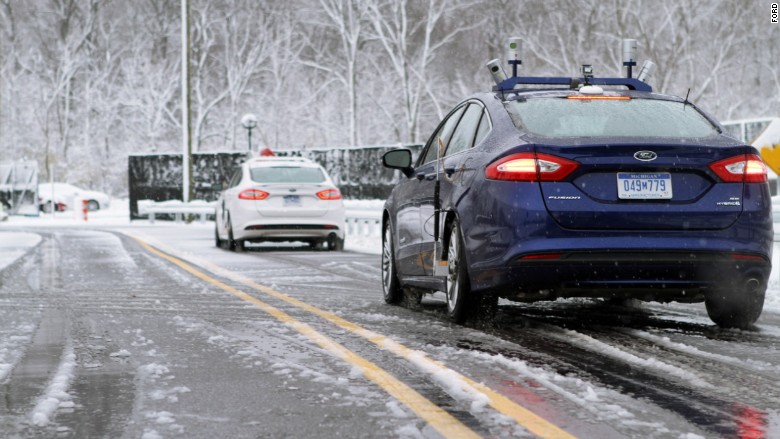
Ford's self-driving cars use 3D maps to navigate snowy roads.
Unlike traditional navigation systems sold by companies like TomTom, HD maps may need to be updated as much as daily for certain regions. For example, a busy city street that goes through construction and pedestrian areas might need more frequent data than a long, uninterrupted freeway.
Ristevski says that opens up the possibility of a subscription model that could one day bring in "billions" for mapping companies.
The race to build up this next generation of maps is only getting more crowded. Google, Uber, Ford (F) and others are each working to collect data for HD maps with sensors in their autonomous cars.
At Waymo, Google's self-driving car division, staffers parse out the data collected to identify objects like driveways and fire hydrants. The cars then "automatically send reports back to our mapping team whenever they detect changes" like construction, according to the company.
But this approach is difficult even for companies with a strong bench of technical talent.
"If you thought creating regular maps for Google was hard, creating self-driving maps is much, much harder," says Brian McClendon, Uber's former VP of maps who previously worked on Google Maps. "The amount of data involved is huge. The precision required is very hard as well."
A number of automakers, including General Motors (GM) and Volkswagen (VLKAF), have opted to lean more on third-party services to get their maps off the ground.
Mobileye, a self-driving car firm recently acquired by Intel for $15 billion, inked agreements in April with Volkswagen, BMW and Nissan (NSANF) for a mapping product. The goal is to pool together mapping data from car manufacturers "to generate as much scale as possible," says Dan Galves, Mobileye's chief communications officer.
"You can spend the money, hire the people -- assuming you can hire the right guys -- but that will take years. That happens too late for this race," says James Wu, a veteran of the mapping teams at Google and Apple (AAPL, Tech30).
His startup, DeepMap, announced $32 million in funding last month that will provide a "full-stack mapping service" to companies. Other mapping startups like Civil Maps, backed by Ford, and Mapbox are also working with automakers.
Carmera, another startup, came out of stealth mode this week with $6.4 million in funding and plans to crowdsource "real-time" data for maps. That includes offering "pedestrian analytics" and a "real-time event feed" for construction and road closures.
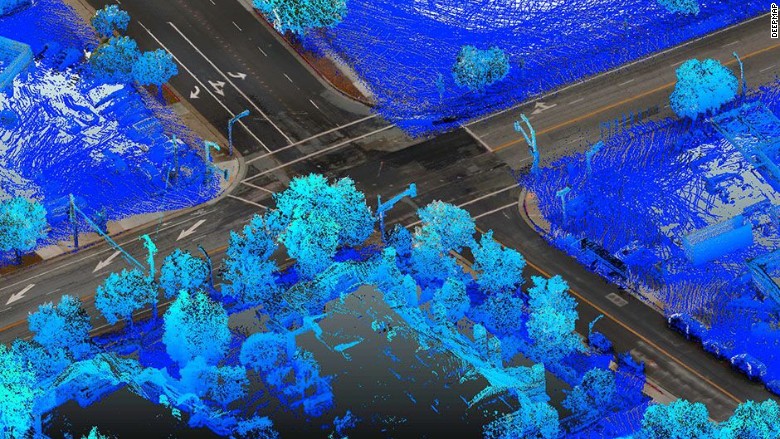
A sample map for a self-driving car from DeepMap
Google remains the obvious frontrunner. The company has deep pockets and a longer history investing in self-driving cars and mapping products like Street View and Google Earth.
Lars Rasmussen, co-creator of Google Maps, remembers Google founders Larry Page and Sergey Brin telling his team years ago that they'd "have to spend billions of dollars" on maps "and it's worth it."
"I think one of the reasons that [maps] excited Larry was that he had this idea of self-driving cars," says Rasmussen, who left Google for Facebook in 2010.
Google may have won the first online mapping battle (sorry Apple), but the HD maps market is still in its early days. The winner -- or winners -- is far from the finish line.
If you believe self-driving cars will eventually operate everywhere, then every city and street will need to be mapped out in granular detail. To put that in context, Uber's self-driving car team is currently mapping just one city, according to its website: Toronto.
"It's a green field," says Sravan Puttagunta, founder and CEO of CivilMaps. "No company has established a majority market share, and even the ones that have a couple cities are spending billions maintaining those maps."
As the race heats up, there is a lingering question in the industry about how useful these costly maps will be down the road. Some argue the cars will eventually get smart enough, with deep learning technology, not to need to rely on extensive maps.
"In the short term, I can see where it's vital, but that long term may not even be 10 years," says Rebecca Lindland, executive analyst with Kelley Blue Book. The "conundrum," she says, is just as comprehensive maps hit the market, car companies "don't need them anymore."
The team at Ford is "looking at the possibility" of developing algorithms for the car that don't require a prior map, according to McBride. But he's skeptical of ditching maps entirely.
"You'd still save the data that you took the first time you drove there," McBride says, "and use it for the second, third and tenth time to make it better."