Tiffany & Co Earnings Preview
Tiffany & Co (TIF) is set to report Q3 results before the market opens tomorrow with a conference call to follow at 8:30 AM ET. Last quarter, results were released at 6:40 ET. The current Capital IQ consensus stands at EPS of $0.76 (vs. $0.76 last year) on revs +1% Y/Y to $957.2 mln.
- Capital IQ Consensus estimates FY 17 diluted EPS of $3.99 (vs $3.74 in 2016) on revs +2% to $4.09 bln
- Capital IQ Consensus estimates Q4 diluted EPS of $1.55 (vs $1.45 last year) on revs +3% Y/Y to $1.266 bln
FY 18 Guidance
- Reaffirmed guidance for diluted EPS up mid-single-digit % Y/Y (2016 EPS was $3.75) to ~$3.94; implies EPS of $3.60-3.67
- Assumptions for co to hit the EPS guidance
- Worldwide net sales increasing lsd ($4.001 bln last year
- Worldwide gross retail square footage increasing 2%, net through 10 openings, 7 relocations and 7 closings
- Operating margin in-line w/ prior year due to an expected increase in gross margin offset by SG&A expense growth higher than sales growth
- Mgmt. also expects (i) net cash provided by operating activities of ~$700 million and (ii) free cash flow of ~$450 million.
- Worldwide net sales increasing lsd ($4.001 bln last year
Q2 Recap
- Reported Q2 (Jul) earnings of $0.92 per share, $0.06 better than the Capital IQ Consensus of $0.86; revenues rose 3.0% year/year to $960 mln vs the $930.19 mln Capital IQ Consensus.
- Comparable store sales declined 2%.
- Management noted an increase in wholesale sales of diamonds, increased wholesale sales in the Asia-Pacific region and strong e-commerce sales growth. Overall, growth in fashion and designer jewelry sales contrasted with softness in other jewelry categories.
- On a constant-exchange-rate basis that excludes the effect of translating foreign-currency-denominated sales into U.S. dollars, worldwide net sales rose 4% and comparable store sales declined 1% due to the factors noted above.
- In the Americas, total sales rose 1% to $439 million in the quarter and declined 1% to $830 million in the first half; comparable store sales declined 1% and 2%, respectively. In the Asia-Pacific region, total sales of $235 million in the quarter and $492 million in the first half were 2% and 5%, respectively, above the prior year; comparable store sales declined 7% and 5%. Gross margins (gross profit as a percentage of net sales) of 62.3% in the second quarter and 62.2% in the first half were higher than 61.9% and 61.6%, respectively, in the prior year.
Trading View: Shares have been trading slowly in its current 85/95 range since February and could be worth monitoring as a swing/bounce play on any sell-off to the 84/85 level. On the contrary, any strong break above its 97.29 resistance could lead to a run back above 100.
BBVA closes deal to sell property assets to Cerberus in EUR 5bn - EUR 6bn deal – report (translated)
28 NOV 2017
Banco Bilbao Vizcaya Argentaria [BME:BBVA] (BBVA) has closed a deal with US fund Cerberus to sell a majority of its property assets for EUR 5bn - EUR 6bn, Vozpopuli reported, citing financial sources. BBVA will receive EUR 3.5bn - EUR 4bn for a majority stake in a new entity to be controlled by Cerberus, the online Spanish-language report said.
Financial sources valued the property assets for sale, comprising about 70,000 properties with discounts close to 60%, at EUR 13bn - EUR 14bn.
The parties declined to comment, Vozpopuli said.
It was previously reported that, as of September, BBVA’s real estate assets in Spain had a gross valuation of EUR 17.774bn and were covered at 56%. Since the end of 2016, BBVA has reduced its real estate assets by 23.3%.
Batteries Are Taking Over the World
The battery industry is surging. But picking investment winners will be exceedingly hard
“The storage battery is, in my opinion, a catchpenny, a sensation, a mechanism for swindling the public by stock companies,” wrote Thomas Edison in 1883.
Today, the battery industry is mustering for exponential growth as car makers electrify their fleets, most visibly at Telsa’s $5 billion factory in Nevada. For investors looking to gain from the battery’s rise, though, the doubts of the 19th century entrepreneur linger. The path to profitability is far from clear, and technological breakthroughs could upset the current competitive order.
Your mobile phone contains a lithium-ion battery—a technology first commercialized for a Sony camcorder in 1991—and so does every battery-electric or hybrid car. The difference is that cars require vastly more powerful batteries. The industry will need to increase production from 68 gigawatt-hours of lithium-ion cells last year to 1,165 GWh over the next decade, estimates brokerage Berenberg.
A handful of big East Asian companies have rushed into this supply gap. For all the “gigafactory” hype, Tesla doesn’t make batteries: Cell production is the responsibility of its Japanese partner Panasonic. The other leaders in the field are LG Chem and Samsung SDI , both listed subsidiaries of the namesake Korean conglomerates, which supply the electric-vehicle projects of Nissan, General Motors and BMW , among others.

Tesla CEO Elon Musk unveils the Roadster 2 on Nov. 16. Photo: handout/Reuters
Hot on the Koreans’ heels are two Chinese companies determined to supply the ballooning Chinese electric-vehicle market: BYD, 25% owned by Berkshire Hathaway and also an electric-car maker, and CATL, which is planning a $2 billion initial public offering in Shenzhen in the coming months. These five companies and a few newcomers—among whom car makers are conspicuously absent—currently intend to build 24 factories with a total capacity of 332 GWh by 2021, calculates Simon Moores, managing director of consultancy Benchmark Mineral Intelligence.
Investors looking to benefit from this gold rush need to take a very long-term view. The capital requirements are vast, and the contracts being signed are at wafer-thin margins. Sam Jaffe, managing director of battery researcher Cairn ERA, says the companies are taking “the traditional Asian conglomerate approach” of prioritizing market share over profits.
Negotiating with car makers will also be tough. Outside China, the automotive industry is highly consolidated, making competition for contracts fierce. And manufacturers are under intense pressure from environmental regulators to sell electric cars even though their cost is uncompetitive. The only solution for car makers will be to pile pressure on battery prices. Big new factories will enable suppliers to cut unit costs, but profits could get lost in the squeeze.
Investors may be better off looking further up the supply chain. The most valuable component of a battery is its cathode, from which lithium ions scuttle back and forth in the charging and discharging process. The chemistry is sophisticated and fast-evolving, which should offer cathode makers some protection from cost pressures. Japan’s Sumitomo Metal Mining Co. supplies Panasonic for Tesla, while Belgium’s Umicore and a few others cover the rest of the market.
The risk for these companies is that a radically new technology makes existing investments obsolete. John Goodenough, a now 95-year-old professor at the University of Texas considered a founding father of the lithium-ion battery, this year claimed a breakthrough with “solid-state” cells, which sideline various problems by replacing a flammable liquid electrolyte with a hard layer. Toyota expects to sell cars with solid-state batteries by the early 2020s; British engineering firm Dyson has penciled in a 2020 launch date for a solid-state car.
The battery industry is poised to grow very fast, but the growth will be capital intensive and may be technologically volatile. Batteries may no longer be a trick for swindling amateur stock pickers, but that doesn’t mean they will provide an easy way to make money.
Airbus, Rolls-Royce and Siemens to develop hybrid plane
Collaboration aims to have a part-electric test aircraft in the air by 2020
Airbus, Rolls-Royce and Siemens have announced plans to collaborate on a hybrid test aircraft that will fly by 2020.
The companies have formed a partnership to build a technology demonstrator with an electric motor that will help during take-off and the climb to cruising altitude. They aim to have a commercially viable hybrid regional passenger jet flying by the 2030s.
A growing number of companies are exploring the potential of hybrid power in aviation. Boeing last month acquired Aurora Flight Sciences, a cutting edge US aviation research company. Boeing has also taken a stake in Washington-based aerospace start-up Zunum as it steps up its pursuit of autonomous and electrically powered flight. Zunum aims to have a 10-12 seater all electrically powered aircraft flying by 2022 and to eventually scale up to 50-100 seaters by 2030.
Roland Berger, the management consultancy, estimates that 70 electrical propulsion aircraft programmes have been launched globally, about half by start-ups.
The partnership announced on Tuesday will focus on developing an aircraft capable of carrying 50-100 passengers. The tests will be carried out on a BAe146 regional aircraft and one of the four turbines will be replaced by a two megawatt electric motor.
“This is the first concrete step to prove what is possible,” said Mark Cousin, Airbus head of group demonstrators. He estimated that the fuel savings of hybrid propulsion would be “into the double digits”.
While hybrid-electric cars are becoming increasingly commonplace on roads, adoption of the technology in aviation has been held back by the weight and power density of batteries.
Frank Anton, Siemens vice-president of eAircraft, said this hurdle could be cleared in a relatively short time as battery technology is developing exponentially in response to demand from the auto sector.
“We will have to get 10 times more power out of the same weight,” he said. “This is our homework. But we believe we can get there.”
The pressure is on aviation to deliver cleaner propulsion. The industry accounts for 2 per cent of global man-made carbon dioxide emissions, but this is expected to triple by 2050 as demand for air travel accelerates. The number of passengers is forecast to double in the next 20 years alone.
Electrically powered aircraft would help reduce the noise and emissions pollution from this growth.
The partners are hoping to win UK funding for the project, although they refused to quantify the cost.
Airbus, Siemens and Rolls-Royce are initially targeting the regional travel market for their hybrid aircraft.
Paul Stein, chief technology officer of Rolls-Royce, said quieter and cleaner hybrid-electric power would allow airports to be sited more closely to urban areas. “It has the potential to move transport from rail to air, and gives the opportunity to connect any city pairs,” he said.
Mapping company Here buys ATS to boost its over-the-air tech
Here, the mapping company that powers location services in 100 million cars, is today announcing an acquisition to vastly improve how it distributes and updates its data. The company is buying Advanced Telematic Systems (ATS), a Berlin-based developer of secure over-the-air (OTA) technology, the basis for how wireless devices — including not just cars but smartphones and other hardware — get their systems updated securely — and also, these days, help feed back information to improve how those systems operate.
Here has “only had a limited capability in [OTA technolgy] until now,” a spokesperson tells TechCrunch. “The ATS acquisition will make us a major player in this area.”
Financial terms of the deal — which is expected to complete in the first quarter of 2018 — are not being disclosed.
Founded in 2014 by Armin Schmidt, Dirk Pöschl and Arthur Taylor, ATS had earlier raised over $12 million, Here tells me, from consortium of Japanese, US and Taiwanese VCs. Pitchbook notes they include iD Ventures America (formerly known as Acer Technology Ventures), Japan’s IT-Farm Corporation, and the Taiwanese ODM maker Wistron, formerly the manufacturing arm of Acer before getting spun out.
“This is an exciting opportunity for ATS as we will be able to combine HERE’s deep customer relationships with OEMs and our global client and partner network to deliver new commercial solutions and enhance the existing functionality of HERE products and services,” said Schmidt, ATS’s CEO. “We now look forward to joining a business with an inspirational vision to shape the autonomous world.”
(This is Schmidt’s and Taylor’s second exit; they had previously co-founded Aupeo, a music streaming service that was acquired by Panasonic.)
The significance of this deal is that it is about Here getting with the times and continuing to modernise itself.
Once part of Nokia but spun out in a €2.5 billion deal, Here is now owned by a consortium that includes the carmakers Audi, BMW and Daimler and Intel (an attempted stake purchase by GIC, Tencent and NavInfo was blocked by CFIUS in the U.S.). Today, Here claims that its 100 million installs makes it the world’s largest provider of mapping data to the automotive industry.
Its legacy is an old one: Here originally was formed in part through Nokia’s acquisition of Navteq in 2007, which itself had been around since 1985. That age in part underscores the need for the company to invest in, and acquire, more modern technology.
In the case of OTA, ATS’s solution is built around open source OTA technology. Notably, in June it integrated with Uptane, a security framework backed by the U.S. Department of Homeland Security designed specifically for software that runs on autonomous and connected cars — the idea being that vehicles could be especially deadly if they are maliciously hacked, and the aim here is to try to prevent that from happening.
OTA technology has been around for years as a way for mobile carriers to update settings on phones that are on their network, but it’s taken a more proactive turn in more recent times.
Not only are the systems in cars far more complex — covering not just HD maps but real-time pictures of road environments, entertainment services and information, navigation and more — but software engineers are now using the network of devices not so much as dumb endpoints, but as new data gathering tools to continue to feed back information to the central system to improve how it works overall.
This is especially important in the world of mapping, where road conditions and sometimes the roads themselves, are changing constantly, meaning satellite imaging — the basis for a lot of legacy and modern maps — cannot do the full job.
“Data and software delivery is a defining factor for future success within the automotive industry as vehicles are becoming more connected and autonomous,” said Ralf Herrtwich, SVP Automotive of HERE, in a statement. “The acquisition of ATS is a hugely important strategic investment for us to complement our portfolio as a premium automotive cloud provider. I’m excited to welcome Armin and his team into the HERE family.”
Pharma’s broken business model: An industry on the brink of terminal decline





Biotech readers. Commentator Kelvin Stott regularly blogs about the ROI in pharma. You can read more from him News is a contributed article from select Endpoints Voiceshere.
Like many industries, pharma’s business model fundamentally depends on productive innovation to create value by delivering greater customer benefits. Further, sustainable growth and value creation depend on steady R&D productivity with a positive ROI in order to drive future revenues that can be reinvested back into R&D. In recent years, however, it has become clear that pharma has a serious problem with declining R&D productivity.
Various analysts (notably Deloitte and BCG) have tried to measure Big Pharma’s R&D productivity in terms of the internal rate of return (IRR) on investment, but in each case the analysis is highly complex and convoluted (and thus subject to doubt), as it depends on many detailed assumptions and forward-looking forecasts at the individual product level. Here for the first time, I introduce a far simpler, much more robust methodology to calculate pharma’s return on investment in R&D, which is based only on reliable and widely available high-level data on the industry’s actual historic P&L performance. This new analysis confirms the steady decline reported by others, but here I also explore the underlying drivers and make concrete projections, which suggest that the entire industry is on the brink of terminal decline.
A simple new method to measure R&D productivity / IRR
Pharma’s business model essentially involves making a series of investments into R&D and then collecting the return on these investments as profits some years later, once the resulting products have reached the market. However, the situation is complicated by the fact that both investments and returns are phased over many years for each product, and not all products make it to market; in fact, most products fail to reach market at all and they fail at different times and costs during their development.
Now we can greatly simplify this picture by considering only the average return on investment across the industry as a whole, which is what interests us in any case. We simply assume that all profits in any given year come from investments made within a single previous year, where the gap between these two years represents the average investment period, from the midpoint of R&D investment to the midpoint of returns at peak sales. As it happens, this average investment period is relatively stable and well-defined, as it is largely driven by a fixed standard patent term of 20 years, as well as a historically stable R&D phase lasting roughly 14 years from start to finish. Thus, the average investment period is about 13 years, from the midpoint of the R&D phase after 7 years, plus another 6 years to reach peak sales before loss of exclusivity.
There is one potential argument against this method, which is that the later phases of R&D tend to cost many times more than the earlier phases. However, we must also remember that we need to invest in many more projects at the earlier phases than we invest in at the later phases, due to natural attrition within the R&D pipeline. Thus, the total R&D investment is actually distributed quite evenly throughout the development timeline. And, as I show below, the calculated return is not very sensitive to this single assumption in any case.
Before we use this simple method to calculate the return on investment, there is one more small but important detail to remember: The net return on R&D investment includes not only the resulting profits (EBIT), but also the future R&D costs. This is because future R&D spending is an optional use of profits that result from previous investments.
So now we can calculate the average return on investment (IRR) as the compound annual growth in the value of past R&D investments to the value of resulting profits (EBIT) plus future R&D costs, as illustrated here with industry P&L data from EvaluatePharma:
Now we get the following simple formula to calculate the Internal Rate of Return (IRR) on pharma R&D in any given year x:
IRR(x) = [ (EBIT(x+c) + R&D(x+c)) / R&D(x) ]^(1/c) - 1
Where c is the average investment period of 13 years.
Return on investment in pharma R&D is rapidly declining
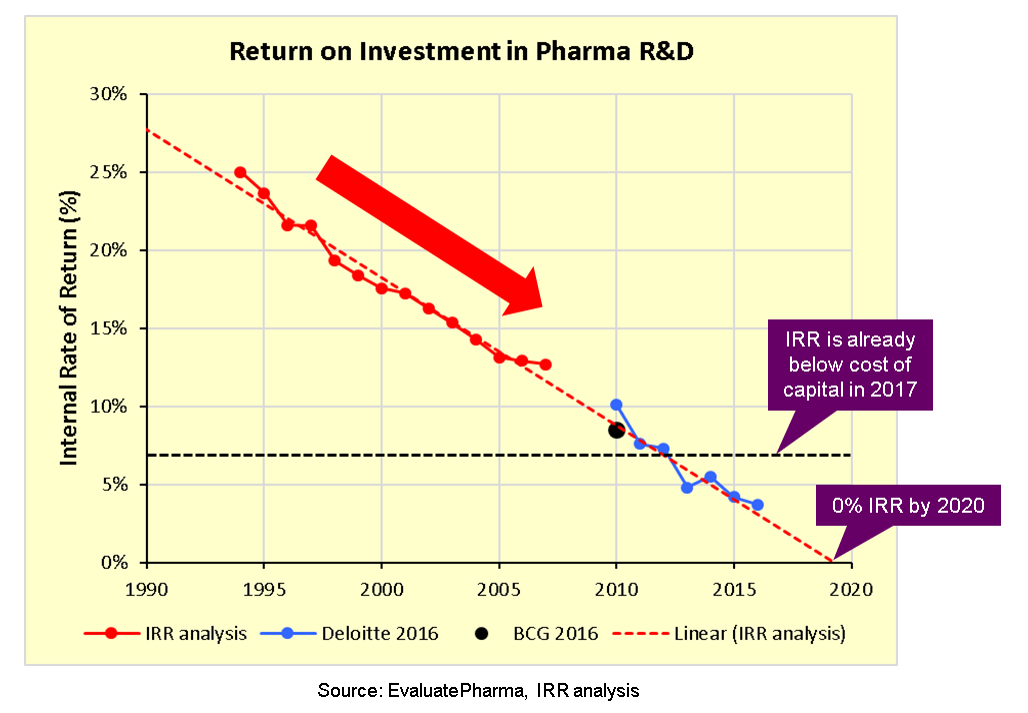
Applying this simple formula across multiple years of P&L data from EvaluatePharma, we see the following downward trend, which is fully consistent with reports published by both Deloitte and BCG:
Now the scariest thing about this analysis, is just how robust, consistent and rapid is the downward trend in return on investment over a period of over 20 years. But moreover, these results confirm that return on investment in pharma R&D is already below the cost of capital, and projected to hit zero within just 2 or 3 years. And this despite all efforts by the industry to fix R&D and reverse the trend.
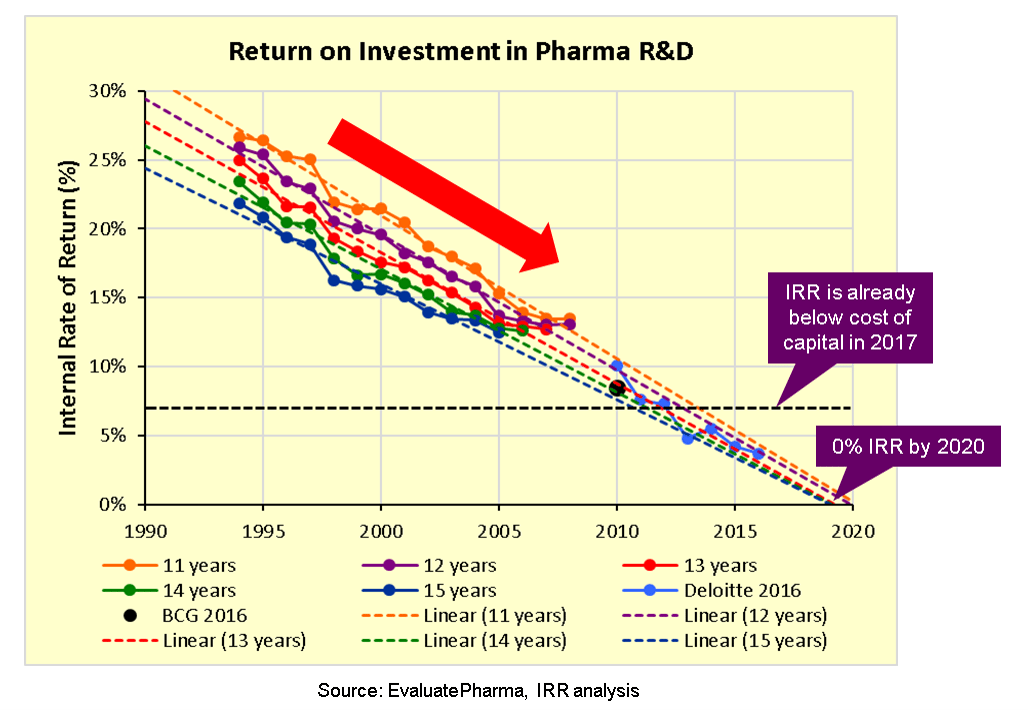
I mentioned earlier that this analysis is based on one assumption, the average investment period which is quite stable and well-defined, but here below we see that the results are not sensitive to this single assumption in any case. The downward trend is just as clear, as is the projected IRR of 0% by 2020:
So what is driving this trend, and why haven’t we been able to do anything about it?
Law of Diminishing Returns
Many different causes and drivers have been suggested to explain the steady decline in pharma R&D productivity, including rising clinical trial costs and timelines, decreasing success rates in development, a tougher regulatory environment, as well as increasing pressure from payers, providers, and increasing generic competition, however there is one fundamental issue at play that drives all these factors together: The Law of Diminishing Returns.
As each new drug improves the current standard of care, this only raises the bar for the next drug, making it more expensive, difficult and unlikely to achieve any incremental improvement, while also reducing the potential scope for improvement. Thus, the more we improve the standard of care, the more difficult and costly it becomes to improve further, so we spend more and more to get diminishing incremental benefits and added value for patients which results in diminishing return on investment, as illustrated here:
But why does the analysis above suggest a linear decline that will hit 0% IRR by 2020? Shouldn’t the decline slow down and curve away so that it never reaches 0% IRR?
No. 0% IRR corresponds to breaking even and getting exactly your original investment back, but as anyone who has worked in pharma will know all too well, you can easily lose all your original R&D investment as most drugs fail without making any return at all, so the minimum theoretical IRR is in fact negative 100%. There is no reason why the IRR should stop declining before it reaches 0%, or even -100%, besides the limited patience of investors.
To further illustrate how the Law of Diminishing Returns applies to pharma R&D, let us consider a limited set of 200 potential drug development opportunities defined by a random exponential distribution of expected costs (investments) yielding an independent random exponential distribution of expected values (returns) after an average investment period of 13 years. The expected IRR of each opportunity is given by the formula:
IRR = [ eReturn / eCost ] ^(1/13) - 1
Now we rank and prioritize all these potential opportunities by their expected IRR over time, just as we select and prioritize drug development projects by their expected return on investment in the pharma industry, and this is what we get:
Notice how the midsection of the IRR plot of prioritized opportunities follows a perfectly linear downward trend that passes right through 0% IRR, which is exactlywhat we have seen with our analysis of pharma R&D productivity above! The implications of this are rather striking:
Return on investment in Pharma R&D is declining because that is precisely how we prioritize investment opportunities over time.
In essence, drug discovery is rather like drilling for oil, where we progressively prioritize and exploit the biggest, best, cheapest and easiest opportunities with the highest expected returns first, leaving less attractive opportunities with lower returns for later. Eventually, we are left spending more value than we are possibly able to extract:
Implications and projections for the pharma industry
Now given that the steady decline in return on investment in pharma R&D follows the Law of Diminishing Returns as the natural and unavoidable consequence of how we prioritize R&D investment opportunities, where does that leave the industry?
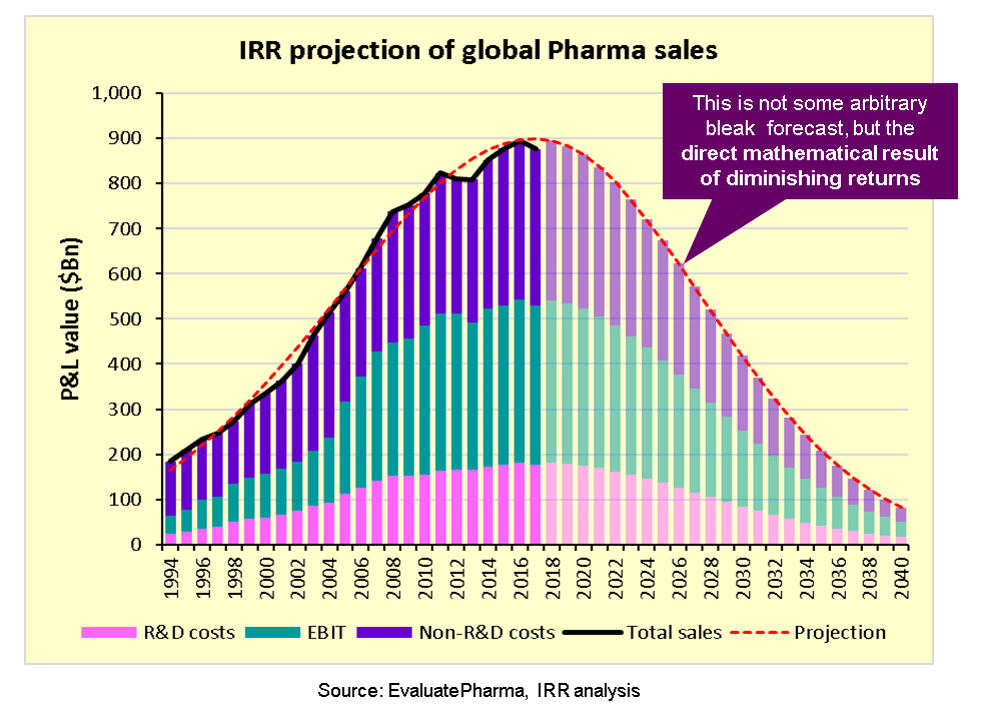
We can simply extrapolate the robust linear downward trend in IRR, and then apply the same formula we used above to calculate IRR based on past performance in reverse, to predict how the industry will evolve in the future. This is what we get:
Wow! What we see is that the entire pharma industry is on the brink of terminal decline, and will already start to contract within the next 2 or 3 years!
This seems incredible, but remember that this is not some arbitrary bleak forecast. It is the direct mathematical result of the Law of Diminishing Returns which we have already seen in our analysis above, and which we have been able to exactly replicate by prioritizing a limited set of random investment opportunities.
So what is going on here? Can this really happen?
Pharma’s broken business model
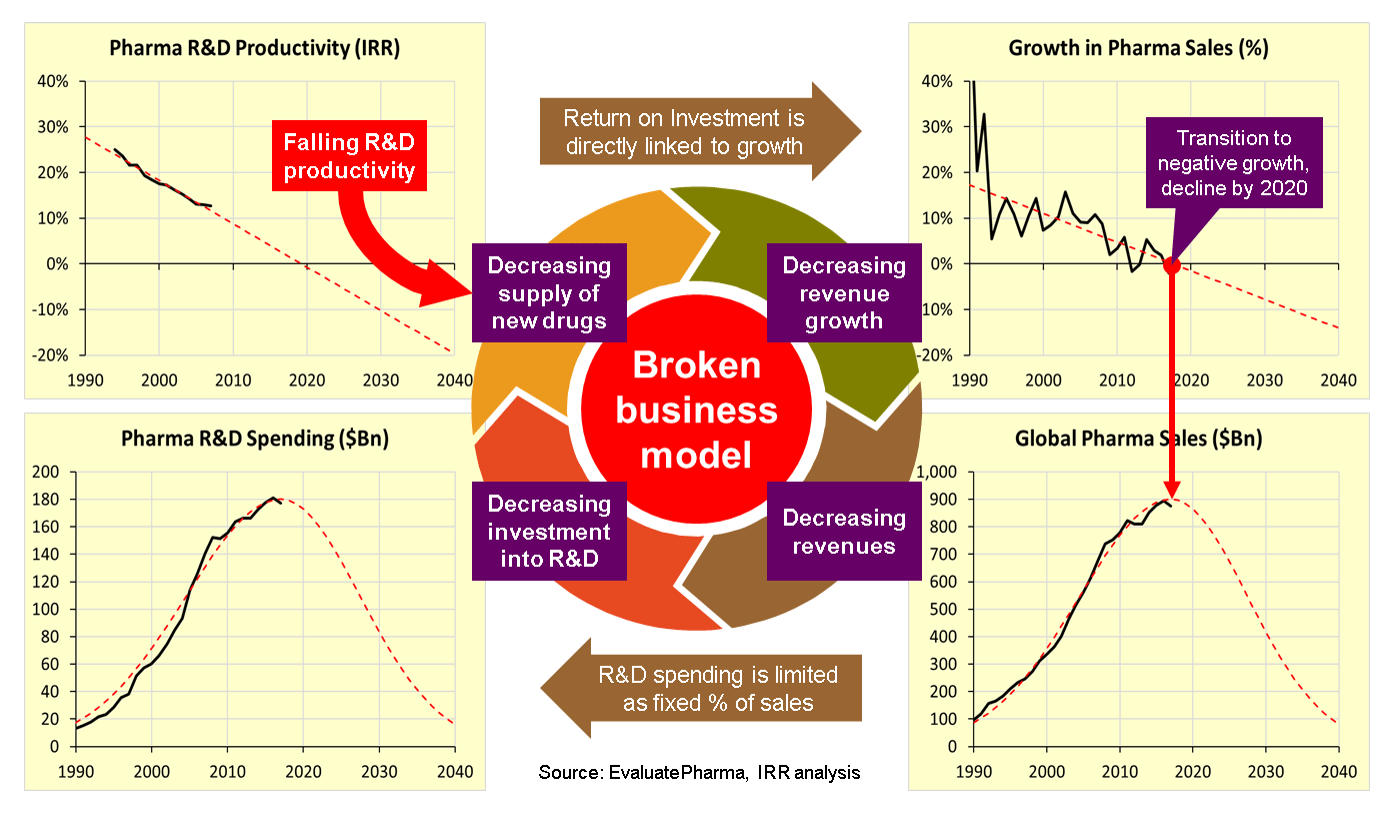
The situation is illustrated nicely by this schematic here below:
What we have here is an industry that is entering a vicious cycle of negative growth and terminal decline as its fundamental business model has run out of steam by the Law of Diminishing Returns: Diminishing R&D productivity and return on investment leads to diminishing growth in sales. Eventually, growth turns negative and sales start to contract. Reduced sales then reduces the amount of money available to invest back into R&D, which causes sales growth to decline even further. And so on, until the industry is gone altogether.
This principle is further illustrated here, showing how value creation is turning negative:
Industry life cycles and regeneration
So can this happen? Will pharma really shrink out of existence, and is there anything we can do to stop it?
In short, yes, it can and will happen. Pharma as we know it will shrink out of existence, and no, there is nothing we can do to stop it. We know this because the steady decline in IRR is an unavoidable consequence of prioritization, and has continued despite all our efforts to slow, stop and reverse the decline to date.
We should not be surprised by this. All industries and business models follow the Law of Diminishing Returns, and many industries have come and gone through history. In fact, the Pharma industry itself sprouted out from the terminal decline of the chemicals and dye industry as it was slowly commoditized. Out of the ashes grows the new.
And therein lies the only real hope for the pharma industry — or at least the companies and hundreds of thousands of people working within it.
Just as the pharma industry evolved from the chemicals industry, and the biopharma industry has evolved from the pharma industry, the pharma and biopharma industries together will evolve into something quite different, most likely continuing the historic trend of increasing complexity towards more complex biological solutions to pressing healthcare problems, such as cell & gene therapy, tissue engineering and regenerative medicine:
But who really knows?
What is clear is that pharma (and biopharma) will not be around forever, and Darwin’s theory of evolution applies to companies and industries just as much as it applies to the species of life:
It is not the strongest of the species that survives, nor the most intelligent, but the one most adaptable to change.
Indeed. Adapt or die!
Ikea shifts focus to city centre stores
Reorganisation to adapt to changing shopping habits hurts profits
Ikea Group is setting its sights firmly on the city centre as the appeal of its out-of-town warehouses wanes and the world’s largest furniture retailer fights to adapt to an increasingly urban and digital shopping environment.
Jesper Brodin, Ikea’s new chief executive, told the Financial Times that the retailer would try different store formats as it sought to conquer the centre of cities such as Copenhagen in Denmark, where a new outlet is due to open in 2020.
“We are eager to claim the city centre,” Mr Brodin said. “We are testing new formats. We have penetrated parts of the city centre but we are mostly outside so the opportunities are there.”
Ikea is thoroughly rethinking its business model as a result of urbanisation and digitalisation. It told the FT this year that it would start selling its goods on third-party websites — perhaps to include Amazon or Alibaba — next year.
The Netherlands-based retailer has also been experimenting with different types of stores from its traditional large warehouses based on the edge of cities. It has opened city-centre collection points as well as smaller stores in regional conurbations.
Mr Brodin said that experimentation would accelerate as he gears up to present his full plans for the company early next year. “We are basically creating structures in a way that we can test many aspects in many places. They are test laboratories to figure out the new world of Ikea,” he added.
His comments came as Ikea revealed a sharp drop in profits, which it blamed largely on a big reorganisation of the flat-pack empire that saw it sell the manufacturing and supply chain businesses to a sister company, Inter Ikea, which owns the brand and concept.
But it also hinted that it had increased its spending on new stores and ecommerce considerably, also contributing to the fall in profits.
Operating income in the year to the end of August was €3bn compared with €4.5bn a year earlier. While revenues increased only modestly from €35.7bn to €36.3bn, the cost of sales rose more rapidly from €20.3bn to €23.7bn. That pushed the gross margin — a key gauge of a retailer’s profitability — down almost 9 percentage points to 34.6 per cent.
Ikea declined to give comparable figures for the previous year stripping out the effects of the sale of manufacturing and supply chain units. Mr Brodin said the company had hit its new profit targets after adjusting for the new size of Ikea.
The challenge for Ikea was underscored by figures that showed the annual number of visits to its website had stagnated at 2.1bn, the same as in the previous year. By contrast, the number of visits to its 355 stores rose 4 per cent to 817m.
Gapping down
In reaction to disappointing earnings/guidance:
In reaction to disappointing earnings/guidance:
- MOMO -7.8%, UNH -1.2%
M&A news:
- ROK -1.9% (Emerson withdraws its proposal to acquire ROK for $225/share due to the Boards continued unwillingness to engage in discussions about a potential combination)
Other news:
- DPW -17.8% (after 160%+ move higher on Monday)
- ASC -9.7% (Ardmore Shipping announces GA Holdings intends to offer for sale in public offering 5,579,978 shares of common stock)
- DCIX -9.1% (pulling back after closing near highs - up 33% on the day)
- PETX -6.1% (provides series of updates for Galliprant, Nocita, & Entyce; commences $35 mln common stock offering)
- GTN -3.7% (commenced an underwritten public offering of 15 million shares of its common stock)
- ISIG -3.4% (files for approx 2.3 mln share common stock offering by holders)
- SGH -2% (filed for 3,261,102 ordinary share offering by selling shareholders)
- VNTR -1.3% (Venator Materials files for 18 mln ordinary share offering by selling shareholder Huntsman Corporation)
- IQV -1% (IQVIA launches 10 mln share secondary offering by certain stockholders, including affiliates of TPG Global, CPP Investment Board Private Holdings, funds associated with Bain Capital and Leonard Green)
Analyst comments:
- EC -0.8% (downgraded to Underperform from Mkt Perform at Raymond James)