Polytetrafluoroethylene (PTFE) is a synthetic fluoropolymer of tetrafluoroethylene that has numerous applications. The best known brand name of PTFE-based formulas is Teflon by Chemours. Chemours is a 2015 spin-off of DuPont Co., which discovered the compound in 1938.
CC jumping
Swiss Paradox: Booming Economy, Negative Interest Rates
Unlike the Fed, the Swiss central bank isn’t increasing rates despite strong growth; Norway raises rates for first time in seven years
At a time when most rich countries are following the U.S. Federal Reserve in moving away from crisis-era policies, Switzerland stands apart.
Its central bank on Thursday left its key policy rate at minus 0.75% despite what a government report has called a “booming” economy. In the U.S., where the economy has exhibited similar strong growth and low joblessness—albeit with higher inflation than in Switzerland—the Federal Reserve has already raised interest rates seven times since late 2015 and is expected to deliver an eighth next week.
In Norway, which like Switzerland isn’t part of the euro but depends on the eurozone for exports, the central bank raised its policy rate for the first time in seven years Thursday, to 0.75% from 0.5%. It said it would adopt a “cautious approach” to future moves, and expects its key rate to reach 2% by the end of 2021, which is close to where the Fed’s key rate is now.
Analysts expect Sweden’s central bank, another non-euro member in Europe—to raise rates in December. The European Central Bank is expected to end bond purchases under its quantitative easing program at the end of 2018, and has put rate increases on the table starting in about one year.
None of the Europeans are in a rush, but they seem less cautious than the Swiss.
The SNB’s inaction in the face of a sub-3% unemployment rate and 3.4% annual economic growth in the second quarter underscores the jagged process central banks around the world have undertaken to wean their economies off emergency measures taken during the global financial crisis and Europe’s debt crisis.
It isn’t just the wealthiest economies that face conflicting signals. On Thursday, the South African Reserve Bank kept its repo rate at 6.5%, highlighting a dilemma confronted by other developing countries such as Turkey. Their economies are slowing, but national currencies hit by global trade tensions and the Fed’s rate rises are forcing them to keep monetary policy tight. The SARB lowered its growth forecast for this year to 0.7%, and said the outcome could be weaker if global conditions sour.
“Medium-term risks are tilted to the downside due to elevated uncertainty arising from escalating trade tensions and tightening global financial conditions,” Governor Lesetja Kganyago said in a news conference.
In contrast, the SNB said Swiss gross domestic product should grow between 2.5% and 3% this year. However, it reduced its inflation forecast for 2020 to 1.2% from 1.6%.
The SNB’s past caution on the economy “did not prepare us for this bumper growth we’ve seen,” said Karsten Junius, chief economist at Bank J. Safra Sarasin. “They don’t seem to be in line with reality so far.”
While decisions by the Fed and ECB tend to dominate financial markets, those by the Swiss and other smaller central banks can also reverberate through bond and currency markets. In Switzerland’s case, it is home to global companies such as Nestlé SA and Swatch Group AG that are sensitive to exchange rates. Swiss banks, which include UBS Group AG and Credit Suisse Group AG, have paid over five billion francs ($5.17 billion) to the SNB because of negative interest rates, which force financial institutions to pay in order to park certain funds with the central bank.
The policy has also led to a boom in Switzerland’s housing market, which, if it were to fizzle, would have a big effect on the economy.
“I am not suggesting they should undo negative rates now, but it’s time to start signaling what’s going to happen,” said Stefan Gerlach, chief economist at EFG Bank in Zurich.
But the SNB is limited in what it can do because it has effectively tethered itself to the euro in recent years. The Swiss franc has typically been a strong currency given Switzerland’s status as a safe haven, meaning investors flood to it in times of global stress. With the franc rising sharply at the height of Europe’s debt crisis, in 2011 the SNB imposed a floor on how weak the euro could trade against the franc. It defended that target for over three years—amassing hundreds of billions of dollars’ worth of foreign assets in the process—before abandoning it in January 2015, when it also cut the deposit rate to its current level.
Many analysts think the Swiss will wait until the ECB raises its deposit rate—currently minus 0.4%—before following suit.
“If they just do what the ECB does, they might as well have the euro,” said Mr. Gerlach.
Kavanaugh Accuser Opens Negotiations on Testimony Next Week
WASHINGTON — The woman who has accused Judge Brett M. Kavanaugh of sexual assault has told the Senate Judiciary Committee, in an apparent bid to jump-start negotiations, that she “would be prepared to testify next week,” so long as senators offer “terms that are fair and which ensure her safety,” according to an email her lawyers sent to committee staff members.
In the email, obtained by The New York Times, the lawyer for Christine Blasey Ford said that testifying Monday — the timetable Republicans have set for a hearing — “is not possible and the Committee’s insistence that it occur then is arbitrary in any event.” The lawyer reiterated that it is Dr. Blasey’s “strong preference” that “a full investigation” occur before her testimony — wording that stopped short of demanding an F.B.I. probe and suggested she is open to testifying without one.
Dr. Blasey has accused Judge Kavanaugh, President Trump’s Supreme Court nominee, of sexually assaulting her when the two were in high school at a gathering of teenagers in Montgomery County, Md. Judge Kavanaugh has categorically denied the allegation and has said he would be willing to testify.
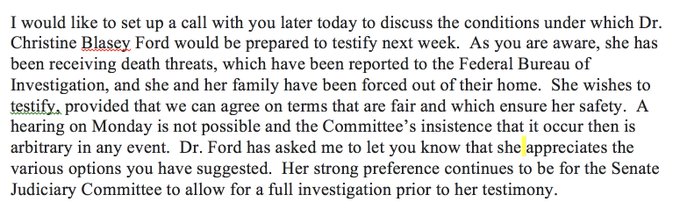
In the email, addressed to top Republican and Democratic aides on the committee, the lawyer, Debra Katz, wrote that she would like to set up a call later on Thursday to “discuss the conditions” under which Dr. Blasey would be prepared to testify.
“As you are aware, she has been receiving death threats, which have been reported to the Federal Bureau of Investigation, and she and her family have been forced out of their home,” the email said. “She wishes to testify, provided that we can agree on terms that are fair and which ensure her safety.”

Earlier on Thursday, committee Republicans had decided to hire an outside counsel to lead their questioning of Dr. Blasey, rather than the committee members themselves, according to a Republican Senate official familiar with the decision. Although they have yet to hire someone to fill the role, the Republicans have been eager to avoid the image of 11 male senators questioning Dr. Blasey about her account.
Instead, they are seeing to enlist the help of an experienced litigator familiar with assault cases.
Electronic payment companies eye banking license holders to accelerate growth - MergerMarket
Analysis
- M&A sidesteps regulatory hurdles
- Funding limits growth
Mobile banking and cryptocurrency businesses are actively exploring the possibility of buying small banks and holders of electronic money institution (EMI) licenses in an effort to avoid lengthy application processes and to widen their operations into various markets.
Greater opportunities have arisen for tech companies to displace banks as the consumer-facing front-end of choice across the payments market since the EU’s Payment Services Directive 2 (PSD2) came into force on 13 January intended to enhance competition among European payment service providers, adding a further incentive to obtain the required licenses, partner at Arma Partners Bank, John Meehan, said.
EMI licenses allow companies involving electronic money payments to operate, whereas gaining a banking license allows such platforms to operate more closely to that of a bank and permit companies to provide additional offerings such as credit services, mortgages and related products.
Operating with a banking license allows companies to gain scale and grow their customer base, with Meehan adding this consequently adds credibility.
Since the process of applying for a full bank license can be lengthy, it is often quicker and typically substantially less burdensome, to acquire a bank than to apply for a license, Partner at White & Case Guy Potel said adding that an acquirer must comply to change-in-controller requirements.
An EMI can be approved within three-to-twelve months. By contrast, a banking license can generally take up to 18 months.
In August 2017, Tandem Bank bought Harrods Bank off London’s prestigious luxury department store, Harrods, for an undetermined amount to shortcut its application process and gain regulatory status.
In February, George Basiladze, CEO of London-headquartered bitcoin wallet and prepaid card company Cryptopay told Mergermarket it was looking to acquire a “cheap bank” or an EMI as a way of gaining a license.
More fintech companies operating in the crypto-currency space are also applying for E-Money licenses to ensure part of their business operations are regulated, Tony Anderson, banking partner at Pinsent Masons said. In the UK, there is no regulation governing the issuance of crypto-currency, he said.
In June, the FCA issued “Dear CEO” letters to UK banks highlighting, in its view, the risks associated with crypto-related activities, informing banks’ on processes for on-boarding such businesses as customers, he said.
While still a substantive process, applying for an E-Money license is a far simpler process than applying to become an authourised deposit taking institution in the UK, Anderson said. Fees differ too; GBP 25,000 as opposed to GBP 5,000 for an authourised EMI, while threshold conditions, financial resources - liquidity and capital requirements - and the scrutiny of the bank’s operations including its key personnel, are all higher when operating under a banking license, Anderson said.
In the UK, any firm that wants to become a bank has to be authourised by a recently established bank start-up unit, a joint initiative from Prudential Regulatory Authority (PRA) and the Financial Conduct Authority (FCA). The unit offers such firms an alternative route to becoming authourised prior to becoming a fully operational bank. Through this route, known as Mobilisation, the PRA and the FCA limit the amount of business that can be undertaken by the firm until it is fully operational, Anderson said.
Scarcity of targets
Basiladze agreed that finding cheap banks or EMI targets priced up to EUR 6m in Europe is challenging. Consequently, Cryptopay has not managed to secure any type of acquisition.
In December 2017, Managing Partner of Singapore-based venture capital firm Life.SREDA told this news service that the VC was looking to acquire a bank in the US via its new entity, Arival. Eventually, the company concluded that buying a bank would take as much time as applying for license, COO of Arival Bank Jeremy Berger said.
Arival bank applied for International Financial Entity (IFE) in Puerto Rico, which is a US territory and falls under the US banking system, he said. “The IFE allows us to serve international clients, the option to become FDIC-insured, and share the other benefits of building a bank under the US system”, he said.
Technology start-ups globally are financially restricted, and the number of affordable targets is limited, making deals difficult to conclude. The UK landscape has far fewer registered banks compared to the likes of the US, making competition tighter and more expensive. Small US banks can cost as little as USD 2.5m (EUR 2.1m), Solodkiy said. There are between 6,000 and 9,000 small banks in the US, Berger said whereas there are 300-plus registered banks in the UK, according to Corporate Finance Institute. Moreover, in the US regulators are trying to limit the amount of new banks, which effectively means they are not issuing many new banking licenses, Berger said.
US and them
US banking licenses are also in demand as ambitious European fintech businesses look towards the US, which is one of the largest single markets for financial services companies. UK challenger bank Revolut, for example, plans to use funds from its latest USD 250m Series C injection to expand into the US.
The procedure of providing a lending or payments offering across multiple US states is equally as cumbersome as a company has to find a relevant license in each individual state as well as satisfying certain federal/national registration and compliance programme requirements, Potel said.
On the other side of the coin, some European banks have established funds designed to invest into challengers, aware of the disruption they may face. Financial services institutions have long acquired fintech providers so as not to lose pace with technology companies looking to operate in the financial services space, Potel said.
ING [EPA:INGA] launched a EUR 300m fintech fund ING Ventures in October 2017. Barclays [LON:BARC] announced the establishment ofBarclays UK Ventures in April. In February 2016 BBVA announced a USD 250m increase in its financial technology fund and a partnership with Propel Venture Partners.Santander [BME:SAN] launched its USD 100m InnoVentures in July 2014.
This is a long-term trend and we will see more of these investments in the coming years, Meehan said.
IZettle acquired by PayPal for USD 2.2bn
20 SEP 2018
PayPal Holdings, Inc. [PYPL:NASDAQ], a San Jose, CA-based company providing online payment solutions for individuals and businesses, has acquired iZettle AB, a Sweden-based provider of mobile payment solutions, for approximately USD 2.2bn.
With the close of the deal, Jacob de Geer, co-founder and CEO of iZettle, now joins PayPal and will continue to lead iZettle, reporting to Bill Ready, COO, PayPal. Magnus Nilsson, co-founder and Executive Chairman of iZettle, also joins PayPal.
With the close of the deal, Jacob de Geer, co-founder and CEO of iZettle, now joins PayPal and will continue to lead iZettle, reporting to Bill Ready, COO, PayPal. Magnus Nilsson, co-founder and Executive Chairman of iZettle, also joins PayPal.
Press release:
PayPal Holdings, Inc. [NASDAQ:PYPL] announced today that it has completed its acquisition of iZettle for approximately USD 2.2bn. This transaction builds on PayPal's strong set of products and services for small businesses and is intended to help accelerate growth and deliver a seamless commerce experience for merchants.
"We're thrilled to welcome the iZettle team to the PayPal family and are excited to expand the ways we serve our small business customers," said Bill Ready, chief operating officer, PayPal. "iZettle brings a suite of products and services that allows merchants to meet their customers where they are – online, in store or via mobile. This is another step in our journey toward democratizing commerce tools to help businesses of all sizes thrive."
With the close of the deal, Jacob de Geer, co-founder and CEO of iZettle, now joins PayPal and will continue to lead iZettle, reporting to Ready. Magnus Nilsson, co-founder and Executive Chairman of iZettle, also joins PayPal.
"Today is a very big day – for me and for everyone at iZettle," de Geer said. "We share PayPal's strong belief in the power of small businesses. Together, we will be stronger and move even faster to help small businesses succeed in a world of giants."
Prior to the closing of the acquisition, the UK Competition and Markets Authority (CMA) initiated a review of the transaction. PayPal is working cooperatively with the CMA as it conducts its review. PayPal and iZettle brands and operations will be held separate as agreed with the CMA, pending completion of the CMA's review.
"We're thrilled to welcome the iZettle team to the PayPal family and are excited to expand the ways we serve our small business customers," said Bill Ready, chief operating officer, PayPal. "iZettle brings a suite of products and services that allows merchants to meet their customers where they are – online, in store or via mobile. This is another step in our journey toward democratizing commerce tools to help businesses of all sizes thrive."
With the close of the deal, Jacob de Geer, co-founder and CEO of iZettle, now joins PayPal and will continue to lead iZettle, reporting to Ready. Magnus Nilsson, co-founder and Executive Chairman of iZettle, also joins PayPal.
"Today is a very big day – for me and for everyone at iZettle," de Geer said. "We share PayPal's strong belief in the power of small businesses. Together, we will be stronger and move even faster to help small businesses succeed in a world of giants."
Prior to the closing of the acquisition, the UK Competition and Markets Authority (CMA) initiated a review of the transaction. PayPal is working cooperatively with the CMA as it conducts its review. PayPal and iZettle brands and operations will be held separate as agreed with the CMA, pending completion of the CMA's review.
How hedge funds keep markets trading in a crunch
Data show they supply vital liquidity while most institutions sit on their hands
Hedges Funds make convenient bogeymen for politicians when a market crisis hits. Just think about how George Soros was blamed for “breaking the pound” when sterling plunged in 1992. Or how politicians in Japan and Germany have railed against them. Emerging market governments, such as Turkey’s, are now tossing blame around, too.
But if you want to get a new glimpse into what hedge funds do during currency shocks, ponder a striking piece of data mining that the JPMorgan Chase Institute published this summer.
This analysis confirms that hedge funds do indeed trade frenetically in a crisis. No surprise there. But it also suggests that their impact on currency movements is not as simple as popular discourse might suggest. And there is another finding which matters for the financial regulatory debate: hedge funds may have become more, not less, important in the overall structure of markets during the past decade. Turkey — or Argentina and South Africa — should take note.
The researchers reached this conclusion by focusing on three moments when currencies have moved sharply: the unexpected 2015 decision by the Swiss central bank to abandon its floor for the Swiss franc; the 2016 UK Brexit vote; and Donald Trump’s US election victory later that year. Then they combed through the investment bank’s database of 400m institutional investor transactions to isolate 120,000 spot and forward foreign exchange trades conducted just before and after these events.
Investors already know what happened to prices and overall trading volumes during these shocks, since there is excellent, real-time transparency around currency prices. Moreover, regulators require groups such as Reuters to release daily data on the overall trading volumes and the Bank for International Settlements offers comprehensive data on global flows, after a time lag.
But what is intriguing about the JPMorgan data is that they offer a rare glimpse into what investors were trading during the turbulence, and when. This is revealing. In normal times, JPMorgan cuts an average of $500m in trades each day with hedge funds that involve the Mexican peso and dollar, and some $2.8bn of sterling-dollar trades and $900m for the Swiss franc and euro. Trades with other banks and asset manages are similar in size.
But just after the Swiss bank, Brexit and Trump shocks, daily trading volumes by hedge funds more than tripled. Bank trading volumes also rose sharply after the Swiss and Brexit events (but not after the Trump victory).
This might imply that it was the hedge funds that pushed the currencies around. Not entirely so. Most funds did buy francs after the Swiss bank announcement. But they bought and sold sterling after Brexit, trading on opposing sides on a massive scale. So too after the Trump shock, although there were more hedge fund dollar sales.
This is striking. But what is more important is that the volume of trades cut by pension funds, insurance companies, public investment groups and corporate treasury departments did not rise at all after the shocks. These groups only started to shift risk much later, long after prices had been reset.
That inertia might reflect judicious caution (as Andy Haldane of the Bank of England has often argued, speed does not always benefit investors). Or it might stem from bureaucratic constraints (the JPMorgan data suggest these institutions only trade during the normal business day, or when local markets are open).
Either way, this pattern has important implications. Traditionally, banks were the main providers of liquidity in foreign exchange markets. But since 2008, they have reduced this role because of post-crisis regulatory reforms.
Regulators had hoped that other long-term holdings of capital would start to fill that gap, supplying badly needed liquidity that could stabilise markets when a crunch hit. But the data suggest this is not happening. Most institutions are sitting on their hands in a crisis instead.
It is impossible to know whether this pattern is true of the whole market, since no other bank has published such data. One hopes that regulators will force them to do this one day, not just for foreign exchange but for other asset classes, too.
But in the meantime, governments should take note of the findings. The antics of hedge funds may sometimes appear unseemly. But the unpalatable truth is that it is they who often keep markets trading in a crunch.