Early premarket gappersGapping up:
- TA +15.1%, CRNT +10.1%, JKS +7.8%, CHEK +7.3%, DQ +6.1%, TVPT +6.1%, CHRS +5.7%, DO +5.6%, AXL +4.4%, CYOU +4.4%, SRC +3.5%, UAA +3.4%, FOLD +3%, AU +2.9%, BHC +2.9%, BRK.B +2.9%, FSLR +2.6%, AZN +2.5%, SBGL +2.4%, CMCM +2.2%, RIO +1.9%, BBL +1.7%, TEVA +1.5%, GSK +1.5%, PEGI +1.4%, RDS.A +1.3%, HAIR +1%
Gapping down:
- SOGO -7.9%, FLKS -4%, SOHU -3%, DEA -2.8%, JONE -2.7%, RACE -2.3%, STM -2%, YUMC -2%, UUUU -2%, VIAB -1.5%, ALV -1.4%, LIN -1.3%, DB -1.1%, HSBC -0.9%, BABA -0.9%, EURN -0.8%, BSTI -0.8%, ASML -0.7%, JD -0.6%, CS -0.5%
![]()
Lowe's to wind-down certain underperforming store locations as part of its ongoing strategic reassessment.
To focus on its most profitable stores and improve the overall health of its store portfolio, the company will:
- Close 20 U.S. stores. Most associates at these stores will be extended opportunities to transition to a similar role at a nearby Lowe's store. The majority of impacted stores are located within 10 miles of another Lowe's store.
- Close 31 Canadian stores and other locations.
The expected financial impact of today's announcement of $0.28 to $0.34 per diluted share was not contemplated in the business outlook for fiscal 2018 which the company provided on Aug. 22 when it released its second quarter earnings
S&P 500 Performance Around the Past 14 Midterm Elections
History shows a weak start to the midterm season doesn’t prevent a historically bullish phenomenon from materializing.
With Q4 underway and midterm elections just days away, US stocks are entering a historically bullish three-quarter stretch, as Ken Fisher discussed in his June 3 USA Today column and this video. Since 1926, S&P 500 returns during Q4 of the midterm year—and each of the subsequent two quarters—have been positive 87% of the time, far above stocks’ non-midterm 64.6% quarterly frequency of positivity.[i] In the 23 historical nine-month periods between September 30 of a midterm year and the subsequent June 30, US stocks rose 21 times—a 91.3% frequency. But this year, markets’ rocky October—in which the S&P 500 fell -6.9%—has some wondering if midterms’ bullish impact has been preempted.[ii] In our view, there is little reason to suspect so at this point. Weakness in advance of US midterm elections is surprisingly common. The S&P 500 declined in eight midterm-year Octobers since 1926.[iii] Q4 finished negative just twice. The nine-month period? Only once—in 1930. Simply, seeing weakness at times—especially ahead of the vote—isn’t uncommon. The following are charts of the S&P 500 for every midterm year and subsequent two quarters going back to 1962. You have to go all the way back to 1958 to find an example where the market didn’t experience some sort of weakness in advance of the midterm election. In our view, this illustrates the fact weakness before the vote doesn’t negate midterms’ bullish impact.
Exhibit 1: 1962 – 1963
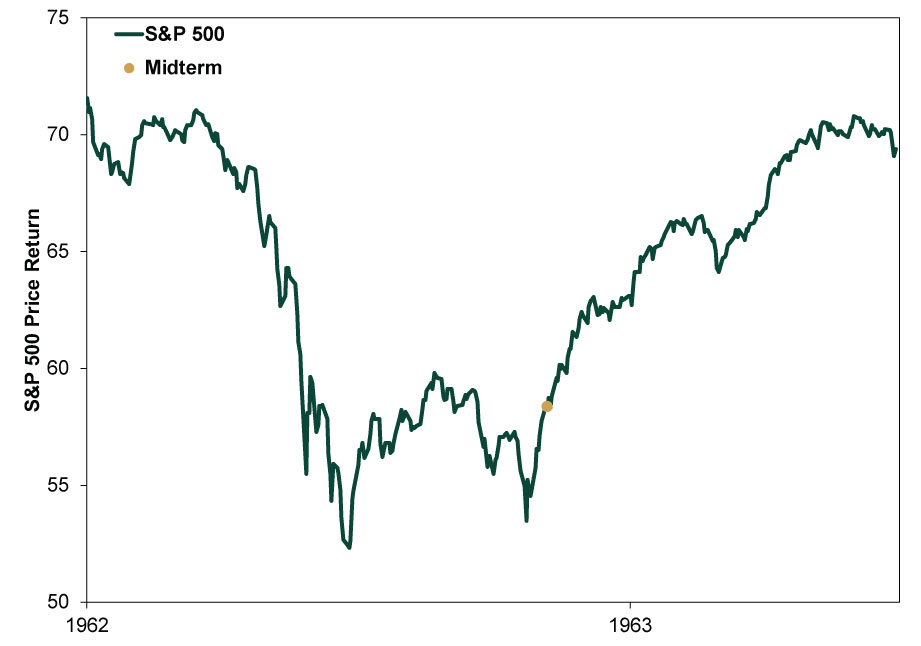
Source: FactSet, as of 10/30/2018. S&P 500 price index level, 1/1/1962 – 6/28/1963.
Exhibit 2: 1966 – 1967
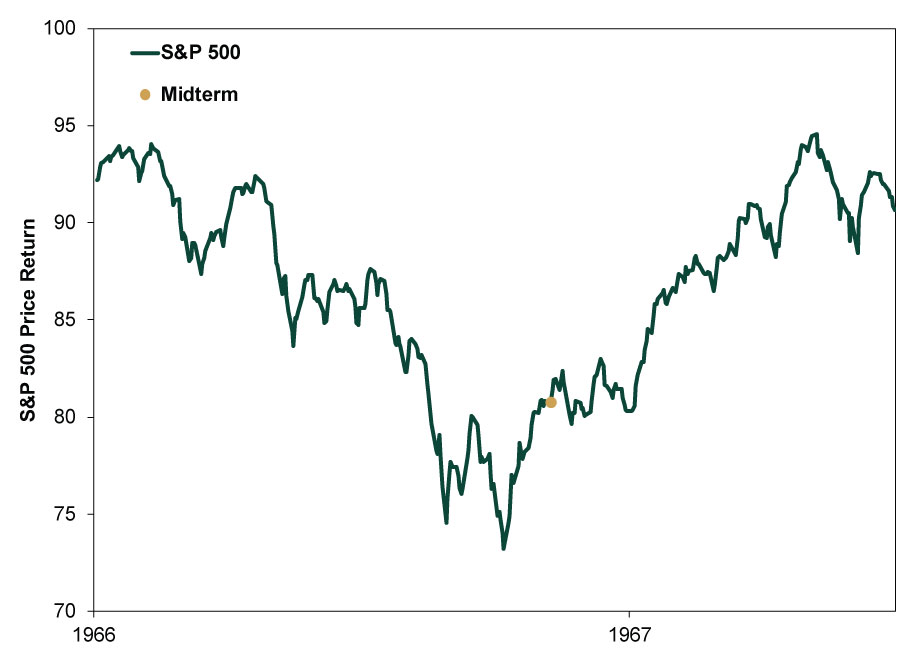
Source: FactSet, as of 10/30/2018. S&P 500 price index level, 1/3/1966 – 6/30/1967.
Exhibit 3: 1970 – 1971
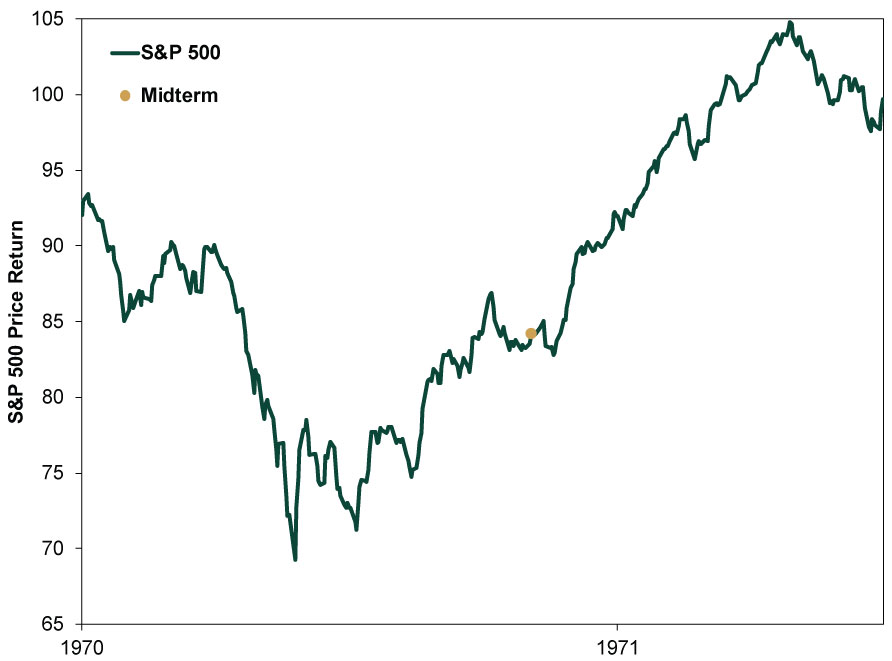
Source: FactSet, as of 10/30/2018. S&P 500 price index level, 1/1/1970 – 6/30/1971.
Exhibit 4: 1974 – 1975
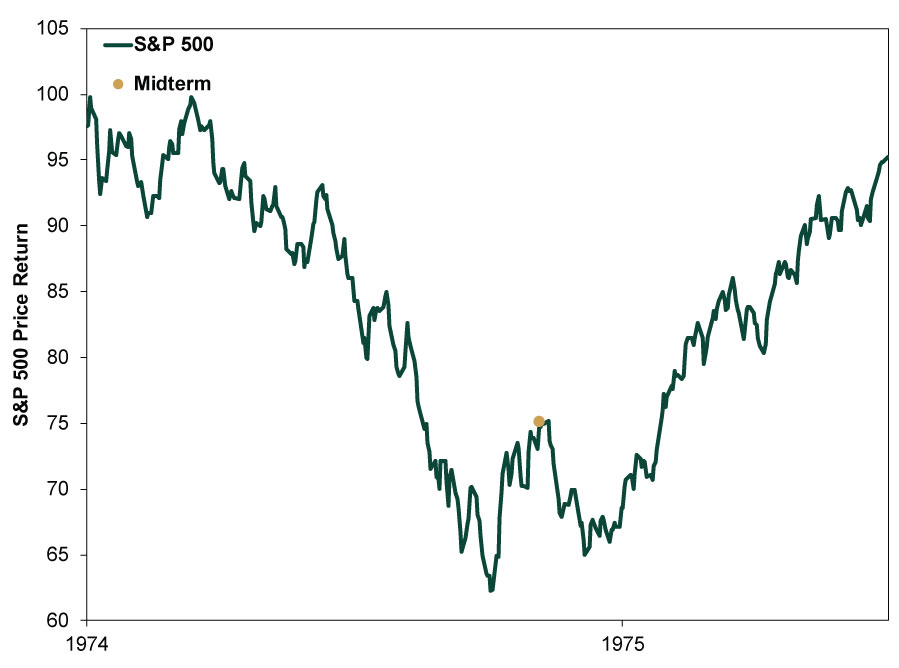
Source: FactSet, as of 10/30/2018. S&P 500 price index level, 1/1/1974 – 6/30/1975.
Exhibit 5: 1978 – 1979
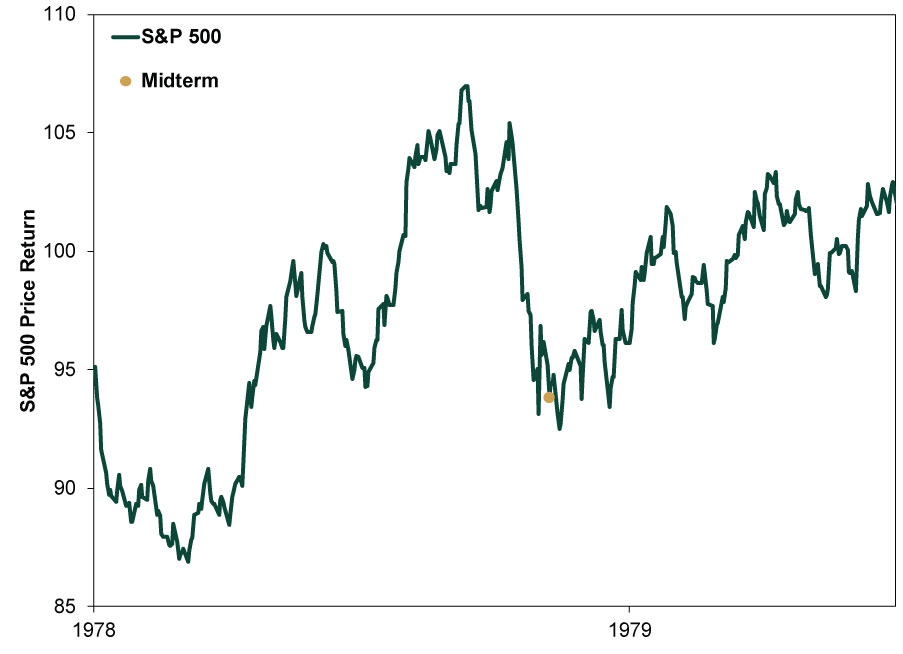
Source: FactSet, as of 10/30/2018. S&P 500 price index level, 1/2/1978 – 6/29/1979.
Exhibit 6: 1982 – 1983
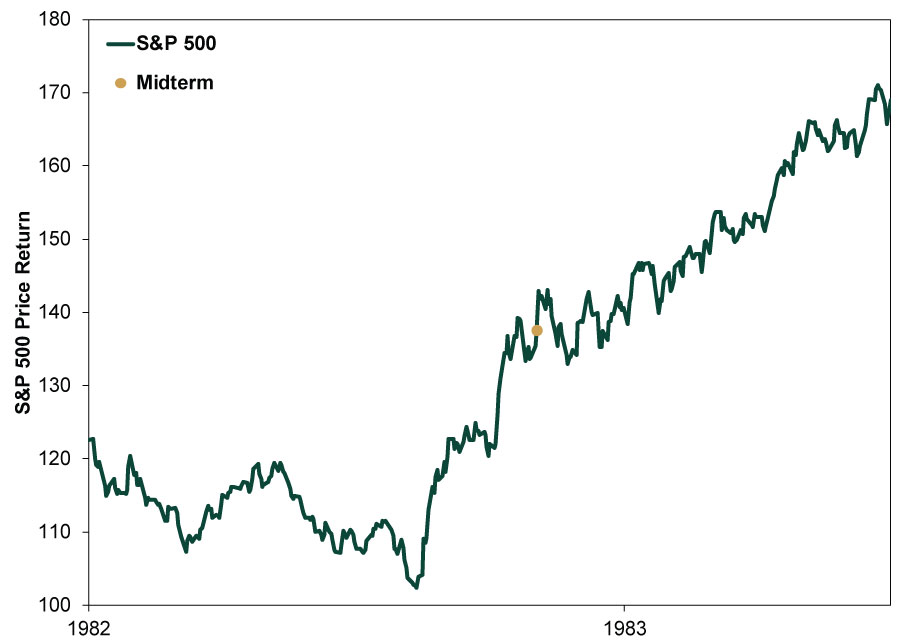
Source: FactSet, as of 10/30/2018. S&P 500 price index level, 1/1/1982 – 6/30/1983.
Exhibit 7: 1986 – 1987
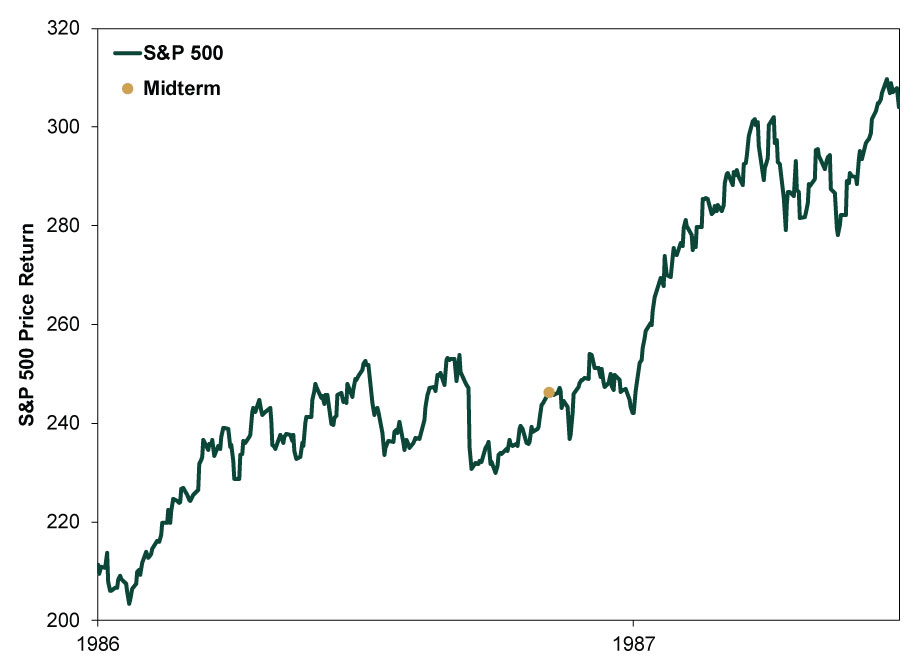
Source: FactSet, as of 10/30/2018. S&P 500 price index level, 1/1/1986 – 6/30/1987.
Exhibit 8: 1990 – 1991
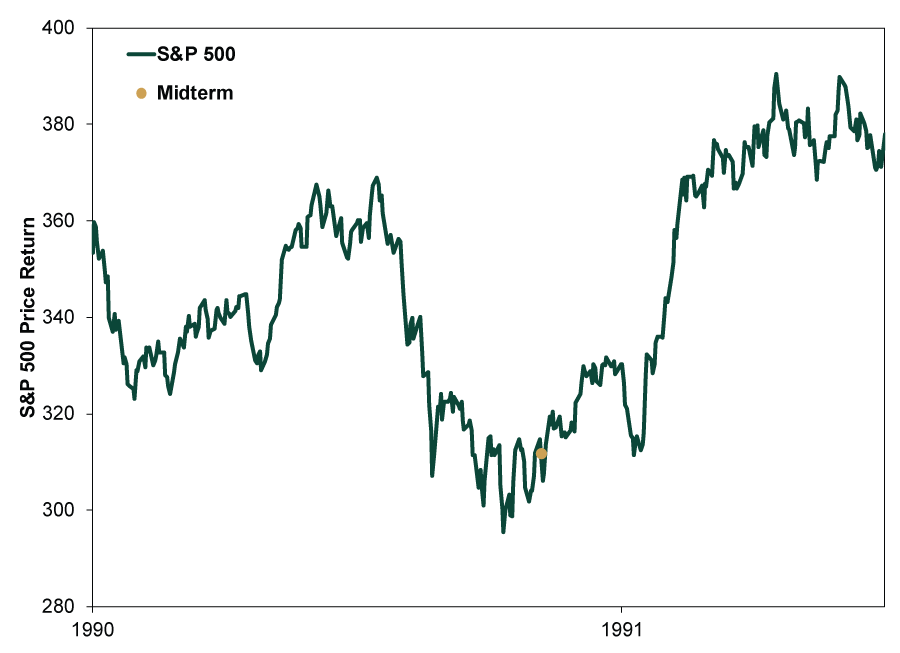
Source: FactSet, as of 10/30/2018. S&P 500 price index level, 1/1/1990 – 6/29/1991.
Exhibit 9: 1994 – 1995
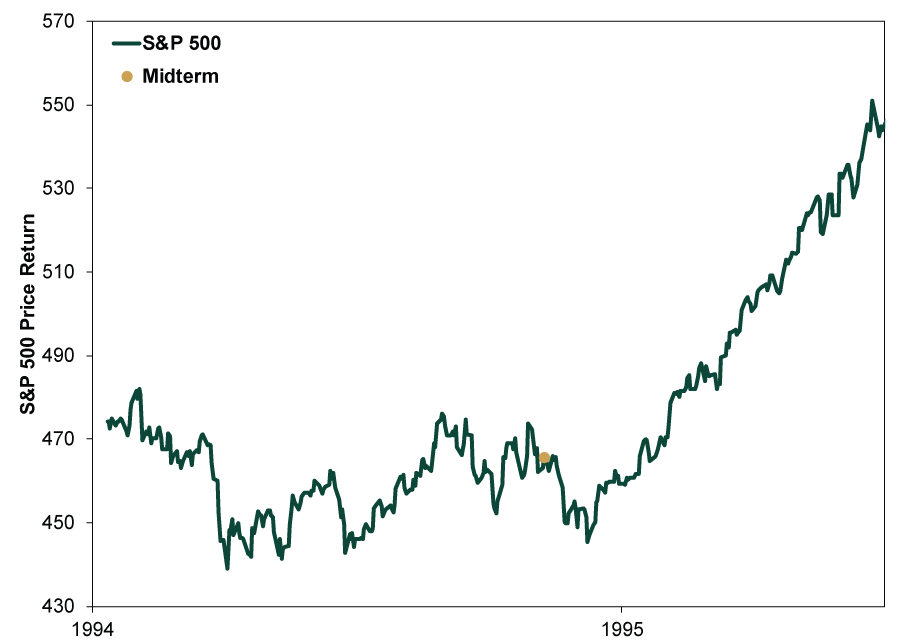
Source: FactSet, as of 10/30/2018. S&P 500 price index level, 1/3/1994 – 6/30/1995.
Exhibit 10: 1998 – 1999
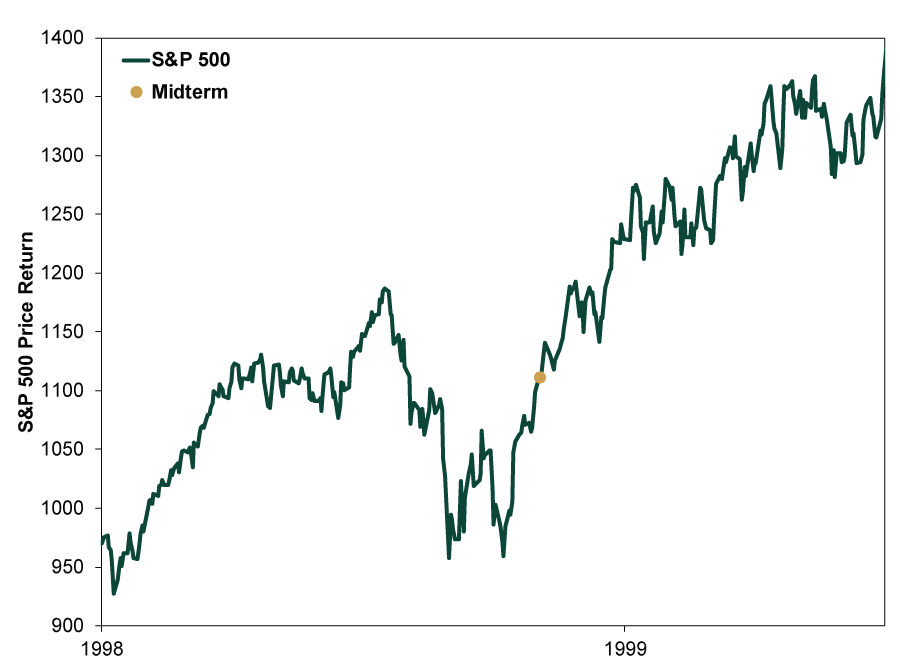
Source: FactSet, as of 10/30/2018. S&P 500 price index level, 1/1/1998 – 6/30/1999.
Exhibit 11: 2002 – 2003
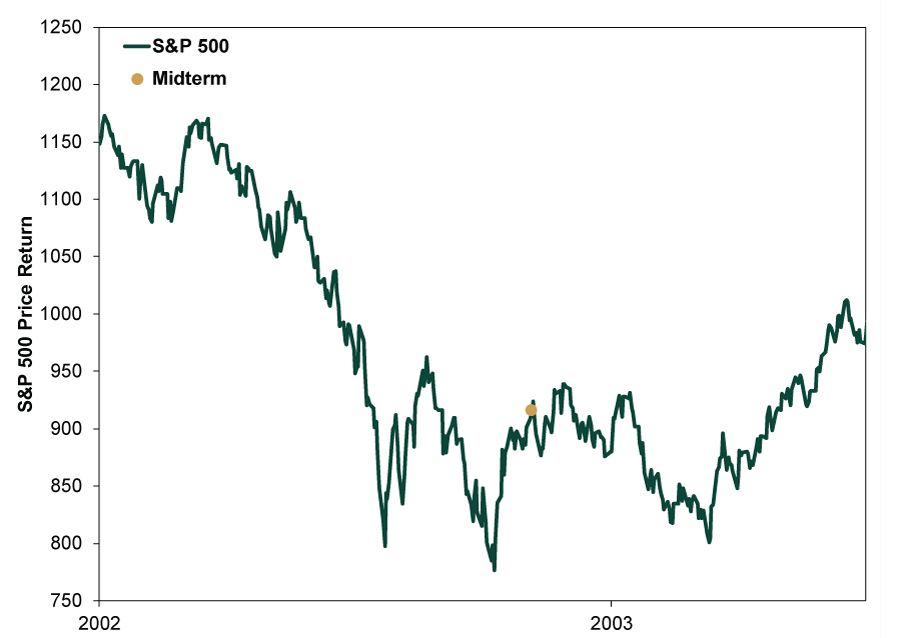
Source: FactSet, as of 10/30/2018. S&P 500 price index level, 1/1/2002 – 6/30/2003.
Exhibit 12: 2006 – 2007
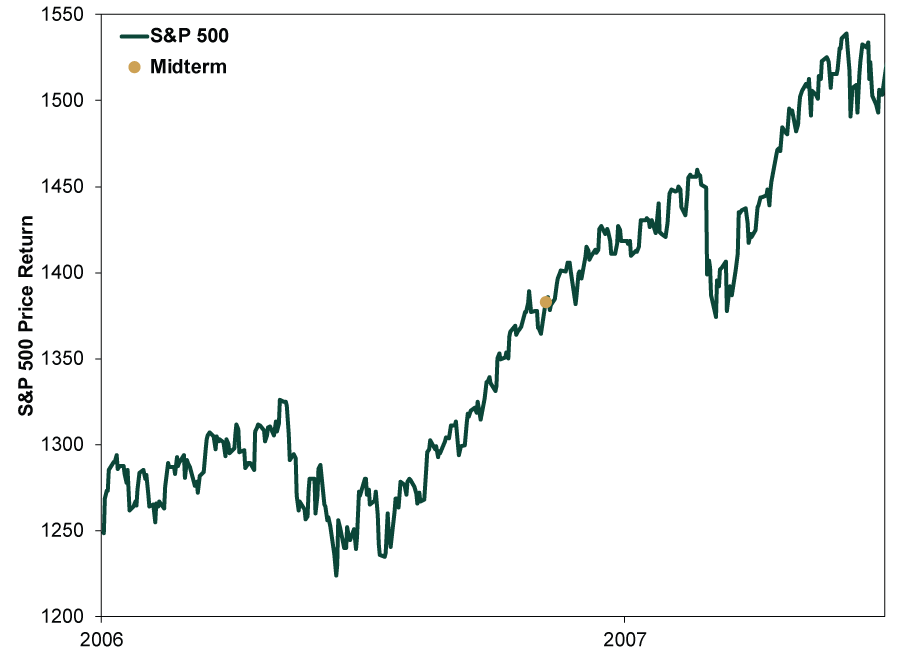
Source: FactSet, as of 10/30/2018. S&P 500 price index level, 1/2/2006 – 7/2/2007.
Exhibit 13: 2010 – 2011
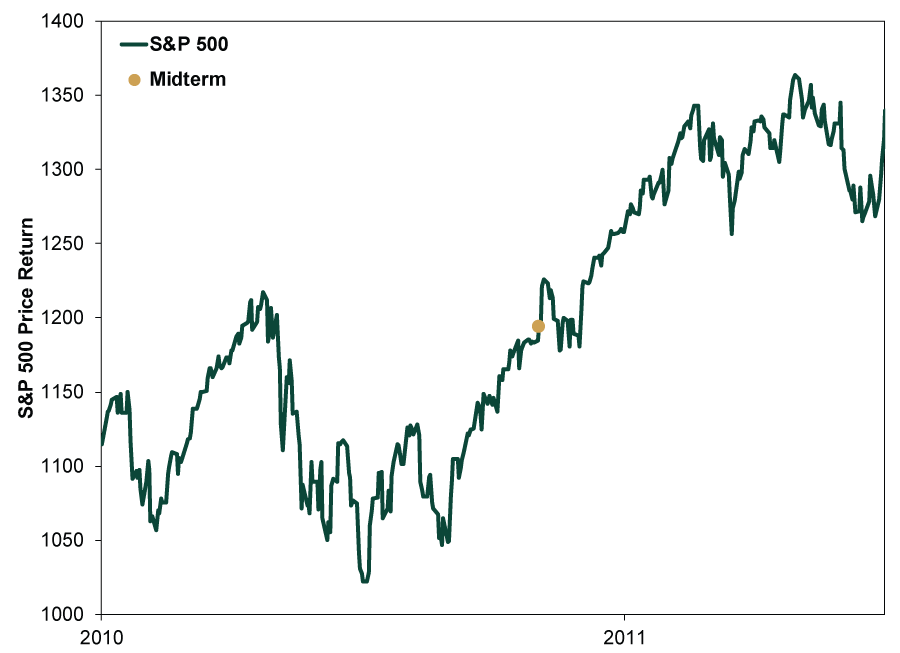
Source: FactSet, as of 10/30/2018. S&P 500 price index level, 1/1/2010 – 6/30/2011.
Exhibit 14: 2014 – 2015
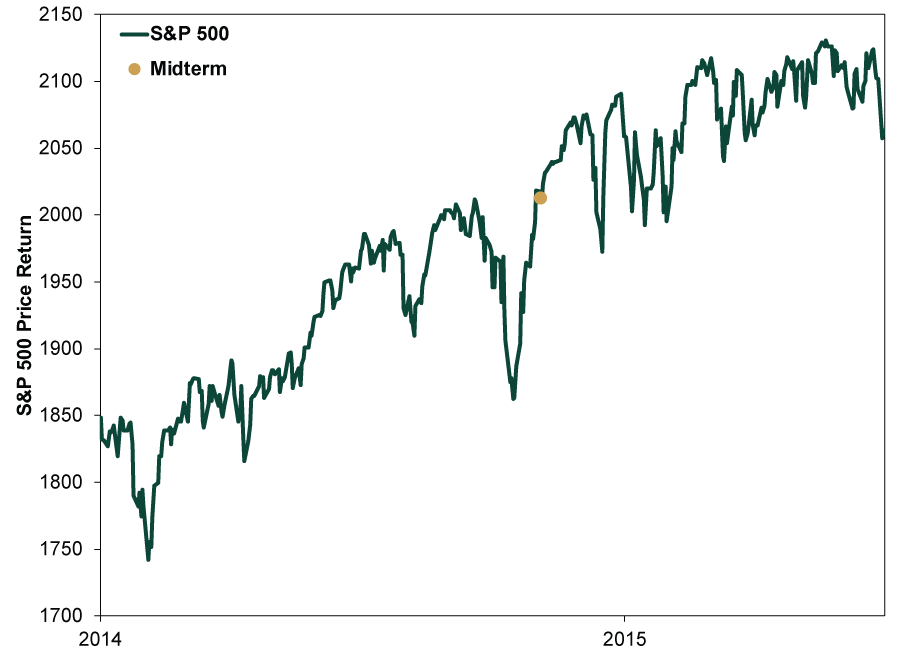
Source: FactSet, as of 10/30/2018. S&P 500 price index level, 1/1/2014 – 6/29/2015.
Exhibit 15: 2018 – 2019 (Through 10/30/2018)
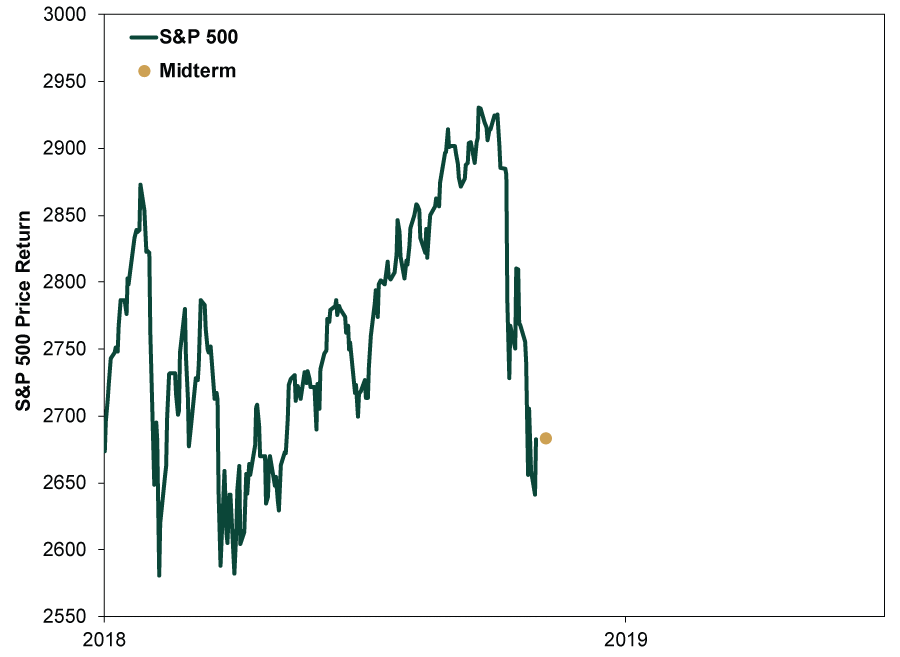
Source: FactSet, as of 10/31/2018. S&P 500 price index level, 1/1/2018 – 10/30/2018.
Keep in mind, too: For those claiming the midterm miracle won’t hold this year because of wrinkles like tariffs, geopolitical tensions and more, these examples cover a range of incidents including many of their own oddities. 1962, for example, came amid the Cuban Missile Crisis. 1998? The Russian ruble crisis and Asia’s regional recession. So while recent market weakness hasn’t been fun, market weakness going into the midterm election is common—not necessarily a sign this year will buck midterms’ bullish history. The relative regularity of pre-midterm market weakness followed by post-midterm market strength should give anyone pause about projecting recent market downside far into the future.
Italian bank shares came under pressure on Monday after Goldman Sachs downgraded some of Italy’s largest lenders and ahead of a meeting of the Eurogroup to discuss the 2019 budgets of eurozone members.
The FTSE MIB index of Italian lenders dropped 1.7 per cent on Monday, a substantially worse perforformance than the broad FTSE MIB index which fell 0.3 per cent.
The biggest faller was BPER Banca, formerly known as Banca Popolare dell’Emilia Romagna, which slid more than 5 per cent in the morning. Intesa San Paolo fell by 1.8 per cent while the Banca Popolare di Milano fell by more than 1 per cent.
The first two banks were singled out by Goldman Sachs which downgraded them to “sell” on the back of lower loan growth and higher funding costs.
Goldman’s Jean-Francois Neuez said:
The rise in Italian top-down risks has been plain for all to see – following the budget announcements bond yields have risen, credit ratings were lowered, and Italian shares fell. Italian banks’ shares were particularly hard hit…Since the Italian election, Italian bank share prices have fallen 30-50 per cent.
Mr Neuez also said Intesa’s valuation looks “vulnerable” and that UniCredit “is now the only Italian bank we rate buy”.
Italian bank shares were also stung by the rise in government bond yields.
The yield on Italian two-year debt rose by as much as 15 basis points to a high 1.228 per cent, while the equivalent yield on 10-year paper hit 3.388 per cent, a rise of 8 basis points. Yields rise when prices fall.
The spread between 10-year German and Italian debt — a widely watched indicator of the risk premium demanded to hold Italian debt — touched a high of 296.70 basis points on Monday before settling at a softer 291.60 bps. Last month it reached a five-and-a-half year high of 340.20 bps.
Italy has been in the EU’s crosshairs since the League and Five Star formed a coalition government in early June, with promises to increase public spending, cut taxes and reverse unpopular pension reforms.
According to Unicredit’s senior economist Daniel Vernazza, markets in Italy may remain volatile ahead of the November 13 deadline for the Italian government to resubmit a revised budgetary plan to the EU Commission.
In an interview with the FT at the weekend, Italian deputy prime minister Luigi di Maio said Rome was leading way for Europe to ditch austerity and embrace Trump’s expansive fiscal policies.
Apple cancels production boost for budget iPhone XR: sources
Dimmer outlook for new model contrasts with extra orders for older versions
TAIPEI -- Apple has signaled disappointing demand for the new iPhone XR, telling its top smartphone assemblers Foxconn and Pegatron to halt plans for additional production lines dedicated to the relatively cost-effective model that hit shelves in late October, sources say.
"For the Foxconn side, it first prepared nearly 60 assembly lines for Apple's XR model, but recently uses only around 45 production lines as its top customer said it does not need to manufacture that many by now," a source familiar with the situation said.
That means Foxconn, the Taiwanese company traded as Hon Hai Precision Industry, would produce around 100,000 fewer units daily to reflect the new demand outlook -- down 20% to 25% from the original optimistic outlook, this person said.
Fellow Taiwanese manufacturer Pegatron faces a similar situation, suspending plans to ramp up production and awaiting further instructions from Apple, a supply chain source said.
"The utilization for the XR production is not reaching its maximum capacity now," the source added.
Apple also had asked smaller iPhone assembler Wistron to stand by for rush orders, but supply chain sources say the company will receive no orders for the iPhone XR this holiday season.
Apple, the world's most profitable smartphone company, had great expectations that the iPhone XR would jump-start shipments this year. This lower-cost model debuted alongside the iPhone XS and top-of-the-line XS Max.
Yet the California-based tech company instead is requesting more of the older iPhone 8 and iPhone 8 Plus models, which are up to 20% cheaper than the XR's starting price of $749.
"Suppliers of iPhone 8 and iPhone 8 Plus are getting a combined order of around 5 million more units," one source said. Apple previous planned 20 million units for the older iPhone models this quarter, but raised the figure to 25 million units, the individual said.
Foxconn is the main supplier for iPhone 8 Plus, while Pegatron is the key supplier for the smaller-screen iPhone 8.
Apple did not respond to Nikkei Asian Review's request for comment. Foxconn, Pegatron and Wistron also declined to comment.
The moves to add orders for year-old iPhone models while suspending extra production for the latest product illustrates Apple's lack of innovation and inability to energize consumers with such a pricing strategy. Last year, Apple gave rush orders for the iPhone 7 series following the launches of the iPhone 8 series and premium iPhone X.
Apple also faces a quickly maturing smartphone market. Worldwide shipments, which slipped 0.1% in 2017 for the first year-over-year decline, are expected to contract again in 2018, research company IDC says.
The Silicon Valley company prepared more cautiously for production this year, looking to avoid severe inventory corrections later. Apple asked suppliers to prepare 20% fewer components for this year's new iPhones compared with last year.
The company is now reviewing iPhone demand weekly to adjust orders quickly in response to the market, a source said.
Apple gave a lukewarm forecast for the holiday season on Thursday. The company also said it will cease disclosing unit shipments for iPhones, Macs and iPads beginning in the December quarter. The unexpected policy change raised concerns that the U.S. tech giant is struggling to spur unit sales growth looking ahead.
"Apple's move will hamper the predictability of earnings," Jeff Pu, a Hong Kong-based analyst for GF Securities, told the Nikkei. The American company's reluctance to disclose shipment volumes also suggests that Apple faces the possibility of its first annual decline next year and wants the public to focus elsewhere, the analyst said.
China's Huawei Technologies snatched Apple's global No. 2 smartphone share for two straight quarters this year. IDC statistics show Apple's shipments trailed Huawei's during the quarter ended in September. Apple's combined iPhone shipments grew only 1.37% on the year over the first nine months, IDC's data showed.
"The chance for Apple to revise upward its production for iPhone XR and iPhone XS during this Christmas holiday season is very thin, given the forecast provided by the company and our supply chains check," Pu said. Demand for the most premium iPhone XS Max is only slightly better than that for the other two new models, the analyst said.
*APPLE CANCELS PRODUCTION BOOST FOR BUDGET IPHONE XR: NIKKEI
Stocks in Europe struggled on Monday after Asian shares declined as optimism over a potential U.S.-China trade deal receded. Treasuries climbed, while the pound strengthened ahead of a U.K. cabinet meeting.
Automakers and financial services companies were among the biggest decliners in the Stoxx Europe 600 Index, with futures on the Dow, Nasdaq and S&P 500 falling alongside those in Asia after White House economic adviser Larry Kudlow downplayed the potential for a quick deal with China. Treasury yields handed back some gains made on Friday, when a strong monthly jobs report reinforced the case for the Federal Reserve to keep raising interest rates. The pound rose on news of further progress in Brexit negotiations.
Nikkei -1.55% Hang Seng -2.08% CSI -0.83% Shanghai -0.41% Shenzen -0.01%
Eur$ 1.1389 CNH 6.9203 CNY 6.9258 JPY 113.20 GBP 1.3001 CHF 1.004 TRY 5.47018 RUB 66.1714 WTI$ 62.72 -0.67%
S&P -0.1% EUROSTOXX +0.12% FTSE -0.21% DAX +0.04% SMI +0.01%
Macro :
- Volatility Remains Elevated Ahead of U.S. Elections: Goldman
- Investors Expect No Relief on the Other Side of U.S. Midterms
- Trump-Xi Trade Deal Is Likely to Begin Rather Than End at G-20
- Salvini’s Surge Renews Turmoil in Italy’s Populist Government
- May Secures Key EU Brexit Concessions on Customs, Times Say
- Hedge Funds Back to Being Long VIX Futures: Volatility Monitor
Keep an eye on :
- AIBG ID : AIB Says No Capital Action Required After Stress-Test Results
- ALO FP : Alstom, Hyundai Make Joint Bid to Build $2.5b Baghdad Railway
- BAMI IM : Banco BPM Says Stress Test Didn’t Factor in Ongoing Derisking
- BIRG ID : Bank of Ireland Says Capital Position ‘Strong’ After Stress Test
- BARC LN : Barclays Remains Comfortable With Its Target CET1 Ratio
- BRK/A US : Berkshire Third Quarter Operating Income $6.88 Bln
- BRK/A US : Berkshire Profit Surges as Buffett’s Insurers Weather Storms
- GBB FP : Bourbon: Search for New Financial Partners Moving Forward
- ACA FP : Credit Agricole Says Stress Test Shows Group Is ‘Very Robust’
- CNHI IM : October Class 8 Truck Net Orders Rose 21% Y/y, ACT Research Says
- DANSKE DC : Danske Is Worst-Hit Nordic Bank in EBA Capital Stress Test
- DBK GY : Deutsche Bank Eyes Later Role in EU Banking Consolidation: HB
- DIE BB : Belgian Oct. Car Registrations Slide 15%; D’Ieteren Has 17.6%
- DWS GY : Deutsche Bank’s DWS Acquires 15% Stake in Neo Mena Technologies
- DTE GY : *T-MOBILE: THOMAS DANNENFELDT TO RESIGN FROM BOARD
- DUFN SW : Dufry: Holzer Neumann to Temporarily Renounce Board Functions
- DUFN SW : Dufry 3Q Sales Weak, No Reasons to Get Involved: Morgan Stanley
- EMI IM : ENI CEO Confirms Company Has ’Strong Commitment’ to Libya
- EKT SM : Euskaltel Third Quarter Revenue Misses Lowest Estimate
- FCA IM : Fiat Chrysler Italy Sales Down 17% in October, Mkt Down 7.4%
- GAM SW : *GAM REBUFFS SCHRODERS APPROACH FOR HEDGE FUND UNIT: FT
- GS US : Goldman May See Significant Fines From U.S. 1MDB Proceedings
- HSBA LN : HSBC Sees CET1 Ratio of 9.18% at the End of 2020
- ING NA : ING CET1 Ratio Drops to 10.7% in Adverse Scenario: EBA test
- ISP iM : Intesa Sanpaolo CET1 Fully Loaded Under Adverse Scenario 9.66%
- IG IM : Ascopiave May Discuss Partnership With Italgas, Sole Says
- MC FP : Billionaire, the restaurant chain owned by Italian entrepreneur Flavio Briatore, has attracted the interest of French luxury goods group
- MKS LN : Marks & Spencer board considered break-up, decides against
- MEL SM : Melia Teams Up With Aberdeen to Invest EU350M in Cuba: Expansion
- NOVN SW : Sandoz Decides Not to Pursue US Biosimilar Rituximab
- NKT DC : NKT Confirms Turnkey Order for Moray East Offshore Wind Project
- RR/ LN : Emirates Edging Toward Rolls A380 Engine Deal, Reuters Reports
- RYA LN : Ryanair Total Traffic Grew 11% to 13.1m Customers in October
- SAB SM : Sabadell Says EBA Stress Results Affected by TSB Acquisition
- SHP LN : Shire Down on Report Dissidents to Sue for Takeda Board Minutes
- SHL GY : Siemens Healthineers to Keep Operations in China, Germany: CEO
- UBI IM : Ubi Banca Says EBA Stress Tests Show Group’s Good Resilience
- UCG IM : UniCredit CET1 at Adverse Scenario 9.34%
- VOW3 GY : VW Financial Services to Maintain Last Year’s Op Profit: BZ
- VOW3 GY : VW Seeks to Link With Rivals on Driverless, Electric Cars: Rtrs
- W US : Citron Research Urges Shorting Wayfair on ‘False Promises’
- WPP LN : WPP Is Said to Freeze Hiring Until Early 2019 as Growth Falters