Nikkei : Ghosn and prosecutors battle over validity of top secret documents

Ghosn and prosecutors battle over validity of top secret documents
Hidden in secretarial office, the papers outlined future payment to ex-chairman

TOKYO -- The clash between Carlos Ghosn and Tokyo prosecutors is heating up as investigators question the former Nissan Motor chairman about evidence that allegedly shows he failed to report deferred compensation in financial reports.

Ghosn and Greg Kelly, a former representative director, had their detention in a facility here extended by 10 days to Dec. 10. The two have denied the allegations in recorded interviews with investigators and argued their innocence, according to sources familiar with the probe.

Much of the investigation is based on a set of documents outlining deferred, undisclosed payments to Ghosn of about 1 billion yen ($8.8 million) per year. There are also thought to be several documents detailing his compensation after retirement. Prosecutors claim that these documents prove that the payments were guaranteed, at which point Ghosn was legally obligated to list them in securities reports.

The documents were held with strict secrecy in Nissan's secretarial office, with only Kelly and a few others close to Ghosn aware of their existence, sources said. They were apparently submitted to investigators by some of those associates as part of a plea bargain.

Nissan's board of directors was not consulted about the documents, but Ghosn is believed to have had the power to determine director compensation, including his own. "As long as Ghosn had the authority [to determine director compensation], the validity of the documents is unquestionable," said a lead investigator.

But Ghosn has refuted that the payments were set in stone, though he had hoped to receive them in the future. The significance of the documents depends on such factors as when they were created, who signed them, and what the payments were listed as.

"The documents are more likely to be considered a binding contract if they include details like future payment dates and conditions for canceling the payments," said an accounting expert. "It is not as simple as saying that the documents exist, therefore the payments were settled."

Ghosn said that Kelly assured him the reporting procedures were legal. Kelly, for his part, says that he sought advice from outside lawyers and Japan's Financial Services Agency, which responded in writing that no disclosure was required.

Defending Ghosn is Motonari Otsuru, the former head of special investigations at the Tokyo Prosecutors' Office. Otsuru has a wealth of experience leading probes into white-collar crimes and is an expert on Japanese financial law. He will now face off against his old employer in a battle that will likely center around Ghosn's intentions and whether he was aware of any wrongdoing.

The former chairman is suspected of earning about 8 billion yen in deferred compensation in the eight years through fiscal 2017. Ghosn was arrested on charges of failing to report this income, not for receiving it.

Internal investigations by Nissan also uncovered other misconduct, such as the purchase of luxury homes with money funneled from an overseas subsidiary and family vacations taken on the automaker's dime.

"Prosecutors must have expected international attention and blowback from arresting a global figure like Ghosn," said a lawyer and former investigator. "They likely aim to prove that he breached trust as chairman by treating the company as his personal property."

NYT : Israeli Police Urge Bribery and Fraud Charges Against Netanyahu. Again.

Israeli Police Urge Bribery and Fraud Charges Against Netanyahu. Again.

JERUSALEM — The Israeli police recommended on Sunday that Prime Minister Benjamin Netanyahu be indicted on bribery, fraud and other charges, accusing him of trading regulatory favors for fawning news coverage.

It was the third separate case this year in which the police have urged that Mr. Netanyahu be prosecuted on corruption charges, and it dealt a damaging blow to his teetering governing coalition, with elections likely to be called at any moment.

Mr. Netanyahu is not accused of getting rich himself, but of enriching Bezeq, the country’s biggest telecommunications company, at the public’s expense and for the sake of his own image and that of his wife and family.

Between 2012 and 2017, the police said, Mr. Netanyahu “intervened in a blatant and ongoing manner, and sometimes even daily,” in coverage at Walla, a news website owned by Bezeq, ensuring “flattering articles and pictures” were published and “removing critical content” about him and his family.

The police said that Mr. Netanyahu and his associates sought to exert sway over Walla’s hiring of senior editors and reporters. In return, the police said, Mr. Netanyahu, who personally oversaw the communications ministry from 2014 to 2017, rewarded Bezeq with enormously lucrative concessions, including approval of its merger with Yes, a satellite television company, despite the objections of lower-level ministry officials.

The police said they had seized about $32 million from those involved during the investigation, which has been known as Case 4000.

In addition to Mr. Netanyahu, the police recommended that his wife, Sara, be charged with bribery, fraud and breach of trust, and disruption of investigative and judicial proceedings.

In a statement, Mr. Netanyahu called the recommendations unsurprising, owing to previously published leaks, and repeated his contention that they would come to nothing. He noted that such recommendations have no legal weight, and that other recommendations against public figures had been rejected recently.

The police also urged the indictment of others on a variety of charges, including Shaul Elovitch, the controlling shareholder of Bezeq; his wife, Iris; their son, Or, an aide to his father and board member in some of their holdings; Stella Handler, chief executive of Bezeq; Amikam Shorer, a senior Bezeq officer; and Zeev Rubinstein, a businessman close to the Elovitch and Netanyahu families who is deputy chairman of the Israel Bonds corporation.

Editors’ Picks

This Library Has New Books by Major Authors, but They Can’t Be Read Until 2114

Beyond the Bitcoin Bubble

Cancer Pushes New York’s ‘First Girlfriend,’ Sandra Lee, Onto Political Stage
The police recommendations, which concluded a long-running investigation that has haunted Mr. Netanyahu for months, added to the sense of looming peril facing Mr. Netanyahu’s governing coalition, which has already narrowly averted one collapse and holds just a one-seat majority in the Knesset.

Mr. Netanyahu was already facing likely indictment in two other scandals. One is known as Case 1000, involving gifts worth hundreds of thousands of dollars, and another, called Case 2000, involves a similar allegation that he negotiated with the publisher of Yediot Ahronot, a leading newspaper, for favorable coverage in exchange for using his influence to curtail a rival paper, Israel Hayom. In that case, the alleged deal never came to fruition.

The attorney general, a political ally and appointee of Mr. Netanyahu’s, has indicated he was waiting for the completion of the investigation of Case 4000 before making a decision on all three pending cases at once. Any actual indictment could still be many months off, and could come only after Mr. Netanyahu is given a chance to argue against it at a hearing.

Sara Netanyahu, for her part, is already on trial on fraud and breach of trust charges over allegations that she improperly spent around $100,000 of public funds, hiring celebrity chefs to cater private meals while covering up the fact that the prime minister’s residence already employed a full-time cook.

In his response to the police recommendations, Mr. Netanyahu faulted what he called “the transparent timing of their publication.” Indeed, the police’s announcement was something of a parting shot for Chief Roni Alsheich, whose term ends on Monday and whom Mr. Netanyahu has frequently attacked over the corruption investigations.

Mr. Alsheich’s efforts to extend his term were rejected by Mr. Netanyahu’s allies in the governing coalition.

But the man named by Public Security Minister Gilad Erdan to succeed Mr. Alsheich, Maj. Gen. Moshe Edri, was rejected on Friday by a screening committee that said his appointment would “harm public trust in the police.”

That leaves the police without a chief, and the government appearing increasingly in disarray.

WSJ : EU Doctors Quit Britain as Brexit Looms

EU Doctors Quit Britain as Brexit Looms
An exodus of medical specialists is putting new strains on the U.K.’s National Health System

BIRMINGHAM, England—Pioneering transplant surgeon Paolo Muiesan is returning to Italy after about 1,000 operations and 26 years in the U.K. The reason, he says, is Brexit.

“I’m disappointed that the European dream, of working and living in a borderless world, has failed,” he said.

The U.K.’s planned exit from the European Union in March next year is fueling an exodus of European workers from the U.K.—one of the outcomes sought by many of those who voted to leave in the 2016 referendum. Their departure highlights how Brexit is rippling through the U.K. economy, worsening labor shortages in critical industries where native Britons with the right skills are in short supply.

This squeeze is especially pronounced in health care, which is dominated by the National Health Service, the strained state-run system that is a pillar of British national life.

The effect has been felt acutely in some areas of specialist medicine. The number of surgeons who are, like Dr. Muiesan, citizens of another EU country is down 23% from its 2014 peak. The comparable number for obstetricians, in another example, has fallen 21%.

The Wall Street Journal obtained those figures through Freedom of Information requests from the U.K.’s General Medical Council, the body responsible for administering medical licenses in the country. They show the number of specialized doctors with non-U.K. EU citizenship has reached an eight-year low of 10,487 in 2018.

Around 10% of NHS doctors in 2017 were from elsewhere in the EU, according to the GMC. In some specialized roles, the percentage is higher. In ophthalmology, one in four doctors hails from elsewhere in the bloc; in surgery, it’s 18%.

Brexit is likely not the only factor encouraging doctors to return home. The GMC noted that economic improvements elsewhere in the EU may have tempted doctors to leave Britain, and an English-language test requirement introduced in 2014 may have discouraged some new entrants. But the declines across the board accelerated significantly in 2016, the year the U.K. voted to leave the EU.

The NHS has long drawn in highly skilled staff from Europe and beyond to fill expert posts in its 1.5 million-strong workforce. Widespread knowledge of English, the easy mutual recognition of qualifications, relatively good salaries and world-class research acted as magnets, doctors said. But now top doctors are quitting, threatening new strains in the creaking 70-year-old institution.

Dr. Muiesan’s unit has seen an outflow of at least five European doctors in recent years. Two of those, German nationals, said Brexit played a role in prompting them to return to their native Germany.

“It’s actually funny, the department is full of people from all over the world, and they are fantastic surgeons,” said Undine Gerlach, a transplant surgeon who worked at the same Birmingham hospital but is now working in Berlin.“That they could all leave, that would be such a loss.”

The agreement British Prime Minister Theresa May has forged with the EU protects the rights of EU citizens already in Britain. But the deal faces strong opposition in Parliament for other reasons, and she has made it plain that EU citizens who arrive after Brexit won’t get privileged treatment compared with other foreigners.

A survey released in November by the British Medical Association said almost four out of five European doctors weren’t reassured by Mrs. May’s commitment to protect their rights in the event of a no-deal Brexit.

That concern isn’t limited to doctors. There were 132,000 fewer EU citizens employed in Britain in the third quarter of this year than during the same period a year ago, the largest such drop recorded since comparable records began in 1997, according to official figures. Factors besides Brexit have been at play, including the eurozone’s economic recovery and a post-referendum fall in the pound.

For the National Health Service, the outflow of skilled workers is intensifying a chronic staffing crunch that medical professionals expect to get worse. The NHS had a personnel shortage just shy of 110,000 in the first six months of this year, 11,500 of which were doctor positions. If nothing changes, the number of NHS vacancies is expected to climb to 190,000 by 2027, according to Health Education England, a state agency that aims to ensure high-quality health care.

The U.K. Department of Health, which oversees the NHS, has countered the GMC findings with its own numbers showing an increase in European doctors, but Parliament has contested the accuracy of those figures in several reports and cautioned against making comparisons with them. The department said it is taking steps to boost foreign staff recruitment and retention. Doctors and nurses have been excluded from visa quotas for non-EU skilled workers, it noted, while 167,000 EU health workers have been given priority access to apply for permanent residency. The department said is also adding 1,500 training places for doctors.

Still, concerns persist not only over specialists leaving Britain, but also that new ones aren’t coming.

“What we’re worried about is trainees, because a sizable proportion of those comes from Europe. We just don’t have enough,” said Eveline Internullo, a consultant cardiothoracic surgeon at University Hospital Bristol, Dr. Internullo, an Italian who has lived in the U.K. since 2011, said her department received no applications from non-British Europeans for the last senior-trainee posting it had open in August.

Oncologist Alfredo Addeo, who moved to the U.K. in 2010, left earlier this year for Geneva, Switzerland, closer to his native Italy. He worked at the same hospital as Dr. Internullo.

Brexit, he said, played an important role in his decision to abandon what he called a “British dream.” When he arrived in the U.K., strapped for cash, he slept on an air mattress; when he left he was a consultant oncologist, one of the most prestigious positions in the NHS.

“The U.K. was for me the prototype of multiculturalism and integration,” he said. “When Brexit happened, it was just a slap in the face.”

That sense of hopes betrayed is echoed by other foreign physicians. “Europeans in the U.K. have been treated like bargaining chips,” said Dr. Muiesan, who was the first in Europe to introduce a new procedure allowing organs to be harvested quickly from the deceased, speeding up and increasing transplants.

Some doctors say even patients’ attitudes changed after the referendum. Anna Zampetti, a consultant dermatologist who returned to Rome in 2017, said a patient in one of her last appointments asked where she came from. “‘Oh, so you’re Italian, you’re not an English consultant,’ they told me. It was glacial. The perception was just that we weren’t welcome anymore,” she said.

Miguel Panades, a Spanish-born consultant oncologist, works at Boston and Lincoln Hospitals in Lincolnshire, an area of the English Midlands that has large numbers of eastern European agricultural workers and that voted for Brexit by the greatest majority in the country.

“The migrant harvesting potatoes and I are the same thing,” Dr. Panades said. “You can’t cherry-pick. At the time of the referendum, that wasn’t explained.”

(9to5) Kuo: ‘All-new design’ AirPods in 2020, wireless charging model in first q

Kuo: ‘All-new design’ AirPods in 2020, wireless charging model in first quarter 2019
The AirPods truly-wireless earbuds are on track to be Apple’s best growth product for the foreseeable future, according to Ming-Chi Kuo. Kuo said that Apple will release an ‘upgraded model with wireless charging support’ in the first quarter of 2019.

Kuo also said an all-new design AirPods is currently on track to launch in early 2020 …

Kuo forecasts dramatic unit growth for AirPods with units rising from 16 million units in 2017 to over 100 million by 2021. He calls them Apple’s most popular accessory ever.
He indicates that existing iPhone users are more likely to buy AirPods than upgrade their phone itself.
Kuo refers to the 1Q2019 update as a ‘model with wireless charging support’, which at first sounds like the wireless charging case Apple originally announced with the AirPower mat in September 2017.
He goes on to say that the new AirPods case will have a ‘rigid-flex board’ internal component upgrade, which will be more expensive to manufacture. The hinge of the charging case will also be redesigned to support appearance changes and higher thermal requirements, and the cost of that component will rise by ~60%.
Interestingly, Kuo also says that the new AirPods will have upgrades to the Bluetooth spec. This seems to suggest that the AirPods themselves will be getting an upgrade, alongside the case. It sounds like that Apple will fulfil its original promise of selling the AirPods wireless charging case as a separate add-on accessory for existing AirPods owners, and release a minor revision to the whole product at the same time — which includes the wireless charging case.
Kuo does not go into detail about what the ‘all-new design’ 2020 AirPods will feature. Previous rumors have suggested features like sweat resistance, Hey Siri integration and more.
Kuo did not mention the AirPower mat at all in today’s report, despite the obvious link between the AirPods case and the seemingly-dead-or-delayed Apple charging mat. For what it is worth, in an October report, Kuo said he that expected new AirPods and AirPower in late 2018 or early 2019.

NY Post : Zuckerberg no-show highlights Facebook’s bad business model

Zuckerberg no-show highlights Facebook’s bad business model

Facebook CEO Mark Zuckerberg ducked the wrath of the world last week when he refused to hear London calling.

The quiet one was even trolled by politicians from nine countries with photos of his empty House of Commons seat and name placard on Twitter.

The occasion drawing ire across the globe was the UK’s International Grand Committee’s hearing on fake news and disinformation.

It was the first time since 1933 foreign politicians had been invited to a hearing at Britain’s House of Commons.

That’s important to show up for, rather than send a flunky, which Zuckerberg did.

Later in the week, The Wall Street Journal got hold of some unredacted e-mails and notes that seem to state pretty clearly that Facebook does indeed “exchange value” (my words) for “access” to data sets. And that they did indeed explore charging “users” for data.

Facebook does not define the user as someone using the service, No, it means someone who can then sell our data to a third party — who in turn bundles the data and sells it to advertisers.

An equally outrageous offense is that 2.2 billion people who log in and use Facebook are in a sense treated like second-class users.

The true users are the product Facebook is selling.

This is why I suggested two weeks ago that Facebook should charge its users (the ones who log in) a monthly fee.

It would provide a revenue stream for the social network and also provide a paper trail of verified people to reduce the fake news proffered on the site.

The e-mails indicate that Facebook did at least consider charging the log-in users, soon after its IPO.

So just rip the Band-Aid off already and charge everybody $5 a month or $1.99 — it doesn’t really matter — and let the real users know their data is their own.

>>> Alaska Rocked By More Than 200 Aftershocks Since Friday's Massive Quake

Alaska Rocked By More Than 200 Aftershocks Since Friday's Massive Quake

As if the chaos that followed Friday's magnitude 7 earthquake didn't create enough mayhem for the residents of Anchorage, Alaska, USGS reported on Saturday that in the wake of what many Alaskans described as the worst earthquake of their lifetime parts of the state have already been rocked by more than 200 aftershocks.
And the quakes are expected to continue for "some time," according to Seismologist Randy Baldwin. As of noon ET on Saturday, the official tracker on the Alaska Earthquake Center's website stood at 224.
Residents were still shaken from Friday's back-to-back magnitude 7 and magnitude 5.7 quakes, which destroyed roads and sent goods flying off of store shelves as people ran into the street for cover.

Shortly after returning, the second quake hit, and Alaskans went through the whole ritual again. Fortunately, there have been no reports of deaths or serious injuries (since the state is located above an area where two tectonic plates converge, Alaskans are accustomed to earthquakes - they experience more than the other 49 states combined).
Still, Alaskans insisted that this one was different, according to several people who shared their stories with CNN.
"It was absolutely terrifying," Palmer resident Kristin Dossett said. "It shook like I have never felt anything shake before," she said.
"It was very loud when it came," Anchorage Mayor Ethan Berkowitz said. "It was very clear that this was something bigger than what we normally experience. We live in earthquake country...but this was a big one."
[...]
Philip Peterson was in a multistory building in downtown Anchorage as the structure swayed and coffee mugs fell from tables and tiles from the ceiling.
"I just jumped under my desk and had to ride it out," Peterson said.

(ZH) JPMorgan Spots A Rare And "Even Worse Omen" For The Market

JPMorgan Spots A Rare And "Even Worse Omen" For The Market
When it comes to timing the next recession - or the next Fed policy mistake - there are few signals that pundits rely more on than the shape of the yield curve, which, as we have covered extensively in the past year, has bear flattened dramatically since 2015 as the Fed has hiked rates, with the 2s10s now just a tiny 20bps away from inverting at which point the countdownto both a recession and a bear market begins.
However, at a time of unprecedented central bank meddling and manipulation in all rates (and equity) markets, many believe that the longer-dated curve is no longer indicative of anything but noise, especially since the long-end is directly being bought by central banks (or sold by Chinese reserve managers depending on how much Trump's trade war escalates) thus distorting any "signal" value it may have. In its place, a more accurate "signal" has emerged in the short-end of the curve, as manifested by the Overnight Index Swap, or OIS, futures market.
It was here that back in April JPMorgan observed something very notable: the forward curve for the 1-month US OIS rate, a proxy for the Fed policy rate, had inverted after the two-year forward point for the first time this cycle. This implied some expectation was priced in of a reduction in the Fed policy rate after Q1 2020; that or the market starting to actually price in - and not just contemplating - the next Fed policy error, i.e., hiking right into the next recession.
This is a big deal: as JPM's Nikolaos Panigirtzoglou wrote, an inversion at the front end of the US curve is a significant market development, not least because it occurs rather rarely, and has happened only three times over the past two decades: in 2005, 2000 and 1998 - all periods in time preceding major market busts.

While redundant, JPM explained that "such inversion is also generally perceived as a bad omen for risky markets" and highlighted that the two potential explanations are either markets pricing in a Fed policy mistake, or pricing in end-of-cycle dynamics.
Fast forward to today, when 8 months later, Panigirtzoglou writes in his latest Flows and Liquidity commentary that since then, not only has this inversion worsened, but it has shifted forward, and since the middle of November, the forward curve is inverted between the 1-year and the 2-year forward points.
This shift forward in Fed policy reversal expectations is in line with historical experience. As JPM wrote back in April, the 3y-2y forward rate spread had historically led the 2y-1y one, and this has now occurred since mid-November.
What does this mean in practical terms? Simple: the latest curve inversion implies that markets are now pricing in a peak in the Fed policy rate in end-2019 rather than during 2020 previously. JPMorgan shows this in Figure 2, which depicts the forward curve of the 1-month dollar OIS curve currently vs. its snapshot at the beginning of October before the equity market correction.

Not only has the market-implied path of policy rate expectations shifted downward in the aftermath of the equity market correction, but the whole curve has shifted forward. And this week’s comments by the Fed Chairman appear to have reinforced these policy reversal expectations with the 2y-1y forward rate spread inverting further to below -3 basis points.
Of course, as we discussed extensively in April, such pronounced shifts forward in Fed policy rate reversal expectations has also traditionally been associated with end-phases of the US monetary policy cycle. In the 2000 monetary policy cycle, the 3y-2y forward rate spread of the 1-month OIS rate turned negative in February 2000. And as JPMorgan adds, the 2y-1y forward rate spread turned negative four months later in June 2000. The Fed delivered the last hike in May 2000.
In other words, from a timing point of view, the last hike of the Fed at the time almost coincided with the inversion of the 2y-1y rate forward spread. Incidentally that also marked the bursting of the dot com bubble, as the US equity market had started declining at roughly the same time in June 2000. The subsequent equity market correction induced the Fed to start cutting rates in 2001.

Fast forward to the next rate hike cycle, when in the 2006 monetary policy cycle, the 3y-2y rate forward spread of the 1-month OIS rate turned negative rather early in August 2005. The 2y-1y forward spread turned negative ten months after in June 2006. Similar to the 2000 cycle, the last hike of the Fed at the time in June 2006 coincided with the inversion of the 2y-1y forward rate spread. There was one material diference to the 2000 cycle: the equity market had started declining much later in October 2007 when the Fed started cutting rates.
Rather concerningly, here JPM notes that although it is still early to draw conclusions, the lags from the 3y-2y inversion to the 2y-1y inversion and the September peak in the US equity market appear more consistent with the 2000 rather than the 2006 cycle.
Now as readers may recall, when the 3y-2y forward spread inversion first emerged last April, JPM argued that an inversion at the front end of the US curve "was a bad omen for risky markets."
So, perhaps not unexpectedly, the ensuing 2y-1y inversion and shift forward in Fed policy rate reversal expectations is, according to JPMorgan, "worsening this bad omen."
Why? Because in even more bad news for the BTFD crew, the lesson from the previous US monetary policy cycles is that a sustained recovery in equity and risky markets has tended to occur only after the inversion disappears and the front end of the US curve, in particular the 2y-1y forward rate spread, resteepens.
Negative implications for the stock market aside, as we briefly mentioned above JPM previously argued back in April that this yield curve inversion could be consistent with two potential fundamental explanations: markets have been either pricing in a Fed policy mistake or end-of-cycle dynamics. As Panigirtzoglou explains, while it is difficult to distinguish between the two - especially as a Fed policy mistake be definition naturally shorten the cycle - there should be some distinction in terms of investor flow patterns.
  1. Pricing in a Fed policy mistake should induce investors to focus on earlier growth weakness and should, therefore, be accompanied by weak equity fund flows, weak cyclical sector flows, greater flows in long-dated bond funds vs. short-dated ones on potentially earlier reversal of US monetary policy, and weak flows in interest rate-sensitive sectors such as housing.
  2. Pricing in end-of-cycle dynamics should be accompanied by overheating and inflation concerns, i.e. greater flows into inflation-protected vs nominal bond funds, greater flows in short-dated vs. long-dated bond funds on later reversal of monetary policy and greater flows into cyclical sectors and equity funds, in general, as the best equity and cyclical sector returns are typically seen at the end of the cycle.
How to distinguish between the two hypotheses? JPM has an idea:
There should be less distinction in terms of credit flows as credit should respond to higher uncertainty and volatility and underperform under both Fed policy mistake and end-of-cycle dynamics. So the weakness seen in credit flows this year, especially in HY bond funds, is in our opinion less useful in helping to distinguish between the two hypotheses.
So which pattern do this year’s flows fit? Back in April, when the 3y-2y first inverted, JPM had argued that there was more flow support for the Fed policy mistake hypothesis. Updating that flow analysis with more recent data reinforces that conclusion. This is shown in the five flow metrics below:
1) The trajectory of equity fund flows has been rather weak and erratic since last February with no signs of change in the most recent months.
2) Flows into cyclical vs. defensive equity sectors. Since the yield curve inversion first emerged last April, inflows into US sector ETFs have favored more defensive sectors such as Staples, Healthcare and traditional Telecoms, while outflows have focused on cyclical sectors such as Financials, Industrials and Consumer Discretionary.
3) Relative flows in inflation protected vs. nominal bond funds. The chart below splits overall US government bond ETF flows into nominal and inflation-linked bonds. Nominal bond funds have had steady inflows since the start of the year, while flows into inflation-linked government bond ETFs have been negative since July.
4) Relative flows in short-dated vs. long-dated bond funds. The duration impulse of flows into US bond ETFs has decreased this year, with inflows going mostly into shorter-term and floating-rate rather than longer-term bond ETFs. And if anything, this trend has intensified in the most recent months.
5) Interest rate-sensitive sector funds such as REITS have seen significant outflows in the US relative to a flattish pattern globally.
In other words, according to JPM, flow metrics 1, 2, 3 and 5 look more consistent with the Fed policy mistake hypothesis, while the flow metric 4 looks more consistent with the end-of-cycle hypothesis.
JPM's's conclusion, incidentally, is the same as what it said back in April, namely that "while we recognize it is difficult to distinguish between the two hypotheses, there still appears to be more flow support for the Fed policy mistake hypothesis"
In other words, between the market's ongoing preoccupation with the US-China trade war, and traders suddenly pricing in either a policy mistake as the Fed continues to hike into an economic slowdown and eventually recession, or the end of the hiking cycle, it would explain the violent market selloff of the past two months, and the associated spike in volatility, as forward-looking investors and traders simply look to cash in their chips as suddenly the market is signalling that the trading environment observed just before the tech and credit bubbles burst, is once again imminent.

(ZH) "Never Seen Anything Like It" - Scientists Baffled By Strange Seismic Waves

"Never Seen Anything Like It" - Scientists Baffled By Strange Seismic Waves Rocking The Globe
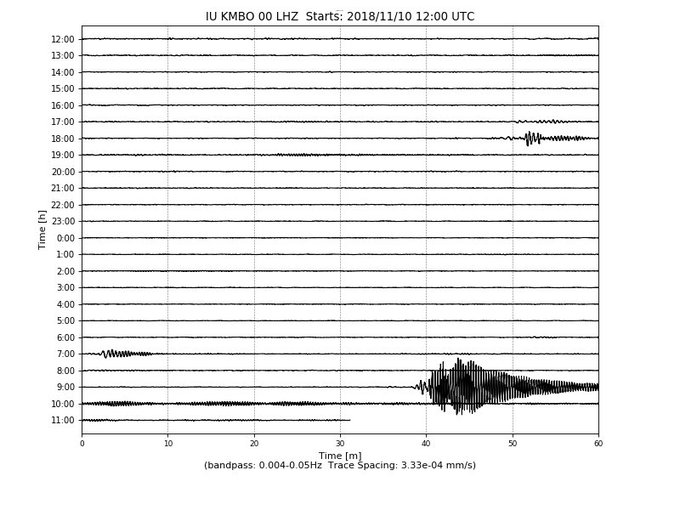
On November 11, mysterious seismic waves caused a rumble in the Indian Ocean that reverberated around the globe. Low-frequency waves shook the entire Earth for about 20 minutes that day, but scientists now believe they know what caused that strange phenomenon.
Researches have declared that they don’t think any large earthquake was responsible for the worldwide rumblings. Instead, they feel that an eruption of an underwater volcano was to blame. Well, according to scientists, it was “almost certainly” an underwater volcano, anyway…

The rumble, which was described as a monotone ring, was picked up by seismographs almost 11,000 miles (18,000 km) from Mayotte and were spotted by happenstance. A New Zealand based Earthquake enthusiast who goes by the handle @matarikipax noticed unusual seismology readings from the United States Geological Survey. The agency publishes all of its recordings for free online, allowing anyone across the globe to trawl through its data. “This is a most odd and unusual seismic signal. Recorded at Kilima Mbogo, Kenya,” @matarikipax wrote on Twitter on November 11. “The signal can be seen all around the world."
******* Pax@matarikipax

This is a most odd and unusual seismic signal.
Recorded at Kilima Mbogo, Kenya ...#earthquakehttps://earthquake.usgs.gov/static/earthquake-network-operations/Seismic_Data/telemetry_data/KMBO_24hr.html …

377 people are talking about this


According to The Daily Mail, a low-rumbling that could not be felt above ground was detected on November 11 and narrowed down the origin to a region just off the coast of the island of Mayotte. One scientist who has studied the charts told MailOnline that the trembling was almost certainly caused by a low-level underwater volcanic eruption off the northeast of Mayotte.
Anthony Lomax, an independent seismology consultant, said that “There has been ongoing low-level seismic activity there since May,” he told MailOnline.

WSJ : U.S., China Reach a Truce on Trade

U.S., China Reach a Truce on Trade
The U.S. will delay a planned increase in tariffs on Chinese goods, as the two sides prepare for further negotiations.

BUENOS AIRES—China and the U.S. agreed to a cease-fire in a trade battle that has shaken global markets, with the U.S. postponing plans to increase tariffs on $200 billion in Chinese goods and the two sides entering negotiations on other contentious issues.

The truce was designed to ease tensions between the two sides after months of escalating trade conflict, and held out the prospect that the world’s two largest economies could find an accommodation that would set their trading relationship on a different path. Amid the consensus, though, there were already differing interpretations over what happens next in a possible portend of the difficult talks to come.

According to the White House, the two nations will discuss thorny issues of Chinese economic policy, including forced technology transfer, intellectual-property protection, non-tariff barriers, cyberintrusions and cybertheft, services and agriculture. The two sides would “endeavor” to wrap up the talks in 90 days.

Should the talks fail, the White House said, the tariffs on the $200 billion of goods would increase to 25% from the current 10%. The tariffs were set to increase to that level on Jan. 1.

Chinese Foreign Minister Wang Yi and Commerce Vice Minister Wang Shouwen, in a press briefing, said only that the talks would focus on removing all U.S. tariffs and Chinese retaliatory tariffs and made no mention of a deadline.

The deal, which emerged after a dinner between President Trump and President Xi Jinping following a summit of the Group of 20 nations in Argentina, won immediate praise from business groups that oppose tariffs and have urged the administration to take a different path in pressuring Beijing.

“We’re encouraged to see Presidents Trump and Xi working together to reduce trade barriers between the U.S. and China,” said the Consumer Technology Association, a trade group that opposes tariffs.

Already, officials in China have begun to plan for negotiations in Washington in mid-December, people briefed on the plans said. Among the issues that the U.S. said would be discussed was a list of longstanding grievances from American business, including China’s forced transfer of technology from some U.S. firms doing business there, intellectual property protection, cyberintrusions and cybertheft.

The deal is likely to be attacked by some of Mr. Trump’s conservative backers, who look to him to take a hard line against Beijing. He has sometimes bowed to such pressure. In the spring, he quickly disowned a truce in the trade battle declared by Treasury Secretary Steven Mnuchin, after it was panned by conservative commentators.

“President Xi has successfully slow-walked President Trump,” said Peter Morici, a University of Maryland economist who takes a hard line on China. “The president has fallen into the same trap as Barack Obama, George W. Bush and even Bill Clinton. He will get more platitudes and promises and very few results.”

Other obstacles in the talks include the participation on the U.S. side of U.S. Trade Representative Robert Lighthizer, who has a skeptical view of Beijing and its willingness to deliver on promises. He has been pushing for the now-postponed Jan. 1 tariff increase on $200 billion of Chinese goods, to 25% from 10%.

The 90-day time frame given by the U.S. means the talks would wrap up around March 1, just before China’s annual national legislative session, a time when Chinese leaders are wary of making concessions to foreigners, heightening the stakes since the U.S. said the tariffs would increase if talks weren’t successful.

“An escalation of the tariff war then would be embarrassing for Xi Jinping,” said Scott Kennedy, a China expert at the Center for Strategic and International Studies, a Washington, D.C. think tank.

The cease-fire follows the model of partial agreements the U.S. has cut in recent months with the European Union and Japan, U.S. officials said.

According to the White House, Beijing agreed to purchase a “very substantial” amount of agricultural, energy, industrial, and other products from the U.S.

The White House also announced that President Xi said he would consider again the previously unapproved merger between Qualcomm Inc. and NXP Semiconductors NV, should the deal be presented. Chinese officials at the press briefing didn’t mention that pledge.

The proposed merger fell apart earlier this year after Beijing failed to approve it. According to people with knowledge of the matter, President Xi himself had expressed reservations about clearing the deal when it was going through Beijing’s antitrust review for fear it would pose too big a threat to Chinese competitors.

San Diego, Calif.-based Qualcomm and Dutch chip maker NXP have publicly moved on since abandoning the proposed merger in late July. Qualcomm in September announced it would repurchase $16 billion in shares as part of a plan to buy back some $30 billion in shares after abandoning its takeover of NXP.

Other pledges went well beyond trade issues. Both sides agreed that China would designate the heavily addictive opioid Fentanyl as a controlled substance, subjecting those selling the drug to criminal penalties. They also said China would help the U.S. in its efforts to get North Korea to give up nuclear weapons.

Mr. Wang, China’s foreign minister, said the U.S. had agreed to continue to adhere to the one-China policy, where Beijing asserts that Taiwan is a part of China. The White House statement didn’t mention that issue.

The highly anticipated meeting between Mr. Trump and Mr. Xi took place in dining room at the Park Hyatt, the hotel where Mr. Trump stayed for the G-20. Mr. Trump and Mr. Xi sat across from each other at a long table, joined by top officials from their respective sides, and were served a main course of grilled sirloin with red onions, goat ricotta and dates.

A full settlement of their trade dispute will require big changes from both governments, said Andy Rothman, a China analyst at Matthews Asia, an investment firm. Washington must accept that it “will have to share economic and strategic power with a rising China,” he said, while Beijing would have to follow the rules of (multilateral) system and to be transparent.”

FT : Trump offers Xi tariffs reprieve in trade war ceasefire

Trump offers Xi tariffs reprieve in trade war ceasefire
US president agrees to hold off on higher imports due in January to give talks more time

Donald Trump, the US president, has agreed to hold off on imposing higher tariffs on Chinese imports next year after reaching a deal with Xi Jinping, China’s president, to stall the trade war afflicting both countries and rattling financial markets.

The temporary ceasefire was reached after a working dinner involving the two presidents and their top advisers in Argentina, following the end of the G20 world leaders summit on Saturday. 

According to the terms of the deal outlined by the White House, the US will not ratchet up tariffs on more than $200bn of Chinese goods from 10 per cent to 25 per cent in January, as had been planned. 

Meanwhile, China would move to purchase a “very substantial” amount of farm, energy and industrial goods, though the amount was not specified, in order to reduce the trade gap with the US. The US also said the two countries would begin negotiations to resolve some of the thorniest issues in their economic relationship, like alleged intellectual property theft and the forced transfer of technology. They set a deadline of three months for those talks, with failure resulting in a new escalation of tariffs. 

China’s state-run Global Times quoted Wang Yi, China’s foreign minister, as telling a G20 press conference: “China is willing to expand imports on the basis of its own needs, agrees to open its market and satisfy the legitimate concerns of the United States as part of the process of reform and opening up.”

Mr Trump and Mr Xi entered the critical summit at the Park Hyatt hotel — where the US president was based — on an upbeat tone, suggesting a truce in trade tensions between the two countries was within striking distance. Afterwards, once he was in flight back to Washington on Air Force One, Mr Trump issued a positive statement. “This was an amazing and productive meeting with unlimited possibilities for both the United States and China,” he said.

Mr Xi, in opening remarks at the dinner, said it was a “great pleasure” to see Mr Trump. “A lot of things have taken place in the world,” he said. “Only with co-operation between us can we serve the interest of both peace and prosperity.”

The delegations were arranged around a long rectangular table, with a crystal chandelier hung above it and a row of flowers down the middle. The main course was grilled sirloin with red onions, goat ricotta, and dates. The wine was a Malbec.

The agreement pauses a trade conflict that was already showing signs of inflicting serious damage to the economies of both the US and China, denting global growth forecasts and causing turmoil and volatility in financial markets.

Mr Trump entered the dinner facing trouble at home, following the loss of the House of Representatives for the Republican party in midterm elections, and new activity in the probe by special prosecutor Robert Mueller into his 2016 election campaign. But despite these pressures, there are no guarantees that the ceasefire will last — so the possibility of a new escalation is likely to hang over Washington and Beijing until there is a more solid resolution.

Abigail Grace, a China expert at the Center for New American Security said the agreement was a “time out” for both countries. “Expect a public cooling period for the next three months, with tough discussions between two bureaucracies taking place behind the scenes. The trade war is far from over yet,” she said.

Mr Trump has shifted between bluster and compromise on trade depending on his impulse and the political priorities of the moment. Within the space of two months he struck agreements to ease trade tensions with the EU and Japan and revamp the North American Trade Agreement with Canada and Mexico.

China was always considered a much tougher challenge, however. Confronting Beijing on trade was a centrepiece of his successful presidential campaign in 2016 and became a leitmotif of his time in office. This has been particularly true this year after his efforts at dialogue with Mr Xi during his first few months at the White House faltered. 

As Mr Trump took an increasingly tough line against China, ratcheting up tariffs and the threats of more tariffs, he was encouraged by hawks within his own administration, particularly Peter Navarro, the White House trade adviser, and Robert Lighthizer, the influential US trade representative.

On the other side of the internal divide, however, Steven Mnuchin, the Treasury secretary, and Larry Kudlow, the director of the National Economic Council, have been more willing to consider a deal. All four were present at the negotiating table with Chinese officials in Buenos Aires. Prominent Wall Street figures, including Steve Schwarzman, the chief executive of Blackstone, had also worked behind the scenes for a compromise. 

Mr Trump’s own views have always been more difficult to pinpoint, leaving officials from both sides guessing until the end. But Mr Trump had claimed to have a strong personal relationship with Mr Xi, which optimists had often cited as a factor that might lead to a breakthrough.

After a sharp drop in equity markets in October, Mr Trump made an overture to Mr Xi in a phone call that relaunched talks after a lengthy hiatus. He then instructed staff to see if it might be possible to reach some form of deal at the G20 in Buenos Aires, or at least a framework to resolve some of the sources of tension with Beijing. 

But until the past week, Chinese officials had offered few meaningful concessions to Mr Trump, leading the White House to dampen expectations of an agreement and even threaten a burst of new levies in the near future. The tone from the US side became more positive as they landed in Argentina, with Mr Trump claiming that he was seeing “good signs” in the talks.

Other aspects of the deal included commitments by Mr Xi to designate fentanyl, the opioid, a controlled substance, meaning harsher sentences for those selling it to the US, and to be “open” to approving the merger of chipmakers Qualcomm and NXP, which China had been blocking.

Hardliners within the administration are likely to grow impatient if the next round of talks does not yield more concrete results, and there were already some signs of a backlash to the truce from some of Mr Trump’s supporters who are most hostile to China.

“Is #Trump making a huge mistake? The devil is in the details! But I’d be lying if I didn’t say at first glance this is very disappointing,” wrote Dan DiMicco, a steel executive who led Mr Trump’s trade unit during the presidential transition. “I don’t agree but I defer to the president,” he said. However, business groups are likely to be relieved that at least any further escalation was avoided for now.