This week’s trading was predominately focused on headlines out of Beijing. Investor sentiment was buoyed by apparent progress made in trade talks culminating in positive overtures from both President Trump and President Xi. Separately, President Trump ultimately signed on to a border funding agreement hashed out on Capitol Hill, avoiding another shutdown, but he also declared a national emergency pledging to come up with roughly $8B in wall funding from various government resources.
Earnings season chugged along into the latter innings and overall managements remained reluctant to go out on a limb in terms of FY19 forecasts given macro uncertainties. Treasury yields moved up during the first few trading sessions with the positive trade vibes largely propelling risk-on flows out of bonds, only to come under some modest pressure after a very poor, delayed December US retail sales report.
For the week, the S&P gained 2.5%, the DJIA added 3.1%, and the Nasdaq rose 2.4%. In corporate news this week, Coca-Cola shares experienced their worse day in a decade after the company guided slowing organic revenue and flat comparable earnings in the coming year, affected by FX headwinds and structural items. Investors reacted positively after Nvidia's FY forecasts came in better than expected. Newell Brands’ outlook disappointed the market again, as the consumer goods firm pointed to tariffs, commodity inflation, and FX volatility as particular hurdles. EA surged after it announced its new ‘Apex Legends’ free-to-play game surpassed 25M users, growing faster than rival game Fortnite. Toy makers Mattel and Hasbro saw shares slide sharply on Friday as they both gave strategy updates that indicated they continue to struggle in the post-Toys R Us world. Mortgage software developer Ellie Mae agreed to be acquired by PE firm Thoma Bravo for $99/share in a $3.7B all-cash deal.
Macro :
Keep an eye on :
- SEM PL : Semapa Full Year Net Income EU132.6 Mln
China’s new trade offer is better than a tariff war
Xi Jinping’s plan would turn the country into a deficit economy
Although investors have become increasingly optimistic about the US-China trade negotiations, there are many “structural issues” concerning the Chinese economic model still to be solved.
Recent reports suggest that China has made a dramatic proposal to address the central issue of imbalanced trade. This would eliminate entirely its bilateral trade surplus with America within six years. Since this surplus reached $380bn in 2018 on trade in goods and services, and may exceed $500bn by 2024, this idea could have a large effect on global trade flows and world gross domestic product.
Noah Smith dismisses this new Chinese suggestion as a massive red herring because its implementation would clash with other objectives of President Xi Jinping’s administration. But it is clearly at the centre of the latest talks so it deserves analysis.
The basic idea is that China would directly stimulate purchases of American goods, closing the bilateral trade imbalance without the need for US tariffs on imports from China.
At the extreme, China would boost its American imports by the entire $500bn while leaving its trading flows with the rest of the world unchanged. Even a smaller version of this plan would be significant.
In theory, this looks like an attractive idea, since it would involve an increase in global demand if China financed the purchases by fiscal or monetary expansion. Economists have typically argued for such expenditure-increasing initiatives by other countries with chronic trade surpluses, such as Germany and Japan.
In simple national accounting terms, China would reduce its overall savings ratio by boosting domestic demand, say through fiscal expansion. Imports to China would rise by the same amount, leaving Chinese GDP unchanged.
In the US, there would be a rise in exports and GDP. Assuming a multiplier of 1.5, the level of US GDP could rise by 2.5-3 per cent when the plan is fully implemented over six years.
This would be less damaging for the global economy than a war of escalating tariffs, which would increase inflation, reduce real demand and disrupt supply chains.
However, this assumes that the extra US exports to China are genuinely incremental and are not just diverted from other markets. It also assumes that the US economy has enough spare capacity to produce these extra exports without causing inflation, tighter US monetary policy and a rising dollar.
If these caveats fail to hold, as would probably be the case in the real world, the benefits to the US economy would be much smaller.
The plan would increase US exports to China by at least threefold. This looks implausibly large. Furthermore, these additional US exports would come partly from high technology sectors, triggering even greater American complaints about forced technology transfers to China.
The plan could also create collateral financial problems. If China directly increases imports from the US by about $500bn, the initial effect would be to worsen its global current account balance by the same amount.
In an earlier era, when China was running a huge current account surplus, that would have been considered a good outcome. But that era has changed. China’s current account was almost exactly in balance in 2018, so the change in the bilateral position versus the US, all else equal, could take China into an overall current account deficit of about half a trillion dollars,
Why would this cause a problem? One issue is that, at times, China also runs a very large deficit on net capital flows. For example, from mid-2014 to early 2017, when the capital account was liberalised and the renminbi was expected to depreciate, net private capital outflows exceeded $1tn. These outflows have now diminished, but could return, if in smaller scale.
This means that, under the new plan, the current account plus private capital account outflows could shift into heavy deficit, implying that other capital inflows will be needed to balance the books. China is aiming to deepen and open its domestic financial markets, attracting inflows of long-term portfolio flows from the advanced economies. But it will take a long time to create enough financial capacity in China to handle the scale of the necessary inflows.
A structural deficit in China’s balance of payments (ex official flows) could therefore lead to downward pressure on the renminbi, exporting deflationary pressures to other economies, and causing American complaints about currency manipulation.
As a last resort, China could support its currency by running down its foreign exchange reserves, which are still more than $3tn. But this would involve selling their holdings of US Treasuries, adding to recent market concerns about the effects of quantitative tightening by the Federal Reserve. All this could cause global financial instability.
In order to avoid some of these problems, China could adopt a different approach, which would be to increase imports from the US by substituting them for goods currently purchased from other economies. Switching energy purchases towards the US would, for example, seem relatively straightforward.
In principle, China might also raise tariffs on items such as German manufactured goods and Brazilian soyabeans, while eliminating tariffs on American goods. However, such a wholesale repudiation of multilateral World Trade Organization principles would cause a new set of losers and almost certainly tariff retaliations from the likes of the eurozone and Japan.
Conclusion
Although fraught with difficulties, a new trade agreement to restore peace between the US and China by focusing on higher US exports as the main vehicle to close the bilateral imbalance would probably be better than a tariff war, for both global demand and supply chains.
But the negotiators are stuck in a “second best” world. An export purchase plan would be hard to implement and could create problems elsewhere in the global trade and financial system. A rising dollar could undermine the whole plan.
The “first best” system would involve global free trade and flexible exchange rates on a multilateral basis. But that does not appear to be on the agenda, while President “I happen to like tariffs” Trump remains at the helm.
* NYT (Saturday): Donald Trump declared a national emergency to access billions of dollars to build a wall on the Mexican border that Congress refused to provide in its recent spending bill, transforming a highly charged policy dispute into a confrontation over the separation of powers outlined in the Constitution; related story says none of the times emergency powers have been invoked since 1976, the year Congress enacted the National Emergencies Act, involved a president bypassing lawmakers to spend money on a project they had decided not to fund; A former warehouse employee who had recently lost his job stormed through his old workplace in Aurora, Illinois, a suburb of Chicago, killing five workers and injuring five police officers before he was killed in an exchange of gunfire with police; Former Massachusetts governor William Weld announced he would form an exploratory committee to challenge Trump for the Republican Party’s 2020 nomination, presenting himself as a dissident voice in a party that has abandoned its mainstream roots; The increasing possibility that Britain will leave the European Union on March 29 without an agreement has rallied moderates and extremists in the united-Ireland camp behind renewed talk of a single Irish state; Michael Calvey, the American founder of Baring Vostok, one of the oldest and largest Russia-focused private equity firms, was detained on fraud charges in Moscow on Friday in a case that jolted the country’s business community; Since the recession of the late 2000s, the middle class has shrunk in over two-thirds of the European Union, echoing a similar decline in the United States and reversing two decades of expansion, with Spain feeling the brunt of the change; (Sunday): The political opposition that prompted AMZN to abandon plans to build a headquarters in New York City featured a key element of progressives’ economic agenda: ending tax policies that unfairly reward and pamper the wealthy—but it also exposed a political vulnerability, because it’s unclear what alternative strategy opponents are offering to encourage growth; Facing prolonged waits in dangerous and squalid conditions in parts of Northern Mexico, thousands of caravan members waiting to seek asylum in the U.S. appear to have given up and will return home, dealing President Trump an apparent win; Trump’s plan to declare a national emergency to get border wall funding left Senate Republicans sharply divided, and it remains to be seen how far into uncharted territory they are willing to follow a headstrong president operating with no road map beyond his own demands; Chancellor Angela Merkel of Germany delivered a strong rejoinder on Saturday to American demands that European allies pull out of the Iran nuclear deal, and defended multilateral institutions in a world increasingly marked by great-power rivalry; Sunday Business: Story profiles the Patriotic Millionaires, founded in 2010 by a former BLK executive to advocate higher taxes on businesses and the wealthy, and which in recent years has met with legislators in Washington and state capitals, and testified before Congress, to endorse its agenda; Magazine: Climeworks, a company in Switzerland, is building a technology it thinks can help stop climate change by removing carbon from the air at prices cheap enough to scale.
* WSJ (Weekend): “Economic data are usually noisy, but this week included an onslaught of negative and often contradictory signals that made even seasoned economists scratch their heads,” though its tricky to read economic data now because the government shutdown delayed some reports, and economic growth appears to be slowing; The Supreme Court said it would move quickly to decide whether the Trump administration can ask U.S. residents on the 2020 census whether they are citizens, a case infused with time pressures and immigration politics; Trump’s proposal to move billions of dollars from military spending and drug interdiction to fund a Mexican border wall sets up two new conflicts: one over where the money is coming from, and one over where it might go; Republican senator Mike Rounds of South Dakota introduced legislation calling for a broad assessment of the Indian Health Service, after an investigation by the WSJ and the PBS series Frontline revealed mishandled allegations of sexual assault by a pediatrician it employed for decades; China and the U.S. inched toward a broad agreement aimed ending their trade war, with top negotiators agreeing to further talks next week in Washington after a weeklong session that laid the foundations for a memorandum of understanding; Inflation in China last month was moderate during last month in another sign of lethargic domestic demand—one that economists said gives the central bank more room to stimulate economic growth; The Commerce Department is ending a probe into whether imported cars and parts pose a national-security threat under U.S. trade law, which could spur levies on cars made in Japan, Germany, making the vehicles more expensive; Saudi Arabia’s crown prince Mohammed bin Salman will visit five Asian countries to improve ties with the East as the murder of a Saudi dissident and the Saudi-led war in Yemen continue to disrupt relations with Washington and other Western powers; +/- MA, V: Beginning in April, the card companies will raise a range of fees that U.S. merchants will pay to process transactions starting, a move likely to inflame already fractious relations between many businesses and card networks; Venture capitalist Steve Jurvetson is back on the investment scene with a new fund, more than a year after he was hit with allegations that he mistreated women and left Draper Fisher Jurvetson, the firm he co-founded; H.O.T.S.: Videogame giants EA, ATVI, and TTWO “are learning that their blockbuster titles need staying power to capitalize on the games-as-a-service trend”; Economic forecasters are having trouble trying to determine how much of the economy’s recent spate of weakness should be ascribed to temporary causes and how much comes from longer-lasting factors; If central banks around the world resort to stimulus measures, it could further depress their currencies, and thus the earnings of U.S. multinationals such as KO, PEP, PG, and KMB.
* FT (Weekend): Investors are closely watching the growth trajectory at Uber as the ride-hailing startup lays the ground for an initial public offering that could value it at $100B, with chief Dara Khosrowshahi prioritizing investment in growth areas rather than focusing only on driver profitability; Researchers are applying artificial intelligence with too much haste to analyze data in some areas of biomedical research, leading to inaccurate findings, according to U.S. academics speaking at the American Association for the Advancement of Science meeting; Big Read piece says that “Flushed with youthful energy, the Democrats are embracing progressive policies on tax, health, and climate—but some in the party worry about alienating the voters they need to defeat Donald Trump”; Lex Column: Supporters and opponents of AMZN’s move to drop plans for a New York headquarters “are fooling themselves in claiming to know precisely how much was lost or won through its cancellation”; RBS, “once emblematic of financial excess, is healthy and paying fat dividends to taxpayers who bailed it out”; NFLX has had no trouble raising debt so far, but finds itself in a delicate position as it plans for more international growth; Comment: European banks were once larger than their American peers, but the situation has reversed—in the U.S., margins are higher and there is greater opportunity, says John Gapper.
* NY POST (Saturday): Ken Griffin, the billionaire head of Chicago-based trading firm Citadel, earned $870M in 2018 and has gone on a home-buying binge in New York, Miami Beach, and London; + Lyft: Startup will pitch investors on its fast growth in the U.S. as it seeks to beat rival Uber to the punch and become the first publicly listed ride-hailing company; (Sunday): + NFLX: Company is one of the biggest spenders this Academy Award season, ponying up about $25M to promote its film “Roma” for an Oscar, far more than the $15M the movie cost to make; A new study by LendEDU found that automated teller machines in the New York City region harbor more bacteria than public toilets and subway poles, with card readers the dirtiest part of the machines.
Howard Marks: The Most Dangerous Thing The Fed Ever Did Was Convince Investors That "It's Different This Time"

As the infamous quote from the movie "the Usual Suspects" goes: "The greatest trick the devil ever pulled was convincing the world he didn't exist." Similarly, as the billionaire investor and Oaktree Capital Management founder Howard Marks explained during a recent interview with RealVision's Grant Williams, the most dangerous trick the Federal Reserve ever pulled was to convince investors that "it's different this time".
That in the post-crisis era, the central bank has discovered an elixir to eliminate the business cycle, installing in its place an everlasting bull market, abetted by a "goldilocks" economy, where every dip presents an immediate buying opportunity.
Williams described Marks in their interview as "a great student of [market] cycles" before questioning whether old-school thinking about the boom-bust nature of the markets was even still relevant in the post-crisis brave new world that QE and negative interest rates have brought us.

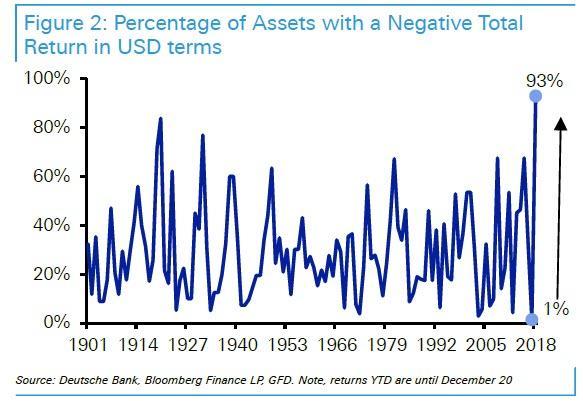
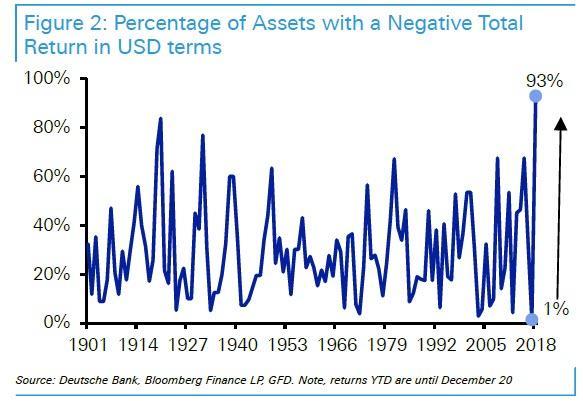
But Marks quickly dismissed this, affirming that he is still believes in the value of analyzing and timing the market cycle. Perhaps that's why his fund, Oaktree Management, seized the opportunity to deploy capital during Q4, when nothing was working (2018 will go down in history as one of the worst years for financial markets on record, given the breadth of losses across asset classes), and everybody seemed to be selling in a panic.
Elaborating further Marks explained his view on where we are in the cycle. Until Trump's arrival in the West Wing, the recovery had been chugging along slowly (while asset prices had been moving in a nearly uninterrupted diagonal line from left to right). Setting aside the direct impact of central bank liquidity, Marks explained that after the crisis, people and businesses were left traumatized, which was one reason why growth was so tepid, even once this immense monetary assistance had been factored in. But the fiscal stimulus unleashed by the Trump administration, in the form of tax cuts and increased federal spending, was like administering a "shot of adrenaline to an already healthy patient."
For this reason, Marks doesn't think the highs are in - at least not yet. But ultimately, he believes we will get to new "highs that lead to lows."
GRANT WILLIAMS: There must come a point where things get out of hand. Going back to the original question of 2005, 2006, do you see any similarities in what you're seeing and what's starting to make your spidey sense tingle?HOWARD MARKS: Not similarities in the sense of specific things repeating. But I have felt that because people were traumatized by the great recession, the recovery has been the slowest one since World War II. And that has kept things moderate, which meant that we would certainly have a recession one of these days. But it would be moderate. When you don't have a boom, you don't have to have a bust in my belief.But now between the tax bill, which was a shot of adrenaline into, in my opinion, an already healthy patient, and then the possibility that we're going to see a Powell put in action, I think that we may get to highs that lead to lows.I'm a believer in cycles. I believe they always have occurred, I think I understand why. And I think they always will occur and I try to study them. And then when I kind of got to the end of writing the book I said, well why do we have cycles? If the market goes up 10% a year on average, why doesn't just go 10% every year? And in fact, it almost never goes up between 8 and 12. So the average is not the norm. Why not?And the answer, I think, is excesses and corrections. So you have a trend line and most trend lines are upward sloping, but then you deviate from the trend line on the upside because of some combination of optimism and greed and wishful thinking. And then you have to have a correction to the downside. So now I'm thinking we may have more of an excess, which leads to more of a correction.
And the longer the Fed and the federal government forestall a recession by artificial means, the worse the fallout will be when one finally arrives. Offering an extremely apt analogy, Marks contrasted the Fed's machinations with the "good forest management"policies needed to prevent out-of-control wildfires like those that have erupted in California over the past two years (see here for an example of what we're talking about).
Marks reasoning goes, the best way to avoid an out-of-control blaze is to permit moderate fires to burn from time to time. That way, they clear out the underbrush. But if we extinguish every blaze before it has a chance to burn, then we put ourselves at risk for a "big one" that could quickly accelerate beyond our control.
GRANT WILLIAMS: When did we get to the point where a recession is something that has to be avoided at all costs?HOWARD MARKS: Yeah, well it's a big mistake. In one of my memos - postmortem for the global financial crisis - I talked about forest fires. Good forest management, you permit there to be fires once in a while. And if there are fires of moderate size, occasionally it burns out the fuel and then you don't get the one big one. Same thing, in my opinion.And the fluctuations of the economy are natural, in my opinion. And should be permitted to occur. And if you try to forestall them, then when they happen - I don't think you can forestall forever. And when they happen, they're bigger.
Over the past 20 years, the whims of the financial markets have grown to outweigh the influence of the economic cycle. The financial crisis, for example, had almost nothing to do with the real economy, Marks explained. Which is why tacit Fed policies like the "Powell Put" could be far more destabilizing than many investors might suspect.
GRANT WILLIAMS: Yeah sure. Well you mentioned cycles, I know you're a great student of cycles. And they used to be so important in markets - everywhere you look. Whether it was the human cycle, whether it was a market cycle, credit cycles - everything seemed to have a rhythm.And it made investing a lot easier because you could at least have some sense of how these cycles would turn. That seems to have changed significantly in the last 15, 20 years. You're shaking your head there.HOWARD MARKS: I don't agree with that. If you talk about 20 years, if you came in this business 20 years ago, you have seen two profound cycles. You had the TMT bubble and crash and then you had the mortgage bubble and crash. And I think that maybe they weren't predictable, but I'm not sure they ever were.GRANT WILLIAMS: I wouldn't classify those cycles. I kind of look at them and think they were both attempts at cycle turns that happened quickly in kind of short order in small corners of the market. And then got squashed quickly by Fed policy.HOWARD MARKS: Well, they were market cycles - bubble and crash.GRANT WILLIAMS: Yeah.HOWARD MARKS: They weren't economic cycles in the traditional sense. And in the last 20 years, I think that developments in the financial world have taken over in importance from developments in the rest of the business world.
Ultimately, Marks still believes in the importance of understanding market cycles because, fundamentally, human nature hasn't changed. Which is why it's dangerous to believe that, in an increasingly unstable world, that stability has become the norm.
HOWARD MARKS: ...And the big theme of the book is Mark Twain - history does not repeat, but it does rhyme. And the world is just too unstable a place to believe that stability is the norm.And you know if you think about it, in the economy a great year is up four, and a bad year is down two. So the economy has an upward trend and it kind of goes like this. Then companies have leverage - financial leverage and operating leverage. So their profits go like this. And then the market goes like this. And why? Because of people.The risk in the market does not come from stock certificates, companies, exchanges, it comes from people. But people are prone to excess and I don't see how it can be argued otherwise.And by the way, when people say, I don't think we're going to have cycles in the future because the astute Fed has it under control - or whatever it is - what they're saying is what I consider the four worst words in the world - it's different this time. OK until now we've had cycles, but we're not going to have anymore.
One risk that markets are probably failing to truly understand is the rise of the radical left, and their support for "confiscatory" taxation policies.
GRANT WILLIAMS: I mean, it certainly seems that way. When you look at the traction Ocasio- Cortez is getting - and Liz Warren - and it's clear that they both realize that this is how we're going to create that traction - by going against the elite.But some of the things they're proposing are the 70% tax. Liz Warren was on MSNBC looking straight down the camera at everybody else saying, we're going to find your wealth and we're going to come and get it. These are things that I'm sure a lot of people in America never thought they'd hear in this country.HOWARD MARKS: I think the thing in the memo that I got heated about the most, and I was trying to put it out and then Friday Elizabeth Warren came out with her wealth tax idea. But what got me was that - she tweeted it out of course - the way she did it.She said something like - don't quote me - the rich and powerful run America and look at what they have arranged for themselves. They are allowed to keep their accumulated wealth. Well, guess what? We're all allowed to keep our accumulated wealth.And she makes it sound like - through some skullduggery - they have exempted themselves from the wealth tax. You can't exempt yourself from something that doesn't exist. But she makes it sound nefarious. And that's populism - they, they. And it's not constructive.I would lay a strong bet that five years from now, my tax rate will be higher than it is today. But it should be, as I said in the memo, it should be progressive, but not punitive. And not confiscatory. Among other things, people don't have to sit still and pay it.I wrote a memo back in 2016 called "Economic Reality" and I talked about a guy I know who was the biggest taxpayer in New Jersey. They raised the rates to a point where he moved to Florida where there is no tax.So the point is, the people who want to confiscate seemed to think that there's nothing that the confiscatees can do about it.
Marks believes the growing divisiveness in Washington will lead to increasingly counterproductive policymaking, as Democrats and Republicans focus more on spiting one another by passing major policy initiatives without any participation from the minority party (Obamacare and Trump's tax bill are both examples of this). But shifting his focus back to his investing strategy, Marks explained that he recently realized that cyclical extremes offer probably the best chances of trades with high returns. "When you are at an extreme high or an extreme low, the logic is compelling and the probability of being right is high."
But the problem is, these opportunities don't come around very often. Marks most successful market calls occurred about once a decade - 5 times in 50 years.
But another inflection point where valuations are obviously overstretched could be just around the corner.
Facebook may be facing a “multibillion-dollar” fine from the FTC. Here’s why.
Cambridge Analytica is still causing headaches for Facebook.
The FTC isn’t messing around.
The Federal Trade Commission, which is still investigating Facebook for potential privacy violations related to how the company has shared data in the past with outside developers, is negotiating with Facebook to settle the issue with a fine that could be billions of dollars, the Washington Post reported Thursday, February 14.
The negotiations are ongoing, and it’s still unclear exactly how much Facebook would have to pay — or if the company will settle at all. Without a settlement, the two sides could go to court.
But a multibillion-dollar fine would be the agency’s largest ever against a tech company, the Washington Post says. Facebook brought in almost $56 billion in revenue in 2018, so while the fine is steep, it’s also affordable.
The FTC, which has been investigating Facebook’s privacy practices since March 2018, is nearing the end of that investigation and is prepping what the Post described previously as a “record-setting fine” against the company.
Why is the FTC investigating Facebook?
Facebook’s Cambridge Analytica privacy scandal, which became public last March, inspired this investigation. It was learned that Facebook shared — without their permission — the personal profile information for tens of millions of people with an outside app developer back in 2014. That developer then sold that information to Cambridge Analytica, a data analytics firm that eventually worked with Donald Trump’s 2016 presidential campaign. The fact that the app developer collected the data was not against Facebook’s rules at the time. But selling the data was.
The entire incident left Facebook scrambling to explain how its data collection practices work — they’ve since been changed — and raised some serious questions about user privacy. Among them: Did this data sharing violate an agreement Facebook made with the FTC back in 2011 to better protect people’s privacy? The FTC wanted to find out, so it started investigating.
What did Facebook promise as part of its 2011 consent decree?
That agreement with the FTC, known as a consent decree, has multiple parts, including a requirement that Facebook receive “affirmative express consent” from users before making any changes to its privacy policies. The part of the agreement that seems to be up for interpretation is Facebook’s promise that it wouldn’t make any “misrepresentations about the privacy or security of consumers’ personal information.” It seems possible that allowing third-party developers to access a user’s personal information without their knowledge could be seen as a “misrepresentation” on Facebook’s part.
Facebook would disagree. The company has argued in the past that this data collection took place appropriately, given the company’s privacy policies that were in place at the time. People may not have known their data was being collected in the way it was, but that explanation was in the fine print of Facebook’s policies. The problem arose when the developer then sold that data to Cambridge Analytica, which was against Facebook’s rules.
Is that all the FTC is investigating?
Cambridge Analytica is what set off this investigation in March, but the company has had a number of privacy slip-ups since then that the FTC could be looking into. A number of software bugs created privacy concerns for Facebook this summer: One changed the privacy settings for as many as 14 million people without their knowledge; another “unblocked” people that hundreds of thousands of users had blocked, putting users’ safety at risk; yet another “vulnerability” exposed to hackers the personal Facebook data of almost 30 million people. When Facebook announced that breach, a company spokesperson said Facebook was “closely coordinating” with the FTC to let them know what happened, so the two sides have been in touch about more than just Cambridge Analytica.
What will Facebook’s punishment be?
There will most certainly be a fine imposed on Facebook, and the Post is reporting that it could be “record-setting.” Facebook’s 2011 consent decree says that the company could be fined as much as $16,000 per day for “each violation.” It’s unclear exactly what that means — does each impacted user count as a separate violation? — but when Google was fined by the FTC for privacy-related reasons in 2012, the fine was just $22.5 million, a record penalty at the time.
If Facebook is fined, the total is likely to be much higher, though it’s unclear how much damage the FTC can do with a monetary penalty alone. Facebook’s revenue in 2018 is estimated to be more than $50 billion. Even a $1 billion fine, which would be a huge leap from the penalty Google faced, would be less than 2 percent of the company’s total sales. Google was fined by regulators in France for violating Europe’s strict new data privacy laws. Even that fine was just $57 million.
It’s also possible Facebook will face other penalties, like a renewed privacy agreement that could create stricter penalties and rules for the company to follow.
How soon might this happen?
“Soon,” according to the Washington Post, though the government shutdown likely slowed things, given that most FTC employees were not working then. The New York Times says that the committee’s five FTC commissioners, who will ultimately decide on punishment for Facebook, had been coming into the office during the shutdown, though when we reached out to the FTC during the shutdown, we received this automatic reply: “The FTC Office of Public Affairs is closed due to the government shutdown. We are unable to respond to your email until the government is funded and resumes operation.”
What is Facebook saying about this?
Nothing, really. The company issued a statement last March, when the FTC first announced the investigation, to say that it welcomed “the opportunity to answer questions the FTC may have.” A source familiar with Facebook tells Recode the company is still cooperating with the FTC. Other than that, Facebook has been quiet.
How long before big media companies become big sports-gambling companies?
Sooner than you think. But AT&T, which owns HBO, TNT, and CNN, says they won’t be taking your bets.
Sports betting in the US used to be illegal, for the most part. Now it’s up to individual states to decide if they want it. Besides Nevada, which has always had legal sports betting, a handful of states have authorized it, with only New Jersey jumping in completely. But with estimates of US sports gambling hovering around $150 billion annually, it won’t be long before many states decide they want a piece of that action.
So here’s the question for media companies that are hoping to profit in some way from the billions of dollars gamblers are going to bet on sports: How do we get a slice?
I’ve been talking to people who make money in sports betting and media, and this looks like the way it’s going to play out:
The easiest way for media companies to play in this is to simply take ad money from sports bookmakers, and/or develop programming aimed at sports gamblers. We’re already seeing plenty of people getting into this, from ESPN to WarnerMedia’s Bleacher Report, which just announced a deal with Caesars Entertainment to produce a gambling show hosted in Caesars’ Las Vegas casino; in return, Caesars will buy ads on Bleacher Report and on other properties — including TV networks — owned by WarnerMedia. One complicating wrinkle: The overwhelming majority of sports gambling happens via illegal/offshore operations. Do media companies want to take money from those guys, the legal/US guys, or both?
Trickier: Making more money via affiliate advertising, where the media companies make money by sending viewers and readers directly to casinos and sports books, and getting paid for each referral. Affiliate revenue is increasingly important to all kinds of publishers (including Vox Media, which owns this site), so this isn’t a difficult idea to grasp. But it does link the media companies more directly with betting, which may give some of them pause. Maybe because they’re worried about liability issues that could arise when problem gamblers end up looking for someone to sue once they’ve lost all their money, or perhaps because they simply don’t feel great about embracing gambling, period.
The most involved: Actually getting into the sports betting business by taking bets and making payouts. This isn’t an unheard-of idea. Sky, the UK satellite TV business recently acquired by Comcast*, owned its own betting business for 15 years. And yesterday an executive from a sports betting company told me they are reasonably confident we will see it happening with one or two US-based companies in the coming years — but wouldn’t tell me who they will be.
You can argue that Big Media has already been touching sports gambling in lots of different ways, from NFL pre-game shows that mention betting lines, to the March Madness brackets CBS and other companies produce, or the fantasy sports services run by ESPN, Yahoo, and others.
But none of those toe-touches into gambling offer the media companies a direct way to benefit from people directly wagering on sports. And when media companies have bumped against more traditional gambling in the past, they’ve been skittish about it. In 2015, for instance, Disney was set to invest in Draft Kings, a “daily fantasy” betting operation (that is now morphing into a real betting operation), but backed out.
But now we are talking — in theory — about big media companies actually running their own sports books. Who might that be? We can rule out AT&T’s WarnerMedia, per AT&T CEO Randall Stephenson: Onstage at the NBA’s Tech Summit event in Charlotte, North Carolina, I asked him whether he’d be in the sports betting business directly and he responded with an emphatic, “No.” (But, per above, his company’s Bleacher Report is indeed going to be taking other gambling operations’ sports money.)
My uneducated hunch is that Rupert Murdoch’s Fox will be up for it, given that they’ve already been exposed to it via Murdoch’s operations in the UK and other territories where sports gambling has been legal for years. Any other guesses? Feel free to ping and I’ll follow up.
Meanwhile, if you want to hear my conversation with Stephenson, I’m happy to oblige: We’ll be running it as the next episode of Recode Media, which you can hear here (or many other places!) next Thursday.
* Comcast is a minority investor in Vox Media.
Deal-hungry JAB hunts for new partner to steer Reimann fortune
Peter Harf says he has options to replace Bart Becht who left last month
JAB Holdings, the acquisitive investment group whose portfolio spans Pret A Manger and Keurig Dr Pepper, plans to recruit a new managing partner to replace Bart Becht, who left unexpectedly last month after a disagreement over strategy.
Peter Harf, JAB chairman, told the Financial Times that the 29-person investment group and its portfolio companies were stocked with “young talent” who could be promoted if they showed the right combination of skills and ambition.
“We need someone who is incredibly honest, humble, and of course who has a stellar track record,” said Mr Harf in an interview, who said JAB might wait up to three years. “I have options in mind.”
The clash between Mr Becht, the former chief executive of Reckitt Benckiser, and the other partners stemmed from a differing views on how JAB should function.
Mr Becht advocated taking a more direct approach to running the portfolio of casual dining and coffee-dominated businesses, which also include Jacobs Douwe Egberts and Panera Bread Company.
He also wanted JAB to do fewer deals. But during a $50bn-plus acquisition spree, Mr Harf became convinced that JAB should be an investment company, and leave the day-to-day management to the executives at the businesses.
“This is my mistake, a construction mistake, at the beginning,” Mr Harf said, confirming an earlier FT report. “It was a conflict, if you will, of objectives.”
He added: “What I didn’t realise at the time [I hired him] was that Bart is really more interested in operations, in operating, and we were trying to form an investment company. An investment company . . . is fundamentally different from a company that operates as its major thing.”
Asked whether Mr Becht had sold his JAB shares, Mr Harf said: “We did a very friendly deal that takes the financial side out of the equation. We’re friends, I like the guy. We worked together for 30 years.”
Mr Becht declined to comment.
For now, the task of running JAB falls to Mr Harf and fellow managing partner Olivier Goudet, a skilled dealmaker who joined from US food group Mars around the same time Mr Becht arrived in 2012.
The men are in charge of steering the vehicle that manages the wealth of Germany’s Reimann family, a fortune that Forbes put estimated $18bn, as well as more than $11bn raised from outside investors. The family owns 90 per cent of JAB Holdings, and the equity partners own the rest.
The group’s reputation has taken a knock after one of its older investments, cosmetics maker Coty, botched a flagship $12.5bn acquisition. Moody’s has also put JAB’s credit rating under review, questioning its “aggressive growth strategy”.
The unexpected exit of Mr Becht, who was the most experienced of the partners operationally, has compounded concerns.
5 Ways to Invest in the Robotics Revolution
ROCHESTER HILLS, Mich.—Large yellow metallic arms quietly performed a myriad of tasks like placing a windshield on a car, stacking boxes, and sorting red and green pills randomly poured out from a container at Fanuc ’s robotic-training facility here, a sprawling campus some 40 minutes north of Detroit.
Then an elephant-size robot picked up a red Kia sedan and spun it as if it were a child’s toy. “That’s our biggest robot,” explained the plant’s manager, Mike Estes.
While that feat was eye-popping, what’s truly impressive about robotic automation today is its brains, not its brawn: new applications, new software, and connected technologies that are making robots more efficient and more versatile.
At General Motors (ticker: GM), 13,000 of the 30,000 robots in its plants worldwide are now connected. Each day, those robots feed operating data into the cloud. GM uses the data to do predictive maintenance on its machines to improve plant uptime.
“One [percentage point] improvement in uptime is significant,” says Dan Grieshaber, GM’s director of global manufacturing engineering integration. “We got seven [percentage points] improvement in our first month with data analytics. That’s huge dollars.”
Technology is also enabling robots to do more. The sorting of red and green pills in the Fanuc facility wasn’t directed by any human. The machines recognize color and can react to object orientation and a changing environment like never before.
A fast-growing niche is collaborative robots, or cobots. These smaller robots work alongside humans and are cheaper, easier to program, and appeal to smaller enterprises that wouldn’t have considered robotic automation in the past.
The new technologies are part of what manufacturing executives are calling the next industrial revolution, one that makes robotic automation accessible to a wider assortment of customers. Already, growth has been explosive. Robot deliveries have grown 19% a year on average for the past five years, up from the 5% annual growth averaged in the previous 20 years.
For investors, there are opportunities to be found in the major robot makers. Fanuc (6954.Japan), whose U.S. subsidiary is in Rochester Hills, is the largest. ABB Group (ABB), Yaskawa Electric (6506.Japan), and Kuka (KU2.Germany) are the other big robot makers. Boston-based semiconductor company Teradyne (TER) crashed the party in 2015 through its $285 million acquisition of Universal Robots.
Of the five, Teradyne is particularly attractive. Robots are 12% of total sales but the business is growing rapidly, and investors don’t give the company credit for that growth. Its stock trades for 17.2 estimated 2019 earnings—a small premium to other semiconductor equipment companies that don’t have high-growth franchises.
Teradyne’s automation business generated $261 million in 2018, and Weston Twigg, an analyst with KeyBanc, says that cobots can be a $1 billion business by 2021. That’s a huge opportunity for a company with $2.1 billion in revenue.
Based on the multiples paid for other high-growth industrials and for Teradyne’s semiconductor peers, the company’s shares could double over the next couple of years.
Barron’s has also been bullish on ABB because the company is selling its slower- growth power-grid infrastructure business. What’s left will be dedicated to electrification and advanced automation technologies—including robotics.
It’s impossible to write about growing robot use without considering the impact on factory workers. One side of the debate worries that robotic automation steals jobs from the people who have the most trouble training for a new career. The other side maintains that higher productivity will create more jobs.
Everyone in the robotics industry is painfully aware of this debate. Robot users are quick to point out that they apply robotic technology to dirty and dangerous jobs they have trouble filling.
ABB CEO Ulrich Speisshofer frames the debate another way: Better manufacturers get the work. Economies with the highest penetration of robotics—South Korea, Germany, Japan—have healthy manufacturing sectors that create jobs.
The penetration data also point to the potential demand. To increase robot density to the levels of those three countries, the industry would need to ship four million to five million industrial robots—more than 11 years of production at current rates. (There are only about two million robots around the world today.)
Consider what happened in aerospace when China emerged as an economic power. Boeing ’s backlog went from three years of production to seven. Along the way, its valuation went from 15 times estimated earnings to around 18 times. The robotic backlog is expanding in a similar way.
Fortunately, you don’t have to rely solely on a Boeing-like multiple expansion with industrial robots. Higher growth and a stable industry structure should do the trick for investors in Teradyne and ABB.
Corporate Credit Could Be the Next Bubble to Burst
The Cassandras of the corporate credit market are being ignored, again.
Amid their warnings—or perhaps because of them—companies and countries have been getting low-cost money while the getting’s good. To some, this has echoes of the time preceding the subprime mortgage meltdown that led to the financial crisis of 2008.
At this year’s Barron’s Roundtable, DoubleLine CEO Jeffrey Gundlach warned that the corporate bond market poses the biggest risk to a debt-dependent economy. While the investment-grade sector has burgeoned in size, its quality has deteriorated, with much of its lower tier actually deserving speculative grade, aka junk, ratings.
But before the last call, companies are bellying up to the bar for mega-size shots of debt. Altria Group (ticker: MO) issued $11.5 billion of bonds to help fund its stake in Juul, the maker of e-cigarettes, according to Bloomberg. That followed an even bigger borrowing of $15.5 billion by Anheuser-Busch InBev (BUD) last month to refinance some SABMiller debt. AT&T (T) sold $5 billion to refinance outstanding debt, which has swelled to $171 billion at the end of 2018 in the wake of last year’s acquisition of Time Warner. And Boeing (BA) has issued $1.5 billion.
This rush to borrow has followed the Federal Reserve’s shift in its policy stance last month, essentially signaling that its short-term interest rate target would remain on hold. But that has raised red flags, warns Stephanie Pomboy of MacroMavens.
At his press conference after the last Federal Open Market Committee meeting, Fed Chairman Jerome Powell was asked if pausing rate increases would “contribute to a bubble in corporate debt.” While noting that he had “called out corporate debt as a risk,” Powell added that the risk was de minimis.
To Pomboy’s ears, that echoed loudly former Fed boss Ben Bernanke’s insistence in May 2007 that problems in subprime mortgages were contained and “posed no serious spillover to banks or thrift institutions.”
Regulators insist there can’t be a replay of 2008-09 because of reforms that have left banks far better-capitalized and more closely scrutinized. But, as Pomboy pointedly observes, the problem then was the nonbank sector. Banks would offload their dubious credits, somehow turning them into derivatives that got top-grade ratings, which were then scooped up by unsuspecting investors in the form of collateralized debt obligations, or CDOs.
“While it’s true that ‘til just recently there’s been a welcome dearth of alphabet soup tied to low-tier corporate debt, that doesn’t mean there isn’t leverage. Plenty of it. Where banks and CDOs were providing explicit leverage back then, [exchange-traded funds] are providing leverage (both explicit and implicit) today,” she writes in her weekly client note.
In addition to levered funds that amplify the move of the underlying securities by two or three times, many individuals invest in high-yield ETFs on margin, she continues, while hedge funds do the same tenfold. The real risk is the myth that ETFs will provide “abundant and immediate liquidity,” which Pomboy says has emboldened investors “to stake out far larger positions than they otherwise would.” In that, they’re like CDO buyers who believed they had quality investments.
“In 2007, the lie was that you could take a cornucopia of crap, package it together, and somehow make it AAA,” she says. “This time, the lie is that you can take a bunch of bonds that trade by appointment, lump them together in an ETF, and magically make them liquid.”
Given the reduced inventories of corporate bonds held by institutions, there are fewer market makers to step into the void when the selling of ETFs begins. “The upshot is that these vehicles are only liquid in one direction,” Pomboy contends. Yet Bank of America Merrill Lynch’s high-yield analysts say their gauge of the yield premium to compensate for illiquidity is the lowest since 2007.
To be sure, ETF managers dispute such dire predictions. They say that they have come through spates of selling without significant dislocations. That liquidity, however, could be tested by $1.3 trillion in leveraged loans, another $1.2 trillion in junk bonds, and $3 trillion of investment-grade corporates just one rung above junk, with $780 billion coming due this year, Pomboy counters.
While she sees dire consequences for institutions, such as pension funds, that have loaded up on dicey debt, others can take advantage or protect themselves from a junk debacle. And it’s less complicated than buying credit default swaps against subprime CDOs, as a few savvy traders did to profit in the crisis.
Peter Cecchini, chief market strategist at Cantor Fitzgerald, recently suggested that the firm’s institutional clients buy a put spread on the iShares iBoxx $ High Yield Corporate Bond ETF (HYG). That would involve the purchase of a put option that would give the right to sell the fund through April 18 at $83 and the simultaneous sale of another put with the same expiration and a strike price of $80, for a net cost of 40 cents.
The ETF, selling at $85.12 at the time of his recommendation, would have to fall to $82.60 for the put spread to become profitable. The maximum profit would be $2.60, if the fund fell to $80—6.5 times the cost of the put spread. In comparison, at its recent low on Dec. 24, the iShares product closed at $79.27.
Pomboy might sound overly negative. But remember, she warned of the risk posed by mortgages in the last decade long before they nearly brought down the global financial system and economy. The Cassandra of mythology also turned out to be right, if unheeded.
Corrections & Amplifications
AT&T’s debt was about $171 billion at the end of the year. An earlier version of this article said the debt level was $180 billion, which was the total at the time of the Time Warner acquisition.