Closing Stock Market SummaryThe S&P 500 advanced as much as 0.8% on Monday after President Trump said he will delay the March 1 trade deadline as negotiations with China have progressed favorably. The benchmark index, however, steadily retreated throughout the session, ultimately finishing higher by 0.1%.
The Dow Jones Industrial Average (+0.2%), the Nasdaq Composite (+0.4%), and the Russell 2000 (-0.1%) also finished near their session lows.
President Trump followed up with a tweet during late trading action that U.S.-China talks are in advanced stages, but he did not provide a new deadline or any further details. Still, growing expectations for a trade deal underpinned the leadership from the S&P 500 cyclical sectors.
The S&P 500 materials (+0.7%), information technology (+0.5%), financials (+0.4%), and industrial (+0.4%) sectors outperformed the broader market.
Shares of semiconductor companies, many of which have revenue exposure to China, also outperformed and helped lift the heavily-weighted tech sector. The Philadelphia Semiconductor Index increased 0.8%.
General Electric (GE 10.82, +0.65, +6.4%) gave the industrial sector a boost after it agreed to sell its biopharma business to Danaher (DHR 123.15, +9.67, +8.5%) for $21.4 billion, which includes $21 billion in cash. General Electric had surged 15.5% in the opening minutes of trading but, like the broader market, finished near its session low.
Conversely, the real estate (-0.8%), utilities (-0.6%), consumer staples (-0.5%), and consumer discretionary (-0.3%) sectors finished the session with losses. The underperformance from the consumer discretionary sector was a drag on the broader market considering it was up as much as 0.7% in the opening minutes of trading.
U.S. Treasuries closed on a lower note, pushing yields higher across the curve. The 2-yr yield increased three basis points to 2.51%, and the 10-yr yield increased two basis points to 2.67%. The U.S. Dollar Index declined 0.1% to 96.42. WTI crude lost 3.1% to $55.45/bbl.
Separately, Wholesale Inventories for December increased 1.1% (Briefing.com consensus +0.4%). The November reading was revised up to 0.4% from 0.3%.
Looking ahead, investors will receive Housing Starts and Building Permits for December, the Conference Board's Consumer Confidence Index for February, the S&P Case-Shiller Home Price Index for December, and the FHFA Housing Price Index for December on Tuesday.
- Russell 2000 +17.8% YTD
- Nasdaq Composite +13.7% YTD
- Dow Jones Industrial Average +11.9% YTD
- S&P 500 +11.5% YTD

The Next LTCM? $8 Billion Hedge Fund Is Using 10x Leverage
According to some, America's bailout culture started long before the 2008 global financial crisis, with Wall Street's bailout of Long-Term Capital Management, an iconic hedge fund whose employee roster included a "who is who" of Nobel prize winners and financial luminaries, and whose core business model was, for lack of a better word, collecting pennies in front of a steamroller: one of the fund's most popular trades was in the arena of fixed-income arbitrage, where the fund would take advantage of tiny mispricing between more expensive "on the run" treauries and cheaper "old benchmark" notes, capitalizing on a tiny spread which was at most a few basis points, betting that over the long run this spread would collapse. To make this trade economic, the fund employed massive leverage: at the beginning of 1998, the firm had equity of only $4.72 billion against which it had borrowed over $124.5 billion resulting in "regulatory assets" of around $129 billion, for a debt-to-equity ratio of over 25 to 1 (the fund also had off-balance sheet interest rate derivatives with a notional value of approximately $1.25 trillion).
For a while, the fund's massively leverage trades worked as expected, with the fund returning 21%, 43% and 41% in its first three years, respectively, however in year four things turned ugly when first the Asian Financial Crisis struck in 1997 followed by the 1998 Russian Financial Crisis. At that point the fund lost $4.6 billion in just weeks, wiping out its entire equity stack, and prompting the first official "intervention" by the Federal Reserve alongside a consortium of 16 banks, which stepped in to help an orderly unwind of the fund whose implosion was rocking the market.

We bring this iconic hedge fund blow up - which was entirely due to far too much leverage - because it appears that we may be returning to the good old days of stratospherically insane hedge fund leverage. Case in point, Michael Gelband’s new hedge - just a few months old - which may not have quite the leverage of LTCM just yet, appears to be giving it the old college try; in fact, as Bloomberg notes, Gelband is already already using more leverage than his former boss, Israel Englander.
ExodusPoint Capital Management, one of the industry’s highest-profile launches in recent history, had $82.3 billion of regulatory assets as of Dec. 31, or almost 10 times the $8.4 billion of investor capital the firm had under management, resulting in roughly 10x leverage according to a the fund's Form ADV.
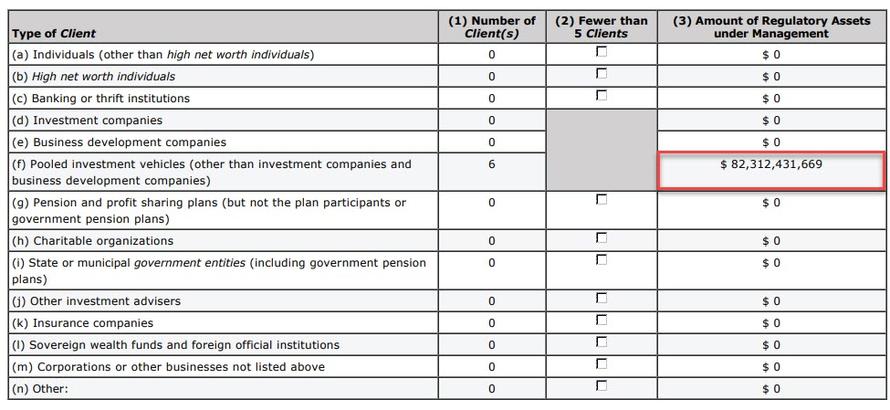
While not yet LTCM level leverage, it's quickly getting there. By comparison, Izzy Englander’s Millennium, which Gelband quit in 2017 after realizing he would not take over for Englander any time soon, had regulatory leverage of "only" 5.85x net assets according to SEC filings.
As we have discussed before...
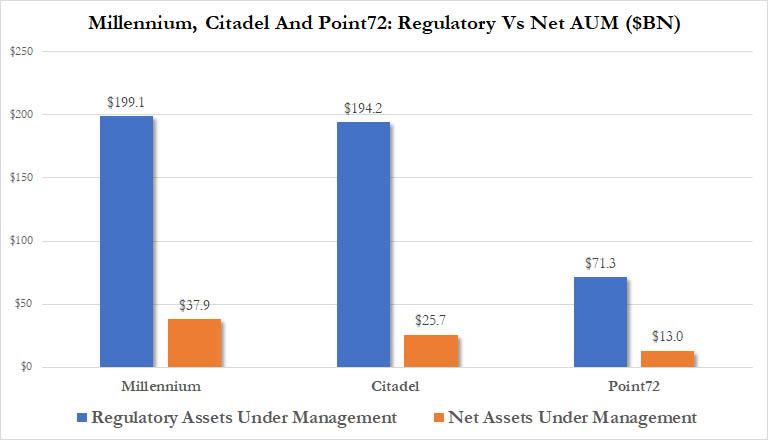
... and as Bloomberg reminds us today, multi-strat funds like ExodusPoint, which frequently include various HFT strategies among their various "pods", use massive leverage to boost returns on tiny arbs while using risk controls to limit losses. Ken Griffin’s Citadel, another behemoth among multi-manager firms which extensively uses HFT trading strategies to scalp traders and front-run retail orderflow, had average leverage of over 7 times capital last year.
This was s the first time ExodusPoint has disclosed its regulatory assets which includes investments made through the use of borrowed money, repos, derivatives and other synthetic leverage instruments. Net assets, roughly equivalent to investor capital, omit leverage.
Amusingly even Bloomberg here admits that "funds have generally taken on more leverage since the 2008 financial crisis as efforts by central bankers to prop up markets depress the premiums investors receive to assume risk."
Translation: it's only a matter of time before we get another headline such as this: "Multistrat Massacre: Steve Cohen, Millennium, Citadel Suffer "One Of Worst Months Ever" and we have the Fed again to thank for it.
“We have been in an environment where risk premiums are narrowing, so people have had to embrace more risk,” said Eric Petroff, a former institutional consultant and research director who now provides money managers with research and marketing services.
ExodusPoint began trading last June as the industry’s largest startup after receiving some $8 billion in capital commitments, though about half of the money didn’t arrive until October, according to filings. The firm generated a 0.6% return over the ensuing seven months of 2018, despite suffering a sharp hit in December alongside most of its multi-strat peers.
So is ExodusPoint's 10x leverage a harbinger of an LTCM-type blow up? Without knowing the fund's full portfolio - something which Gelfand will guard with his life - it is impossible to know, however it is safe to speculate that 10x leverage on most ordinary positions would be sufficient to wipe out the fund overnight during even a modest market hiccup, which is why it is most likely that like Citadel and Millennium, Exodus point is applying this leverage to capture tiny arbitrage in the market microstructure, i.e., using HFTs to scalp micropennies. As to whether or not we experience another December-type "steamroller" event, it's not a question of if but when. And when that happens, the only Exodus will be that of the fund's investors, assuming of course that the fund won't need another Fed-mediated bailout, just like its far more infamous, and levered, 4-letter acronymed ancestor.