Barrons weekend summary: cautious cover story on SPOT; cautious feature on SAM; positive on health insurers
* Cover story: Investors love Spotify because it’s a fast-growing, youth-focused, cloud-based streaming service with a visionary founder—and it’s investing heavily in podcasting, a growing business; But for the company to become indispensable for investors, the music industry’s underlying structure must change radically in the coming decade and the tech giants competing aggressively with Spotify must lose interest, an unlikely scenario; At current prices, the stock’s potential reward isn’t worth the risk.
* Features: 1) Cautious on SAM: Shares of the company have climbed during the past two years while those of rivals TAP and BUD slipped, but much of the growth came from hard cider and spiked tea and seltzer, areas in which the company will soon face growing competition; 2) Podcasting appears similar to other forms of digital media that have gained prominence and big money in the era of portable, on-demand consumption, but it remains a “strange niche phenomenon” and won’t likely scale like other digital formats; 3) Positive on ANTM, CI, CVS, HUM, UNH: Shares of the leading insurers look appealing, given the long odds of an industry-killing plan such as Bernie Sanders’ Medicare for All becoming law, though the shares could “be under a cloud” until the 2020 presidential election is over; 4) Large mergers and acquisitions typically generate the most goodwill, and are the biggest destroyers of it as buyers overpay, such as in the deal that led to KHC; savvy investors should focus on companies’ return on assets, which could indicate whether a buyer is squeezing more profit out of an acquisition.
* Tech Trader: Positive on INTC: Company’s move to exit the smartphone modem business following the resolution of the AAPL–QCOM lawsuit gets the chipmaker out of a money-losing business and will allow it to focus more on core strengths. Trader: A drop in XLV could push investors out of defensive growth stocks, where health care makes up 57% of the universe, and into cyclical growth stocks, says Thomas Lee, head of research at Fundstrat—and the same pattern might play out in the quality universe as well; PINS may have “surged” after its debut, but since only a select institutional investors get IPO stock at the offering price, regular investors who have to buy on the secondary market didn’t see the same bump. Interview: Don Bilson of Gordon Haskett takes a less traditional approach than many of his peers with what he calls “event driven” research, though some investors prefer the term “special situations.” Profile: Jason Callan of Columbia Mortgage Opportunities has done well in the unloved sector of non-agency mortgage-backed securities, but he says the strategies involved have time limits and investors who fail to adapt will be left behind.
* Advisor Rankings: 1) Barron’s list of the Top 100 Financial Advisors is topped by Lyon Polk, Gregory Vaughan, Andy Chase of Morgan Stanley PWM; the ranking reflects the volume of assets overseen by the advisors and their teams, revenues generated for the firms, and the quality of the advisors’ practices; 2) Demand for institutional consulting services has soared over the past couple of years, increasing the competition and the need for firms to cater to the more-specialized needs of institutions instead of being generalists; 3) Profile of the Jones Zafari Group, which caters to ultrahigh-net-worth individuals and serves as a “virtual family office”; 4) San Francisco-based Elaine Meyers, a managing director and financial advisor at J.P. Morgan Securities, has transformed her traditional advisory practice into one of the top family-office-style teams in the industry; 5) Lyon Polk, founder and managing director of Morgan Stanley’s Polk Wealth Management Group, has $15.4B under management and 20 employees in three areas—family and client services, investments, and business development.
* European Investor: Cautious on Lindt & Sprungli: Confectionary company’s stock is the second-most-expensive consumer stock in Europe behind Hermes; analysts are “unsure whether the company is undergoing a brief rough patch or suffering from a more serious secular downturn.”
* Emerging Markets: Indonesian President Joko Widodo’s apparent re-election to a second five-year term April 17 was welcomed by investors, but the country lags peers economically and in growth, a situation that will demand structural reforms such as loosening labor restrictions and limiting minimum wage hikes.
* Commodities: Oil prices this month touched the highest levels of the year, but the market now faces a number of key tests, including tightening crude supplies and violence in Libya that could cut off the flow of more oil.
* Streetwise: “The U.S. stock market is approaching an all-time high. Relative to earnings, it is pricier than average. And in the next few weeks, we’ll learn whether first-quarter earnings have merely stalled versus a year ago, or gone into decline,” says columnist Jack Hough.
Man Group urges investors to back Jersey move
Holding group in tax haven will free global operations from UK regulatory oversight
Man Group has urged shareholders to sign off its plan to set up a holding company in Jersey, after the alternative investment specialist won regulatory approval for the move.
The Financial Conduct Authority has agreed to Man’s proposal, which the London-listed group said would free its global operations from British regulatory oversight.
Man said it did not expect the arrangement to affect its tax rate as it would still be domiciled in the UK for tax purposes but market-watchers suggested the move would bring advantages.
“This added ‘flexibility’ will make it easier to access potential tax savings structures, such as easier sharing of tax losses between entities, especially in the US,” said David McCann, an analyst at Numis.
Man’s chairman, Ian Livingston, wrote to shareholders last week asking them to back the plan at the company’s annual meeting on May 10. Man needs the support of shareholders that own 75 per cent of its stock. This would allow the group to set up the structure later that month.
Big shareholders in Man include Franklin Templeton, Silchester, BlackRock and Standard Life Aberdeen. Analysts expect the vote to pass with little resistance.
Man would still be listed on the FTSE 250 index. The UK and European businesses would continue to be regulated by the FCA and report into the Jersey holding company, while the US and Asian entities would report directly into the holding company and bypass the UK regulator.
“At present, Man’s businesses in the US and Asia are prudentially regulated by the UK authorities as well as local regulators,” Lord Livingston wrote to shareholders. “The proposed structure would result in the group no longer being subject to global consolidated capital requirements and would therefore provide the group with greater flexibility going forward comparable to other such global groups.”
The FCA has taken an increasingly tough stance on the asset management industry after a hard-hitting government investigation two years ago. Last week, for example, the FCA said it would publish profit margins of investment groups and increase its scrutiny of the fees charged by active managers.
Analysts said the reorganisation offered other advantages. “The proposed structure would result in Man Group no longer being subject to global consolidated capital requirements and would thereby provide it with greater flexibility comparable to other such global groups,” wrote Jon Peace, an analyst at Credit Suisse.
Man said it was following international best practice. Janus Henderson, the New York and Sydney-listed group, has a similar structure, with a holding company registered in Jersey. Henderson Group set up the Jersey entity in 2008. Janus Henderson is tax-domiciled in the UK.
Fidelity International, the sister company of US manager Fidelity Investments, is registered in Bermuda. Fidelity said it paid taxes in all the countries in which it operated and did business.
Man said there would be no effect on its London operations, although Robyn Grew, the group’s chief operating officer and general counsel, would relocate to the US as part of the restructure. The company said the impetus for the change was its increased business in North America.
“I believe part of the rationale is to make it easier for them the manage the group and in particular acquisitions in the US should they wish to do more in the future,” said Mr McCann.
“The other component is to create greater distributable reserves to allow for less disruption to the dividend in event of distributions in excess of statutory profits.”
This month, Man reported a $3.8bn increase in assets under management in its first-quarter results to $112bn thanks to market returns, despite $700m net outflows.
Osram/Bain/Carlyle: lightweight
Lighting group’s shareholders should ignore a lower bid
The light at the end of a tunnel might turn out to be an onrushing train. Weary shareholders of Osram will know that fear. They had more bad news this week. Interest from US private equity firms Bain and Carlyle in taking over the German lighting maker is flickering, according to local media. Osram countered that discussions are still on. Shares nonetheless dipped 6 per cent on Thursday. Osram shareholders should be wary of any opportunistic bids that follow.
Osram was spun out of conglomerate Siemens in 2013. As LEDs replace incandescent bulbs, lighting makers have had to adapt. Osram chose to specialise; half of its sales go to the automotive sector. A slump in global car sales is one reason for the company’s trouble.
Its share price has collapsed by more than half since the start of 2018, and sits not so far from all-time lows. Exposure to the chip cycle as well as China has only compounded the pain. Demand growth for lightbulbs used to be steady if unspectacular, somewhat insulated from economic cycles. Industrial specialisation at Osram has changed that.
One bright spot is Osram’s sound financial health. It has little net debt, only 0.4 times its ebitda (a cash earnings measure). Analysts forecast €150m of free cash flow annually from this year, after a difficult period. Its operating profit margin has more than halved to just over 2 per cent since it separated from Siemens. Indeed, a sound balance sheet should give private equity groups such as Bain and Carlyle more, not less, confidence to add leverage in the case of a buyout.
Bain and Carlyle may try to convince shareholders their offer is fair, but depressed earnings make Osram shares look expensive on any measure. Against peak earnings, Osram trades on just 6 times, a small fraction of its 2019 estimated PER of nearly 40.
Takeover talks with the US groups were confirmed in February at a price near €40. Since then Osram issued a profit warning at the end of March. Should a lower bid emerge, Osram investors should shine it on.
A giant new investment will make StockX the first billion-dollar sneaker reseller
DST, the venture capital firm founded by Yuri Milner, is expected to lead the deal.
The online sneaker resale marketplace StockX is in advanced talks to be valued at at least $1 billion in a new round of financing, Recode has learned.
DST Global, the late-stage venture firm run by Russian-American billionaire Yuri Milner, is expected to lead the deal, according to people familiar with the matter. It will be the latest bet by the firm on an e-commerce startup after backing companies like DoorDash, Wish, and Faire.
The exact size of the financing round couldn’t be learned. Another expected participant is GGV Capital, the venture firm famous for investing in both the US and China, according to the people. StockX is planning to make some other major company announcements when it unveils the fundraising round, which is likely to be closed in the next few weeks.
StockX, DST, and GGV all declined to comment.
StockX launched in 2016 and was founded by Dan Gilbert, the billionaire owner of the Cleveland Cavaliers, COO Greg Schwartz and CEO Josh Luber, who previously ran Campless, a site that eventually became StockX and displayed data about hard-to-find sneakers.
StockX plays matchmaker for sneakerheads looking for rare kicks and resellers looking to flip unworn, in-demand sneakers for a profit. Sellers ship their goods to StockX facilities where employees authenticate that the sneakers are genuine before shipping them out to a buyer.
StockX, which is not profitable, charges a minimum $5 selling fee, plus as much as 12.5 percent in transaction and payments fees. Luber told the New York Times a year ago that StockX generated about $2 million in gross sales every day. The company has 700 employees.
The Detroit-based company gets its name from its stock market-like pricing structure, which lets shoppers either pay the lowest asking price from one of StockX’s sellers or place an even lower bid and see if it eventually matches up with a seller’s asking price. StockX also makes the pricing history of a given sneaker transparent, which is one reason it bills itself as a next-generation eBay. While sneakers are StockX’s sweet spot, the site also sells watches, handbags, and streetwear through the same model.
Like competitors GOAT and Stadium Goods, StockX has benefited from the rising popularity of acquiring tough-to-buy sneakers, especially among millennial men and teenage boys.
And the valuations of the companies in the space show it. The luxury e-commerce website Farfetch paid around $250 million to acquire Stadium Goods, which uses a consignment model, last year. And GOAT, which also owns the boutique sneaker store chain Flight Club, was valued at more than $550 million when Foot Locker invested $100 million in the company earlier this year.
Because of its real-time pricing model, StockX is often able to offer slightly cheaper prices, But StockX’s success and billion-dollar valuation are predicated on these high-end sneakers remaining fashionable or collectors’ items — and that’s no guarantee.
Previously, StockX has been financially backed by Gilbert, as well as Battery Ventures and GV, Alphabet’s early-stage arm.
The Tech IPOs Delivering the Most for Investors
Shares of business-software firms soar above high-profile consumer-tech companies
Consumer-focused businesses may have more cachet, but technology startups that cater to companies are what is really hot.
Until recently, few people outside the corporate IT department had heard of Zoom Video Communications Inc., ZM 72.22% a specialist in videoconferencing software for companies. Still, the company, which counts tens of thousands of business customers, overshadowed better-known Pinterest Inc., which claims some 265 million monthly users of its online pinboards, when the two companies made their debuts on the stock market Thursday.
Zoom shares soared 72% to close at $62 each from its initial-public-offering price of $36 a share—which itself was a nearly 10-fold jump when Zoom last raised capital privately in 2017.
Pinterest shares rose 28% to close at $24.40 a share. Bankers said its $19-a-share IPO price was above its target range, yet the figure still fell short of the $21.53 when it last raised capital in June 2017. Zoom ended the day with a market value of $18 billion, while Pinterest was at $16 billion.
Zoom ended the day with a market value of $18 billion, while Pinterest was at $16 billion.
Nearly 50 U.S. business-software companies have gone public since 2016, including Twilio Inc., MongoDB Inc. and Zscaler Inc. That compares with 13 consumer-technology companies, such as Dropbox Inc. and Snap Inc.
The business-software companies have performed much better, their shares rising a median 126% from their debuts through Tuesday’s market close, according to a Wall Street Journal analysis of Dealogic data. That compares with a median 15% increase for the consumer-tech companies.
Why the different reception? For one thing, consumer technology—from smartphones to social media—is dominated by giants that have proven effective at fending off upstart rivals. “It’s hard to compete with Facebook , Apple , Amazon, Netflix and Google,” said Jeff Richards, managing partner at venture firm GGV Capital.
Social-networking company Snap is exhibit A, robbed of momentum after Facebook Inc.’s Instagram mimicked Snap’s core product. Since its 2017 IPO Snap shares have fallen 31%.
The existing players in business technology, including Microsoft Corp. , International Business Machines Corp. , and Oracle Corp. , have less of a stranglehold on their markets. That is largely because the shift to cloud computing—where companies rent computing power, software and services on others’ servers—has disrupted old markets and created vast new opportunities. “Fund managers have made a ton of money on enterprise companies the last few years,” said Mr. Richards.
Shares in little-known PagerDuty Inc., which helps companies manage their web operations, jumped 63% since its IPO last week, giving it a market capitalization of roughly $3 billion.
UiPath Inc., a closely held specialist in “software robots” that mimic humans to complete mundane back-office tasks, is in talks to raise capital at around a $7 billion valuation, said a person familiar with the company. That equates to a sevenfold jump in just 12 months.
Concerns over huge losses are robbing some consumer-focused tech companies of momentum. Ride-sharing company Lyft Inc.’s shares have slid 19% since its late March IPO, and rival Uber Technologies Inc. recently cut its proposed IPO valuation.
Overall, business-software firms tend to go public at lower market capitalizations, a median of $1.3 billion for those that went public since 2016, according to Dealogic data, compared with $1.6 billion for consumer-focused tech companies.
Zoom was valued more highly relative to its size than Pinterest at its IPO price, with a market capitalization 32 times last year’s sales compared with 17 times for Pinterest. Zoom was slightly profitable last year while Pinterest lost money.
Before they went public, Snap and file-storage firm Dropbox, like Pinterest, were high-profile consumer-focused companies well known to Silicon Valley investors. They drew private capital at high valuations only to stagnate before going public. Dropbox’s valuation has flatlined—it currently trades near its IPO price just over a year ago—in part because the company has struggled to move beyond consumers and sell its software to companies.
Zoom says it has grown because it developed video-focused conferencing software tailored to cloud computing, rather than having to adapt old products like some competitors did.
Chief Executive and founder Eric Yuan came to the U.S. from his native China in 1997 and started as an engineer at videoconferencing service WebEx Communications Inc., which was acquired by Cisco Systems Inc. a decade later. He said in an interview that his expertise in videoconferencing enabled him to spot an opportunity for an alternative service, leading him to start Zoom in 2011.
Santiago Subotovsky, a general partner at venture firm Emergence Capital, was the first institutional investor to plow money into Zoom in 2014. He said consumer-oriented tech companies such as Pinterest get more attention, and that leaves more opportunity for investors focused on technology for businesses.
“You’re not competing with everyone else and their dog” to invest, he said.
Zoom went mostly unnoticed for some time by venture investors who depended on products like WebEx, Microsoft’s Skype, and Google Hangouts for videoconferencing, said Mr. Subotovsky.
He said he used Zoom to do videoconferencing with people abroad—he hails from Argentina and his wife lived in Kenya—and found that it worked better than the other products. When he recommended that his foreign contacts download it, and saw them share Zoom on their own, he decided he wanted to invest, buying in at 87 cents a share.
It wasn’t until March, when the company filed to go public and revealed both fast growth and a solidly profitable bottom line, that the wider market took notice of the company, said Mr. Subotovsky.
The big spike in Zoom shares on their first trading day suggests bankers may have priced them too low for the IPO. But Mr. Yuan said that isn’t a concern, that it is “better to leave money on the table” for investors to profit.
Gucci turns to call centres to lure high-spending millennial shoppers
Fashion brand tries to reinvent the traditional shop assistant for the smartphone age
Gucci is opening six customer service centres, including in Florence and Shanghai, staffed by 500 people, as the company tries to reinvent the traditional shop assistant for the smartphone age.
The call centres, which will resemble Gucci shops, are intended to cater for shoppers wanting to discuss a $2,200 GG handbag or a $1,590 pair of trainers by phone, email or live chat.
It is the latest move by the Italian fashion brand, which is part of the French group Kering, to keep up with rapidly changing consumer habits, which has helped the company deliver industry-leading sales growth in recent years.
Marco Bizzarri, Gucci’s chairman and chief executive, said the call centres aim to give customers “a direct connection to the Gucci community that is seamless, always accessible, personalised experience”.
Gucci has branded the new client service centers with the name Gucci 9, an indication of importance it is placing on the rollout of the centers in driving sales.
Industry analysts are closely watching the next steps from Mr Bizzarri, and Gucci’s designer, Alessandro Michele, to see if they will be able to hit the company’s target of €10bn in revenues and further close the gap on rival Louis Vuitton.
Luca Solca, an analyst, said Gucci has grown at a “pace never seen before” by a big brand by understanding the new social and technological trends that are reshaping the idea of luxury. “A generation shift and the internet are the root cause,” said Mr Solca.
However, the pressure to sustain that growth is rising. Although Gucci’s 20 per cent jump in organic sales last quarter led the industry, the pick-up failed to outpace the consensus of financial analysts in the way it did a year ago.
The company’s main call centre on the outskirts of Florence opened this month, and offers an idea of how Gucci hopes they will help. In a 2,300 sq m building with similarities to the group’s store in Milan, rows of smartly dressed young people sit at desks chatting on phones or tapping at emails.
Mr Bizzarri said it is a place where he and his team can “explore the best ways to optimise the remote client experience” that is important for driving sales particularly among fickle, smartphone-addicted millennial shoppers who account for more than half of Gucci’s revenues. Call centre staff are encouraged to strike up personal relationships online with high-spending callers, just as the traditional shop assistant would.
Gucci’s latest Ophidia GG handbags and Flashtrek trainers sit on yellow coloured boiserie shelves, while upholstered screens divide up rooms, helping to muffle sound. In an adjacent room, young people in jeans and Gucci sneakers drink espresso from a bar. While it looks like an expensively appointed start-up, it is full of 150 people answering calls from customers in 26 countries who want to buy, return or chat about Gucci — invariably from their smartphones.
It is brisk work. On a recent Friday, a digital screen at one end of the room shows 74 calls have been received. Another screen shows tens of thousands of euros of sales have been logged. And it is just before 10 in the morning.
By 2020, Gucci plans to open similar call centres in New York, Tokyo, Seoul, Shanghai and Singapore.
But the most prized luxury they promise has nothing to do with technology: there is no limit to the length of time a caller can talk to a real person on the phone.
An Unexpected Scandal Threatens To Cripple Amazon
Amazon.com, Inc.’s Web Services (AWS) unit has been the engine behind the company’s spectacular recent performance, with operating income of $7.2 billion last year, up 68% year-over-year and accounting for 59% of Amazon’s total operating income. The near-consensus cadre of bullish analysts (48 out of 50 tracked by Bloomberg have a “buy” rating on Amazon) call for more of the same. But will an ongoing government kerfuffle derail the AWS miracle?
Last Wednesday, the Department of Defense (DoD) cleared itself of wrongdoing following an internal investigation into the forthcoming award of the $10 billion cloud computing Joint Enterprise Defense Initiative (JEDI) program. Yet the Pentagon’s self-exoneration was not comprehensive, as Bloomberg noted that: “The investigation uncovered evidence of unethical conduct that will be referred to the DoD inspector general for a separate review.”
The JEDI contract has been hotly contested among some of the largest cloud-computing companies in the U.S., and for good reason. The winner-take-all award has been narrowed to two contenders, AWS and Microsoft Corp. According to an updated timeline issued by a Federal judge Tuesday, the JEDI mandate will be awarded sometime after mid-July.
With the stakes high, Uncle Sam’s corporate suitors are pulling no punches. In December, recently-eliminated Oracle Corp. filed suit with U.S. Court of Federal Claims asserting that the JEDI process has been marred by conflicts of interest. The suit alleges that a pair of Amazon-connected former DoD staffers unduly influenced the proceedings in favor of AWS. One of whom, Deap Ubhi, worked in business development at AWS from 2014 to 2016 before joining the DoD, during which period he continued to praise Amazon from his Twitter account (including tweeting “once an Amazonian, always an Amazonian” in January 2017) while criticizing Oracle, Alphabet, Inc.’s Google and other Silicon Valley firms.
According to an April 5 report by The Capitol Forum, in January 2017 Ubhi lamented missing a conference call between Defense Department officials and AWS personnel, writing via email: “I am ex-AWS, and would have liked to have been on the call.” Eight months later, when acting as the DoD’s lead JEDI project manager, Ubhi asked DoD higher-ups to name him “the point of contact for all industry conversations.” After reportedly recusing himself from the JEDI procurement process in late October, Ubhi left the DoD, returning to AWS in November 2017.
In March, the Federal News Network reported that the FBI is involved in the DoD inspector general investigation, potentially signaling “some sort of wrongdoing involving DoD civilian personnel and/or DoD procurement procedures.”
In addition to Ubhi, other former DoD officials have seen their actions around JEDI come under scrutiny. In August, Vanity Fair reported that Sally Donnelly, a former senior advisor to Secretary of Defense James Mattis from January 2017 to March 2018, “sold her stake in [consulting firm] SBD Advisors, LLC for $1.17 million two days before she went to work for Mattis.” But Donnelly continued to receive payments from the company, which counted Amazon as an active client. Two weeks after Donnelly left the Pentagon, SBD was purchased by C5 Capital, “a private equity firm with direct ties to Amazon.”
Anthony DeMartino, Donnelly’s colleague at SBD, who was also named in the Oracle lawsuit, likewise consulted for Amazon before moving to the DoD to serve as Mattis’ deputy chief of staff.
The close proximity of Donnelly and DeMartino to the Secretary of Defense was a favorable development for AWS, as The Capitol Forum reported on March 15 that Mattis “expressed interest in meeting with Amazon CEO Jeff Bezos at a dinner” with Donnelly in early 2017, according to emails received via a Freedom of Information Act request. Mattis and Bezos met in Seattle in August 2017.
As controversy over JEDI continues to swirl, another government agency pivots away from the winner-take-all format. On March 22, the CIA unveiled a new Commercial Cloud Enterprise (C2E) initiative, in which the agency disclosed plans to use “multiple commercial cloud vendors that can provide” necessary services.
An anonymity-seeking, D.C.-based source believes that the CIA’s move might suggest wider government dissatisfaction with AWS, which commanded 46% of worldwide public cloud infrastructure market share as of year-end 2017 according to the International Data Corporation:
The AWS story, as sold to enterprise customers and the Street, is built upon the intelligence community (IC) reference case and the cash that has come in from that deal. The IC’s movement toward a multi-cloud environment is an admission that use of AWS has not been successful as claimed, increasing the likelihood of massive IC contracts for the other hyperscale cloud providers.
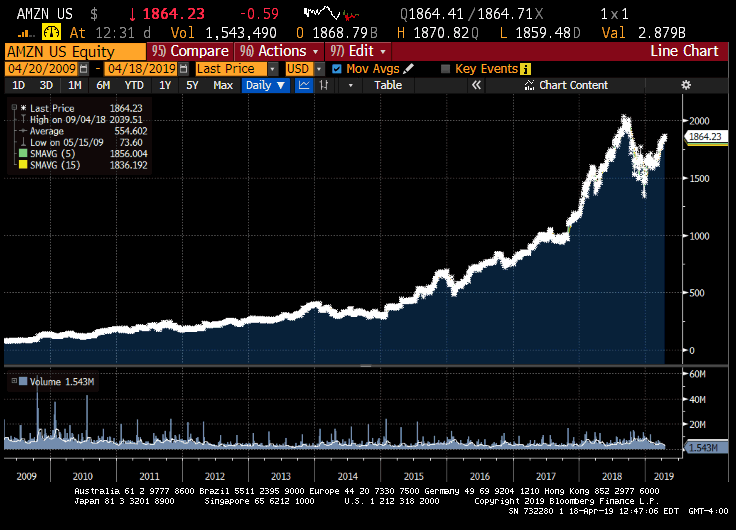
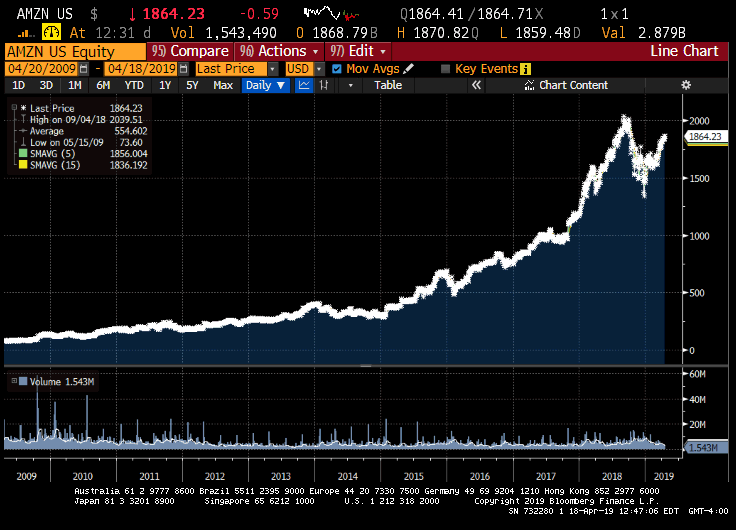
Amazon.com, Inc. ten-year stock price, 37% compound annual growth rate. Source: The Bloomberg
Continued cloud dominance is crucial to sustaining Amazon’s success. Analyst consensus calls for Amazon’s net income margin to jump to 6.4% in 2019 from 4.3% a year ago, thanks to expected growth in AWS. But at the same time, the core e-commerce business is showing signs of a slowdown, as Bloomberg estimated last week that gross merchandise volume growth fell to 19% last year from 24% and 27% in 2017 and 2016, respectively.
While the C.I.A.’s move toward multiple cloud vendors highlights the difficulty in growing AWS’ commanding public cloud market share, legal risks surrounding JEDI represent a potentially underappreciated pitfall to the AMZN bull case. Our D.C.-based observer concludes:
If AWS is found to have committed wrongdoing related to DoD’s JEDI contract, it could be debarred as a government contractor. My prediction: Amazon bulls expecting continued blistering growth from AWS will be in for disappointment.
Asked for comment on Thursday afternoon, Amazon had not responded by press time.
DE Shaw Is Reverting To A "3 And 30" Fee Model After Spectacular Results
In a world in which most hedge funds have failed to outperform both their benchmark and the S&P for the past decade (which is understandable when central banks are now activist investors and talk up or buy stocks on every dip, with the BOJ expected to soon be a top-10 holder in over 50% of all Japanese equities), investors are increasingly dumping the world of 'alternative investments', redeeming their funds and choosing the zero cost SPY instead which has forced many of those formerly charging their investors "2 and 20" for the privilege of holding their money, to cut their fees to 1.5% and 15%, 1% and 10%, or even less.
However, while the vast majority of funds do indeed suck especially when compared to the S&P - with most fundamental, value funds a disaster ever since central banks took over in 2009 - a handful of quant, algo and/or HFT funds have posted stellar results year after year (much of thanks to ordinary frontrunning of order flow masked as "providing liquidity") and few more so than that "other" iconic quant shop (the first one being, of course, Renaissance), DE Shaw, which is bucking the trend of cutting fees and starting in 2020, it will revert to a fee model that it held for the better part of the 2000s, when it charged 3% of assets under management and 30% of profits.
While fees across DE Shaws various funds - which manage a total of $50 billion - tend to be all over the place, the firm’s $14 billion Composite fund, which is closed to new investors, charged a 2.5% management fee and 25% incentive fee, a fee structure that will ramp up to "3 and 30" starting next year.
Historically, as in when they actually generated alpha so prior to 2010, hedge funds charged a 2 per cent annual management fee and 20 per cent of any profits; however in light of their disastrous performance in recent year, only 3% now charge a 2% management fee, and 16% take a fifth of profits, according to Credit Suisse. The average is now just 1.45% and 16.9% respectively, according to the FT, which notes that DE Shaw, founded by the reclusive billionaire computer scientist David Shaw, also cut the fees on its Composite Fund in 2011, from a 3% management fee and a 30% performance fee to a still-high 2.5 per cent and 25 per cent.
The fund is boosting fees amid rising costs for technology and infrastructure and increasing competition for talent. The roughly 1,300-person firm has grown its investment staff by 45 percent over the past five years as investors search for market-beating returns and diversification.
There is another, far implers reason why the Composite fund is ramping up its fee structure: it can, because last year it returned a whopping 11.2% in spite of the market turmoil which let to negative returns for most hedge funds. Furthermore, the Composite Fund has not had a down year since the financial crisis, which was also its only P&L drop this century.
Furthermore, the fact that the fund which was launched in 1988 and among the earliest to use complex mathematical models for trading, is based on a quant architecture is certainly in its favor when most other strategies have failed to generate consistent returns.
“There are powerful trends that are reshaping the industry underneath the surface,” Barclays wrote in a report covering the hedge funds industry earlier this spring, adding that "Strategy-wise, there has been a massive rotation over the past few years away from discretionary strategies and into quantitative ones."
And, as the FT notes, the industry’s top players are benefiting disproportionately from this, in what analysts have termed a “barbelling” of the asset management ecosystem, where cheap and simple strategies and expensive, high-octane ones enjoy most of the investor demand.
And nowhere is the octane higher than in the systematic, quant world.
While the average hedge fund lost 4.8 per cent in 2018, according to HFR, a researcher, DE Shaw and other big, largely computer-powered “systematic” players managed to profit from the turbulence. Bridgewater’s Pure Alpha returned 14.6 per cent, Renaissance Technologies’ Institutional Equities fund gained 8.5 per cent, and Two Sigma’s Absolute Return and Compass funds rose 11 per cent and 14 per cent respectively.
So for all those fund fundamental managers who get some ideas and decide to follow in DE Shaw's footsteps, we have one word of advice: don't, because even though hedge funds are enjoying their best start to a year since 2006, investors i) know this won't last and as a result ii) yanked another $17.8 billion out in the first quarter. It is diametrically opposite in the world of quant, thought, as several of the biggest quant hedge fund vehicles remain closed to new investors, given that their strategies could splutter if too much money was put to work.
And yes, DE Shaw may also be raising prices simply because quants, unlike traditional financial analysts which can be found a dime a dozen these days, have become exorbitantly expensive: ironically it is no longer financial professionals, but rather rocket scientists, quantum physicists and programmers that control the daily ebb and flow of the market, and as a result have become increasingly important in the money management industry, and form the backbone of people at quantitative investment groups such as DE Shaw. According to headhunters quoted by the FT, a quant with just five years of experience could expect pay packages of at least $300,000 a year, up from about $250,000 a few years ago, while more senior analysts and portfolio managers can expect at least $500,000 and probably well over $1MM.
And that's why this market no longer makes sense to anyone except, perhaps a math PhD.
Lindt Stock Valuation Only Makes Sense If You Believe in the Easter Bunny
Switzerland is one of the world’s most expensive countries—something that appears to have rubbed off on one of its best known confectionery stocks.
Lindt & Sprüngli currently trades at 35.7 times its expected 2019 earnings, making it the second-most-expensive consumer stock in Europe behind French luxury group Hermès International (ticker: RMS. France) at 41.5 times and ahead of Italian drinks firm Davide Campari-Milano (CPR. Italy) at 34.9 times.
Easter is obviously a key time for Lindt, which opened its first shop in 1845 and is famous for its golden bunnies and Lindor balls. It has more than 410 shops around the world and 12 production sites that employ more than 14,000 workers.
But it has run into some problems of late. The shares (LISN) fell 18.96% in the second half of last year after a period of slower organic growth. But they’ve rebounded by 8.07% more recently as net profits for 2018 were in line with expectations. That has left analysts unsure whether the company is undergoing a brief rough patch or suffering from a more serious secular downturn.
Among the more positive is Andrew Wood, a Bernstein analyst who rates the stock Market Perform and has a target price of 8,360 Swiss francs ($8,244), which works out to a 7% rise on a recent CHF7,820 price.
He and others note that earnings growth has been steady; Lindt posted CHF816.2 million of earnings before interest, taxes, depreciation, and amortization for 2018 on sales of CHF4.3 billion. The Ebitda earnings were up from CHF764 million in 2017. Another brokerage estimate puts earnings at CHF940.4 million for 2020. Given that Lindt has delivered organic growth of at least 6% in seven of the past nine years, Wood views it as a growth stock, meriting a high multiple. He notes that it also operates in just one category, chocolate, which would suggest that Lindt benefits from a more focused management and economies of scale.
That said, Andreas von Arx, an analyst at German bank Baader, recommends selling and, in a March note, set a target price of CHF5,800, or 25.8% below the recent level.
He is one of the bears who note that overall sales growth has been held back by underperformance at its U.S. unit, Russell Stover, which Lindt bought in 2014 for a rich $1.5 billion. The unit has lost market share, sales growth has been negative, and it doesn’t fit well with Lindt’s premium brands, some analysts say. “We remain skeptical with the U.S. market outlook,” von Arx wrote. The U.S. accounted for 32% of company revenue in 2018.
Hurting all chocolate retailers is a consumer shift to healthier foods and online purchases, but Lindt is still supporting an expensive network of shops. Von Arx wrote in a separate note at the end of last year, “Our data show a general slowdown in the premium segment across all markets, which indicates that structural drivers are at least partially in play.”
Lindt’s pricey shares also include a premium for a potential takeover. Woods notes that the firm wants to remain independent, so any bid would need to be hostile. Lindt, which declined to speak to Barron’s, has a complex shareholding structure, making a takeover or activist shareholder campaign difficult.
The Easter Bunny might well be laden with Lindt confectionery on Sunday, but investors should hop away from this expensive stock and seek sweeter rewards elsewhere.
Rupert Steiner is the bureau chief for the Barron’s Group in London.