>>> Tate & Lyle said to have attracted takeover interest from Roquette Freres; s

Tate & Lyle said to have attracted takeover interest from Roquette Freres; speculation downplayed - reported rumour
03 MAY 2019
Tate & Lyle [LON:TATE], a UK-based food ingredients supplier, is said to have attracted takeover interest from privately-owned French rival Roquette Frères, the Financial Times reported. The newspaper’s market report section mentioned gossip that Roquette Frères was preparing an offer for Tate & Lyle at a premium of close to 15% on the UK-based company’s closing share price of 773.2p on Thursday, 2 May, but did not attribute the information to a source.
Tate & Lyle and Roquette Frères both declined to comment on the speculation, the item said.
The Daily Mail's market report section also mentioned speculation that Roquette Frères has offered 900p per share for Tate & Lyle. However, the newspaper went on to cite sources close to Tate & Lyle who quickly dismissed the speculation as "wild."
Tate & Lyle’s share price climbed above 800p on Thursday, before falling back to close unchanged at 773.2p. The company’s market capitalisation stood at GBP 3.65bn (EUR 4.25bn).

The Financial Times report appeared on page 26 of the print edition of the newspaper on Friday, 3 May.

>>> US After Hours Summary: WW +16%, OLED +14%, MELI +11%, MNST +8%, X


After Hours Summary: WW +16%, OLED +14%, MELI +11%, MNST +8%, X +5% are higher, while SRCL -17%, ANET -15%, TDC -8.5%, FSLR / EXPE -3% are lower following earnings/guidance

After Hours Gainers:

Companies trading higher in after hours in reaction to earnings/guidance: WW +15.7%, OLED +13.9%, ZIXI +12.2%, BTE +11.4%, MELI +10.7%, CBLK +9.4%, MNST +7.6%, CRC +7.4%, SHAK +6.8%, MTZ +6.7% (light volume), FNKO +6.5%, UCTT +6.2%, CARB +5.8%, X +5.2%, BLDR +4.2% (light volume), RMD +4% (light volume), MERC +3.8%, VRAY +3.4%, WSC +3.4%, USM +3.2% (light volume), DATA +2.9%, PVG +2.8% (ticking higher; also Executive Chairman and founding shareholder, Robert Quartermain, will be retiring), MSI +2.6%, ERII +1.6%, EOG +1.5%,

Companies trading higher in after hours in reaction to news: BYND +4.9% (continued momentum), DBD +2.3% (Director Anton bought 25K shares worth ~$225K, SVP of Services disclosed the purchase of ~20K shares worth ~$180K), CHRS +2.3% (Coherus BioSciences and Amgen settle trade secrets action), WMT +0.7% (upgraded to Outperform from Market Perform at Bernstein), DWDP +0.4% (Trinseo [TSE] announces agreement with The Dow Chemical Company to acquire latex binders assets; announces evaluation of strategic alternatives for Germany polycarbonate unit)

After Hours Losers:

Companies trading lower in after hours in reaction to earnings/guidance: SRCL -17%, ANET -15.2%, APPN -12.8%, FND -11%, GMED -9.7%, TDC -8.5%, RBBN -7.9%, EPAY -7.7% (light volume), LOCO -6.6%, APPF -6.2%, PLNT -5.8%, LGND -5.7%, KLIC -5.4%, GDDY -5.2%, NPTN -5.2%, ATVI -5.1%, HLF -5%, BL -4.3% (light volume), ACIA -4.2%, BGS -3.9%, SWKS -3.6%, FSLR -3.4%, MDRX -3.4%, EXPE -3.3%, FTNT -3.3%, UIS -3.2%, CTSH -2.7% (continued weakness after late sell-off following the early release of its earnings), TRUP -2.6% (light volume), CC -2.1% (light volume), CBS -0.9%

Companies trading lower in after hours in reaction to news: SRC -1.7% (announces public offering of 8.5 mln shares of common stock in connection with forward sale agreement), CSCO -1.1% (following ANET earnings/guidance), TGT -0.4% (downgraded to Market Perform from Outperform at Bernstein)

>>> US Close Dow -0.46% S&P -0.21% Nasdaq -0.16% Russell +0.40%

Closing Stock Market Summary

The S&P 500 declined 0.2% on Thursday, although it had been down as much as 0.8% in the session. Energy stocks weighed on the broader market for the second straight day, as oil prices ($61.77/bbl, -$1.82, -2.9%) fell to a one-month low.

The Dow Jones Industrial Average lost 0.5%, and the Nasdaq Composite lost 0.2%. The Russell 2000, however, increased 0.4%.

There was a lack of buying conviction following the Fed's decision Wednesday to remain firmly on hold. With few market catalysts to support a move back to all-time highs, investors continued to embrace a profit-taking mindset that sent the S&P 500 back to the 2900 level.

Buying support at this level, coupled with a stabilization in Treasury yields, helped abate selling pressure, though. Still, an awareness that the market was overextended and due for a pullback contributed to tepid buying interest in front of Friday's release of the April employment report.

The S&P 500 energy sector (-1.7%) was the day's worst-performing group amid a drop in the price of oil. Prices were pressured by rising U.S. inventory and by reports that Asian refiners asked Saudi Arabia for additional supply amid global disruptions.

Conversely, the broader market found support from the S&P 500 health care (+0.5%), financials (+0.2%), and real estate (+0.2%) sectors. Many stocks within the Dow Jones Transportation Average (+1.2%) and the Philadelphia Semiconductor Index (+1.1%) provided additional support.

In corporate news, Dow Inc (DOW 72.50, -3.43, -6.1%), Square (SQ 67.74, -5.88, -8.0%), Kellogg (K 57.38, -2.01, -3.4%), and Cigna (CI 158.22, -3.78, -2.3%) were some of the more notable companies that fell after disappointing investors with their earnings results/guidance. Tesla (TSLA 244.10, +10.09) rose 4.3% after the company announced plans to raise $2.0 billion through new equity and convertible notes. 

U.S. Treasuries continued their post-FOMC retreat, sending yields higher across the curve. The 2-yr yield and the 10-yr yield increased four basis points each to 2.34% and 2.55%, respectively. The U.S. Dollar Index increased 0.2% to 97.83.

Reviewing Thursday's economic data, which included the weekly Initial and Continuing Claims report, preliminary first quarter readings for Nonfarm Productivity and Unit Labor Costs, and Factory Orders for March:

  • Initial claims for the week ending April 27 were unchanged from the prior week at 230,000 (consensus 212,000). Continuing claims for the week ending April 20 increased by 17,000 to 1.671 million.
    • Initial claims might have been higher than expected, yet the key takeaway is that they still remain relatively low, evidenced by a four-week moving average of 212,500 that isn't far off a 50-year low.
  • Nonfarm business sector productivity increased 3.6% in the first quarter (consensus 2.3%) following a downwardly revised 1.3% increase (from 1.9%) for the fourth quarter. The first quarter increase was the strongest pace since the third quarter of 2014. Unit labor costs decreased 0.9% in the first quarter (consensus +1.6%) following an upwardly revised 2.5% increase (from 2.0%) in the fourth quarter.
    • The key takeaway from the backward-looking report is that it fit quite well with the understanding that U.S. economic activity is solid while inflation pressures are muted.
  • Factory orders increased 1.9% in March (consensus +1.6%) on the heels of an upwardly revised 0.3% decline (from -0.5%) in February.
    • The key takeaway from the report is that business investment picked up in March, evidenced by the 1.4% increase in orders for nondefense capital goods excluding aircraft, which are a proxy for business spending.

Looking ahead, investors will receive the following reports on Friday: the Employment Situation Report for April; the ISM Non-Manufacturing Index for April; and the Advance figures for International Trade in Goods, Wholesale Inventories, and Retail Inventories for March.

  • Nasdaq Composite +21.1% YTD
  • Russell 2000 +17.4% YTD
  • S&P 500 +16.4% YTD
  • Dow Jones Industrial Average +12.8% YTD

(TechCrunch) Beyond Meat rockets in early trading on Nasdaq, reaching a valuatio

Beyond Meat rockets in early trading on Nasdaq, reaching a valuation of over $3 billion

Meat alternatives are getting a big public market debut with the Beyond Meat public offering, as shares of the company rocketed above their initial list price.

The company’s shares surged up 135% in their market opener, valuing the company as high as $3.52 billion. Volatility was so high on the company’s stock that the Nasdaq had to pause trading of “BYND” shares.

The company’s first trade came in at $46 at 12:18 p.m. Eastern, according to a report in MarketWatch. That’s a whopping 76% above the initial price. Gains extended throughout the morning reaching an intraday high of $63.43 (or around 154% above its initial high) and the stock is now trading at around $55 per share.

The company priced its public offering at $25 per share last night — at the upper end of an already increased share price (likely in response to shareholder demand).

In all the company raised more than $240 million at just under a $1.5 billion valuation through the sale of at least 9.6 million shares when it priced yesterday.

“Beyond Meat is a pioneer of the plant-based meat movement, and the listing is a remarkable and unprecedented move for the industry,” said Bruce Friedrich, the executive director of the sustainable food industry research and watchdog group, the Good Food Institute. “While it’s the first company of its kind to go public, the move could pave a way forward for other plant-based meat makers who will be watching on.”

Investor appetite for the company comes despite its balance sheet problems. Beyond Meat reported a net loss of $29.9 million on $87.9 million in revenue for 2018.

What’s steeling investors’ stomachs for an investment in the company appears to be its gross margins, which came in at 25% for the first quarter and were at 20% for 2018 up from negative margins in the preceding year.

The company’s success could be a harbinger of things to come. There’s a crop of meat substitutes and alternative protein products on the market or coming to market — and they’ve met with enormous customer success.

Earlier this week, Burger King announced that it would begin a nationwide rollout of its Impossible Whopper, and companies like Memphis Meat, which develops lab-grown animal proteins, and Sustainable Bioproducts, another developer of protein replacements are waiting in the wings to bring their own products to market.

Beyond Meat’s public offering is the second-highest liquidity event for a company in the sustainable foods market. The largest was WhiteWave Foods acquisition for $12.5 billion by Danone in 2017 after a public listing five years earlier.

“Securing funds like this is a big deal for Beyond Meat and will allow it to ramp up its supply chain capabilities and make delicious plant-based meat accessible to all,” said Friedrich in a statement. “Investors recognize that this is not a niche but a mainstream movement and a huge business opportunity… Beyond Meat is on the frontier of food system transformation. Their success and the successes of other plant-based meat makers could help repair our food system and mitigate the many harms caused by conventional meat production.”

(ZH) Luxury Home Sales Crash Last Quarter, Biggest YoY Decline Since 2010 Profil

Luxury Home Sales Crash Last Quarter, Biggest YoY Decline Since 2010

Demand for the nation's most expensive properties collapsed in 1Q19.
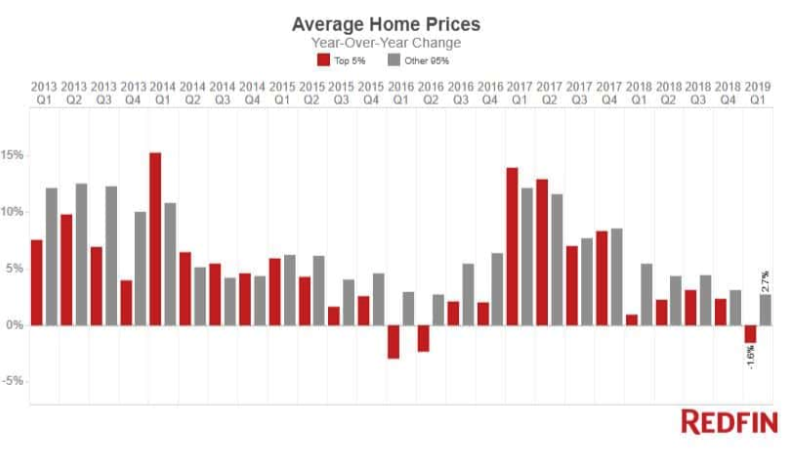
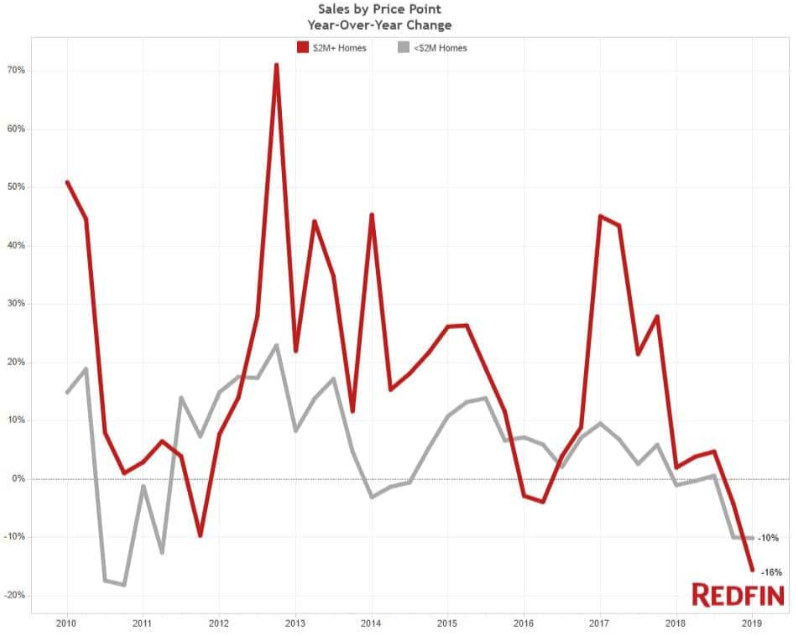
Sales of homes listed above $2 million plunged 16% YoY last quarter, the most significant decline since 2010, according to Redfin. This comes at a time when sellers understand the cycle is turning, as they flood real estate markets across the country with homes, depressing prices for the fourth consecutive quarter.
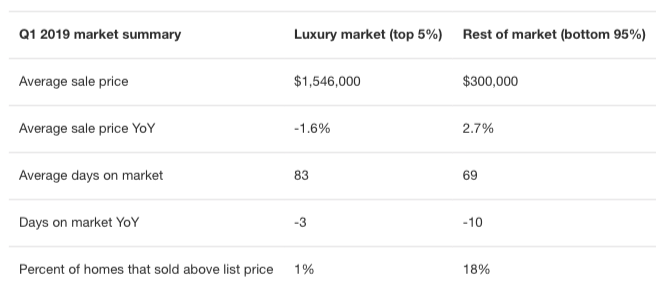
The average sale price for a luxury home, which Redfin describes as the top 5% most expensive homes in each of the more than 1,000 cities it tracks across the U.S. (not including New York City), fell 1.6% to $1.55 million in 1Q19, the first annual decline in three years.

The supply of luxury homes surged 14% annually in 1Q19, the fourth quarter in a row of increases.

Waning demand for luxury homes can be attributed to the recent changes in tax law. State and local taxes that homeowners regularly deduct were limited to $10,000, and mortgage interest deduction was reduced from $1 million to $750,000 in mortgage debt.
"Because homeowners can’t deduct as much mortgage interest as they used to be able to, the calculus has changed when it comes to buying a home, especially an expensive one," said Redfin chief economist Daryl Fairweather. "Although the new mortgage rule applies to everyone in the country, high earners in states with high income taxes like California and Massachusetts saw their tax bills surge."
"Not only do the new rules make it less desirable to purchase a multi-million dollar home in high-tax states, it has also motivated some people—especially those with big incomes and big housing budgets—to consider moving to places like Florida, Washington or Nevada, which have no state income tax," Fairweather added.
Redfin shows the downshift in the luxury market has been damaging to certain metropolitan areas. The average luxury sale price dropped the most in Boston (-22.4%), Newport Beach, California (-21.8%), and Miami (-19.3%).
In San Diego, prices fell 1.4%, this was the first quarter of declining luxury home prices in two years. Earlier this week, we documented how San Francisco Bay Area homes dropped last month on a YoY basis for the first time in seven years. We also noted how West Coast markets were some of the hottest areas in the cycle, but now, the markets have cooled, if not reversed.
Nine of the ten markets listed above contributed to the overall sales drop in 1Q19, with Newport Beach, California, posting a -33.3% decline in the number of luxury homes sold and West Palm Beach posting a -23.1% decrease. Seattle was the only city on the Redfin list that didn't post YoY decline in sales.
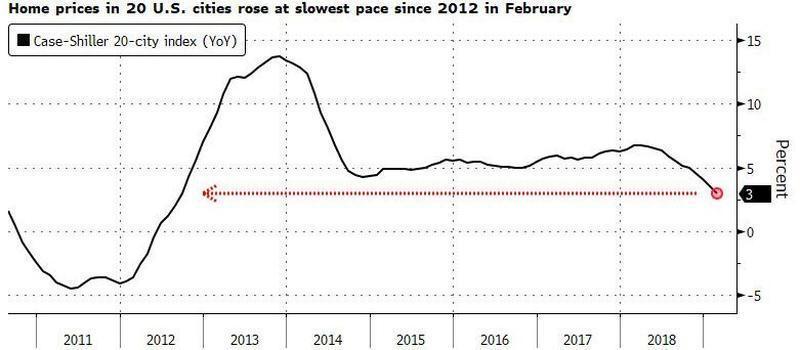
And to get a broad scope of things, S&P CoreLogic Case-Shiller Indices on Tuesday published a new report that showed home price declines weren't just located in the San Francisco Bay Area but were widespread.
The real estate cycle is turning. Federal Reserve Chairman Jerome Powell on Wednesday overlooked President Trump's call for a 100bps cut, a move that could continue weakening real estate markets for the foreseeable future.