Escaping the Wrath of China’s Netizens


With brands seemingly unable to avoid outrage in the face of rising nationalism in the world’s largest luxury market, hiring chief diversity officers may not be enough.
Shanghai, CHINA — Dolce & Gabbana, Versace, Balenciaga, Burberry, Givenchy, Coach: it’s a who’s who of luxury brands, but it’s also a (far from exhaustive) list of brands that have issued apologies, cancelled shows, pulled marketing campaigns and otherwise found themselves experiencing the wrath of the Chinese netizen over the past 12 months.
Their offences have varied in nature and seriousness, from Stefano Gabbana’s racist online tirade against Chinese consumers, to disrespecting China’s national sovereignty by listing Hong Kong and Macau as independent countries on products, to a poorly judged Chinese New Year campaign that some saw as “othering” Chinese people.
Of course, it’s not just fashion and luxury companies who have failed in Chinese eyes, particularly when it comes to respecting Beijing’s One China policy, with consequences that go far beyond the kind of virtual pummelling seen on Chinese social networks this week.
Last year, hotel giant Marriott International saw its Chinese website blocked for seven days after Taiwan, Tibet, Hong Kong and Macau were listed as separate countries on a customer questionnaire.
In Shanghai, Japanese lifestyle retailer Muji was fined 200,000 yuan (or $31,000) for suggesting Taiwan was a country on its packaging. Chinese regulators have also demanded apologies from the fashion brand Zara and medical device maker Medtronic, when their websites appeared to do the same.
International airlines have also been slapped with official sanctions, with Cathay Pacific being forced to fire staff and limit others from flying mainland China routes if they are known to support protesters in their home market of Hong Kong.
Why Is ‘One China’ so Hard to Get Right?
Less than 9 percent of United Nations member countries formally recognise Taiwan — and most are tiny island nations or microstates. Hong Kong and Macau are granted SAR (special administrative region) status but are an integral part of the People's Republic of China.
"I personally think [recent controversies are caused by] a continuation of habits. Foreign companies have always listed the mainland, Hong Kong, Macau, Taiwan and other regions in terms of organisational structure and internal performance reports. But in a strict sense, this is not in line with [today’s] legal and political norms," Shanghai-based fashion business consultant and columnist Leng Yun told BoF.
In many cases, the listing of Hong Kong, Macau and Taiwan as country options in drop-down menus of company websites is a product how software is designed and built. When designers construct a website, they will either copy International Organisation for Standardisation (ISO) country codes for the locations shown in their menus, or simply choose a "country list" or "address" module compatible with the software framework they are using to put the site together.
The problem is, separate ISO codes are created for "countries and their dependent territories", meaning Hong Kong, Macau and Taiwan are given their own codes, which then make their way onto "country" drop down menus, making it look as though they are considered separate countries.
These are mostly just silly mistakes or ignorance about local political sensitivities rather than brands making overt political statements.
“I think these are mostly [just] silly mistakes or ignorance about local political sensitivities rather than brands making overt political statements,” the mainland-born, Shanghai-based editor-at-large of Hong Kong luxury magazine Prestige, Jing Zhang, says.
The speed with which companies such as Coach, Givenchy and Versace moved to apologise for their mistakes in listing Hong Kong, Taiwan and Macau as countries on products, and companies including Calvin Klein issued apologies for listing Hong Kong and Taiwan as separate countries elsewhere, seems to confirm they were not deliberate statements supporting the independence of the regions and territories involved.
But whether or not these cases stem from oversight rather than intentional political provocation matters little to the Chinese.
“[Whether or not it’s intentional] these brands are doing something ignorant and politically incorrect. Macau and Hong Kong are not independent countries; they are part of China. I can’t believe these Western brands are still this uninformed today,” says Chinese stylist, editor and publisher of WeChat magazine LEAF, Leaf Greener, who has previously made comments on Instagram supporting Hong Kong's autonomy but only, she explained, as part of China's "One Country, Two Systems" policy.
In one example of the depth of feeling surrounding this issue, a survey circulating on Weibo on Monday asking about people’s attitudes to brands that “insulted China” quickly garnered more than one million responses, with 70 percent of them saying they'd "never buy their products even if I have nothing to wear."
Respect Us or Feel Our Outrage
It is little wonder Chinese people are more defensive and vocal about sovereignty than before. Nationalism — and in some cases patriotic fervour — is running high as China weathers storms on several political fronts and the consistent message coming from Beijing and echoed in state media on a daily basis is that the trade war with the US and protests in Hong Kong are all part of a broader international effort to blunt China’s rise.
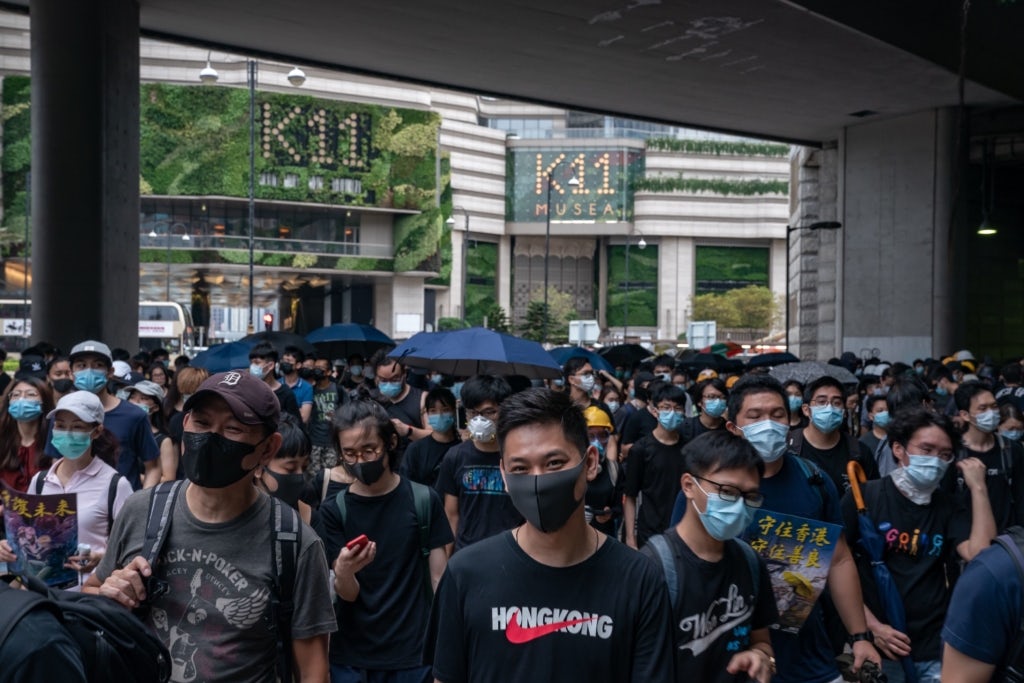
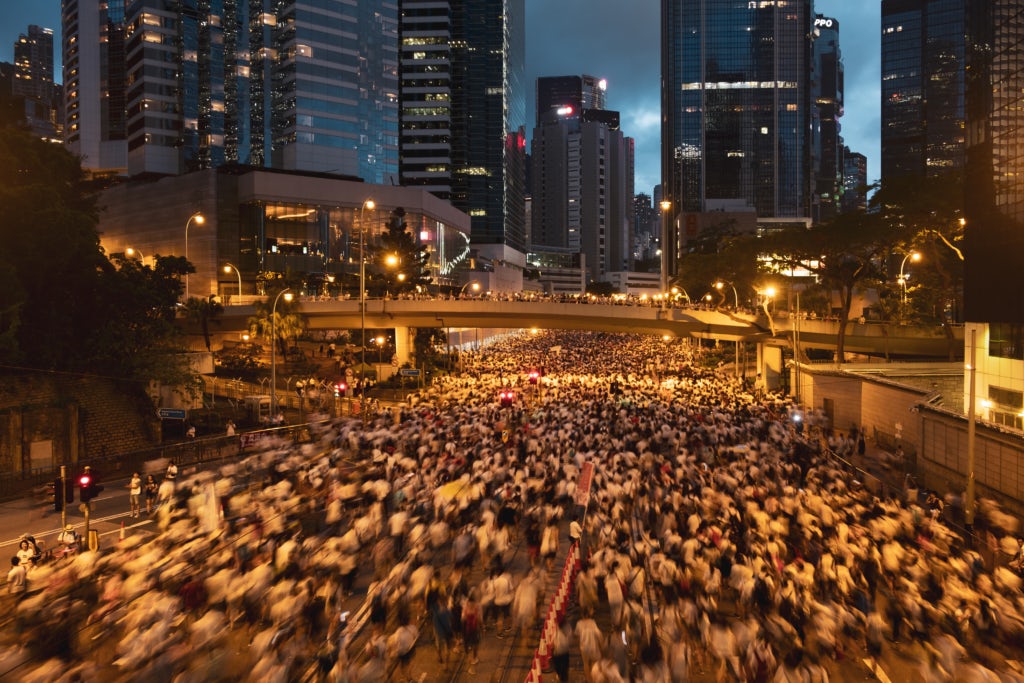
Protesters march on a street on August 3, 2019 in Hong Kong, China. | Source: Getty Images
Although there is some evidence that China’s government is waging an information war against protestors in Hong Kong and the US with its trade dispute, it would be a mistake to dismiss the anger and offence felt by Chinese citizens. Enraged mainland citizens view any ambiguity about the status of Hong Kong as a colonialist affront to their country’s sovereignty. Some even equate the issue — or conflate it, depending on your point of view — with racism.
According to Wang Dan, Chief China Analyst for the Economist Intelligence Unit, China’s ascendant consumer class has started to realise the new-found power it wields. It’s unlikely that Chinese consumers will put up with any slight, whether perceived or real in the foreseeable future.
"I think the impact [of this run of scandals] needs to be a conceptual shift in foreign companies. The Chinese market has changed from being purely a large market, to being the most important market that can determine the fate of a company [and] that changes the relationship,” he said.
For luxury brand executives who are wringing their hands over the public relations nightmare in which they are now embroiled, things could be a lot worse. Despite the reputational and other damage that has been done to brands caught up in the past week’s controversies, some argue that they have got off easy compared to the official sanctions and fines that hotel, airline and other sector brands have endured.
Enraged mainland citizens view any ambiguity about the status of Hong Kong as a colonialist affront to their country’s sovereignty.
Instead, the current playbook includes issuing apologies quickly and unreservedly (with the exception perhaps of Dolce & Gabbana), laying low for a while to weather the storm and then gradually working their way back into the good graces of the Chinese consumer, which, according to McKinsey & Company spent 770 billion yuan ($115 billion) on luxury goods at home and abroad last year, equivalent to a third of the world’s total.
So rather than risking the biggest potential business opportunity in the world (Chinese consumers are set to make up 40 percent of global luxury spend by 2025), and weathering months (or longer) of poor public perception and sales, the question on everyone’s lips is how to avoid these situations in the first place?
The Case for a CCO
“I think having somebody, whether you call them ‘China Cultural Officer’ or whatever, there should be someone who is thinking about this stuff on a daily basis and giving final approval on any web content, any product content that could be a problem,” Benjamin Cavender, China Market Research Consulting's senior researcher.
“Having someone like that makes a lot of sense given how important China is as a market for these brands now. They can’t afford to be making these mistakes,” he adds.
Advocates of a senior executive representing the interests of Chinese consumers at company headquarters argue that such a role would nip many of these issues in the bud.
Although some find the comparison with Chinese outrage unfair, this year has seen the fashion industry wrestle with its image and values after an unfortunate spate of blackface controversies. These scandals rightly prompted action in the form of diversity chiefs being appointed at Chanel, Gucci and other major houses. While the verdict is still out on the effectiveness of these executives, the intention is that a greater focus on diversity can help avoid unnecessary, hurtful and damaging mistakes in the future.
Gucci's "Balaclava sweater" | Source: Getty Images
Greener believes that greater representation of Chinese at the global level is key, but is concerned recent moves toward diversity will do little to change broader cultural hierarchies baked into many luxury companies.
“It’s one thing to have a diversity [chief] or department, but actually having diversity throughout the organisation is more important,” she told BoF.
“Right now, I feel like companies are treating diversity as a trend, but that’s totally wrong. Diversity is not a trend, it’s a really important thing to take seriously.”
Greener points out that diversity is not just about having people who look different on a team. It’s just as important to have representation of non-Western cultural viewpoints in leadership positions in order to create a culture that isn’t so myopically Western.
In October last year, Hong Kong-born Charles Leung became the first person of Asian descent to hold a global CEO post within luxury conglomerate LVMH, as head of heritage jewellery line Fred. A year before that, Chinese-born economist Jin Keyu made waves by joining luxury conglomerate Richemont’s board. But the fact that these appointments make headlines at all points to the exceptionalism of Asian representation at the top levels of global management and decision-making.
It’s important to have representation of non-Western cultural viewpoints in leadership positions in order to create a culture that isn’t so myopically Western.
There are also undeniably powerful China and APAC based executives working within luxury companies and conglomerates — Cai Jinqing, President of Greater China for Kering, and Andrew Wu, President of Greater China for LVMH are two such examples. But perhaps the way their roles are structured as regional power centres means they are not able to simultaneously perform those roles and have oversight of broader company culture decisions made at headquarters.
“Certainly, given the portion of revenue coming from China for most of the big luxury brands, they should have specific, native Chinese representation sitting at the senior table with the other grownups for a start,” Mark Tanner, Managing Director of China Skinny insights marketing agency.
Something Needs to Change, and Fast
There are other ways to mitigate risks or overcome a crisis. Tanner points out that Marriott have largely been able to recover their reputation in China a mere 18 months after having their website blocked by joining forces in a big way with Chinese Internet giant Alibaba. The two companies now share membership privileges with Tmall and Taobao’s 600 million users given access to Marriott rewards when they sign up to Alibaba membership, intrinsically making Chinese travellers feel more a part of the “Marriott family” and therefore engendering a lot of good will.
If it’s not a newly invented role in the style of a China Cultural Officer that will act to fix the never-ending PR crises impacting brands in China, the answer may lie in a much simpler notion. Brands need to truly empower the Chinese voices that already exist within these organisations: their existing China team members.
D&G's D&G Loves China campaign | Collage by BoF
“Local talents are [still largely] not allowed to participate [at a global level],” Leng said. “Luxury goods are by far the weakest part of the fashion industry in terms of localisation [of product and messaging].”
The situation still commonly referred to in China as the “Dolce & Gabbana insult”, started with an advertisement that saw a Chinese model struggling to eat Italian food with chopsticks. It was reported in Chinese media at the time of the incident that local members of Dolce & Gabbana’s team had advised against running the ad, but were ignored by the brand’s head office in Europe. It is a harsh lesson in what happens to brands who ignore perhaps their best resource for a pulse check in China.
But the hesitation to embrace localisation in a more substantial way is no accident, with global luxury brands careful to manage the level of their products, compliance and communications across different markets in order to protect arguably their most precious assets — their heritage and luxury positioning.
Leaf Greener recently concluded a months-long contract consulting for Chloe, in the lead-up to their show in Shanghai in June. She has seen first-hand the hesitance of luxury brands to give too much leeway to local teams.
What brands might need to do inside China might not be right for the brand image globally and I know that’s a concern.
“Of course they need to listen to their local team, but the problem is, [in my experience] a lot of local team members, they don’t know what’s going on [because they aren't informed by company headquarters so] they only know what is going on in China,” Greener explained.
“I can see this issue going on with Chinese management and Western management in conflict about how to build up brand image globally. What brands might need to do inside China might not be right for the brand image globally and I know that’s a concern for luxury brands.”
This is not a problem unique to China. Markets outside of the Euro- and US-centric hubs of luxury, including the Middle East, Latin America and other parts of Asia, where culture and language often act as a block for information being shared adequately between headquarters and local teams, and perhaps, vice versa.
Actress Yang Mi, who ended her ambassadorship with Versace this week | Source: Courtesy
But if this is the root of the problem for brands, then they also have the tools to improve the situation, namely, by sharing more information with their Chinese teams to inform them of global strategies and context. This would better enable them to offer guidance from a Chinese perspective, while also allowing brands to retain their international positioning, without losing their DNA of luxury or heritage.
“They need to trust, train and rely on their local teams a bit more to have both the foresight and the balls to pull things up that might be sensitive. It’s about integrating these China teams more with headquarters,” Jing Zhang said, adding that this change needs to “be psychological, not just structural.”
She, along with others interviewed for this story, believes the answer lies in combining a more active role in decision-making about China-related content and products from Chinese teams, as well as a genuine commitment to non-Euro and US centric diversity within the headquarters of fashion brands.
While some changes — like replacing “country” with “location” options on website drop-down menus — are relatively easy, a restructuring of the relationship between Chinese teams and luxury brand headquarters is considerably harder, and requires long-term planning and implementation.
Real and lasting change is difficult, but it’s also necessary, with never-ending PR scandals in luxury’s most important market the decidedly less appealing alternative.
Additional reporting for this article was contributed by Denni Hu and Queennie Yang.
时尚与美容
FASHION & BEAUTY
FASHION & BEAUTY
Chinese Yuan Renminbi banknotes | Source: Shutterstock
Yuan Devaluation Spurs Luxury Jitters
In response to President Trump's plans for a 10 percent tariff hike, Beijing allowed the value of its currency to drop 2 percent against the dollar this week (its lowest level since April 2008), aiming to offset the effect of Trump's tariffs by making US-bound Chinese imports less expensive. In the wake of the news, LVMH, Kering and L'Oréal's shares dropped 4.2, 1.9 and 3.1 percent respectively. Brands are fretting that the falling yuan and China's slowing GDP will affect consumption in the mainland, where they may have to increase prices locally, undoing the price harmonisation moves they have been making over the past year to boost sales. Experts forecast that the yuan could still drop a further 5 percent before the end of 2019, and brands should brace themselves for rougher waters ahead. (Jing Daily)
Dazed China Launches at Shanghai’s Yohood Festival
China’s largest annual streetwear fete is back. Dazed Media Co-Founder and Chief Executive Jefferson Hack was named this year’s creative director of Yohood, Chinese streetwear media empire Yoho!’s annual consumer-facing fair taking place August 29-31. The announcement celebrates the launch of Dazed China’s first print issue, and the three-day fair is expected to draw over 60,000 visitors. The Youthquake-themed space, visually reimagined by artist and Dior and Adidas collaborator Daniel Arsham, will feature areas designed by A-Cold-Wall* Creative Director Samuel Ross, collaborations between DazedChina and designers Craig Green and Ambush. (Dazed Media)
China Crowned World’s Biggest Medical Aesthetics Market
According to a recently published white paper by Tencent-backed plastic surgery marketplace app SoYoung, China now boasts the highest spending on medical aesthetic services, which spans treatments from the non-invasive to surgical.The report adds that while consumers in first and second tier cities are maturing and boast higher conversion rates, consumers third and fourth tier cities still lack knowledge of the medical aesthetic market and tend to raise queries on the app rather than book appointments. Meanwhile, consumption in China’s so-called "new tier one cities" such as Kunming are set to overtake that of established top tier hotspots to drive growth. Compared to the US’ 420,000 facial surgery estimated to take place this year, SoYoung forecasts that the number of Chinese surgeries will exceed 738,800. (Jiemian)
科技与创新
TECH & INNOVATION
TECH & INNOVATION
Youtube | Source: Reuters
Youtube Could be the Next Frontier for Douyin’s Biggest Stars
Douyin (or its western equivalent Tiktok) is the app to watch. As of July 2018, 14-year-old YouTube’s monthly users exceeded 1.9 billion, whereas 3-year-old Douyin is catching up with global users exceeded 500 million. However, with Youtube’s monthly activity quadrupling that of Douyin’s, many are wondering if Chinese influencers will soon expand to other platforms to potentially reach a larger audience. According to Mediakix, global influencer spending will reach $10 billion by 2020, and the first Chinese stars to successfully establish a presence on global platforms are likely to reap the rewards, considering the diversity monetisation options available to Youtubers. (36KR)
Douyin (or its western equivalent Tiktok) is the app to watch. As of July 2018, 14-year-old YouTube’s monthly users exceeded 1.9 billion, whereas 3-year-old Douyin is catching up with global users exceeded 500 million. However, with Youtube’s monthly activity quadrupling that of Douyin’s, many are wondering if Chinese influencers will soon expand to other platforms to potentially reach a larger audience. According to Mediakix, global influencer spending will reach $10 billion by 2020, and the first Chinese stars to successfully establish a presence on global platforms are likely to reap the rewards, considering the diversity monetisation options available to Youtubers. (36KR)
Troubling Time for Xiaohongshu
Social e-commerce app Xiaohongshu has been going through a rough patch. Recently, the firm has been removed from the Google Play store, disenfranchised its community KOLs after enacting new creator posting and sponsorships rules and battled rumours of escort listings, fake accounts and the unlawful collection of user data. According to Parklu’s Elijah Whaley, the company faces a plethora of obstacles, from its easily hackable social recommendation engine to its contradictory pursuit of authenticity and restricting what users post. He writes, “if the company doesn’t value the creator community, tighten up its PR, and find a way to monetize without negatively impacting the user experience, someone else will.” (Technode)
Social e-commerce app Xiaohongshu has been going through a rough patch. Recently, the firm has been removed from the Google Play store, disenfranchised its community KOLs after enacting new creator posting and sponsorships rules and battled rumours of escort listings, fake accounts and the unlawful collection of user data. According to Parklu’s Elijah Whaley, the company faces a plethora of obstacles, from its easily hackable social recommendation engine to its contradictory pursuit of authenticity and restricting what users post. He writes, “if the company doesn’t value the creator community, tighten up its PR, and find a way to monetize without negatively impacting the user experience, someone else will.” (Technode)
Behind the Livestream E-Commerce Boom
Three years after e-commerce players Taobao, Mogu, Suning and JD.com saw success with their livestream functions, the feature has become par for the course for China’s retail firms. Early on, these frontrunners positioned sales at the heart of the medium, with conversion rates and sales volumes as indicators of success. According to Taobao, livestream users spend an average of an hour a day watching content, and the number of users and time spent on the app per day are both on the rise. And though many compare the rise of livestream e-commerce to QVC-style retail, the former has thrived by virtue of its interactivity, immediacy and perceived authenticity, bringing consumers a more realistic experience and allowing China's livestream 'anchors' to single-handedly orchestrate a niche product's overnight success. (36KR)
Three years after e-commerce players Taobao, Mogu, Suning and JD.com saw success with their livestream functions, the feature has become par for the course for China’s retail firms. Early on, these frontrunners positioned sales at the heart of the medium, with conversion rates and sales volumes as indicators of success. According to Taobao, livestream users spend an average of an hour a day watching content, and the number of users and time spent on the app per day are both on the rise. And though many compare the rise of livestream e-commerce to QVC-style retail, the former has thrived by virtue of its interactivity, immediacy and perceived authenticity, bringing consumers a more realistic experience and allowing China's livestream 'anchors' to single-handedly orchestrate a niche product's overnight success. (36KR)
消费与零售
CONSUMER & RETAIL
CONSUMER & RETAIL
Shangpin founder and CEO David Zhao | Source: Courtesy
Luxury E-Tailer Shangpin Files for Bankruptcy
On August 7, Chinese luxury e-tailer Shangpin filed for bankruptcy, reported National Business Daily. It was announced on the retailer’s site and app on July 31 that it would suspend operations, though no mention was made of bankruptcy or liquidation; according to a number of former employees, they received an email from the company containing the subject line “Bankruptcy Dismissal Notice” on the same day. Shangpin’s downfall illustrates the cutthroat nature of China’s e-commerce landscape, largely dominated by tech and retail giants Alibaba and JD.com and increasingly uninhabitable for smaller outliers. Founded in 2010 by David Zhao, Shangpin pivoted from a flash sale model to focus on forming ties with brands from the affordable — Shangpin served as Topshop’s official China e-tail partner for years — to the high end. (NBD)
Chinese Consumers Up Spending Amid Trade War
In spite of the trade war tariffs adding to the costs of imported goods, mainland consumers are spending more on consumer goods and services, and plan on spending more over the next 12 months, according to a UBS survey. The survey results, made up of data collected from 3,000 respondents in May, reveal that one in three consumers said they were spending more on goods and services, while one in five said they would spend more in the next year. While it was announced in July that GDP growth slowed to 6.2 percent (the weakest quarter since record-keeping began in 1992), monthly retail sales had increased year-on-year for more than a decade, and onlookers remain optimistic — for now. (SCMP)
Tmall Global Launches Celebrity Stores
China’s top e-tailer is focusing on content to drive sales. On August 8, the e-commerce giant global arm opened its first celebrity-curated online stores. The launch sees the retailer move into territory currently occupied by social e-commerce app Xiaohongshu and Look, a tech company that manages e-commerce storefronts for KOLs; while Tmall will manage the logistics and customer services, influencers and celebrities will take the reigns as ‘buyers’ and content creators of their own online boutiques. “The Great Wall” actress Jing Tian was the first to collaborate with Tmall to debut her store, and harnessed Taobao’s livestream function and Weibo’s vlog platform to promote its offerings, which included her favourite Aspiration curling iron and Phillips electric toothbrush. (Tech 163)
政治、经济、社会
POLITICS, ECONOMY, SOCIETY
POLITICS, ECONOMY, SOCIETY
Protestors demonstrate against controversial extradition law in Hong Kong | Source: Shutterstock
How the Hong Kong Protests Are Discussed on Chinese Sites
Though mentions of Hong Kong’s escalating protests were previously censored across Chinese social media, Beijing has changed tacts. The demonstrations, now past their fourth month, are currently trending on Chinese social media site Weibo as well as video app Douyin and news app Toutiao, with state media propagating hashtags and illustrations in favour of the city’s Beijing-elected government and police force. Though a handful of netizens have voiced their support for protestors, many have since been labelled ‘traitors’ by other users, and a majority of mentions are calling for the protection of Hong Kong and support for its police force. In sharp contrast to reports of police brutality, reports of violence against police officers are circulating, and some posts accuse western media of fabricating reports of violence against protestors. Meanwhile, a Chinese armed police truck convoy has rolled into neighbouring Shenzhen in what state media claims is a drill, but analysts have deemed a "psychological warfare tactic." (What's on Weibo)
The Currency War Is a Bigger Threat Than Tariffs, Adidas Boss Says
Since China let the yuan drop to its lowest value since 2008 last Monday in response to Trump’s threat of new tariffs, the prospect of a fully-fledged currency war has flustered global markets. The German sportswear giant’s Chief Executive Kasper Rorsted said that the company is more worried about a currency war between the US and China than the possibility that President Donald Trump will increase tariffs on footwear, as the former will lead to “a slowdown in the global economy.” Rorsted made his comments during a call with the press after Adidas released its second-quarter earnings that narrowly missed estimates, and the company’s shares fell for most of the day on August 8, then plunged 8 percent after Rorsted told analysts that margins would decline in the second half of the year. (Bloomberg)
Chinese Millennials are Saying No to the Dress
Chinese youth are embracing the idea of a "single society." As social and economic shifts widen generational gaps in China, a growing cohort of the country's post-'90s generation is putting off marriage, and phrases such as “people born after 1990 do not want to marry” are trending on social media. According to official data, the number of Chinese couples who tied the knot fell from 13.47 million to 10.11 million from 2013 to 2018, a trend that experts are attributing to young women becoming more financially independent. Meanwhile, as social and medical insurance covers most Chinese residents, couples are feeling less inclined to start families for benefits, and are focusing on their careers instead. (Inkstone)
Bergdorf, Goat Partner on Sneaker Installation
Rare sneakers will be on display and for sale in the men’s store through New York Fashion Week.
Bergdorf Goodman is hoping to attract sneakerheads by partnering with Goat for a special installation at its men’s store that will run through New York Fashion Week.
On Wednesday, the retailer and the Los Angeles-based sneaker reseller will open an installation at the Goodman’s Men’s Store that will showcase some highly coveted models including Chanel’s collaboration with Pharrell on the Adidas NMD Human Race Trail, and the auto-lacing Air Mag Back to the Future. Both will be on display in the store and will also be available for purchase for $16,400 and $47,250 respectively.
“Sneakers and athletic-driven sportswear have been a leading component of the designer and luxury men’s wear world, and we see this influence continuing to be very important,” said Bruce Pask, men’s fashion director for Bergdorf Goodman. “Goat is an innovator and leader in the resale space with an elevated aesthetic, peerless expertise and a focus on customer experience and service — aspects that we absolutely share, making this a perfectly suited partnership and an exciting new experience that our customers can only find at Bergdorf Goodman.”
Pask said he met Matt Cohen, Goat’s vice president of business development and strategy, a little over a year ago, and they visited the company’s Culver City, Calif., warehouse together.
“It was immediately apparent to me that Goat was something very special and that we shared many common aspirations and values as companies. We were easily able to envision what a collaboration could look like and how exciting that may be for our customers to bring the world of Goat to life inside our store and in our windows on Fifth Avenue,” Pask said.
“Retail and resale are just at the beginning of their convergence, and as the global demand for streetwear increases, we will continue to see its influence in the luxury market,” said Daishin Sugano, cofounder of Goat Group. “Collaborating with Bergdorf Goodman exemplifies the endless possibilities in the industry.”
Bergdorf has created a series of collaborations at its men’s store over the years, the most recent of which was a pop-up with Bravado USA and The Rolling Stones that Pask said was “very successful. Customers loved the giant sculptures of the band’s iconic logo and the array of exclusive merchandise created in collaboration with artists and designers.”
Pask said the Goat partnership is seen as the latest way to offer its customers “exclusive products and experiences.”
Goat views the Bergdorf partnership as “a huge opportunity for luxury brands to capture the growing audience of sneaker enthusiasts,” Sugano said. “In 2018, we partnered with Versace to exclusively launch their new Chain Reaction sneaker to our community of more than 15 million members. And this year, we also worked with Chloé to distribute their newest sneaker, Sonnie. These partnerships truly demonstrate how we’re able to connect brands with our community.”
He said the Bergdorf partnership “creates an opportunity to further expand into the luxury space, which our users are increasingly valuing. With this exclusive partnership, we hope to provide an elevated shopping experience for Bergdorf Goodman’s clientele, where they can experience in person some of the rarest and most coveted sneakers in the world.”
The Goat installation opens at Goodman’s Men’s Store on Wednesday, Aug. 21, and will remain through New York Fashion Week.
Investment banks are losing their grip on IPOs
The technology sector in particular now favours direct listing
The coming week marks the 15th anniversary of Google’s initial public offering — the first concerted effort to break the hammerlock that investment banks have always held on stock offerings. That attempt failed. But now, due to mounting frustrations, advances in technology and changes in the capital markets, investment banks are about permanently to lose the gatekeeping position they have jealously protected.
Google’s IPO was the first time a large technology company had expressed public frustration at the way investment banks cloaked IPOs in secrecy, making it impossible for either issuer or buyer to figure out what was happening behind the curtain. Instead, Google’s management asked the banks to run an open auction — much as eBay conducts a sale — to determine an eventual price. No other company followed suit, largely because the banks closed ranks and succeeded, in a disinformation campaign worthy of the NRA gun lobby in the US, in portraying the IPO as a flop.
Now, years later, the groundswell of dissatisfaction is about to erupt into action. This new approach, dubbed a direct listing, has so far been employed by only three companies: the music streaming service Spotify and payments company Adyen (both of which started outside the US), and Slack, a San Francisco software company.
These direct listings, largely controlled by the company that is selling shares, occurred because the shrewd and the brave caught on to the idea that, for stock offerings, investment banks occupy the same position in the investment universe as a scalper does in the theatre world. No actor, theatre owner, producer or audience member enjoys knowing that a ticket tout has run off with money that should belong to them. The same goes for the people involved with private companies.
It took the backbone of Barry McCarthy, chief financial officer at Spotify (and previously CFO at Netflix), to buck the system, shining a light on the tactics that the banks have used to frustrate and exasperate everyone but themselves. Bill Hambrecht, a San Francisco investment banker who helped take Apple public in 1980, spent much of the 1990s making similar arguments to Mr McCarthy — but he failed because his former competitors and collaborators made him a pariah in the manner that the mob treats a turncoat.
Mr McCarthy’s complaints against traditional IPOs included an inflexible commission structure; a tendency to dictate how much money a company should raise; an arcane instrument known as the “greenshoe”, which allows the banks to raise more money than the company wants; gruelling two and three-week roadshows; and — the final indignity — selection of who is permitted to price and buy the shares.
Buyers have been just as frustrated. Genuine long-term shareholders wanting to buy large amounts of a company’s stock have been stymied because the banks allocated shares to their favoured clientsthe way fishermen chum the waters. The result: these buyers usually flip their initial shares for a short-term profit and wait for a market pullback to build the position they want.
The world has changed. There has been a blurring between the public and the private markets. Young companies are staying private far longer than their predecessors: by now, many of the managements have ample experience raising large amounts of money without any intermediaries. Similarly, the usual customers for IPOs — mutual funds and hedge funds — are seeking out independently the most promising private companies, and alternate market makers are raising their hands.
Technology also favours the direct listing. The traditional roadshow, during which management teams rush through 30-minute slide-decks in front of investors, look antiquated compared with comprehensive business reviews or lengthy YouTube videos — duly vetted by the US Securities and Exchange Commission and available for all.
Some banks are mounting a rearguard action. They claim that only sizeable or well-known consumer companies have the heft and following to stage a direct listing. They cling to the vain hope that less high-profile businesses will be unable to manage for themselves or that managements without a lot of cash on their balance sheets will lose their nerve. This is despite the fact that hundreds of companies operating in obscure niches are publicly traded.
During the next couple of years, companies already well advanced with plans to go public will probably use the conventional approach. But, for all others, the choice of a direct listing or a traditional IPO has become a test of two attributes: courage and intelligence.
Disney’s Latest Endeavor: Getting the Fox Studio on Track
Lack of direction and communication rankle Fox personnel; Disney complains about the poor box office of its newly acquired studio
LOS ANGELES—About three months after Walt Disney Co. DIS 1.34% acquired Twentieth Century Fox, the two studios hosted a red-carpet premiere in Hollywood for the X-Men movie “Dark Phoenix,” the first major Fox offering since the merger.
Before the event this summer, Disney sent Fox executives a 13-page memo outlining exactly how the event should go. Men were to shave, and women were to “wear light make-up.” Workers were encouraged to wear a wristwatch since using a phone, either to check the time or to take pictures, was a strict no-no. And Fox employees were to make sure the movie’s stars weren’t chewing gum on the red carpet, according to the memo, which was seen by The Wall Street Journal.
It was one of the few detailed communications Fox executives had received in the roughly year-and-a-half since Disney agreed to buy the entertainment assets of 21st Century Fox for $71.3 billion, including Twentieth Century Fox. So when Disney Chief Executive Robert Iger told Wall Street analysts this month that Fox films had dragged down a record year for his studio, some Fox executives pointed the finger back at Disney.
Mr. Iger said the Fox studio’s performance “was well below where it had been, and well below where we hoped it would be when we made the acquisition.” He put most of the blame on a protracted acquisition process, with 17 months passing from when the deal was announced in late 2017 to its closing in March. Fox executives, however, privately say it had more to do with uncertainty and indecisiveness stemming from Disney’s lack of communication during that time.
The clashing views highlight an issue common in large acquisitions, particularly ones that drag on due to regulatory scrutiny or other complications. Such delays and uncertainty often lead to a talent exodus, employee anxiety and corporate paralysis at the company being acquired.
In this case, Disney was preparing to absorb not only a movie studio, but also a major television-production operation, overseas subscription-TV providers and a controlling stake in Hulu, the streaming service. Disney is leaning on the Fox film and television library to bolster the separate streaming service it is creating to compete against Netflix Inc.
After the deal closed, the challenge of integrating Fox was compounded by the poor performance of its movie lineup. The collective box-office gross of Fox’s six 2019 releases—about $240 million—is still around $100 million less than Disney’s “Avengers: Endgame” made in its opening weekend.
“Dark Phoenix” flopped terribly, forcing Disney to take an impairment charge. It was the biggest bomb on a Fox slate that also included the misfires “Stuber,” “The Kid Who Would Be King” and last week’s “The Art of Racing in the Rain,” all of which came and went with dismal showings.
Layoffs and attrition since the deal’s announcement left Fox’s marketing and publicity departments depleted, resulting in advertising campaigns that some employees describe as creatively uninspired, paint-by-numbers operations. As Fox continues to release movies left on its calendar, there are still some employees remaining in those divisions, but many offices look abandoned, said current and former Fox employees.
Some employees announced their intention to leave Fox just hours after news of the Disney deal broke. Others left more gradually, many decamping to the competitor that inspired Disney to buy Fox in the first place: Netflix.
On his call with analysts, Mr. Iger laid most of the blame on the extended lag before the deal closed. “That’s a long period of time for a business that relies on constant decision-making and constant attention to detail,” he said. “Often, decision-making can grind to a halt or certainly slow down.”
Current and former Fox executives don’t dispute that work at the studio slowed, but several said it was also due to a lack of communication on Disney’s part about how the Fox studio would fit into the larger company and which executives would stay after the deal closed.
Disney executives didn’t address large groups of Fox employees to outline the way forward, these people say. With many Fox executives unsure of their future at Disney, their subordinates were also left weighing whether to stick around.
Disney was barred from discussing hiring plans or any broader strategy with Fox before the deal closed due to rules tied to the acquisition, a person familiar with the situation said. Since the closing, Disney executives have been meeting with their Fox studio counterparts, and Mr. Iger said his company is at work “applying the same discipline and creative standards behind the success of Disney, Pixar, Marvel and Lucasfilm.”
Fox’s woes are partly a result of Disney’s own success. The latter’s record-setting year of megahits--“Captain Marvel,” “Toy Story 4” and “The Lion King” among them—have sucked up so much box-office oxygen that many midsize movies released by rivals have struggled.
Fans are eager for Disney’s more successful teams to get their hands on certain Fox characters. At the Comic-Con International fan gathering in San Diego earlier this summer, Marvel Studios head Kevin Feige teased that his team would be making a movie with the Fantastic Four—a comic book Fox failed twice at turning into a viable franchise. Fans in the auditorium erupted in cheers.
The rest of the year could brighten up for Fox. The car-racing drama “Ford vs. Ferrari,” starring Matt Damon and Christian Bale, is building good buzz among awards pundits, but it isn’t the type of movie that can generate blockbuster returns like “The Martian” or “Deadpool,” previous Fox hits.
Disney is likely to mine Fox’s extensive library of older movie titles for shows on Disney+, its forthcoming family-oriented streaming service. It already has reboots of Fox movies like “Home Alone” and “Night at the Museum” in development for the service, which will launch in November.
Mr. Iger, for one, is looking ahead.
“As I said a few times,” he told Wall Street analysts, “we analyzed the 21st Century Fox opportunity entirely through the lens of our future business.”
Trump Administration Plans to Give Huawei More Time to Work With U.S. Customers
Commerce officials to extend temporary license for the Chinese telecom currently on an export blacklist
WASHINGTON—The Trump administration is preparing to extend the length of a license that has enabled Huawei Technologies Co. to continue working with U.S. customers despite national-security concerns that landed the Chinese telecom company on an export blacklist earlier this year.
Commerce Department officials plan to announce Monday that they will grant a 90-day extension to the license that has allowed Huawei to continue doing some business within the U.S., according to an administration official.
The planned extension was reported by Reuters on Friday. The Commerce Department didn’t immediately respond to a request for comment Saturday.
In May, Commerce officials put Huawei and its affiliates on an export blacklist, citing national-security concerns. U.S. officials have warned that Huawei products could be used to spy on or disrupt telecom networks. Huawei officials have denied these claims.
The blacklisting escalated trade tension between the U.S. and China. Negotiators from both countries are set to meet next month.
The ban initially raised questions about whether U.S. customers that use Huawei equipment could receive service and support or even communicate with the company.
Shortly after the move, Commerce officials announced a temporary license that authorized some transactions between Huawei and U.S. business partners, including rural wireless carriers in the U.S. that use its equipment. It also enabled Huawei to support its popular handsets.
That license is scheduled to expire on Monday.