>>> Europe : Brokers Upgrades & Downgrades - 14th of January 202

>>> Up
* Barratt Raised to Buy at Deutsche Bank; PT 807 pence
* Cranswick Raised to Buy at HSBC; PT 3,630 pence
* Danske Bank Raised to Hold at Handelsbanken; PT 115 kroner
* Dixons Carphone Raised to Buy at Goldman; PT 170 pence
* EasyJet Raised to Overweight at Morgan Stanley
* Imerys Raised to Buy at Oddo BHF; PT 60 euros
* McCarthy & Stone Raised to Buy at Deutsche Bank; PT 154 pence
* Neste Raised to Buy at UBS; PT 36 euros
* Nobia Raised to Buy at SEB Equities; PT 82 kronor
* Orange Belgium Raised to Buy at Jefferies; PT 23.90 euros
* PKO Raised to Buy at UBS; PT 44 zloty
* Repsol Raised to Outperform at Exane; PT 17 euros
* Ryanair Raised to Equal-Weight at Morgan Stanley
* SBM Offshore Raised to Outperform at Bernstein
* Shell Raised to Buy at Berenberg
* Telenet Raised to Buy at HSBC; PT 47 euros
* Verona Pharma ADRs PT Raised to $60 from $58 at Wedbush
* Vinci Raised to Buy at HSBC; PT 108 euros
* Wizz Air Raised to Overweight at Morgan Stanley

>>> Down
* ABB Cut to Sell at ABG; PT 19.51 Swiss francs
* Aker Solutions Cut to Underweight at Morgan Stanley
* Beiersdorf Cut to Sell at SocGen; PT 99 euros
* BP Cut to Hold at Berenberg; PT 560 pence
* Crest Nicholson Cut to Sell at Deutsche Bank; PT 368 pence
* Danone Cut to Sell at SocGen; PT 69 euros
* Dometic Cut to Sell at ABG; PT 85 kronor
* DSM Cut to Hold at MainFirst; PT 113 euros
* FLSmidth Cut to Hold at ABG; PT 275 kroner
* Just Eat Cut to Hold at Liberum; PT 870 pence
* Logitech Cut to Neutral at JPMorgan; PT 46.61 Swiss francs
* Nokian Renkaat Cut to Sell at UBS; PT 22 euros
* OMV Cut to Neutral at Exane; PT 53 euros
* OMV Cut to Hold at Deutsche Bank; PT 52 euros
* Petrofac Cut to Underperform at Bernstein; PT 2.80 pence
* Pirelli Cut to Neutral at UBS; PT 5.50 euros
* Proximus Cut to Underperform at Jefferies; PT 20.70 euros
* Repsol Cut to Hold at Berenberg; PT 16 euros
* Siemens Gamesa Cut to Sell at Alantra Equities; PT 12.96 euros
* Trelleborg Cut to Sell at ABG; PT 155 kronor
* Vivendi Cut to Hold at HSBC; PT 28.50 euros

>>> Initiation
* AB Dynamics Rated New Buy at Peel Hunt
* E.On Rated New Neutral at Citi
* Gismondi 1754 Rated New Outperform at EnVent S.p.A.

>>> Call
* Sell U.S. Oil Service Giants and Buy Tenaris, Bernstein Says
>>> US After Hours Summary: MMSI up on Starboard stake; ICHR and M

After Hours Summary: MMSI up on Starboard stake; ICHR and MX up on guidance but GME sharply lower; Visa to acquire Plaid

After Hours Gainers:

Companies trading higher in after hours in reaction to earnings/guidance: ICHR +11.9% (issues upside rev guidance for 4Q19 and 1Q20), MX +10.8% (raises Q4 rev and gross margin guidance), TCS +6.3% (guides DecQ revs slightly below consensus ), MCK +3.3% (raises FY20 adj. EPS), CLDR +2.1% (reaffirms Q4 guidance, also names new CEO), ZUMZ +0.5% (increases Q4 EPS and comp guidance)

Companies trading higher in after hours in reaction to news: RTIX +95.7% (announces sale of OEM business for $490 mln), MMSI +7.8% (Bloomberg reports activist investor has built stake in MMSI, Starboard later confirms stake), ACM +7.2% (speculation of WSP (WSPOF) interest in deal), BYND +2.3% (continued strength), V +0.4% (to acquire Plaid for $5.3 bln)

After Hours Losers:

Companies trading lower in after hours in reaction to earnings/guidance: STML -20.5% (guides to $11.8 mln in ELZONRIS Q4 revenue), ACIW -10.4% (lowers guidance for FY19; issues downside rev guidance for FY20), GME -9.4% (reports holiday comps down 24.7%; sees FY20 adj. net loss for the year vs. $0.13 consensus), ETH -7.9% (guides DecQ EPS and revs below consensus), BLDR -0.9% (reaffirms FY19 outlook, also CEO will retire)

Companies trading lower in after hours in reaction to news: NK -11.9% (surged late in day on Bloomberg report that CEO claims pancreatic cancer patient achieved a complete response, stock has been volatile after hours), STAG -1.3% (commences 8 mln share offering)

FT : Alphabet: the $2tn challenge

Alphabet: the $2tn challenge
Google’s owner contends with Apple, Microsoft and Amazon in the great market capitalisation race

The race for $2tn is on. Alphabet, the parent of Google, is poised to scale the $1tn market capitalisation number any day now. Its shares are already up 7 per cent in 2020 and 34 per cent since the start of 2019. It would be the fourth company to hit the trillion dollar milestone after Apple, Microsoft and Amazon. But their products, business models and threats differ. So do their chances of doubling their equity market values.

At the beginning of 2015, the consensus five-year earnings per share growth for Alphabet was 18 per cent. That figure today has dropped to 15 per cent. But even as that growth rate moderated, Alphabet’s valuation has exploded. Its forward price-to-earnings ratio is now a whopping 28 times, compared with just 18 times a half decade ago. Still, that 50 per cent hike is lower than the jump for Apple and Microsoft. Apple’s current multiple of 23 times lags behind the bunch but is up 64 per cent. Both figures are astounding for a hardware maker prone to product cycles.

Google continues to dominate internet search even as the marketplace has shifted to mobile advertising. The Alphabet structure was created to separate that core business from other “moonshots”, such as autonomous vehicles unit Waymo. They may yet prosper, though their hype, for now, exceeds anything in the way of financial returns.

Microsoft is the dark-horse contender whose steady performance and relatively dull software business have dazzled investors. It is valued at nearly 30 times earnings despite a lower expected earnings growth rate than Google. Its shares have outperformed Google sharply in the past five years.

But if the $2tn figure is going to be reached solely thanks to growth potential, then Amazon is the answer. It starts at a disadvantage, with a market value that has fallen closer to $900bn than $1tn. Yet its projected five-year earnings growth rate is still 30 per cent.

The risks for all are equally formidable. Antitrust enforcers may finally step up and demand the break-up of these companies — or at least force changes in their business models. Moreover, the business may themselves choose to separate their parts. Finally, steep valuations may be held back by market saturation. Trees do not go on growing until they touch the sky.

FT : Germany’s shift to electric cars puts 400,000 jobs at risk in next decade

Germany’s shift to electric cars puts 400,000 jobs at risk in next decade
Industry forum warns of danger of relying on imports for key technology

More than 400,000 jobs could be lost in Germany over the next decade as its auto industry shifts towards electric vehicles, according to a government-sanctioned report that underlines the wrenching change facing Europe’s largest economy.

In a worst-case scenario, Germany’s workforce could shrink by almost 1 per cent by 2030 if carmakers such as Volkswagen and Daimler are forced to rely on imports to meet targets for electric vehicle sales. The vast majority of vehicle batteries — the most valuable component of electric cars — are manufactured in Asia.

The rapid shift away from the combustion engine, spurred by increasingly stringent EU emissions regulations, will be “accompanied by a profound change in terms of value creation”, warns the study by a focus group from the National Platform on Future Mobility (NPM), which included executives from carmakers as well as suppliers such as Bosch.

“If we want to maintain industrial value creation and jobs in the local automotive industry, we will need the entire value chain to be here,” said Jörg Hofmann, chairman of Germany’s IG Metall union and head of the NPM working group.

The report comes at a time of deep gloom in the German car industry, as one of the pillars of the country’s export-led economy confronts the staggering cost of moving away from combustion engines.

Last year, German carmakers and suppliers announced more than 50,000 job cuts as the transition to battery-operated cars reverberated through the industry.

The caution from the NPM, an advisory body established by Angela Merkel’s administration, comes just days before industry bosses are set to meet the German chancellor in Berlin at the start of a critical year for the country’s carmakers. They face onerous regulations designed to spur a transition towards low-emission cars.

Hundreds of thousands of emission-free vehicles will have to be produced over the next 24 months, if Germany’s carmakers are to avoid billions of euros in fines from Brussels.

The government wants the country’s automakers to produce up to 10m battery-powered cars by the end of the decade. However, pure electric cars still account for just under 2 per cent of all new registrations in Germany.

The report also predicts that the assembly of electric vehicles, which contain far fewer components, will become more automated and require less manpower than the production of petrol or diesel models. It adds that jobs will also be lost in mechanical and automotive engineering, technical development and design, and metal production.

Last year cost-cutting by German carmakers contributed to a 1.3 per cent drop in the auto industry workforce, according to the Ifo economic institute, which said the transformation to electric vehicles was already weighing on Europe’s largest economy.

The country’s carmakers employ more than 800,000 directly and support 3m jobs in the wider national economy.

The VDA, the association that represents Germany’s carmakers, criticised the NPM study for citing an “extreme scenario”. The VDA projected about 88,000 job losses over the same period.

“It is the joint responsibility of industry, trade unions and politics to promote reskilling so that negative effects on the labour market can be kept to a minimum,” said Kurt-Christian Scheel, the VDA’s managing director.

Volkswagen’s Zwickau factory and Porsche’s Zuffenhausen assembly line have been partially converted into electric vehicle plants without any jobs being lost, largely due to the bargaining power of workers’ representatives, including IG Metall.

The union hailed NPM proposals for regional hubs to pool electric vehicle expertise, and measures to make it easier for workers to combine part-time work with training.

But it also urged the government to accelerate the installation of charging points and to consider other eco-friendly options for vehicles, including the use of synthetic fuels.

FT : Wirecard shareholders seek own review into accounting scandal

Wirecard shareholders seek own review into accounting scandal
Investors push for appointment of special auditor at German fintech group

A small group of Wirecard shareholders are attempting to force their own review into allegations of fraud and false accounting at the German fintech, following what a lawyer for the investors called “a history of cover up” at the Dax 30 company.

The campaign was launched after Wirecard announced late on Friday night that its longstanding chairman Wulf Matthias had resigned “for personal reasons”, to be replaced by Thomas Eichelmann, the former Deutsche Börse chief financial officer. 

Wirecard has faced questions over its accounting practices for months, after the Financial Times reported concerns raised by whistleblowers, and in October hired big four accountant KPMG to investigate the matter, overseen by Mr Eichelmann. 

Wolfgang Schirp, the lawyer for the investor group, said his clients “have seen the stock fall and fall and just want to know what’s going on”. He said the group comprised more than 100 mostly German individual shareholders, family offices and small fund managers, who together own more than 2 per cent in the company. 

The group first needs backing from 5 per cent of shareholders for an emergency meeting to vote on the appointment of their own special auditor who would provide a full report to investors. “We don't want the management from the company to filter the information,” Mr Schirp said, citing concerns that any findings might be watered down. 

Meanwhile, Artisan Partners, an investment manager which has long been one of Wirecard’s largest shareholders, on Monday disclosed it had cut its stake from 4.5 per cent to 3 per cent.

Wirecard is a payments specialist that displaced Commerzbank from the Dax 30 index in 2018, following years of rapid expansion. However, its market value has dropped by a third since the FT last year began to report on alleged accounting irregularities in the group’s operations in Singapore. 

The company has faced criticism from German investor associations about its disclosures and response as the Singapore scandal unfolded. Mr Schirp pointed to questions about whether Wirecard should have previously disclosed problems in Singapore, where it faces a criminal inquiry into suspected forgery and fraudulent accounting at eight subsidiaries in Asia.

KPMG was appointed after the FT published documents that appeared to indicate a concerted effort to fraudulently inflate sales and profits at Wirecard subsidiaries in Dubai and Dublin. 

The company has denied wrongdoing, said the FT’s reporting was based on inauthentic documents, and said that the purpose of the special audit was to provide additional confidence to investors. 

Wirecard has always received clean audits from EY, its existing auditor.

It said it will publish the results of KPMG’s audit, once available. “This of course does not restrict the rights of shareholders to bring forward such a motion,” it said.

Mr Eichelmann joined the Wirecard board in mid-2019, taking control of its accounting committee. He had pressed hard for a thorough and independent evaluation of the accusations as well as the publication of the final KPMG report, according to a person familiar with the discussions. 

“[Mr Eichelmann] is facing a short window of opportunity to get to the bottom of things,” said one insider, adding that he was new to Wirecard and has no personal stake in past conduct.

The Mr Eichelmann, 54, started his career as a business consultant at Boston Consulting, Bain and Roland Berger. In 2007, he joined Deutsche Börse as chief financial officer where he kicked off a cost-cutting programme designed to slash annual costs by €100m.

While analysts praised Mr Eichelmann's cost-cutting zeal, he fell out with the worker's council and fellow board members and left prematurely after just two years. Deutsche Börse said at the time that Mr Eichelmann's departure was “a result of partial differences concerning individual business aspects, but in positive accord with the supervisory board”. 

From 2010 to 2018, Mr Eichelmann was the chief executive of Aton, the investment holding of family entrepreneur Lutz Helmig, whose fortune is estimated at $1.6bn by Forbes. In 2015, Mr Eichelmann told Handelsblatt in an interview that he had doubled the value of Aton's assets within five years. 

Mr Matthias, a 75-year-old former senior banker at Credit Suisse in Germany and other lenders, will remain an ordinary member of the board he has headed since 2008, until his term expires in mid-2021.

News of the plan was first reported by Frankfurter Allgemeine Zeitung. Shares in Wirecard were up 1.5 per cent, to €112.60, in mid-afternoon trading on Monday.

>>> US Gapping down

Gapping down
In reaction to disappointing earnings/guidance
:

  • SSI -42.1%, ABMD -10.1%, TLYS -5.8%, EXAS -5.4%, EXEL -4.5%, BOOT -2%, AXDX -1.9%, ANF -1.3%, DENN -1%

Select metals/mining stocks trading lower:

  • RRC -3.7%, HMY -2.4%, DRD -1.8%, GFI -1.8%, AU -1.7%, DNR -1.6%, SBGL -0.8%, AG -0.6%

Other news:

  • ACST -65.6% (reports topline results for TRILOGY 1 Phase 3 Trial of CaPre; study did not reach statistical significance due to unusually large placebo effect)
  • AQST -9.2% (receives FDA response to citizen's petition)
  • CSOD -5% (Praesidium Investment lowers active stake below the 5% threshold following the sale of 75K shares on 1/9)
  • ICAD -1% (files for $40 mln mixed securities shelf offering)

Analyst comments:

  • AAP -2.9% (downgraded to Neutral from Overweight at JP Morgan and removed from Focus List)
  • GVA -2.8% (downgraded to Sell from Neutral at Goldman)
  • CHKP -2.1% (downgraded to Underweight from Equal-Weight at Morgan Stanley)
  • EGHT -1.8% (downgraded to Equal-Weight from Overweight at Morgan Stanley)
  • DOCU -1.4% (downgraded to Equal-Weight from Overweight at Morgan Stanley)
  • ADSK -1.3% (downgraded to Mkt Perform from Outperform at Bernstein)
  • AVT -1.3% (downgraded to Underweight from Equal Weight at Wells Fargo)

>>> US Gapping up

Gapping up
In reaction to strong earnings/guidance
:

  • HOME +12.2%, VERO +10.5%, NVTA +8.6%, SFET +6.1%, RIGL +5.8%, AXGN +5%, CALA +3.2%, CDNA +2.8%, CDLX +2.3%, LULU +2.2%, GWPH +1.6%, RRGB +1.5%, CROX +1.4%, SIEN +1.4%, AEO +1.3%, STAA +1.1%

M&A news:

  • PRMW +26.4% (Cott Corporation (COT) will acquire PRMW for $14.00/share in cash)
  • TERP +11% (confirms receipt of unsolicited proposal from Brookfield Renewable (BEP) and announces formation of special committee)
  • OCX +9.4% (to acquire Insight Genetics for closing consideration of approx. $12 mln)
  • JMEI +7.9% (receives non-binding proposal to be acquired for $20.0 per ADS)
  • HXL +5.2% (Woodward (WWD) and Hexcel (HXL) combine in merger of equals)
  • TDOC +2.3% (to acquire InTouch Health)
  • WWD +1.8% (Woodward (WWD) and Hexcel (HXL) combine in merger of equals)

Other news:

  • VRNA +58.4% (reports positive top-line data in 4 week Phase 2b COPD Study with nebulized ensifentrine on top of tiotropium therapy)
  • ADAP +57.9% (reported two confirmed Partial Responses (PRs) -- one in a patient with liver cancer and one in a patient with melanoma)
  • LCI +12.7% (announces FDA approval of nda for branded anesthetic product, cocaine hydrochloride nasal solution 4%)
  • OBSV +7.6% (ObsEva and Yuyuan announce sublicense agreement to develop and commercialize nolasiban in the People's Republic of China)
  • ADVM +7% (reports additional clinical data from first cohort of OPTIC Phase 1 trial of ADVM-022)
  • DTIL +6.3% (FDA has accepted its IND application for PBCAR269A)
  • KDMN +5.3% (indicated higher after late-breaking abstract of KD025 for cGVHD was accepted at the 2020 TCT Meetings)
  • AXSM +5.3% (Axsome Therapeutics enters into exclusive license agreement with Pfizer (PFE) for Pfizer's Reboxetine clinical and nonclinical data and for new phase 3 esreboxetine product candidate)
  • QTNT +4.6% (commences EU field trial activities and announces the FDA has received its 510(k) submission)
  • CALA +3.2% (expects to utilize cash and investments $75-85 million in 2020)
  • SNDX +2.1% (announces strategic outlook for 2020)
  • LK +2% (upsizes offering and prices 13.8 mln shares of ADSs by co and selling shareholders at $42.00 per ADS)
  • BHC +1.9% (publication of pivotal phase 3 data on Arazlo; Arazlo lotion demonstrated statistically significant superiority over placebo with favorable efficacy, safety and tolerability profile)
  • MGI +1.8% (Moneygram and EbixCash (EBIX) sign exclusive strategic agreement to expand presence in India)
  • ATRA +1.7% (presents new milestones for 2020)

Analyst comments:

  • ERIC +2.3% (upgraded to Buy from Neutral at Citigroup)
  • NVDA +1.5% (upgraded to Hold at Needham)
  • INN +1.4% (upgraded to Overweight from Equal Weight at CapitalOne)
  • AMT +0.9% (upgraded to Buy from Neutral at Goldman)
  • GS +0.8% (upgraded to Mkt Outperform from Mkt Perform at JMP Securities)

(ZH) Institutions, Retail And Algos Are Now All-In, Just As Buybacks Tumble

Institutions, Retail And Algos Are Now All-In, Just As Buybacks Tumble

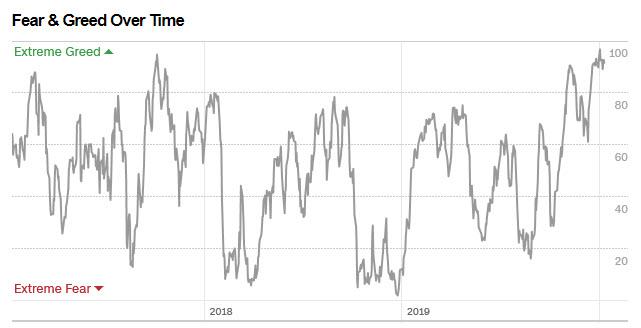
When it comes to gauging market euphoria, one place to find the current state of retail investor (super) sentiment, is the CNN Fear and Greed Index, which over the past three weeks, has printed at all time series highs.
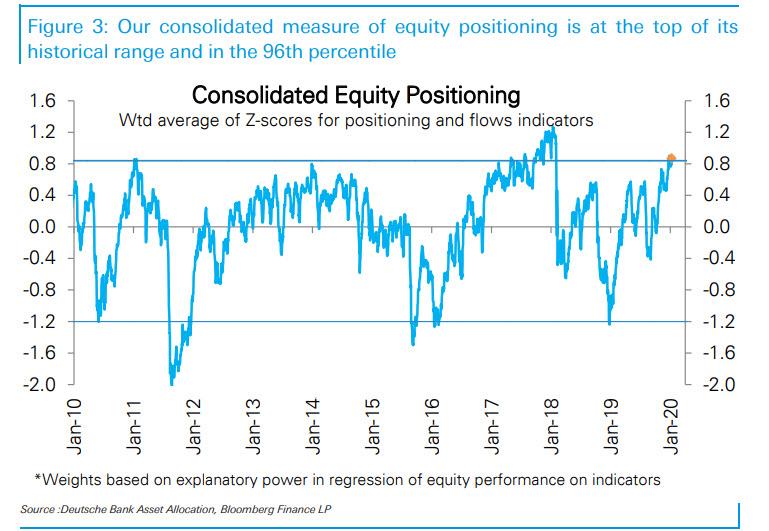
What about institutional sentiment? Well, contrary to several goalseeked indicators which erroneously repeat week after week that whales and other prominent institutional traders remain "on the fence" despite the now daily record highs in the S&P, the truth is that virtually everyone is now all in: from simple human-driven discretionary, to macro funds, all the way to algo and CTAs. In fact, as Deutsche Bank's Parag Thatte writes in his weekly flow report, "positioning in equities has been rising and is now in the 96th percentile on our consolidated measure, with a wide variety of metrics very stretched." And, as we have noted previously, equity flows as well as "equity positioning, like the market itself, has run far ahead of current growth as investors price in a global growth rebound."


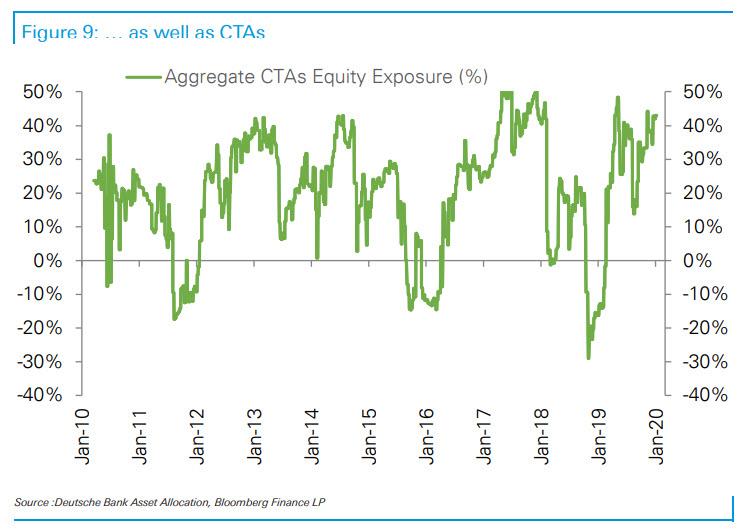
But while it has been known for a while that most humans have thrown in the towel amid a mauling of bears and shorts, it now appears that systematic strategies - i.e., algos, quants, risk parity, etc - have also raised equity exposure to the top of its range. According to Thatte, the equity allocations for Vol Control, CTAs, and Risk Parity are all near a historical maximum, which means that algos are now effectively all in.
Some more details:
  • Vol Control: Vol Control funds are near their maximum equity allocations for more than 2 months now. 1M SPX realized volatility has been sub-10% since November without >1% daily moves in more than 2 months. VIX was also seasonally low this past December. Sustained low volatility environment helped VC funds maintain their high equity exposure through the recent flare-up in geopolitical risk.
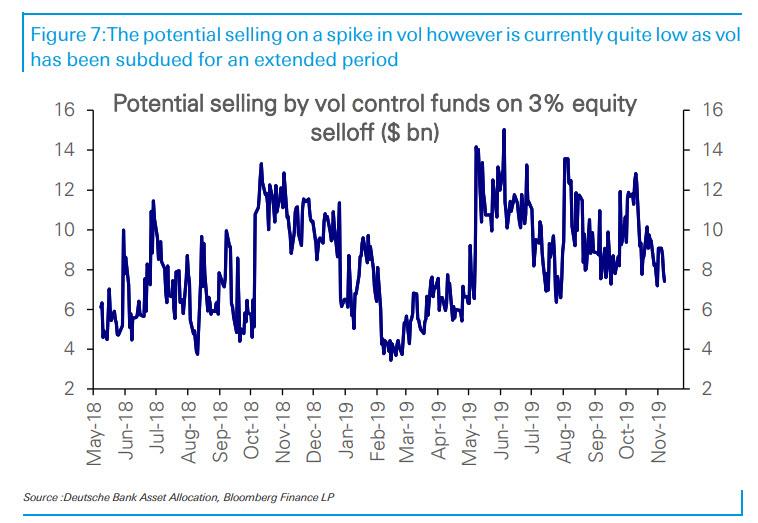
Selling pressure from VC on a 3% pullback in SPX now stands at ~ $7bn-$8bn, while DB's aggregate volatility metric targeted by VC funds is close to 10% and stands near the bottom end of its past 10Y range. And here a warning from Thatte: with barely any upside bid left, the downside risk from VCs is higher at this stage of the market rally.
  • Risk Parity funds: Risk parity have scaled their SPX exposure back up to near record levels. A near uniform uptrend in equities, coupled with low equity volatility and bonds moving sideways, have boosted RP exposure to equities. Extended period of low RV likely prompted relatively slow moving RP funds to steadily increase their equity allocation over the past month. In addition, moderating negative returns correlation between bonds and equities have seen this equity exposure increase occur at the expense of exposure to bonds. Bond volatility remains relatively elevated despite trending lower over the past month. Indicative RP bond exposure is now back near March 2019, leaving limited upside for further higher equity exposure and lower bond exposure.
  • CTAs: CTA equity exposure increased with the upward trending markets to near peak levels. Recent momentum in US equities have been uniformly strong across short and medium term signals, translating to a higher level of confidence in the latest uptrend. CTA exposure to EM equities also shows up as heavy with spot reaching back to 1Q18 levels. Bond positioning by CTAs have steadily moved lower and reached their 1Y lows. The cuts in bond exposure have been across most regions, especially in Japan where 10Y JGB yields have almost turned positive.
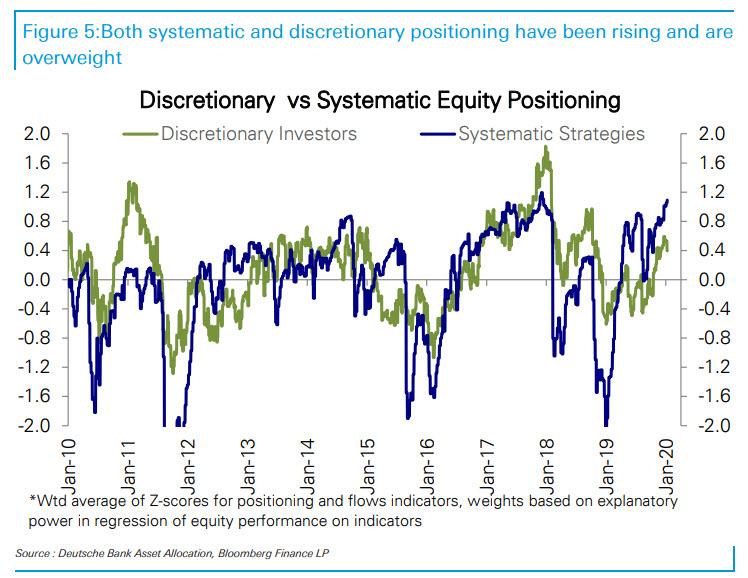
In this context, it is hardly surprisingly that the Deutsche strategist observes that the only other time that systematic strategy positioning was higher was in January 2018... just before the large February selloff.
And yet, unlike Feb 2018, a vol spike like the one observed in Feb 2018 may not be enough to trigger a market crash. The reason: vol control funds are usually the first to sell equities when vol rises, but with volatility having been subdued for an extended period of time, they would need to see a large and sustained spike in vol for their selling thresholds to be hit.
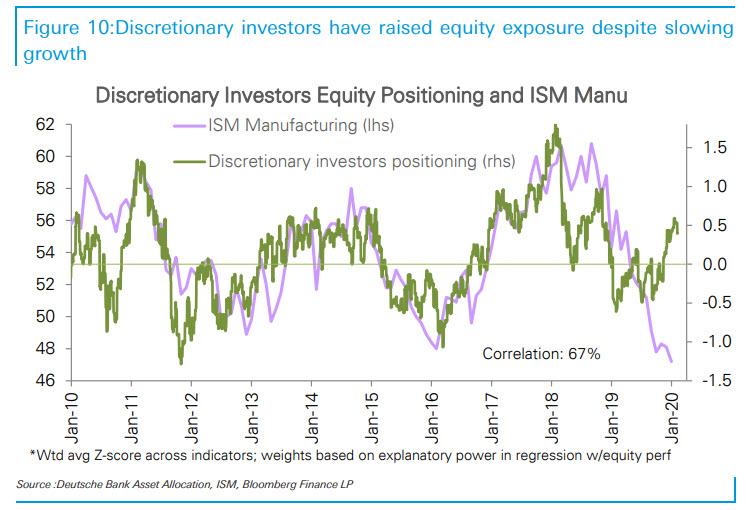
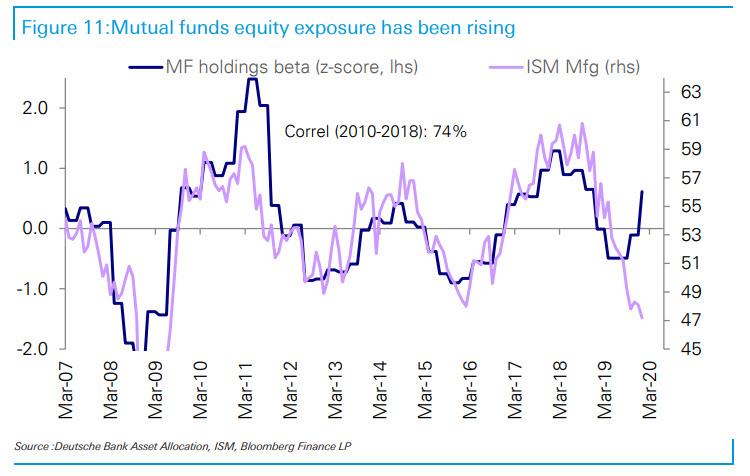
Still, while algos are only now rush to go balls to the wall, they are only now catching up to discretionary investors who have steadily raised their bullish positioning since August and are now clearly overweight in DB's reading, and exposure is at the highest levels since October 2018. Discretionary positioning typically follows growth indicators closely but since September, it has diverged and has moved sharply higher even as growth is yet to rebound (instead, it appears that positioning is merely chasing the broader market which has soared on the back of the Fed's QE4 which was launched to "fix" the repo market after JPMorgan broke it). Active mutual funds as well as retail investors have raised exposure following the strong market rally.
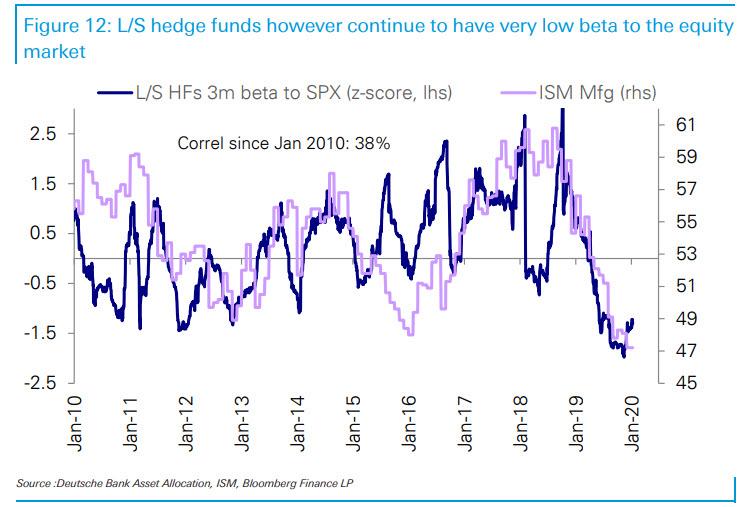
However, there is one place where the euphoria has yet to go off the chart: the popularly followed beta positioning for long-short hedge funds still remains very low, and in line with subdued growth indicators.
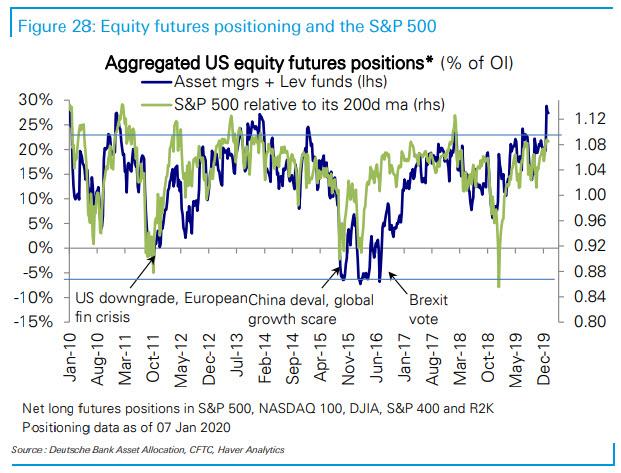
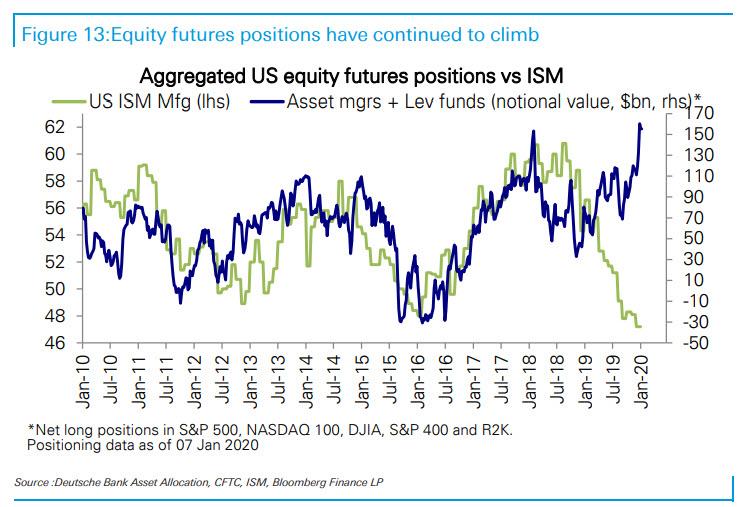
Finally, several indicators point to stretched positioning across other metrics. For example, equity futures long positioning for asset managers and leveraged funds combined is at record highs, driven by a broad-based rise in longs across the S&P 500 and Nasdaq as well as the small-cap Russell 2000 futures.
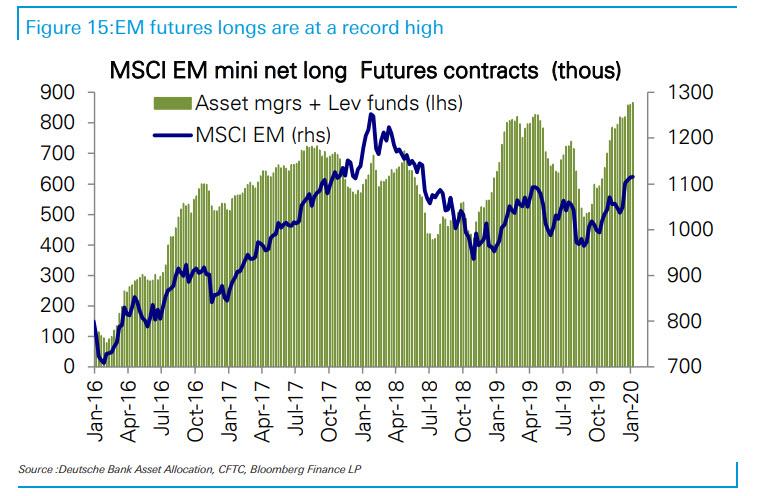
Longs in EM futures have risen to record highs.
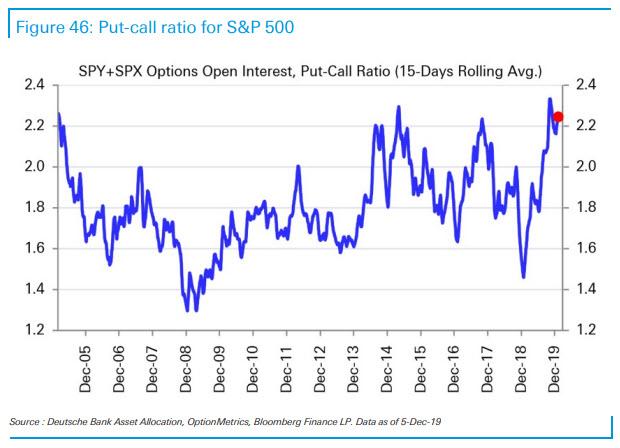
Call/put volume ratios are at the top of their historical range;
And short interest in single stocks is near record lows; and that in ETFs has also fallen to a new low.
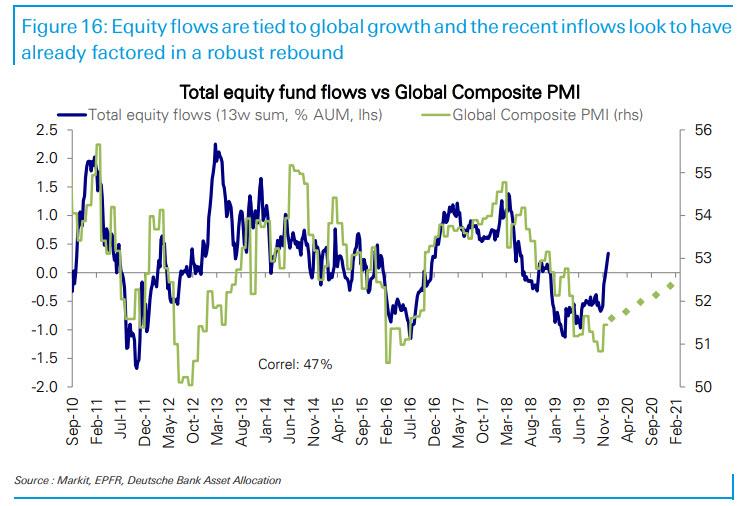
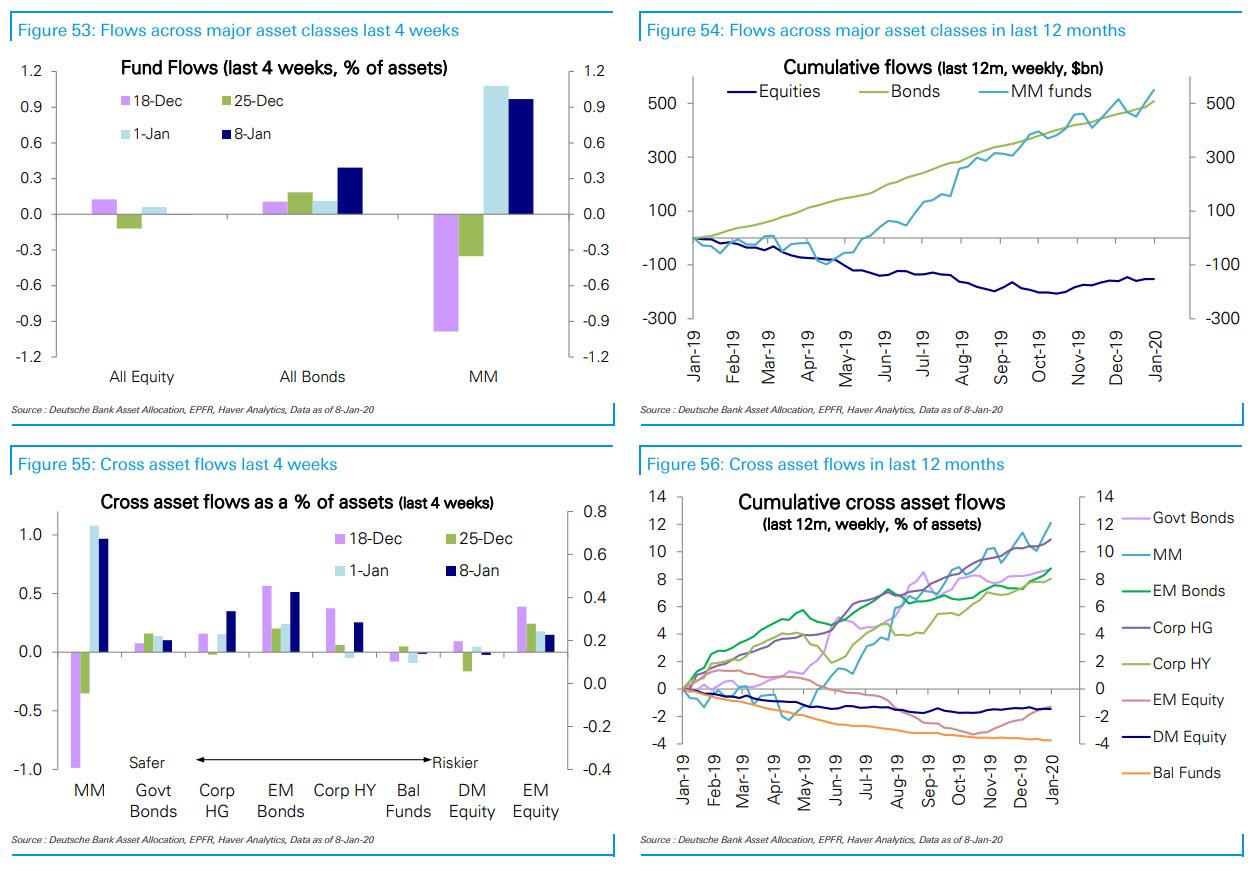
One last confirmation of what appears to be a bullish capitulation into the QE4-inspired melt up is that equity fund flows have also turned up strongly over the last 3 months. Almost $50bn came in over this period, compared with over -$300bn in outflows in the prior 10 months.
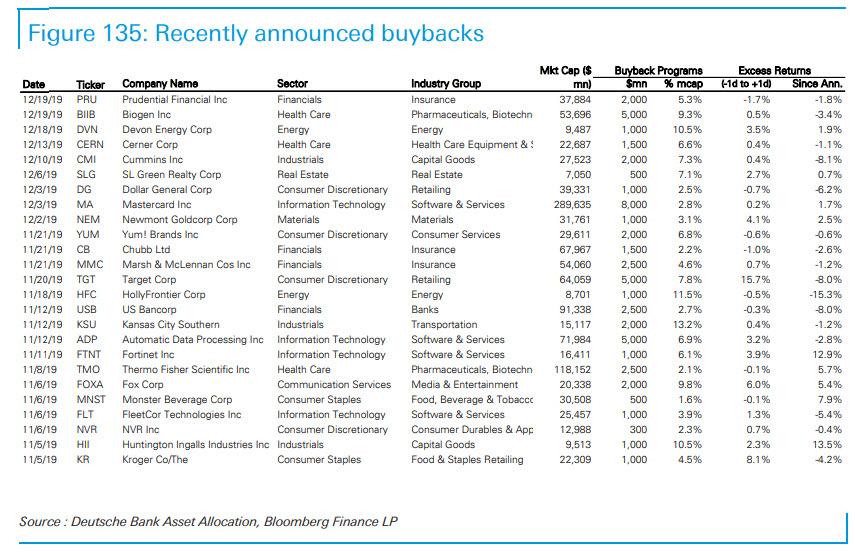
Oh, one more thing we almost forget: with institutions, retail investors and algos all in stocks, the biggest source of equity demand, corporations themselves, appear to be easing off the stock buyback pedal. Indeed, awhile there has been a flurry of recent buyback announcements...
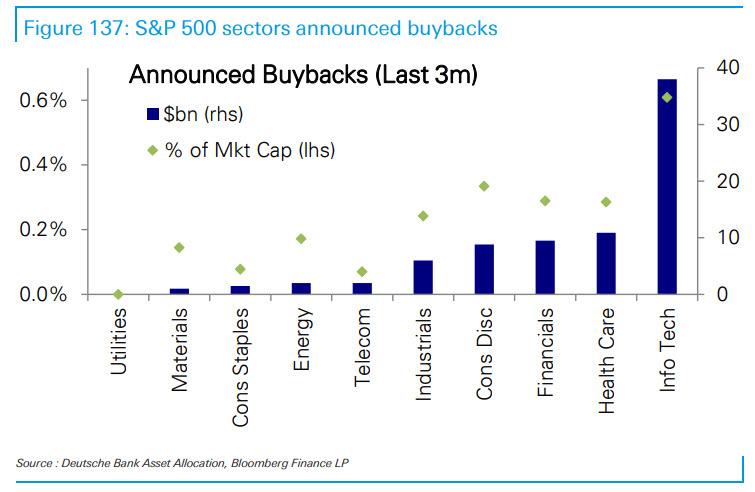
... with tech names leading by the runner up, healthcare, by nearly 3 to 1 in buyback announcements...
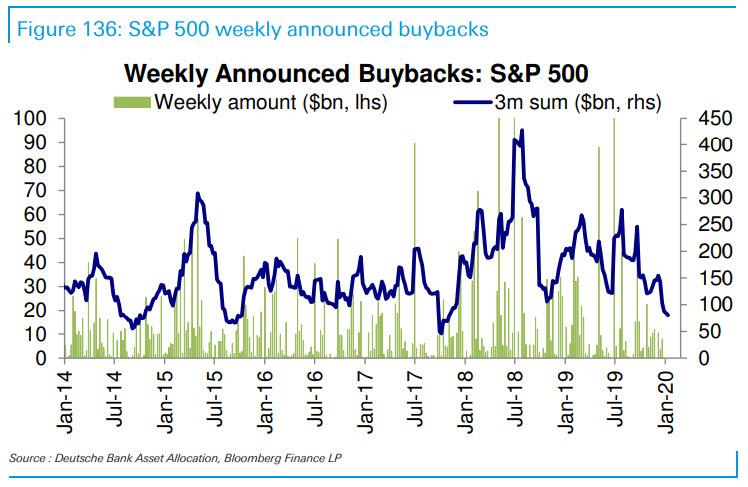
... in the grand scheme of things, and on a rolling 3 month basis, stock buybacks are a far cry from where there were just two years ago, and fading fast to levels not seen since before the Trump tax reform which unleashed a $1.5 trillion buyback bonanza.
It is this sudden reversal in buyback appetite that may be the biggest danger for a market where 77% of CFOs now think the market is significantly overvalued.