Hedge fund co-founder returns to London from New York
Glen Point Capital has suffered tough period with losing bets in Argentina
The co-founder of Glen Point Capital, a hedge fund that raised money from billionaire investor George Soros, has relocated back to London from New York in the wake of a tough period for the emerging markets-focused manager.
Jonathan Fayman, Glen Point’s co-chief investment officer and a former senior fund manager at BlueBay Asset Management, moved to the US a couple of years ago but moved back to the hedge fund’s London office late last year, according to people familiar with the firm.
Mr Fayman’s move to New York, which separated him from co-founder Neil Phillips, has been viewed as a possible mis-step by some people close to the firm.
Last year Glen Point, which manages around $2.5bn in assets, posted a 3.3 per cent loss in its main fund. It lost money with bets on Argentina, following a shock primary election result in August that knocked the country’s stock market and currency. So far this year, the fund has gained 4 per cent, said a person who had seen the numbers.
Glen Point declined to comment.
Mr Fayman joins a number of hedge fund managers who have made London their base in recent years, despite political and regulatory uncertainty as the UK exits the EU.
Alan Howard, co-founder of Brevan Howard, moved to Geneva in 2010 but the switch was later seen internally as a mistake and he returned to London in 2017.
Last year Caxton Associates, one of the world’s oldest hedge funds, told investors its headquarters were now in London rather than New York after a burst of hiring that roughly doubled headcount in its London office over 18 months.
Why hedge funds are still searching for the next big thing
However, former GLG star trader Greg Coffey moved to New York last year, citing concerns about London’s role as a global financial centre.
Mr Phillips and Mr Fayman managed a $1.4bn global macro fund at BlueBay before their departure in 2014. Glen Point, which follows a similar mandate, trading global markets with a focus on emerging markets, was one of London’s biggest hedge fund launches in recent years in a largely tough environment for start-ups.
Glen Point recently hired Themos Fiotakis, the former head of fundamental strategy across assets at UBS Investment Bank and a former Goldman Sachs strategist, as its head of research in London.
Hedge funds based in London have received a boost from the weakness in sterling against the dollar, as most funds manage money and earn fees in dollars, while their UK-based costs are in sterling.
Closing Stock Market Summary
The large-cap indices started Tuesday's session hitting intraday highs, but stocks steadily pulled back throughout the day amid a lack of follow-though buying interest. The S&P 500 (+0.2%) and Nasdaq Composite (+0.1%) still eked out closing records, while the Dow Jones Industrial Average (unch) finished flat. The Russell 2000 rose 0.6%.
The initial boost in the market was attributed to reports indicating that the rate of new coronavirus cases was slowing down and a view that monetary policy will remain favorable given the risks that remain due to the virus. Fed Chair Powell told the House Financial Services Committee today that the Fed is "closely monitoring" the situation.
The S&P 500 real estate (+1.2%) and energy (+1.0%) sectors advanced at least 1.0%. The communication services (-0.4%), consumer staples (-0.3%), and information technology (-0.3%) sectors underperformed, with the former pressured by Facebook (FB 207.19, -5.87, -2.8%) after it was downgraded to Sell from Hold at Pivotal Research.
The ratio of advancers to decliners in the NYSE was more than 2:1, but today's advance was slim given the missing leadership from the mega-cap technology stocks. On a related note, the FTC said it will be examining small acquisitions made by Apple (AAPL 319.61, -1.94, -0.6%), Microsoft (MSFT 184.44, -4.26, -2.3%), Alphabet (GOOG 1508.79, +0.11, unch), Amazon (AMZN 2150.80, +16.89, +0.8%), and Facebook (FB).
Separately, the merger agreement between Sprint (S 8.52, +3.72, +77.5%) and T-Mobile US (TMUS 94.49, +9.96, +11.8%) was finally approved by a federal court in New York. Shares of Sprint surged more than 75% in response.
In earnings news, Under Armour (UAA 16.59, -3.86, -18.9%) and Goodyear Tire (GT 11.56, -1.63, -12.4%) disappointed investors with results and/or guidance and both mentioned the negative impact caused by the coronavirus. Burlington Stores (BURL 243.45, +14.95, +6.5%) outperformed after raising guidance.
U.S. Treasuries finished on a lower note and barely moved during Fed Chair Powell's congressional testimony. The 2-yr yield increased four basis points to 1.42%, and the 10-yr yield increased four basis points to 1.42%. The U.S. Dollar Index declined 0.1% to 98.75. WTI crude rose 0.9%, or $0.44, to $50.01/bbl.
Reviewing Tuesday's economic data:
- The NFIB Small Business Optimism Index for January increased to 104.3 from 102.7 in December.
- The December Job Openings and Labor Turnover Survey showed job openings decline to 6.423 million from a revised 6.787 million in November (from 6.800 million).
Looking ahead, investors will receive the weekly MBA Mortgage Applications Index and the Treasury Budget for January on Wednesday.
- Nasdaq Composite +7.4% YTD
- S&P 500 +3.9% YTD
- Dow Jones Industrial Average +2.6% YTD
- Russell 2000 +0.5% YTD
NTSB releases detail on ongoing crash probes
- Tesla driving itself on 'autopilot' struck side of truck
- truck driver in 2019 tesla crash ran stop sign
- truck slowed, didn't come to full stop at crash intersection -- crash in delray beach, florida, killed tesla driver
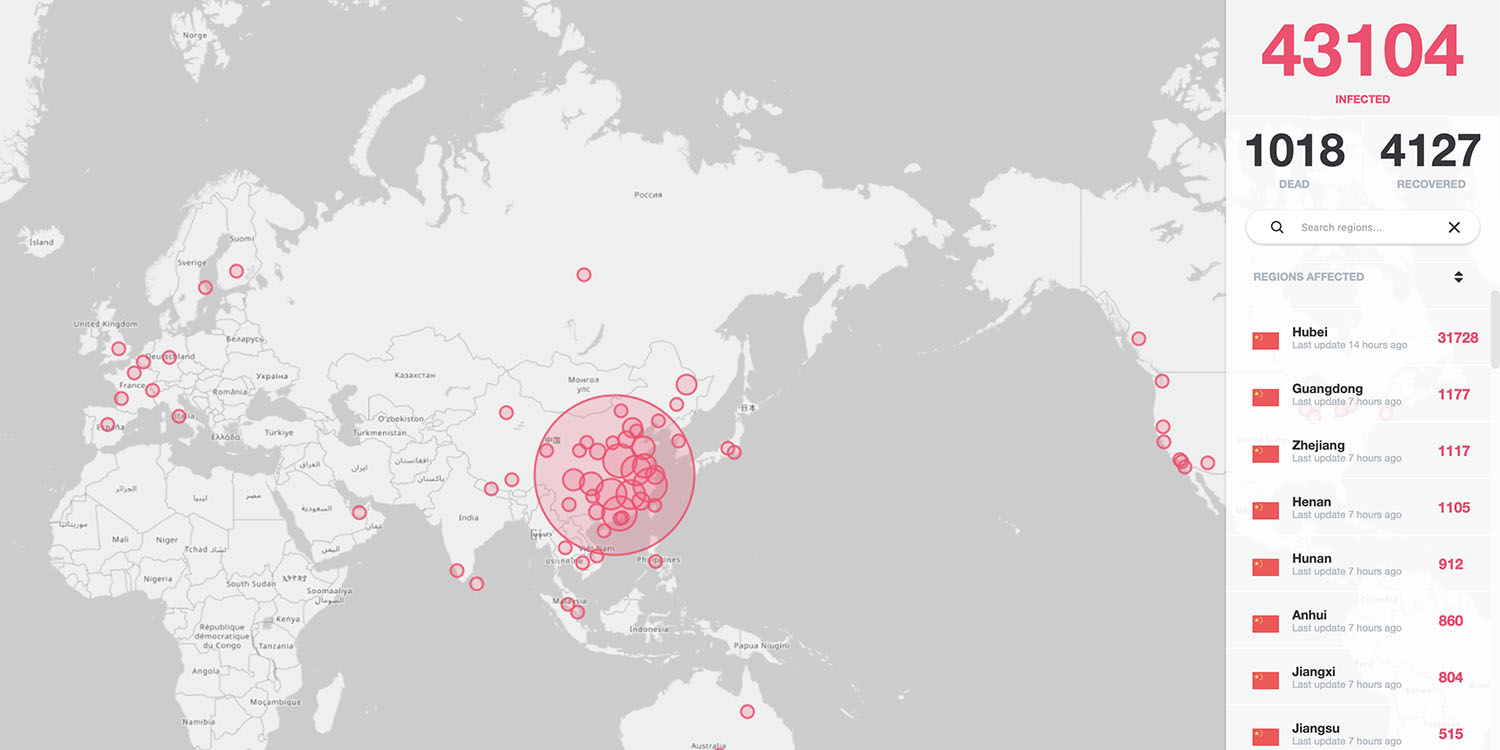
A coronavirus app created by the Chinese government lets people check whether they have been in close contact with someone confirmed or suspected to have the virus.
The app is made possible because of close government monitoring of Chinese citizens…
The BBC reports.
Once the new app is registered with a phone number, users are asked to enter their name and ID number […]The app was jointly developed by government departments and the China Electronics Technology Group Corporation and supported by data from health and transport authorities, according to the state-run news agency Xinhua.It is widely known that the Chinese government conducts high levels of surveillance on its citizens but experts in the field suggest, in this case at least, it will not be seen as controversial within the country.
It appears that the app checks a database of known or suspected carriers, and then checks location histories to see whether you were in the same place at the same time.
The report says that ‘close contact’ is flagged in three cases.
- People who work closely together, share a classroom, or live in the same home
- Medical staff, family members or other people who have been in close contact with patients and their caregivers
- Passengers and crew who have been on planes, trains and other forms of transport with an infected person
For example, all air passengers within three rows of an infected person, as well as cabin staff, are seen as being in close contact, while other passengers would be recorded as having general contact.When it comes to air-conditioned trains, all passengers and crew members in the same carriage are regarded as being in close contact.
While we would likely be alarmed at the level of tracking needed to make the coronavirus app work, a local lawyer says Chinese people are generally more relaxed about this provided they know about it.
From a Chinese perspective this is a really useful service for people… It’s a really powerful tool that really shows the power of data being used for good.