Why American fashion is migrating to LA
The West Coast has movie moguls, the East Coast has editors. But which US city is the home of American fashion?
The global tour of the Autumn/Winter 2020 fashion collections began in Los Angeles this season, despite being part of New York Fashion Week. This oddity was driven by the overlap of the Academy Awards with New York’s fashion calendar, but the fact that the glitz of Hollywood could shift decades of American fashion tradition highlights the quakes that are shaking fashion industry traditions.
Tom Ford revealed his collection with a catwalk that looked more like an Oscars after-party than a fashion show, with Hollywood powerhouses such as Jeff Bezos and Ron Howard mingling there. He generated headlines on the Friday of Oscars weekend with a massive and valuable grab of media attention, which is exactly the point of a fashion show these days. The sheer number of stories suggests that Ford’s move created the sort of return on investment that a fashion show is intended to garner.
But Ford was not the first of the fashion reveals that took place in LA in advance of New York Fashion Week. First came M Missoni on Tuesday, which held a dance-a-thon presentation at the famous — or infamous, depending how you feel about wieners — Pink’s Hot Dogs on La Brea Avenue. Technically, it was the Italian label’s Spring 2020 season, but with see-now-buy-now so fully ensconced on fashion calendars, no one is counting. Dozens of beautiful people lounging about in M Missoni’s vivid knitwear — the newly legal scent of cannabis wafting about — looked as though they were staged for the Italian brand’s next advertising campaign, and images were immediately released on social media.
Three afternoons later, Baja East took over the nightclub at the Edition hotel in West Hollywood, which has a ceiling full of disco balls and, for the show, a floor strewn with colourful woven rugs. That was a fitting location for this hipster-ease label, which exudes a stoned-on-the-beach-after-all-night-partying sensibility.
The Baja East story taps into a wider tale of two cities locked in a rivalry to lead America in cultural relevance. The label started out in New York in 2013, an unapologetically expensive luxury brand that promoted loose ungendered clothing one might want to wear après-surf in Baja. But its designers — then Scott Studenberg and John Targon — were New Yorkers — hence the “East”.
In the seven years since, Baja East has pared its prices dramatically to the so-called contemporary level and cut to one designer, Studenberg. (Targon briefly joined Marc Jacobs, then launched his own line called Fall Risk.) Studenberg migrated to Los Angeles in August 2017, where he lives in Laurel Canyon a few minutes from the Edition hotel where he showed his Autumn/Winter collection to a crowd of friends and fans that included the musical artist Paula Abdul. He says he has no plans to return to New York Fashion Week.
“I don’t like New York. It’s not my vibe anymore,” Studenberg said backstage after his show. “I don’t want to go on Monday, but I’ll go to sell my collection,” he added, giving a nod to the fact that New York is the indispensable home of America’s most productive wholesale showrooms.
A few hours after Baja East, the fashion-going crowd moved several miles east to central Hollywood, where Tom Ford revealed his AW2020 collection to many of the same people who would be attending the Academy Awards two nights later. Ford’s gravitas in Hollywood comes both as the fashion designer who dresses the entertainment industry’s power brokers — a role he took over from Giorgio Armani and Brioni — as well as an accomplished film director.
This created a wholly different front row than any fashion show in recent recall. The Amazon billionaire Jeff Bezos was seated in the place of honor beside Anna Wintour. Super agent and Creative Artists Agency partner and managing director Bryan Lourd chatted with producer Brian Grazer. Guests included Jennifer Lopez, Miley Cyrus, Jon Hamm, Jason Momoa and so many more that it’s easy to see why Ford chose LA over New York. He owned the city and the fashion internet that night.
From left: Jeff Bezos, Anna Wintour and Jennifer Lopez at Tom Ford AW20
The event generated $6.1m of media value in the days after the show, according to London-based Launchmetrics, which scrapes the internet for mentions and calculates the financial value if the media had been purchased. That’s 36 per cent more than the $4.5m in media that Launchmetrics estimated Ford’s show generated in September 2019, when he held it in a New York subway station. Showing in LA was a daring move for Ford, who is the newly appointed chairman of the Council of Fashion Designers of America. Many in the industry felt he should remain loyal to New York’s fashion week in order to be more supportive of other designers. However, it’s hard to argue with his results.
The question remains, for designers who lack Ford’s might, how to generate the greatest return from a fashion show. This is something that is too little studied by fashion brands who often lack the finances or know-how. If publicity and pictures are the primary products of fashion shows today, which is more valuable — an audience full of influencers and editors in New York, or the cabal of Hollywood stars and starlets and the organised hype behind them in Los Angeles?
Diving deeper into the numbers suggests that breaking away from the fashion week pack can be highly beneficial to a brand. The stories coming out of Ford’s Hollywood runway tended to be specifically about Ford, rather than mentioning him among other New York designers, according to Launchmetrics. In fact, the analysts calculate that, when accounting for the benefit of celebrities and influencers and lack of shared references with fashion week, the better comparison to media value is a stunning $9.7m rather than the $6.1m measured within the fashion context. That’s bad for New York Fashion Week, but suggests a massive benefit to Ford.
Big Oil is facing an existential struggle
BP’s ambitious climate targets set a challenge for its global peers
BP has been a laggard in the race among oil and gas majors to reposition themselves in the battle against climate change. Now Bernard Looney, its new chief executive, is living up to his promises to be bold. BP, he has declared, will become a “net zero carbon” company by 2050 or sooner — that is, its own operations will produce no net carbon dioxide emissions. The group will also cut by half the amount of carbon in the products it sells by the same date.
For a company that traces its roots to the first oilfields in Iran more than a century ago, this is a radical departure. The Anglo-Persian Oil Company — later British Petroleum — was synonymous with the development of the modern oil industry and became one of the Seven Sisters that dominated global energy. Going to net zero will mean eliminating or offsetting about 415m tonnes of emissions — 55m from BP’s operations and 360m tonnes from the carbon content of the oil and gas it currently produces. The company, said Mr Looney, will make the shift by investing more in low-carbon businesses and less in oil and gas over time. Its structure will be revamped. The traditional split into “upstream” exploration and production, and “downstream” refining and marketing operations, will be dismantled.
Mr Looney deserves credit for his ambition. After an ill-timed attempt to go “Beyond Petroleum” in the early 2000s was quietly abandoned, BP faced growing pressure to set out its plans to reduce its carbon footprint. Spain’s smaller Repsol was the first major to set a net-zero target for 2050 in December. Royal Dutch Shell has pledged to halve its “net carbon footprint” over the same period.
Yet while targets are welcome, the scale of the challenge requires more action. BP gave few details about how it plans to make the promised cuts. The strategy is likely to include reducing emissions from its operations as well as carbon offsetting measures and more money spent on low-carbon energy. Mr Looney has promised to say more about near-term targets in September but more investment will be critical. The International Energy Agency notes that the average investment by oil and gas companies in non-core areas has so far been limited to about 1 per cent of total capital spending.
BP’s shift reflects an inescapable truth: “Big Oil”, often seen as the villain in the climate change debate, faces an existential crisis. Climate change has moved to the forefront of the public’s consciousness. Investor alliances such as Climate Action 100+ have been lobbying for action. Countries’ energy systems will need to be radically transformed if the world is to meet the climate targets set out under the Paris agreement. The business models of traditional utilities have already been upended as they have had to respond to the shift to renewable energy.
The survival of the oil industry will require more than just BP to commit to radical action. US majors, including ExxonMobil, have been much slower in embracing climate pledges. National oil companies, which account for more than half of global oil production and whose government owners typically rely heavily on the income, need to play their part. If investors are to hold companies to account, moreover, common standards for measuring exposure to climate risk need to emerge from several competing initiatives that have been launched.
Listed companies such as BP must also reinvent themselves while keeping their shareholders on board — many of whom will continue to demand chunky dividends. Mr Looney has set aggressive goals. Achieving them will be among the biggest management challenges of the coming years.
Fed Injects $79BN In Liquidity: Term Repo Most Oversubscribed Since Repo Crisis
The repo market was supposed to be fixed in September; then the year-end liquidity flood was supposed to definitely fix the repo market. But it is now mid-February and moments ago the Fed just reported it conducted the fourth oversubscribed term-repo operation as the liquidity shortage among dealers appears to persist.
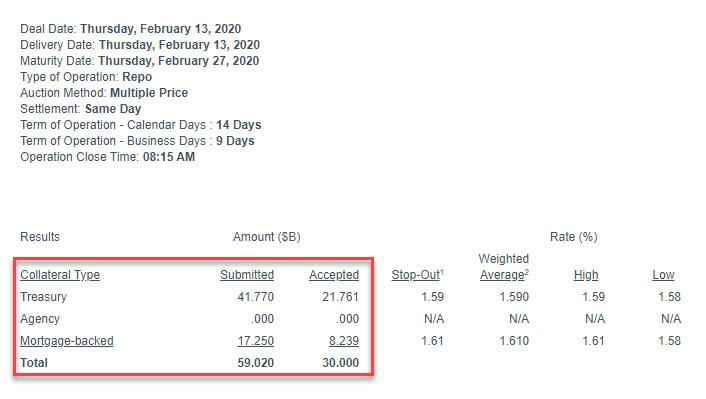
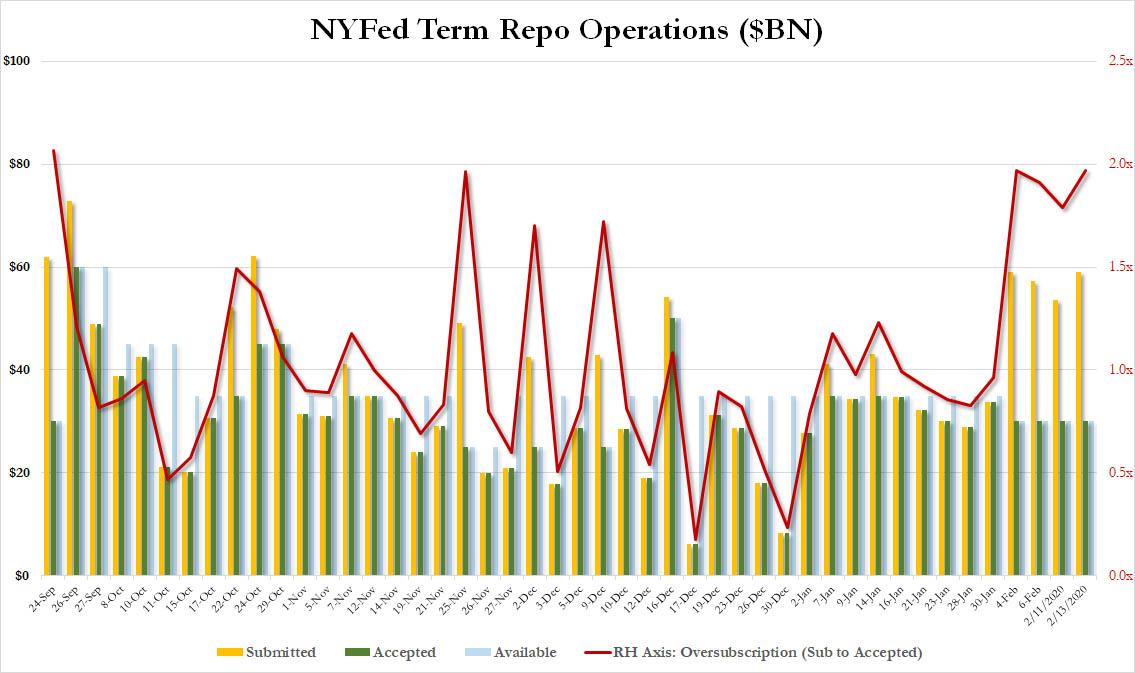
This means, that at a submitted to accepted ratio just shy of 2.0x, this was tied for the most oversusbcribed term repo operation since the September repo crisis as there clearly remains a big hole in dealer liquidity.
And confirming that liquidity indeed remains quite scarce a month and a half after year-end, moments ago the Fed also conducted its overnight repo which saw $48.85BN in liquidity injected...
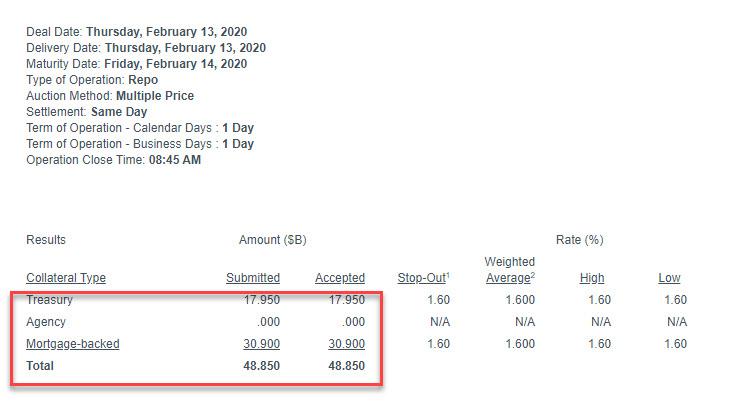
... and which together with the oversubscribed $30BN term repo conducted earlier, means the Fed has injected $79BN in liquidity for today's market needs.
Ominously, the ongoing excess demand for term repo (which in February was cut by $5BN from $35BN to $30BN, and later today will be cut by another $5 billion or so when the Fed releases its upcoming monthly repo schedule) means that the liquidity crisis that continues to percolate just below the surface of the market and has clogged up the critical plumbing within the US financial system, is getting worse, not better, and today's massive oversubscription indicates that one or more entities continues to face a dire shortage of reserves, i.e., cash.