Mifid II review aims to boost euro trading in commodity derivatives
Two years on from landmark legislation, Brussels prepares series of tweaks
Europe is considering relaxing its rules on the trading of commodity derivatives, in order to reduce its dependence on oil benchmarks priced in US dollars while boosting euro-area trading of alternatives like natural gas.
The announcement is part of a series of changes the European Commission is planning to make to its flagship Mifid II legislation, which was introduced in early 2018 in an effort to bring greater transparency and competition to the region’s financial markets.
The commission’s long-awaited consultation on Monday confirmed that Brussels’ priorities include reforming the rules that let EU investors trade shares in London after the Brexit transition period ends; introducing a single record of stock trades; and finding ways to improve analysts’ research on small and medium-sized listed businesses.
With respect to commodity derivatives, Brussels is keen to promote the euro as a credible alternative to the US currency. Policymakers in the EU have focused on the crude oil sector in particular, where the main benchmarks such as Brent and WTI are tied to the dollar. Proposals include easing transparency standards and limits before a position has to be traded on an exchange. Another option is to allow for trades negotiated over the counter to be brought on to exchanges, so investors could get more comfortable with the idea of electronic trading.
Valdis Dombrovskis, the EU’s financial services commissioner, said the changes aimed to strike the right balance between the competitiveness of the EU’s financial sector and safeguarding the interests of investors.
“We need well-functioning financial market rules to ensure that EU capital markets work, both for companies raising financing, and for Europeans looking to invest their money,” he said.
The main euro-denominated gas benchmark is the Netherlands’ TTF. Derivatives based on the benchmark are traded in Amsterdam. So-called open interest, or the number of contracts outstanding on ICE Futures Europe, rose 89 per cent last year to 2.25m. That is faster-growing than the CME Group’s natural gas futures contract in the US.
Two weeks ago, the European Securities and Markets Authority highlighted weaknesses in the Mifid II regime, including a failure to address big rises in trading in “dark pools”, where prices are disclosed only after a deal has been executed.
Since the advent of Mifid II, trading has become more fragmented between different venues and investors have used more waivers to avoid putting large blocks of shares on to the market.
The commission said that another proposal, for a single record of trading data — known as a “consolidated tape” — may require changes to the primary legislation.
Brussels will also look at rules in derivatives markets that would force futures exchanges to allow outside clearing houses to compete for traders’ business, but admitted the matter was not a priority.
The reforms were delayed by 30 months when Mifid II came into effect, because of regulators’ concerns about financial stability. The consultation on tweaks to Mifid will run until mid-April.
Q4 Earnings Shocker: Excluding The FAAMGs, Net Income Is Down 7.5%
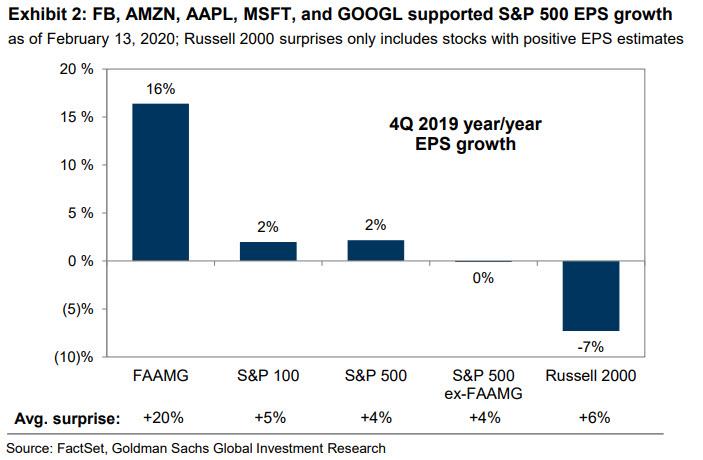
Yesterday we showed readers a remarkable statistic from the latest Weekly Kickstart report by Goldman's David Kostin: according to the chief Goldman US equity strategist, whereas modest S&P500 earnings growth in Q4 was set to finally end a 4 quarters-streak of negative EPS growth, with S&P earnings per share set to rise by a modest 2% Y/Y, virtually all of the earnings upside came from just the top 5 biggest companies: Facebook, Amazon, Apple, Microsoft and Google (aka FAAMG), which collectively saw their EPS rise by a whopping 16% (mostly on the back of record stock buybacks which reduced the number of shares outstanding thus lowering the denominator in the EPS calculation). Without them, S&P earnings were flat, while earnings for small-cap companies represented by the Russell 2000 were actually down a whopping 7% Y/Y, prompting us to say that "It's "The 1%" vs Everyone Else: FAAMG Earnings Soar As Russell 2000 EPS Growth Craters."
One day later, on Monday morning, SocGen's Andrew Lapthorne has further refined Goldman's analysis, and come up with an even more jarring conclusion on corporate profitability, one which avoids the impact of buybacks on artificially inflating EPS by simply looking at Net Income. What he founds is that "despite strong markets last year, net income barely moved, with a rise of just 0.3%. More worrying is without the Big 5 companies (Microsoft, Alphabet, Apple, Amazon and Facebook), net income fell 7.5%", which further underscores our recent discussion of how bifurcated the market is becoming between the handful of mega-caps, i.e., the "other 1%", and the "other" 495 companies in the S&P.
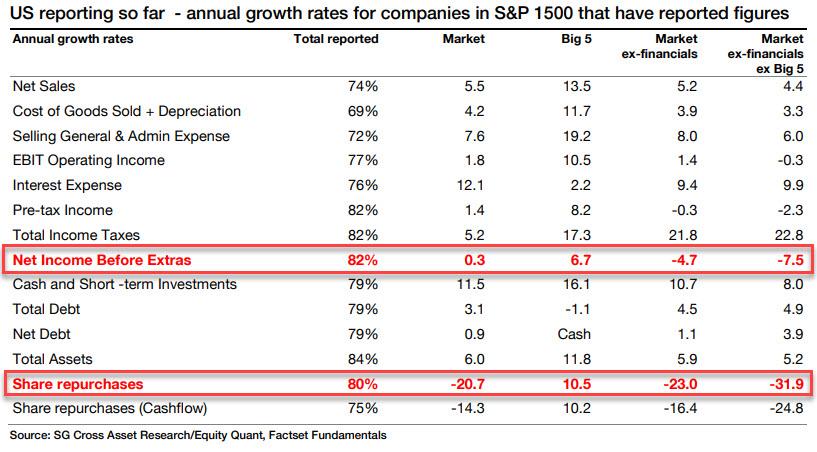
What is behind this disappointing result for virtually all publicly traded companies with the exception of a handful of mega techs? According to Lapthorne, "this is due to higher costs (SG&A) and a significant rise in both interest expense and taxes" with the SocGen strategist noting "that interest costs are rising so quickly despite low interest rates is remarkable and a challenge to policymakers." His bottom line is a carbon copy replica of what we have said on countless prior occasions, namely that "with all this debt, higher interest rates seem no longer feasible", something which even the Fed has now figured out.
There were other issues as well: first, looking at the leverage front, asset growth rose marginally quicker than Net Debt, so debt-to-asset ratios declined but, at the same time, EBIT hardly grew, and again this problem is accentuated once the Big 5 are excluded.
But the headline-grabbing figure is share buybacks. We measure buybacks both from the declared amount repurchased to the repurchase figure from the cashflow statement. As Lapthorne explains, "typically, the former is bigger than the latter. With 80% of the overall value of buybacks reported so far, buybacks are 20% lower in 2019 than 2018 - excluding the Big 5, the figure is down 32%" , which incidentally is exactly what we warned about a month ago when we showed that virtually every investor class - from institutions, to retail, to systematics (risk parity/CTA/vol targeting) are all in - and yet buybacks are tumbling.
Yet not everyone is cutting back on buybacks: that the Big 5 continue to buy back - with a 10.5% increase in buybacks compared to the 32% decrease for everyone else - "no doubt helps explain the performance divergence" which Lapthorne demonstrated last week, when he showed that the top 5 (and 10) largest companies are now outperforming the broader market by the widest margin on record.
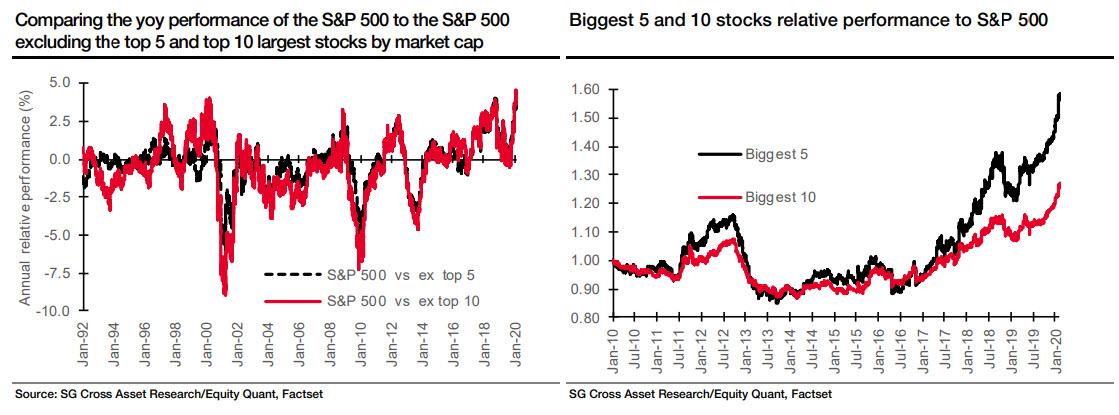
And now we know why.
NMC/advisers: the companies they keep
Well-paid toil of bankers, brokers and bean counters has proved of little value to investors
The single most important number an investor should know? For the billionaire founder of NMC Health it was the size of his shareholding. BR Shetty resigned from the board of the Abu Dhabi-based hospital operator on Monday, taking two executives with him. Mr Shetty’s departure follows claims from his co-chairman that the entrepreneur incorrectly reported his shareholding.
London’s popularity as a venue for foreign listings comes at a cost. Unfamiliar businesses require investors to take more on trust. Listing rules — widely criticised in this case — provide one backstop. The reputation of local advisers is another soft guarantee. Their credibility suffers collateral damage when the client they vouch for suffers a governance implosion.
A gold-plated bevy of banks, brokers, bean counters and lawyers has worked for NMC over the years. They include Deutsche Bank, JPMorgan, Numis, EY, Allen & Overy and Clifford Chance. Some have spent thousands of hours preparing documents on which investors depended, including bumf for the 2012 flotation.
That well-paid toil has proved of little value to investors. There is something badly wrong with the governance of a business where a powerful director took out loans secured on shares, some of which may then have gone walkabout.
Adding to investor woes, Carson Block, the short seller that nervous chief executives see as the Fifth Horseman of the Apocalypse, rode into town in December. He claims NMC inflated cash flows and understated debt. NMC denies claim but shares in the group have still dropped 70 per cent. Finablr, another UK-listed business set up by Mr Shetty, is tainted by association. The stock of the group, which owns foreign currency retailer Travelex, is down 65 per cent.
The Financial Conduct Authority is investigating the conduct of Mr Shetty and his associates. Accounting authorities may probe the quality of audits at their usual leisurely pace. None of this helps shareholders who have lost their shirts. Some had already forfeited their jackets during the governance implosions of foreign miners Bumi and ENRC.
Investors should take an appropriately sceptical view of new financings brought to them by NMC’s advisers. Professional services firms are not taxis. They can turn down clients whose credibility they doubt. Banks, brokers and accountants who avoided NMC should congratulate themselves on their foresight.
US law firm partners pocket bumper $3m profits
Surge of corporate megadeals and litigation cases in 2019 drive record growth
Top tier partners at a slew of US law firms firms pocketed record profits of $3m on average last year as a host of bumper litigation and corporate dealmaking boosted their coffers.
US firms have started reporting their annual results, with many notching up double-digit revenue increases in 2019 that helped drive record partner profits.
Last year was marked by a series of US megadeals including Bristol-Myers Squibb’s $93bn takeover of rival drugmaker Celgene. Companies also responded to the disruption wreaked by tech giants such as Google and Amazon by striking deals, and US law firms benefited in particular from a surge in domestic M&A. An increasingly tough stance from competition regulators also generated work.
Philadelphia-based Dechert sent its top partners home with profit shares averaging $3m for the first time for its 2019 financial year, an increase of 10.2 per cent on the $2.7m profit per equity partner they generated the previous year. Dechert, which advised Airbus on the world’s largest-ever corruption settlement, posted an 11.1 per cent rise in revenue in 2019 to $1.14bn.
Law firms pay their most senior partners in profit shares instead of salaries — a closely-watched metric of a firm’s financial health. Few can compete with the likes of private equity powerhouse Kirkland & Ellis, whose partners took home profit per equity partner of $5m on average in 2018. The firm has not yet reported 2019 figures.
Atlanta-based King & Spalding’s top-tier partners also received a record-breaking $3m on average last year, up from $2.84m the previous year. The firm generated global revenues of $1.34bn in 2019, up 6.1 per cent.
In London, litigation specialist Quinn Emanuel grew its London revenue by a fifth to £100.6m last year, making it the first litigation boutique to break the £100m barrier in the UK. The partnership, which has 19 partners in its London office, generated a profit of £67.2m, up 11 per cent on the previous year.
Quinn Emanuel’s London senior partner Richard East said Brexit and the rise of populist leaders such as US President Donald Trump had resulted in a growing wave of large commercial disputes, as companies fought back against law changes.
Not all US firms experienced stellar growth in their London offices. Cadwalader, Wickersham & Taft posted a 4 per cent drop in revenue last year, to $41.3m.
The dip in revenues was outweighed by a rise in global revenues and profits, however. The firm’s equity partners generated profit per equity partner of $3m, an increase of 11 per cent on the previous year.
Managing partner Pat Quinn said 2019 was “another outstanding year for the firm”.
Dubai to Delist Global Port Operator DP World
Deal comes as the emirate faces another looming debt crisis
DUBAI—Dubai plans to delist its global port operator and return it to full state ownership in a deal that would help the emirate repay billions of dollars in debt.
The emirate—which was bailed out by neighboring Abu Dhabi following a financial crisis in 2009—is again facing economic turmoil. Real-estate prices have fallen sharply since 2015, driven by oversupply and weakened consumer sentiment on lower oil prices and geopolitical tensions.
It faces another looming debt crisis. In September, Fitch Ratings said the emirate and its state-related entities could be forced to restructure a significant portion of $23 billion in loans maturing through 2021.
The deal involves DP World, one of the largest operators of ports and terminals around the globe.
State-owned Port and Free Zone World is set to buy the 19.55% it doesn’t already own in DP World by acquiring shares listed on the Nasdaq Dubai exchange for $2.7 billion, both companies said in a statement. The deal values DP World at $13.9 billion.
PFZW is owned by Dubai World, the investment vehicle of the emirate’s government. As part of the deal, PFZW will also pay $5.15 billion to Dubai World to help repay its owner’s debts, the statement said.
The payment is required, the parties said, to ensure the ports operator isn’t subject to restrictions imposed on Dubai World by its creditors, though they didn’t detail those restrictions.
PFZW will finance the transaction via new debt facilities arranged by Citibank and Deutsche Bank AG , according to the statement. As a result, DP World will be a guarantor of an expected further $8.1 billion of debt, PFZW and DP World said in the statement.
DP World, one of Dubai’s most successful companies, has itself suffered from recent global trade tensions and now faces the threat of further disruption from the outbreak of the coronavirus in China.
Sultan Ahmed bin Sulayem, chairman and chief executive of DP World, in a statement said that private ownership would free the firm from the public market’s demands for short-term returns, which he said are incompatible with the ports industry.
But Moody’s Investors Service said it would review DP World’s credit rating for a possible downgrade, saying the additional debt required for the transaction and the payment to Dubai World would be a “material deviation from the group’s self-imposed financial policy.”
Dubai World was at the heart of the Dubai government’s crisis-era woes in 2009 when it called a standstill on debts and began negotiations with banks to restructure about $25 billion of loans.
The conglomerate had borrowed heavily to fund eye-catching real-estate projects and investments, including a palm-tree-shaped island off the coast of the emirate. It was caught by surprise when banks suddenly weren’t willing to refinance loans following the global financial crisis, which left Dubai’s real-estate market in a downturn.
Abu Dhabi, the capital of the United Arab Emirates, which includes Dubai, subsequently provided $10 billion to its neighbor to help meet some of its debt obligations.
State-owned developers have again been on a building spree, driving down property prices, ahead of hosting a world exposition later this year. Dubai officials hope the event, called Expo 2020 and focused on science, innovation and entertainment, will attract 25 million visitors over a six-month period and boost state revenue.
Dubai’s economy, which is largely based on trade, tourism and retail, could suffer in the short term from the global fallout of the coronavirus, according to S&P Global. The ratings firm warned Monday that Gulf economies were susceptible to falling oil prices caused by lower demand from China as a result of the virus.
The U.A.E. has the highest contribution from Chinese nationals to airline traffic, tourism, retail, of all of the Gulf states, S&P said. However, the impact of the virus on Gulf economies will be limited should it be contained by March, the firm added.
DP World earlier this month reported a 1% like-for-like increase in 2019 container volumes across its network compared with a year earlier. The company said it was operating in a challenging market, caused by the trade war between the U.S. and China and geopolitical tensions in the Middle East.
DP World shares were up 10% at $14.30 on Monday.
Alstom/Bombardier: keeping track
Alstom will have its work cut out to get the Canadian group’s margins back on track, but greater scale would help it compete with industry leader CRRC
The only way to catch a train is to miss the one before, wrote GK Chesterton. Alstom also appears to believe in second chances. Its hopes of scaling up were dashed last year when a mooted rail merger with Siemens was nixed on competition grounds. Now it is in talks with Canada’s Bombardier over a possible acquisition of its train business.
The mooted price — about $7bn including debt — is a sign of Bombardier’s weakness. It would value its rail business at 13 times its trailing operating profit. That compares with just over 18 times for Alstom, a business of comparable scale and — until recently — lower profit margins. Projects in the UK, Switzerland and Germany have knocked Bombardier’s Berlin-based business off the rails.
Alstom will have its work cut out to get Bombardier’s margins back on track. But there is a bigger prize. Greater scale would help it compete with China’s CRRC, the industry leader. Its global ambitions were evident in its offer to build Britain’s high-speed railway, HS2, at breakneck speed.
Over-extended Bombardier needs cash to cut its $7bn net debt pile, more than six times this year’s expected ebitda. Alstom has about $1bn of net cash. But the latter business, which nearly went bust in 2003, would struggle to gear up and retain its credit rating. The purchase probably requires the issuance of more shares.
Investors seem unfazed. Alstom shares are up 11 per cent over the past month, as deal speculation mounted. The deal could result in savings of about €244m, worth about €1.8bn taxed and capitalised. That assumes savings of about 1.5 per cent combined revenues, normal for the capital goods sector but only half as large as the target in the proposed Siemens Alstom transaction, says UBS.
That is a good sign. Less overlap between the businesses reduces the chance of regulators blocking the deal, as with Siemens Alstom. Scale matters in this industry. Consolidation may be necessary to respond to growing economic nationalism.
Kantar chief ousted as Bain flexes its muscles
Eric Salama had already signalled plan to leave after surviving stabbing
Eric Salama has been abruptly ousted as chief executive of Kantar, the market data business he helped build, after private equity group Bain Capital decided to cut short his remaining time at the company, according to two people familiar with the matter.
Mr Salama had already announced in December that he would be stepping down this summer for “personal reasons” after recovering from a stabbing outside a London café early last year.
But following a dispute over unspecified business decisions Mr Salama was told on Friday that he would be relieved of his responsibilities with immediate effect, even before a successor had been found, according to the people.
They said the decision was taken by Bain Capital, which bought a controlling stake in the business from WPP last year.
“It’s a power play,” said one. “Bain take a different view on how to manage the business. Fundamentally, they want to run it.”
The boardroom coup came three days after Adam Crozier, the former chief executive of ITV, took over as chairman of Kantar. Three people with knowledge of the situation said Mr Crozier was not closely involved in the process. The Kantar board only formally met to approve the decision on Sunday, two days after Mr Salama was informed.
Although Bain took the decision, WPP, which still holds a 40 per cent stake in Kantar, were informed.
Until a new chief executive is appointed, Kantar will be run by the heads of its respective business arms with the group board handling any disputes. A third person familiar with the decision said Mr Salama’s early departure will give remaining executives the “space and empowerment” to implement some key decisions and test new ideas.
But one insider at Kantar questioned the benefits of moving Mr Salama early. “I do think it is very odd because there is no individual running the business now,” the person said. “It is a very strange situation.”
Kantar confirmed Mr Salama would step down with “immediate effect”. In a statement the company thanked Mr Salama “for his immense contribution and leadership”.
Mr Salama, Bain Capital and WPP declined to comment.
With its traditional market research division under pressure from tech companies, Kantar is expected to look at cost-savings and its priorities for future investment.
Mr Salama was lauded as “the architect of Kantar’s success” by Bain Capital when he announced his plan to step down in December. He has been at Kantar since it was bought by WPP in 1988 and was once tipped as a successor to Martin Sorrell at the holding group.
Mr Salama, 58, cast his decision to leave, which came shortly after Bain Capital completed its acquisition, as purely for personal reasons. He said he had taken time to “reflect” after being stabbed with an eight-inch knife in January 2019 that punctured his lung during an attempted robbery in the London suburb of Kew.
At the time of his stabbing, Mr Salama joked that as an Arsenal fan “the most distressing aspect” of the ordeal was “being identified as a Chelsea fan in some press reports”.
He has spoken openly about the psychological aftermath of the events and his decision to return to work at Kantar within a week of the attack. “It was probably a week too early, but we were right in the middle of putting a business plan together and just about putting presentations to private equity,” he told the Financial Times in December.
Bain Capital had in December asked Mr Salama to remain as a non-executive at Kantar after he leaves in the summer. While the offer is still open, Mr Salama is highly unlikely to take up the role, according to one person close to the situation.